Big Data Project: Designing a Big Data Plan for Telstra's Success
VerifiedAdded on 2022/08/13
|18
|3813
|9
Project
AI Summary
This project provides an in-depth analysis of Telstra's big data strategy, focusing on its implementation and future plans. The project begins with an overview of Telstra's business, highlighting its position as a leading telecommunications and technology company in Australia. It then details the company's key initiatives, including strategies to improve customer experiences and expand its network capabilities. The project emphasizes Telstra's aims to leverage customer feedback for product improvements, utilizing big data to store and analyze vast amounts of customer data. It applies the Big Data Business Model Maturity Index (BDBMMI) to Telstra's strategy, outlining the phases from Business Monitoring to Business Metamorphosis. The project also identifies Telstra's primary data sources, including social, machine, and transactional data. Finally, it discusses the key challenges Telstra faces in its big data implementation, providing a comprehensive understanding of the company's data-driven approach.

Running head: BIG DATA
BIG DATA
Enter the name of the Student:
Enter the name of the University:
Author note:
BIG DATA
Enter the name of the Student:
Enter the name of the University:
Author note:

Paraphrase This Document
Need a fresh take? Get an instant paraphrase of this document with our AI Paraphraser
1BIG DATA
Executive Summary
The big data is the grouping of the structured, semi-structured also unstructured data
composed by the organization that can mine for the data also used in the predictive
modelling, machine learning projects and other applications of advanced analytics. It can also
analyze for the visions which lead to better decisions also for the moves of strategic business.
The telecom company Telstra adopts the big data for storing the feedback of the customer to
verify and after that rectify the issues of the product and also mark down the positive and
negative sides of the discussed product. The company uses the BDBMMI or Big Data
Business Model Maturity Index and follows its five phases for utilizing Big Data analytics.
This company selected the Hadoop MapReduce methods. Also, the key challenges for using
big data analytics are discussed in this project.
Executive Summary
The big data is the grouping of the structured, semi-structured also unstructured data
composed by the organization that can mine for the data also used in the predictive
modelling, machine learning projects and other applications of advanced analytics. It can also
analyze for the visions which lead to better decisions also for the moves of strategic business.
The telecom company Telstra adopts the big data for storing the feedback of the customer to
verify and after that rectify the issues of the product and also mark down the positive and
negative sides of the discussed product. The company uses the BDBMMI or Big Data
Business Model Maturity Index and follows its five phases for utilizing Big Data analytics.
This company selected the Hadoop MapReduce methods. Also, the key challenges for using
big data analytics are discussed in this project.
2BIG DATA
Table of Contents
1. Introduction............................................................................................................................3
2. Discussion..............................................................................................................................3
2.1. Overview of business......................................................................................................3
2.2. Key initiative overview...................................................................................................4
2.3. Aims................................................................................................................................5
2.4. Application to Big Data Business Model Maturity Index...............................................6
2.5. Data Sources..................................................................................................................10
2.6. Key challenges facing data plan....................................................................................10
ii) Paying loads of money....................................................................................................11
iv) Troubles of upscaling.....................................................................................................11
3. Conclusion............................................................................................................................11
4. References............................................................................................................................12
5. Appendix..............................................................................................................................14
Table of Contents
1. Introduction............................................................................................................................3
2. Discussion..............................................................................................................................3
2.1. Overview of business......................................................................................................3
2.2. Key initiative overview...................................................................................................4
2.3. Aims................................................................................................................................5
2.4. Application to Big Data Business Model Maturity Index...............................................6
2.5. Data Sources..................................................................................................................10
2.6. Key challenges facing data plan....................................................................................10
ii) Paying loads of money....................................................................................................11
iv) Troubles of upscaling.....................................................................................................11
3. Conclusion............................................................................................................................11
4. References............................................................................................................................12
5. Appendix..............................................................................................................................14
⊘ This is a preview!⊘
Do you want full access?
Subscribe today to unlock all pages.

Trusted by 1+ million students worldwide
3BIG DATA
1. Introduction
The term Big Data states the huge amount of the information or data both the
structured also unstructured, which overcomes the business on the base of the day today. The
amount of data does not matter, what any organization does with this data is important
(Bhadani and Jothimani 2016). The big data can analyze for visions which lead to better
decisions also for the moves of strategic business. The organizations collect the data from
several sources such as transactions of the business, smart or IoT devices, videos, social
media, equipment of industry and many more. Big data is important for enabling cost
decreases, time decreases, and development of fresh product also making smart decisions
(Vidgen, Shaw and Grant 2017). In this project, the Telstra Company is used for analysis and
design planning of the big data. In the discussion part, the overview of this company, the key
initiative of this company, their aims is described. From where they have collected the data
and also design a plan for this organization to collect the big data. Also, the key challenges of
this proposed structure are discussed briefly. There is also discussed the application to the big
data business model maturity index.
2. Discussion
In this section, the overview and design plan of the big data of the company named
Telstra are discussed.
2.1. Overview of business
Telstra is the foremost telecommunication also technology organization in Australia.
It is proposing the full range of the services of communication also challenging in all the
telecommunications market. In Australia, this company provides 18.3 million services of
selling mobile device, 3.7 million services of selling static bundles also individual data and
1.4 million services of the retail static standalone voice (Zhou et al. 2014). They build content
1. Introduction
The term Big Data states the huge amount of the information or data both the
structured also unstructured, which overcomes the business on the base of the day today. The
amount of data does not matter, what any organization does with this data is important
(Bhadani and Jothimani 2016). The big data can analyze for visions which lead to better
decisions also for the moves of strategic business. The organizations collect the data from
several sources such as transactions of the business, smart or IoT devices, videos, social
media, equipment of industry and many more. Big data is important for enabling cost
decreases, time decreases, and development of fresh product also making smart decisions
(Vidgen, Shaw and Grant 2017). In this project, the Telstra Company is used for analysis and
design planning of the big data. In the discussion part, the overview of this company, the key
initiative of this company, their aims is described. From where they have collected the data
and also design a plan for this organization to collect the big data. Also, the key challenges of
this proposed structure are discussed briefly. There is also discussed the application to the big
data business model maturity index.
2. Discussion
In this section, the overview and design plan of the big data of the company named
Telstra are discussed.
2.1. Overview of business
Telstra is the foremost telecommunication also technology organization in Australia.
It is proposing the full range of the services of communication also challenging in all the
telecommunications market. In Australia, this company provides 18.3 million services of
selling mobile device, 3.7 million services of selling static bundles also individual data and
1.4 million services of the retail static standalone voice (Zhou et al. 2014). They build content
Paraphrase This Document
Need a fresh take? Get an instant paraphrase of this document with our AI Paraphraser
4BIG DATA
solutions and technology which are simple also easy to usage covering the biggest and the
fastest network of national mobile in Australia. They can offer not only the digital connection
as well as the digital content for their customers. It is the leading provider for Internet service
in Australia. This organization also delivers wholesale facilities to another carriers the service
providers, generates also maintains telephone directories also offer the services of pay-
television via its Foxtel subsidiary. It is helped to fix the network of telephone that ranges
from the main cities to the rural outback. It is also established the various delivery stages over
that services are given, containing the transaction also the digital data networks and also the
access to the infrastructure of the international satellite.
Telstra continues to devote the important resources for upgrading also modernizing
their networks systems (Vidgen, Shaw and Grant 2017). The development of this marketplace
claim that this company change its corporate culture and become more customer-focused and
commercially oriented.
This company collects the maximum quantities of data from the usage of mobile
phone, server logs, detail records of the call, equipment for the network, social networks, and
billing, giving much evidence about the network also the customers (Sathi 2017). Telstra is
using the big data for doing the effects such as understanding probable of the fresh product
offerings, progress the involvements of the customer, minimize the facility truck rolls
whenever improving the service of the customer, estimate the capability of the network also
demand more accurate and faster, implement the planning of the capacity of value-based
network and decrease the customer churn.
2.2. Key initiative overview
Telstra is a big and famous telecom company in Australia. They have a great strategy
to profit on their business globally (Gerrand 2014). The CEO of Telstra announced its major
solutions and technology which are simple also easy to usage covering the biggest and the
fastest network of national mobile in Australia. They can offer not only the digital connection
as well as the digital content for their customers. It is the leading provider for Internet service
in Australia. This organization also delivers wholesale facilities to another carriers the service
providers, generates also maintains telephone directories also offer the services of pay-
television via its Foxtel subsidiary. It is helped to fix the network of telephone that ranges
from the main cities to the rural outback. It is also established the various delivery stages over
that services are given, containing the transaction also the digital data networks and also the
access to the infrastructure of the international satellite.
Telstra continues to devote the important resources for upgrading also modernizing
their networks systems (Vidgen, Shaw and Grant 2017). The development of this marketplace
claim that this company change its corporate culture and become more customer-focused and
commercially oriented.
This company collects the maximum quantities of data from the usage of mobile
phone, server logs, detail records of the call, equipment for the network, social networks, and
billing, giving much evidence about the network also the customers (Sathi 2017). Telstra is
using the big data for doing the effects such as understanding probable of the fresh product
offerings, progress the involvements of the customer, minimize the facility truck rolls
whenever improving the service of the customer, estimate the capability of the network also
demand more accurate and faster, implement the planning of the capacity of value-based
network and decrease the customer churn.
2.2. Key initiative overview
Telstra is a big and famous telecom company in Australia. They have a great strategy
to profit on their business globally (Gerrand 2014). The CEO of Telstra announced its major
5BIG DATA
four strategies for the next three years. For enhancing the infrastructure of the business of the
company and also improving the consumer better service, the following initiatives are taken
by the company:
i) Improving the consumer experiences.
ii) Make simpler the products, operating model and business.
iii) Extend the superiority of network and leadership of 5G.
iv) Achieving the global great performance in the engagement of the employee.
v) Achieving the net charge output of AU$2.5 billion by the FY22.
vi) Attaining the post-National Broadband Network (NBN) reoccurrence on the
invested principal of 10 %.
Four pillars of the strategy of this company Telstra are as follows:
I) They fundamentally simplify the product offerings, remove the consumer pain
points also generate all the digital experiences.
II) They inaugurate the business unit of standalone infrastructure for driving the
performance and give the upcoming optionality post-NBN rollout (Vidgen, Shaw and Grant
2017).
III) They are greatly made simpler the structure also the ways of working for
empowering the people also serve their customers.
IV) They arranged the program about the industry-leading cost reduction also the
management of the portfolio.
This company also constructs on up to the $3 billion of the CAPEX that they are
spending their networks for programs of the Future and business digitization.
four strategies for the next three years. For enhancing the infrastructure of the business of the
company and also improving the consumer better service, the following initiatives are taken
by the company:
i) Improving the consumer experiences.
ii) Make simpler the products, operating model and business.
iii) Extend the superiority of network and leadership of 5G.
iv) Achieving the global great performance in the engagement of the employee.
v) Achieving the net charge output of AU$2.5 billion by the FY22.
vi) Attaining the post-National Broadband Network (NBN) reoccurrence on the
invested principal of 10 %.
Four pillars of the strategy of this company Telstra are as follows:
I) They fundamentally simplify the product offerings, remove the consumer pain
points also generate all the digital experiences.
II) They inaugurate the business unit of standalone infrastructure for driving the
performance and give the upcoming optionality post-NBN rollout (Vidgen, Shaw and Grant
2017).
III) They are greatly made simpler the structure also the ways of working for
empowering the people also serve their customers.
IV) They arranged the program about the industry-leading cost reduction also the
management of the portfolio.
This company also constructs on up to the $3 billion of the CAPEX that they are
spending their networks for programs of the Future and business digitization.
⊘ This is a preview!⊘
Do you want full access?
Subscribe today to unlock all pages.
Trusted by 1+ million students worldwide
6BIG DATA
2.3. Aims
For the Telstra Company, the feedback of the customer can define the quality of the
product they are produced.
Is the feedback of the consumer seriously help the company to measure the quality of
the product?
For this reason, the company must store the data of the feedback of the customer, so
that they can verify and after that rectify the issues of the product and also mark down the
positive and negative sides of the discussed product (van Rijmenam 2017). The customers are
many, so the process of storing data is not possible by the traditional method. So they have to
practice the big data concept for storing huge data of the customer's feedback (Vidgen, Shaw
and Grant 2017). After that, they can analyze this feedback for their betterment of the
business.
Telstra surveys its customers for producing many data points for analysis which
includes direct comments from the customers (Vidgen, Shaw and Grant 2017). So they are
trying to find the best way to rapidly understand also generate the decision-ready insights
from this feedback of the customers for minimizing the manual analysis to maximize the
speed to insight. For this, they worked with the Adoreboard and found it can produce high-
quality insights within a much reduced time frame (Kitchin 2014). Also, they are attaching
the analytics of big data in cloud offers access to fresh business intelligence connecting the
data of marketing, sales, and customer with online communities and social media.
So, the company has the aim to find the best way to rapidly understand and create
decision-ready insights from this response of the customers for reducing the manual
investigation also maximize the speed to insight.
2.3. Aims
For the Telstra Company, the feedback of the customer can define the quality of the
product they are produced.
Is the feedback of the consumer seriously help the company to measure the quality of
the product?
For this reason, the company must store the data of the feedback of the customer, so
that they can verify and after that rectify the issues of the product and also mark down the
positive and negative sides of the discussed product (van Rijmenam 2017). The customers are
many, so the process of storing data is not possible by the traditional method. So they have to
practice the big data concept for storing huge data of the customer's feedback (Vidgen, Shaw
and Grant 2017). After that, they can analyze this feedback for their betterment of the
business.
Telstra surveys its customers for producing many data points for analysis which
includes direct comments from the customers (Vidgen, Shaw and Grant 2017). So they are
trying to find the best way to rapidly understand also generate the decision-ready insights
from this feedback of the customers for minimizing the manual analysis to maximize the
speed to insight. For this, they worked with the Adoreboard and found it can produce high-
quality insights within a much reduced time frame (Kitchin 2014). Also, they are attaching
the analytics of big data in cloud offers access to fresh business intelligence connecting the
data of marketing, sales, and customer with online communities and social media.
So, the company has the aim to find the best way to rapidly understand and create
decision-ready insights from this response of the customers for reducing the manual
investigation also maximize the speed to insight.
Paraphrase This Document
Need a fresh take? Get an instant paraphrase of this document with our AI Paraphraser
7BIG DATA
2.4. Application to Big Data Business Model Maturity Index (BDBMMI)
BDBMMI or Big Data Business Model Maturity Index as the framework for
measuring how active any organization is at the leveraging all information or data also
analytics to the power of the business (Hilbert 2016). Anyone can use this BDBMMI for
helping the organizations not only recognize where also how to start the journey of the big
data.
2.4. Application to Big Data Business Model Maturity Index (BDBMMI)
BDBMMI or Big Data Business Model Maturity Index as the framework for
measuring how active any organization is at the leveraging all information or data also
analytics to the power of the business (Hilbert 2016). Anyone can use this BDBMMI for
helping the organizations not only recognize where also how to start the journey of the big
data.
8BIG DATA
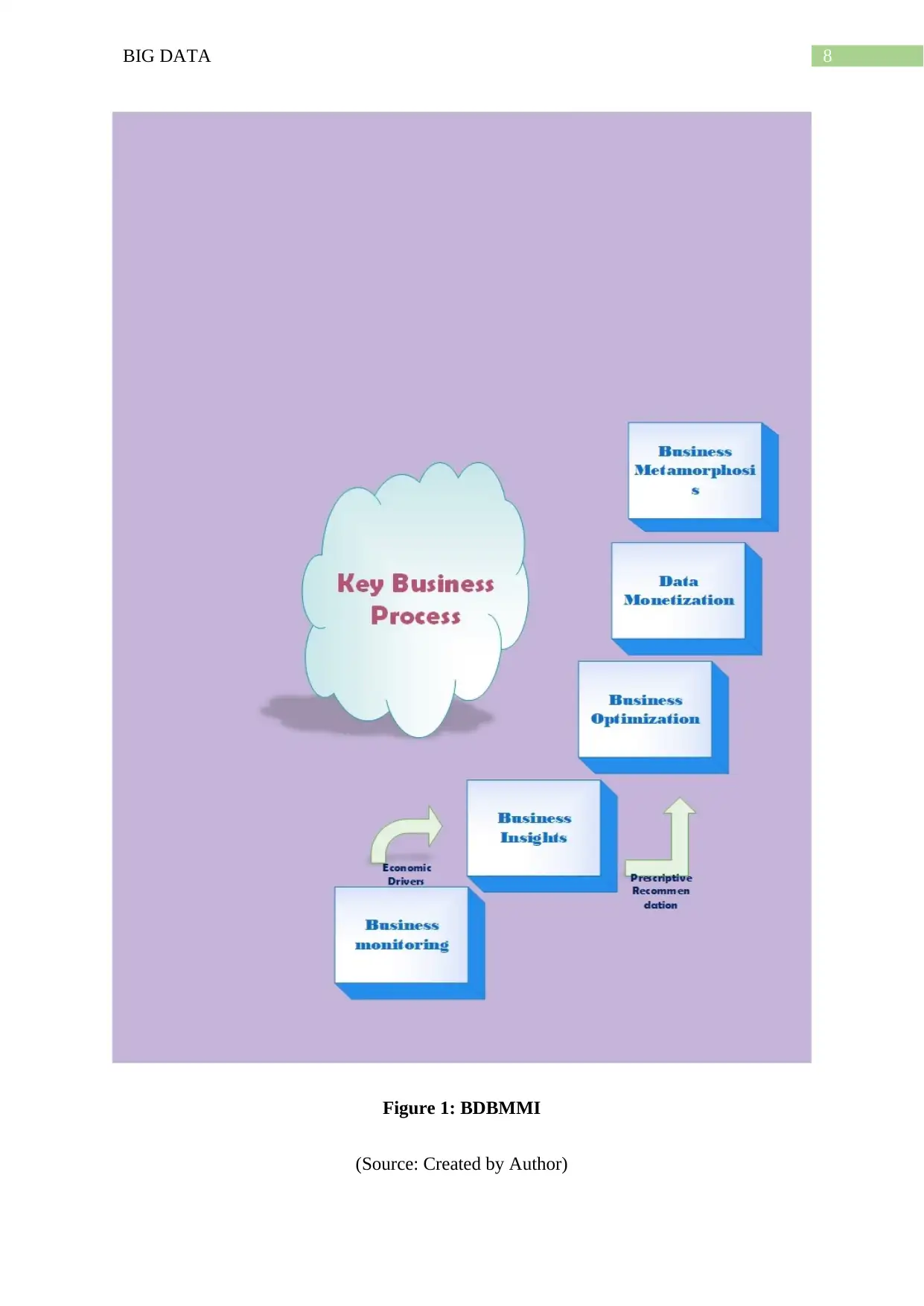
Figure 1: BDBMMI
(Source: Created by Author)
Figure 1: BDBMMI
(Source: Created by Author)
⊘ This is a preview!⊘
Do you want full access?
Subscribe today to unlock all pages.
Trusted by 1+ million students worldwide
9BIG DATA
This Big Data Business Model Maturity Index has five phases which are Business
Monitoring, Business Insights, Business Optimization, Data Monetization, and Business
Metamorphosis.
Phase 1: Business Monitoring
In the phase, the organization applied the data warehousing and the techniques of
Business Intelligence also the tools for monitoring the business performance of the
organization which is also known as the Management of the Business Performance. There are
many business intelligence methods present for example data mining also analytics, big data
analytics and the text analytics and many more (Jin et al. 2015). The procedure to analyze a
huge amount of the data sets or big data including several data types to reveal the unseen
patterns, new marketing strategies, customer interests, unknown relations and other
significant information about the business is known as the big data analytics (Kambatla et al.
2014). The Hadoop MapReduce and Apache Spark are the two best open-source techniques
for Big Data processing. This company takes the Hadoop MapReduce methods.
Phase 2: Business Insights
In this phase, the organization enlarge their assets of data aggressively by build-up
total comprehensive operational also transactional data link these data with the sources of the
internal data, for example, email conversations, notes of technician, consumer comments and
the external data, for instance, social media, economic, weather sources. After that, the
organization uses predictive analytics to expose the customer, the product and operational
insights suppressed through sources of data (Bughin 2016). This company has the aim to find
the best way to rapidly understand and create decision-ready insights from this response of
the customers for reducing the manual investigation also maximize the speed to insight.
Phase 3: Business Optimization
This Big Data Business Model Maturity Index has five phases which are Business
Monitoring, Business Insights, Business Optimization, Data Monetization, and Business
Metamorphosis.
Phase 1: Business Monitoring
In the phase, the organization applied the data warehousing and the techniques of
Business Intelligence also the tools for monitoring the business performance of the
organization which is also known as the Management of the Business Performance. There are
many business intelligence methods present for example data mining also analytics, big data
analytics and the text analytics and many more (Jin et al. 2015). The procedure to analyze a
huge amount of the data sets or big data including several data types to reveal the unseen
patterns, new marketing strategies, customer interests, unknown relations and other
significant information about the business is known as the big data analytics (Kambatla et al.
2014). The Hadoop MapReduce and Apache Spark are the two best open-source techniques
for Big Data processing. This company takes the Hadoop MapReduce methods.
Phase 2: Business Insights
In this phase, the organization enlarge their assets of data aggressively by build-up
total comprehensive operational also transactional data link these data with the sources of the
internal data, for example, email conversations, notes of technician, consumer comments and
the external data, for instance, social media, economic, weather sources. After that, the
organization uses predictive analytics to expose the customer, the product and operational
insights suppressed through sources of data (Bughin 2016). This company has the aim to find
the best way to rapidly understand and create decision-ready insights from this response of
the customers for reducing the manual investigation also maximize the speed to insight.
Phase 3: Business Optimization
Paraphrase This Document
Need a fresh take? Get an instant paraphrase of this document with our AI Paraphraser
10BIG DATA
In this phase, the administrations construct on customer, then product and finally
operational insights revealed in the previous phase by relating the prescriptive analytics for
optimizing the important process of the business (Adrian et al. 2016). Organizations in this
phase push analytical results such as rules, scores, recommendations to the frontline staff and
the managers of the business to support them optimizing directed business procedures via the
enhanced creation of the decision (Kambatla et al. 2014). This phase also gives chances for
the companies to push the analytic insights to the customers to impact the behaviours of
customers (Bhadani and Jothimani 2016). This company Telstra recommends to enhance the
mark-ups based on the consumer comments, inventory, purchase patterns, weather
conditions, postings on social media and holidays.
Phase 4: Data Monetization
This phase is in which any company want to generate new revenue sources (Chen and
Zhang 2014). It contains the insights or the selling data into the new markets, operational
insights to make completely fresh services also products which assist them to enter the fresh
markets target the new consumers (Chen, Mao and Liu 2014). This Company Telstra is a
reputed and famous telecommunication company in Australia, but they want to increase their
market globally by creating new branches outside Australia.
Phase 5: Business Metamorphosis
This BDBMMI is completed when the organization leverages the data, the analytics
also the insights into the metamorphose of their industry (Chen, Mao and Liu 2014). It
requires the major shift in core business model of organization such as procedures, people
products and services, target marketplaces, partnerships, recompenses, incentives also
management driven by insights collected as organization navigated this BDBMMI (Bhadani
In this phase, the administrations construct on customer, then product and finally
operational insights revealed in the previous phase by relating the prescriptive analytics for
optimizing the important process of the business (Adrian et al. 2016). Organizations in this
phase push analytical results such as rules, scores, recommendations to the frontline staff and
the managers of the business to support them optimizing directed business procedures via the
enhanced creation of the decision (Kambatla et al. 2014). This phase also gives chances for
the companies to push the analytic insights to the customers to impact the behaviours of
customers (Bhadani and Jothimani 2016). This company Telstra recommends to enhance the
mark-ups based on the consumer comments, inventory, purchase patterns, weather
conditions, postings on social media and holidays.
Phase 4: Data Monetization
This phase is in which any company want to generate new revenue sources (Chen and
Zhang 2014). It contains the insights or the selling data into the new markets, operational
insights to make completely fresh services also products which assist them to enter the fresh
markets target the new consumers (Chen, Mao and Liu 2014). This Company Telstra is a
reputed and famous telecommunication company in Australia, but they want to increase their
market globally by creating new branches outside Australia.
Phase 5: Business Metamorphosis
This BDBMMI is completed when the organization leverages the data, the analytics
also the insights into the metamorphose of their industry (Chen, Mao and Liu 2014). It
requires the major shift in core business model of organization such as procedures, people
products and services, target marketplaces, partnerships, recompenses, incentives also
management driven by insights collected as organization navigated this BDBMMI (Bhadani
11BIG DATA
and Jothimani 2016). This company Telstra can change its model of telecommunication
products to increase the market value of their company.
2.5. Data Sources
The three primary data sources for the Big Data are Social data, Machine data and
Transactional data (Fan, Han, and Liu, 2014). The big data sources for this
telecommunication company named Telstra include emails, phone calls, transactions,
messages, usage of social media, digital media, geospatial information, log data, data from
the sensors and many more.
This data source is categorized as follows:
i) Structured data sources.
ii) Unstructured data sources.
iii) Internal data sources and the elements.
iv) Operational sources.
The reason for this is that the big data can be provided with the general view of the
operations of the company also its customers, it can be improved profitability also the
operations across the whole telecom value chain of this company Telstra (Al-Sai and
Abdullah 2019). Whenever the big data can use to improve the internal operations of the
company, the data about the mobile users can also sell to third-party companies, making the
new proceeds stream.
2.6. Key challenges facing data plan
The telecom company Telstra faced many major challenges for applying the Big Data
for storing huge data of their company which are as follows:
i) Inadequate understanding also the approval of the big data
and Jothimani 2016). This company Telstra can change its model of telecommunication
products to increase the market value of their company.
2.5. Data Sources
The three primary data sources for the Big Data are Social data, Machine data and
Transactional data (Fan, Han, and Liu, 2014). The big data sources for this
telecommunication company named Telstra include emails, phone calls, transactions,
messages, usage of social media, digital media, geospatial information, log data, data from
the sensors and many more.
This data source is categorized as follows:
i) Structured data sources.
ii) Unstructured data sources.
iii) Internal data sources and the elements.
iv) Operational sources.
The reason for this is that the big data can be provided with the general view of the
operations of the company also its customers, it can be improved profitability also the
operations across the whole telecom value chain of this company Telstra (Al-Sai and
Abdullah 2019). Whenever the big data can use to improve the internal operations of the
company, the data about the mobile users can also sell to third-party companies, making the
new proceeds stream.
2.6. Key challenges facing data plan
The telecom company Telstra faced many major challenges for applying the Big Data
for storing huge data of their company which are as follows:
i) Inadequate understanding also the approval of the big data
⊘ This is a preview!⊘
Do you want full access?
Subscribe today to unlock all pages.
Trusted by 1+ million students worldwide

1 out of 18


Related Documents


Your All-in-One AI-Powered Toolkit for Academic Success.
+13062052269
info@desklib.com
Available 24*7 on WhatsApp / Email
![[object Object]](/_next/static/media/star-bottom.7253800d.svg)
Unlock your academic potential
Copyright © 2020–2026 A2Z Services. All Rights Reserved. Developed and managed by ZUCOL.