Bilingualism: Exploring Cognitive, Social, and Academic Impacts

Verified

Added on  2022/08/21

|3
|397
|34
Discussion Board Post
AI Summary
This discussion post delves into the multifaceted aspects of bilingualism, addressing its cognitive, academic, and social impacts. The author reflects on the advantages of knowing multiple languages, highlighting enhanced cognitive functions, improved academic performance, and stronger familial bonds. The post acknowledges potential disadvantages such as limited vocabulary in the first language due to infrequent use. The author references studies that support the cognitive benefits, including improved multitasking, memory skills, and potential protective effects against neurodegenerative diseases. The discussion also touches upon the social advantages of bilingualism, such as strengthening family connections. The author supports their arguments with references to relevant research, providing a comprehensive overview of the topic.
Document Page
Running Head: BILINGUALISM
Bilingualism
Name of the student
Name of the University
Author’s Note:
tabler-icon-diamond-filled.svg

Paraphrase This Document

Need a fresh take? Get an instant paraphrase of this document with our AI Paraphraser
Document Page
1BILINGUALISM
Bilinguals
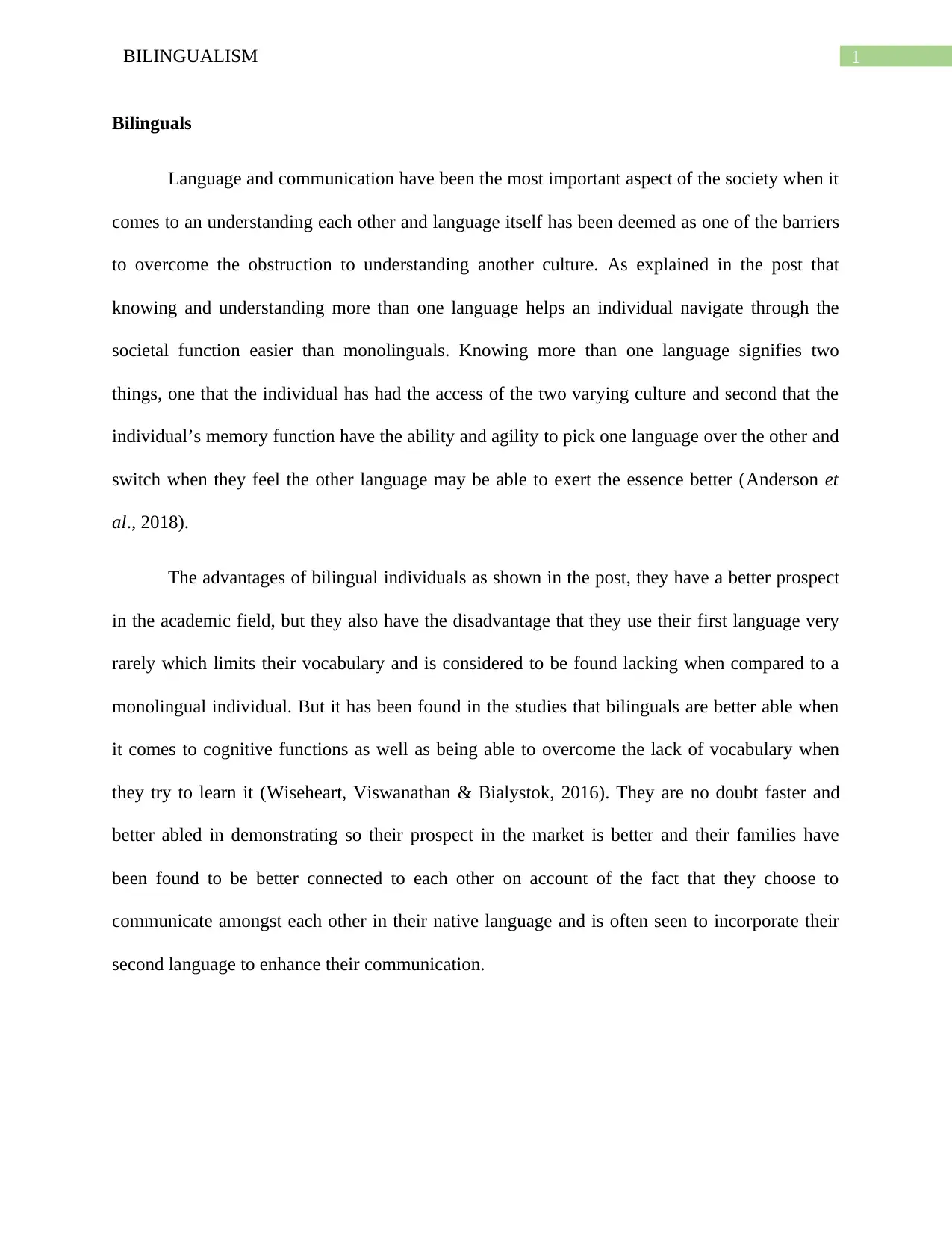
Language and communication have been the most important aspect of the society when it
comes to an understanding each other and language itself has been deemed as one of the barriers
to overcome the obstruction to understanding another culture. As explained in the post that
knowing and understanding more than one language helps an individual navigate through the
societal function easier than monolinguals. Knowing more than one language signifies two
things, one that the individual has had the access of the two varying culture and second that the
individual’s memory function have the ability and agility to pick one language over the other and
switch when they feel the other language may be able to exert the essence better (Anderson et
al., 2018).
The advantages of bilingual individuals as shown in the post, they have a better prospect
in the academic field, but they also have the disadvantage that they use their first language very
rarely which limits their vocabulary and is considered to be found lacking when compared to a
monolingual individual. But it has been found in the studies that bilinguals are better able when
it comes to cognitive functions as well as being able to overcome the lack of vocabulary when
they try to learn it (Wiseheart, Viswanathan & Bialystok, 2016). They are no doubt faster and
better abled in demonstrating so their prospect in the market is better and their families have
been found to be better connected to each other on account of the fact that they choose to
communicate amongst each other in their native language and is often seen to incorporate their
second language to enhance their communication.
Document Page
2BILINGUALISM
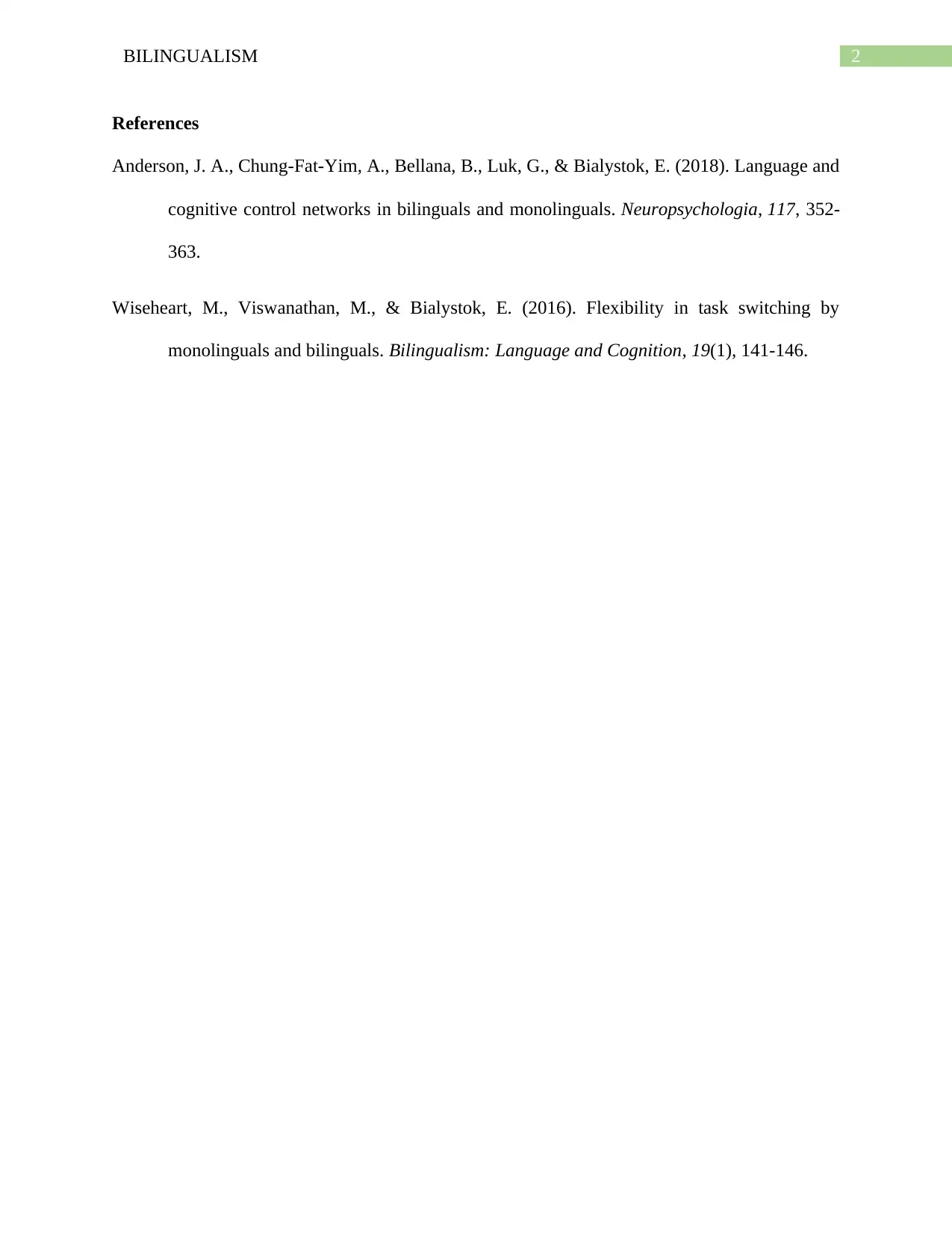
References
Anderson, J. A., Chung-Fat-Yim, A., Bellana, B., Luk, G., & Bialystok, E. (2018). Language and
cognitive control networks in bilinguals and monolinguals. Neuropsychologia, 117, 352-
363.
Wiseheart, M., Viswanathan, M., & Bialystok, E. (2016). Flexibility in task switching by
monolinguals and bilinguals. Bilingualism: Language and Cognition, 19(1), 141-146.
chevron_up_icon
1 out of 3
circle_padding
hide_on_mobile
zoom_out_icon
[object Object]