Discussion on Bilingualism: Cognitive Advantages and Disadvantages

Verified

Added on  2022/08/21

|4
|807
|24
Discussion Board Post
AI Summary
This discussion post critically analyzes the concept of bilingualism, acknowledging it as the ability to use two languages fluently, while also recognizing the broader spectrum of individuals with varying levels of language proficiency. The post accurately identifies the challenges of learning a second language and highlights the importance of speaking in language acquisition. It then explores bilingualism not only as an individual characteristic but also as a societal phenomenon. The post provides insights into the cognitive advantages of bilingualism, such as improved executive function and memory, and discusses the potential for delayed lexical selection and reduced verbal fluency in bilinguals, drawing upon various research studies. It also addresses the cognitive benefits of bilingualism in older adults. The post is well-supported by references to relevant studies, and it emphasizes the advantages of bilingualism in enhancing cognitive abilities.

Document Page
Running head: BILINGUALISM
BILINGUALISM
Name of the Student:
Name of the University:
Author note:
tabler-icon-diamond-filled.svg

Paraphrase This Document

Need a fresh take? Get an instant paraphrase of this document with our AI Paraphraser
Document Page
1BILINGUALISM
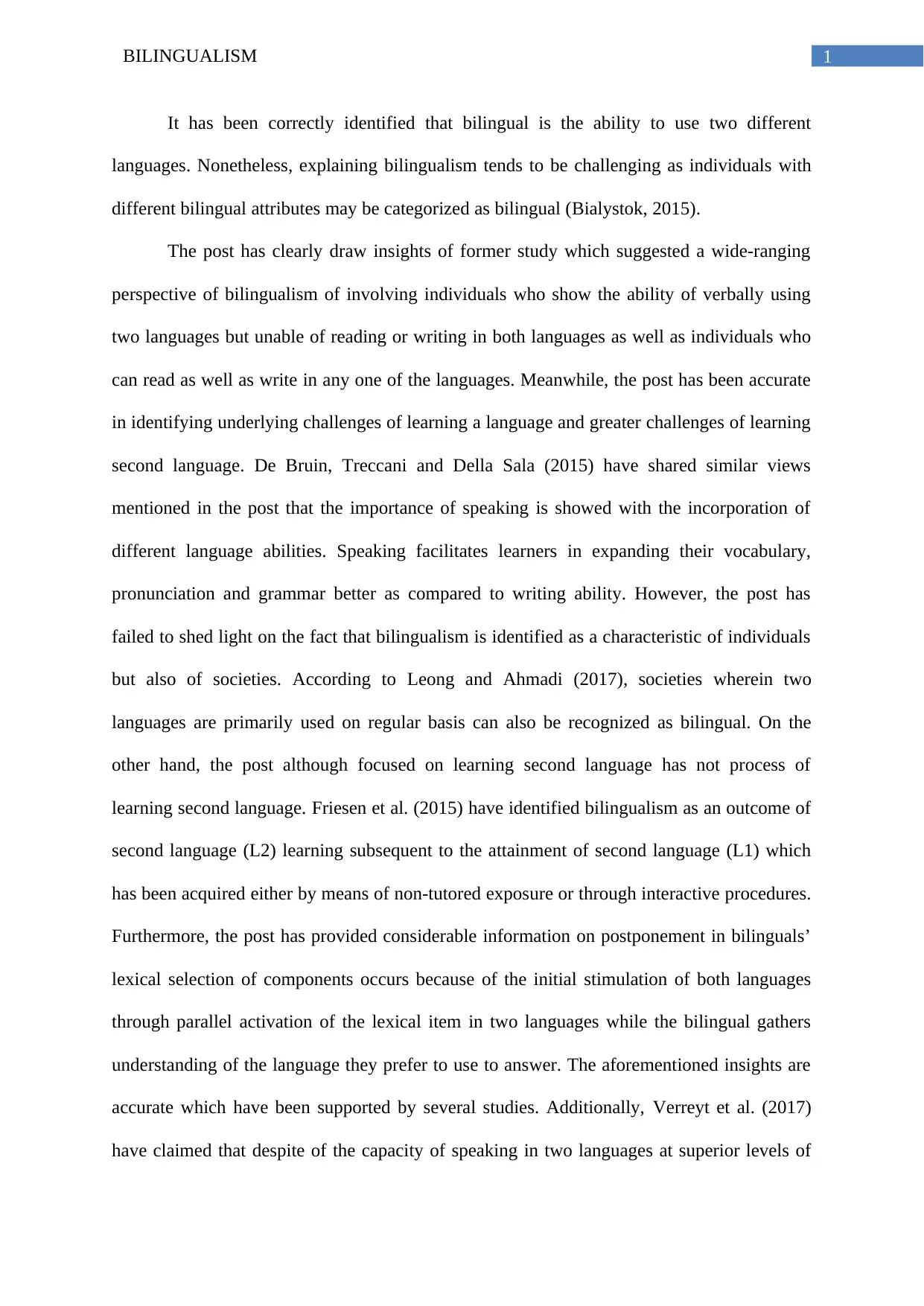
It has been correctly identified that bilingual is the ability to use two different
languages. Nonetheless, explaining bilingualism tends to be challenging as individuals with
different bilingual attributes may be categorized as bilingual (Bialystok, 2015).
The post has clearly draw insights of former study which suggested a wide-ranging
perspective of bilingualism of involving individuals who show the ability of verbally using
two languages but unable of reading or writing in both languages as well as individuals who
can read as well as write in any one of the languages. Meanwhile, the post has been accurate
in identifying underlying challenges of learning a language and greater challenges of learning
second language. De Bruin, Treccani and Della Sala (2015) have shared similar views
mentioned in the post that the importance of speaking is showed with the incorporation of
different language abilities. Speaking facilitates learners in expanding their vocabulary,
pronunciation and grammar better as compared to writing ability. However, the post has
failed to shed light on the fact that bilingualism is identified as a characteristic of individuals
but also of societies. According to Leong and Ahmadi (2017), societies wherein two
languages are primarily used on regular basis can also be recognized as bilingual. On the
other hand, the post although focused on learning second language has not process of
learning second language. Friesen et al. (2015) have identified bilingualism as an outcome of
second language (L2) learning subsequent to the attainment of second language (L1) which
has been acquired either by means of non-tutored exposure or through interactive procedures.
Furthermore, the post has provided considerable information on postponement in bilinguals’
lexical selection of components occurs because of the initial stimulation of both languages
through parallel activation of the lexical item in two languages while the bilingual gathers
understanding of the language they prefer to use to answer. The aforementioned insights are
accurate which have been supported by several studies. Additionally, Verreyt et al. (2017)
have claimed that despite of the capacity of speaking in two languages at superior levels of
Document Page
2BILINGUALISM
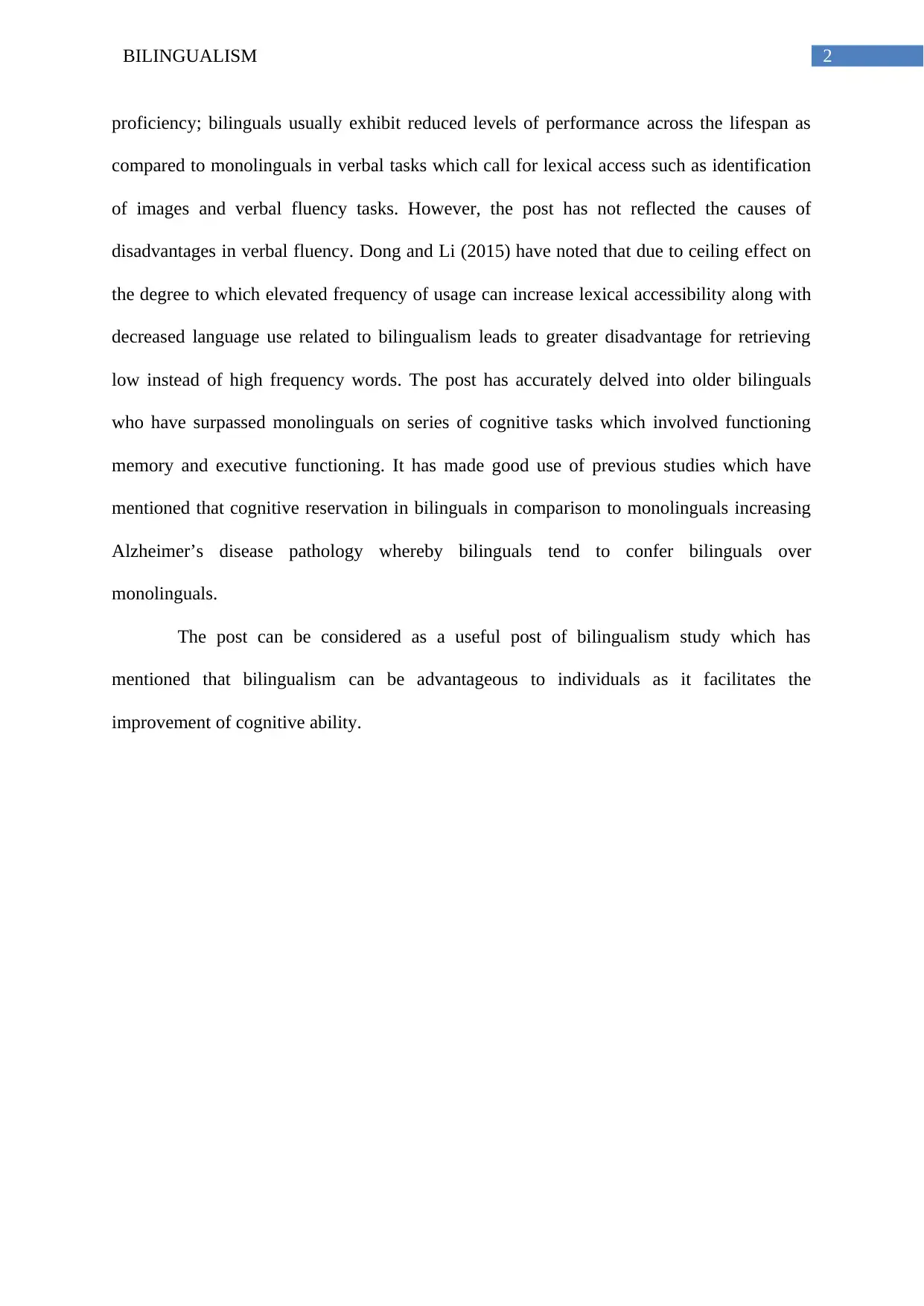
proficiency; bilinguals usually exhibit reduced levels of performance across the lifespan as
compared to monolinguals in verbal tasks which call for lexical access such as identification
of images and verbal fluency tasks. However, the post has not reflected the causes of
disadvantages in verbal fluency. Dong and Li (2015) have noted that due to ceiling effect on
the degree to which elevated frequency of usage can increase lexical accessibility along with
decreased language use related to bilingualism leads to greater disadvantage for retrieving
low instead of high frequency words. The post has accurately delved into older bilinguals
who have surpassed monolinguals on series of cognitive tasks which involved functioning
memory and executive functioning. It has made good use of previous studies which have
mentioned that cognitive reservation in bilinguals in comparison to monolinguals increasing
Alzheimer’s disease pathology whereby bilinguals tend to confer bilinguals over
monolinguals.
The post can be considered as a useful post of bilingualism study which has
mentioned that bilingualism can be advantageous to individuals as it facilitates the
improvement of cognitive ability.
Document Page
3BILINGUALISM
References
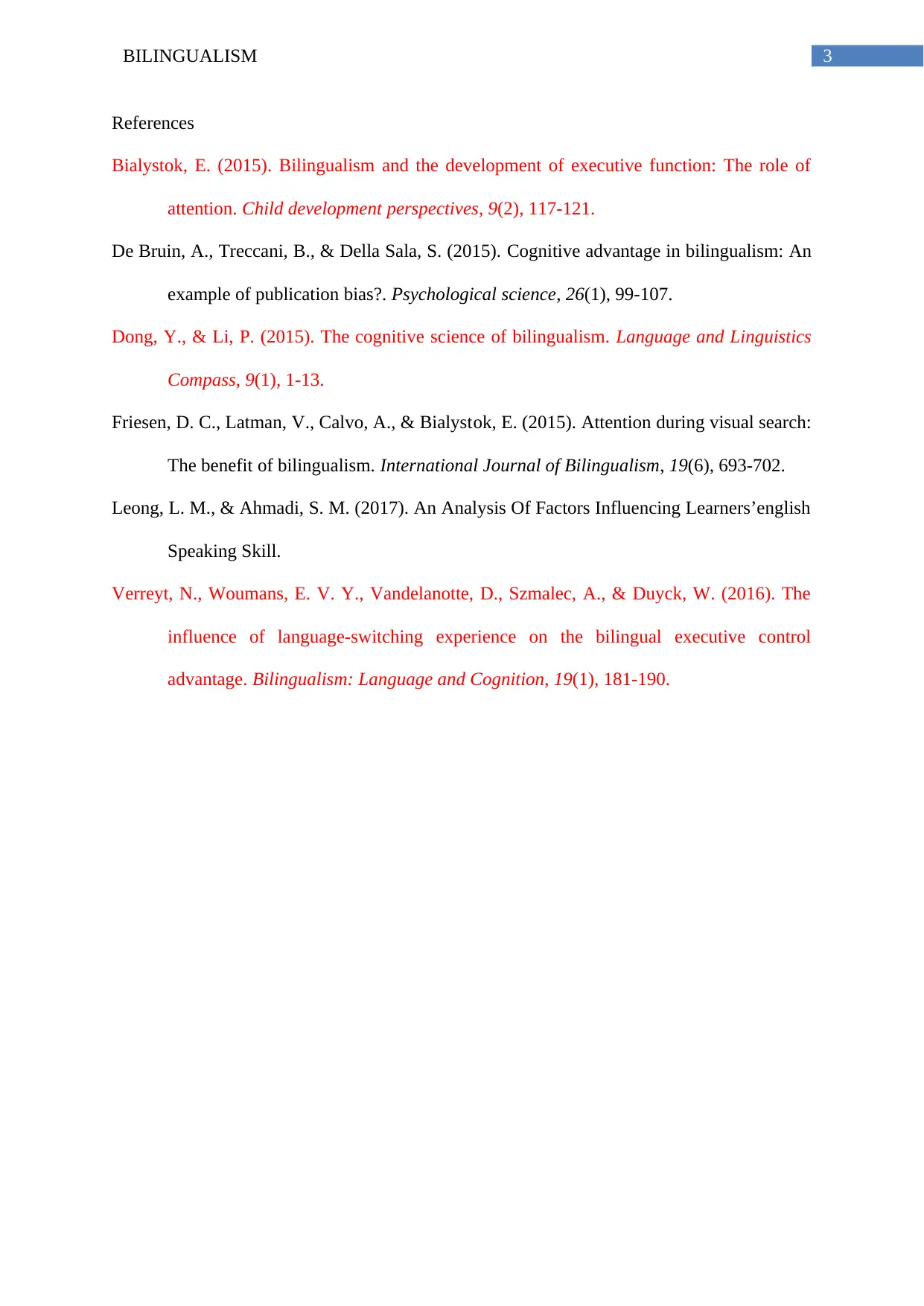
Bialystok, E. (2015). Bilingualism and the development of executive function: The role of
attention. Child development perspectives, 9(2), 117-121.
De Bruin, A., Treccani, B., & Della Sala, S. (2015). Cognitive advantage in bilingualism: An
example of publication bias?. Psychological science, 26(1), 99-107.
Dong, Y., & Li, P. (2015). The cognitive science of bilingualism. Language and Linguistics
Compass, 9(1), 1-13.
Friesen, D. C., Latman, V., Calvo, A., & Bialystok, E. (2015). Attention during visual search:
The benefit of bilingualism. International Journal of Bilingualism, 19(6), 693-702.
Leong, L. M., & Ahmadi, S. M. (2017). An Analysis Of Factors Influencing Learners’english
Speaking Skill.
Verreyt, N., Woumans, E. V. Y., Vandelanotte, D., Szmalec, A., & Duyck, W. (2016). The
influence of language-switching experience on the bilingual executive control
advantage. Bilingualism: Language and Cognition, 19(1), 181-190.
chevron_up_icon
1 out of 4
circle_padding
hide_on_mobile
zoom_out_icon
[object Object]