BIOCHEMISTRY Homework: Analysis and Preparation of PBS Solutions

Verified

Added on  2023/06/06

|6
|1097
|182
Homework Assignment
AI Summary
This homework assignment delves into the analysis and preparation of a Phosphate Buffered Saline (PBS) solution, a common buffer used in biochemical experiments. The assignment begins by exploring the relationship between pH and H3O+ concentration, explaining how dilution affects the pH of acids and bases. It then identifies the acid and base in PBS, determines the ions produced, and calculates the molecular mass and molar concentrations of the compounds used. The solution compares the calculated concentrations for 10x PBS with those of a 1x working solution. The assignment also covers practical aspects of solution preparation, such as the correct use of lab equipment (weighing boats, graduated cylinders), calibration of pH meters, and the rationale behind specific protocol steps, including autoclaving. The solution provides a detailed step-by-step guide on how to prepare a 1x working solution of PBS, including glassware, reagents, and pH adjustments.
Document Page
BIOCHEMISTRY
[Author Name(s), First M. Last, Omit Titles and Degrees]
[Institutional Affiliation(s)]
tabler-icon-diamond-filled.svg

Paraphrase This Document

Need a fresh take? Get an instant paraphrase of this document with our AI Paraphraser
Document Page
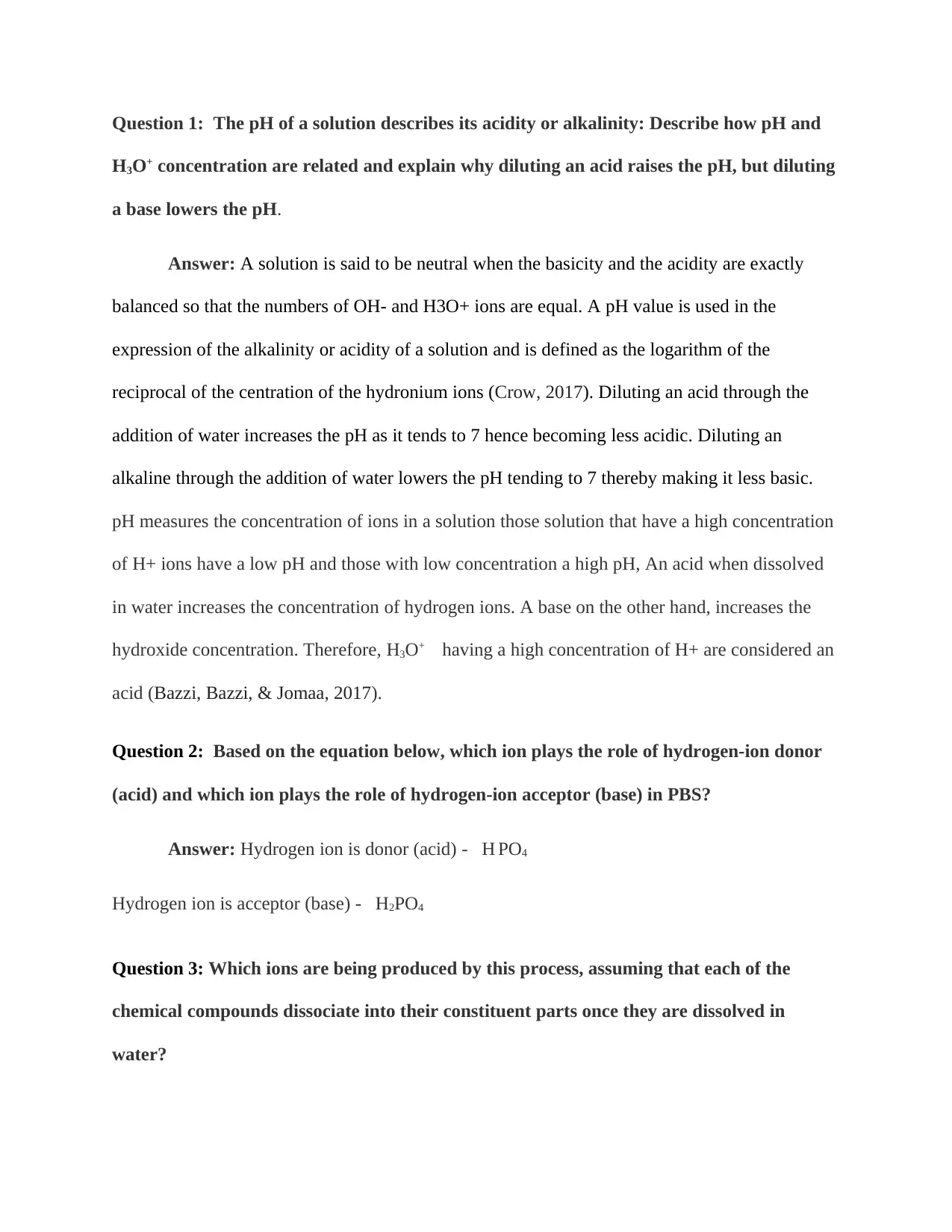
Question 1: The pH of a solution describes its acidity or alkalinity: Describe how pH and
H3O+ concentration are related and explain why diluting an acid raises the pH, but diluting
a base lowers the pH.
Answer: A solution is said to be neutral when the basicity and the acidity are exactly
balanced so that the numbers of OH- and H3O+ ions are equal. A pH value is used in the
expression of the alkalinity or acidity of a solution and is defined as the logarithm of the
reciprocal of the centration of the hydronium ions (Crow, 2017). Diluting an acid through the
addition of water increases the pH as it tends to 7 hence becoming less acidic. Diluting an
alkaline through the addition of water lowers the pH tending to 7 thereby making it less basic.
pH measures the concentration of ions in a solution those solution that have a high concentration
of H+ ions have a low pH and those with low concentration a high pH, An acid when dissolved
in water increases the concentration of hydrogen ions. A base on the other hand, increases the
hydroxide concentration. Therefore, H3O+ having a high concentration of H+ are considered an
acid (Bazzi, Bazzi, & Jomaa, 2017).
Question 2: Based on the equation below, which ion plays the role of hydrogen-ion donor
(acid) and which ion plays the role of hydrogen-ion acceptor (base) in PBS?
Answer: Hydrogen ion is donor (acid) - H PO4
Hydrogen ion is acceptor (base) - H2PO4
Question 3: Which ions are being produced by this process, assuming that each of the
chemical compounds dissociate into their constituent parts once they are dissolved in
water?
Document Page
Answer: Na+, Cl-, K+, H+, PO4-
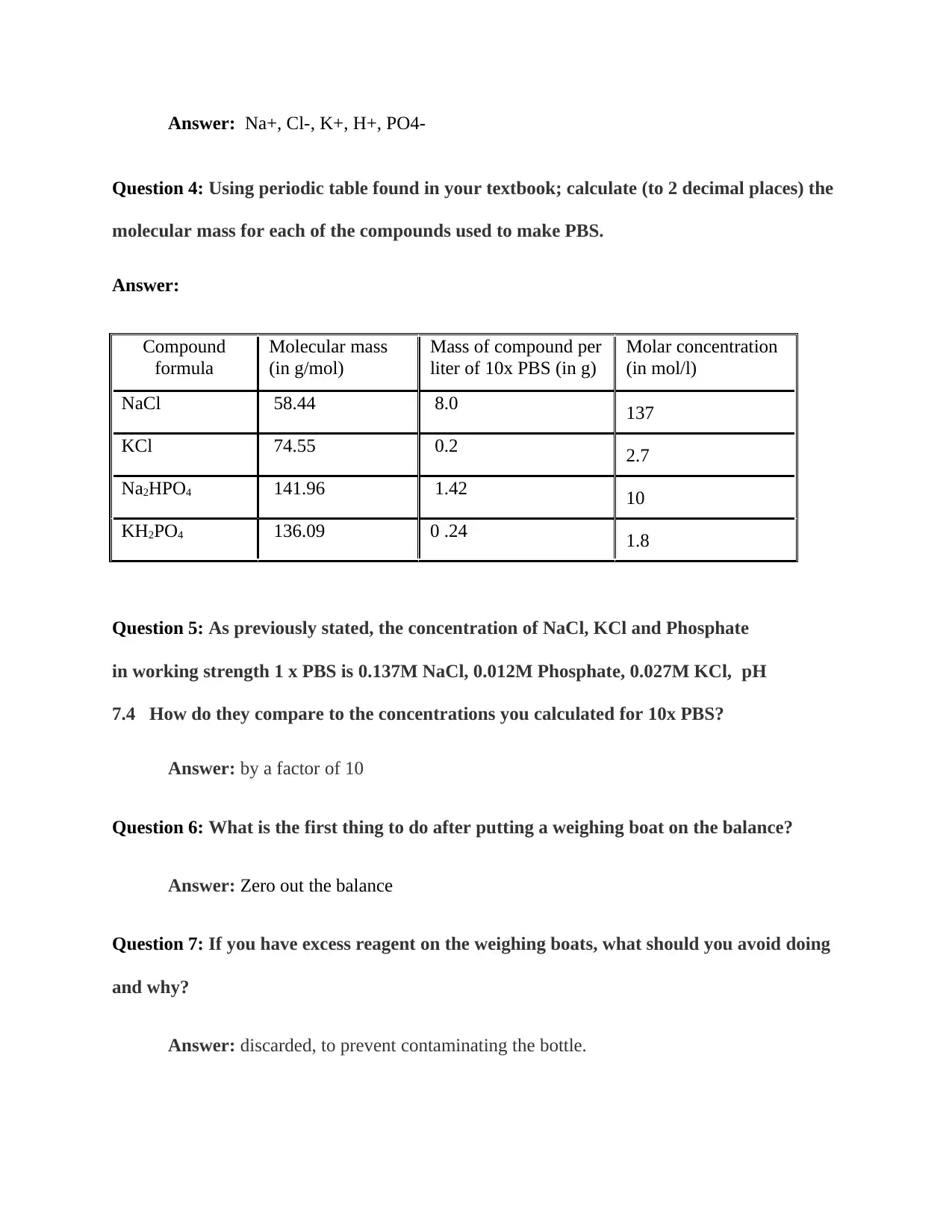
Question 4: Using periodic table found in your textbook; calculate (to 2 decimal places) the
molecular mass for each of the compounds used to make PBS.
Answer:
Compound
formula
Molecular mass
(in g/mol)
Mass of compound per
liter of 10x PBS (in g)
Molar concentration
(in mol/l)
NaCl 58.44 8.0 137
KCl 74.55 0.2 2.7
Na2HPO4 141.96 1.42 10
KH2PO4 136.09 0 .24 1.8
Question 5: As previously stated, the concentration of NaCl, KCl and Phosphate
in working strength 1 x PBS is 0.137M NaCl, 0.012M Phosphate, 0.027M KCl, pH
7.4 How do they compare to the concentrations you calculated for 10x PBS?
Answer: by a factor of 10
Question 6: What is the first thing to do after putting a weighing boat on the balance?
Answer: Zero out the balance
Question 7: If you have excess reagent on the weighing boats, what should you avoid doing
and why?
Answer: discarded, to prevent contaminating the bottle.
Document Page
Question 8: If you had the choice between a 1 liter beaker and a 1 liter graduated cylinder,
which one should you use to measure volumes with maximal precision when making 1 liter
of PBS?
Answer: The markings on a beaker are not accurate, the word graduated indicates that
the markings are accurate therefore a beaker should never be used for accuracy since its marking
are approximate (Arndt, Rudolph, & Hashmi, 2017).
Question 9: What should be done before measuring an unknown pH of a solution using a
pH meter?
Answer: Prior to use is must be calibrated using color coded solution and the electrode
must be rinse with distilled water (Vogel, 2013)
Question 10: Why do you think the protocol does not say to dissolve compounds directly in
1 liter of water?
Answer: The reason for this is not to disrupt the pH and avoid a chemical reaction.
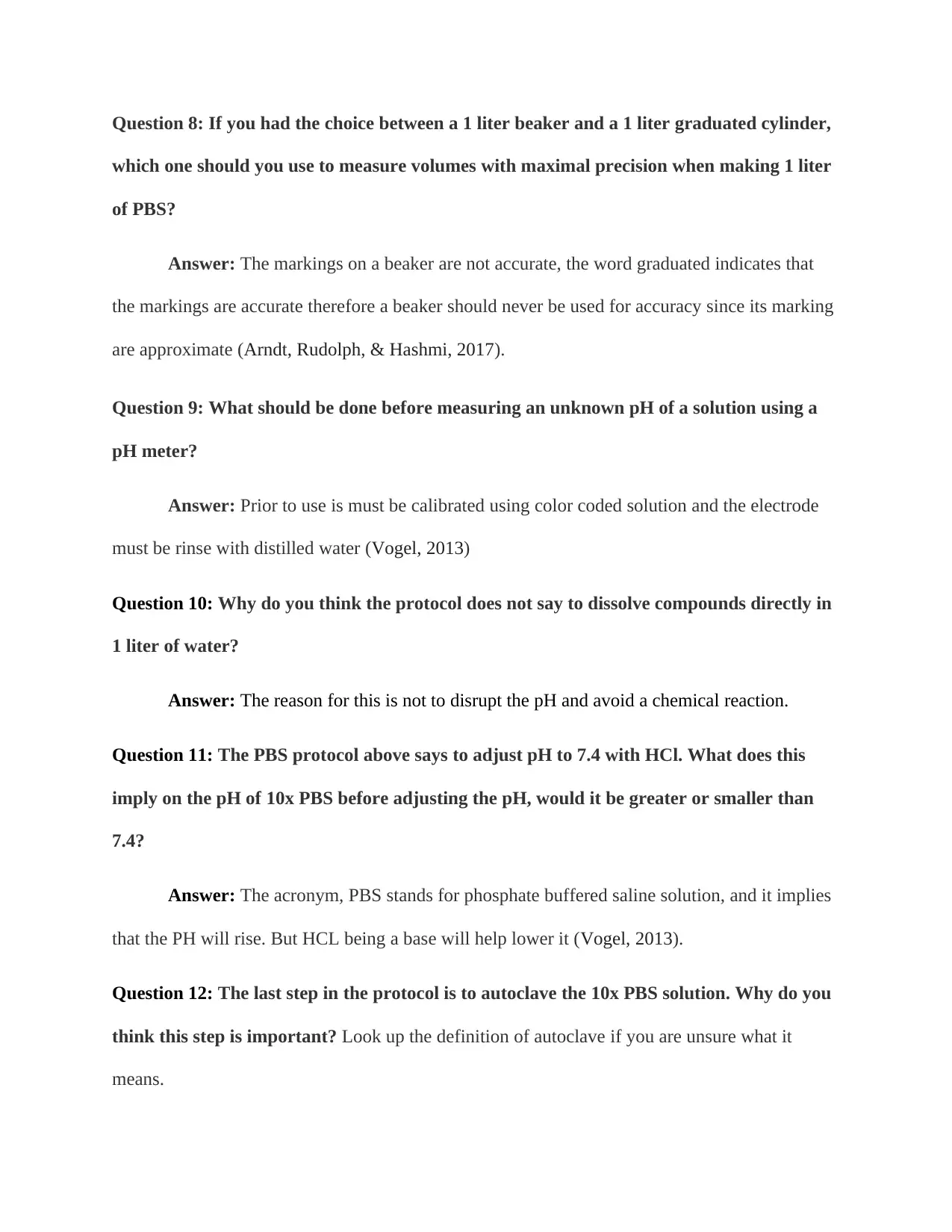
Question 11: The PBS protocol above says to adjust pH to 7.4 with HCl. What does this
imply on the pH of 10x PBS before adjusting the pH, would it be greater or smaller than
7.4?
Answer: The acronym, PBS stands for phosphate buffered saline solution, and it implies
that the PH will rise. But HCL being a base will help lower it (Vogel, 2013).
Question 12: The last step in the protocol is to autoclave the 10x PBS solution. Why do you
think this step is important? Look up the definition of autoclave if you are unsure what it
means.
tabler-icon-diamond-filled.svg

Paraphrase This Document

Need a fresh take? Get an instant paraphrase of this document with our AI Paraphraser
Document Page
Answer: Autoclaving 10x PBS solution is important the reason being is to ovoid cross
contamination.
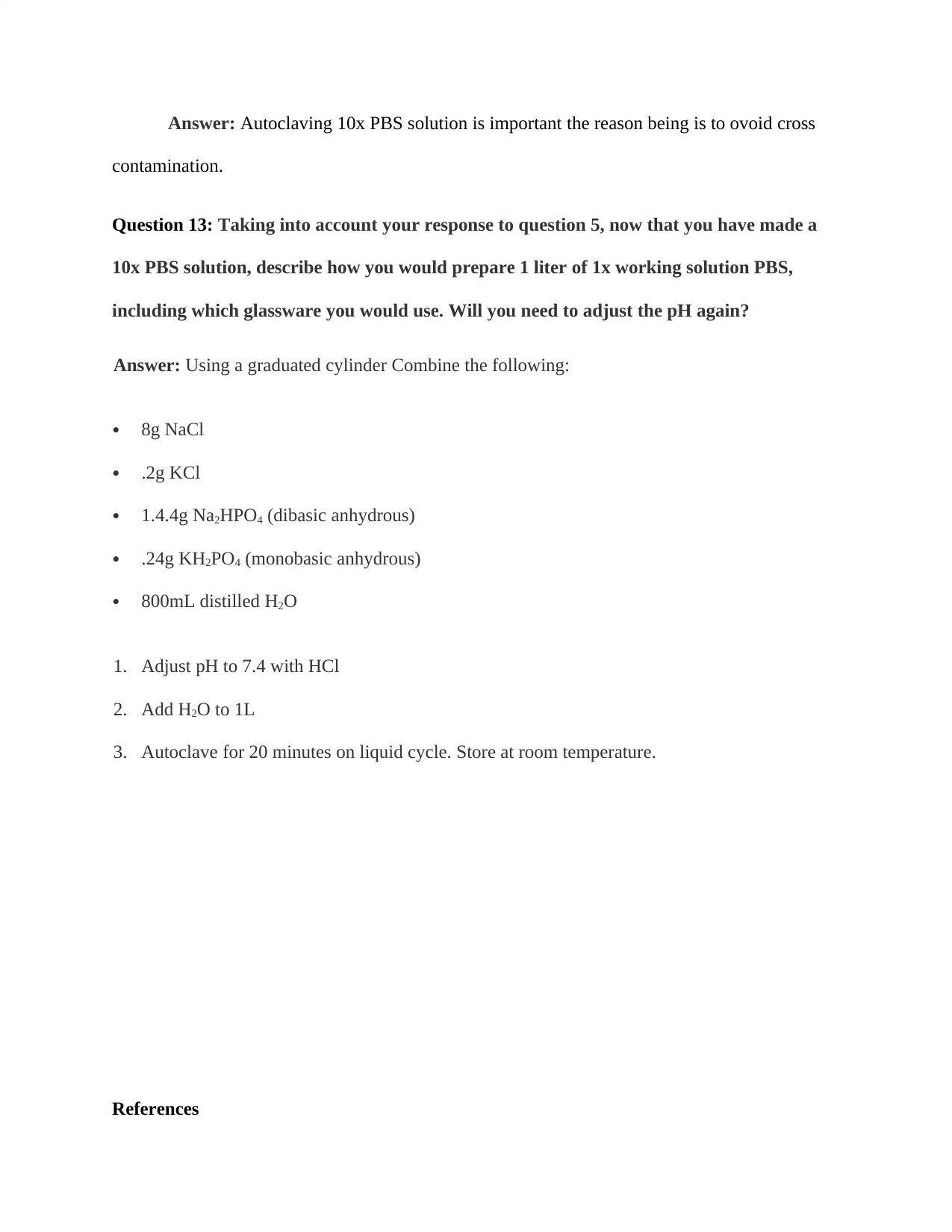
Question 13: Taking into account your response to question 5, now that you have made a
10x PBS solution, describe how you would prepare 1 liter of 1x working solution PBS,
including which glassware you would use. Will you need to adjust the pH again?
Answer: Using a graduated cylinder Combine the following:
8g NaCl
.2g KCl
1.4.4g Na2HPO4 (dibasic anhydrous)
.24g KH2PO4 (monobasic anhydrous)
800mL distilled H2O
1. Adjust pH to 7.4 with HCl
2. Add H2O to 1L
3. Autoclave for 20 minutes on liquid cycle. Store at room temperature.
References
Document Page
Arndt, S., Rudolph, M., & Hashmi, A. S. K. (2017). Gold-based frustrated Lewis acid/base pairs
(FLPs). Gold Bulletin, 50(3), 267-282
Bazzi, A., Bazzi, J., & Jomaa, N. (2017, August). Understanding acid-base chemistry of aqueous
salt solutions: A general chemistry laboratory experiment. In ABSTRACTS OF PAPERS
OF THE AMERICAN CHEMICAL SOCIETY (Vol. 254). 1155 16TH ST, NW,
WASHINGTON, DC 20036 USA: AMER CHEMICAL SOC
Crow, D. R. (2017). Principles and applications of electrochemistry. Routledge
Vogel, A. I. (2013). A Text-Book of Quantitative Inorganic Analysis-Theory and Practice
Longmans, Green And Co.; London; New York; Toronto
chevron_up_icon
1 out of 6
circle_padding
hide_on_mobile
zoom_out_icon
[object Object]