Biogeochemical Cycles: Human Impacts and Cycle Analysis - CE 2J4

Verified

Added on  2023/04/23

|4
|954
|186
Homework Assignment
AI Summary
This assignment analyzes the carbon, phosphorus, nitrogen, and sulfur cycles. It details how each element enters and leaves its respective cycle, focusing on the forms and processes involved, such as photosynthesis, weathering, respiration, and decomposition. The assignment further examines the roles of autotrophs and heterotrophs within each cycle, highlighting their interactions and contributions to maintaining balance. Finally, it identifies and discusses the impacts of human activities, including carbon emissions, excessive fertilizer use, and deforestation, on these crucial biogeochemical processes, emphasizing their effects on air and water quality, and soil health.
Document Page
BIOGEOCHEMICAL CYCLES
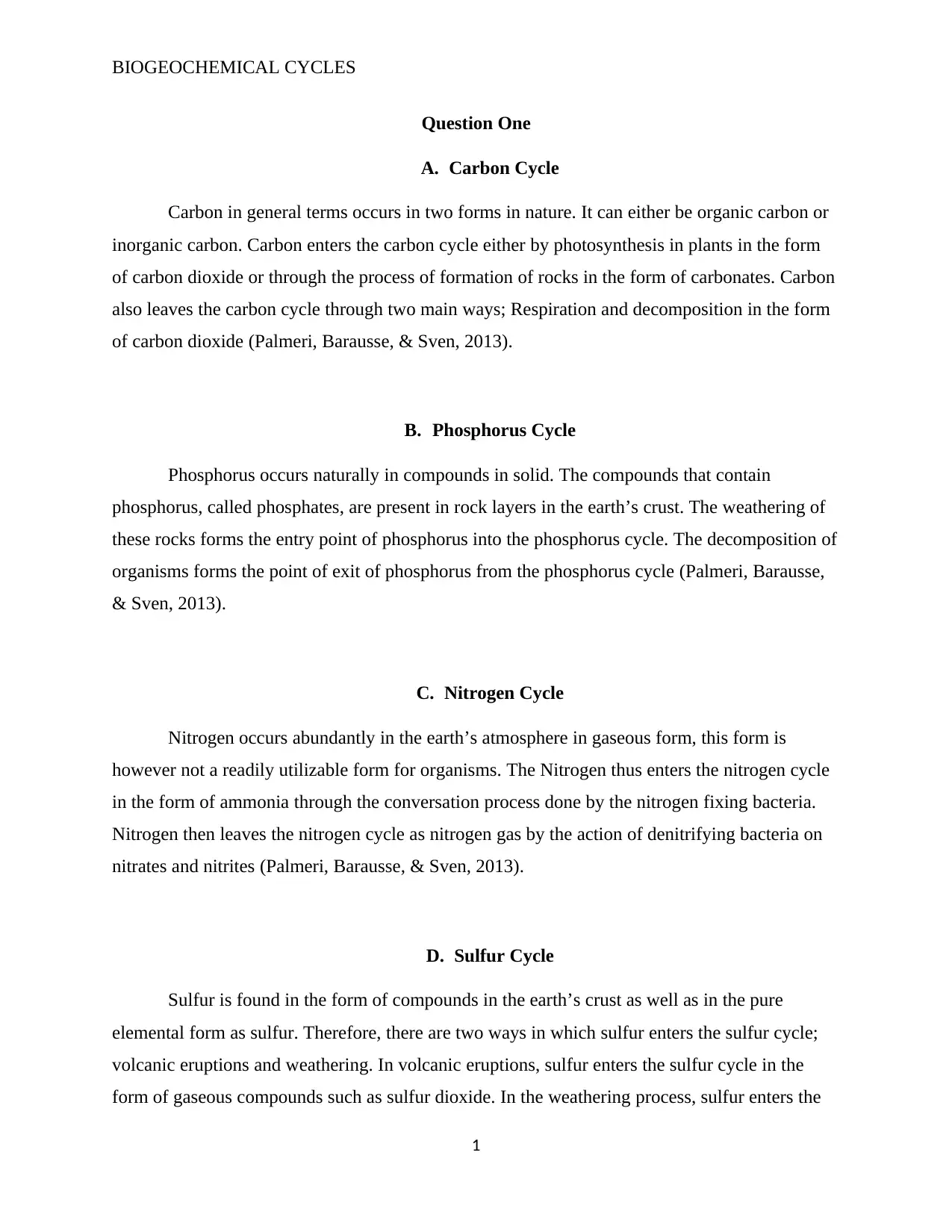
Question One
A. Carbon Cycle
Carbon in general terms occurs in two forms in nature. It can either be organic carbon or
inorganic carbon. Carbon enters the carbon cycle either by photosynthesis in plants in the form
of carbon dioxide or through the process of formation of rocks in the form of carbonates. Carbon
also leaves the carbon cycle through two main ways; Respiration and decomposition in the form
of carbon dioxide (Palmeri, Barausse, & Sven, 2013).
B. Phosphorus Cycle
Phosphorus occurs naturally in compounds in solid. The compounds that contain
phosphorus, called phosphates, are present in rock layers in the earth’s crust. The weathering of
these rocks forms the entry point of phosphorus into the phosphorus cycle. The decomposition of
organisms forms the point of exit of phosphorus from the phosphorus cycle (Palmeri, Barausse,
& Sven, 2013).
C. Nitrogen Cycle
Nitrogen occurs abundantly in the earth’s atmosphere in gaseous form, this form is
however not a readily utilizable form for organisms. The Nitrogen thus enters the nitrogen cycle
in the form of ammonia through the conversation process done by the nitrogen fixing bacteria.
Nitrogen then leaves the nitrogen cycle as nitrogen gas by the action of denitrifying bacteria on
nitrates and nitrites (Palmeri, Barausse, & Sven, 2013).
D. Sulfur Cycle
Sulfur is found in the form of compounds in the earth’s crust as well as in the pure
elemental form as sulfur. Therefore, there are two ways in which sulfur enters the sulfur cycle;
volcanic eruptions and weathering. In volcanic eruptions, sulfur enters the sulfur cycle in the
form of gaseous compounds such as sulfur dioxide. In the weathering process, sulfur enters the
1
tabler-icon-diamond-filled.svg

Paraphrase This Document

Need a fresh take? Get an instant paraphrase of this document with our AI Paraphraser
Document Page
BIOGEOCHEMICAL CYCLES
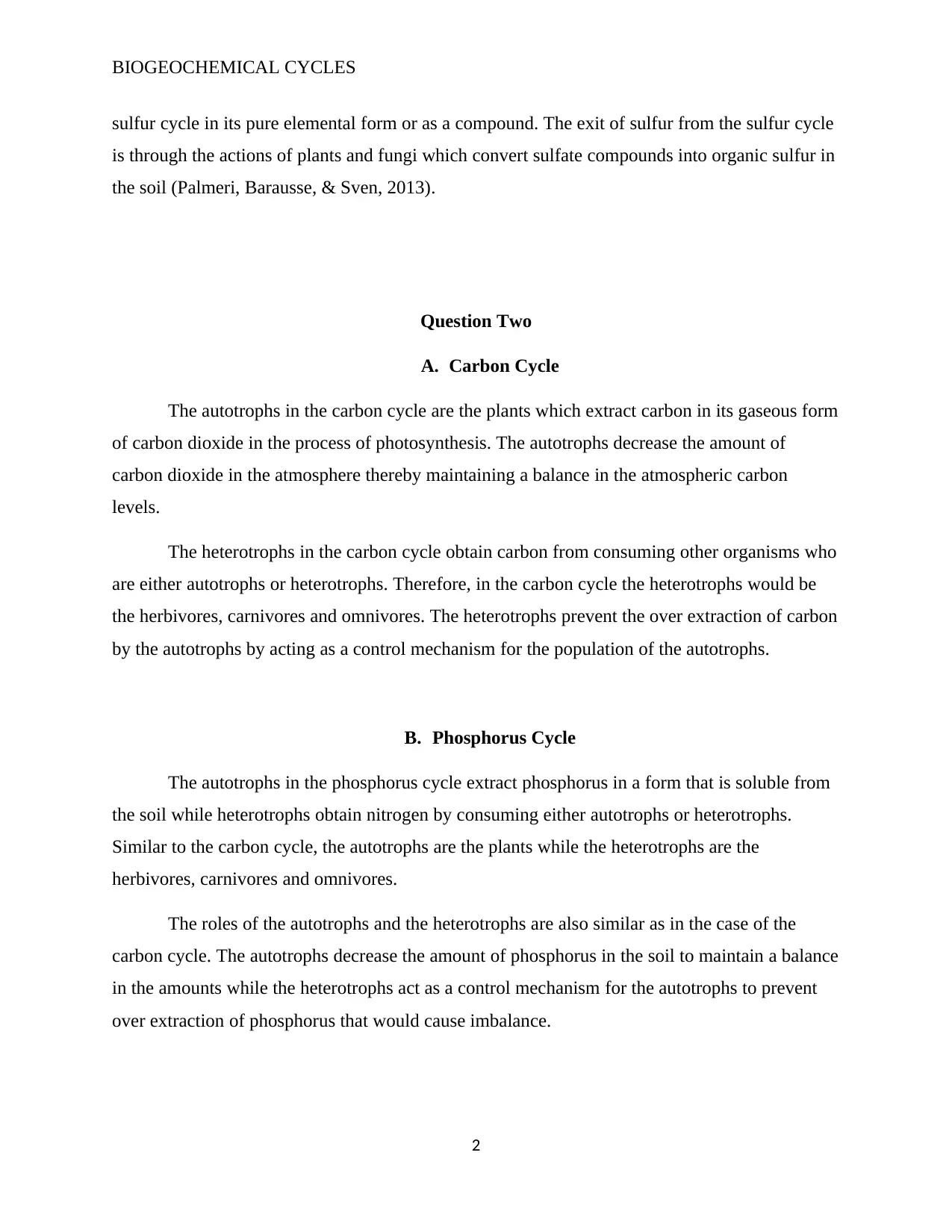
sulfur cycle in its pure elemental form or as a compound. The exit of sulfur from the sulfur cycle
is through the actions of plants and fungi which convert sulfate compounds into organic sulfur in
the soil (Palmeri, Barausse, & Sven, 2013).
Question Two
A. Carbon Cycle
The autotrophs in the carbon cycle are the plants which extract carbon in its gaseous form
of carbon dioxide in the process of photosynthesis. The autotrophs decrease the amount of
carbon dioxide in the atmosphere thereby maintaining a balance in the atmospheric carbon
levels.
The heterotrophs in the carbon cycle obtain carbon from consuming other organisms who
are either autotrophs or heterotrophs. Therefore, in the carbon cycle the heterotrophs would be
the herbivores, carnivores and omnivores. The heterotrophs prevent the over extraction of carbon
by the autotrophs by acting as a control mechanism for the population of the autotrophs.
B. Phosphorus Cycle
The autotrophs in the phosphorus cycle extract phosphorus in a form that is soluble from
the soil while heterotrophs obtain nitrogen by consuming either autotrophs or heterotrophs.
Similar to the carbon cycle, the autotrophs are the plants while the heterotrophs are the
herbivores, carnivores and omnivores.
The roles of the autotrophs and the heterotrophs are also similar as in the case of the
carbon cycle. The autotrophs decrease the amount of phosphorus in the soil to maintain a balance
in the amounts while the heterotrophs act as a control mechanism for the autotrophs to prevent
over extraction of phosphorus that would cause imbalance.
2
Document Page
BIOGEOCHEMICAL CYCLES
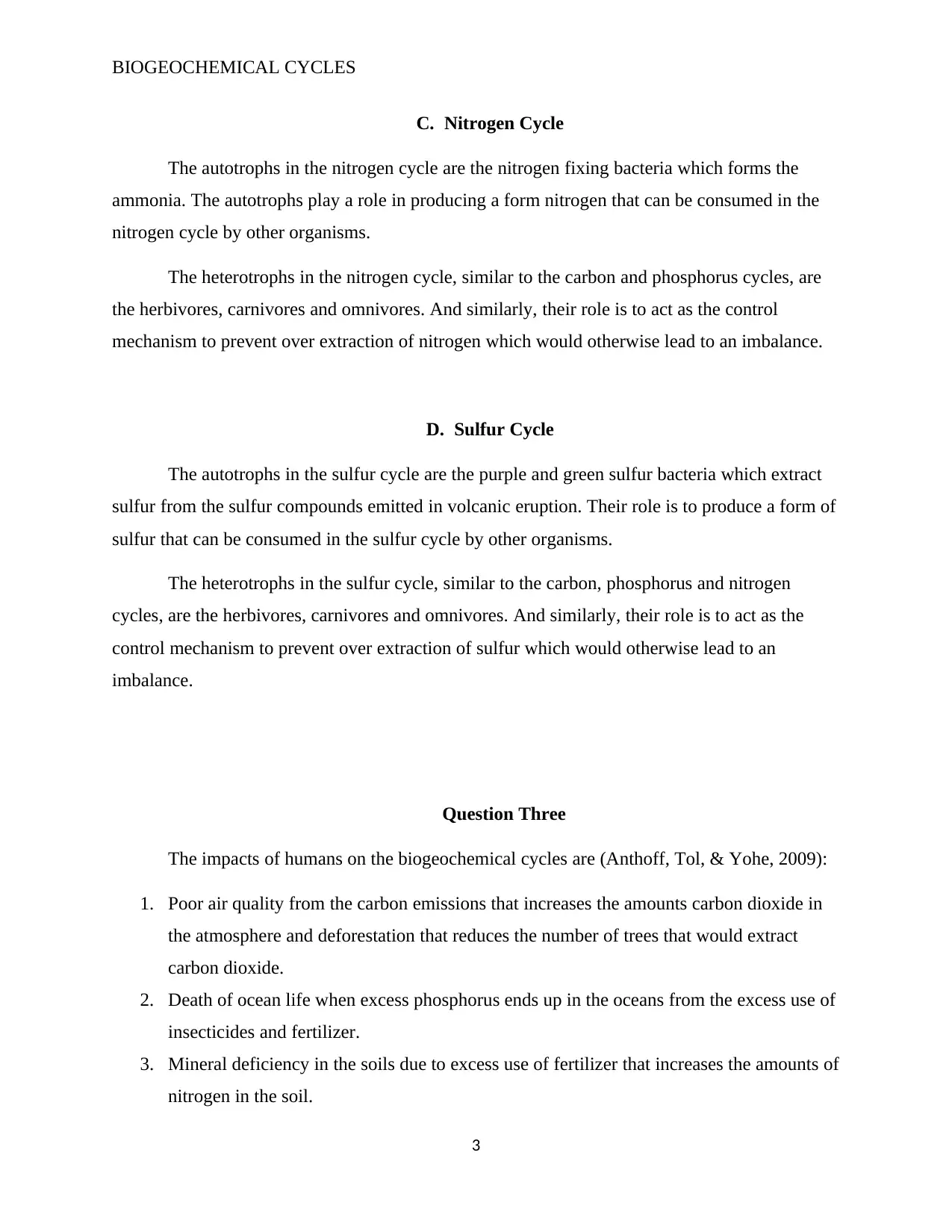
C. Nitrogen Cycle
The autotrophs in the nitrogen cycle are the nitrogen fixing bacteria which forms the
ammonia. The autotrophs play a role in producing a form nitrogen that can be consumed in the
nitrogen cycle by other organisms.
The heterotrophs in the nitrogen cycle, similar to the carbon and phosphorus cycles, are
the herbivores, carnivores and omnivores. And similarly, their role is to act as the control
mechanism to prevent over extraction of nitrogen which would otherwise lead to an imbalance.
D. Sulfur Cycle
The autotrophs in the sulfur cycle are the purple and green sulfur bacteria which extract
sulfur from the sulfur compounds emitted in volcanic eruption. Their role is to produce a form of
sulfur that can be consumed in the sulfur cycle by other organisms.
The heterotrophs in the sulfur cycle, similar to the carbon, phosphorus and nitrogen
cycles, are the herbivores, carnivores and omnivores. And similarly, their role is to act as the
control mechanism to prevent over extraction of sulfur which would otherwise lead to an
imbalance.
Question Three
The impacts of humans on the biogeochemical cycles are (Anthoff, Tol, & Yohe, 2009):
1. Poor air quality from the carbon emissions that increases the amounts carbon dioxide in
the atmosphere and deforestation that reduces the number of trees that would extract
carbon dioxide.
2. Death of ocean life when excess phosphorus ends up in the oceans from the excess use of
insecticides and fertilizer.
3. Mineral deficiency in the soils due to excess use of fertilizer that increases the amounts of
nitrogen in the soil.
3
Document Page
BIOGEOCHEMICAL CYCLES
References
Anthoff, D., Tol, R. S., & Yohe, G. W. (2009). Discounting for Climate Change. Economics,
3(2009-24), 1-24.
Palmeri, L., Barausse, A., & Sven, E. J. (2013). Ecological Processes Handbook. Boca Raton :
CRC Press.
4
chevron_up_icon
1 out of 4
circle_padding
hide_on_mobile
zoom_out_icon
[object Object]