Exploring the Synergistic Relationship Between Bioinformatics and AI
VerifiedAdded on 2023/01/13
|10
|3065
|61
Report
AI Summary
This report examines the interplay between bioinformatics and artificial intelligence (AI) in healthcare, focusing on their combined impact on drug discovery, disease diagnosis, and overall patient care. It reviews the current applications of bioinformatics tools in identifying molecular disease targets and the role of AI in automating tasks and reducing operational expenses. The report also explores the anticipated growth of AI in healthcare over the next five years, including its potential to enhance diagnostic accuracy and treatment planning. Furthermore, it delves into the synergistic benefits of integrating bioinformatics and AI, particularly in streamlining analytical workflows and accelerating biological discovery. The research methodology involves a qualitative investigation using primary and secondary data sources, incorporating descriptive design, interpretivism philosophy, and inductive approach. Ethical considerations are addressed to ensure the integrity and validity of the study. Desklib provides access to this and many similar documents.
Bioinformatics And Artificial
Intelligence
1
Intelligence
1

Paraphrase This Document
Need a fresh take? Get an instant paraphrase of this document with our AI Paraphraser
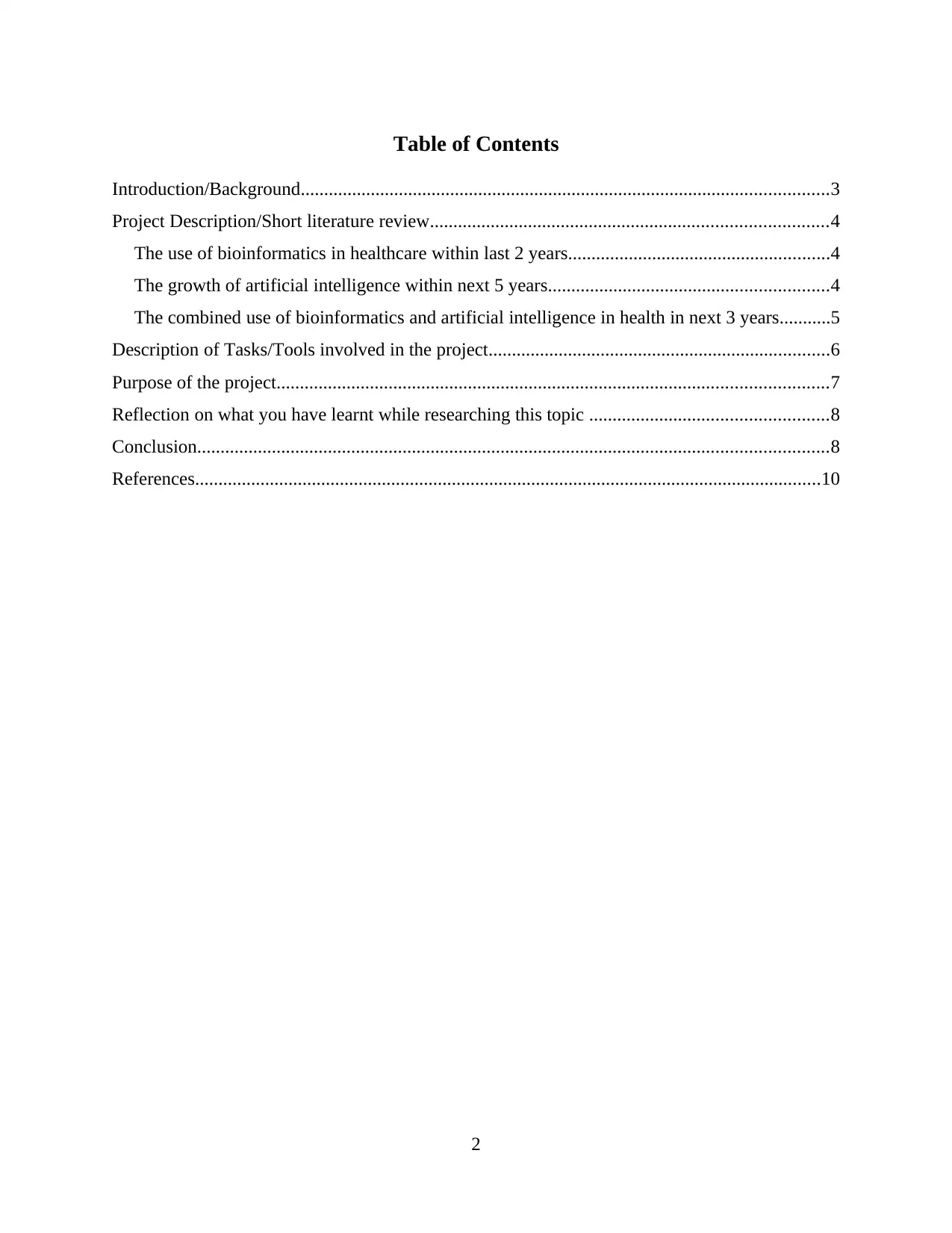
Table of Contents
Introduction/Background.................................................................................................................3
Project Description/Short literature review.....................................................................................4
The use of bioinformatics in healthcare within last 2 years........................................................4
The growth of artificial intelligence within next 5 years............................................................4
The combined use of bioinformatics and artificial intelligence in health in next 3 years...........5
Description of Tasks/Tools involved in the project.........................................................................6
Purpose of the project......................................................................................................................7
Reflection on what you have learnt while researching this topic ...................................................8
Conclusion.......................................................................................................................................8
References......................................................................................................................................10
2
Introduction/Background.................................................................................................................3
Project Description/Short literature review.....................................................................................4
The use of bioinformatics in healthcare within last 2 years........................................................4
The growth of artificial intelligence within next 5 years............................................................4
The combined use of bioinformatics and artificial intelligence in health in next 3 years...........5
Description of Tasks/Tools involved in the project.........................................................................6
Purpose of the project......................................................................................................................7
Reflection on what you have learnt while researching this topic ...................................................8
Conclusion.......................................................................................................................................8
References......................................................................................................................................10
2
Introduction/Background
Bioinformatics have been defined as the science of stocking, retrieving and examining
huge amount of data as well as information related to biology. The field is largely
interdisciplinary including several kinds of biological specialist, computer scientist, biologist,
mathematicians, molecular biology scientist (Lesk, 2019). The term refers to the study of
informatics procedures associated with the systems of biotic, the use of such process began more
when the initial sequence related to biology came into use. Artificial intelligence is a kind of
human intellectual modelling process by the assistance of machine and computers. It has a
significant role in healthcare organisation by regulating health and well-being of service users. It
enhance the ability of care professionals to understand requirements of consumers in a better way
and to develop an understanding of day to day patterns. Utilization of artificial intelligence in
healthcare will bring effective quality of care and will help healthcare professionals to assist and
support their patients to maintain healthy conditions. The prior objective of this study is to draw
out a link between bioinformatics and artificial intelligence. However, bioinformatics is consider
as a promoter of artificial intelligence. The basic objective includes the spontaneous language
processing, identification of speech, expert system and device vision. The project will include the
relatedness among the artificial intelligence and bioinformatics in the healthcare.
Aim: “To analyse the relation between bioinformatics and artificial intelligence.”
Objectives
To evaluate the use of bioinformatics in healthcare within last 2 years.
To identify the growth of artificial intelligence within next 5 years.
To analyse the combined use of bioinformatics and artificial intelligence in health in next
3 years.
Questions
How to evaluate the use of bioinformatics in healthcare within last 2 years?
What is the growth of artificial intelligence within next 5 years?
How to analyse the combined use of bioinformatics and artificial intelligence in health in
next 3 years?
3
Bioinformatics have been defined as the science of stocking, retrieving and examining
huge amount of data as well as information related to biology. The field is largely
interdisciplinary including several kinds of biological specialist, computer scientist, biologist,
mathematicians, molecular biology scientist (Lesk, 2019). The term refers to the study of
informatics procedures associated with the systems of biotic, the use of such process began more
when the initial sequence related to biology came into use. Artificial intelligence is a kind of
human intellectual modelling process by the assistance of machine and computers. It has a
significant role in healthcare organisation by regulating health and well-being of service users. It
enhance the ability of care professionals to understand requirements of consumers in a better way
and to develop an understanding of day to day patterns. Utilization of artificial intelligence in
healthcare will bring effective quality of care and will help healthcare professionals to assist and
support their patients to maintain healthy conditions. The prior objective of this study is to draw
out a link between bioinformatics and artificial intelligence. However, bioinformatics is consider
as a promoter of artificial intelligence. The basic objective includes the spontaneous language
processing, identification of speech, expert system and device vision. The project will include the
relatedness among the artificial intelligence and bioinformatics in the healthcare.
Aim: “To analyse the relation between bioinformatics and artificial intelligence.”
Objectives
To evaluate the use of bioinformatics in healthcare within last 2 years.
To identify the growth of artificial intelligence within next 5 years.
To analyse the combined use of bioinformatics and artificial intelligence in health in next
3 years.
Questions
How to evaluate the use of bioinformatics in healthcare within last 2 years?
What is the growth of artificial intelligence within next 5 years?
How to analyse the combined use of bioinformatics and artificial intelligence in health in
next 3 years?
3
⊘ This is a preview!⊘
Do you want full access?
Subscribe today to unlock all pages.

Trusted by 1+ million students worldwide
Project Description/Short literature review
The use of bioinformatics in healthcare within last 2 years
As per the views of Min, Lee and Yoon (2017), the tools which are being employed in
bioinformatics are majorly utilise in the process of discovering drugs associated with the
molecular diseases. In last 2 years, scientist have identified the manner through which they can
manage the diagnosis and their further disease by developing major medicines which have the
potential to suit more than 500 genes. The computational tool of bioinformatics assist in
determining the features of proteins, phylogenetic study and physiochemical characteristics of
proteins. Due to the invention of bioinformatics, the process of breaking the molecules and lead
in the discovery of computer aided drug design (CADD) so as to formulate highly productive
drugs. Such practice are being used in the healthcare for comforting the patients, the database
provided by bioinformatics renders complete information of the patients condition to the heath
practitioners. Such information eventually aids in making correct decision regarding the
treatment of patients. Over the past two years, bioinformatics has bring innovation and creativity
in healthcare organisation. Advancement of bioinformatics has lead to better ways for storing,
organizing, retrieving an analysis overall biological data. There has been development of tools
and techniques for developing and interpretation human data. It contribute in driving best
outcomes for patients. As per the development of bioinformatics in healthcare sectors, care
professionals could be able to analyse their patients very deeply by investigating the root of the
disease and factor which is contributing in enhancement of disease. It plays a vital role in
processing of gene based drug discovery which is proved to an effective method to cure various
number of genetic disorders. Thus will contribute in enhancing quality and level of clinical
practices. As per the opinion of Wang and et.al., (2016), in last two years, advancement of
bioinformatics has been result in introduction of expertise in healthcare professional and help to
enhance critical thinking of care professionals in respect to their patients as they get to know and
drive information about each and every gene in their body with the help of bioinformatics. It has
created an understanding of evolutionary factors of molecular biology.
The growth of artificial intelligence within next 5 years
Artificial intelligence (AI) has considered as one of most innovative advancement made
by the human which is now leading in large growth in many domains. As mentioned by Hamet
4
The use of bioinformatics in healthcare within last 2 years
As per the views of Min, Lee and Yoon (2017), the tools which are being employed in
bioinformatics are majorly utilise in the process of discovering drugs associated with the
molecular diseases. In last 2 years, scientist have identified the manner through which they can
manage the diagnosis and their further disease by developing major medicines which have the
potential to suit more than 500 genes. The computational tool of bioinformatics assist in
determining the features of proteins, phylogenetic study and physiochemical characteristics of
proteins. Due to the invention of bioinformatics, the process of breaking the molecules and lead
in the discovery of computer aided drug design (CADD) so as to formulate highly productive
drugs. Such practice are being used in the healthcare for comforting the patients, the database
provided by bioinformatics renders complete information of the patients condition to the heath
practitioners. Such information eventually aids in making correct decision regarding the
treatment of patients. Over the past two years, bioinformatics has bring innovation and creativity
in healthcare organisation. Advancement of bioinformatics has lead to better ways for storing,
organizing, retrieving an analysis overall biological data. There has been development of tools
and techniques for developing and interpretation human data. It contribute in driving best
outcomes for patients. As per the development of bioinformatics in healthcare sectors, care
professionals could be able to analyse their patients very deeply by investigating the root of the
disease and factor which is contributing in enhancement of disease. It plays a vital role in
processing of gene based drug discovery which is proved to an effective method to cure various
number of genetic disorders. Thus will contribute in enhancing quality and level of clinical
practices. As per the opinion of Wang and et.al., (2016), in last two years, advancement of
bioinformatics has been result in introduction of expertise in healthcare professional and help to
enhance critical thinking of care professionals in respect to their patients as they get to know and
drive information about each and every gene in their body with the help of bioinformatics. It has
created an understanding of evolutionary factors of molecular biology.
The growth of artificial intelligence within next 5 years
Artificial intelligence (AI) has considered as one of most innovative advancement made
by the human which is now leading in large growth in many domains. As mentioned by Hamet
4
Paraphrase This Document
Need a fresh take? Get an instant paraphrase of this document with our AI Paraphraser
and Tremblay (2017), the functional property of AI aids in reduction of additional operation
expenses, automatic attainment of tedious task. Within next 5 years, more expansion will be
observed in such field from making leverage growth in security to high achievements in the
health care sector. For the process of anti money laundering, many banks are using such
technology for determining as well as improve the risk possibilities. For protecting the data from
being hacked and strengthening the safety scheme from network attacks will further be more
improved in upcoming years. In health care such AI can make a regular and full scan of the body
vitals, in coming years it will be more efficient in detecting deadly diseases in the patients from
potential imaging. There is a great significance of artificial intelligence in healthcare sector. In
next five years, doctors and care professionals would be able to access to number of diagnostic
resources for better delivery of treatment. As per the perception of Stefano and Fernandez(2017)
Healthcare market of artificial intelligence tends to expand in next five years. Utilization of
artificial intelligence is increasing faster as doctors are involve in doing research for further
improvement. Thus it will result in enhancing their clinical skills and knowledge. There are
chances that patients in healthcare organisations has been diagnosed with multiple symptoms
which is related with both physical and genetic characteristics, that may often results in delaying
of treatment and can give rise to many serious consequences. However, advancement in artificial
intelligence will help a practitioner in an effective manner and gives both qualitative and
quantitative data. In next five years, this element will bring accuracy in diagnosis, plan of
treatment and prediction of results. Introduction of artificial intelligence in healthcare sectors
will enhance relevance and accuracy in treatment. It has been proved that artificial intelligence
has a strong potential in different healthcare areas, considering drug discovery and biomedical
analysis.
The combined use of bioinformatics and artificial intelligence in health in next 3 years
The collective use of bioinformatics and AI has been increasing, there combination
enables the evaluation of convoluted biological system and the AI ensures logical reasoning like
human. In wet laboratory, the use of AI and bioinformatics helps in performing the reasoning
task and also aids in the procedure of screening the vaccine binding sites. The functioning of
both the processes makes a complete workflow design in a particular framework which renders
evaluation of biological data. According to Jiang and et.al. (2017), perspective, the algorithm
which is involved in the process is improved by AI technique. Such practice of depicting antigen
5
expenses, automatic attainment of tedious task. Within next 5 years, more expansion will be
observed in such field from making leverage growth in security to high achievements in the
health care sector. For the process of anti money laundering, many banks are using such
technology for determining as well as improve the risk possibilities. For protecting the data from
being hacked and strengthening the safety scheme from network attacks will further be more
improved in upcoming years. In health care such AI can make a regular and full scan of the body
vitals, in coming years it will be more efficient in detecting deadly diseases in the patients from
potential imaging. There is a great significance of artificial intelligence in healthcare sector. In
next five years, doctors and care professionals would be able to access to number of diagnostic
resources for better delivery of treatment. As per the perception of Stefano and Fernandez(2017)
Healthcare market of artificial intelligence tends to expand in next five years. Utilization of
artificial intelligence is increasing faster as doctors are involve in doing research for further
improvement. Thus it will result in enhancing their clinical skills and knowledge. There are
chances that patients in healthcare organisations has been diagnosed with multiple symptoms
which is related with both physical and genetic characteristics, that may often results in delaying
of treatment and can give rise to many serious consequences. However, advancement in artificial
intelligence will help a practitioner in an effective manner and gives both qualitative and
quantitative data. In next five years, this element will bring accuracy in diagnosis, plan of
treatment and prediction of results. Introduction of artificial intelligence in healthcare sectors
will enhance relevance and accuracy in treatment. It has been proved that artificial intelligence
has a strong potential in different healthcare areas, considering drug discovery and biomedical
analysis.
The combined use of bioinformatics and artificial intelligence in health in next 3 years
The collective use of bioinformatics and AI has been increasing, there combination
enables the evaluation of convoluted biological system and the AI ensures logical reasoning like
human. In wet laboratory, the use of AI and bioinformatics helps in performing the reasoning
task and also aids in the procedure of screening the vaccine binding sites. The functioning of
both the processes makes a complete workflow design in a particular framework which renders
evaluation of biological data. According to Jiang and et.al. (2017), perspective, the algorithm
which is involved in the process is improved by AI technique. Such practice of depicting antigen
5
antibody interaction will be improved more in coming years and the evaluation of disease like
influenza, HIV and many more will be analysed more. Bioinformatics with a combination with
artificial intelligence will play a vital role in arranging typical analytical workflows for
performing a multi step analysis under one analytical framework. It will enable analysis and
processing of complex biological data. Techniques of artificial intelligence involves knowledge
discovery, machine learning along with reasoning which is improving at a constant rate. It bring
an increased role of AI in bioinformatics. Combination of both these elements will help in
production of savings in time, money and efforts. It will facilitate acceleration in biological
discovery. According to the views of Wassan and Zheng
(2018), collective use of bioinformatics and artificial intelligence will ease the process of
sequencing technologies and thus help in to cure number of vital medical disorders which is
occurred due to some mutation or genetic variance within the body such as cancer. IN next three
coming years, linkage of both these fields will be effective in delivery of quality care of patients
and help a care professional to access through a large number of options that they could
introduce in their operations in a more effective manner.
Description of Tasks/Tools involved in the project
Research tools play a vital role in a research study and it allows a researcher to focus on
research in order to bring out effective results. In this study, qualitative type of investigation will
be conducted in this project and the sources of collecting the data will be primary as well as
secondary for making more centric and logical interpretation. It is basically a scientific method
of research in order to collect non- qualitative data. The method of gathering information is
through surveys or open ended communication. Another important element of this research is
descriptive design. It helped in analysing characteristics, trends, frequency and categories in a
research. Some of the most common methods of descriptive design are observations, surveys and
case study in order to collect useful information. Thus, in this study descriptive design is utilize
in order to draw out some essential information regarding relatedness of bioinformatics and
artificial intelligence. Interpretivism philosophy is also an effective tool used in the study. It
helped in to interpret ate important elements of the and creates an interest in the study. It majorly
focus on qualitative research study. It put emphasis on meaning and brings out different multiple
methods for reflecting various aspects of the study. Inductive approach were used at the end of
overall research process as an outcome of observations. It includes no hypothesis at the
6
influenza, HIV and many more will be analysed more. Bioinformatics with a combination with
artificial intelligence will play a vital role in arranging typical analytical workflows for
performing a multi step analysis under one analytical framework. It will enable analysis and
processing of complex biological data. Techniques of artificial intelligence involves knowledge
discovery, machine learning along with reasoning which is improving at a constant rate. It bring
an increased role of AI in bioinformatics. Combination of both these elements will help in
production of savings in time, money and efforts. It will facilitate acceleration in biological
discovery. According to the views of Wassan and Zheng
(2018), collective use of bioinformatics and artificial intelligence will ease the process of
sequencing technologies and thus help in to cure number of vital medical disorders which is
occurred due to some mutation or genetic variance within the body such as cancer. IN next three
coming years, linkage of both these fields will be effective in delivery of quality care of patients
and help a care professional to access through a large number of options that they could
introduce in their operations in a more effective manner.
Description of Tasks/Tools involved in the project
Research tools play a vital role in a research study and it allows a researcher to focus on
research in order to bring out effective results. In this study, qualitative type of investigation will
be conducted in this project and the sources of collecting the data will be primary as well as
secondary for making more centric and logical interpretation. It is basically a scientific method
of research in order to collect non- qualitative data. The method of gathering information is
through surveys or open ended communication. Another important element of this research is
descriptive design. It helped in analysing characteristics, trends, frequency and categories in a
research. Some of the most common methods of descriptive design are observations, surveys and
case study in order to collect useful information. Thus, in this study descriptive design is utilize
in order to draw out some essential information regarding relatedness of bioinformatics and
artificial intelligence. Interpretivism philosophy is also an effective tool used in the study. It
helped in to interpret ate important elements of the and creates an interest in the study. It majorly
focus on qualitative research study. It put emphasis on meaning and brings out different multiple
methods for reflecting various aspects of the study. Inductive approach were used at the end of
overall research process as an outcome of observations. It includes no hypothesis at the
6
⊘ This is a preview!⊘
Do you want full access?
Subscribe today to unlock all pages.
Trusted by 1+ million students worldwide
beginning of the research as there is no surety about nature and type of the research findings until
and unless the research is completed. Random sampling method will be use in this study. It is
normal sampling method in which each and every sample has a probability of being selected. It
is one of the most easiest method for collecting data from a total number of population. It is an
effective way of sampling as it brings an unbiased representation of overall population. Samples
were chosen according to the random sampling method. Research has been carried out by
considering all ethical considerations which is necessary in this study. It would be a failure for
this research if thesis particular part has been avoided. According to such ethical considerations,
participate of the research study must be treated with respect and their dignity should be
maintained. Communication related to research must be done with transparency and honesty. No
kind of misleading information and presentation of primary data findings in indiscriminate way
must be avoided. Participation of all respondents in the research must be volunteer and they have
a right to take withdrawal form the research in between. In this research study where
interconnectedness between bioinformatics and Artificial intelligence is being carried out, such
research tools will help in driving out some effective and positive outcomes. It will help in to
collect useful and necessary data which is very important to conduct this research study.
Purpose of the project
The purpose of the project is to determine the relatedness between the bioinformatics and
artificial intelligence. In the sector of health care, it has been found that both are collectively
responsible in vaccine target and identifying the antigen antibody interaction. The role of AI and
bioinformatics in detecting deadly disease in healthcare will be achieved more in the recent year,
such practice will be evaluated more in this project. Collective use of bioinformatics and
artificial intelligence will help in developing number of opportunities in healthcare sectors. In
wet laboratory, the use of AI and bioinformatics helps in performing the reasoning task and also
aids in the procedure of screening the vaccine binding sites. It can bring accuracy and perfection
in treatment an operation (Reddy and et.al., 2019). Utilization of artificial intelligence in
healthcare sectors will help in to develop critical thinking of care professionals. It is very
important to bring out effective and positive patient outcomes and bioinformatics and artificial
intelligence has major role in this. The study will analyse various aspects in which linkage of
these two aspects can do wonder in the field of healthcare sector. The collective use of
bioinformatics and AI has been increasing, there combination enables the evaluation of
7
and unless the research is completed. Random sampling method will be use in this study. It is
normal sampling method in which each and every sample has a probability of being selected. It
is one of the most easiest method for collecting data from a total number of population. It is an
effective way of sampling as it brings an unbiased representation of overall population. Samples
were chosen according to the random sampling method. Research has been carried out by
considering all ethical considerations which is necessary in this study. It would be a failure for
this research if thesis particular part has been avoided. According to such ethical considerations,
participate of the research study must be treated with respect and their dignity should be
maintained. Communication related to research must be done with transparency and honesty. No
kind of misleading information and presentation of primary data findings in indiscriminate way
must be avoided. Participation of all respondents in the research must be volunteer and they have
a right to take withdrawal form the research in between. In this research study where
interconnectedness between bioinformatics and Artificial intelligence is being carried out, such
research tools will help in driving out some effective and positive outcomes. It will help in to
collect useful and necessary data which is very important to conduct this research study.
Purpose of the project
The purpose of the project is to determine the relatedness between the bioinformatics and
artificial intelligence. In the sector of health care, it has been found that both are collectively
responsible in vaccine target and identifying the antigen antibody interaction. The role of AI and
bioinformatics in detecting deadly disease in healthcare will be achieved more in the recent year,
such practice will be evaluated more in this project. Collective use of bioinformatics and
artificial intelligence will help in developing number of opportunities in healthcare sectors. In
wet laboratory, the use of AI and bioinformatics helps in performing the reasoning task and also
aids in the procedure of screening the vaccine binding sites. It can bring accuracy and perfection
in treatment an operation (Reddy and et.al., 2019). Utilization of artificial intelligence in
healthcare sectors will help in to develop critical thinking of care professionals. It is very
important to bring out effective and positive patient outcomes and bioinformatics and artificial
intelligence has major role in this. The study will analyse various aspects in which linkage of
these two aspects can do wonder in the field of healthcare sector. The collective use of
bioinformatics and AI has been increasing, there combination enables the evaluation of
7
Paraphrase This Document
Need a fresh take? Get an instant paraphrase of this document with our AI Paraphraser
convoluted biological system and the AI ensures logical reasoning like human. The main
objective of the study is to facilitating the operations of healthcare sectors and to critically
analyse the cause of occurrence of diseases by finding out which part of the gene is causing
problem to the body of patients. It will enhance the level of performance of all healthcare
professionals and help them to deliver an effective care to their service users (Ilzins and et.al.,
2016). The functioning of both the processes makes a complete workflow design in a particular
framework which renders evaluation of biological data.
Reflection on what you have learnt while researching this topic
The study is focusing on relatedness among the artificial intelligence and bioinformatics
in the healthcare. According to me, the study will be helpful in introducing technology and
innovation in healthcare sectors. Bioinformatics and advance technology are the fields that could
help in eliminating errors in operations of healthcare organisations and to deliver a advanced
quality of care to their patients. Going through the overall study, I have learned that
bioinformatics will be helpful in driving out necessary data and information of patients. Artificial
intelligence is a kind of human intellectual modelling process by the assistance of machine and
computers. It help in effective regulation of health and well being of patients. These both factors
would be effective in medicine fields such as personal and preventive medicines, drug discovery,
gene therapy and many more. Thus utilizing the combination of both the fields researchers can
develop number of drugs and medicines for curing different vital diseases which occurs due to
some shift of genes or may be due to damage of a change. The major objective of artificial
intelligence is to solve various healthcare problems and help healthcare professionals to interpret
data of patients which occur due to diagnosis of vital diseases such as diabetes, heart diseases,
cancers and many more. I think artificial intelligence is very important for future development of
bioinformatics. Study will be helpful in knowing present and future aspects of artificial
intelligence in healthcare along with the impact of bioinformatics has been analysed which help
me to know that both the aspects will be helpful in delivering quality care to patients and to store
their information in an effective manner.
Conclusion
From the above study, it can be concluded that bioinformatics and artificial intelligence
plays a vital role in healthcare sectors for delivering a high quality care to patients and to bring
8
objective of the study is to facilitating the operations of healthcare sectors and to critically
analyse the cause of occurrence of diseases by finding out which part of the gene is causing
problem to the body of patients. It will enhance the level of performance of all healthcare
professionals and help them to deliver an effective care to their service users (Ilzins and et.al.,
2016). The functioning of both the processes makes a complete workflow design in a particular
framework which renders evaluation of biological data.
Reflection on what you have learnt while researching this topic
The study is focusing on relatedness among the artificial intelligence and bioinformatics
in the healthcare. According to me, the study will be helpful in introducing technology and
innovation in healthcare sectors. Bioinformatics and advance technology are the fields that could
help in eliminating errors in operations of healthcare organisations and to deliver a advanced
quality of care to their patients. Going through the overall study, I have learned that
bioinformatics will be helpful in driving out necessary data and information of patients. Artificial
intelligence is a kind of human intellectual modelling process by the assistance of machine and
computers. It help in effective regulation of health and well being of patients. These both factors
would be effective in medicine fields such as personal and preventive medicines, drug discovery,
gene therapy and many more. Thus utilizing the combination of both the fields researchers can
develop number of drugs and medicines for curing different vital diseases which occurs due to
some shift of genes or may be due to damage of a change. The major objective of artificial
intelligence is to solve various healthcare problems and help healthcare professionals to interpret
data of patients which occur due to diagnosis of vital diseases such as diabetes, heart diseases,
cancers and many more. I think artificial intelligence is very important for future development of
bioinformatics. Study will be helpful in knowing present and future aspects of artificial
intelligence in healthcare along with the impact of bioinformatics has been analysed which help
me to know that both the aspects will be helpful in delivering quality care to patients and to store
their information in an effective manner.
Conclusion
From the above study, it can be concluded that bioinformatics and artificial intelligence
plays a vital role in healthcare sectors for delivering a high quality care to patients and to bring
8

accuracy in various operations conducted by number of healthcare professionals. The collective
use of bioinformatics and AI has been increasing, there combination enables the evaluation of
convoluted biological system and the AI ensures logical reasoning like human. Thus, the study
will be helpful in analysing current and future aspects of both these fields in healthcare sectors.
9
use of bioinformatics and AI has been increasing, there combination enables the evaluation of
convoluted biological system and the AI ensures logical reasoning like human. Thus, the study
will be helpful in analysing current and future aspects of both these fields in healthcare sectors.
9
⊘ This is a preview!⊘
Do you want full access?
Subscribe today to unlock all pages.
Trusted by 1+ million students worldwide
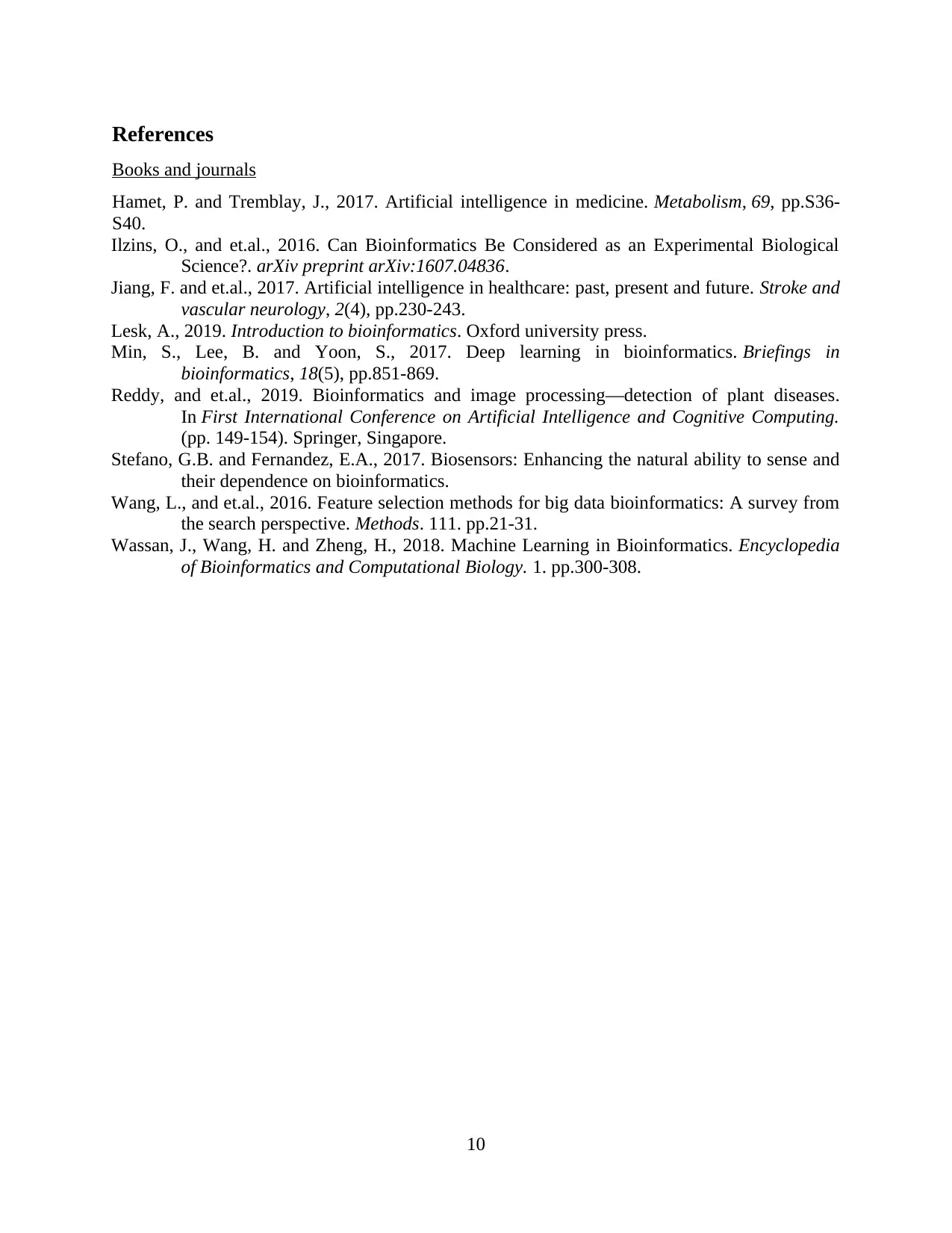
References
Books and journals
Hamet, P. and Tremblay, J., 2017. Artificial intelligence in medicine. Metabolism, 69, pp.S36-
S40.
Ilzins, O., and et.al., 2016. Can Bioinformatics Be Considered as an Experimental Biological
Science?. arXiv preprint arXiv:1607.04836.
Jiang, F. and et.al., 2017. Artificial intelligence in healthcare: past, present and future. Stroke and
vascular neurology, 2(4), pp.230-243.
Lesk, A., 2019. Introduction to bioinformatics. Oxford university press.
Min, S., Lee, B. and Yoon, S., 2017. Deep learning in bioinformatics. Briefings in
bioinformatics, 18(5), pp.851-869.
Reddy, and et.al., 2019. Bioinformatics and image processing—detection of plant diseases.
In First International Conference on Artificial Intelligence and Cognitive Computing.
(pp. 149-154). Springer, Singapore.
Stefano, G.B. and Fernandez, E.A., 2017. Biosensors: Enhancing the natural ability to sense and
their dependence on bioinformatics.
Wang, L., and et.al., 2016. Feature selection methods for big data bioinformatics: A survey from
the search perspective. Methods. 111. pp.21-31.
Wassan, J., Wang, H. and Zheng, H., 2018. Machine Learning in Bioinformatics. Encyclopedia
of Bioinformatics and Computational Biology. 1. pp.300-308.
10
Books and journals
Hamet, P. and Tremblay, J., 2017. Artificial intelligence in medicine. Metabolism, 69, pp.S36-
S40.
Ilzins, O., and et.al., 2016. Can Bioinformatics Be Considered as an Experimental Biological
Science?. arXiv preprint arXiv:1607.04836.
Jiang, F. and et.al., 2017. Artificial intelligence in healthcare: past, present and future. Stroke and
vascular neurology, 2(4), pp.230-243.
Lesk, A., 2019. Introduction to bioinformatics. Oxford university press.
Min, S., Lee, B. and Yoon, S., 2017. Deep learning in bioinformatics. Briefings in
bioinformatics, 18(5), pp.851-869.
Reddy, and et.al., 2019. Bioinformatics and image processing—detection of plant diseases.
In First International Conference on Artificial Intelligence and Cognitive Computing.
(pp. 149-154). Springer, Singapore.
Stefano, G.B. and Fernandez, E.A., 2017. Biosensors: Enhancing the natural ability to sense and
their dependence on bioinformatics.
Wang, L., and et.al., 2016. Feature selection methods for big data bioinformatics: A survey from
the search perspective. Methods. 111. pp.21-31.
Wassan, J., Wang, H. and Zheng, H., 2018. Machine Learning in Bioinformatics. Encyclopedia
of Bioinformatics and Computational Biology. 1. pp.300-308.
10

1 out of 10


Related Documents


Your All-in-One AI-Powered Toolkit for Academic Success.
+13062052269
info@desklib.com
Available 24*7 on WhatsApp / Email
![[object Object]](/_next/static/media/star-bottom.7253800d.svg)
Unlock your academic potential
Copyright © 2020–2026 A2Z Services. All Rights Reserved. Developed and managed by ZUCOL.