An Analysis of Biological and Social Influences on Human Development
VerifiedAdded on 2023/01/13
|9
|2717
|52
Essay
AI Summary
This essay examines the significant impact of biological and social influences on human development, particularly during adolescence. It explores how genetic factors, hormonal changes, and cognitive processes, as highlighted by Jean Piaget's theory of cognitive development, interact to shape individual behavior. The essay also delves into the role of social influences, including conformity, compliance, and obedience, and their effects on decision-making and career choices. Erik Erikson's theory of psychosocial development is used to further analyze the influence of social environments on adolescent development, specifically examining stages such as Industry vs. Inferiority, Identity vs. Role Confusion, and Intimacy vs. Isolation. The essay emphasizes how social inclusion, peer pressure, and cultural norms can significantly affect an individual's development and well-being, making it a comprehensive analysis of the multifaceted influences on human behavior.

WRITTEN ESSAY

Paraphrase This Document
Need a fresh take? Get an instant paraphrase of this document with our AI Paraphraser
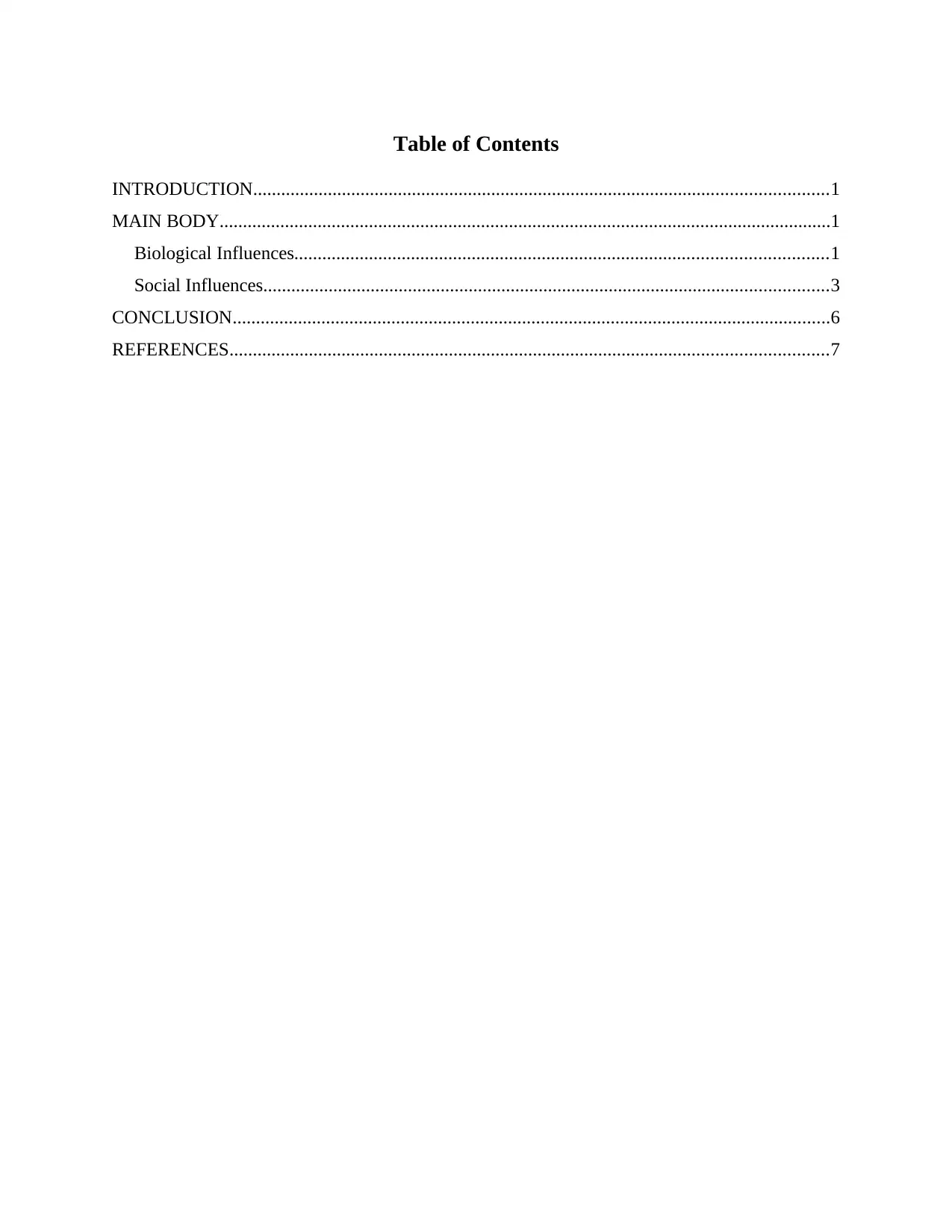
Table of Contents
INTRODUCTION...........................................................................................................................1
MAIN BODY...................................................................................................................................1
Biological Influences..................................................................................................................1
Social Influences.........................................................................................................................3
CONCLUSION................................................................................................................................6
REFERENCES................................................................................................................................7
INTRODUCTION...........................................................................................................................1
MAIN BODY...................................................................................................................................1
Biological Influences..................................................................................................................1
Social Influences.........................................................................................................................3
CONCLUSION................................................................................................................................6
REFERENCES................................................................................................................................7
INTRODUCTION
Biological and social influences refer to the kind of effect which the biological elements
and society have on individuals and which sets the basis of how a person lives their whole life
(Winking, 2018). Such influences are necessary to be analysed and tapped in order to understand
the nature behind the actions of individuals towards other individuals, events and personal
development. Hence, in this relation, the essay below is based on the importance of biological
and social influences during development period of individuals.
MAIN BODY
Biological Influences
Biological Influences are inclusive of several factors that contributes towards a great
extent in relation to ensuring variation amongst different individuals with similar environment.
These are the result of genetic make-up of a person that have a difference within their actions
and behaviours. Hence, as per these influences, genes and other biological factors such as
cognition have a major impact upon an individual's responses towards the environment.
Hence, it becomes necessary that these influences are evaluated and analysed upon
distinct development stages in order to understand their importance in a better manner. For this
purpose, adolescence is being chosen as the developmental stage to reflect the importance of
biological influences. This stage within an individual's life is a developmental and transitional
phase where an individual experiences several shifts within a person's behaviour, specifically
within experimentations and risks (Mayer and McHugh, 2016).
In this context, there are several appropriate biological factors that influence the
behaviour of individuals during adolescence development period. For instance, the very first
element is gender, which play a major factor within the cognitive maturation between individuals
of both genders. For instance, readiness towards education is higher within girls than boys,
which explains the difference in behaviour towards high school of students. Moreover, another
biological element which have an influence on behaviour of people within the adolescence stage
is the differential distribution of hormones. As an example, excessive amounts of sex hormones
have an impact upon the behaviour of an individual. An evident fact to support this statement is
that adolescent males with higher level of androgen behave in a similar manner to their male
peers, whereas girls with such androgen levels showcase stereotypic male traits. This has an
1
Biological and social influences refer to the kind of effect which the biological elements
and society have on individuals and which sets the basis of how a person lives their whole life
(Winking, 2018). Such influences are necessary to be analysed and tapped in order to understand
the nature behind the actions of individuals towards other individuals, events and personal
development. Hence, in this relation, the essay below is based on the importance of biological
and social influences during development period of individuals.
MAIN BODY
Biological Influences
Biological Influences are inclusive of several factors that contributes towards a great
extent in relation to ensuring variation amongst different individuals with similar environment.
These are the result of genetic make-up of a person that have a difference within their actions
and behaviours. Hence, as per these influences, genes and other biological factors such as
cognition have a major impact upon an individual's responses towards the environment.
Hence, it becomes necessary that these influences are evaluated and analysed upon
distinct development stages in order to understand their importance in a better manner. For this
purpose, adolescence is being chosen as the developmental stage to reflect the importance of
biological influences. This stage within an individual's life is a developmental and transitional
phase where an individual experiences several shifts within a person's behaviour, specifically
within experimentations and risks (Mayer and McHugh, 2016).
In this context, there are several appropriate biological factors that influence the
behaviour of individuals during adolescence development period. For instance, the very first
element is gender, which play a major factor within the cognitive maturation between individuals
of both genders. For instance, readiness towards education is higher within girls than boys,
which explains the difference in behaviour towards high school of students. Moreover, another
biological element which have an influence on behaviour of people within the adolescence stage
is the differential distribution of hormones. As an example, excessive amounts of sex hormones
have an impact upon the behaviour of an individual. An evident fact to support this statement is
that adolescent males with higher level of androgen behave in a similar manner to their male
peers, whereas girls with such androgen levels showcase stereotypic male traits. This has an
1
⊘ This is a preview!⊘
Do you want full access?
Subscribe today to unlock all pages.

Trusted by 1+ million students worldwide
influence over the behaviour of individuals based on the biological aspects (Lei, Beach and
Simons, 2018).
Another prominent biological influence that is exhibited within individuals at this
development stage is genes. These appropriately and effectively showcases several influences
across the adolescence development period. Moreover, its influences are exhibited and are
evident within the human behaviour within this stage. For instance, one prominent example of
biological influences is alcohol usage. For instance, if parent(s) of an individual are quite
inclined towards consuming alcohol, it becomes evident that individuals during adolescence
adopt alcohol as a regular usage component. Hence, the influence of this biological factor is
upon the usage of alcohol, which contributes towards maintaining a positive behaviour towards
alcohol usage of individuals. Another example where biological influences play active role
within human behaviour is the down syndrome. This is one of the most common disorder which
is found due to issues within chromosomes. It could be evident through facial characteristics of
individuals, along with certain hearing issues or defects within the heart. The major influence
which this genetic disorder has on individuals is the intellectual impairment.
However, in this context, there are several theorists who have contributed within towards
developing an understanding and insight within these biological influences in a better and more
structured manner. One such theorist is Jean Piaget, who has given the “Theory of Cognitive
Development”. According to this theory, there are basically four stages of mental development
of an individual. These stages are sensorimotor, pre-operational, concrete operational, as well as
formal operational stage. Out of all these stages, the last two stages are quite viable towards
understanding the biological influences upon adolescence development stage.
One prominent stage in this regard is the Concrete Operational Stage, where individuals
experience effective biological growth in terms of their mental processes. For instance, a more
logical thinking is developed within these individuals towards concrete events, along with a
sense of conservation. In addition to this, inductive logic and reasoning is also developed during
this stage. Moreover, characteristics of adolescents within this stage are that they become more
logical, develop of sense of understanding towards reversibility and so forth (Kelly and Kelly,
2018).
Biological influences are very important within this developmental stage. For instance,as
per the theory, through inductive reasoning, adolescents might notice that they have allergy
2
Simons, 2018).
Another prominent biological influence that is exhibited within individuals at this
development stage is genes. These appropriately and effectively showcases several influences
across the adolescence development period. Moreover, its influences are exhibited and are
evident within the human behaviour within this stage. For instance, one prominent example of
biological influences is alcohol usage. For instance, if parent(s) of an individual are quite
inclined towards consuming alcohol, it becomes evident that individuals during adolescence
adopt alcohol as a regular usage component. Hence, the influence of this biological factor is
upon the usage of alcohol, which contributes towards maintaining a positive behaviour towards
alcohol usage of individuals. Another example where biological influences play active role
within human behaviour is the down syndrome. This is one of the most common disorder which
is found due to issues within chromosomes. It could be evident through facial characteristics of
individuals, along with certain hearing issues or defects within the heart. The major influence
which this genetic disorder has on individuals is the intellectual impairment.
However, in this context, there are several theorists who have contributed within towards
developing an understanding and insight within these biological influences in a better and more
structured manner. One such theorist is Jean Piaget, who has given the “Theory of Cognitive
Development”. According to this theory, there are basically four stages of mental development
of an individual. These stages are sensorimotor, pre-operational, concrete operational, as well as
formal operational stage. Out of all these stages, the last two stages are quite viable towards
understanding the biological influences upon adolescence development stage.
One prominent stage in this regard is the Concrete Operational Stage, where individuals
experience effective biological growth in terms of their mental processes. For instance, a more
logical thinking is developed within these individuals towards concrete events, along with a
sense of conservation. In addition to this, inductive logic and reasoning is also developed during
this stage. Moreover, characteristics of adolescents within this stage are that they become more
logical, develop of sense of understanding towards reversibility and so forth (Kelly and Kelly,
2018).
Biological influences are very important within this developmental stage. For instance,as
per the theory, through inductive reasoning, adolescents might notice that they have allergy
2
Paraphrase This Document
Need a fresh take? Get an instant paraphrase of this document with our AI Paraphraser
through certain animals, for instance dogs, as the moment they are exposed to them, they start
experiencing the symptoms such as swollen throat, runny nose, as well as itchy eyes. However,
the importance of biological influences within this example is that allergies could be genetic and
might be transmitted through heredity, which might influence a negative behaviour within
individuals towards animals due to the same (Winterhalder and Smith, 2017). Similarly, if
parents prefer to have pets and are careful and considerate over animals, the same trait is likely to
be carried out during their offspring, which might lead to a better mindset and logical thinking of
the individuals towards animals around them. Moreover, this might also lead to a better
conceptual thinking development during adolescence towards animals, their breeds, things which
could lead to their development and so forth.
Social Influences
Social Influences refer to any change within the behaviour of a person, which could be
either intentional, or unintentional, that could be directed through or demanded by the social
environment. It takes several forms that could be socialisation, conformity, obedience, social or
peer pressure and so forth.
Individuals tend to expose themselves in social circles when they reach their adolescence
developmental stage, as well as they belong to a society and have certain cultural teachings and
practices that influence and persuade individuals of showcasing a particular kind of behaviour
towards situations, events and other individuals (Garbarino, 2017).
There are certain categories related to social influences which have their impact upon
individuals, as well as, their decision making. However, out of all these categories, there are
three prominent ones that have major influences on people. The very first category is
Conformity, which refers to the changes within behaviour and opinions of individuals in order to
match a certain norm within their social groups. These shifts in behaviour are generally
voluntary, which people might not be aware about. In addition to this, another category is
Compliance, where the changes in opinions and behaviours become evident through direct
requests. These requests might be subjected onto certain favours, donations or to buy a certain
commodity. Furthermore, the last category in question is Obedience, which refer to shifts in
mindsets and responses, resulting from a direct command, which might or might not be
physically coerced.
3
experiencing the symptoms such as swollen throat, runny nose, as well as itchy eyes. However,
the importance of biological influences within this example is that allergies could be genetic and
might be transmitted through heredity, which might influence a negative behaviour within
individuals towards animals due to the same (Winterhalder and Smith, 2017). Similarly, if
parents prefer to have pets and are careful and considerate over animals, the same trait is likely to
be carried out during their offspring, which might lead to a better mindset and logical thinking of
the individuals towards animals around them. Moreover, this might also lead to a better
conceptual thinking development during adolescence towards animals, their breeds, things which
could lead to their development and so forth.
Social Influences
Social Influences refer to any change within the behaviour of a person, which could be
either intentional, or unintentional, that could be directed through or demanded by the social
environment. It takes several forms that could be socialisation, conformity, obedience, social or
peer pressure and so forth.
Individuals tend to expose themselves in social circles when they reach their adolescence
developmental stage, as well as they belong to a society and have certain cultural teachings and
practices that influence and persuade individuals of showcasing a particular kind of behaviour
towards situations, events and other individuals (Garbarino, 2017).
There are certain categories related to social influences which have their impact upon
individuals, as well as, their decision making. However, out of all these categories, there are
three prominent ones that have major influences on people. The very first category is
Conformity, which refers to the changes within behaviour and opinions of individuals in order to
match a certain norm within their social groups. These shifts in behaviour are generally
voluntary, which people might not be aware about. In addition to this, another category is
Compliance, where the changes in opinions and behaviours become evident through direct
requests. These requests might be subjected onto certain favours, donations or to buy a certain
commodity. Furthermore, the last category in question is Obedience, which refer to shifts in
mindsets and responses, resulting from a direct command, which might or might not be
physically coerced.
3
Human behaviour is directly influenced from the social influences and that becomes one
of the main reasons as to why it is importance in adolescent development stages. For instance,
one point of importance in this context is that it might be social inclusion and exclusion upon
behaviour towards an opportunity (Doyle and et. al, 2015). Risk taking is highly influenced by
the culture in which one grows as well as the society in which the individuals have their
belongingness. Hence, during adolescence stage, social exclusion or inclusion have a deep role in
playing towards the future career choices. As an example if a person is socially included, then
their actions and responses towards certain academic opportunity would be directed by the
society rather than their own self belief or capabilities, which might let them in choosing an
opportunity which might not be quite beneficial for them in future. However, on the other hand,
individuals who are socially excluded might be able to take calculative and beneficial decisions
for themselves due to less intervention of society and social circles in which they prevail in.
Hence, it becomes very important and crucial to appropriately and effectively determine the
importance of social influences on the behaviour and choices of individuals.
In this context as well, there are certain theorists who have contributed towards
structurally enhancing the importance of social influences upon individuals who belong to
adolescence development phase. A theorist in this context is Erik Erikson, who has provided the
“Theory of Psychosocial Development”. This theory proposes eight stages of human
psychosocial development from infancy to adulthood which influence the whole personality of
person in predetermined order. On every stage, an individual observes a psychosocial dilemma
which might have either positive or negative impact over nature. At the adolescence stage of
person, there are various factors within this framework which influence the development cycle
quite effectively (Daly, Boyce and Wood, 2015).
The very first stage in this context is Industry vs Inferiority, which arises in human's life
during beginning of their adolescence stage. It justifies that during these years, person can either
gain competent or inferior behaviour skills depends on how their surroundings (peers, family or
friends) are treating them. People at this phase start comparing their abilities with others to seek
how much they are capable of doing something. This stage also focuses on the fact that a person
learns number of creative skills, develops knowledge and expects that someone will appreciate
for same in positive manner this build up a sense of compatibility and self-esteem otherwise
negative compliments from others will lead an individual towards introvert nature which could
4
of the main reasons as to why it is importance in adolescent development stages. For instance,
one point of importance in this context is that it might be social inclusion and exclusion upon
behaviour towards an opportunity (Doyle and et. al, 2015). Risk taking is highly influenced by
the culture in which one grows as well as the society in which the individuals have their
belongingness. Hence, during adolescence stage, social exclusion or inclusion have a deep role in
playing towards the future career choices. As an example if a person is socially included, then
their actions and responses towards certain academic opportunity would be directed by the
society rather than their own self belief or capabilities, which might let them in choosing an
opportunity which might not be quite beneficial for them in future. However, on the other hand,
individuals who are socially excluded might be able to take calculative and beneficial decisions
for themselves due to less intervention of society and social circles in which they prevail in.
Hence, it becomes very important and crucial to appropriately and effectively determine the
importance of social influences on the behaviour and choices of individuals.
In this context as well, there are certain theorists who have contributed towards
structurally enhancing the importance of social influences upon individuals who belong to
adolescence development phase. A theorist in this context is Erik Erikson, who has provided the
“Theory of Psychosocial Development”. This theory proposes eight stages of human
psychosocial development from infancy to adulthood which influence the whole personality of
person in predetermined order. On every stage, an individual observes a psychosocial dilemma
which might have either positive or negative impact over nature. At the adolescence stage of
person, there are various factors within this framework which influence the development cycle
quite effectively (Daly, Boyce and Wood, 2015).
The very first stage in this context is Industry vs Inferiority, which arises in human's life
during beginning of their adolescence stage. It justifies that during these years, person can either
gain competent or inferior behaviour skills depends on how their surroundings (peers, family or
friends) are treating them. People at this phase start comparing their abilities with others to seek
how much they are capable of doing something. This stage also focuses on the fact that a person
learns number of creative skills, develops knowledge and expects that someone will appreciate
for same in positive manner this build up a sense of compatibility and self-esteem otherwise
negative compliments from others will lead an individual towards introvert nature which could
4
⊘ This is a preview!⊘
Do you want full access?
Subscribe today to unlock all pages.
Trusted by 1+ million students worldwide
be difficult for them in future adulthood stage. The importance of social influences within this
phase is reflected through aspects such as that learning. For instance, if individual belongs in a
society where learning is valued, then gaining effective knowledge and better construct of self is
developed within them, rather than in those who belong to an opposite environment (Coall and
et. al., 2016).
Another stage of this aspect is Identity vs Role confusion. This stage occurs during the
age of twelve to eighteen which describes that adolescents explore their personal identity on
basis of their individual beliefs and values. At this phase, person seek various opportunities to
become independent and responsible for future career as well as relationships. They try to find
out possible ways to fit in the society. Erik suggest that success in this phase will direct to the
sense of fidelity. This stage can positively affects the development if person gets great moral
values from the society in which they live in, with a clear picture of where they are heading
themselves in future. However, it could also work in a negative manner if individual is in a state
of confusion and they do not get proper directions for their future well-being from their societies.
This refers to the situation of role of confusion when various question occurs in mind like what
they are going to do, how will they survive and the pressure of accomplishing the goals set by
parents, peers and other elements of the society.
Intimacy vs Isolation is another stage in which the major difficulty faced by the people
belonging to adolescence developmental stage is feeling of being loved by others. At this phase,
everyone wants to sense the affection and social interaction with their peers or loved ones. This
can lead either positive or negative development of person, if an individual shares oneself
thoughts and norms freely with others and explore cordial relationships with longer
commitments will brings positive impact on overall development. This could be achieved if
individuals belong in a society where personal values, care and affection are highly valued.
However, if person avoids to give or do not get proper commitment or has lack of intimacy, care
and communication, then it could lead towards state of loneliness, depression which creates
isolation. Therefore, these individuals have a negative social influence as they might not receive
the desired experience, which might develop a reluctance towards different individuals
(Campbell, 2016).
5
phase is reflected through aspects such as that learning. For instance, if individual belongs in a
society where learning is valued, then gaining effective knowledge and better construct of self is
developed within them, rather than in those who belong to an opposite environment (Coall and
et. al., 2016).
Another stage of this aspect is Identity vs Role confusion. This stage occurs during the
age of twelve to eighteen which describes that adolescents explore their personal identity on
basis of their individual beliefs and values. At this phase, person seek various opportunities to
become independent and responsible for future career as well as relationships. They try to find
out possible ways to fit in the society. Erik suggest that success in this phase will direct to the
sense of fidelity. This stage can positively affects the development if person gets great moral
values from the society in which they live in, with a clear picture of where they are heading
themselves in future. However, it could also work in a negative manner if individual is in a state
of confusion and they do not get proper directions for their future well-being from their societies.
This refers to the situation of role of confusion when various question occurs in mind like what
they are going to do, how will they survive and the pressure of accomplishing the goals set by
parents, peers and other elements of the society.
Intimacy vs Isolation is another stage in which the major difficulty faced by the people
belonging to adolescence developmental stage is feeling of being loved by others. At this phase,
everyone wants to sense the affection and social interaction with their peers or loved ones. This
can lead either positive or negative development of person, if an individual shares oneself
thoughts and norms freely with others and explore cordial relationships with longer
commitments will brings positive impact on overall development. This could be achieved if
individuals belong in a society where personal values, care and affection are highly valued.
However, if person avoids to give or do not get proper commitment or has lack of intimacy, care
and communication, then it could lead towards state of loneliness, depression which creates
isolation. Therefore, these individuals have a negative social influence as they might not receive
the desired experience, which might develop a reluctance towards different individuals
(Campbell, 2016).
5
Paraphrase This Document
Need a fresh take? Get an instant paraphrase of this document with our AI Paraphraser
CONCLUSION
Thus, it is concluded that both biological and social influences are important for an
individual which shapes up their lives, as well as control their actions. Moreover, determination
of their importance is very helpful in context of getting an appropriate and effective insight onto
these influences and how are they responsible towards a person's actions. On the other hand,
theories such as Piaget's Cognitive Development Theory, as well as Erik Erikson's Psychosocial
Theories further enables in understanding how best these elements influences an individual's
personality and behaviour towards different personal and societal contexts.
6
Thus, it is concluded that both biological and social influences are important for an
individual which shapes up their lives, as well as control their actions. Moreover, determination
of their importance is very helpful in context of getting an appropriate and effective insight onto
these influences and how are they responsible towards a person's actions. On the other hand,
theories such as Piaget's Cognitive Development Theory, as well as Erik Erikson's Psychosocial
Theories further enables in understanding how best these elements influences an individual's
personality and behaviour towards different personal and societal contexts.
6
REFERENCES
Books and Journals
Campbell, M. K., 2016. Biological, environmental, and social influences on childhood
obesity. Pediatric research. 79(1). pp.205-211.
Coall, D. A. and et. al., 2016. Developmental influences on fertility decisions by women: an
evolutionary perspective. Philosophical Transactions of the Royal Society B: Biological
Sciences. 371(1692). p.20150146.
Daly, M., Boyce, C. and Wood, A., 2015. A social rank explanation of how money influences
health. Health Psychology. 34(3). p.222.
Doyle, L. W. and et. al, 2015. Biological and social influences on outcomes of
extreme-preterm/low-birth weight adolescents. Pediatrics. 136(6). pp.e1513-e1520.
Garbarino, J., 2017. Children and families in the social environment: Modern applications of
social work. Routledge.
Kelly, M. P. and Kelly, R. S., 2018. Quantifying social influences throughout the life course:
Action, structure and ‘omics’. In The Palgrave handbook of biology and society (pp.
587-609). Palgrave Macmillan, London.
Lei, M. K., Beach, S. R. and Simons, R. L., 2018. Biological embedding of neighborhood
disadvantage and collective efficacy: Influences on chronic illness via accelerated
cardiometabolic age. Development and psychopathology. 30(5). pp.1797-1815.
Mayer, L. S. and McHugh, P. R., 2016. Sexuality and gender: Findings from the biological,
psychological, and social sciences. The New Atlantis, pp.10-143.
Winking, J., 2018. Exploring the great schism in the Social Sciences: Confirmation bias and the
interpretation of results relating to biological influences on human behavior and
psychology. Evolutionary Psychology. 16(1). p.1474704917752691.
Winterhalder, B. and Smith, E. A., 2017. Evolutionary ecology and the social sciences.
In Evolutionary ecology and human behavior (pp. 3-24). Routledge.
7
Books and Journals
Campbell, M. K., 2016. Biological, environmental, and social influences on childhood
obesity. Pediatric research. 79(1). pp.205-211.
Coall, D. A. and et. al., 2016. Developmental influences on fertility decisions by women: an
evolutionary perspective. Philosophical Transactions of the Royal Society B: Biological
Sciences. 371(1692). p.20150146.
Daly, M., Boyce, C. and Wood, A., 2015. A social rank explanation of how money influences
health. Health Psychology. 34(3). p.222.
Doyle, L. W. and et. al, 2015. Biological and social influences on outcomes of
extreme-preterm/low-birth weight adolescents. Pediatrics. 136(6). pp.e1513-e1520.
Garbarino, J., 2017. Children and families in the social environment: Modern applications of
social work. Routledge.
Kelly, M. P. and Kelly, R. S., 2018. Quantifying social influences throughout the life course:
Action, structure and ‘omics’. In The Palgrave handbook of biology and society (pp.
587-609). Palgrave Macmillan, London.
Lei, M. K., Beach, S. R. and Simons, R. L., 2018. Biological embedding of neighborhood
disadvantage and collective efficacy: Influences on chronic illness via accelerated
cardiometabolic age. Development and psychopathology. 30(5). pp.1797-1815.
Mayer, L. S. and McHugh, P. R., 2016. Sexuality and gender: Findings from the biological,
psychological, and social sciences. The New Atlantis, pp.10-143.
Winking, J., 2018. Exploring the great schism in the Social Sciences: Confirmation bias and the
interpretation of results relating to biological influences on human behavior and
psychology. Evolutionary Psychology. 16(1). p.1474704917752691.
Winterhalder, B. and Smith, E. A., 2017. Evolutionary ecology and the social sciences.
In Evolutionary ecology and human behavior (pp. 3-24). Routledge.
7
⊘ This is a preview!⊘
Do you want full access?
Subscribe today to unlock all pages.
Trusted by 1+ million students worldwide

1 out of 9


Related Documents


Your All-in-One AI-Powered Toolkit for Academic Success.
+13062052269
info@desklib.com
Available 24*7 on WhatsApp / Email
![[object Object]](/_next/static/media/star-bottom.7253800d.svg)
Unlock your academic potential
Copyright © 2020–2026 A2Z Services. All Rights Reserved. Developed and managed by ZUCOL.