Comprehensive Case Study: Biological Surveys, Pest Eradication Plan
VerifiedAdded on 2023/06/14
|18
|6063
|332
Case Study
AI Summary
This document presents a comprehensive case study focused on biological surveys, encompassing planning, execution, and analysis. It details the stages involved in undertaking a biological survey, including data collection, weather considerations, and the importance of consulting with biologists. The case study emphasizes the necessity of proper reporting tools, such as obtaining permissions and communicating with resource agencies, to ensure the success and legality of the survey. Furthermore, it addresses the critical issue of noxious pest species, outlining effective actions for their eradication, including prevention, biological control, and mechanical techniques. The document also includes a communication plan to mitigate the negative impacts of these species and a risk management document to address potential challenges during the survey process. Practical tools like survey and daily site activity reporting templates are provided. The analysis underscores the importance of expert advice and scientific methods for effective and sustainable land management. Desklib provides more such solved assignments for students.
Biological Surveys
1
1

Paraphrase This Document
Need a fresh take? Get an instant paraphrase of this document with our AI Paraphraser
TABLE OF CONTENT
CASE STUDY 1..............................................................................................................................3
PART A...........................................................................................................................................3
Planning to undertake biological survey......................................................................................3
PART B............................................................................................................................................4
Reporting tools for completion of activity and their importance in success of activities............4
PART C............................................................................................................................................5
Biological survey area and methods to approach this activity.....................................................5
Part D...............................................................................................................................................6
Findings and recommendations...................................................................................................6
CASE STUDY 2..............................................................................................................................6
Actions that need to be taken to eradicate noxious pest species..................................................6
Communication plan to decrease negative impact, caused by noxious pest species...................9
CASE STUDY 3............................................................................................................................12
Risk management document......................................................................................................12
Survey tool.................................................................................................................................13
Daily site activity reporting tool................................................................................................15
REFERENCES..............................................................................................................................16
2
CASE STUDY 1..............................................................................................................................3
PART A...........................................................................................................................................3
Planning to undertake biological survey......................................................................................3
PART B............................................................................................................................................4
Reporting tools for completion of activity and their importance in success of activities............4
PART C............................................................................................................................................5
Biological survey area and methods to approach this activity.....................................................5
Part D...............................................................................................................................................6
Findings and recommendations...................................................................................................6
CASE STUDY 2..............................................................................................................................6
Actions that need to be taken to eradicate noxious pest species..................................................6
Communication plan to decrease negative impact, caused by noxious pest species...................9
CASE STUDY 3............................................................................................................................12
Risk management document......................................................................................................12
Survey tool.................................................................................................................................13
Daily site activity reporting tool................................................................................................15
REFERENCES..............................................................................................................................16
2
CASE STUDY 1
PART A
Planning to undertake biological survey
One of the main reason of planning biological survey is to gather species distribution data
for identifying priority conservation area. Some stages that will be undertaken for biological
survey include:
Collecting and documenting communities: Research is one of the main stage of
undertaking biological survey. It is important to gather data about specific region and provided
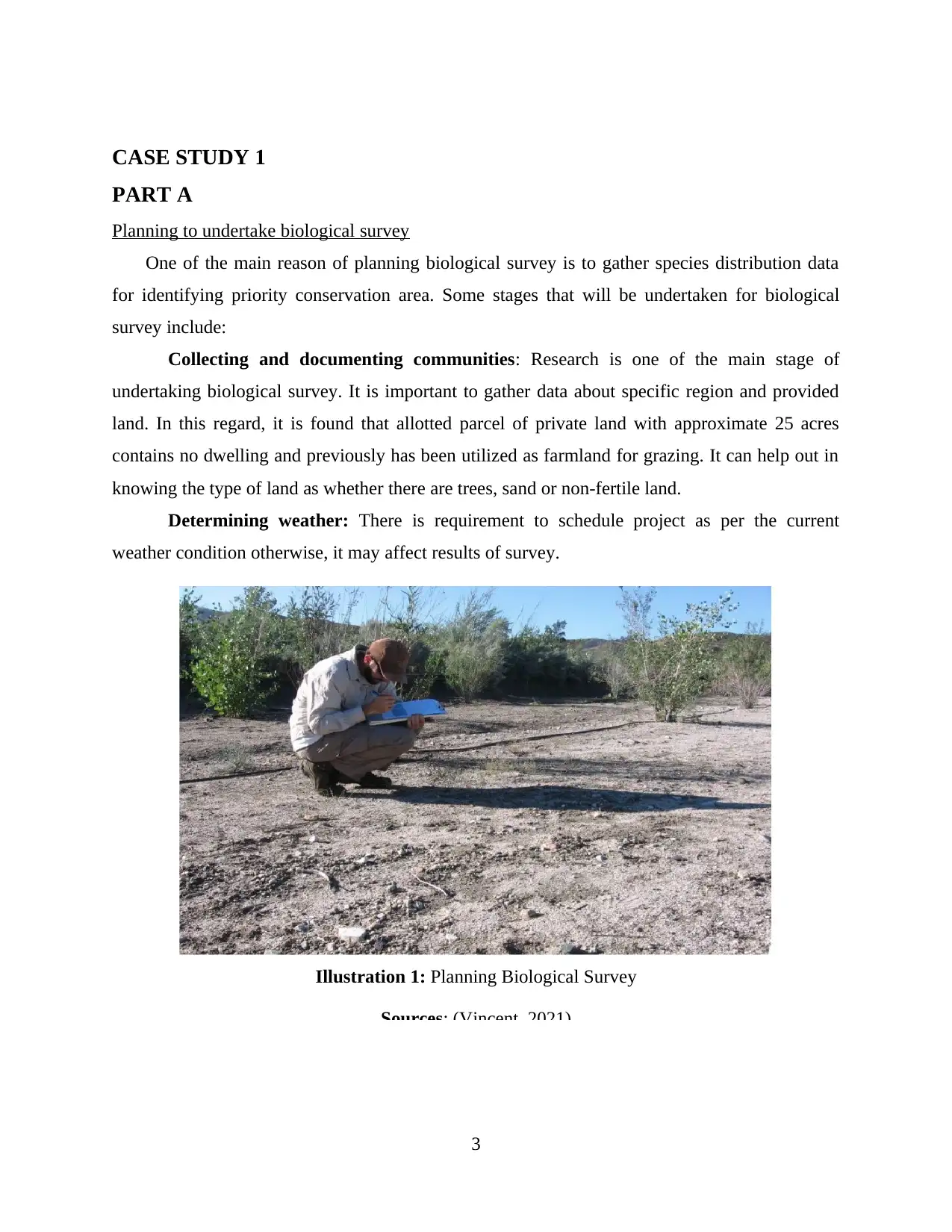
land. In this regard, it is found that allotted parcel of private land with approximate 25 acres
contains no dwelling and previously has been utilized as farmland for grazing. It can help out in
knowing the type of land as whether there are trees, sand or non-fertile land.
Determining weather: There is requirement to schedule project as per the current
weather condition otherwise, it may affect results of survey.
3
Illustration 1: Planning Biological Survey
Sources: (Vincent, 2021)
PART A
Planning to undertake biological survey
One of the main reason of planning biological survey is to gather species distribution data
for identifying priority conservation area. Some stages that will be undertaken for biological
survey include:
Collecting and documenting communities: Research is one of the main stage of
undertaking biological survey. It is important to gather data about specific region and provided
land. In this regard, it is found that allotted parcel of private land with approximate 25 acres
contains no dwelling and previously has been utilized as farmland for grazing. It can help out in
knowing the type of land as whether there are trees, sand or non-fertile land.
Determining weather: There is requirement to schedule project as per the current
weather condition otherwise, it may affect results of survey.
3
Illustration 1: Planning Biological Survey
Sources: (Vincent, 2021)
⊘ This is a preview!⊘
Do you want full access?
Subscribe today to unlock all pages.

Trusted by 1+ million students worldwide
Contacting biologists: For successful biological survey and getting accurate information,
it is important to contact biologists. They can help out in identifying about resources that may be
present on. They can help out in knowing vegetation communities and soil type. Biologists have
in-depth knowledge, so they can provide initial assessment of the potential resources that may
affect the overall project and help device a plan.
Determining the type of survey: There are different types of survey and as per the
available resources and the type of project, it is important to select appropriate survey type.
Specific vegetation communities as well as other environmental factors will be considered.
Establishing infrastructure: After completing all stages, it is important to establish
infrastructure and monitoring effects of long term ecological change on Western Australia's
biodiversity. It can help out in knowing effectiveness of survey and areas where we need to make
improvements for doing survey in a successful manner (Li, Yang and Xu, 2019).
Computer mapping will be done for protecting data and gathering accurate information.
PART B
Reporting tools for completion of activity and their importance in success of activities
It is important to report this plan in order to make it in a effective manner and protecting
against lawsuit. Some reporting tools that will be required to consider while making a plan of
biological survey such as:
Permission: As this is a parcel of private land and for surveying, we will require taking
permission of land owner. For conducting biological survey, it is important for an individual to
have formal educational background in local floral and faunal relationships and sufficient field
experience (Tolonen and et.al., 2018). As it is focused survey and there is requirement to take
permission and surveying as per the biological guidelines.
Communicating with resources agencies to gain approval: For surveying all different
species, covered on land, it is important to take approval from resource agencies. Regulatory
agencies may appreciate and can help out us by providing guidelines and information by which
survey can be conducted in an effective manner.
There is need to support decision-making on referral applications, assessments as well as
approvals under the environment protection and biodiversity protection act 1999. These
guidelines outline information requirements at the time of survey such as: listed marine
species, threatened species, migratory species and invasive species (Simon, 2020).
4
it is important to contact biologists. They can help out in identifying about resources that may be
present on. They can help out in knowing vegetation communities and soil type. Biologists have
in-depth knowledge, so they can provide initial assessment of the potential resources that may
affect the overall project and help device a plan.
Determining the type of survey: There are different types of survey and as per the
available resources and the type of project, it is important to select appropriate survey type.
Specific vegetation communities as well as other environmental factors will be considered.
Establishing infrastructure: After completing all stages, it is important to establish
infrastructure and monitoring effects of long term ecological change on Western Australia's
biodiversity. It can help out in knowing effectiveness of survey and areas where we need to make
improvements for doing survey in a successful manner (Li, Yang and Xu, 2019).
Computer mapping will be done for protecting data and gathering accurate information.
PART B
Reporting tools for completion of activity and their importance in success of activities
It is important to report this plan in order to make it in a effective manner and protecting
against lawsuit. Some reporting tools that will be required to consider while making a plan of
biological survey such as:
Permission: As this is a parcel of private land and for surveying, we will require taking
permission of land owner. For conducting biological survey, it is important for an individual to
have formal educational background in local floral and faunal relationships and sufficient field
experience (Tolonen and et.al., 2018). As it is focused survey and there is requirement to take
permission and surveying as per the biological guidelines.
Communicating with resources agencies to gain approval: For surveying all different
species, covered on land, it is important to take approval from resource agencies. Regulatory
agencies may appreciate and can help out us by providing guidelines and information by which
survey can be conducted in an effective manner.
There is need to support decision-making on referral applications, assessments as well as
approvals under the environment protection and biodiversity protection act 1999. These
guidelines outline information requirements at the time of survey such as: listed marine
species, threatened species, migratory species and invasive species (Simon, 2020).
4
Paraphrase This Document
Need a fresh take? Get an instant paraphrase of this document with our AI Paraphraser
The report that will be prepared should be presented to land owners and state agricultural
departments. This report should mention the frequency of wildfire that may affect proposed
development sites and length of time since its last used. This report will contain a map that
shows biological features of site while taking approval and knowing guidelines that need to be
followed. It will help out land owners and department of agriculture in knowing biological
impacts of proposed development as well as identifying difference between temporary and
permanent impact.
PART C
Biological survey area and methods to approach this activity
On the basis of above data and mapping it is found that this private land contains no
dwelling and land owner has used it as farmland for grazing. There were some different sizes and
shapes of trees, open expanse areas of grass. There was a clear ground with a gully to be a mix of
native re vegetation naturally occurring. Focused survey approach has been selected for knowing
all about of this land and knowing about different species of plant (Lu, Xue, Xia and Zhang,
2018). On the basis of this, it can be said that there is requirement to follow all guidelines and
use gloves as there are chances of having noxious plant species and it may affect other local
plants and wild life as well.
5
departments. This report should mention the frequency of wildfire that may affect proposed
development sites and length of time since its last used. This report will contain a map that
shows biological features of site while taking approval and knowing guidelines that need to be
followed. It will help out land owners and department of agriculture in knowing biological
impacts of proposed development as well as identifying difference between temporary and
permanent impact.
PART C
Biological survey area and methods to approach this activity
On the basis of above data and mapping it is found that this private land contains no
dwelling and land owner has used it as farmland for grazing. There were some different sizes and
shapes of trees, open expanse areas of grass. There was a clear ground with a gully to be a mix of
native re vegetation naturally occurring. Focused survey approach has been selected for knowing
all about of this land and knowing about different species of plant (Lu, Xue, Xia and Zhang,
2018). On the basis of this, it can be said that there is requirement to follow all guidelines and
use gloves as there are chances of having noxious plant species and it may affect other local
plants and wild life as well.
5
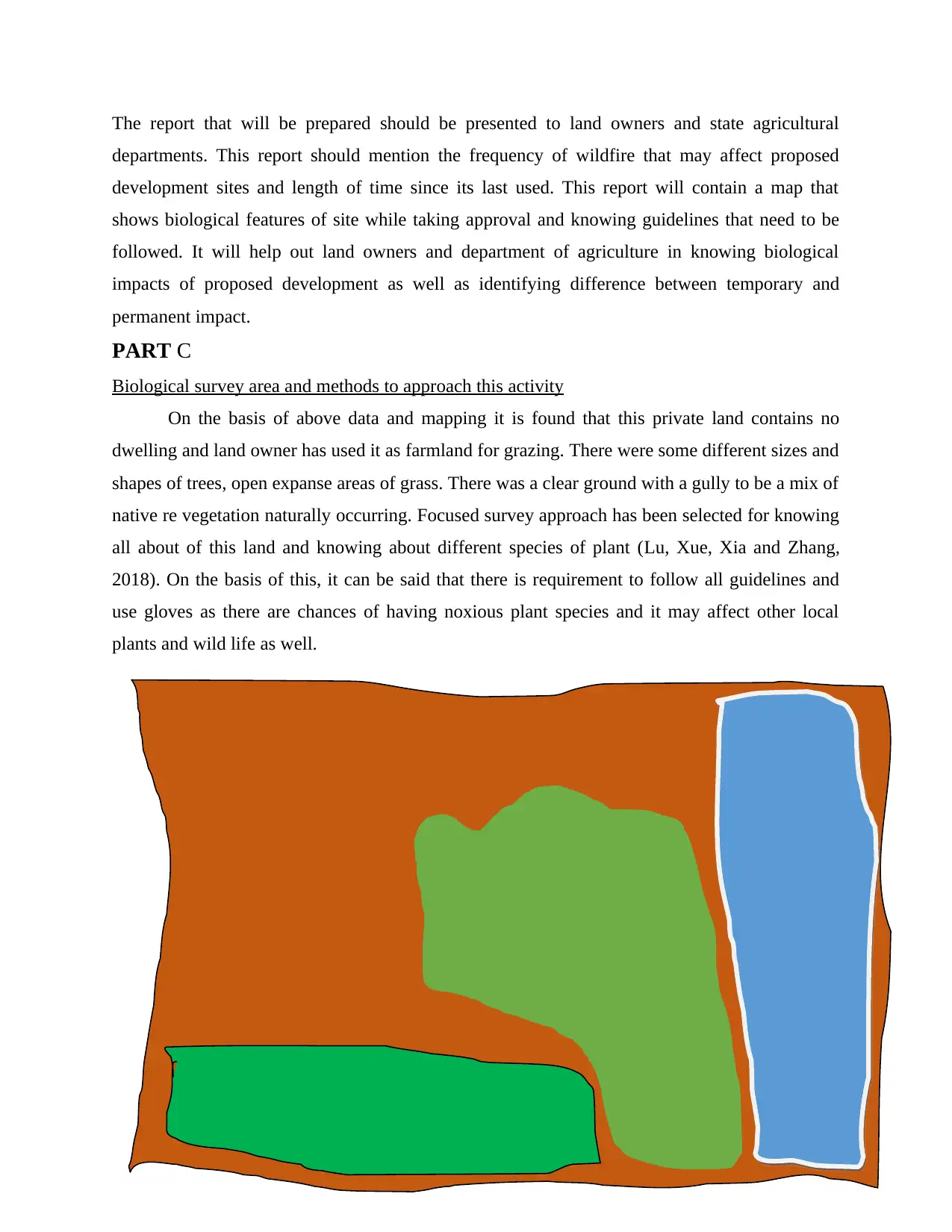
Above created map of 25-acre land, it can be said that most of the part is covered with small
trees, big trees and water. Other part is covered with sand and it is not used for many years and it
required to be fertile. Light green area in above map represent small trees, dark green area
represents big trees.
Some problem mapping areas that need to be identified include: non-native annual
grasslands as it contains annual grass species but not limited to, bromes, wid oat and fescues.
Other disturbed areas include: those lands that can commonly be defined as ruder-al habitat. This
type of habitat develops on sites with heavily compacted soils and to the great level of
disturbance such as: grading. On the basis of allocated land and region, it can be said that it is
Ruderal habitat and disturbed area (Kahila-Tani, Kytta and Geertman, 2019). It can help out in
knowing and measuring efficacy of survey methods and it will be expressed as the number of
species recorded per sampling unit efforts. Grad sect and focused survey method proved to be
efficient as the habitat specific survey. The reason of selecting this method is to make this survey
cost effective as well as swift representative sample of regional fauna.
Part D
Findings and recommendations
From the identification and evaluation of multiple aspects of biological survey of
property it’s been identified that utilization of scientific and experts’ advices has power to
develop effectiveness and efficiency in proper sustainability. Because this land influence from
grass which provide harm to other plants or tree as well. And from the research it been identified
that dangerous plant harmful for other plans which require presentation approach which develop
safety and effective ways for control expansion in invasive species. And it been also evaluated
from the study of biological survey evaluation when it’s clear that this and get affects from
germs, weather or many more reasons, so one major things important to consider that take help
from experts, scientific or technology approaches (Reaser and et.al., 2020). It's been also
determined from the above study that noxious pest species plan badly impacts on other plants
and it mainly determines from the experts when develop survey process. Because negative aspect
identification is essential term for crops and plants development.
This study makes more clarity that education and training distribution to target people
which mainly prefer to do farm activity they do have duty to evaluate and apply practices to
control and manage risk or challenges like germs control, remove trees, crops or other land
6
trees, big trees and water. Other part is covered with sand and it is not used for many years and it
required to be fertile. Light green area in above map represent small trees, dark green area
represents big trees.
Some problem mapping areas that need to be identified include: non-native annual
grasslands as it contains annual grass species but not limited to, bromes, wid oat and fescues.
Other disturbed areas include: those lands that can commonly be defined as ruder-al habitat. This
type of habitat develops on sites with heavily compacted soils and to the great level of
disturbance such as: grading. On the basis of allocated land and region, it can be said that it is
Ruderal habitat and disturbed area (Kahila-Tani, Kytta and Geertman, 2019). It can help out in
knowing and measuring efficacy of survey methods and it will be expressed as the number of
species recorded per sampling unit efforts. Grad sect and focused survey method proved to be
efficient as the habitat specific survey. The reason of selecting this method is to make this survey
cost effective as well as swift representative sample of regional fauna.
Part D
Findings and recommendations
From the identification and evaluation of multiple aspects of biological survey of
property it’s been identified that utilization of scientific and experts’ advices has power to
develop effectiveness and efficiency in proper sustainability. Because this land influence from
grass which provide harm to other plants or tree as well. And from the research it been identified
that dangerous plant harmful for other plans which require presentation approach which develop
safety and effective ways for control expansion in invasive species. And it been also evaluated
from the study of biological survey evaluation when it’s clear that this and get affects from
germs, weather or many more reasons, so one major things important to consider that take help
from experts, scientific or technology approaches (Reaser and et.al., 2020). It's been also
determined from the above study that noxious pest species plan badly impacts on other plants
and it mainly determines from the experts when develop survey process. Because negative aspect
identification is essential term for crops and plants development.
This study makes more clarity that education and training distribution to target people
which mainly prefer to do farm activity they do have duty to evaluate and apply practices to
control and manage risk or challenges like germs control, remove trees, crops or other land
6
⊘ This is a preview!⊘
Do you want full access?
Subscribe today to unlock all pages.
Trusted by 1+ million students worldwide
which effects on and effectiveness and other plants. Without proper identification and evaluation
of this term badly impacts on sustainability of land. This study develops guidance that biological
survey for property require for proper identification of land so that when property own decide to
develop crops they do have clear idea that this specific problem they do have to face in farming
process or activity. Therefore, it’s been identified that communication channels, anticipating
obstacles, ways of connecting with the media is useful approach for information distribution
towards with the control expansion on noxious pest species with experts’ involvement.
CASE STUDY 2
Actions that need to be taken to eradicate noxious pest species
While biological survey, it is found that on the parcel of private land there were no
dangerous plant species as it is thought that noxious pest was previously eradicated but it was not
eradicated. After observation, it is found that there was noxious plant species that possess a
significant threat to native flora and significant hazard to wildlife. In regard to noxious plant
species, it can be said that these plants are considered as dangerous or detrimental to the health as
well as welfare of diverse wildlife (Bellettini and et.al., 2018). This plant species is poisonous to
livestock, carry diseases, impact management of agricultural system in a negative manner and
aggressively invade native plant communities as well as agricultural crops.
Plant species that are considered to be noxious throughout the state of Wyoming can be
identified on the list of State designated weeds and pests. Such species or plants have an ability
to cause problems for natural resources, wildlife, agriculture, navigation and public health. In
addition, it is also stated from secondary data that this plant species does not allow local species
to grow and wildlife to move through. Some common and main types of noxious and invasive
species of plant include: purple loosestrife, Japanese honeysuckle, English Ivy, Kudzu and
others. So, in this regard, it can be said that it is important for us to take an effective action to
decrease negative impacts of this species and eradicated this plant species (Burgos-Rodríguez
and Burgiel, 2020).
Some actions that need to be taken immediately to get rid of noxious plant include:
Prevention: Early detection and rapid response is one of the safest and effective ways of
eradication of invasive species. There are number of preventive methods that can be used to
manage such species and protecting local plants and wildlife from getting affected with these
species. Biological control is one of the best ways as it is a process of manipulation of natural
7
of this term badly impacts on sustainability of land. This study develops guidance that biological
survey for property require for proper identification of land so that when property own decide to
develop crops they do have clear idea that this specific problem they do have to face in farming
process or activity. Therefore, it’s been identified that communication channels, anticipating
obstacles, ways of connecting with the media is useful approach for information distribution
towards with the control expansion on noxious pest species with experts’ involvement.
CASE STUDY 2
Actions that need to be taken to eradicate noxious pest species
While biological survey, it is found that on the parcel of private land there were no
dangerous plant species as it is thought that noxious pest was previously eradicated but it was not
eradicated. After observation, it is found that there was noxious plant species that possess a
significant threat to native flora and significant hazard to wildlife. In regard to noxious plant
species, it can be said that these plants are considered as dangerous or detrimental to the health as
well as welfare of diverse wildlife (Bellettini and et.al., 2018). This plant species is poisonous to
livestock, carry diseases, impact management of agricultural system in a negative manner and
aggressively invade native plant communities as well as agricultural crops.
Plant species that are considered to be noxious throughout the state of Wyoming can be
identified on the list of State designated weeds and pests. Such species or plants have an ability
to cause problems for natural resources, wildlife, agriculture, navigation and public health. In
addition, it is also stated from secondary data that this plant species does not allow local species
to grow and wildlife to move through. Some common and main types of noxious and invasive
species of plant include: purple loosestrife, Japanese honeysuckle, English Ivy, Kudzu and
others. So, in this regard, it can be said that it is important for us to take an effective action to
decrease negative impacts of this species and eradicated this plant species (Burgos-Rodríguez
and Burgiel, 2020).
Some actions that need to be taken immediately to get rid of noxious plant include:
Prevention: Early detection and rapid response is one of the safest and effective ways of
eradication of invasive species. There are number of preventive methods that can be used to
manage such species and protecting local plants and wildlife from getting affected with these
species. Biological control is one of the best ways as it is a process of manipulation of natural
7
Paraphrase This Document
Need a fresh take? Get an instant paraphrase of this document with our AI Paraphraser
enemies by humans with the main aim of controlling pests. Along with this, chemical control can
also be done as in this type of control, pesticides, herbicides, insecticides and fungicides can be
done. There is some man made behaviour that can also help out in decreasing negative impacts
of noxious plants and this action can be known as cultural control (Osunkoya, Froese and Nicol,
2019). It is also important for people to use labels and following direction that is prescribed or
mentioned on chemical bottles for personal safety.
Mechanical control techniques: Along with chemical and biological control, people can
use mechanical control techniques such as: tilling, girdling, hoeing, moving and chopping.
Barriers to increase these crops can also be constructed by making use of machines and tools.
Pulling and digging: Along with this, there are number of physical control ways that can
also be used such as: digging, hand pulling, mulching, flooding and manual removal of nests. If
noxious plant species is in less quantity, then it needs to be removed as much of the root system
as possible. Small portion of such species have higher chances to regrow so, it is important to
make sure that these plant species have been removed from root. it can be done by removing
larger woody stems, by using weed wrench and rooting talon. These tools are available from
manufacturers and specially designed for removing the above ground portion of the plant and
entire root system (Synder, 2021). So, on the basis of this, it can be said that it is easiest ways of
eradication of noxious plant species if it is in less quantity.
Suffocation: By suffocating small seeding and herbaceous plants, noxious plant species
can be controlled from spreading. It is stated that thick UV stabilised plastic sheet can also be
used and it is important to use double or triple layers of this and securing plastic with stakes. It
needs to make sure that plastic extend at least 5 feet past the edge of i9nfestation of all sides and
then leaving plastic sheets for at least 2 years. This is one of the best technique that will take time
but will kill everything beneath the plastic. Invasive plans can be eradicated completely with this
technique.
Cultural control methods: In this type of action, people just need to manipulate their
habits to increase mortality of noxious as well as decreasing its rate of damage. By selecting and
using pest resistant crops, changing planting dates, making an effective crop and farming
planning, people can protect themselves and wildlife as well. Educating and making people
aware about invasive plants, their habits of spreading invasive. Public awareness programmes
and signage can be used for educating people. By using signs and other means that can make
8
also be done as in this type of control, pesticides, herbicides, insecticides and fungicides can be
done. There is some man made behaviour that can also help out in decreasing negative impacts
of noxious plants and this action can be known as cultural control (Osunkoya, Froese and Nicol,
2019). It is also important for people to use labels and following direction that is prescribed or
mentioned on chemical bottles for personal safety.
Mechanical control techniques: Along with chemical and biological control, people can
use mechanical control techniques such as: tilling, girdling, hoeing, moving and chopping.
Barriers to increase these crops can also be constructed by making use of machines and tools.
Pulling and digging: Along with this, there are number of physical control ways that can
also be used such as: digging, hand pulling, mulching, flooding and manual removal of nests. If
noxious plant species is in less quantity, then it needs to be removed as much of the root system
as possible. Small portion of such species have higher chances to regrow so, it is important to
make sure that these plant species have been removed from root. it can be done by removing
larger woody stems, by using weed wrench and rooting talon. These tools are available from
manufacturers and specially designed for removing the above ground portion of the plant and
entire root system (Synder, 2021). So, on the basis of this, it can be said that it is easiest ways of
eradication of noxious plant species if it is in less quantity.
Suffocation: By suffocating small seeding and herbaceous plants, noxious plant species
can be controlled from spreading. It is stated that thick UV stabilised plastic sheet can also be
used and it is important to use double or triple layers of this and securing plastic with stakes. It
needs to make sure that plastic extend at least 5 feet past the edge of i9nfestation of all sides and
then leaving plastic sheets for at least 2 years. This is one of the best technique that will take time
but will kill everything beneath the plastic. Invasive plans can be eradicated completely with this
technique.
Cultural control methods: In this type of action, people just need to manipulate their
habits to increase mortality of noxious as well as decreasing its rate of damage. By selecting and
using pest resistant crops, changing planting dates, making an effective crop and farming
planning, people can protect themselves and wildlife as well. Educating and making people
aware about invasive plants, their habits of spreading invasive. Public awareness programmes
and signage can be used for educating people. By using signs and other means that can make
8
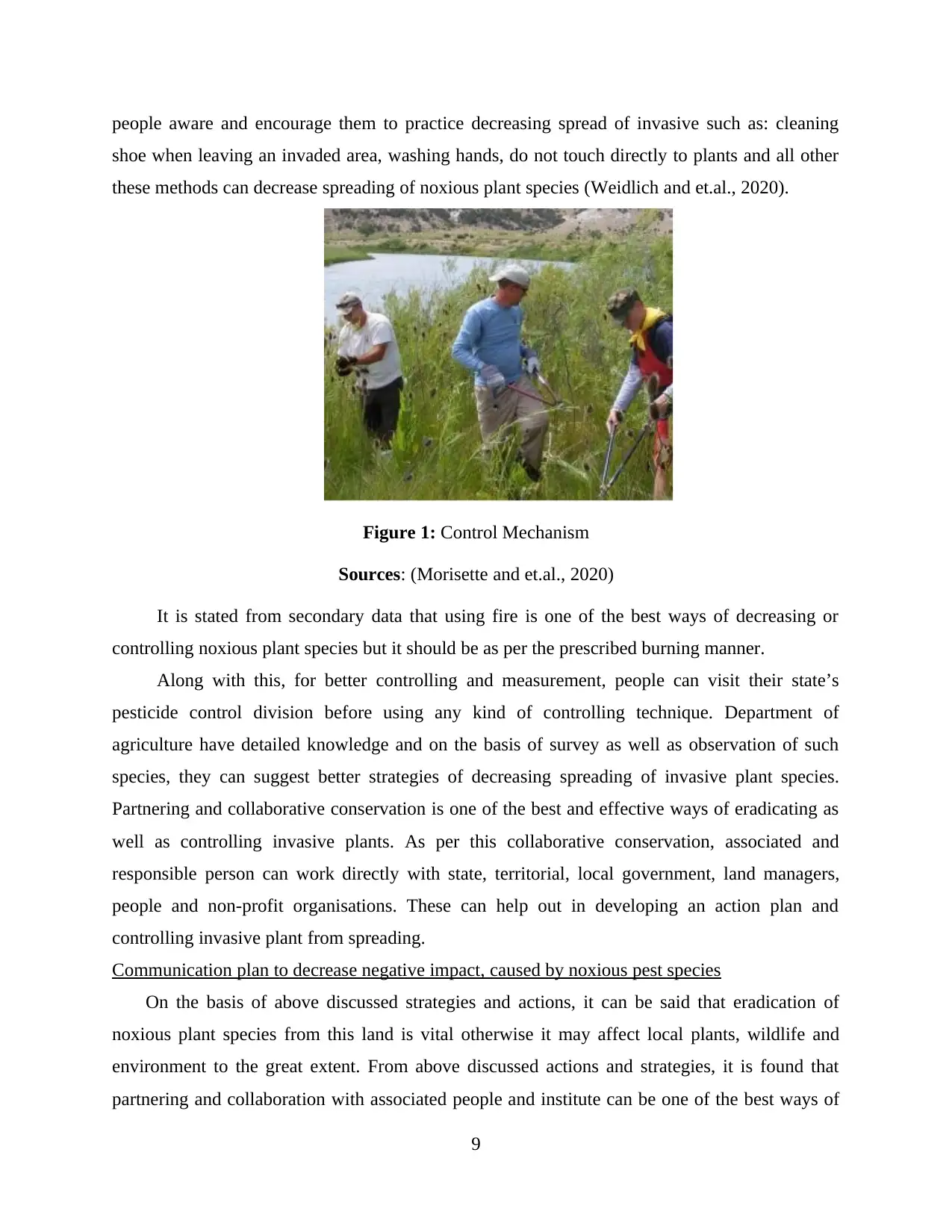
people aware and encourage them to practice decreasing spread of invasive such as: cleaning
shoe when leaving an invaded area, washing hands, do not touch directly to plants and all other
these methods can decrease spreading of noxious plant species (Weidlich and et.al., 2020).
Figure 1: Control Mechanism
Sources: (Morisette and et.al., 2020)
It is stated from secondary data that using fire is one of the best ways of decreasing or
controlling noxious plant species but it should be as per the prescribed burning manner.
Along with this, for better controlling and measurement, people can visit their state’s
pesticide control division before using any kind of controlling technique. Department of
agriculture have detailed knowledge and on the basis of survey as well as observation of such
species, they can suggest better strategies of decreasing spreading of invasive plant species.
Partnering and collaborative conservation is one of the best and effective ways of eradicating as
well as controlling invasive plants. As per this collaborative conservation, associated and
responsible person can work directly with state, territorial, local government, land managers,
people and non-profit organisations. These can help out in developing an action plan and
controlling invasive plant from spreading.
Communication plan to decrease negative impact, caused by noxious pest species
On the basis of above discussed strategies and actions, it can be said that eradication of
noxious plant species from this land is vital otherwise it may affect local plants, wildlife and
environment to the great extent. From above discussed actions and strategies, it is found that
partnering and collaboration with associated people and institute can be one of the best ways of
9
shoe when leaving an invaded area, washing hands, do not touch directly to plants and all other
these methods can decrease spreading of noxious plant species (Weidlich and et.al., 2020).
Figure 1: Control Mechanism
Sources: (Morisette and et.al., 2020)
It is stated from secondary data that using fire is one of the best ways of decreasing or
controlling noxious plant species but it should be as per the prescribed burning manner.
Along with this, for better controlling and measurement, people can visit their state’s
pesticide control division before using any kind of controlling technique. Department of
agriculture have detailed knowledge and on the basis of survey as well as observation of such
species, they can suggest better strategies of decreasing spreading of invasive plant species.
Partnering and collaborative conservation is one of the best and effective ways of eradicating as
well as controlling invasive plants. As per this collaborative conservation, associated and
responsible person can work directly with state, territorial, local government, land managers,
people and non-profit organisations. These can help out in developing an action plan and
controlling invasive plant from spreading.
Communication plan to decrease negative impact, caused by noxious pest species
On the basis of above discussed strategies and actions, it can be said that eradication of
noxious plant species from this land is vital otherwise it may affect local plants, wildlife and
environment to the great extent. From above discussed actions and strategies, it is found that
partnering and collaboration with associated people and institute can be one of the best ways of
9
⊘ This is a preview!⊘
Do you want full access?
Subscribe today to unlock all pages.
Trusted by 1+ million students worldwide
decreasing spreading of noxious plant species (Foster, 2018). For this purpose, people will need
to communicate with them and encourage them to engage in action plan. Communication plan
for engaging stakeholders and partners in implementation of action plan include:
Purpose: Educating people about issue that wildlife and people may face of this region
because of increasing rate of noxious plant species and encouraging them to engage in
preventing activities.
Target people: Target people to whom we want to engage in an action plan for controlling
invasive plant species include: territorial, land managers, non-profit organisations, people from
department of agriculture of this state and local people of this region. It is believed that
department of agriculture have in depth knowledge and they can help out to the great extent in
eradication of noxious plant species from this land and region in a systematic and effective
manner (Ma, Clarke and Church, 2018).
Key message: To implement an action plan for decreasing spreading of noxious plant
species and protecting public, environment, wildlife and local people from noxious plan species
is the key message of this communication plan (Mabon, 2020). For communicating this message,
English and common language will be used as Australian understand English language. So, it
would be better for making them understand about purpose and key message of this plan.
Key resources: Preparing a list of resources is also important as it can enable people in
implementation of action and communication plan successfully. Financial resources, human
resource including technical staff, technical software will main resources for implementation of
communication plan (Graham and et.al., 2019).
Communicational channels: Deciding and selection of communicational channel is one of
the main key steps of communication plan. It is the main key of success of this plan. It is
important to select channel by keeping target people in mind. All target people of this plan are
educated so, for this reason, brochures, newsletters and internet sites can be used. Nowadays,
people spend a lot of time on internet sites and they get information from these sites. they find
easier to collect and read information from these sites so, for this reason, Facebook, Twitter and
YouTube will be used as main internet sites (Ramasubramanian and Albrecht, 2018). By posting
key message with in detailed summary of action plan on these sites, stakeholders and target
people can be attracted and encouraged for participating in action plan.\
10
to communicate with them and encourage them to engage in action plan. Communication plan
for engaging stakeholders and partners in implementation of action plan include:
Purpose: Educating people about issue that wildlife and people may face of this region
because of increasing rate of noxious plant species and encouraging them to engage in
preventing activities.
Target people: Target people to whom we want to engage in an action plan for controlling
invasive plant species include: territorial, land managers, non-profit organisations, people from
department of agriculture of this state and local people of this region. It is believed that
department of agriculture have in depth knowledge and they can help out to the great extent in
eradication of noxious plant species from this land and region in a systematic and effective
manner (Ma, Clarke and Church, 2018).
Key message: To implement an action plan for decreasing spreading of noxious plant
species and protecting public, environment, wildlife and local people from noxious plan species
is the key message of this communication plan (Mabon, 2020). For communicating this message,
English and common language will be used as Australian understand English language. So, it
would be better for making them understand about purpose and key message of this plan.
Key resources: Preparing a list of resources is also important as it can enable people in
implementation of action and communication plan successfully. Financial resources, human
resource including technical staff, technical software will main resources for implementation of
communication plan (Graham and et.al., 2019).
Communicational channels: Deciding and selection of communicational channel is one of
the main key steps of communication plan. It is the main key of success of this plan. It is
important to select channel by keeping target people in mind. All target people of this plan are
educated so, for this reason, brochures, newsletters and internet sites can be used. Nowadays,
people spend a lot of time on internet sites and they get information from these sites. they find
easier to collect and read information from these sites so, for this reason, Facebook, Twitter and
YouTube will be used as main internet sites (Ramasubramanian and Albrecht, 2018). By posting
key message with in detailed summary of action plan on these sites, stakeholders and target
people can be attracted and encouraged for participating in action plan.\
10
Paraphrase This Document
Need a fresh take? Get an instant paraphrase of this document with our AI Paraphraser
Anticipating obstacles: Problems can occur while implementation of communication such
as: Skip mentioning main message on internet sites, forgetting to e-mail a press release and
others. Other than this, some external environmental factors can also lead barriers to successful
implementation of communication plan such as: environmental factors, technical factors and
others. Covid-19 and climate change are some main examples of external environmental factors
that can affect implementation of communication plan (Bird and Gísladóttir, 2020). So, making a
risk plan or risk register for protecting against these risks is also important. Risk register and
back plan will be prepared and key message will be delivered to target people in an effective
manner.
Ways of connecting with the media: Making an effective plan and identifying ways of
connecting with the media for spreading key message to target people and engaging them in an
action plan is also important. Improving relationship with individual media representatives is an
important part of communication plan. Personal contacts will be established and they will be
encouraged to help us out in reaching with main target. For this purpose, they will be made
aware about reasons of eradication of noxious plant species and key reasons of communicating
with target people. When media knows the reason then they are more likely to help out and
media plays a vital role in implementation of communication plan as well as reaching target
people.
Creation of an action plan: After performing all stages and making an effective plan, it is
important to put all together into a plan that people can act on. By putting all details together
such as the key message, target people, what people can afford and all, it is important to design
message and getting everything that is required in place to start communication effort (Firestone
and et.al., 2020).
Evaluation: It is important to measure effectiveness of an action plan as it enables us in
taking appropriate actions. By knowing as whether we are going on the right track or not, we can
make changes accordingly. The main reason of evaluation and monitoring is to protect from
failure and risks as well as implementing plan in a successful manner. Tracking open rates,
clicking rates on social media sites can be used as an effective key performance indicator for
communication plan. We can make changes and develop strategies accordingly.
So, on the basis of above discussed stages of communication plan, it can be said that target
people can be encouraged for participating in an action plan. It will help us out in accomplishing
11
as: Skip mentioning main message on internet sites, forgetting to e-mail a press release and
others. Other than this, some external environmental factors can also lead barriers to successful
implementation of communication plan such as: environmental factors, technical factors and
others. Covid-19 and climate change are some main examples of external environmental factors
that can affect implementation of communication plan (Bird and Gísladóttir, 2020). So, making a
risk plan or risk register for protecting against these risks is also important. Risk register and
back plan will be prepared and key message will be delivered to target people in an effective
manner.
Ways of connecting with the media: Making an effective plan and identifying ways of
connecting with the media for spreading key message to target people and engaging them in an
action plan is also important. Improving relationship with individual media representatives is an
important part of communication plan. Personal contacts will be established and they will be
encouraged to help us out in reaching with main target. For this purpose, they will be made
aware about reasons of eradication of noxious plant species and key reasons of communicating
with target people. When media knows the reason then they are more likely to help out and
media plays a vital role in implementation of communication plan as well as reaching target
people.
Creation of an action plan: After performing all stages and making an effective plan, it is
important to put all together into a plan that people can act on. By putting all details together
such as the key message, target people, what people can afford and all, it is important to design
message and getting everything that is required in place to start communication effort (Firestone
and et.al., 2020).
Evaluation: It is important to measure effectiveness of an action plan as it enables us in
taking appropriate actions. By knowing as whether we are going on the right track or not, we can
make changes accordingly. The main reason of evaluation and monitoring is to protect from
failure and risks as well as implementing plan in a successful manner. Tracking open rates,
clicking rates on social media sites can be used as an effective key performance indicator for
communication plan. We can make changes and develop strategies accordingly.
So, on the basis of above discussed stages of communication plan, it can be said that target
people can be encouraged for participating in an action plan. It will help us out in accomplishing
11
them main aim of eradicating and controlling spreading of noxious plant species (Markosyan and
Ghahramanyan, 2019). It can help out in protecting or preventing local people, wildlife of that
region and environment as well. Overall, it can be said that survey and observation plays a vital
role as it makes us able in knowing areas of improvement. On the basis of identified areas, we
can make appropriate changes and accomplish the main aim of developing plan. By engaging
target people, we can make easier in implementing communication plan. Lastly, we can take
feedbacks from general people and can ask some suggestions by which we can implement this
plan successfully and can take specific outcomes.
12
Ghahramanyan, 2019). It can help out in protecting or preventing local people, wildlife of that
region and environment as well. Overall, it can be said that survey and observation plays a vital
role as it makes us able in knowing areas of improvement. On the basis of identified areas, we
can make appropriate changes and accomplish the main aim of developing plan. By engaging
target people, we can make easier in implementing communication plan. Lastly, we can take
feedbacks from general people and can ask some suggestions by which we can implement this
plan successfully and can take specific outcomes.
12
⊘ This is a preview!⊘
Do you want full access?
Subscribe today to unlock all pages.
Trusted by 1+ million students worldwide

1 out of 18


Related Documents


Your All-in-One AI-Powered Toolkit for Academic Success.
+13062052269
info@desklib.com
Available 24*7 on WhatsApp / Email
![[object Object]](/_next/static/media/star-bottom.7253800d.svg)
Unlock your academic potential
Copyright © 2020–2026 A2Z Services. All Rights Reserved. Developed and managed by ZUCOL.