Biology Report: Psychosocial Predictors of Immune Response After BMT
VerifiedAdded on 2022/10/11
|6
|1214
|17
Report
AI Summary
This biology report examines the process of resetting the immune system following a bone marrow transplant (BMT). It focuses on the role of blood stem cells, T cells, and the implications of delayed T cell production on patient vulnerability to infections. The report analyzes a primary source, a clinical study titled "Psychosocial Predictors of Immune Response Following Bone Marrow Transplantation," which investigates the correlation between psychosocial variables and immunological outcomes, including the time of engraftment and the number of infections. The study's methodology, results, and discussion are summarized, highlighting the importance of coping strategies and other psychosocial factors. A secondary source, an article from the New York Times, is also discussed, contrasting its general overview with the structured approach of the primary source. The report emphasizes the importance of understanding immune system recovery and psychosocial influences in BMT patients, as well as the limitations and strengths of the sources used.
Running head: BIOLOGY
BIOLOGY
Name of Student
Name of University
Author’s Note
BIOLOGY
Name of Student
Name of University
Author’s Note
Paraphrase This Document
Need a fresh take? Get an instant paraphrase of this document with our AI Paraphraser

1BIOLOGY
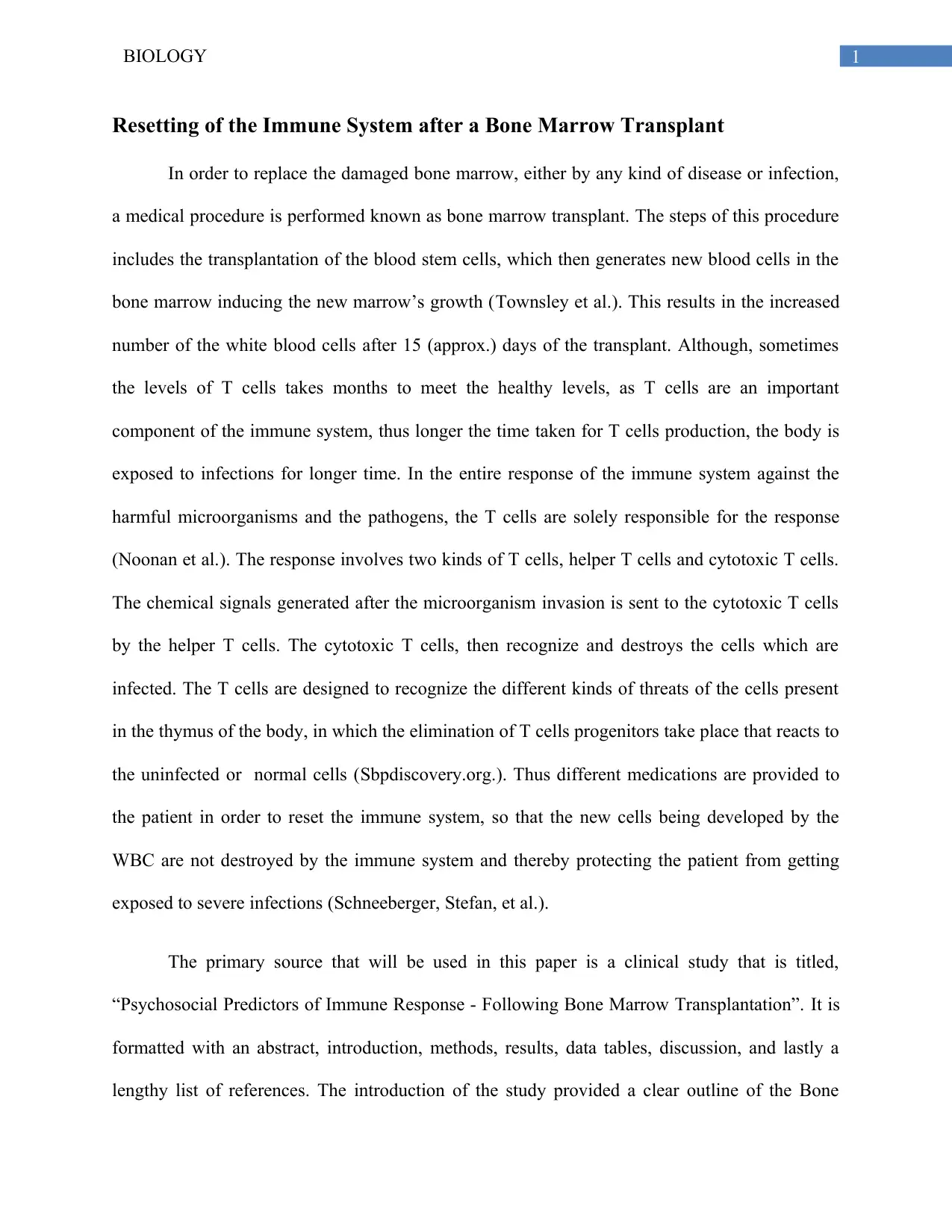
Resetting of the Immune System after a Bone Marrow Transplant
In order to replace the damaged bone marrow, either by any kind of disease or infection,
a medical procedure is performed known as bone marrow transplant. The steps of this procedure
includes the transplantation of the blood stem cells, which then generates new blood cells in the
bone marrow inducing the new marrow’s growth (Townsley et al.). This results in the increased
number of the white blood cells after 15 (approx.) days of the transplant. Although, sometimes
the levels of T cells takes months to meet the healthy levels, as T cells are an important
component of the immune system, thus longer the time taken for T cells production, the body is
exposed to infections for longer time. In the entire response of the immune system against the
harmful microorganisms and the pathogens, the T cells are solely responsible for the response
(Noonan et al.). The response involves two kinds of T cells, helper T cells and cytotoxic T cells.
The chemical signals generated after the microorganism invasion is sent to the cytotoxic T cells
by the helper T cells. The cytotoxic T cells, then recognize and destroys the cells which are
infected. The T cells are designed to recognize the different kinds of threats of the cells present
in the thymus of the body, in which the elimination of T cells progenitors take place that reacts to
the uninfected or normal cells (Sbpdiscovery.org.). Thus different medications are provided to
the patient in order to reset the immune system, so that the new cells being developed by the
WBC are not destroyed by the immune system and thereby protecting the patient from getting
exposed to severe infections (Schneeberger, Stefan, et al.).
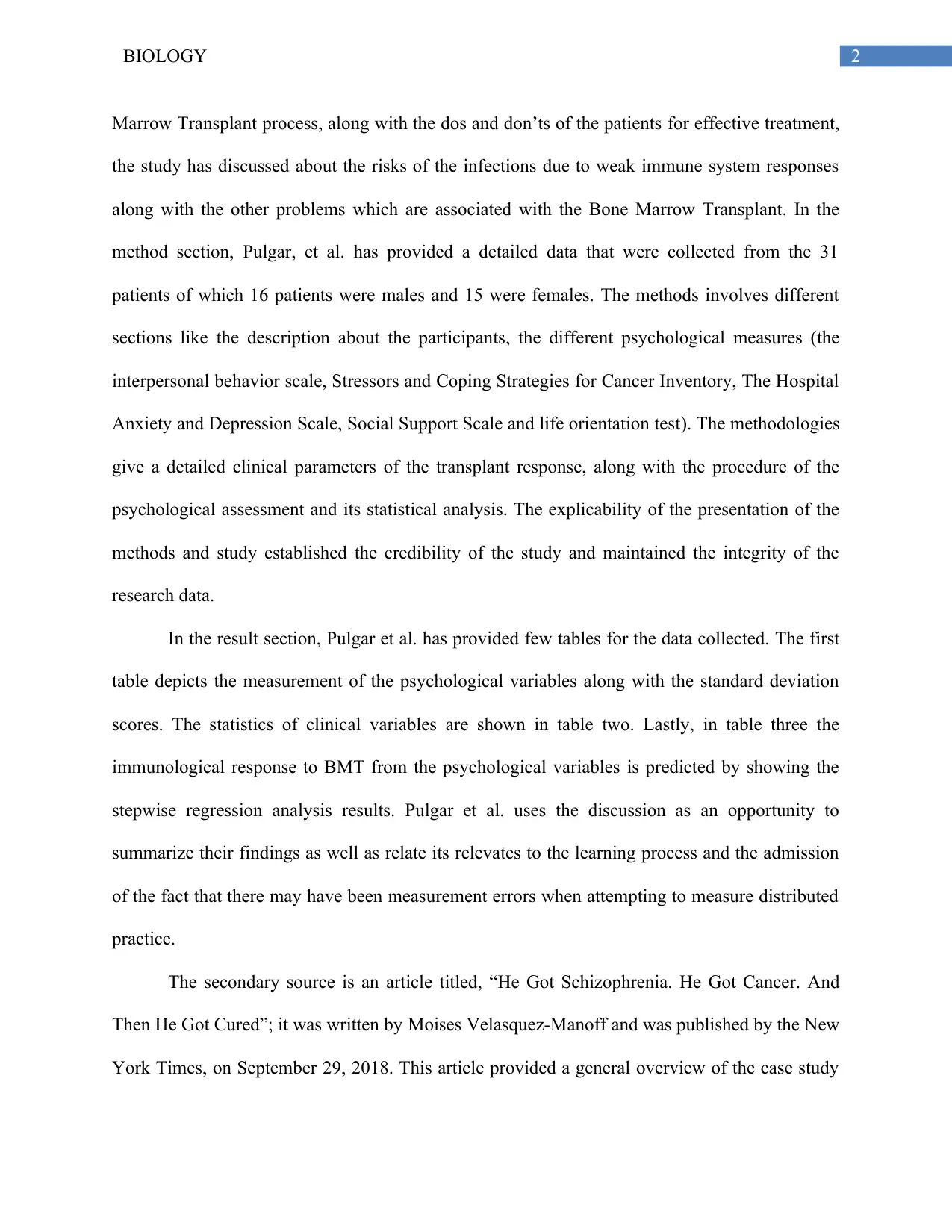
The primary source that will be used in this paper is a clinical study that is titled,
“Psychosocial Predictors of Immune Response - Following Bone Marrow Transplantation”. It is
formatted with an abstract, introduction, methods, results, data tables, discussion, and lastly a
lengthy list of references. The introduction of the study provided a clear outline of the Bone
Resetting of the Immune System after a Bone Marrow Transplant
In order to replace the damaged bone marrow, either by any kind of disease or infection,
a medical procedure is performed known as bone marrow transplant. The steps of this procedure
includes the transplantation of the blood stem cells, which then generates new blood cells in the
bone marrow inducing the new marrow’s growth (Townsley et al.). This results in the increased
number of the white blood cells after 15 (approx.) days of the transplant. Although, sometimes
the levels of T cells takes months to meet the healthy levels, as T cells are an important
component of the immune system, thus longer the time taken for T cells production, the body is
exposed to infections for longer time. In the entire response of the immune system against the
harmful microorganisms and the pathogens, the T cells are solely responsible for the response
(Noonan et al.). The response involves two kinds of T cells, helper T cells and cytotoxic T cells.
The chemical signals generated after the microorganism invasion is sent to the cytotoxic T cells
by the helper T cells. The cytotoxic T cells, then recognize and destroys the cells which are
infected. The T cells are designed to recognize the different kinds of threats of the cells present
in the thymus of the body, in which the elimination of T cells progenitors take place that reacts to
the uninfected or normal cells (Sbpdiscovery.org.). Thus different medications are provided to
the patient in order to reset the immune system, so that the new cells being developed by the
WBC are not destroyed by the immune system and thereby protecting the patient from getting
exposed to severe infections (Schneeberger, Stefan, et al.).
The primary source that will be used in this paper is a clinical study that is titled,
“Psychosocial Predictors of Immune Response - Following Bone Marrow Transplantation”. It is
formatted with an abstract, introduction, methods, results, data tables, discussion, and lastly a
lengthy list of references. The introduction of the study provided a clear outline of the Bone

2BIOLOGY
Marrow Transplant process, along with the dos and don’ts of the patients for effective treatment,
the study has discussed about the risks of the infections due to weak immune system responses
along with the other problems which are associated with the Bone Marrow Transplant. In the
method section, Pulgar, et al. has provided a detailed data that were collected from the 31
patients of which 16 patients were males and 15 were females. The methods involves different
sections like the description about the participants, the different psychological measures (the
interpersonal behavior scale, Stressors and Coping Strategies for Cancer Inventory, The Hospital
Anxiety and Depression Scale, Social Support Scale and life orientation test). The methodologies
give a detailed clinical parameters of the transplant response, along with the procedure of the
psychological assessment and its statistical analysis. The explicability of the presentation of the
methods and study established the credibility of the study and maintained the integrity of the
research data.
In the result section, Pulgar et al. has provided few tables for the data collected. The first
table depicts the measurement of the psychological variables along with the standard deviation
scores. The statistics of clinical variables are shown in table two. Lastly, in table three the
immunological response to BMT from the psychological variables is predicted by showing the
stepwise regression analysis results. Pulgar et al. uses the discussion as an opportunity to
summarize their findings as well as relate its relevates to the learning process and the admission
of the fact that there may have been measurement errors when attempting to measure distributed
practice.
The secondary source is an article titled, “He Got Schizophrenia. He Got Cancer. And
Then He Got Cured”; it was written by Moises Velasquez-Manoff and was published by the New
York Times, on September 29, 2018. This article provided a general overview of the case study
Marrow Transplant process, along with the dos and don’ts of the patients for effective treatment,
the study has discussed about the risks of the infections due to weak immune system responses
along with the other problems which are associated with the Bone Marrow Transplant. In the
method section, Pulgar, et al. has provided a detailed data that were collected from the 31
patients of which 16 patients were males and 15 were females. The methods involves different
sections like the description about the participants, the different psychological measures (the
interpersonal behavior scale, Stressors and Coping Strategies for Cancer Inventory, The Hospital
Anxiety and Depression Scale, Social Support Scale and life orientation test). The methodologies
give a detailed clinical parameters of the transplant response, along with the procedure of the
psychological assessment and its statistical analysis. The explicability of the presentation of the
methods and study established the credibility of the study and maintained the integrity of the
research data.
In the result section, Pulgar et al. has provided few tables for the data collected. The first
table depicts the measurement of the psychological variables along with the standard deviation
scores. The statistics of clinical variables are shown in table two. Lastly, in table three the
immunological response to BMT from the psychological variables is predicted by showing the
stepwise regression analysis results. Pulgar et al. uses the discussion as an opportunity to
summarize their findings as well as relate its relevates to the learning process and the admission
of the fact that there may have been measurement errors when attempting to measure distributed
practice.
The secondary source is an article titled, “He Got Schizophrenia. He Got Cancer. And
Then He Got Cured”; it was written by Moises Velasquez-Manoff and was published by the New
York Times, on September 29, 2018. This article provided a general overview of the case study
⊘ This is a preview!⊘
Do you want full access?
Subscribe today to unlock all pages.

Trusted by 1+ million students worldwide

3BIOLOGY
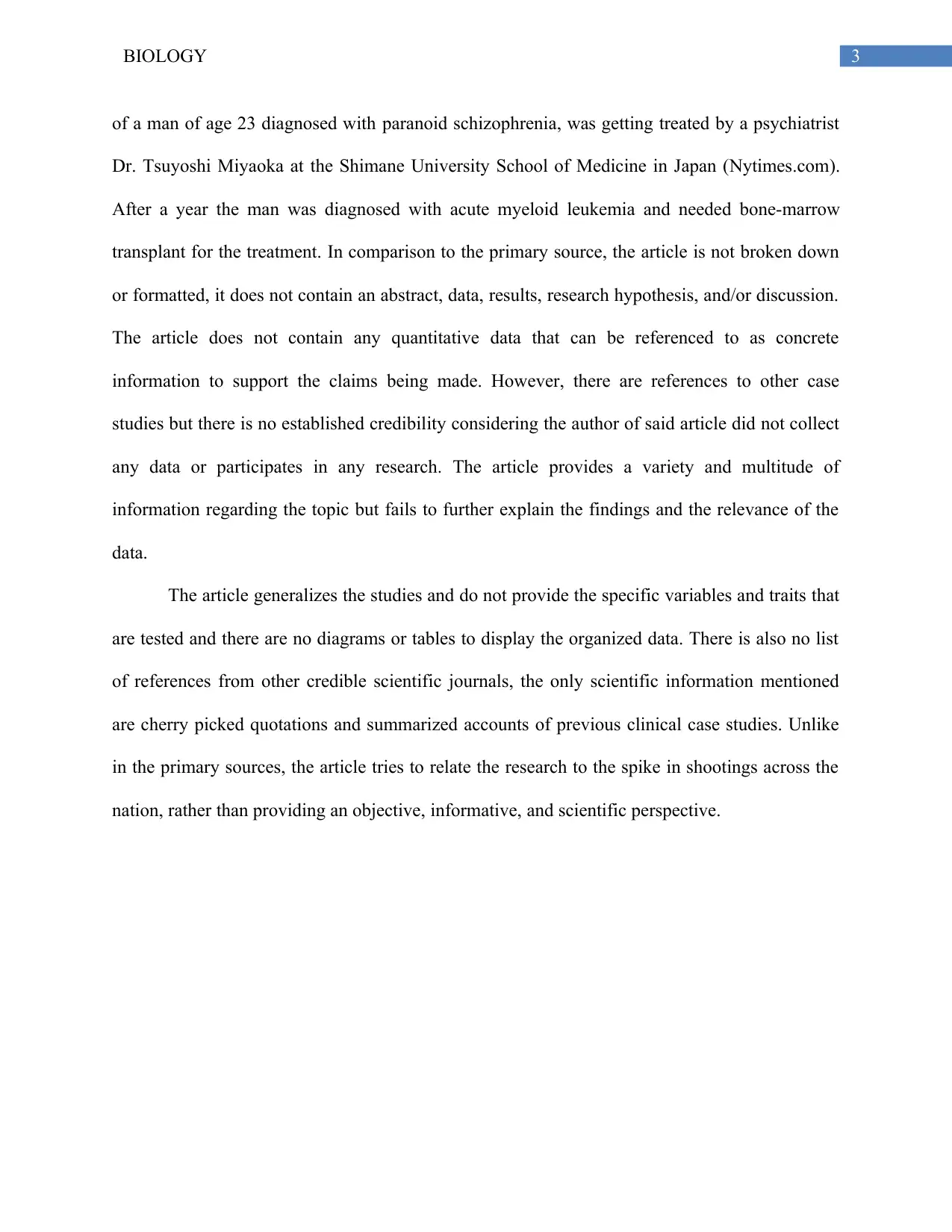
of a man of age 23 diagnosed with paranoid schizophrenia, was getting treated by a psychiatrist
Dr. Tsuyoshi Miyaoka at the Shimane University School of Medicine in Japan (Nytimes.com).
After a year the man was diagnosed with acute myeloid leukemia and needed bone-marrow
transplant for the treatment. In comparison to the primary source, the article is not broken down
or formatted, it does not contain an abstract, data, results, research hypothesis, and/or discussion.
The article does not contain any quantitative data that can be referenced to as concrete
information to support the claims being made. However, there are references to other case
studies but there is no established credibility considering the author of said article did not collect
any data or participates in any research. The article provides a variety and multitude of
information regarding the topic but fails to further explain the findings and the relevance of the
data.
The article generalizes the studies and do not provide the specific variables and traits that
are tested and there are no diagrams or tables to display the organized data. There is also no list
of references from other credible scientific journals, the only scientific information mentioned
are cherry picked quotations and summarized accounts of previous clinical case studies. Unlike
in the primary sources, the article tries to relate the research to the spike in shootings across the
nation, rather than providing an objective, informative, and scientific perspective.
of a man of age 23 diagnosed with paranoid schizophrenia, was getting treated by a psychiatrist
Dr. Tsuyoshi Miyaoka at the Shimane University School of Medicine in Japan (Nytimes.com).
After a year the man was diagnosed with acute myeloid leukemia and needed bone-marrow
transplant for the treatment. In comparison to the primary source, the article is not broken down
or formatted, it does not contain an abstract, data, results, research hypothesis, and/or discussion.
The article does not contain any quantitative data that can be referenced to as concrete
information to support the claims being made. However, there are references to other case
studies but there is no established credibility considering the author of said article did not collect
any data or participates in any research. The article provides a variety and multitude of
information regarding the topic but fails to further explain the findings and the relevance of the
data.
The article generalizes the studies and do not provide the specific variables and traits that
are tested and there are no diagrams or tables to display the organized data. There is also no list
of references from other credible scientific journals, the only scientific information mentioned
are cherry picked quotations and summarized accounts of previous clinical case studies. Unlike
in the primary sources, the article tries to relate the research to the spike in shootings across the
nation, rather than providing an objective, informative, and scientific perspective.
Paraphrase This Document
Need a fresh take? Get an instant paraphrase of this document with our AI Paraphraser

4BIOLOGY
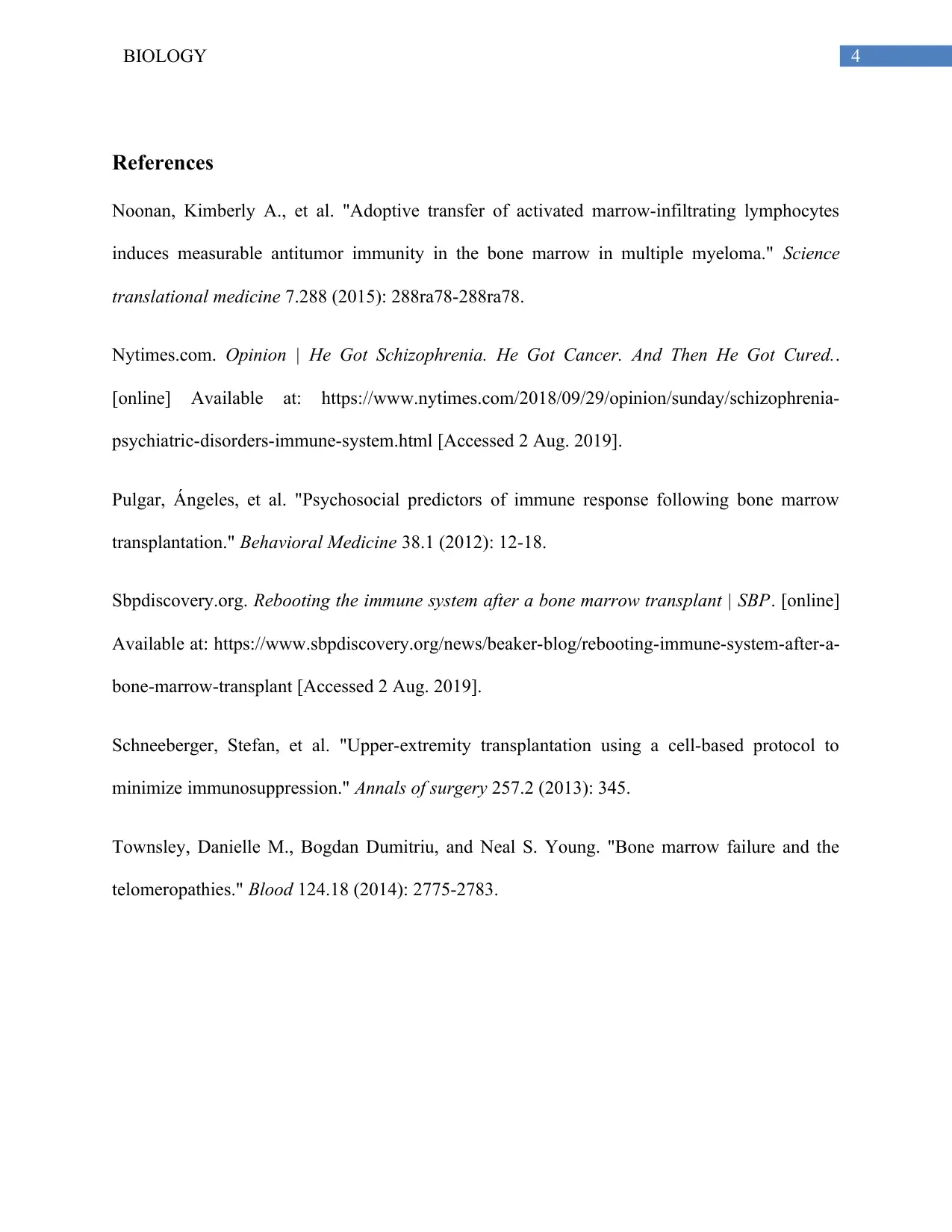
References
Noonan, Kimberly A., et al. "Adoptive transfer of activated marrow-infiltrating lymphocytes
induces measurable antitumor immunity in the bone marrow in multiple myeloma." Science
translational medicine 7.288 (2015): 288ra78-288ra78.
Nytimes.com. Opinion | He Got Schizophrenia. He Got Cancer. And Then He Got Cured..
[online] Available at: https://www.nytimes.com/2018/09/29/opinion/sunday/schizophrenia-
psychiatric-disorders-immune-system.html [Accessed 2 Aug. 2019].
Pulgar, Ángeles, et al. "Psychosocial predictors of immune response following bone marrow
transplantation." Behavioral Medicine 38.1 (2012): 12-18.
Sbpdiscovery.org. Rebooting the immune system after a bone marrow transplant | SBP. [online]
Available at: https://www.sbpdiscovery.org/news/beaker-blog/rebooting-immune-system-after-a-
bone-marrow-transplant [Accessed 2 Aug. 2019].
Schneeberger, Stefan, et al. "Upper-extremity transplantation using a cell-based protocol to
minimize immunosuppression." Annals of surgery 257.2 (2013): 345.
Townsley, Danielle M., Bogdan Dumitriu, and Neal S. Young. "Bone marrow failure and the
telomeropathies." Blood 124.18 (2014): 2775-2783.
References
Noonan, Kimberly A., et al. "Adoptive transfer of activated marrow-infiltrating lymphocytes
induces measurable antitumor immunity in the bone marrow in multiple myeloma." Science
translational medicine 7.288 (2015): 288ra78-288ra78.
Nytimes.com. Opinion | He Got Schizophrenia. He Got Cancer. And Then He Got Cured..
[online] Available at: https://www.nytimes.com/2018/09/29/opinion/sunday/schizophrenia-
psychiatric-disorders-immune-system.html [Accessed 2 Aug. 2019].
Pulgar, Ángeles, et al. "Psychosocial predictors of immune response following bone marrow
transplantation." Behavioral Medicine 38.1 (2012): 12-18.
Sbpdiscovery.org. Rebooting the immune system after a bone marrow transplant | SBP. [online]
Available at: https://www.sbpdiscovery.org/news/beaker-blog/rebooting-immune-system-after-a-
bone-marrow-transplant [Accessed 2 Aug. 2019].
Schneeberger, Stefan, et al. "Upper-extremity transplantation using a cell-based protocol to
minimize immunosuppression." Annals of surgery 257.2 (2013): 345.
Townsley, Danielle M., Bogdan Dumitriu, and Neal S. Young. "Bone marrow failure and the
telomeropathies." Blood 124.18 (2014): 2775-2783.

5BIOLOGY
⊘ This is a preview!⊘
Do you want full access?
Subscribe today to unlock all pages.

Trusted by 1+ million students worldwide
1 out of 6
Related Documents
Your All-in-One AI-Powered Toolkit for Academic Success.
+13062052269
info@desklib.com
Available 24*7 on WhatsApp / Email
Unlock your academic potential
Copyright © 2020–2025 A2Z Services. All Rights Reserved. Developed and managed by ZUCOL.