Biology Assignment: Analysis of Proteins and Water Soluble Vitamins

Verified

Added on  2021/09/15

|4
|451
|74
Homework Assignment
AI Summary
This assignment delves into the realms of proteins and water-soluble vitamins, providing a comprehensive overview of their structures, functions, and associated deficiencies. The assignment begins by examining protein structure, including primary, secondary, tertiary, and quaternary levels, and then explores the roles of proteins in the body, such as their involvement in immune responses, enzymatic activities, and transport mechanisms. Furthermore, the assignment discusses water-soluble vitamins, specifically focusing on vitamin C and the B-complex group, detailing their sources, functions, and the consequences of both deficiencies and excesses. The document references key scientific articles to support the information presented, providing a well-rounded understanding of the subject matter.
Document Page
1
Running Head: PROTEIN AND WATER SOLUBLE VITAMINS
Proteins and water soluble vitamins
Student’s Name
Professor’s name
Name of the institution
tabler-icon-diamond-filled.svg

Paraphrase This Document

Need a fresh take? Get an instant paraphrase of this document with our AI Paraphraser
Document Page
2
PROTEIN AND WATER SOLUBLE VITAMINS
Part B
Question 1: Protein structure
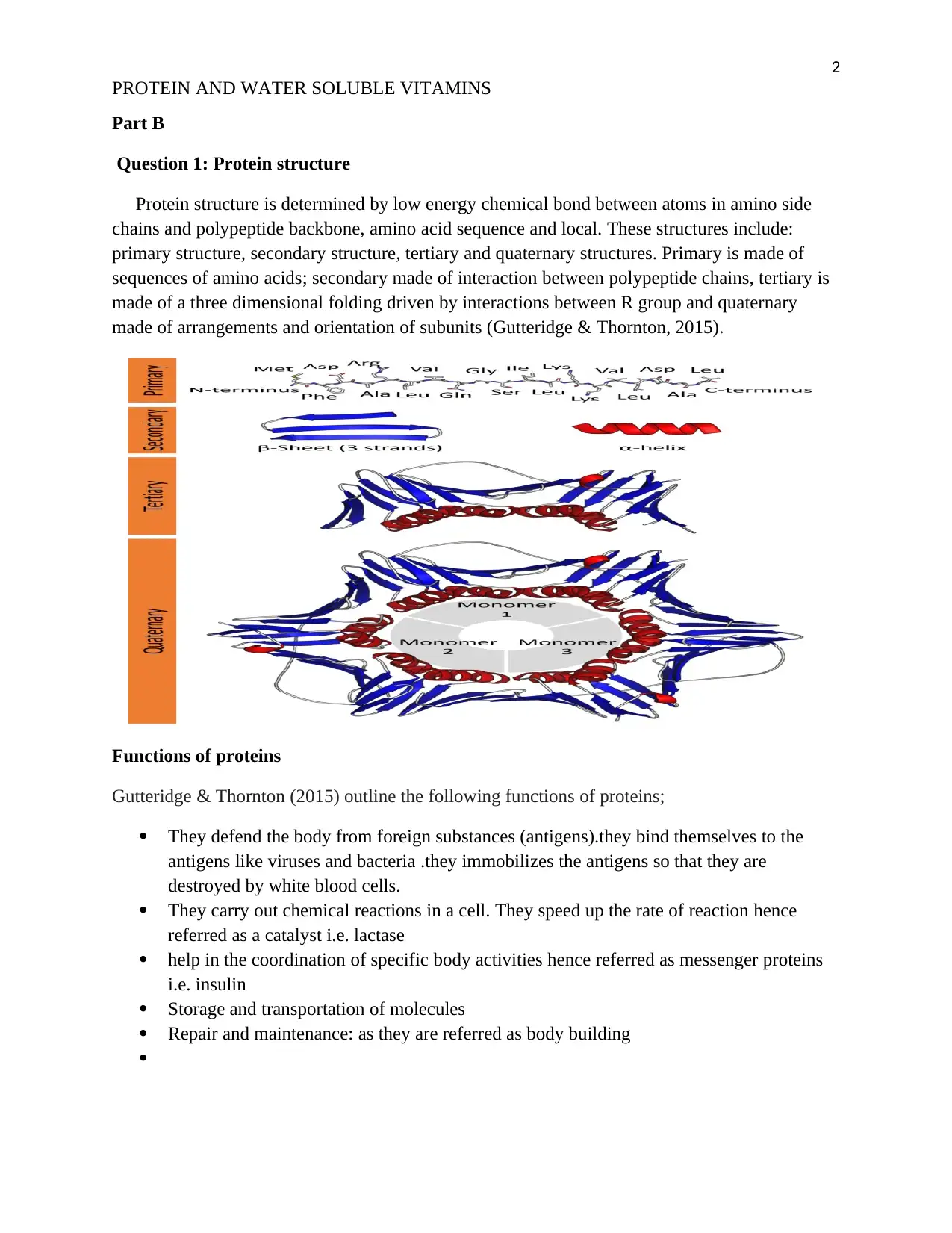
Protein structure is determined by low energy chemical bond between atoms in amino side
chains and polypeptide backbone, amino acid sequence and local. These structures include:
primary structure, secondary structure, tertiary and quaternary structures. Primary is made of
sequences of amino acids; secondary made of interaction between polypeptide chains, tertiary is
made of a three dimensional folding driven by interactions between R group and quaternary
made of arrangements and orientation of subunits (Gutteridge & Thornton, 2015).
Functions of proteins
Gutteridge & Thornton (2015) outline the following functions of proteins;
They defend the body from foreign substances (antigens).they bind themselves to the
antigens like viruses and bacteria .they immobilizes the antigens so that they are
destroyed by white blood cells.
They carry out chemical reactions in a cell. They speed up the rate of reaction hence
referred as a catalyst i.e. lactase
help in the coordination of specific body activities hence referred as messenger proteins
i.e. insulin
Storage and transportation of molecules
Repair and maintenance: as they are referred as body building
Document Page
3
PROTEIN AND WATER SOLUBLE VITAMINS
Question 2: Water soluble vitamins
Vitamin C:
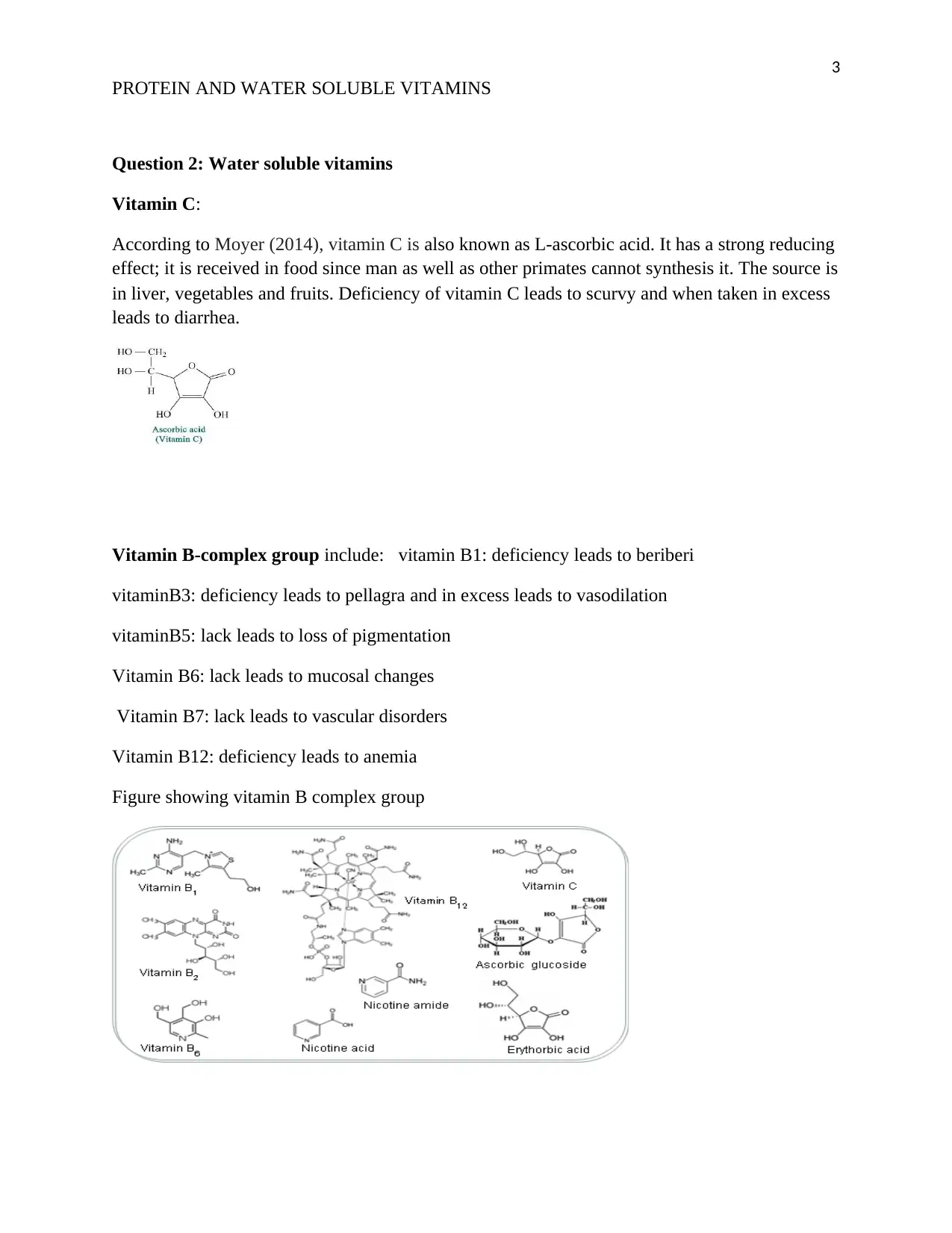
According to Moyer (2014), vitamin C is also known as L-ascorbic acid. It has a strong reducing
effect; it is received in food since man as well as other primates cannot synthesis it. The source is
in liver, vegetables and fruits. Deficiency of vitamin C leads to scurvy and when taken in excess
leads to diarrhea.
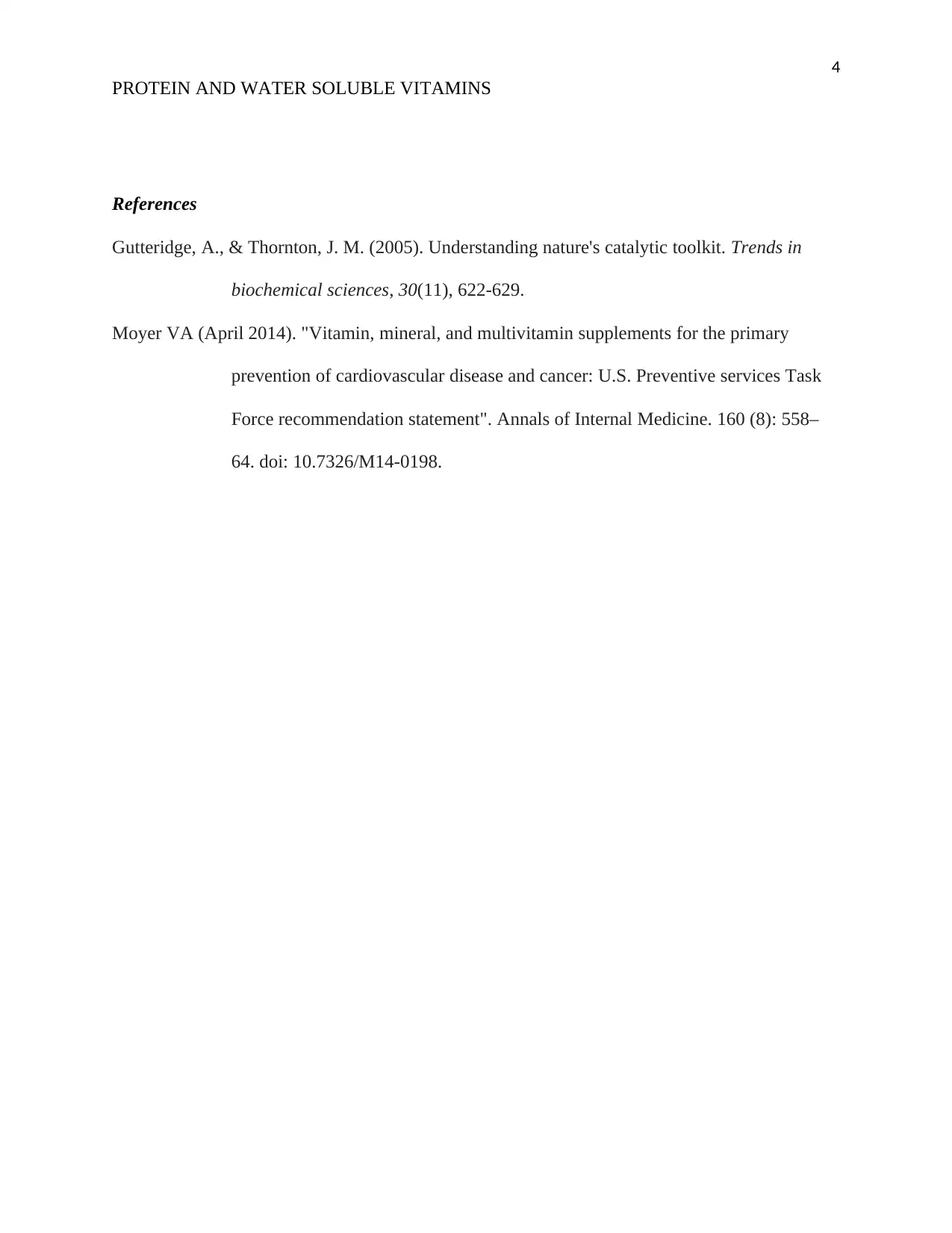
Vitamin B-complex group include: vitamin B1: deficiency leads to beriberi
vitaminB3: deficiency leads to pellagra and in excess leads to vasodilation
vitaminB5: lack leads to loss of pigmentation
Vitamin B6: lack leads to mucosal changes
Vitamin B7: lack leads to vascular disorders
Vitamin B12: deficiency leads to anemia
Figure showing vitamin B complex group
Document Page
4
PROTEIN AND WATER SOLUBLE VITAMINS
References
Gutteridge, A., & Thornton, J. M. (2005). Understanding nature's catalytic toolkit. Trends in
biochemical sciences, 30(11), 622-629.
Moyer VA (April 2014). "Vitamin, mineral, and multivitamin supplements for the primary
prevention of cardiovascular disease and cancer: U.S. Preventive services Task
Force recommendation statement". Annals of Internal Medicine. 160 (8): 558–
64. doi: 10.7326/M14-0198.
chevron_up_icon
1 out of 4
circle_padding
hide_on_mobile
zoom_out_icon
[object Object]