Biology - SCSA Elaboration: DNA Replication, Genes, Mutations, Biotech
VerifiedAdded on 2021/08/10
|29
|7440
|203
Homework Assignment
AI Summary
This document provides a comprehensive overview of key biological concepts, including the structure and properties of DNA, detailing nucleotide composition, base pairing, and the role of hydrogen bonds in replication. It explains DNA replication as a semi-conservative process, describing the roles of enzymes like DNA helicase, DNA polymerase, and DNA ligase, as well as the leading and lagging strands. The notes further elaborate on the genetic code, genes, coding and non-coding DNA, and protein synthesis, including the function of proteins and the impact of gene mutations (point, silent, missense, nonsense, and insertion/deletion). Additionally, it covers somatic and germ-line cells, mutation inheritance, and biotechnology, including genetic engineering, restriction enzymes, vectors (plasmids, viral, and liposome), and transgenic organisms. These notes are designed to aid biology students in understanding complex topics, offering a detailed and organized approach to the subject matter.
BIOLOGY NOTES
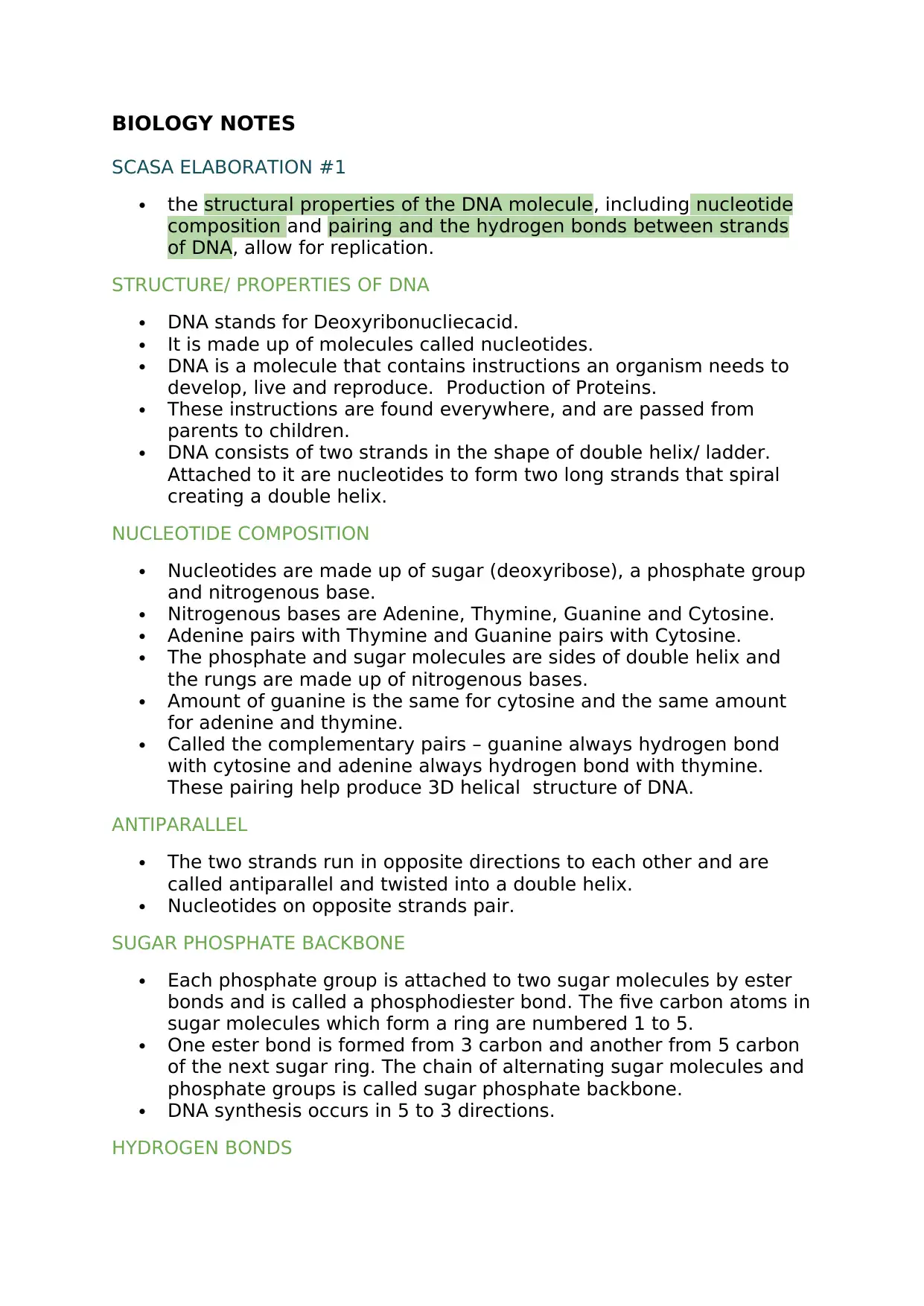
SCASA ELABORATION #1
the structural properties of the DNA molecule, including nucleotide
composition and pairing and the hydrogen bonds between strands
of DNA, allow for replication.
STRUCTURE/ PROPERTIES OF DNA
DNA stands for Deoxyribonucliecacid.
It is made up of molecules called nucleotides.
DNA is a molecule that contains instructions an organism needs to
develop, live and reproduce. Production of Proteins.
These instructions are found everywhere, and are passed from
parents to children.
DNA consists of two strands in the shape of double helix/ ladder.
Attached to it are nucleotides to form two long strands that spiral
creating a double helix.
NUCLEOTIDE COMPOSITION
Nucleotides are made up of sugar (deoxyribose), a phosphate group
and nitrogenous base.
Nitrogenous bases are Adenine, Thymine, Guanine and Cytosine.
Adenine pairs with Thymine and Guanine pairs with Cytosine.
The phosphate and sugar molecules are sides of double helix and
the rungs are made up of nitrogenous bases.
Amount of guanine is the same for cytosine and the same amount
for adenine and thymine.
Called the complementary pairs – guanine always hydrogen bond
with cytosine and adenine always hydrogen bond with thymine.
These pairing help produce 3D helical structure of DNA.
ANTIPARALLEL
The two strands run in opposite directions to each other and are
called antiparallel and twisted into a double helix.
Nucleotides on opposite strands pair.
SUGAR PHOSPHATE BACKBONE
Each phosphate group is attached to two sugar molecules by ester
bonds and is called a phosphodiester bond. The five carbon atoms in
sugar molecules which form a ring are numbered 1 to 5.
One ester bond is formed from 3 carbon and another from 5 carbon
of the next sugar ring. The chain of alternating sugar molecules and
phosphate groups is called sugar phosphate backbone.
DNA synthesis occurs in 5 to 3 directions.
HYDROGEN BONDS
SCASA ELABORATION #1
the structural properties of the DNA molecule, including nucleotide
composition and pairing and the hydrogen bonds between strands
of DNA, allow for replication.
STRUCTURE/ PROPERTIES OF DNA
DNA stands for Deoxyribonucliecacid.
It is made up of molecules called nucleotides.
DNA is a molecule that contains instructions an organism needs to
develop, live and reproduce. Production of Proteins.
These instructions are found everywhere, and are passed from
parents to children.
DNA consists of two strands in the shape of double helix/ ladder.
Attached to it are nucleotides to form two long strands that spiral
creating a double helix.
NUCLEOTIDE COMPOSITION
Nucleotides are made up of sugar (deoxyribose), a phosphate group
and nitrogenous base.
Nitrogenous bases are Adenine, Thymine, Guanine and Cytosine.
Adenine pairs with Thymine and Guanine pairs with Cytosine.
The phosphate and sugar molecules are sides of double helix and
the rungs are made up of nitrogenous bases.
Amount of guanine is the same for cytosine and the same amount
for adenine and thymine.
Called the complementary pairs – guanine always hydrogen bond
with cytosine and adenine always hydrogen bond with thymine.
These pairing help produce 3D helical structure of DNA.
ANTIPARALLEL
The two strands run in opposite directions to each other and are
called antiparallel and twisted into a double helix.
Nucleotides on opposite strands pair.
SUGAR PHOSPHATE BACKBONE
Each phosphate group is attached to two sugar molecules by ester
bonds and is called a phosphodiester bond. The five carbon atoms in
sugar molecules which form a ring are numbered 1 to 5.
One ester bond is formed from 3 carbon and another from 5 carbon
of the next sugar ring. The chain of alternating sugar molecules and
phosphate groups is called sugar phosphate backbone.
DNA synthesis occurs in 5 to 3 directions.
HYDROGEN BONDS

Paraphrase This Document
Need a fresh take? Get an instant paraphrase of this document with our AI Paraphraser
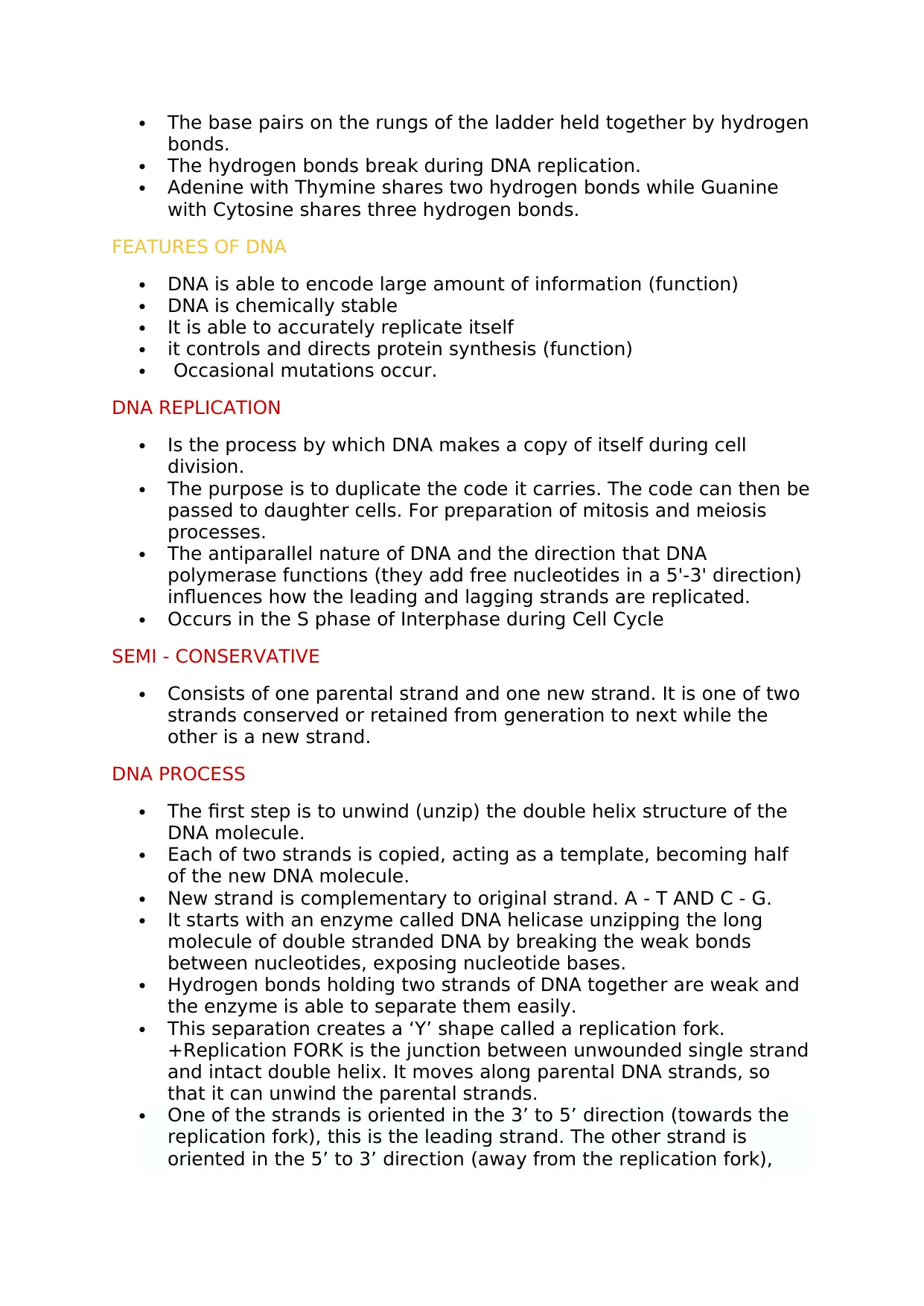
The base pairs on the rungs of the ladder held together by hydrogen
bonds.
The hydrogen bonds break during DNA replication.
Adenine with Thymine shares two hydrogen bonds while Guanine
with Cytosine shares three hydrogen bonds.
FEATURES OF DNA
DNA is able to encode large amount of information (function)
DNA is chemically stable
It is able to accurately replicate itself
it controls and directs protein synthesis (function)
Occasional mutations occur.
DNA REPLICATION
Is the process by which DNA makes a copy of itself during cell
division.
The purpose is to duplicate the code it carries. The code can then be
passed to daughter cells. For preparation of mitosis and meiosis
processes.
The antiparallel nature of DNA and the direction that DNA
polymerase functions (they add free nucleotides in a 5'-3' direction)
influences how the leading and lagging strands are replicated.
Occurs in the S phase of Interphase during Cell Cycle
SEMI - CONSERVATIVE
Consists of one parental strand and one new strand. It is one of two
strands conserved or retained from generation to next while the
other is a new strand.
DNA PROCESS
The first step is to unwind (unzip) the double helix structure of the
DNA molecule.
Each of two strands is copied, acting as a template, becoming half
of the new DNA molecule.
New strand is complementary to original strand. A - T AND C - G.
It starts with an enzyme called DNA helicase unzipping the long
molecule of double stranded DNA by breaking the weak bonds
between nucleotides, exposing nucleotide bases.
Hydrogen bonds holding two strands of DNA together are weak and
the enzyme is able to separate them easily.
This separation creates a ‘Y’ shape called a replication fork.
+Replication FORK is the junction between unwounded single strand
and intact double helix. It moves along parental DNA strands, so
that it can unwind the parental strands.
One of the strands is oriented in the 3’ to 5’ direction (towards the
replication fork), this is the leading strand. The other strand is
oriented in the 5’ to 3’ direction (away from the replication fork),
bonds.
The hydrogen bonds break during DNA replication.
Adenine with Thymine shares two hydrogen bonds while Guanine
with Cytosine shares three hydrogen bonds.
FEATURES OF DNA
DNA is able to encode large amount of information (function)
DNA is chemically stable
It is able to accurately replicate itself
it controls and directs protein synthesis (function)
Occasional mutations occur.
DNA REPLICATION
Is the process by which DNA makes a copy of itself during cell
division.
The purpose is to duplicate the code it carries. The code can then be
passed to daughter cells. For preparation of mitosis and meiosis
processes.
The antiparallel nature of DNA and the direction that DNA
polymerase functions (they add free nucleotides in a 5'-3' direction)
influences how the leading and lagging strands are replicated.
Occurs in the S phase of Interphase during Cell Cycle
SEMI - CONSERVATIVE
Consists of one parental strand and one new strand. It is one of two
strands conserved or retained from generation to next while the
other is a new strand.
DNA PROCESS
The first step is to unwind (unzip) the double helix structure of the
DNA molecule.
Each of two strands is copied, acting as a template, becoming half
of the new DNA molecule.
New strand is complementary to original strand. A - T AND C - G.
It starts with an enzyme called DNA helicase unzipping the long
molecule of double stranded DNA by breaking the weak bonds
between nucleotides, exposing nucleotide bases.
Hydrogen bonds holding two strands of DNA together are weak and
the enzyme is able to separate them easily.
This separation creates a ‘Y’ shape called a replication fork.
+Replication FORK is the junction between unwounded single strand
and intact double helix. It moves along parental DNA strands, so
that it can unwind the parental strands.
One of the strands is oriented in the 3’ to 5’ direction (towards the
replication fork), this is the leading strand. The other strand is
oriented in the 5’ to 3’ direction (away from the replication fork),
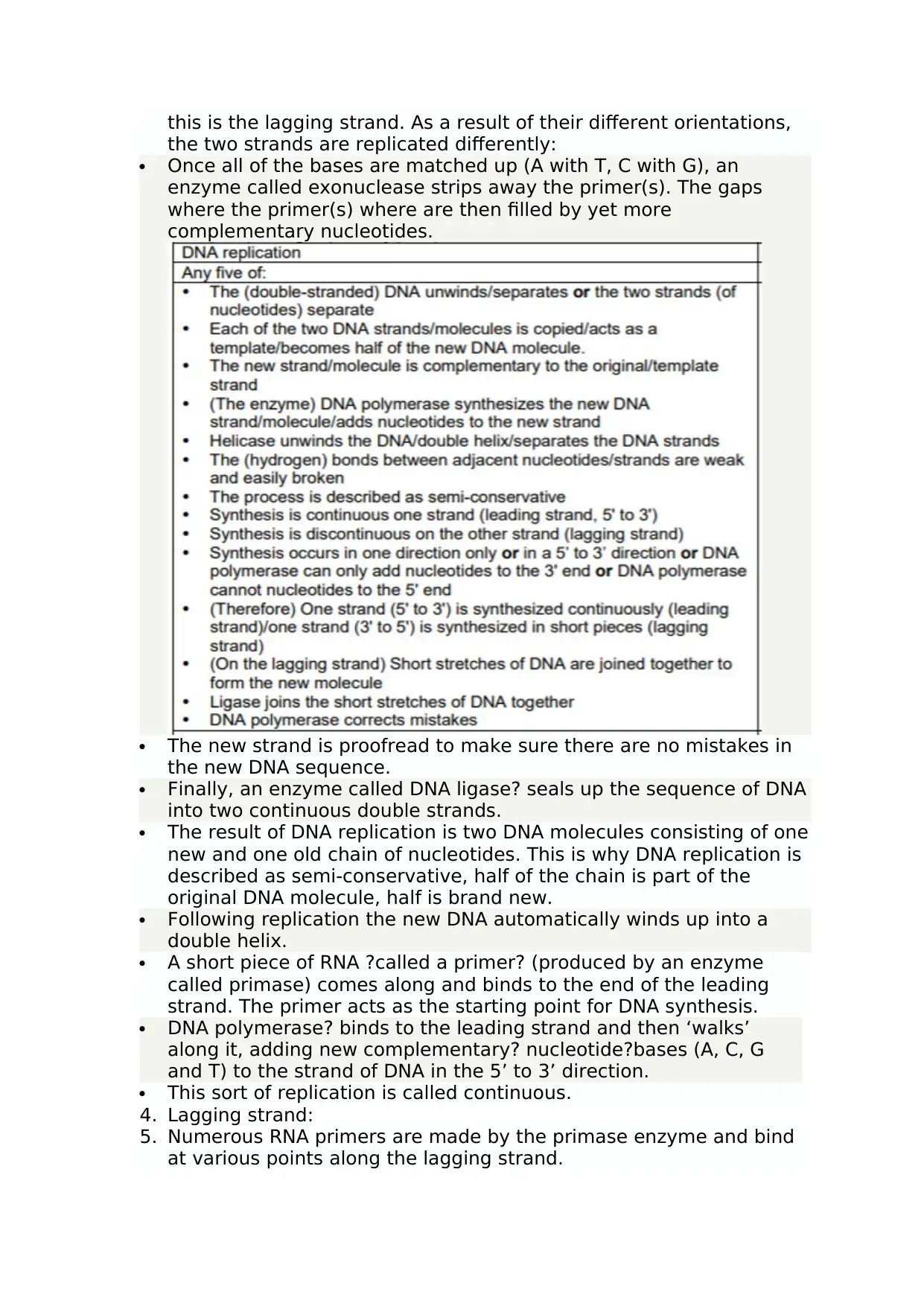
this is the lagging strand. As a result of their different orientations,
the two strands are replicated differently:
Once all of the bases are matched up (A with T, C with G), an
enzyme called exonuclease strips away the primer(s). The gaps
where the primer(s) where are then filled by yet more
complementary nucleotides.
The new strand is proofread to make sure there are no mistakes in
the new DNA sequence.
Finally, an enzyme called DNA ligase? seals up the sequence of DNA
into two continuous double strands.
The result of DNA replication is two DNA molecules consisting of one
new and one old chain of nucleotides. This is why DNA replication is
described as semi-conservative, half of the chain is part of the
original DNA molecule, half is brand new.
Following replication the new DNA automatically winds up into a
double helix.
A short piece of RNA ?called a primer? (produced by an enzyme
called primase) comes along and binds to the end of the leading
strand. The primer acts as the starting point for DNA synthesis.
DNA polymerase? binds to the leading strand and then ‘walks’
along it, adding new complementary? nucleotide?bases (A, C, G
and T) to the strand of DNA in the 5’ to 3’ direction.
This sort of replication is called continuous.
4. Lagging strand:
5. Numerous RNA primers are made by the primase enzyme and bind
at various points along the lagging strand.
the two strands are replicated differently:
Once all of the bases are matched up (A with T, C with G), an
enzyme called exonuclease strips away the primer(s). The gaps
where the primer(s) where are then filled by yet more
complementary nucleotides.
The new strand is proofread to make sure there are no mistakes in
the new DNA sequence.
Finally, an enzyme called DNA ligase? seals up the sequence of DNA
into two continuous double strands.
The result of DNA replication is two DNA molecules consisting of one
new and one old chain of nucleotides. This is why DNA replication is
described as semi-conservative, half of the chain is part of the
original DNA molecule, half is brand new.
Following replication the new DNA automatically winds up into a
double helix.
A short piece of RNA ?called a primer? (produced by an enzyme
called primase) comes along and binds to the end of the leading
strand. The primer acts as the starting point for DNA synthesis.
DNA polymerase? binds to the leading strand and then ‘walks’
along it, adding new complementary? nucleotide?bases (A, C, G
and T) to the strand of DNA in the 5’ to 3’ direction.
This sort of replication is called continuous.
4. Lagging strand:
5. Numerous RNA primers are made by the primase enzyme and bind
at various points along the lagging strand.
⊘ This is a preview!⊘
Do you want full access?
Subscribe today to unlock all pages.

Trusted by 1+ million students worldwide
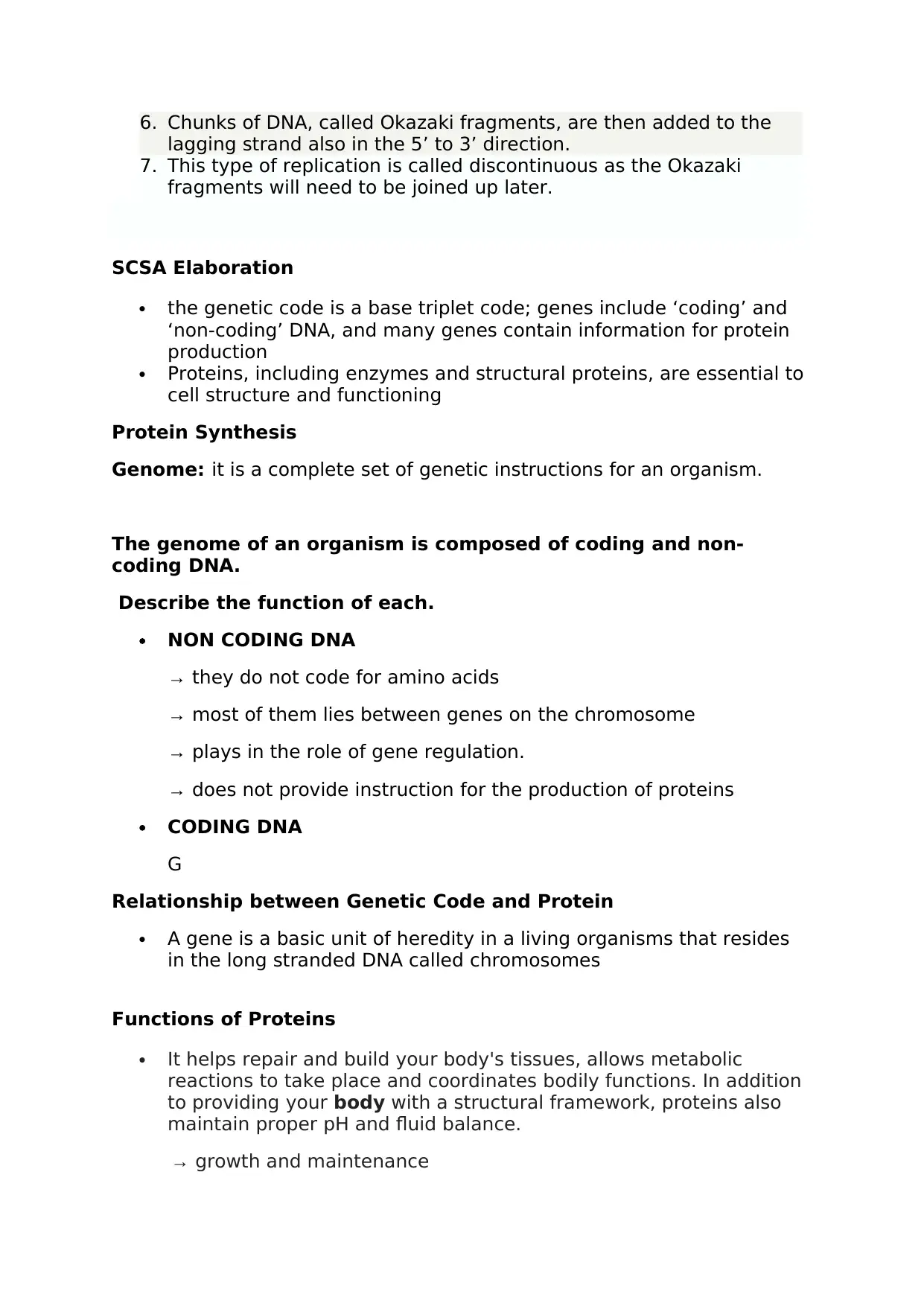
6. Chunks of DNA, called Okazaki fragments, are then added to the
lagging strand also in the 5’ to 3’ direction.
7. This type of replication is called discontinuous as the Okazaki
fragments will need to be joined up later.
SCSA Elaboration
the genetic code is a base triplet code; genes include ‘coding’ and
‘non-coding’ DNA, and many genes contain information for protein
production
Proteins, including enzymes and structural proteins, are essential to
cell structure and functioning
Protein Synthesis
Genome: it is a complete set of genetic instructions for an organism.
The genome of an organism is composed of coding and non-
coding DNA.
Describe the function of each.
NON CODING DNA
→ they do not code for amino acids
→ most of them lies between genes on the chromosome
→ plays in the role of gene regulation.
→ does not provide instruction for the production of proteins
CODING DNA
G
Relationship between Genetic Code and Protein
A gene is a basic unit of heredity in a living organisms that resides
in the long stranded DNA called chromosomes
Functions of Proteins
It helps repair and build your body's tissues, allows metabolic
reactions to take place and coordinates bodily functions. In addition
to providing your body with a structural framework, proteins also
maintain proper pH and fluid balance.
→ growth and maintenance
lagging strand also in the 5’ to 3’ direction.
7. This type of replication is called discontinuous as the Okazaki
fragments will need to be joined up later.
SCSA Elaboration
the genetic code is a base triplet code; genes include ‘coding’ and
‘non-coding’ DNA, and many genes contain information for protein
production
Proteins, including enzymes and structural proteins, are essential to
cell structure and functioning
Protein Synthesis
Genome: it is a complete set of genetic instructions for an organism.
The genome of an organism is composed of coding and non-
coding DNA.
Describe the function of each.
NON CODING DNA
→ they do not code for amino acids
→ most of them lies between genes on the chromosome
→ plays in the role of gene regulation.
→ does not provide instruction for the production of proteins
CODING DNA
G
Relationship between Genetic Code and Protein
A gene is a basic unit of heredity in a living organisms that resides
in the long stranded DNA called chromosomes
Functions of Proteins
It helps repair and build your body's tissues, allows metabolic
reactions to take place and coordinates bodily functions. In addition
to providing your body with a structural framework, proteins also
maintain proper pH and fluid balance.
→ growth and maintenance
Paraphrase This Document
Need a fresh take? Get an instant paraphrase of this document with our AI Paraphraser
→ causes biochemical reaction
Types of Mutation: Gene Mutation
Gene Mutation: is where one gene's mutates could possibly affect the proteins produced.
Point Mutation: is a type of gene mutation that changes the base sequence on one gene and
can form a new allele if not a silent mutation.
Single Nucleotide Polymorphism: a single nucleotide difference that occurs at a given
position in the genomes of two or more individuals.
3 types of substitution mutation
Silent: a mutation in which the DNA codon for one amino acids becomes another
DNA codon for the same amino acids.
Missense: a gene mutation that results in one amino acid being replaced by another
amino acid in the encoded protein.
Nonsense: a mutation in which a codon for an amino acid is changed to one that
codes for a stop codon, terminating translation.
Deletion and Insertion
BIOLOGY - MUTATION
SCSA ELABORATION
Mutations in genes and chromosomes can result from errors in DNA replication or
cell division, or from damage by physical or chemical factors in the environment
Mutation: a permanent change in the DNA sequence of a gene, an only source of new
alleles in a population’s gene pool; the process of generating a mutation.
Distinguish between Somatic and Germ - Line Cells
SOMATIC CELLS GERM LINE CELLS
Are any cells that are not involved in the
production of gametes.
Cells that create reproductive
cells or gametes.
Arranged into different types of tissues in
body of multicellular organisms,
Produce male and female
gametes to participate in sexual
Types of Mutation: Gene Mutation
Gene Mutation: is where one gene's mutates could possibly affect the proteins produced.
Point Mutation: is a type of gene mutation that changes the base sequence on one gene and
can form a new allele if not a silent mutation.
Single Nucleotide Polymorphism: a single nucleotide difference that occurs at a given
position in the genomes of two or more individuals.
3 types of substitution mutation
Silent: a mutation in which the DNA codon for one amino acids becomes another
DNA codon for the same amino acids.
Missense: a gene mutation that results in one amino acid being replaced by another
amino acid in the encoded protein.
Nonsense: a mutation in which a codon for an amino acid is changed to one that
codes for a stop codon, terminating translation.
Deletion and Insertion
BIOLOGY - MUTATION
SCSA ELABORATION
Mutations in genes and chromosomes can result from errors in DNA replication or
cell division, or from damage by physical or chemical factors in the environment
Mutation: a permanent change in the DNA sequence of a gene, an only source of new
alleles in a population’s gene pool; the process of generating a mutation.
Distinguish between Somatic and Germ - Line Cells
SOMATIC CELLS GERM LINE CELLS
Are any cells that are not involved in the
production of gametes.
Cells that create reproductive
cells or gametes.
Arranged into different types of tissues in
body of multicellular organisms,
Produce male and female
gametes to participate in sexual
performing specific functions reproduction.
Undergoes Mitosis Undergoes Meiosis
Mutation may not pass through the
generations and have no effect on
evolution
Mutation passes through the
generation having an effect on
evolution.
How can mutation be passed onto offspring?
A mutation can change the genetic sequence. Some mutations are hereditary
because they are passed down to offspring from a parent carrying a mutation through
the germ line - an egg or sperm carrying mutations. Mutation can affect sex cells
called gametes and can be inherited and incorporated into every cell of offspring.
BIOTECHNOLOGY
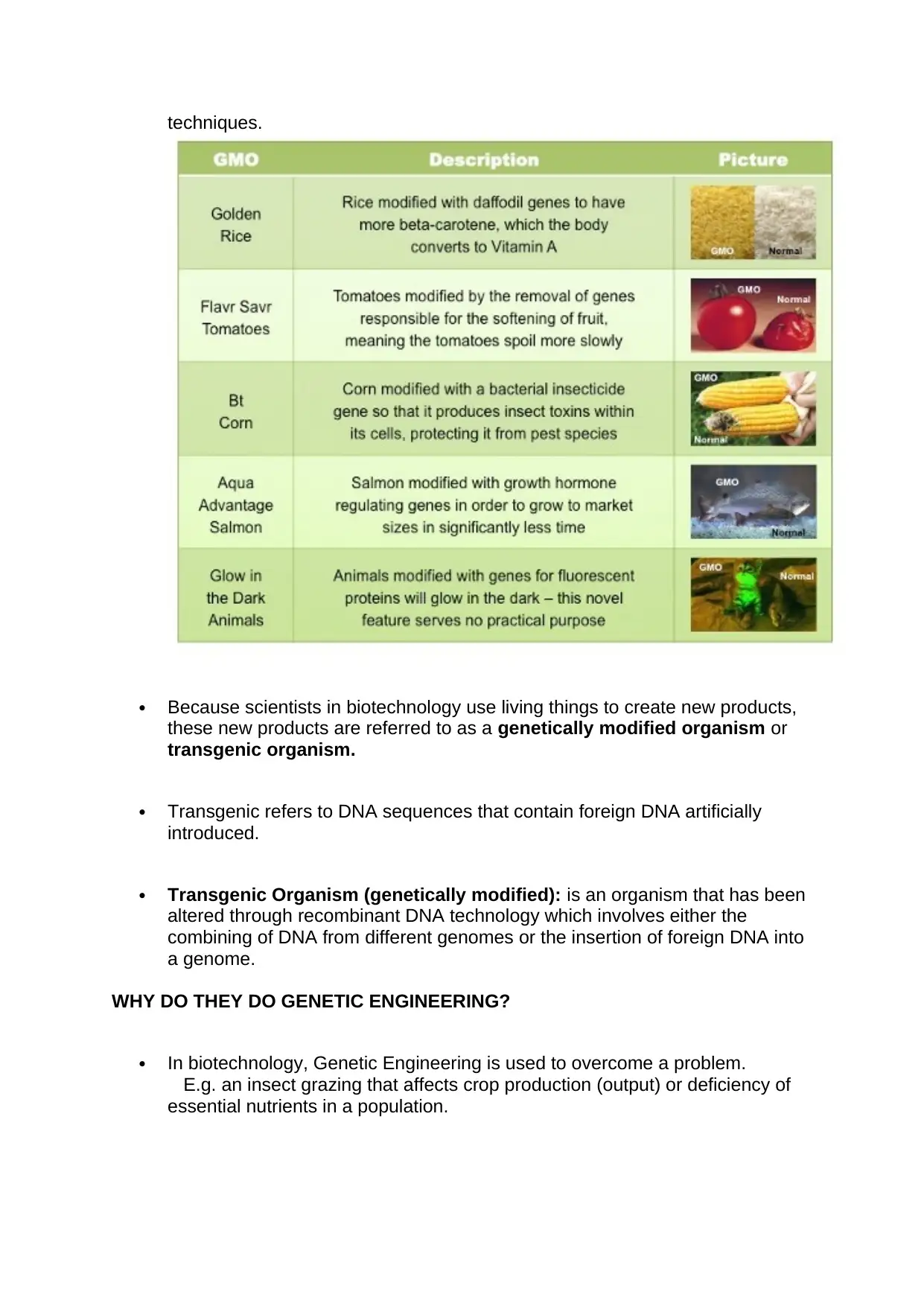
Describes the use of living things to make new products
E.g. Golden Rice, GM Cotton
Genetic Engineering: refers to the process in changing the genetic
sequence of an organism using modern biotechnological
Undergoes Mitosis Undergoes Meiosis
Mutation may not pass through the
generations and have no effect on
evolution
Mutation passes through the
generation having an effect on
evolution.
How can mutation be passed onto offspring?
A mutation can change the genetic sequence. Some mutations are hereditary
because they are passed down to offspring from a parent carrying a mutation through
the germ line - an egg or sperm carrying mutations. Mutation can affect sex cells
called gametes and can be inherited and incorporated into every cell of offspring.
BIOTECHNOLOGY
Describes the use of living things to make new products
E.g. Golden Rice, GM Cotton
Genetic Engineering: refers to the process in changing the genetic
sequence of an organism using modern biotechnological
⊘ This is a preview!⊘
Do you want full access?
Subscribe today to unlock all pages.
Trusted by 1+ million students worldwide
techniques.
Because scientists in biotechnology use living things to create new products,
these new products are referred to as a genetically modified organism or
transgenic organism.
Transgenic refers to DNA sequences that contain foreign DNA artificially
introduced.
Transgenic Organism (genetically modified): is an organism that has been
altered through recombinant DNA technology which involves either the
combining of DNA from different genomes or the insertion of foreign DNA into
a genome.
WHY DO THEY DO GENETIC ENGINEERING?
In biotechnology, Genetic Engineering is used to overcome a problem.
E.g. an insect grazing that affects crop production (output) or deficiency of
essential nutrients in a population.
Because scientists in biotechnology use living things to create new products,
these new products are referred to as a genetically modified organism or
transgenic organism.
Transgenic refers to DNA sequences that contain foreign DNA artificially
introduced.
Transgenic Organism (genetically modified): is an organism that has been
altered through recombinant DNA technology which involves either the
combining of DNA from different genomes or the insertion of foreign DNA into
a genome.
WHY DO THEY DO GENETIC ENGINEERING?
In biotechnology, Genetic Engineering is used to overcome a problem.
E.g. an insect grazing that affects crop production (output) or deficiency of
essential nutrients in a population.
Paraphrase This Document
Need a fresh take? Get an instant paraphrase of this document with our AI Paraphraser
Used to enhance or modify the characteristics of an individual
organism.
Gene of Interest/ Target Sequence
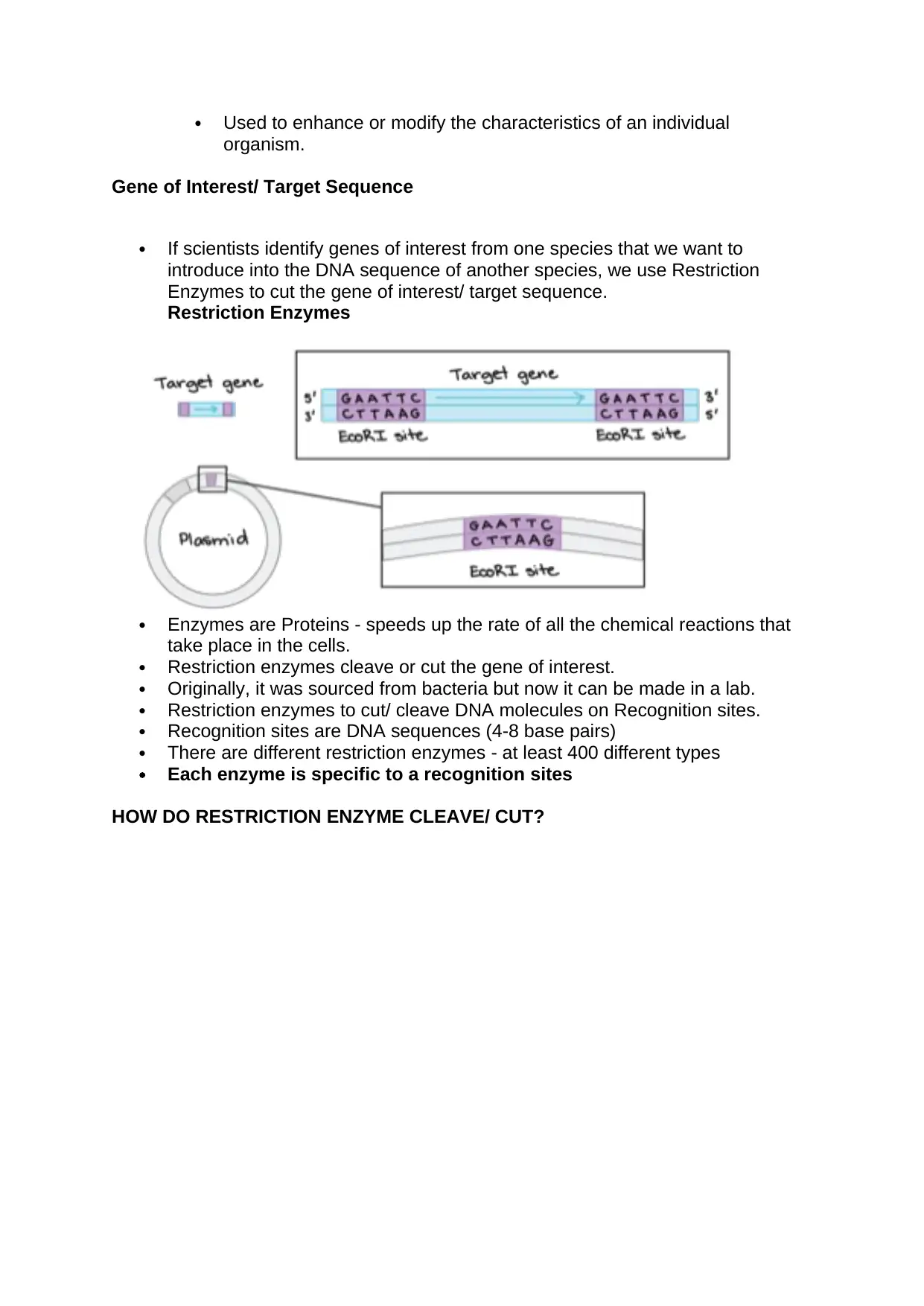
If scientists identify genes of interest from one species that we want to
introduce into the DNA sequence of another species, we use Restriction
Enzymes to cut the gene of interest/ target sequence.
Restriction Enzymes
Enzymes are Proteins - speeds up the rate of all the chemical reactions that
take place in the cells.
Restriction enzymes cleave or cut the gene of interest.
Originally, it was sourced from bacteria but now it can be made in a lab.
Restriction enzymes to cut/ cleave DNA molecules on Recognition sites.
Recognition sites are DNA sequences (4-8 base pairs)
There are different restriction enzymes - at least 400 different types
Each enzyme is specific to a recognition sites
HOW DO RESTRICTION ENZYME CLEAVE/ CUT?
organism.
Gene of Interest/ Target Sequence
If scientists identify genes of interest from one species that we want to
introduce into the DNA sequence of another species, we use Restriction
Enzymes to cut the gene of interest/ target sequence.
Restriction Enzymes
Enzymes are Proteins - speeds up the rate of all the chemical reactions that
take place in the cells.
Restriction enzymes cleave or cut the gene of interest.
Originally, it was sourced from bacteria but now it can be made in a lab.
Restriction enzymes to cut/ cleave DNA molecules on Recognition sites.
Recognition sites are DNA sequences (4-8 base pairs)
There are different restriction enzymes - at least 400 different types
Each enzyme is specific to a recognition sites
HOW DO RESTRICTION ENZYME CLEAVE/ CUT?
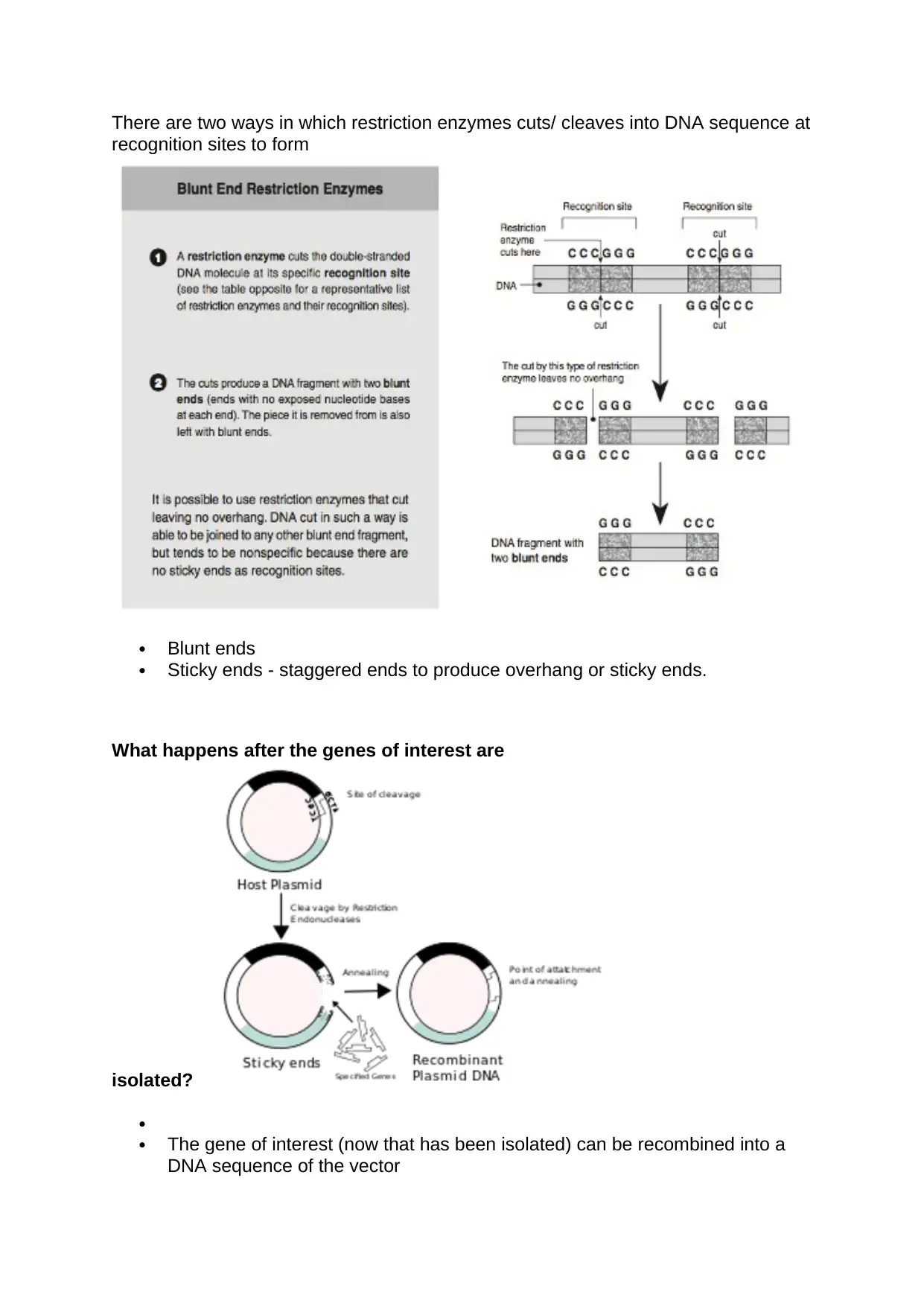
There are two ways in which restriction enzymes cuts/ cleaves into DNA sequence at
recognition sites to form
Blunt ends
Sticky ends - staggered ends to produce overhang or sticky ends.
What happens after the genes of interest are
isolated?
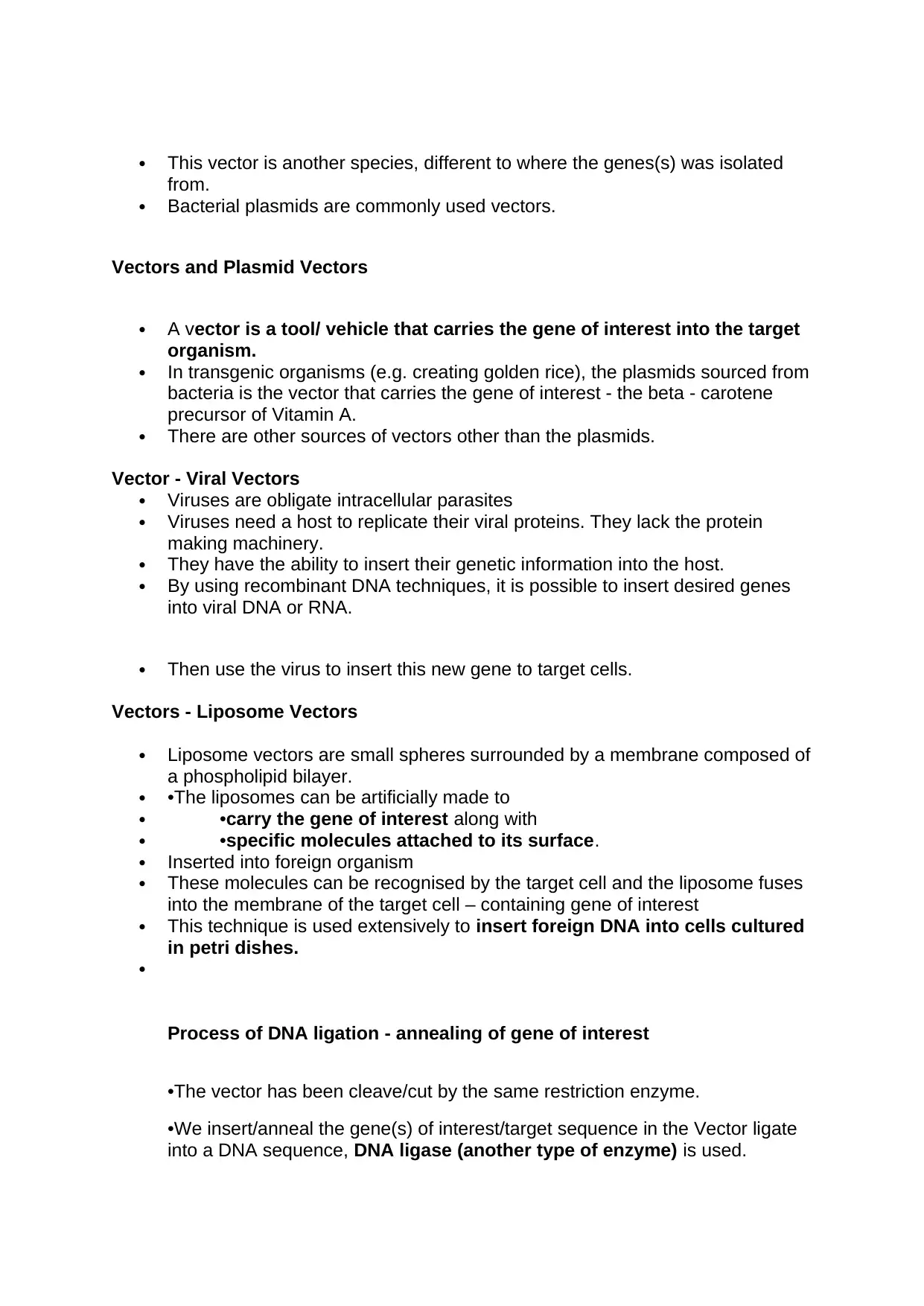
The gene of interest (now that has been isolated) can be recombined into a
DNA sequence of the vector
recognition sites to form
Blunt ends
Sticky ends - staggered ends to produce overhang or sticky ends.
What happens after the genes of interest are
isolated?
The gene of interest (now that has been isolated) can be recombined into a
DNA sequence of the vector
⊘ This is a preview!⊘
Do you want full access?
Subscribe today to unlock all pages.
Trusted by 1+ million students worldwide
This vector is another species, different to where the genes(s) was isolated
from.
Bacterial plasmids are commonly used vectors.
Vectors and Plasmid Vectors
A vector is a tool/ vehicle that carries the gene of interest into the target
organism.
In transgenic organisms (e.g. creating golden rice), the plasmids sourced from
bacteria is the vector that carries the gene of interest - the beta - carotene
precursor of Vitamin A.
There are other sources of vectors other than the plasmids.
Vector - Viral Vectors
Viruses are obligate intracellular parasites
Viruses need a host to replicate their viral proteins. They lack the protein
making machinery.
They have the ability to insert their genetic information into the host.
By using recombinant DNA techniques, it is possible to insert desired genes
into viral DNA or RNA.
Then use the virus to insert this new gene to target cells.
Vectors - Liposome Vectors
Liposome vectors are small spheres surrounded by a membrane composed of
a phospholipid bilayer.
•The liposomes can be artificially made to
•carry the gene of interest along with
•specific molecules attached to its surface.
Inserted into foreign organism
These molecules can be recognised by the target cell and the liposome fuses
into the membrane of the target cell – containing gene of interest
This technique is used extensively to insert foreign DNA into cells cultured
in petri dishes.
Process of DNA ligation - annealing of gene of interest
•The vector has been cleave/cut by the same restriction enzyme.
•We insert/anneal the gene(s) of interest/target sequence in the Vector ligate
into a DNA sequence, DNA ligase (another type of enzyme) is used.
from.
Bacterial plasmids are commonly used vectors.
Vectors and Plasmid Vectors
A vector is a tool/ vehicle that carries the gene of interest into the target
organism.
In transgenic organisms (e.g. creating golden rice), the plasmids sourced from
bacteria is the vector that carries the gene of interest - the beta - carotene
precursor of Vitamin A.
There are other sources of vectors other than the plasmids.
Vector - Viral Vectors
Viruses are obligate intracellular parasites
Viruses need a host to replicate their viral proteins. They lack the protein
making machinery.
They have the ability to insert their genetic information into the host.
By using recombinant DNA techniques, it is possible to insert desired genes
into viral DNA or RNA.
Then use the virus to insert this new gene to target cells.
Vectors - Liposome Vectors
Liposome vectors are small spheres surrounded by a membrane composed of
a phospholipid bilayer.
•The liposomes can be artificially made to
•carry the gene of interest along with
•specific molecules attached to its surface.
Inserted into foreign organism
These molecules can be recognised by the target cell and the liposome fuses
into the membrane of the target cell – containing gene of interest
This technique is used extensively to insert foreign DNA into cells cultured
in petri dishes.
Process of DNA ligation - annealing of gene of interest
•The vector has been cleave/cut by the same restriction enzyme.
•We insert/anneal the gene(s) of interest/target sequence in the Vector ligate
into a DNA sequence, DNA ligase (another type of enzyme) is used.
Paraphrase This Document
Need a fresh take? Get an instant paraphrase of this document with our AI Paraphraser
•Once it is recombined into another DNA sequence of a different species,
Recombinant plasmid DNA is produced.
DNA SEQUENCING (SANGER METHOD)
It refers to the methods and technologies used to determine the
order of the nucleotides bases in DNA molecules : adenine,
guanine, cytosine and thymine. The genome (the entire DNA
sequence of an organism) can be determined.
The method and technologies used are PCR and Gel
Electrophoresis
Scientists cut DNA into fragments to sequence one section at a
time. The entire set can then be put together to create a whole
genome.
The genome of thousands of species have been sequenced,
allowing genomes and genes to be compared.
Knowing the sequences can help scientists determine the genetic
code for particular phenotypes. There may be survival benefits in
identifying, for example genes that increase drought resistance or
salt tolerance.
Sequencing genes of different species has assisted scientists in
determining genetic relatedness and evolutionary links.
PCR
Thermal cycler
Free nucleotides
Primers (radioactive
DNA polymerase
DNA SEQUENCE
Thermal cycle
Free Nucleotide
Primers
DNA Polymerase
Terminator - modified nucleotides - dideoxynucleotides.
Short fragment - start - travels further because it is light weight.
DNA PROFILING (SEQUENCING)
Recombinant plasmid DNA is produced.
DNA SEQUENCING (SANGER METHOD)
It refers to the methods and technologies used to determine the
order of the nucleotides bases in DNA molecules : adenine,
guanine, cytosine and thymine. The genome (the entire DNA
sequence of an organism) can be determined.
The method and technologies used are PCR and Gel
Electrophoresis
Scientists cut DNA into fragments to sequence one section at a
time. The entire set can then be put together to create a whole
genome.
The genome of thousands of species have been sequenced,
allowing genomes and genes to be compared.
Knowing the sequences can help scientists determine the genetic
code for particular phenotypes. There may be survival benefits in
identifying, for example genes that increase drought resistance or
salt tolerance.
Sequencing genes of different species has assisted scientists in
determining genetic relatedness and evolutionary links.
PCR
Thermal cycler
Free nucleotides
Primers (radioactive
DNA polymerase
DNA SEQUENCE
Thermal cycle
Free Nucleotide
Primers
DNA Polymerase
Terminator - modified nucleotides - dideoxynucleotides.
Short fragment - start - travels further because it is light weight.
DNA PROFILING (SEQUENCING)
Summary
1. Identify and Isolate DNA : short tandem repeats (STRs)
2. PCR - once STR’s are isolated - (amplify) make multiple copies of
STR.
3. Gel Electrophoresis: load amplified sample and separate
fragments.
4. Analyse and draw conclusions.
STR - Short Tandem Repeat
They are non-coding DNA (don’t code for proteins)
Highly variable between individuals of the same species.
There are multiple loci regions of STR’s on the human genome.
DNA sequence 3-5 base pairs (bp) in length
They are repeated.
Process of DNA profiling
1. DNA samples are collected, processed and DNA is extracted from
individuals.
2. Primers for each location are added.
- Primers are flanked to the DNA to be amplified to allow DNA
polymerase to initiate elongation.
-> Multiple locus is used, therefore multiple primers would be added - this
increases in the accuracy of DNA profiling.
E.g. if four loci are used, there would be 8 different primers.
3. The DNA and fluorescent primers are run through the polymerase chain
reaction (PCR) to amplify the targeted STR region on the DNA.
4. The amplified DNA in a sample is separated by electrophoresis in a
genetic analyzer
5. DNA fragments (negative charge) move through the gel tube by size,
smallest first
6. Results are analysed
GEL ELECTROPHORESIS
The main purpose of a gel electrophoresis is to separate a large sample of
DNA fragments of various sizes
Various components of a gel electrophoresis include
DNA sample (previously underwent PCR)
Agarose Gel (Made of agar jelly)
Positive and negative terminal on either side of the Gel electrophoresis
Wells to place DNA sample
One well is used for “markers” that contain fragments of known size so it is
possible to det
1. Identify and Isolate DNA : short tandem repeats (STRs)
2. PCR - once STR’s are isolated - (amplify) make multiple copies of
STR.
3. Gel Electrophoresis: load amplified sample and separate
fragments.
4. Analyse and draw conclusions.
STR - Short Tandem Repeat
They are non-coding DNA (don’t code for proteins)
Highly variable between individuals of the same species.
There are multiple loci regions of STR’s on the human genome.
DNA sequence 3-5 base pairs (bp) in length
They are repeated.
Process of DNA profiling
1. DNA samples are collected, processed and DNA is extracted from
individuals.
2. Primers for each location are added.
- Primers are flanked to the DNA to be amplified to allow DNA
polymerase to initiate elongation.
-> Multiple locus is used, therefore multiple primers would be added - this
increases in the accuracy of DNA profiling.
E.g. if four loci are used, there would be 8 different primers.
3. The DNA and fluorescent primers are run through the polymerase chain
reaction (PCR) to amplify the targeted STR region on the DNA.
4. The amplified DNA in a sample is separated by electrophoresis in a
genetic analyzer
5. DNA fragments (negative charge) move through the gel tube by size,
smallest first
6. Results are analysed
GEL ELECTROPHORESIS
The main purpose of a gel electrophoresis is to separate a large sample of
DNA fragments of various sizes
Various components of a gel electrophoresis include
DNA sample (previously underwent PCR)
Agarose Gel (Made of agar jelly)
Positive and negative terminal on either side of the Gel electrophoresis
Wells to place DNA sample
One well is used for “markers” that contain fragments of known size so it is
possible to det
⊘ This is a preview!⊘
Do you want full access?
Subscribe today to unlock all pages.
Trusted by 1+ million students worldwide

1 out of 29


Related Documents


Your All-in-One AI-Powered Toolkit for Academic Success.
+13062052269
info@desklib.com
Available 24*7 on WhatsApp / Email
![[object Object]](/_next/static/media/star-bottom.7253800d.svg)
Unlock your academic potential
Copyright © 2020–2026 A2Z Services. All Rights Reserved. Developed and managed by ZUCOL.