PubH 6002.11 Biostatistical Applications for Public Health Quiz 2 - AD

Verified

Added on  2022/12/30

|3
|376
|76
Quiz and Exam
AI Summary
This document provides detailed solutions for the PubH 6002.11 Biostatistical Applications for Public Health Quiz 2, focusing on statistical analysis related to metal ions and Alzheimer's disease. The quiz covers topics such as hypothesis testing, confidence intervals, t-tests, and z-values, using data from a study on metal ion levels in AD patients. Solutions include calculations for z-scores, standard errors, and critical values, along with interpretations of statistical significance and the rejection or acceptance of null hypotheses. The answers to multiple-choice questions are clearly explained, demonstrating the application of biostatistical principles to public health research. The document also includes the formulas and steps used to arrive at the correct answers for each question, demonstrating the application of biostatistical principles to public health research.
Document Page
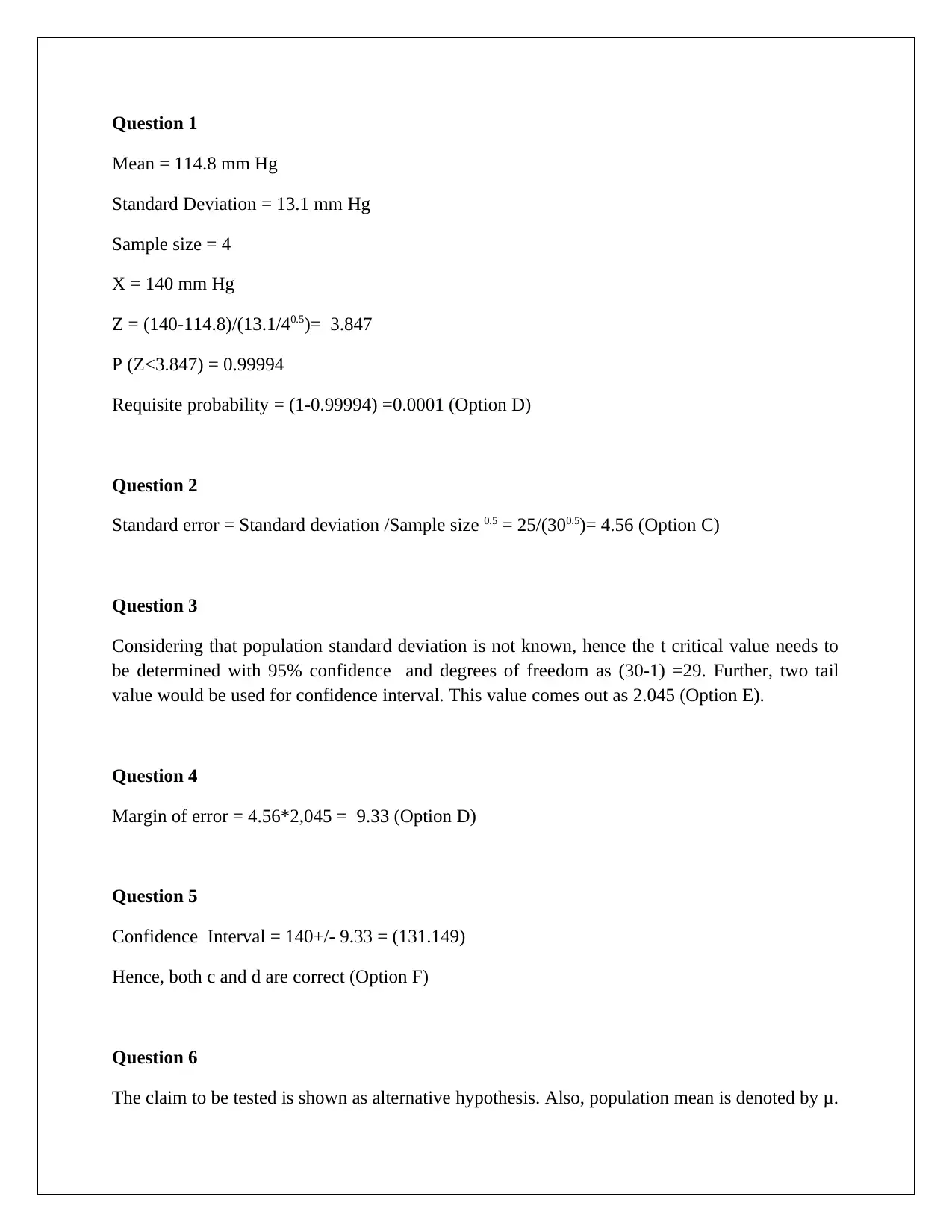
Question 1
Mean = 114.8 mm Hg
Standard Deviation = 13.1 mm Hg
Sample size = 4
X = 140 mm Hg
Z = (140-114.8)/(13.1/40.5)= 3.847
P (Z<3.847) = 0.99994
Requisite probability = (1-0.99994) =0.0001 (Option D)
Question 2
Standard error = Standard deviation /Sample size 0.5 = 25/(300.5)= 4.56 (Option C)
Question 3
Considering that population standard deviation is not known, hence the t critical value needs to
be determined with 95% confidence and degrees of freedom as (30-1) =29. Further, two tail
value would be used for confidence interval. This value comes out as 2.045 (Option E).
Question 4
Margin of error = 4.56*2,045 = 9.33 (Option D)
Question 5
Confidence Interval = 140+/- 9.33 = (131.149)
Hence, both c and d are correct (Option F)
Question 6
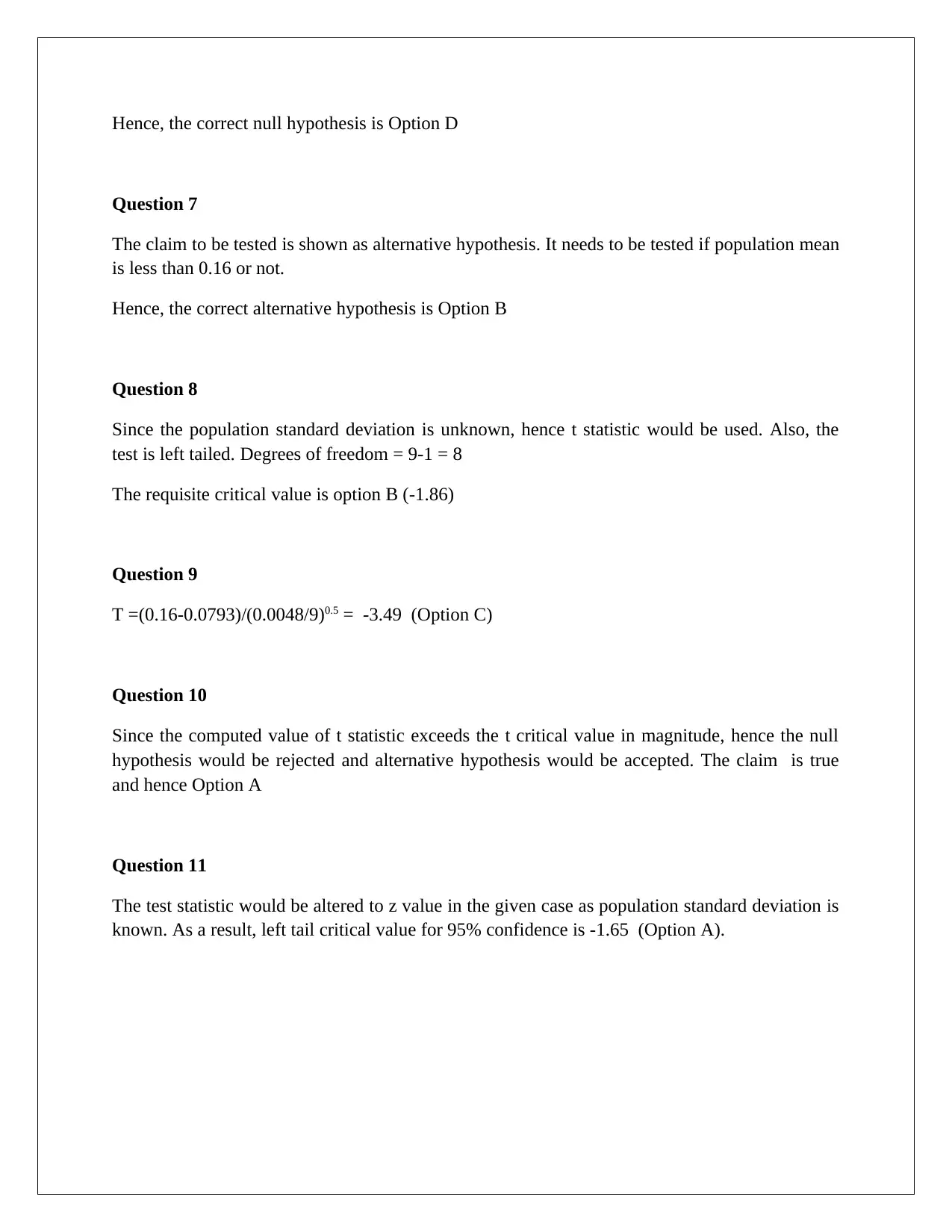
The claim to be tested is shown as alternative hypothesis. Also, population mean is denoted by μ.
tabler-icon-diamond-filled.svg

Paraphrase This Document

Need a fresh take? Get an instant paraphrase of this document with our AI Paraphraser
Document Page
Hence, the correct null hypothesis is Option D
Question 7
The claim to be tested is shown as alternative hypothesis. It needs to be tested if population mean
is less than 0.16 or not.
Hence, the correct alternative hypothesis is Option B
Question 8
Since the population standard deviation is unknown, hence t statistic would be used. Also, the
test is left tailed. Degrees of freedom = 9-1 = 8
The requisite critical value is option B (-1.86)
Question 9
T =(0.16-0.0793)/(0.0048/9)0.5 = -3.49 (Option C)
Question 10
Since the computed value of t statistic exceeds the t critical value in magnitude, hence the null
hypothesis would be rejected and alternative hypothesis would be accepted. The claim is true
and hence Option A
Question 11
The test statistic would be altered to z value in the given case as population standard deviation is
known. As a result, left tail critical value for 95% confidence is -1.65 (Option A).
Document Page
chevron_up_icon
1 out of 3
circle_padding
hide_on_mobile
zoom_out_icon
[object Object]