Biostatistics and Epidemiology Assignment: Diabetes in Massachusetts

Verified

Added on  2022/08/13

|5
|1091
|15
Homework Assignment
AI Summary
This assignment delves into the biostatistics and epidemiology of diabetes, focusing on a case study in Massachusetts. The student addresses questions about the sources used to estimate diabetes prevalence, highlighting the limitations of relying on older data and the need for primary data collection. The assignment then explores how prevalence impacts the reliability and validity of diagnostic tests, specifically through sensitivity, specificity, positive predictive value (PPV), and negative predictive value (NPV) analyses. The student also discusses the concept of false positives and how follow-up tests like FPG and OGTT can be used to confirm initial test results. Finally, the assignment calculates the potential costs associated with using FPG and OGTT for diabetes screening, comparing their reliability and cost-effectiveness to inform legislative decisions. The assignment references relevant literature to support its findings.
Document Page
Running head: BIOSTATISTICS AND EPIDEMIOLOGY
Biostatistics and Epidemiology
Name of the Student
Name of the University
Author note
tabler-icon-diamond-filled.svg

Paraphrase This Document

Need a fresh take? Get an instant paraphrase of this document with our AI Paraphraser
Document Page
1BIOSTATISTICS AND EPIDEMIOLOGY
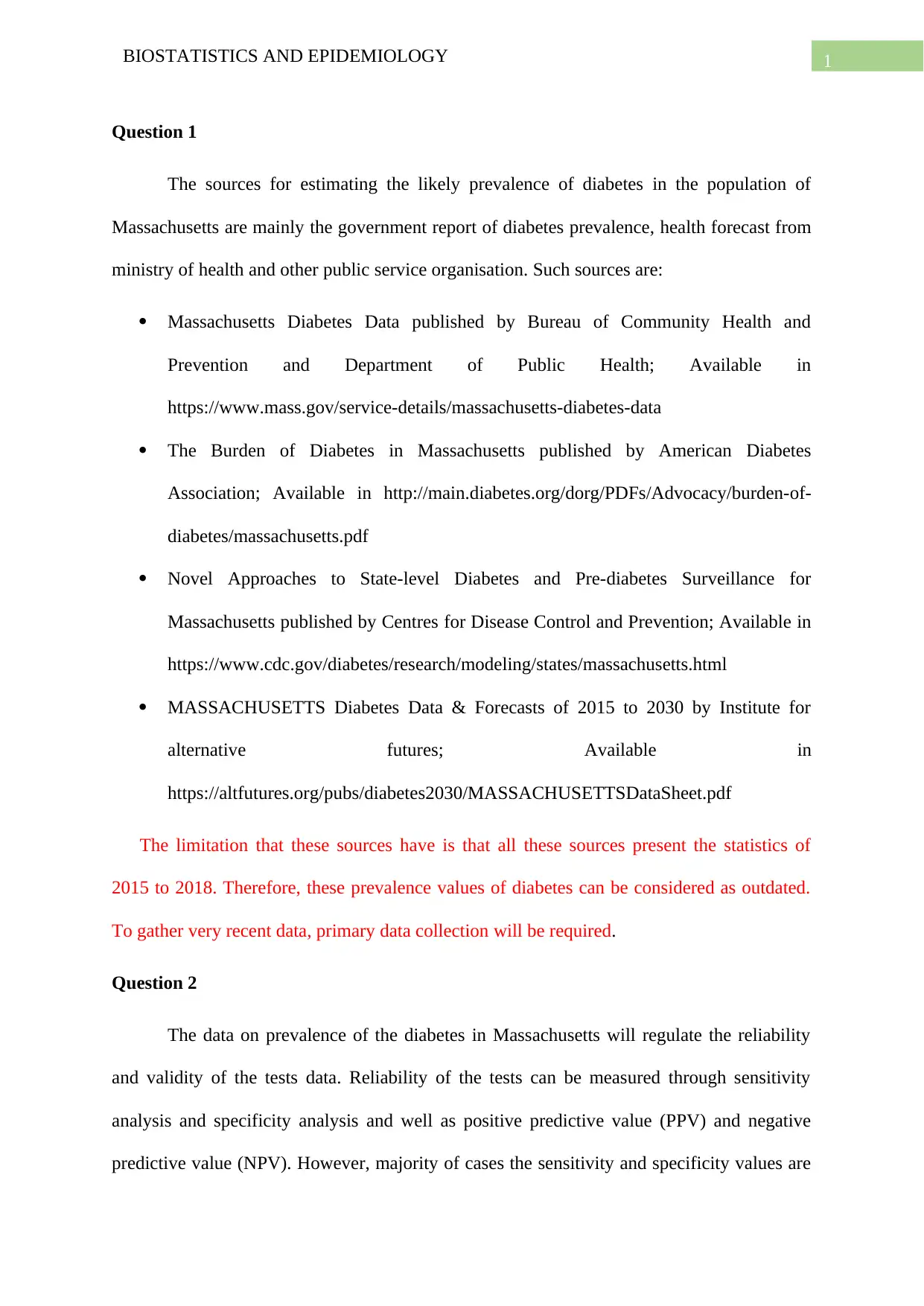
Question 1
The sources for estimating the likely prevalence of diabetes in the population of
Massachusetts are mainly the government report of diabetes prevalence, health forecast from
ministry of health and other public service organisation. Such sources are:
Massachusetts Diabetes Data published by Bureau of Community Health and
Prevention and Department of Public Health; Available in
https://www.mass.gov/service-details/massachusetts-diabetes-data
The Burden of Diabetes in Massachusetts published by American Diabetes
Association; Available in http://main.diabetes.org/dorg/PDFs/Advocacy/burden-of-
diabetes/massachusetts.pdf
Novel Approaches to State-level Diabetes and Pre-diabetes Surveillance for
Massachusetts published by Centres for Disease Control and Prevention; Available in
https://www.cdc.gov/diabetes/research/modeling/states/massachusetts.html
MASSACHUSETTS Diabetes Data & Forecasts of 2015 to 2030 by Institute for
alternative futures; Available in
https://altfutures.org/pubs/diabetes2030/MASSACHUSETTSDataSheet.pdf
The limitation that these sources have is that all these sources present the statistics of
2015 to 2018. Therefore, these prevalence values of diabetes can be considered as outdated.
To gather very recent data, primary data collection will be required.
Question 2
The data on prevalence of the diabetes in Massachusetts will regulate the reliability
and validity of the tests data. Reliability of the tests can be measured through sensitivity
analysis and specificity analysis and well as positive predictive value (PPV) and negative
predictive value (NPV). However, majority of cases the sensitivity and specificity values are
Document Page
2BIOSTATISTICS AND EPIDEMIOLOGY
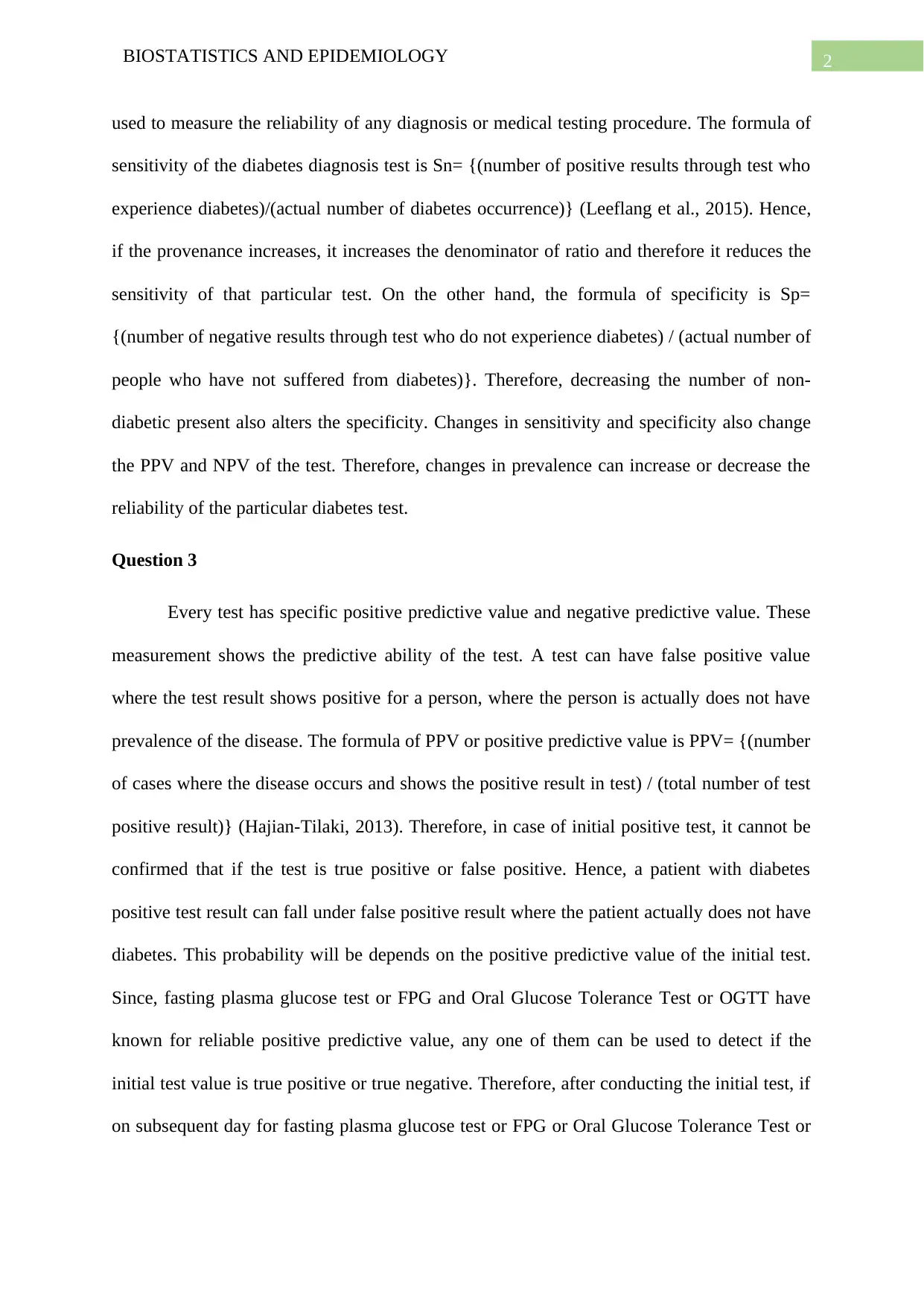
used to measure the reliability of any diagnosis or medical testing procedure. The formula of
sensitivity of the diabetes diagnosis test is Sn= {(number of positive results through test who
experience diabetes)/(actual number of diabetes occurrence)} (Leeflang et al., 2015). Hence,
if the provenance increases, it increases the denominator of ratio and therefore it reduces the
sensitivity of that particular test. On the other hand, the formula of specificity is Sp=
{(number of negative results through test who do not experience diabetes) / (actual number of
people who have not suffered from diabetes)}. Therefore, decreasing the number of non-
diabetic present also alters the specificity. Changes in sensitivity and specificity also change
the PPV and NPV of the test. Therefore, changes in prevalence can increase or decrease the
reliability of the particular diabetes test.
Question 3
Every test has specific positive predictive value and negative predictive value. These
measurement shows the predictive ability of the test. A test can have false positive value
where the test result shows positive for a person, where the person is actually does not have
prevalence of the disease. The formula of PPV or positive predictive value is PPV= {(number
of cases where the disease occurs and shows the positive result in test) / (total number of test
positive result)} (Hajian-Tilaki, 2013). Therefore, in case of initial positive test, it cannot be
confirmed that if the test is true positive or false positive. Hence, a patient with diabetes
positive test result can fall under false positive result where the patient actually does not have
diabetes. This probability will be depends on the positive predictive value of the initial test.
Since, fasting plasma glucose test or FPG and Oral Glucose Tolerance Test or OGTT have
known for reliable positive predictive value, any one of them can be used to detect if the
initial test value is true positive or true negative. Therefore, after conducting the initial test, if
on subsequent day for fasting plasma glucose test or FPG or Oral Glucose Tolerance Test or
Document Page
3BIOSTATISTICS AND EPIDEMIOLOGY
OGTT shows the positive result the patient will be treated as true positive case. Otherwise,
for negative result in FPG or OGTT the patient will be considered as false positive case.
Question 4
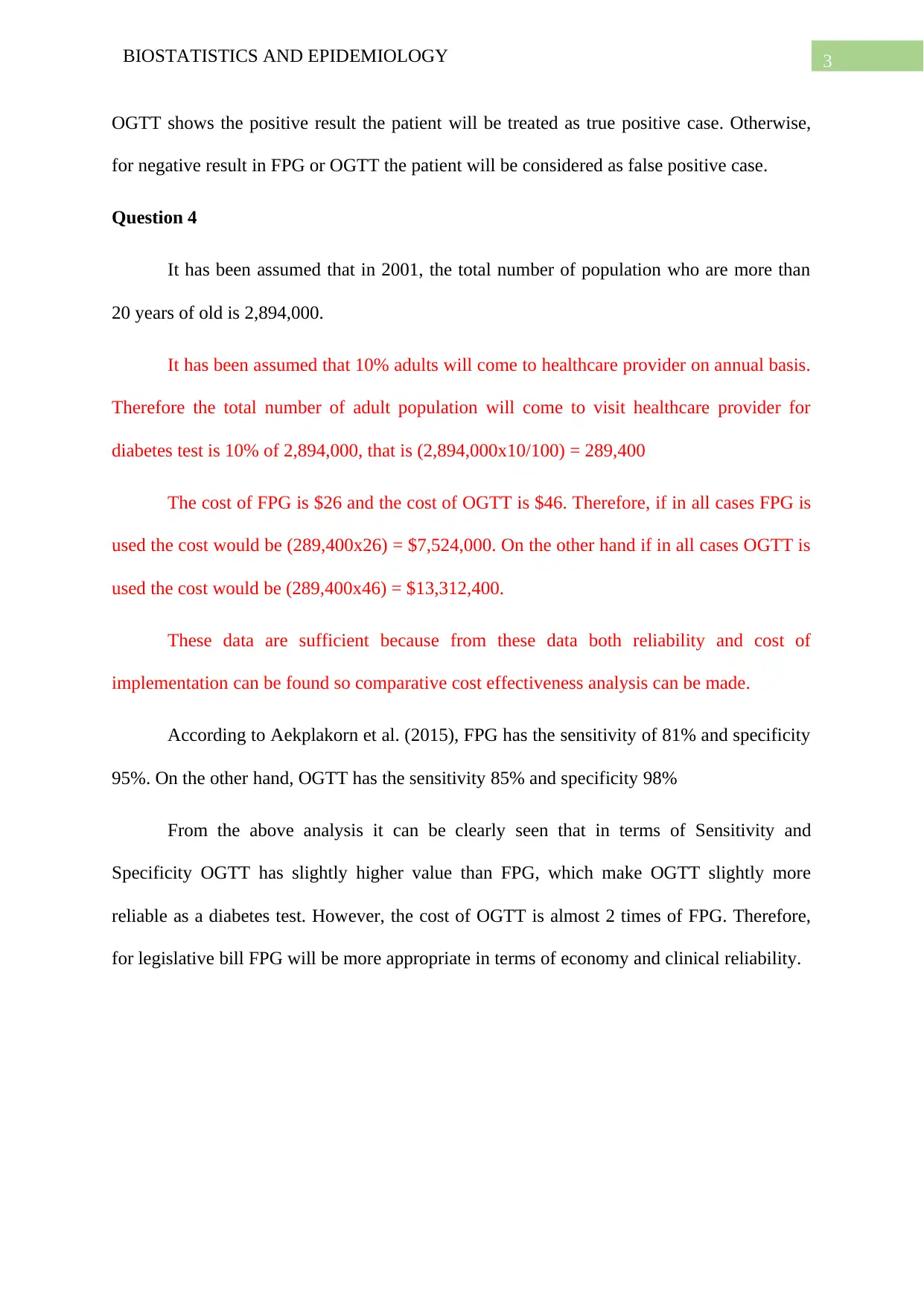
It has been assumed that in 2001, the total number of population who are more than
20 years of old is 2,894,000.
It has been assumed that 10% adults will come to healthcare provider on annual basis.
Therefore the total number of adult population will come to visit healthcare provider for
diabetes test is 10% of 2,894,000, that is (2,894,000x10/100) = 289,400
The cost of FPG is $26 and the cost of OGTT is $46. Therefore, if in all cases FPG is
used the cost would be (289,400x26) = $7,524,000. On the other hand if in all cases OGTT is
used the cost would be (289,400x46) = $13,312,400.
These data are sufficient because from these data both reliability and cost of
implementation can be found so comparative cost effectiveness analysis can be made.
According to Aekplakorn et al. (2015), FPG has the sensitivity of 81% and specificity
95%. On the other hand, OGTT has the sensitivity 85% and specificity 98%
From the above analysis it can be clearly seen that in terms of Sensitivity and
Specificity OGTT has slightly higher value than FPG, which make OGTT slightly more
reliable as a diabetes test. However, the cost of OGTT is almost 2 times of FPG. Therefore,
for legislative bill FPG will be more appropriate in terms of economy and clinical reliability.
tabler-icon-diamond-filled.svg

Paraphrase This Document

Need a fresh take? Get an instant paraphrase of this document with our AI Paraphraser
Document Page
4BIOSTATISTICS AND EPIDEMIOLOGY
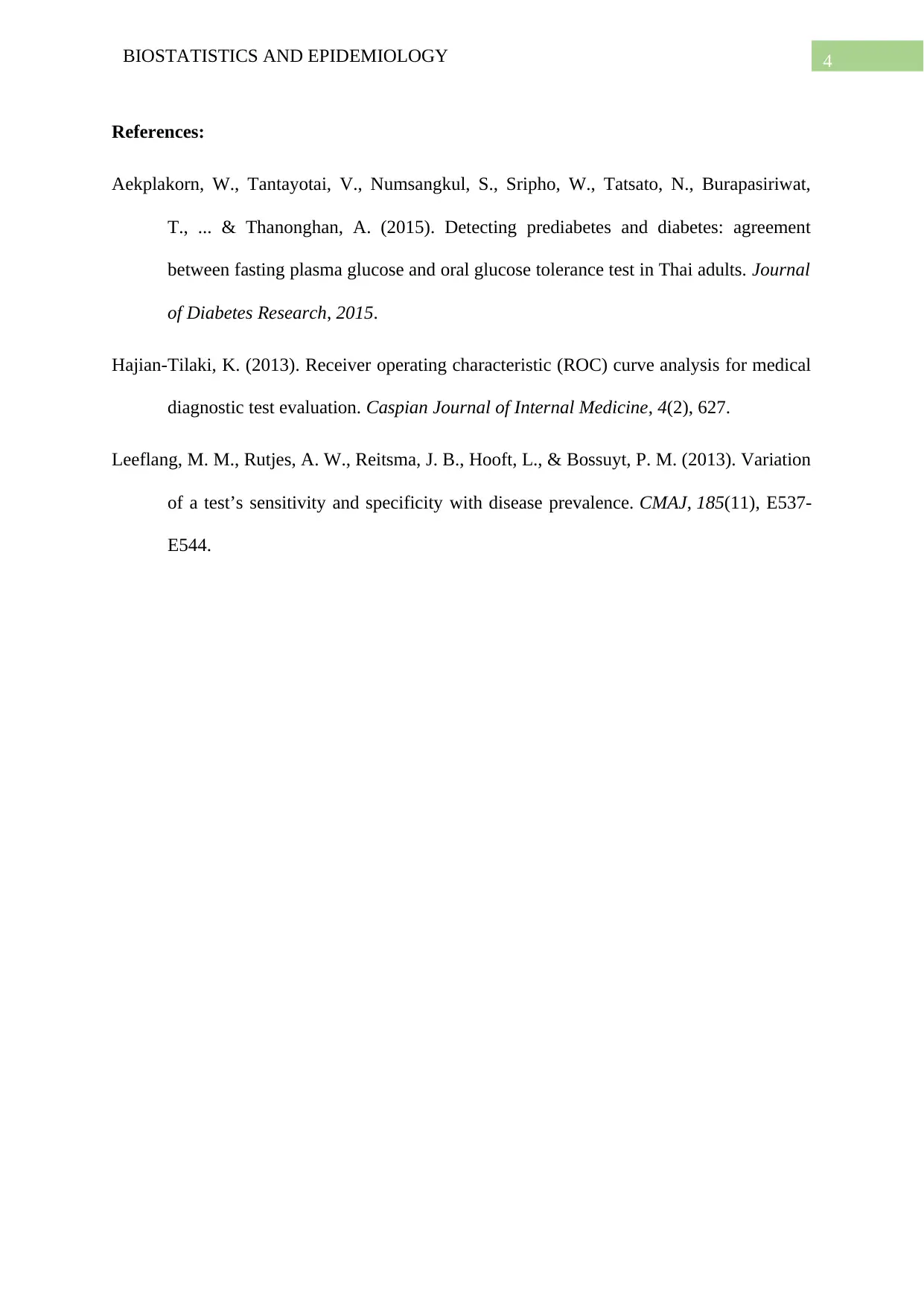
References:
Aekplakorn, W., Tantayotai, V., Numsangkul, S., Sripho, W., Tatsato, N., Burapasiriwat,
T., ... & Thanonghan, A. (2015). Detecting prediabetes and diabetes: agreement
between fasting plasma glucose and oral glucose tolerance test in Thai adults. Journal
of Diabetes Research, 2015.
Hajian-Tilaki, K. (2013). Receiver operating characteristic (ROC) curve analysis for medical
diagnostic test evaluation. Caspian Journal of Internal Medicine, 4(2), 627.
Leeflang, M. M., Rutjes, A. W., Reitsma, J. B., Hooft, L., & Bossuyt, P. M. (2013). Variation
of a test’s sensitivity and specificity with disease prevalence. CMAJ, 185(11), E537-
E544.
chevron_up_icon
1 out of 5
circle_padding
hide_on_mobile
zoom_out_icon
[object Object]