Biostatistics Assignment: Solutions for Data Analysis Problems
VerifiedAdded on 2023/06/08
|12
|1011
|333
Homework Assignment
AI Summary
This document presents a comprehensive solution to a biostatistics assignment. The assignment covers various aspects of biostatistics, including descriptive statistics, probability calculations, and data analysis. The solution includes answers to questions on variable classification, analysis of relationships between gender and mode of transport, descriptive statistics for driver's license status, and the application of z-scores. The assignment also involves interpreting plots, calculating probabilities related to age and area of study, and analyzing blood group distributions. Furthermore, the solution addresses questions on sleep duration, including z-score calculations and probability estimations for different sample sizes. The document provides a thorough understanding of the concepts and methodologies used in biostatistics.
Running Head: BIOSTATISTICS
Biostatistics
Name of the Student
Name of the University
Author Note
Biostatistics
Name of the Student
Name of the University
Author Note
Paraphrase This Document
Need a fresh take? Get an instant paraphrase of this document with our AI Paraphraser

1BIOSTATISTICS
Table of Contents
Answer 2..........................................................................................................................................3
Part a............................................................................................................................................3
Part b............................................................................................................................................3
Answer 3..........................................................................................................................................4
Part a............................................................................................................................................4
Part b............................................................................................................................................5
Part c............................................................................................................................................5
Answer 4..........................................................................................................................................6
Part a............................................................................................................................................6
Part b............................................................................................................................................6
Answer 5..........................................................................................................................................6
Part a............................................................................................................................................6
Part b............................................................................................................................................6
Part c............................................................................................................................................7
Answer 6..........................................................................................................................................8
Part a............................................................................................................................................8
Part b............................................................................................................................................8
Part c............................................................................................................................................9
Answer 7..........................................................................................................................................9
Table of Contents
Answer 2..........................................................................................................................................3
Part a............................................................................................................................................3
Part b............................................................................................................................................3
Answer 3..........................................................................................................................................4
Part a............................................................................................................................................4
Part b............................................................................................................................................5
Part c............................................................................................................................................5
Answer 4..........................................................................................................................................6
Part a............................................................................................................................................6
Part b............................................................................................................................................6
Answer 5..........................................................................................................................................6
Part a............................................................................................................................................6
Part b............................................................................................................................................6
Part c............................................................................................................................................7
Answer 6..........................................................................................................................................8
Part a............................................................................................................................................8
Part b............................................................................................................................................8
Part c............................................................................................................................................9
Answer 7..........................................................................................................................................9

2BIOSTATISTICS
Part a............................................................................................................................................9
Part b............................................................................................................................................9
Part c..........................................................................................................................................10
Part d..........................................................................................................................................11
Part a............................................................................................................................................9
Part b............................................................................................................................................9
Part c..........................................................................................................................................10
Part d..........................................................................................................................................11
⊘ This is a preview!⊘
Do you want full access?
Subscribe today to unlock all pages.

Trusted by 1+ million students worldwide

3BIOSTATISTICS
Answer 2
Part a
Gender Mode of Transport
Driver Passenger Other
Female 28 61 39
Male 52 62 29
Part b
Gender Mode of Transport Total
Driver Passenger Other
Female 28 61 39 128
21.9% 47.7% 30.5% 100%
Male 52 62 29 143
36.4% 43.4% 20.3% 100%
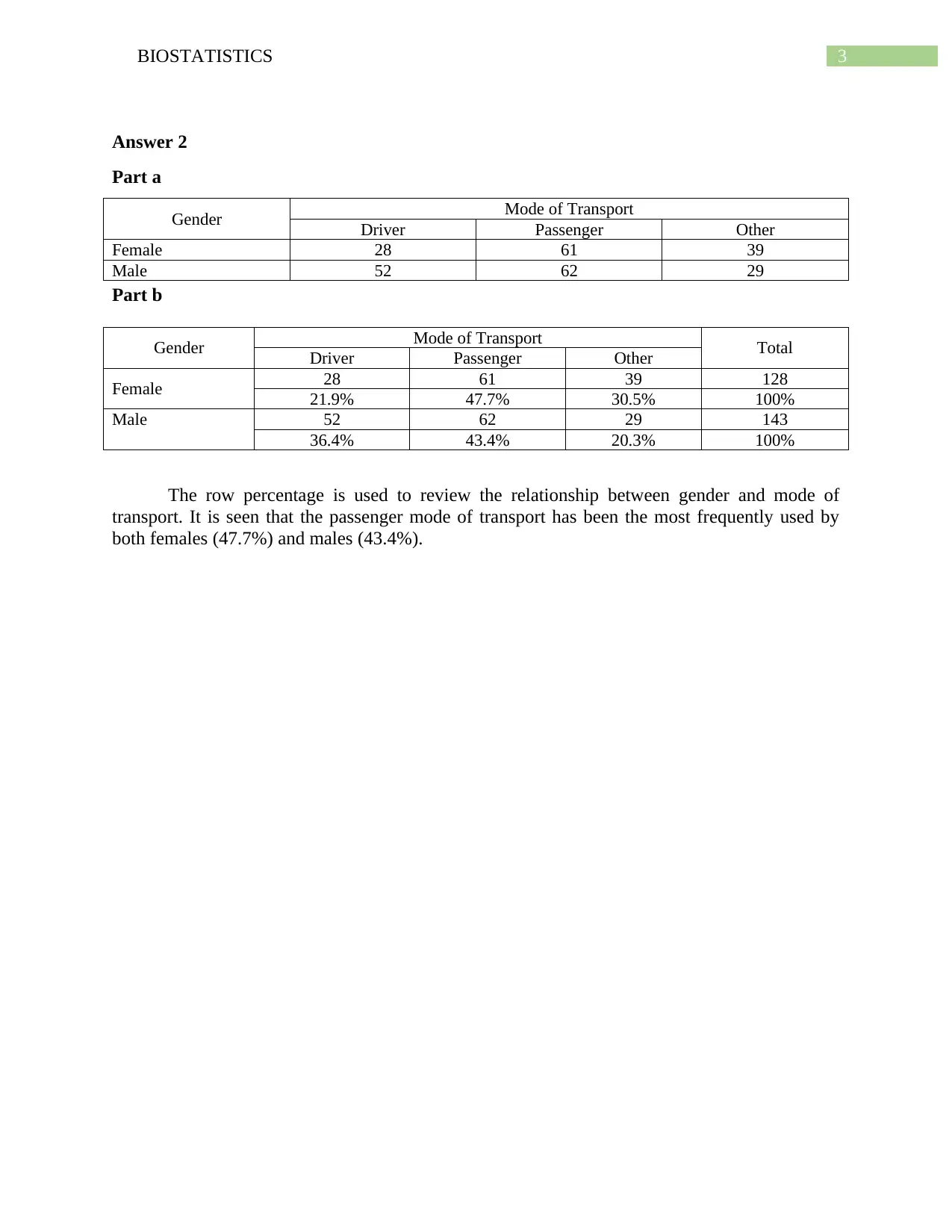
The row percentage is used to review the relationship between gender and mode of
transport. It is seen that the passenger mode of transport has been the most frequently used by
both females (47.7%) and males (43.4%).
Answer 2
Part a
Gender Mode of Transport
Driver Passenger Other
Female 28 61 39
Male 52 62 29
Part b
Gender Mode of Transport Total
Driver Passenger Other
Female 28 61 39 128
21.9% 47.7% 30.5% 100%
Male 52 62 29 143
36.4% 43.4% 20.3% 100%
The row percentage is used to review the relationship between gender and mode of
transport. It is seen that the passenger mode of transport has been the most frequently used by
both females (47.7%) and males (43.4%).
Paraphrase This Document
Need a fresh take? Get an instant paraphrase of this document with our AI Paraphraser

4BIOSTATISTICS
Answer 3
Part a
Answer 3
Part a

5BIOSTATISTICS
Part b
Statistics Not-licenced Learners permit Licenced
Mean 6.550725 6.293333 8.370079
Standard Deviation 2.179694 2.252766 2.107444
Minimum 3 2 3
1st Quartile 5 4 7
Median 6 6 9
3rd Quartile 8 8 10
Maximum 11 12 13
Range 8 10 10
IQR 3 4 3
Skewness 0.135572 0.3590054 -0.2056677
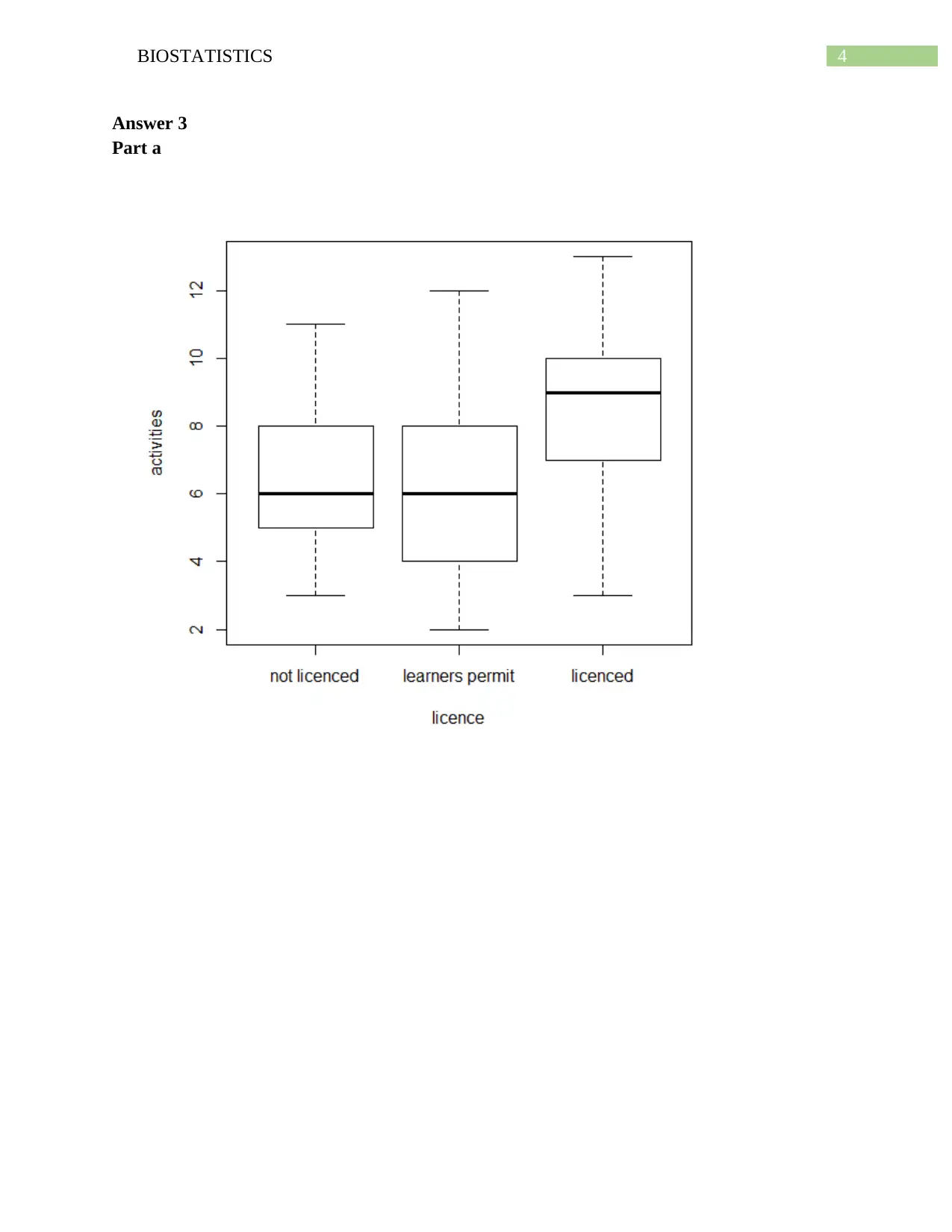
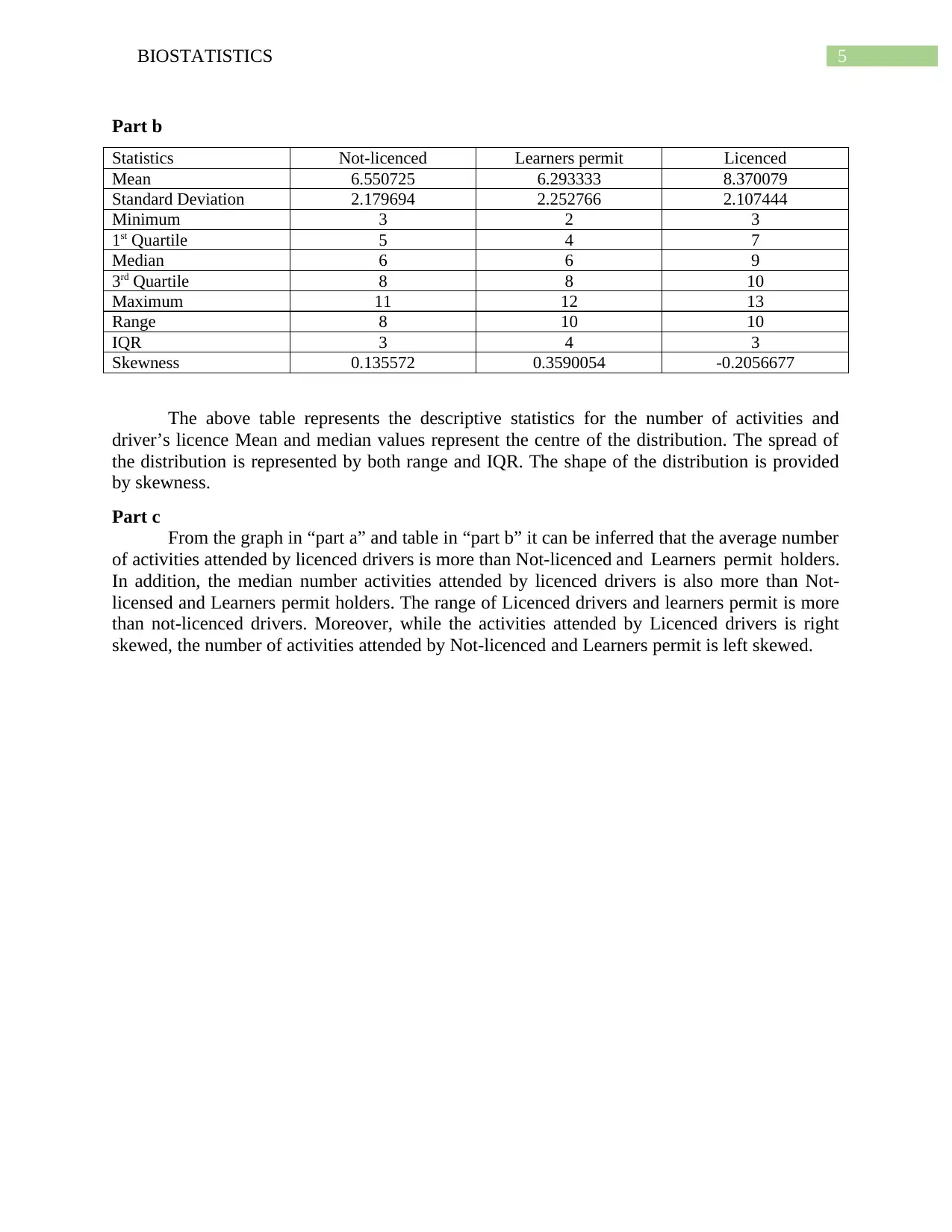
The above table represents the descriptive statistics for the number of activities and
driver’s licence Mean and median values represent the centre of the distribution. The spread of
the distribution is represented by both range and IQR. The shape of the distribution is provided
by skewness.
Part c
From the graph in “part a” and table in “part b” it can be inferred that the average number
of activities attended by licenced drivers is more than Not-licenced and Learners permit holders.
In addition, the median number activities attended by licenced drivers is also more than Not-
licensed and Learners permit holders. The range of Licenced drivers and learners permit is more
than not-licenced drivers. Moreover, while the activities attended by Licenced drivers is right
skewed, the number of activities attended by Not-licenced and Learners permit is left skewed.
Part b
Statistics Not-licenced Learners permit Licenced
Mean 6.550725 6.293333 8.370079
Standard Deviation 2.179694 2.252766 2.107444
Minimum 3 2 3
1st Quartile 5 4 7
Median 6 6 9
3rd Quartile 8 8 10
Maximum 11 12 13
Range 8 10 10
IQR 3 4 3
Skewness 0.135572 0.3590054 -0.2056677
The above table represents the descriptive statistics for the number of activities and
driver’s licence Mean and median values represent the centre of the distribution. The spread of
the distribution is represented by both range and IQR. The shape of the distribution is provided
by skewness.
Part c
From the graph in “part a” and table in “part b” it can be inferred that the average number
of activities attended by licenced drivers is more than Not-licenced and Learners permit holders.
In addition, the median number activities attended by licenced drivers is also more than Not-
licensed and Learners permit holders. The range of Licenced drivers and learners permit is more
than not-licenced drivers. Moreover, while the activities attended by Licenced drivers is right
skewed, the number of activities attended by Not-licenced and Learners permit is left skewed.
⊘ This is a preview!⊘
Do you want full access?
Subscribe today to unlock all pages.

Trusted by 1+ million students worldwide

6BIOSTATISTICS
Answer 4
Part a
Part b
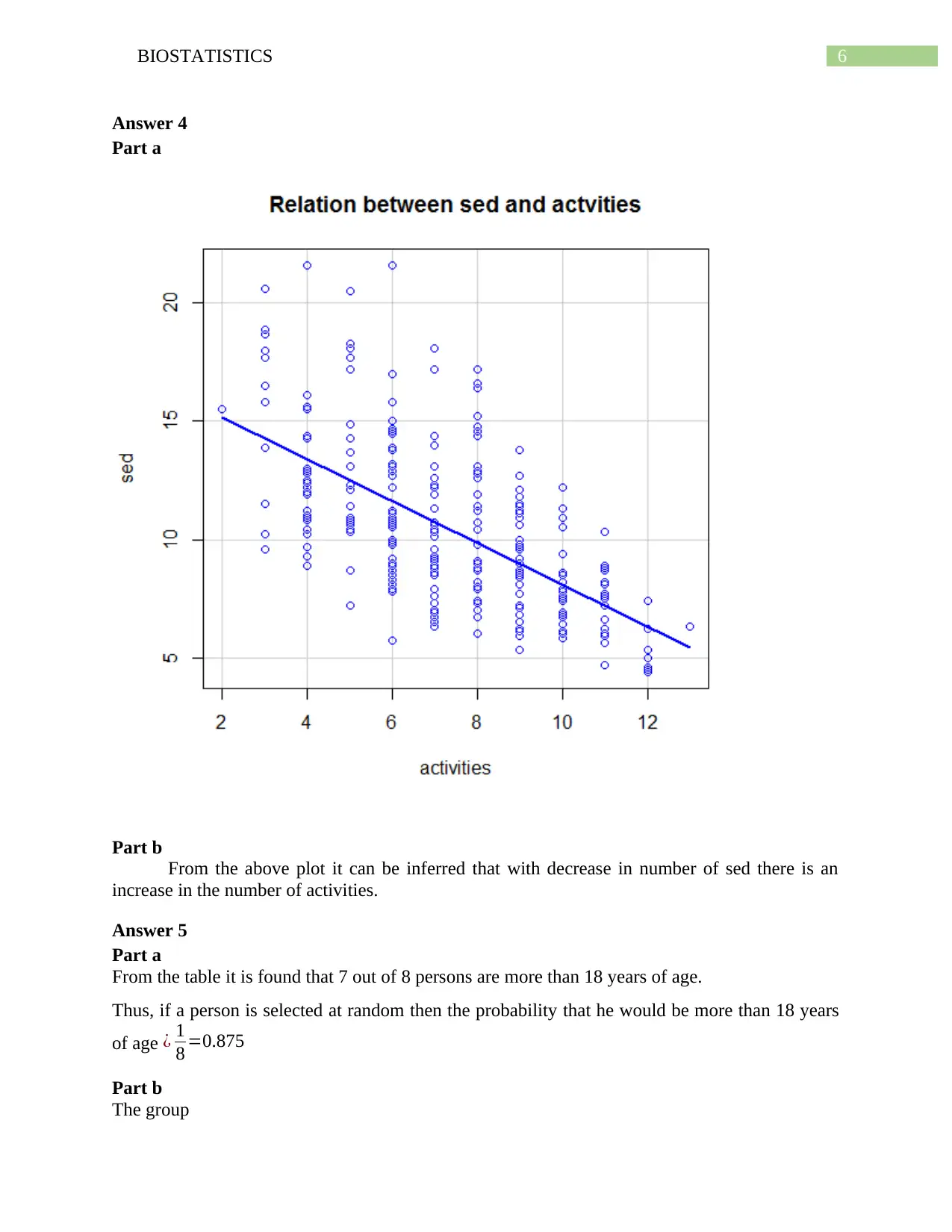
From the above plot it can be inferred that with decrease in number of sed there is an
increase in the number of activities.
Answer 5
Part a
From the table it is found that 7 out of 8 persons are more than 18 years of age.
Thus, if a person is selected at random then the probability that he would be more than 18 years
of age ¿ 1
8 =0.875
Part b
The group
Answer 4
Part a
Part b
From the above plot it can be inferred that with decrease in number of sed there is an
increase in the number of activities.
Answer 5
Part a
From the table it is found that 7 out of 8 persons are more than 18 years of age.
Thus, if a person is selected at random then the probability that he would be more than 18 years
of age ¿ 1
8 =0.875
Part b
The group
Paraphrase This Document
Need a fresh take? Get an instant paraphrase of this document with our AI Paraphraser

7BIOSTATISTICS
Gender Area of Study Total
Accounting Nursing Psychology
Female 0 2 2 4
Male 1 1 2 4
Total 1 3 4 8
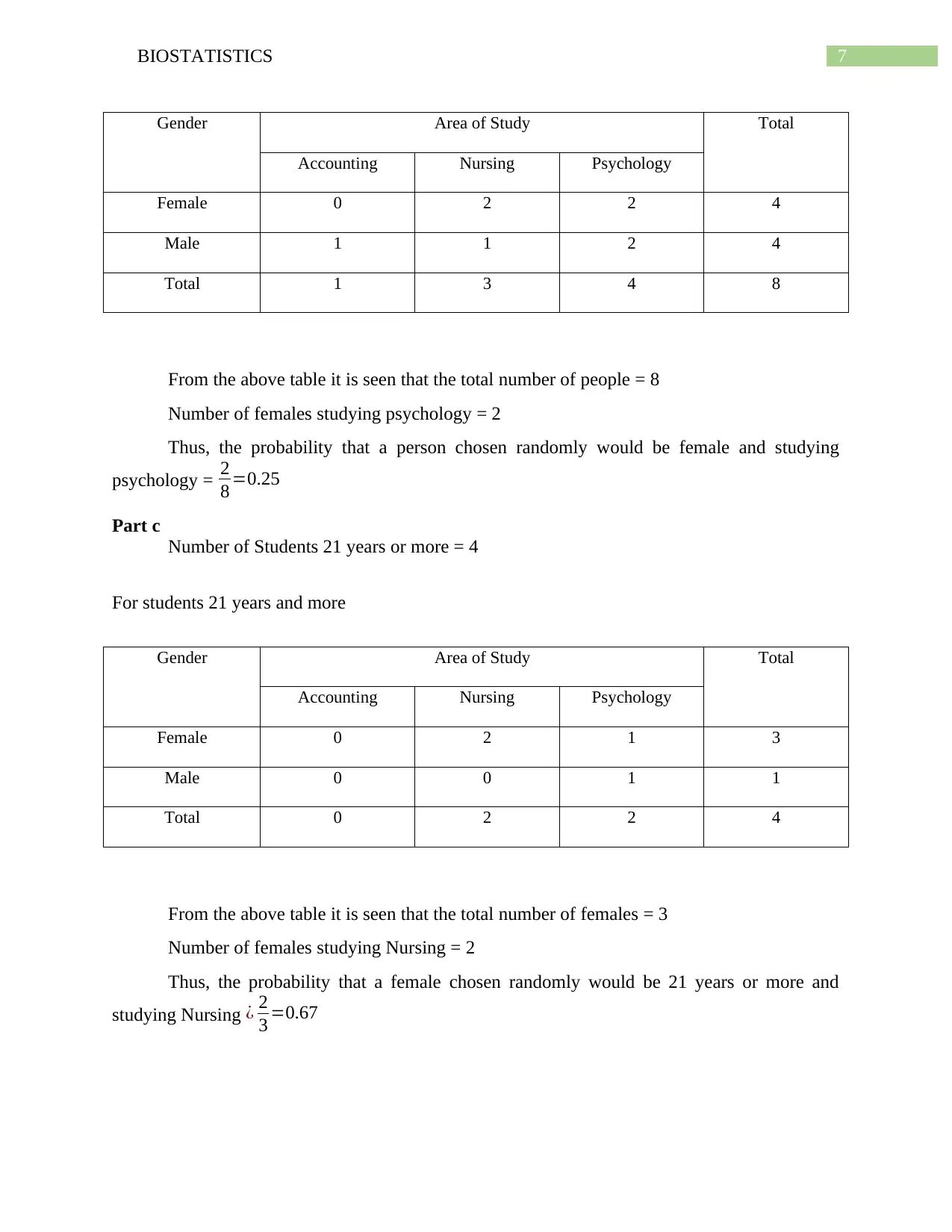
From the above table it is seen that the total number of people = 8
Number of females studying psychology = 2
Thus, the probability that a person chosen randomly would be female and studying
psychology = 2
8 =0.25
Part c
Number of Students 21 years or more = 4
For students 21 years and more
Gender Area of Study Total
Accounting Nursing Psychology
Female 0 2 1 3
Male 0 0 1 1
Total 0 2 2 4
From the above table it is seen that the total number of females = 3
Number of females studying Nursing = 2
Thus, the probability that a female chosen randomly would be 21 years or more and
studying Nursing ¿ 2
3 =0.67
Gender Area of Study Total
Accounting Nursing Psychology
Female 0 2 2 4
Male 1 1 2 4
Total 1 3 4 8
From the above table it is seen that the total number of people = 8
Number of females studying psychology = 2
Thus, the probability that a person chosen randomly would be female and studying
psychology = 2
8 =0.25
Part c
Number of Students 21 years or more = 4
For students 21 years and more
Gender Area of Study Total
Accounting Nursing Psychology
Female 0 2 1 3
Male 0 0 1 1
Total 0 2 2 4
From the above table it is seen that the total number of females = 3
Number of females studying Nursing = 2
Thus, the probability that a female chosen randomly would be 21 years or more and
studying Nursing ¿ 2
3 =0.67

8BIOSTATISTICS
Answer 6
Part a
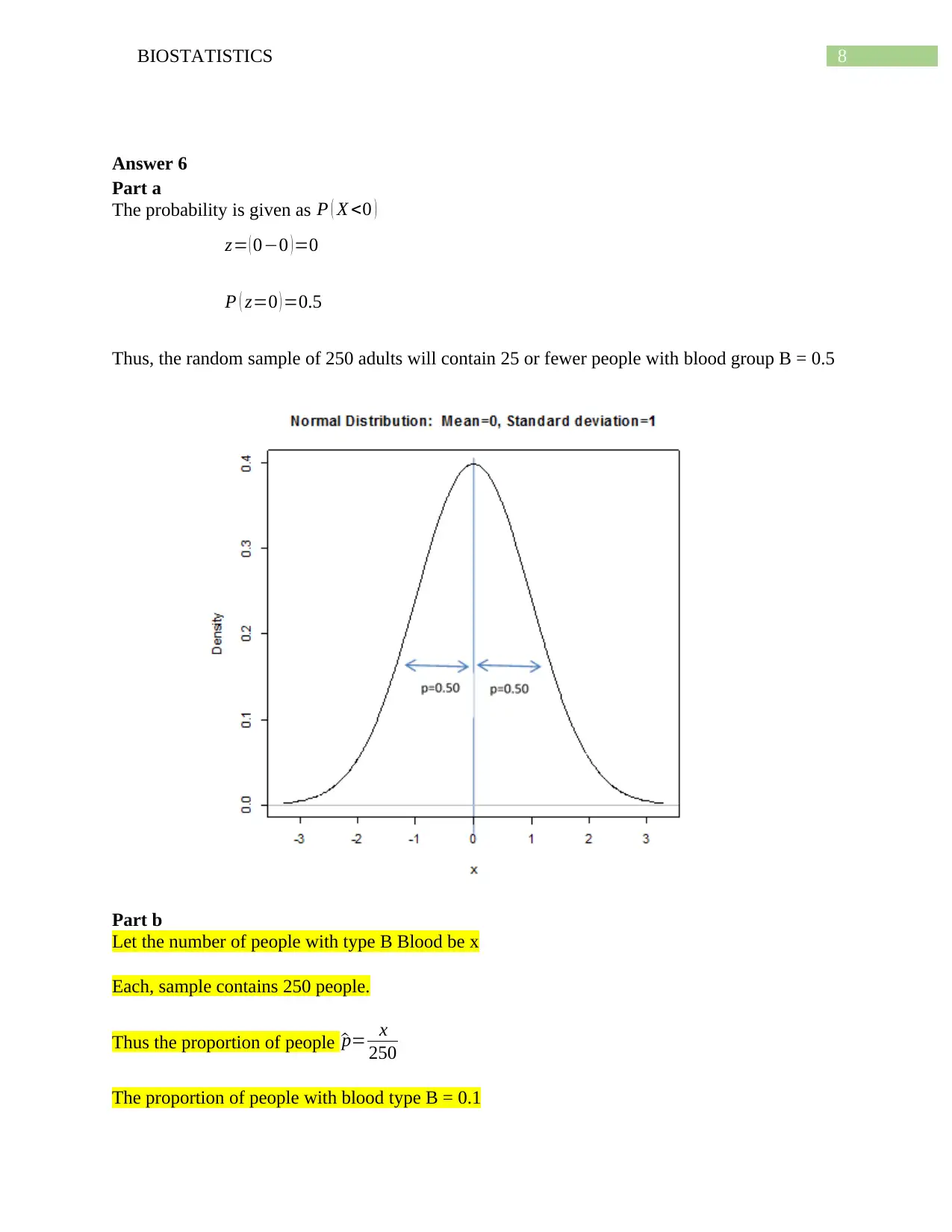
The probability is given as P ( X <0 )
z= ( 0−0 )=0
P ( z=0 ) =0.5
Thus, the random sample of 250 adults will contain 25 or fewer people with blood group B = 0.5
Part b
Let the number of people with type B Blood be x
Each, sample contains 250 people.
Thus the proportion of people ^p= x
250
The proportion of people with blood type B = 0.1
Answer 6
Part a
The probability is given as P ( X <0 )
z= ( 0−0 )=0
P ( z=0 ) =0.5
Thus, the random sample of 250 adults will contain 25 or fewer people with blood group B = 0.5
Part b
Let the number of people with type B Blood be x
Each, sample contains 250 people.
Thus the proportion of people ^p= x
250
The proportion of people with blood type B = 0.1
⊘ This is a preview!⊘
Do you want full access?
Subscribe today to unlock all pages.

Trusted by 1+ million students worldwide

9BIOSTATISTICS
Thus,
^p−0.1
√ 0.1∗0.9
250
=0.12
Thus, ^p=25.6≈ 26
Thus, there are fewer than 26 people with blood type B in a sample
Part c
Thus, the mean number of people per sample with blood type B = 26*0.1 = 2.6
Answer 7
Part a
z-score = 1
mean number of hours of sleep = 8.2
standard deviation of hours of sleep = 0.6
1= X −μ
σ = X−8.2
0.6
X =0.6+8.2=8.8
Thus, 8.8 hours of sleep corresponds to z-score of 1
Part b
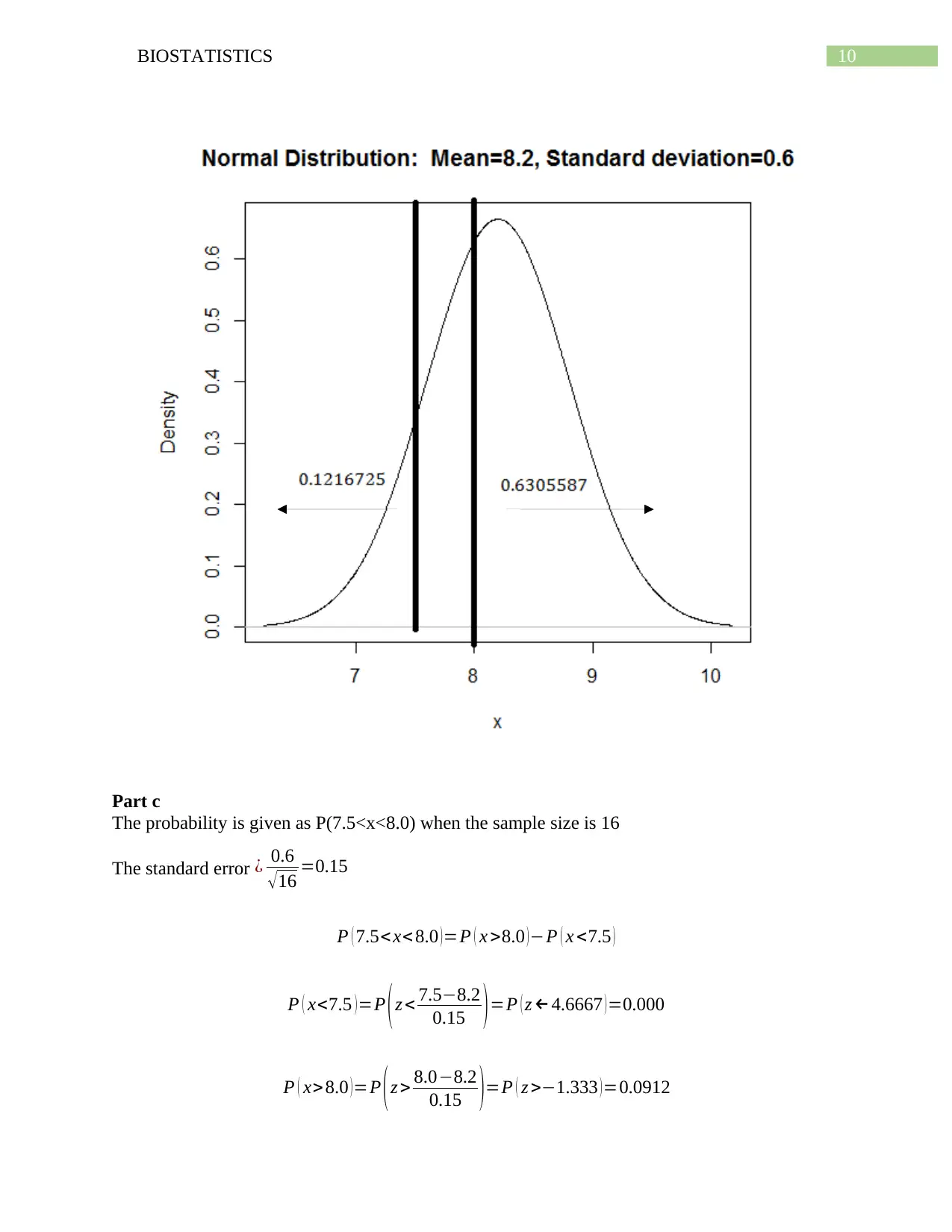
P ( 7.5<x<8.0 )=1−P ( x <7.5 ) −P ( x >8.0 )
¿ 1−0.1216725−0.6305587=0.2477688
The probability that the persons sleeps between 8.0 and 7.5 hours 0.2477688
Thus,
^p−0.1
√ 0.1∗0.9
250
=0.12
Thus, ^p=25.6≈ 26
Thus, there are fewer than 26 people with blood type B in a sample
Part c
Thus, the mean number of people per sample with blood type B = 26*0.1 = 2.6
Answer 7
Part a
z-score = 1
mean number of hours of sleep = 8.2
standard deviation of hours of sleep = 0.6
1= X −μ
σ = X−8.2
0.6
X =0.6+8.2=8.8
Thus, 8.8 hours of sleep corresponds to z-score of 1
Part b
P ( 7.5<x<8.0 )=1−P ( x <7.5 ) −P ( x >8.0 )
¿ 1−0.1216725−0.6305587=0.2477688
The probability that the persons sleeps between 8.0 and 7.5 hours 0.2477688
Paraphrase This Document
Need a fresh take? Get an instant paraphrase of this document with our AI Paraphraser

10BIOSTATISTICS
Part c
The probability is given as P(7.5<x<8.0) when the sample size is 16
The standard error ¿ 0.6
√16 =0.15
P ( 7.5< x< 8.0 )=P ( x >8.0 )−P ( x <7.5 )
P ( x<7.5 ) =P ( z < 7.5−8.2
0.15 ) =P ( z ← 4.6667 ) =0.000
P ( x> 8.0 )=P (z > 8.0−8.2
0.15 )=P ( z >−1.333 )=0.0912
Part c
The probability is given as P(7.5<x<8.0) when the sample size is 16
The standard error ¿ 0.6
√16 =0.15
P ( 7.5< x< 8.0 )=P ( x >8.0 )−P ( x <7.5 )
P ( x<7.5 ) =P ( z < 7.5−8.2
0.15 ) =P ( z ← 4.6667 ) =0.000
P ( x> 8.0 )=P (z > 8.0−8.2
0.15 )=P ( z >−1.333 )=0.0912

11BIOSTATISTICS
¿ 0.0912−0.000=0.0912
Thus the probability that the sample mean would lie between 7.5 and 8.0 hours = 0.0912
Part d
The probability = 0.0912
The sample size = 16
Thus the number in the groups = 16*0.0912 = 1.4592 ≈1
¿ 0.0912−0.000=0.0912
Thus the probability that the sample mean would lie between 7.5 and 8.0 hours = 0.0912
Part d
The probability = 0.0912
The sample size = 16
Thus the number in the groups = 16*0.0912 = 1.4592 ≈1
⊘ This is a preview!⊘
Do you want full access?
Subscribe today to unlock all pages.

Trusted by 1+ million students worldwide
1 out of 12
Related Documents
Your All-in-One AI-Powered Toolkit for Academic Success.
+13062052269
info@desklib.com
Available 24*7 on WhatsApp / Email
Unlock your academic potential
Copyright © 2020–2025 A2Z Services. All Rights Reserved. Developed and managed by ZUCOL.