Marketing Report: Jones Blair Company's Market Segmentation Analysis
VerifiedAdded on 2023/01/13
|22
|5638
|47
Report
AI Summary
This report provides a comprehensive marketing analysis of the Jones Blair Company, a paint manufacturer and marketer operating in the southwestern United States. The report begins with an overview of the U.S. paint industry, segmenting it into architectural coatings, original equipment manufacturing (OEM) coatings, and special-purpose coatings. It then examines the characteristics of Jones Blair's service area, including sales and distribution channels, and analyzes the competitive landscape at both the retail and manufacturing levels. The report segments the local market into urban and rural DFW areas, further dividing each segment into do-it-yourself homeowners and professional painters. It assesses the attractiveness of each segment, considering the needs and wants of purchasers. The analysis delves into the competitive position of Jones Blair, and recommends a targeting strategy, evaluating the economic and financial implications of different strategic options. The report concludes with a recommendation for the company's future marketing approach.
Sample of Cover Page
University / Institution ……………………………………
Program Name ……………………………………
Full Name ……………………………………
Student ID ……………………………………
Module Code ……………………………………
Module Name ……………………………………
Submission Date ……………………………………
Total Pages ……………………………………
(Include Cover Page)
University / Institution ……………………………………
Program Name ……………………………………
Full Name ……………………………………
Student ID ……………………………………
Module Code ……………………………………
Module Name ……………………………………
Submission Date ……………………………………
Total Pages ……………………………………
(Include Cover Page)

Paraphrase This Document
Need a fresh take? Get an instant paraphrase of this document with our AI Paraphraser
Introduction
John Blair Company manufactures and markets the paint products and sundry items across fifty
counties in Oklahoma, Texas, and Louisiana. The products are supplied from the Dallas headquarters
and plants in Texas. The company’s sundries and architectural paint sales volume in the FY 1996
reached over $12 million, and the total accumulated net profit was recorded to be $1,140,000 Dollar
sales witnessed an average annual rate increase of 4 percent per year for the next ten years. Though
the paint gallonage remained stable for five consecutive years.
Jones Blair company haven't been able to get access to the retail outlets, but they have significant
opportunity to buy their way into through promotional allowances, free goods, or anything that can
be available for them shortly. The owner and managers at Jones Blair believe that mass
merchandisers control almost half of the do-it-yourself homeowners in the metropolitan area of
DFW.
John Blair Company manufactures and markets the paint products and sundry items across fifty
counties in Oklahoma, Texas, and Louisiana. The products are supplied from the Dallas headquarters
and plants in Texas. The company’s sundries and architectural paint sales volume in the FY 1996
reached over $12 million, and the total accumulated net profit was recorded to be $1,140,000 Dollar
sales witnessed an average annual rate increase of 4 percent per year for the next ten years. Though
the paint gallonage remained stable for five consecutive years.
Jones Blair company haven't been able to get access to the retail outlets, but they have significant
opportunity to buy their way into through promotional allowances, free goods, or anything that can
be available for them shortly. The owner and managers at Jones Blair believe that mass
merchandisers control almost half of the do-it-yourself homeowners in the metropolitan area of
DFW.
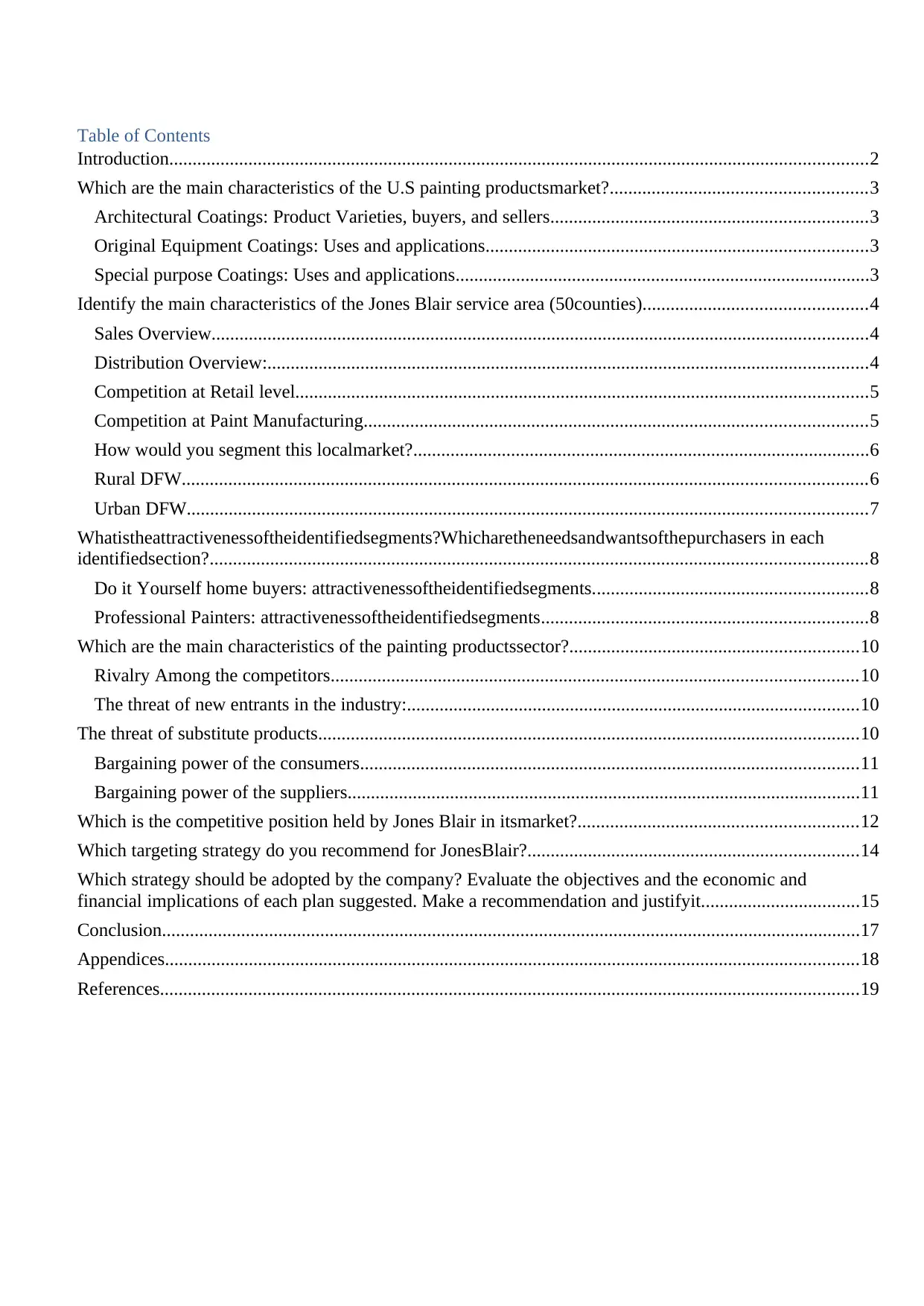
Table of Contents
Introduction......................................................................................................................................................2
Which are the main characteristics of the U.S painting productsmarket?.......................................................3
Architectural Coatings: Product Varieties, buyers, and sellers....................................................................3
Original Equipment Coatings: Uses and applications..................................................................................3
Special purpose Coatings: Uses and applications.........................................................................................3
Identify the main characteristics of the Jones Blair service area (50counties)................................................4
Sales Overview.............................................................................................................................................4
Distribution Overview:.................................................................................................................................4
Competition at Retail level...........................................................................................................................5
Competition at Paint Manufacturing............................................................................................................5
How would you segment this localmarket?..................................................................................................6
Rural DFW...................................................................................................................................................6
Urban DFW..................................................................................................................................................7
Whatistheattractivenessoftheidentifiedsegments?Whicharetheneedsandwantsofthepurchasers in each
identifiedsection?.............................................................................................................................................8
Do it Yourself home buyers: attractivenessoftheidentifiedsegments...........................................................8
Professional Painters: attractivenessoftheidentifiedsegments......................................................................8
Which are the main characteristics of the painting productssector?..............................................................10
Rivalry Among the competitors.................................................................................................................10
The threat of new entrants in the industry:.................................................................................................10
The threat of substitute products....................................................................................................................10
Bargaining power of the consumers...........................................................................................................11
Bargaining power of the suppliers..............................................................................................................11
Which is the competitive position held by Jones Blair in itsmarket?............................................................12
Which targeting strategy do you recommend for JonesBlair?.......................................................................14
Which strategy should be adopted by the company? Evaluate the objectives and the economic and
financial implications of each plan suggested. Make a recommendation and justifyit..................................15
Conclusion......................................................................................................................................................17
Appendices.....................................................................................................................................................18
References......................................................................................................................................................19
Introduction......................................................................................................................................................2
Which are the main characteristics of the U.S painting productsmarket?.......................................................3
Architectural Coatings: Product Varieties, buyers, and sellers....................................................................3
Original Equipment Coatings: Uses and applications..................................................................................3
Special purpose Coatings: Uses and applications.........................................................................................3
Identify the main characteristics of the Jones Blair service area (50counties)................................................4
Sales Overview.............................................................................................................................................4
Distribution Overview:.................................................................................................................................4
Competition at Retail level...........................................................................................................................5
Competition at Paint Manufacturing............................................................................................................5
How would you segment this localmarket?..................................................................................................6
Rural DFW...................................................................................................................................................6
Urban DFW..................................................................................................................................................7
Whatistheattractivenessoftheidentifiedsegments?Whicharetheneedsandwantsofthepurchasers in each
identifiedsection?.............................................................................................................................................8
Do it Yourself home buyers: attractivenessoftheidentifiedsegments...........................................................8
Professional Painters: attractivenessoftheidentifiedsegments......................................................................8
Which are the main characteristics of the painting productssector?..............................................................10
Rivalry Among the competitors.................................................................................................................10
The threat of new entrants in the industry:.................................................................................................10
The threat of substitute products....................................................................................................................10
Bargaining power of the consumers...........................................................................................................11
Bargaining power of the suppliers..............................................................................................................11
Which is the competitive position held by Jones Blair in itsmarket?............................................................12
Which targeting strategy do you recommend for JonesBlair?.......................................................................14
Which strategy should be adopted by the company? Evaluate the objectives and the economic and
financial implications of each plan suggested. Make a recommendation and justifyit..................................15
Conclusion......................................................................................................................................................17
Appendices.....................................................................................................................................................18
References......................................................................................................................................................19
⊘ This is a preview!⊘
Do you want full access?
Subscribe today to unlock all pages.

Trusted by 1+ million students worldwide
Which are the main characteristics of the U.S painting productsmarket?
The painting product market of the United States is divided into three main segments: the
architectural coatings, special-purpose coatings, and the original equipment manufacturing coatings
(OEVI). The pain industry in the U.S. is generally considered to be a developing industry, with
considerable growth in the average annual sales. The industry sales (inclusive of all three types of product
segmentation) was estimated to be higher over $13 billion, and the forecast of average annual growth was
estimated to approximate the average rate of inflation through the financial year 2000 (Cravens & Piercy,
2006).
Architectural Coatings: Product Varieties, buyers, and sellers
Out of the three main types of a paint product, the architectural coatings alone account for 43% of
the total industry sales (in the dollar). These are commonly called as shelf goods. The architectural paint
coatings primarily consist of general-purpose paints, such as the lacquers and varnishes, which are used on
commercial, institutional, and residential buildings. These products are sold through independent retailers
and wholesalers, and purchases by painting contractors, do-it-yourself homeowners, and the professional
painters (Wilson, Jones, & Pentecost, 2009).
Original Equipment Coatings: Uses and applications
Out of the three main types of pain products, the OEM coatings are the second best-selling coatings.
They account for 35% of the total industry sales (in the dollar). The Original Equipment Coatings sold in
the U.S are specially formulated to fulfil the requirement of industrial buyers and their specifications.
These are primarily used on original equipment during the manufacturing stages. The coatings are
applicable for durable goods such as transportation, trucks, automobiles, appliances, fixtures, furniture,
building products, industrial machinery, metal containers, and the metal equipment (Wilson, Jones, &
Pentecost, 2009).
Special purpose Coatings: Uses and applications
This is the third variety of paint product in the U.S market. Special-purpose coatings account for
over 22% of the total dollar sales in the paint industry (Wilson, Jones, & Pentecost, 2009). These coatings
are manufactured for particular applications or specific environmental conditions such as exposure to
chemicals, extreme temperature, protection against machinery corrosives or chemicals, and other corrosive
conditions. The special purpose coatings have main application in the machinery and automotive
refinishing, for example, industrial maintenance and construction work (including equipment, railroads,
factories, and utilities). Other areas of application include marine application, ship and offshore utilities,
The painting product market of the United States is divided into three main segments: the
architectural coatings, special-purpose coatings, and the original equipment manufacturing coatings
(OEVI). The pain industry in the U.S. is generally considered to be a developing industry, with
considerable growth in the average annual sales. The industry sales (inclusive of all three types of product
segmentation) was estimated to be higher over $13 billion, and the forecast of average annual growth was
estimated to approximate the average rate of inflation through the financial year 2000 (Cravens & Piercy,
2006).
Architectural Coatings: Product Varieties, buyers, and sellers
Out of the three main types of a paint product, the architectural coatings alone account for 43% of
the total industry sales (in the dollar). These are commonly called as shelf goods. The architectural paint
coatings primarily consist of general-purpose paints, such as the lacquers and varnishes, which are used on
commercial, institutional, and residential buildings. These products are sold through independent retailers
and wholesalers, and purchases by painting contractors, do-it-yourself homeowners, and the professional
painters (Wilson, Jones, & Pentecost, 2009).
Original Equipment Coatings: Uses and applications
Out of the three main types of pain products, the OEM coatings are the second best-selling coatings.
They account for 35% of the total industry sales (in the dollar). The Original Equipment Coatings sold in
the U.S are specially formulated to fulfil the requirement of industrial buyers and their specifications.
These are primarily used on original equipment during the manufacturing stages. The coatings are
applicable for durable goods such as transportation, trucks, automobiles, appliances, fixtures, furniture,
building products, industrial machinery, metal containers, and the metal equipment (Wilson, Jones, &
Pentecost, 2009).
Special purpose Coatings: Uses and applications
This is the third variety of paint product in the U.S market. Special-purpose coatings account for
over 22% of the total dollar sales in the paint industry (Wilson, Jones, & Pentecost, 2009). These coatings
are manufactured for particular applications or specific environmental conditions such as exposure to
chemicals, extreme temperature, protection against machinery corrosives or chemicals, and other corrosive
conditions. The special purpose coatings have main application in the machinery and automotive
refinishing, for example, industrial maintenance and construction work (including equipment, railroads,
factories, and utilities). Other areas of application include marine application, ship and offshore utilities,
Paraphrase This Document
Need a fresh take? Get an instant paraphrase of this document with our AI Paraphraser
bridges facilities, traffic, metallic paints, aerosol, and roof-paints (Morgan, Kaplan, & Gaffey, 2011).
Identify the main characteristics of the Jones Blair service area (50counties).
As a privately-owned company, John Blair company markets the architectural paint under their
brand name ‘John-Blair.’ Apart from producing a complete range of architectural coatings, the
manufactures also distribute and sell and an extensive range of sundries under the brand tag ‘John Blair
Sundries. The sundries include products that rollers, brushes, and thinners. These products are available
under different specifications and dimensions. Apart from manufacturing and marketing the pant and
sundries, the company also operates an exclusive range of very large OEM coatings division. They sell
their products in all the major cities of the United States and have distribution channels supplying these
products globally as well(Morgan, Kaplan, & Gaffey, 2011).
Sales Overview
John Blair Company manufactures and markets the paint products and sundry items across fifty
counties in Oklahoma, Texas, and Louisiana. The products are supplied from the Dallas headquarters and
plants in Texas. The company’s sundries and architectural paint sales volume in the FY 1996 reached
over $12 million, and the total accumulated net profit was recorded to be $1,140,000(Morgan, Kaplan, &
Gaffey, 2011). Dollar sales witnessed an average annual rate increase of 4 percent per year for the next
ten years. Though the paint gallonage remained stable for five consecutive years. The company owner
said that they had been very successful at maintaining their profit margins with thorough research,
advanced development, fine material, and experience labour. The only concern was that they were
approaching the price threshold. He said that they were offering the highest priced product (especially the
architectural paint).
The estimated volume of allied products and architectural paint sold in the 50-county service area by
Jones Blair in 1996 was $80 million. The DFW accounted as an estimated percentage of 60%, where the
remaining volume of 40% was sold in non-DFW areas. Out of all the non-contractor related sales volume
in DFW, 70% of the sales came through the do-it-yourself home owners or household buyers. Out of all
the non-contractor related sales volume in non-DFW, 90% of the sales came through the do-it-yourself
household buyers (Kotabe, Helsen, & Kotabe, 2008).
Identify the main characteristics of the Jones Blair service area (50counties).
As a privately-owned company, John Blair company markets the architectural paint under their
brand name ‘John-Blair.’ Apart from producing a complete range of architectural coatings, the
manufactures also distribute and sell and an extensive range of sundries under the brand tag ‘John Blair
Sundries. The sundries include products that rollers, brushes, and thinners. These products are available
under different specifications and dimensions. Apart from manufacturing and marketing the pant and
sundries, the company also operates an exclusive range of very large OEM coatings division. They sell
their products in all the major cities of the United States and have distribution channels supplying these
products globally as well(Morgan, Kaplan, & Gaffey, 2011).
Sales Overview
John Blair Company manufactures and markets the paint products and sundry items across fifty
counties in Oklahoma, Texas, and Louisiana. The products are supplied from the Dallas headquarters and
plants in Texas. The company’s sundries and architectural paint sales volume in the FY 1996 reached
over $12 million, and the total accumulated net profit was recorded to be $1,140,000(Morgan, Kaplan, &
Gaffey, 2011). Dollar sales witnessed an average annual rate increase of 4 percent per year for the next
ten years. Though the paint gallonage remained stable for five consecutive years. The company owner
said that they had been very successful at maintaining their profit margins with thorough research,
advanced development, fine material, and experience labour. The only concern was that they were
approaching the price threshold. He said that they were offering the highest priced product (especially the
architectural paint).
The estimated volume of allied products and architectural paint sold in the 50-county service area by
Jones Blair in 1996 was $80 million. The DFW accounted as an estimated percentage of 60%, where the
remaining volume of 40% was sold in non-DFW areas. Out of all the non-contractor related sales volume
in DFW, 70% of the sales came through the do-it-yourself home owners or household buyers. Out of all
the non-contractor related sales volume in non-DFW, 90% of the sales came through the do-it-yourself
household buyers (Kotabe, Helsen, & Kotabe, 2008).
Distribution Overview:
John Blair distributes their products through two hundred lumberyards, independent paint store, and
hardware outlets. Of all the outlets, forty percent is located in the eleven county DFW areas, and sixty
percent is situated in thirty-nine other counties of the service area. The company’s sales are distributed
evenly between the non-DFW and DFW accounts (Lambourne & Striven, 2009).
Competition at Retail level
John Blair witnesses an increase in the competition at the retail level over the past few years. The
leading rival companies like Sears and Kmart have streamlined multiple channels and outlets in DFW.
Similarly, other competitors like Home Depot and Sherwin-Williams are operating through several outlets
in the DFW. Rival forces on retail selling space have also strengthened in the lumberyards, paint stores,
and the majority of the hardware stores. Of all the outlets, almost one-thousand are operating in the 50-
county service area (Madsen & Walker, 2015).
Competition at Paint Manufacturing
Not only has the competition at retail level increased, but there also has been a significant increase in
the paint manufacturing department. The major reason is the change in the competitive behaviour which is
occurring among the new and old paint companies trying to sell their products to contractors working in
the home construction Industry (Lambourne & Striven, 2009). These companies have used aggressive
marketing and pricing strategies to capture a significant segment of the home and residential building
construction market. Luckily, these companies are yet to pursue the professional painters or firms in the
DFW areas, and they have not approached the professional painters and the do-it-yourself customers or
homeowners who are outside of the DFW area. Jones Blair company haven't been able to get access to the
retail outlets, but they have significant opportunity to buy their way into through promotional allowances,
free goods, or anything that can be available for them shortly. The owner and managers at Jones Blair
believe that mass merchandisers control almost half of the do-it-yourself homeowners in the metropolitan
area of DFW (Lambourne & Striven, 2009).
John Blair distributes their products through two hundred lumberyards, independent paint store, and
hardware outlets. Of all the outlets, forty percent is located in the eleven county DFW areas, and sixty
percent is situated in thirty-nine other counties of the service area. The company’s sales are distributed
evenly between the non-DFW and DFW accounts (Lambourne & Striven, 2009).
Competition at Retail level
John Blair witnesses an increase in the competition at the retail level over the past few years. The
leading rival companies like Sears and Kmart have streamlined multiple channels and outlets in DFW.
Similarly, other competitors like Home Depot and Sherwin-Williams are operating through several outlets
in the DFW. Rival forces on retail selling space have also strengthened in the lumberyards, paint stores,
and the majority of the hardware stores. Of all the outlets, almost one-thousand are operating in the 50-
county service area (Madsen & Walker, 2015).
Competition at Paint Manufacturing
Not only has the competition at retail level increased, but there also has been a significant increase in
the paint manufacturing department. The major reason is the change in the competitive behaviour which is
occurring among the new and old paint companies trying to sell their products to contractors working in
the home construction Industry (Lambourne & Striven, 2009). These companies have used aggressive
marketing and pricing strategies to capture a significant segment of the home and residential building
construction market. Luckily, these companies are yet to pursue the professional painters or firms in the
DFW areas, and they have not approached the professional painters and the do-it-yourself customers or
homeowners who are outside of the DFW area. Jones Blair company haven't been able to get access to the
retail outlets, but they have significant opportunity to buy their way into through promotional allowances,
free goods, or anything that can be available for them shortly. The owner and managers at Jones Blair
believe that mass merchandisers control almost half of the do-it-yourself homeowners in the metropolitan
area of DFW (Lambourne & Striven, 2009).
⊘ This is a preview!⊘
Do you want full access?
Subscribe today to unlock all pages.
Trusted by 1+ million students worldwide
How would you segment this localmarket?
The local market for the company Jones Blair is segmented into two geographical regions. These
two regions are mainly urban DFW and rural DFW. Both of the market called DFW or non-DFW (rural)
are further segmented into two sub-sections. These two sub-sections Do-it-yourself homeowners, and the
professional painters.
Rural DFW
Jones Blair is one of the leading suppliers of paint, roller, brushes, and other products in this
region. Though it faces significant competition from the existing firms, yet they have established their
position as a favourite brand. The most sold product in this area is architectural paints. The customers of
Rural DFW are mainly the do-it-yourself house owners and professional painters. The estimated volume of
allied products and architectural paint sold in the 50-county service area by Jones Blair in 1996 was $80
million. The DFW accounted as an estimated percentage of 60%, where the remaining volume of 40% was
sold in non-DFW areas. Out of all the non-contractor related sales volume in DFW, 70% of the sales came
through the do-it-yourself homeowners or household buyers. Jones Blair lead this rural segment because
the competitive forces of existing firms are lower in this specific segment.
Do-it-yourself home buyers:
The do-it-yourself homeowners of rural DFW area emphasize the price when they make a purchase
decision. They opt for cheaper products and cheaper alternative for architectural paint and brushes.
Their focus on quality and durability is not as much as it on the price. To attract this segment of the
market, Jones Blair would need to reduce the price and offer cheaper paint and associated products.
Professional Painters:
The professional painter of rural DFW area emphasised quality and durability. They are ready to
compromise with the price and are willing to pay more as long as the paint is highly durable, long-
lasting, and offers impressive quality. To attract buyers from this segment, Jones would need to
continue offering quality products (Morgan, Kaplan, & Gaffey, 2011). The suppliers have good
power to bargain because a lot of vendors are vying for partnering with them. Though, the major
retail stores and outlets like Home Depot cater to several other products from different industries
like home decorating, home appliances, landscapes, the bargaining power of the supplier gets
reduced to some extent. Now that the paint products are getting standardized, this has reduced the
dependency on specific vendors or the suppliers. This makes the overall force as a medium force.
Urban DFW
The local market for the company Jones Blair is segmented into two geographical regions. These
two regions are mainly urban DFW and rural DFW. Both of the market called DFW or non-DFW (rural)
are further segmented into two sub-sections. These two sub-sections Do-it-yourself homeowners, and the
professional painters.
Rural DFW
Jones Blair is one of the leading suppliers of paint, roller, brushes, and other products in this
region. Though it faces significant competition from the existing firms, yet they have established their
position as a favourite brand. The most sold product in this area is architectural paints. The customers of
Rural DFW are mainly the do-it-yourself house owners and professional painters. The estimated volume of
allied products and architectural paint sold in the 50-county service area by Jones Blair in 1996 was $80
million. The DFW accounted as an estimated percentage of 60%, where the remaining volume of 40% was
sold in non-DFW areas. Out of all the non-contractor related sales volume in DFW, 70% of the sales came
through the do-it-yourself homeowners or household buyers. Jones Blair lead this rural segment because
the competitive forces of existing firms are lower in this specific segment.
Do-it-yourself home buyers:
The do-it-yourself homeowners of rural DFW area emphasize the price when they make a purchase
decision. They opt for cheaper products and cheaper alternative for architectural paint and brushes.
Their focus on quality and durability is not as much as it on the price. To attract this segment of the
market, Jones Blair would need to reduce the price and offer cheaper paint and associated products.
Professional Painters:
The professional painter of rural DFW area emphasised quality and durability. They are ready to
compromise with the price and are willing to pay more as long as the paint is highly durable, long-
lasting, and offers impressive quality. To attract buyers from this segment, Jones would need to
continue offering quality products (Morgan, Kaplan, & Gaffey, 2011). The suppliers have good
power to bargain because a lot of vendors are vying for partnering with them. Though, the major
retail stores and outlets like Home Depot cater to several other products from different industries
like home decorating, home appliances, landscapes, the bargaining power of the supplier gets
reduced to some extent. Now that the paint products are getting standardized, this has reduced the
dependency on specific vendors or the suppliers. This makes the overall force as a medium force.
Urban DFW
Paraphrase This Document
Need a fresh take? Get an instant paraphrase of this document with our AI Paraphraser
Jones Blair has a good presence in this service area too. But the competitive forces are stronger. The
rival firms have a strong partnership with the retail outlets. The leading rival companies like Sears and
Kmart have streamlined multiple channels and outlets in DFW. Similarly, other competitors like Home
Depot and Sherwin-Williams are operating through several outlets in the DFW. Rival forces on retail
selling space have also strengthened in the lumberyards, paint stores, and a majority of the hardware
stores. Of all the outlets, almost one-thousand are operating in the 50-county service are (Morgan, Kaplan,
& Gaffey, 2011).
Do-it-yourself home buyers: Urban Do-it-yourself home buyers are more centred towards quality
product available at reasonable prices. This segment is yet to be exploited fully, and Jones Blair
can capture the target market here.
Professional Painters: Urban DFW professional painters prioritize quality and durability. Jones Blair
can partner with these painters to further expand their channels. They buy paint in bulk, and they
are ready to spend more as long as the product is of supreme quality.
rival firms have a strong partnership with the retail outlets. The leading rival companies like Sears and
Kmart have streamlined multiple channels and outlets in DFW. Similarly, other competitors like Home
Depot and Sherwin-Williams are operating through several outlets in the DFW. Rival forces on retail
selling space have also strengthened in the lumberyards, paint stores, and a majority of the hardware
stores. Of all the outlets, almost one-thousand are operating in the 50-county service are (Morgan, Kaplan,
& Gaffey, 2011).
Do-it-yourself home buyers: Urban Do-it-yourself home buyers are more centred towards quality
product available at reasonable prices. This segment is yet to be exploited fully, and Jones Blair
can capture the target market here.
Professional Painters: Urban DFW professional painters prioritize quality and durability. Jones Blair
can partner with these painters to further expand their channels. They buy paint in bulk, and they
are ready to spend more as long as the product is of supreme quality.
Whatistheattractivenessoftheidentifiedsegments?Whicharetheneedsandwantsofthepurchasers in each
identifiedsection?
Do it Yourself home buyers: attractivenessoftheidentifiedsegments.
For Jones Blair, there is Huge market untapped in both the non-DFW and DFW area. About 50
percent of the total architectural coating sales are accounted for by the DIY painters.
With the DIY homeowners and household buyers alone, the paint industry in the US makes an
annual turnover of $5 million, which reflect at the fact that this segment has immense potential for
sales volume increase.
Since there has been 2% decline in the number of paint companies every year because of the high
saturation of the industry, the buyers from this segment are more likely to prioritise Jones Blair
over other new companies.
The rural do it yourself market is yet to be fully exploited by the rival firms, and that’s why it
offers huge potential for Jones Blair (Schultz, 1992).
Apart from the DFW, the company can also expand operations outside the DFW area because the
U.S DIY buyers are growing at the rate of 6-8% each year (Porter, 2007).
The needs and wants of the purchasers in this identified segment:
This segment mainly buys interior paints and exterior paint or coating for painting the interior and
exterior of their house (Porter, 2008).
The buyers view paint mainly as a covering, and they want to buy it as the best price. But the
urban-DFW region, there are a significant number of homeowners who wish to purchase coatings
that are durable, long-lasting, and they are ready to spend extra as long as the quality is promised
(Weiss, 2000).
Professional Painters: attractivenessoftheidentifiedsegments
Urban profession painters segment holds excellent opportunity for expansion and
identifiedsection?
Do it Yourself home buyers: attractivenessoftheidentifiedsegments.
For Jones Blair, there is Huge market untapped in both the non-DFW and DFW area. About 50
percent of the total architectural coating sales are accounted for by the DIY painters.
With the DIY homeowners and household buyers alone, the paint industry in the US makes an
annual turnover of $5 million, which reflect at the fact that this segment has immense potential for
sales volume increase.
Since there has been 2% decline in the number of paint companies every year because of the high
saturation of the industry, the buyers from this segment are more likely to prioritise Jones Blair
over other new companies.
The rural do it yourself market is yet to be fully exploited by the rival firms, and that’s why it
offers huge potential for Jones Blair (Schultz, 1992).
Apart from the DFW, the company can also expand operations outside the DFW area because the
U.S DIY buyers are growing at the rate of 6-8% each year (Porter, 2007).
The needs and wants of the purchasers in this identified segment:
This segment mainly buys interior paints and exterior paint or coating for painting the interior and
exterior of their house (Porter, 2008).
The buyers view paint mainly as a covering, and they want to buy it as the best price. But the
urban-DFW region, there are a significant number of homeowners who wish to purchase coatings
that are durable, long-lasting, and they are ready to spend extra as long as the quality is promised
(Weiss, 2000).
Professional Painters: attractivenessoftheidentifiedsegments
Urban profession painters segment holds excellent opportunity for expansion and
⊘ This is a preview!⊘
Do you want full access?
Subscribe today to unlock all pages.
Trusted by 1+ million students worldwide
segmented distribution Jones Blair.
Because the buyers from this segment are professionals, they order in bulk quantities,
which means a tremendous increase in the sales unit, and extensive reach to the customers.
These painters work for different clients and at different sectors ranging from the residential
buildings, commercial factories, and real estate managers, and industrial institutions, so
there are great chances for them to bring in repeated orders.
Since the professional painters prioritize quality and durability over product price, they are
ready to pay more. Premium charges for the quality product are not much of an issue
because good paint is likely to influence their image in the paint market(Weiss, 2000).
Theneedsandwantsofthepurchasers in each identifiedsegment:
Bulk orders acceptance
Quality and durability guaranteed product
This segment will purchase both the architectural paint and the sundries.
Because the buyers from this segment are professionals, they order in bulk quantities,
which means a tremendous increase in the sales unit, and extensive reach to the customers.
These painters work for different clients and at different sectors ranging from the residential
buildings, commercial factories, and real estate managers, and industrial institutions, so
there are great chances for them to bring in repeated orders.
Since the professional painters prioritize quality and durability over product price, they are
ready to pay more. Premium charges for the quality product are not much of an issue
because good paint is likely to influence their image in the paint market(Weiss, 2000).
Theneedsandwantsofthepurchasers in each identifiedsegment:
Bulk orders acceptance
Quality and durability guaranteed product
This segment will purchase both the architectural paint and the sundries.
Paraphrase This Document
Need a fresh take? Get an instant paraphrase of this document with our AI Paraphraser
Which are the main characteristics of the painting productssector?
The main characteristics of the United States' painting product Sector has been analyzed through
the Porter's five forces model.
Rivalry Among the competitors
Because of the economies of scale, the paint product industry witness's intense competitive rivalry
among the existing companies and manufacturers of paint and paint products. Because there are over six
hundred manufacturers and paint sellers available in the U.S paint industry, the switching costs have
become less for the consumers. This is because most of the manufacturers and marketers are providing the
same products are a good price. The prices are some what differentials but mainly reasonable in context to
quality and high-durability of the products (Ward & Duray, 2000).
One of the main characteristics of the paint product industry is an oligopoly. This is because the
industry has seven top brands which form the backbone of the whole paint and paint product industry. It is
these brands that control the majority of the sales volume witnessed within the industry. Their competitive
position, however, is challenged by existing firms and the major producers of paints. The primary
architectural coatings producers include Benjamin Moore, Sherwin-Williams, PPG industries, the Glidden
Unit of Imperial Chemicals, Valspar Corporation, Pratt and Lambert and Grow Group. These competitors
account for 60% of the total sales volume in the architectural coating department. All of the manufacturers
as mentioned above sell and distribute the coatings (Weiss, 2000).
The threat of new entrants in the industry:
In this industry, the threat of the new entrant is somewhat low to medium. The paint and paint
product enforce some entry barriers. These entry barriers might be small for the companies operating at a
small scale, but they are significantly higher for the companies operating at a large scale. Though the
saturated market is becoming very unattractive for the new entrants, given the requirement to compete
with the ever-changing research and development demands, and the changing customer needs. Some other
entry barriers include the EPA regulations acts, which, for new entrants in the paint industry, is a tough nut
to crack (Kotler, 2009).
The threat of substitute products
This is the lowest force because there is barely any real substitute for paint, especially the
architectural paint and the paint products. There are products like tiles, marbles, and acrylic wallpapers,
aluminium sliding, composite decking, and a vinyl window that might work as a substitute for paint, but
not at large extent. These products might have the potential to replace the versatility of paints, but they are
The main characteristics of the United States' painting product Sector has been analyzed through
the Porter's five forces model.
Rivalry Among the competitors
Because of the economies of scale, the paint product industry witness's intense competitive rivalry
among the existing companies and manufacturers of paint and paint products. Because there are over six
hundred manufacturers and paint sellers available in the U.S paint industry, the switching costs have
become less for the consumers. This is because most of the manufacturers and marketers are providing the
same products are a good price. The prices are some what differentials but mainly reasonable in context to
quality and high-durability of the products (Ward & Duray, 2000).
One of the main characteristics of the paint product industry is an oligopoly. This is because the
industry has seven top brands which form the backbone of the whole paint and paint product industry. It is
these brands that control the majority of the sales volume witnessed within the industry. Their competitive
position, however, is challenged by existing firms and the major producers of paints. The primary
architectural coatings producers include Benjamin Moore, Sherwin-Williams, PPG industries, the Glidden
Unit of Imperial Chemicals, Valspar Corporation, Pratt and Lambert and Grow Group. These competitors
account for 60% of the total sales volume in the architectural coating department. All of the manufacturers
as mentioned above sell and distribute the coatings (Weiss, 2000).
The threat of new entrants in the industry:
In this industry, the threat of the new entrant is somewhat low to medium. The paint and paint
product enforce some entry barriers. These entry barriers might be small for the companies operating at a
small scale, but they are significantly higher for the companies operating at a large scale. Though the
saturated market is becoming very unattractive for the new entrants, given the requirement to compete
with the ever-changing research and development demands, and the changing customer needs. Some other
entry barriers include the EPA regulations acts, which, for new entrants in the paint industry, is a tough nut
to crack (Kotler, 2009).
The threat of substitute products
This is the lowest force because there is barely any real substitute for paint, especially the
architectural paint and the paint products. There are products like tiles, marbles, and acrylic wallpapers,
aluminium sliding, composite decking, and a vinyl window that might work as a substitute for paint, but
not at large extent. These products might have the potential to replace the versatility of paints, but they are
costly. So, the paint industry is not threatened by any of these products. There are multiple varieties of
paints that are available in the market, and so customers have options to choose products that exist within
the same industry (John, Pearce, & Robinson, 2015).
Bargaining power of the consumers
The bargaining power of the consumers is considerably higher in the paint industry, which is one
of the very characteristic features of the entire sector. Bargaining power of buyers is high because a variety
of players are available which are targeting the same consumers, following similar target market profiled,
and offering similar products. Hence, the buyers have the option to try multiple vendors, find the most
affordable deal, and get services and products at lower costs. And, the switching cost is small which allows
the buyer to influence the whole industry and market. The consumers when purchasing paint products can
negotiate for the price when buying products in bulk (Harrigan, 2008).
Bargaining power of the suppliers
Bargaining power of the suppliers is a medium force because the profit and revenue margins of a
paint retail shop are primarily dependent on the supplied products. The suppliers have good power to
bargain because a lot of vendors are vying for partnering with them. Though, the major retail stores and
outlets like Home Depot cater to several other products from different industries like home decorating,
home appliances, landscapes, the bargaining power of the supplier gets reduced to some extent. Now that
the paint products are getting standardized, this has reduced the dependency on specific vendors or the
suppliers. This makes the overall force as a medium force(Gunasekaran, Lai, & Cheng, 2008).
Which is the competitive position held by Jones Blair in itsmarket?
paints that are available in the market, and so customers have options to choose products that exist within
the same industry (John, Pearce, & Robinson, 2015).
Bargaining power of the consumers
The bargaining power of the consumers is considerably higher in the paint industry, which is one
of the very characteristic features of the entire sector. Bargaining power of buyers is high because a variety
of players are available which are targeting the same consumers, following similar target market profiled,
and offering similar products. Hence, the buyers have the option to try multiple vendors, find the most
affordable deal, and get services and products at lower costs. And, the switching cost is small which allows
the buyer to influence the whole industry and market. The consumers when purchasing paint products can
negotiate for the price when buying products in bulk (Harrigan, 2008).
Bargaining power of the suppliers
Bargaining power of the suppliers is a medium force because the profit and revenue margins of a
paint retail shop are primarily dependent on the supplied products. The suppliers have good power to
bargain because a lot of vendors are vying for partnering with them. Though, the major retail stores and
outlets like Home Depot cater to several other products from different industries like home decorating,
home appliances, landscapes, the bargaining power of the supplier gets reduced to some extent. Now that
the paint products are getting standardized, this has reduced the dependency on specific vendors or the
suppliers. This makes the overall force as a medium force(Gunasekaran, Lai, & Cheng, 2008).
Which is the competitive position held by Jones Blair in itsmarket?
⊘ This is a preview!⊘
Do you want full access?
Subscribe today to unlock all pages.
Trusted by 1+ million students worldwide

1 out of 22


Your All-in-One AI-Powered Toolkit for Academic Success.
+13062052269
info@desklib.com
Available 24*7 on WhatsApp / Email
![[object Object]](/_next/static/media/star-bottom.7253800d.svg)
Unlock your academic potential
Copyright © 2020–2026 A2Z Services. All Rights Reserved. Developed and managed by ZUCOL.