Blended, Flexible, and Flipped Learning: A Comprehensive Overview
VerifiedAdded on 2023/06/03
|31
|11325
|88
Essay
AI Summary
This essay provides a comprehensive analysis of three distinct learning styles: blended learning, flexible learning, and flipped learning. It delves into the definitions, foundations, and theories underpinning each approach, examining the roles of both students and teachers. The essay highlights the advantages and disadvantages of each style, considering their application within the context of social studies. Blended learning is presented with its various models, emphasizing student-centered learning and the integration of technology. Flexible learning focuses on adaptability and personalized learning paths, while flipped learning emphasizes pre-class preparation and in-class engagement. The essay concludes by underscoring the importance of understanding these diverse learning styles to create more effective and engaging educational experiences. Desklib offers a platform to access this essay and many other solved assignments to aid students in their learning journey.
Running head- Learning style
LEARNING STYLE
LEARNING STYLE

Paraphrase This Document
Need a fresh take? Get an instant paraphrase of this document with our AI Paraphraser
1
Learning style
Table of Contents
Introduction................................................................................................................................3
Blended Learning.......................................................................................................................3
1 - Blended Learning definitions............................................................................................3
2. Blended learning patterns...................................................................................................4
3 The foundations of blended learning...................................................................................4
4- The theories on blended learning.......................................................................................5
5 - Student and teacher in blended learning...........................................................................6
6 - Blended Learning objectives.............................................................................................7
7- The advantages and disadvantages of blended learning....................................................7
8- The relationship of blended learning to social studies.......................................................8
Flexible learning style..............................................................................................................10
1.The concept of flexible learning........................................................................................10
2. The foundations of flexible learning................................................................................11
3. Flexible learning theories.................................................................................................11
4 - Roles of the student and teacher in flexible learning......................................................13
5. The importance of flexible learning.................................................................................13
6. Advantages and disadvantages of flexible learning.........................................................14
7. The disadvantages and difficulties of learning the mixture..............................................15
8 - The relationship of flexible learning to social studies....................................................16
Flipped learning.......................................................................................................................18
1. Flipped learning definitions..............................................................................................18
2 - The foundations of flipped learning................................................................................18
3. Theories of flipped learning.............................................................................................19
4. The role of the student and teacher in flipped learning....................................................21
5. The importance of flipped learning..................................................................................21
6- The advantages and advantages of flipped learning........................................................22
7- The relationship of flipped learning to social studies......................................................24
Reference list............................................................................................................................26
Learning style
Table of Contents
Introduction................................................................................................................................3
Blended Learning.......................................................................................................................3
1 - Blended Learning definitions............................................................................................3
2. Blended learning patterns...................................................................................................4
3 The foundations of blended learning...................................................................................4
4- The theories on blended learning.......................................................................................5
5 - Student and teacher in blended learning...........................................................................6
6 - Blended Learning objectives.............................................................................................7
7- The advantages and disadvantages of blended learning....................................................7
8- The relationship of blended learning to social studies.......................................................8
Flexible learning style..............................................................................................................10
1.The concept of flexible learning........................................................................................10
2. The foundations of flexible learning................................................................................11
3. Flexible learning theories.................................................................................................11
4 - Roles of the student and teacher in flexible learning......................................................13
5. The importance of flexible learning.................................................................................13
6. Advantages and disadvantages of flexible learning.........................................................14
7. The disadvantages and difficulties of learning the mixture..............................................15
8 - The relationship of flexible learning to social studies....................................................16
Flipped learning.......................................................................................................................18
1. Flipped learning definitions..............................................................................................18
2 - The foundations of flipped learning................................................................................18
3. Theories of flipped learning.............................................................................................19
4. The role of the student and teacher in flipped learning....................................................21
5. The importance of flipped learning..................................................................................21
6- The advantages and advantages of flipped learning........................................................22
7- The relationship of flipped learning to social studies......................................................24
Reference list............................................................................................................................26
2
Learning style
Introduction
Learning style is designed based on the cognitive, vocational and analytical development of
an individual. The course structure and procedure is debated over for centuries in different
countries. With the advent of globalisation and technological innovation, there has been
inventing in educational performance and procedure. Blended, flexible and flipped learning
methods are discussed in gaining insight into various elements covered in performing
academic activities. The study uses secondary resources such as academic literature review,
journals, articles and books in understanding different learning styles. The study focuses on
high degree interaction between teacher and student, develop individualized learning,
integrate time-management skills, flexible forum, engagement of students in digital learning
and learning constant adjustments to course resources.
Blended Learning
1 - Blended Learning definitions
The overview of blended learning and their essentiality focuses on the rational model, flex
model, A La Carte model and enriched virtual model. The students learn about time, place
related control through the process of blended learning. The different modalities along with
each student’s specified learning pathway within a subject or course are associated to deliver
an integrated learning related experience (Motta, 2016). The blended learning criteria and
their activities, the children get to know about the different work possibilities. In the
traditional classroom setting, the online components and other essentialities provide the
children education related perfect base. Any kind of equipment delivers them online so that
the learning experiences can able to generate proper assessment. In-person learning
experiences and the managed work indication process with the systematic formation in a
particular manner. The blended learning criteria vary widely with the processed implications
based on learning delivery along with their processing (Türel, 2016). In some cases, the
students get to learn about the several online courses and they tend to avail that program. The
institutional approaches and their processed learning indication criteria help to generate
focused purposes in a proper manner. The potential implications and the stated efficiency
create the perfect base that includes the possibility of perfect learning related assessment
(Türel, 2016). With the reformation of generation, the students learn to take the online
courses and get to focus on the other learning implications.
Learning style
Introduction
Learning style is designed based on the cognitive, vocational and analytical development of
an individual. The course structure and procedure is debated over for centuries in different
countries. With the advent of globalisation and technological innovation, there has been
inventing in educational performance and procedure. Blended, flexible and flipped learning
methods are discussed in gaining insight into various elements covered in performing
academic activities. The study uses secondary resources such as academic literature review,
journals, articles and books in understanding different learning styles. The study focuses on
high degree interaction between teacher and student, develop individualized learning,
integrate time-management skills, flexible forum, engagement of students in digital learning
and learning constant adjustments to course resources.
Blended Learning
1 - Blended Learning definitions
The overview of blended learning and their essentiality focuses on the rational model, flex
model, A La Carte model and enriched virtual model. The students learn about time, place
related control through the process of blended learning. The different modalities along with
each student’s specified learning pathway within a subject or course are associated to deliver
an integrated learning related experience (Motta, 2016). The blended learning criteria and
their activities, the children get to know about the different work possibilities. In the
traditional classroom setting, the online components and other essentialities provide the
children education related perfect base. Any kind of equipment delivers them online so that
the learning experiences can able to generate proper assessment. In-person learning
experiences and the managed work indication process with the systematic formation in a
particular manner. The blended learning criteria vary widely with the processed implications
based on learning delivery along with their processing (Türel, 2016). In some cases, the
students get to learn about the several online courses and they tend to avail that program. The
institutional approaches and their processed learning indication criteria help to generate
focused purposes in a proper manner. The potential implications and the stated efficiency
create the perfect base that includes the possibility of perfect learning related assessment
(Türel, 2016). With the reformation of generation, the students learn to take the online
courses and get to focus on the other learning implications.
⊘ This is a preview!⊘
Do you want full access?
Subscribe today to unlock all pages.

Trusted by 1+ million students worldwide
3
Learning style
2. Blended learning patterns
The blended learning pattern and their assessment help to create the new technological
approaches for future betterment (Henrie, Bodily, Manwaring, & Graham, 2014). Ranging
from the different computing networking and their processes market criteria the several
approaches can consider is the perfect base for the overall base. Hence, according to the facts
that the effective processed structure and the online learning implications generate the idea
for overall specifications. The larger reformation along with the processed component implies
the different initiative based on the growth practices (Motta, 2016). Blended learning patterns
and their implications follow the potential advantages along with several disadvantages that
can include the market possibilities with execution-based criteria.
The several approaches, knowledge processing along with resource formulation can state the
different effective purposes in a systematic manner. The professionals advocate the learning
pattern so that the students can individually learn about the several knowledge related
processing. The flexible instruction given to the students help for creatively proceed with the
overall online teaching (Ilic et al. 2015). Sufficient knowledge processing and understanding
of the focused specifications help to generate perfect scope based on the proper interaction
with the students.
3 The foundations of blended learning
The effective foundation that generates from the blended learning criteria will help to deliver
the better-practised segment so that the future skill inclusion can able to process. The
structured courses along with their particular knowledge criteria specify the proposed
indication related to the foundation help to proceed with the further work segment. The
teachers provide less time to the students and by following this criterion the overall segment
becomes significant to the students. By taking the assistance of technological basis it has
become easy to corporate with the different planning specification so that the modern
approaches can able to associate. The students get to learn about self-discipline and by
following this criterion blended learning can get to see the better approach from modern
knowledge processing (Ilic et al. 2015). Periodically or on a regular basis, the students get the
perfect assistance from the teachers so that they can able to learn different things.
Learning style
2. Blended learning patterns
The blended learning pattern and their assessment help to create the new technological
approaches for future betterment (Henrie, Bodily, Manwaring, & Graham, 2014). Ranging
from the different computing networking and their processes market criteria the several
approaches can consider is the perfect base for the overall base. Hence, according to the facts
that the effective processed structure and the online learning implications generate the idea
for overall specifications. The larger reformation along with the processed component implies
the different initiative based on the growth practices (Motta, 2016). Blended learning patterns
and their implications follow the potential advantages along with several disadvantages that
can include the market possibilities with execution-based criteria.
The several approaches, knowledge processing along with resource formulation can state the
different effective purposes in a systematic manner. The professionals advocate the learning
pattern so that the students can individually learn about the several knowledge related
processing. The flexible instruction given to the students help for creatively proceed with the
overall online teaching (Ilic et al. 2015). Sufficient knowledge processing and understanding
of the focused specifications help to generate perfect scope based on the proper interaction
with the students.
3 The foundations of blended learning
The effective foundation that generates from the blended learning criteria will help to deliver
the better-practised segment so that the future skill inclusion can able to process. The
structured courses along with their particular knowledge criteria specify the proposed
indication related to the foundation help to proceed with the further work segment. The
teachers provide less time to the students and by following this criterion the overall segment
becomes significant to the students. By taking the assistance of technological basis it has
become easy to corporate with the different planning specification so that the modern
approaches can able to associate. The students get to learn about self-discipline and by
following this criterion blended learning can get to see the better approach from modern
knowledge processing (Ilic et al. 2015). Periodically or on a regular basis, the students get the
perfect assistance from the teachers so that they can able to learn different things.
Paraphrase This Document
Need a fresh take? Get an instant paraphrase of this document with our AI Paraphraser
4
Learning style
4- The theories on blended learning
Social cognitive theory helps in positioning knowledge acquisition related to the perceptions
of others. It helps in assessing the learning of an individual through performance,
interactions, previous and current experience and other factors. The theory was proposed by
Albert Bandura stating that an individual’s perception can be examined through patterns and
the consequences of behaviour. An individual tends to remember a series of events and use
those events and information in shaping succeeding behaviours (Türel, 2016). The
reminiscence and stored memorise help in identifying what they have learned from such
incidents and how it shapes their behaviour pattern. The behavioural pattern does not depend
solely by trying them or failing. It is based on the actions of others within the environmental
setting.
Blended learning has a strong theoretical foundation. The strong theoretical bases of
constructivism and cognitivism help in learning pattern research. The principles of
constructivism were introduced by Merrill that gave rise to learning. According to Merril,
learning occurs through one’s problem-solving qualities. The knowledge gathered from one's
experience and activities help in applying in solutions for real-life problems (Wang, Han &
Yang, 2015). Effective learning can be advocated through problem-related tasks and how one
responds to such problems. Cognitivism was proposed by Clarke sating that blended learning
intends to optimize learning outcomes at the cost of childhood and educational experiences
(Wang et al. 2015). It does not state the basic elementary educations, but the lessons learned
from childhood until the phase of maturity. It is known as program delivery, according to
Reed effective instruction to come into play when an individual is able to identify the root
causes of problems and is able to mitigate them through acquired experience from in and
around.
Social constructivism was established based on the principle of Merrill by Vygotsky that help
to construct knowledge for an individual through collaborative approaches (Szeto, 2015). The
collaboration is created within the small culture domain with shared knowledge, meaning and
information. Adult learning theory was devised by Knowles that acts as the role of the
educator (Porter& Graham, 2016). The central ideas are to allow an individual to have a clear
idea of experience and what he has learnt of it. It is important for one to convince oneself in
deciding to learn from what he achieves, acts or responds to.
Learning style
4- The theories on blended learning
Social cognitive theory helps in positioning knowledge acquisition related to the perceptions
of others. It helps in assessing the learning of an individual through performance,
interactions, previous and current experience and other factors. The theory was proposed by
Albert Bandura stating that an individual’s perception can be examined through patterns and
the consequences of behaviour. An individual tends to remember a series of events and use
those events and information in shaping succeeding behaviours (Türel, 2016). The
reminiscence and stored memorise help in identifying what they have learned from such
incidents and how it shapes their behaviour pattern. The behavioural pattern does not depend
solely by trying them or failing. It is based on the actions of others within the environmental
setting.
Blended learning has a strong theoretical foundation. The strong theoretical bases of
constructivism and cognitivism help in learning pattern research. The principles of
constructivism were introduced by Merrill that gave rise to learning. According to Merril,
learning occurs through one’s problem-solving qualities. The knowledge gathered from one's
experience and activities help in applying in solutions for real-life problems (Wang, Han &
Yang, 2015). Effective learning can be advocated through problem-related tasks and how one
responds to such problems. Cognitivism was proposed by Clarke sating that blended learning
intends to optimize learning outcomes at the cost of childhood and educational experiences
(Wang et al. 2015). It does not state the basic elementary educations, but the lessons learned
from childhood until the phase of maturity. It is known as program delivery, according to
Reed effective instruction to come into play when an individual is able to identify the root
causes of problems and is able to mitigate them through acquired experience from in and
around.
Social constructivism was established based on the principle of Merrill by Vygotsky that help
to construct knowledge for an individual through collaborative approaches (Szeto, 2015). The
collaboration is created within the small culture domain with shared knowledge, meaning and
information. Adult learning theory was devised by Knowles that acts as the role of the
educator (Porter& Graham, 2016). The central ideas are to allow an individual to have a clear
idea of experience and what he has learnt of it. It is important for one to convince oneself in
deciding to learn from what he achieves, acts or responds to.
5
Learning style
5 - Student and teacher in blended learning
Their definition of blended learning is stretched in different directions. According to
researchers, it is a redundant term. There are various blended learning models that act as
educational think-tanks. These models include-
1. Face-to-face tool– here, the teacher shares information and instruction and sometimes
arguments using digital tools
2. Rotational – here, students undergo a time period of independent online study. Herein,
it aligns with face-to-face classroom time as well. Both online and offline modes of
study are applicable.
3. Flex –here, instruction and information are passed through the digital platform. The
team of teachers provide face-to-face information, direction, consultation and support
to the students.
4. Labs – the information and performance are examined within a lab in a fixed
geographic locale. Students are provided with theoretical and practical instructions for
all-round development.
5. Self-blend –here, students attempt to follow instructions and traditional learning
through online mode. It helps in finding online coursework and having them done by
themselves without any involvement of teachers.
6. Online driver –here, teachers and students work in a collateral platform where both
are connected and guided in the online platform (Zacharis, 2015). All curriculum and
teaching are passed on through the digital platform where meetings are scheduled
between teachers and students.
All these modes of learning can be blended in forming larger blended learning strategy.
These models are mostly mutually exclusive. The blending learning needs to aim at
developing a student-centred learning process through printed instructions, computer-
mediated instructions, web-based assessments and teacher-led instructions (Dziuban,
Picciano, Graham, &Moskal). The elements covered in the four starts are traditional study
material; digital, visual and e-learning; feedback, reflection and outcomes; and face-to-face
interactive sessions respectively.
In blended learning, the students and teachers work at the parallel platform in facilitating the
learning process. Using different modes of learning, the teacher is able to coach and tutor
Learning style
5 - Student and teacher in blended learning
Their definition of blended learning is stretched in different directions. According to
researchers, it is a redundant term. There are various blended learning models that act as
educational think-tanks. These models include-
1. Face-to-face tool– here, the teacher shares information and instruction and sometimes
arguments using digital tools
2. Rotational – here, students undergo a time period of independent online study. Herein,
it aligns with face-to-face classroom time as well. Both online and offline modes of
study are applicable.
3. Flex –here, instruction and information are passed through the digital platform. The
team of teachers provide face-to-face information, direction, consultation and support
to the students.
4. Labs – the information and performance are examined within a lab in a fixed
geographic locale. Students are provided with theoretical and practical instructions for
all-round development.
5. Self-blend –here, students attempt to follow instructions and traditional learning
through online mode. It helps in finding online coursework and having them done by
themselves without any involvement of teachers.
6. Online driver –here, teachers and students work in a collateral platform where both
are connected and guided in the online platform (Zacharis, 2015). All curriculum and
teaching are passed on through the digital platform where meetings are scheduled
between teachers and students.
All these modes of learning can be blended in forming larger blended learning strategy.
These models are mostly mutually exclusive. The blending learning needs to aim at
developing a student-centred learning process through printed instructions, computer-
mediated instructions, web-based assessments and teacher-led instructions (Dziuban,
Picciano, Graham, &Moskal). The elements covered in the four starts are traditional study
material; digital, visual and e-learning; feedback, reflection and outcomes; and face-to-face
interactive sessions respectively.
In blended learning, the students and teachers work at the parallel platform in facilitating the
learning process. Using different modes of learning, the teacher is able to coach and tutor
⊘ This is a preview!⊘
Do you want full access?
Subscribe today to unlock all pages.
Trusted by 1+ million students worldwide
6
Learning style
deep learning through discussion and coordination with students. It is important for teachers
to design problem-based opportunities towards the extension of learning (Zacharis, 2015). It
is important for teachers to set up possibilities to collaborate and learn online. The process
gets successful when students have or generate questions that they want to research.
6 - Blended Learning objectives
1. Blended learning help in identifying and connecting community
2. Accumulate resources that can be sued for personal and professional development
3. Usage of tools and techniques in creating the blended course
4. Designing module based on the cognitive and constructive development
5. Integrating tech-based teaching solutions promoting student learning
6. Understanding the basic principles of the learning experience
7. Examining the implications of teaching within a blended environment
A blended program aims at providing online component and learning procedure. It uses basic
face-to-face interactions among candidates channelling knowledge and skills. Compared with
traditional programs, the duration of interaction and discussion is shorter but provides the
lecturer in delivering arguments, information and topics to students in much greater depth.
The course of learning is outlined in benefiting the student. It aims at not delivering
information by lecturer but fosters techniques of coaching, explaining and elaborating on
various aspects, topics and areas, allowing discussions to generate (Zacharis, 2015). It aims at
creating flexible learning program, invoking arguments, questions, answers in a spontaneous
manner. More importantly, it strengthens one’s thought process and responds to its
experiences quickly. The learning method is student-centred where the student remains
pivotal following the lecturer and learning method (Graham et al., 2015). It can be assumed
to be time-extensive but acts beneficially in facilitating the knowledge transfer.
7- The advantages and disadvantages of blended learning
Advantages of the classroom-
1. Develops motivation and responsiveness
2. Develops experiences of an individual and team building
3. Integrates learner control
4. Cost efficient learning method
Learning style
deep learning through discussion and coordination with students. It is important for teachers
to design problem-based opportunities towards the extension of learning (Zacharis, 2015). It
is important for teachers to set up possibilities to collaborate and learn online. The process
gets successful when students have or generate questions that they want to research.
6 - Blended Learning objectives
1. Blended learning help in identifying and connecting community
2. Accumulate resources that can be sued for personal and professional development
3. Usage of tools and techniques in creating the blended course
4. Designing module based on the cognitive and constructive development
5. Integrating tech-based teaching solutions promoting student learning
6. Understanding the basic principles of the learning experience
7. Examining the implications of teaching within a blended environment
A blended program aims at providing online component and learning procedure. It uses basic
face-to-face interactions among candidates channelling knowledge and skills. Compared with
traditional programs, the duration of interaction and discussion is shorter but provides the
lecturer in delivering arguments, information and topics to students in much greater depth.
The course of learning is outlined in benefiting the student. It aims at not delivering
information by lecturer but fosters techniques of coaching, explaining and elaborating on
various aspects, topics and areas, allowing discussions to generate (Zacharis, 2015). It aims at
creating flexible learning program, invoking arguments, questions, answers in a spontaneous
manner. More importantly, it strengthens one’s thought process and responds to its
experiences quickly. The learning method is student-centred where the student remains
pivotal following the lecturer and learning method (Graham et al., 2015). It can be assumed
to be time-extensive but acts beneficially in facilitating the knowledge transfer.
7- The advantages and disadvantages of blended learning
Advantages of the classroom-
1. Develops motivation and responsiveness
2. Develops experiences of an individual and team building
3. Integrates learner control
4. Cost efficient learning method
Paraphrase This Document
Need a fresh take? Get an instant paraphrase of this document with our AI Paraphraser
7
Learning style
5. Gauge progress against learning outcomes
6. Develop supportive learning networks
7. Create massive flexibility of scheduling course
8. Provides feedback quickly to each learner
Disadvantages-
1. Lack of interactive discussion
2. Possibility of bandwidth
3. Students are generally drop-outs
4. Ineffective use of learning technology
5. Individuals are often aware of tools and techniques
6. Lack of willingness to learn online mode
7. Hugh technology set up require maintenance cost
Students are to encourage blended learning as it is a highly educative process, enhancing the
thought process, growth and self-development. The advantages stand strategized and
effective over disadvantages for being practically applicable in outgrowing knowledge among
students. It fosters faster learning that helps to facilitate modern educational institution
integrated with learning principles. With the advent of digital and technological growth,
students aspire more variation in their learning process (Halverson et al., 2014). Blended
learning here becomes intuitive process acting as is a virtual learning environment enabling
face-face interactions. The structure following survey, uploading videos, sketching online
notes, audio training and discussions and online survey create an optimal learning
environment (Porter et al., 2016).
8- The relationship of blended learning to social studies
It has been investigated that blending learning leads to variations in learning outcomes. It is
dependent on particular learner characteristics aligned with cognitive experiences. An
effective blended learning environment can be paved effectively using innovative
pedagogical strategies (Graham et al., 2015). It is important to use technology in teaching and
learning sessions. It then becomes an e-social learning process where people from different
communities and culture are under educative examination. It helps in sharing knowledge
regarding various strata in identifying current social concerns. Blended learning is applied in
social studies through videos, connecting with people from different culture, quizzes, demo
Learning style
5. Gauge progress against learning outcomes
6. Develop supportive learning networks
7. Create massive flexibility of scheduling course
8. Provides feedback quickly to each learner
Disadvantages-
1. Lack of interactive discussion
2. Possibility of bandwidth
3. Students are generally drop-outs
4. Ineffective use of learning technology
5. Individuals are often aware of tools and techniques
6. Lack of willingness to learn online mode
7. Hugh technology set up require maintenance cost
Students are to encourage blended learning as it is a highly educative process, enhancing the
thought process, growth and self-development. The advantages stand strategized and
effective over disadvantages for being practically applicable in outgrowing knowledge among
students. It fosters faster learning that helps to facilitate modern educational institution
integrated with learning principles. With the advent of digital and technological growth,
students aspire more variation in their learning process (Halverson et al., 2014). Blended
learning here becomes intuitive process acting as is a virtual learning environment enabling
face-face interactions. The structure following survey, uploading videos, sketching online
notes, audio training and discussions and online survey create an optimal learning
environment (Porter et al., 2016).
8- The relationship of blended learning to social studies
It has been investigated that blending learning leads to variations in learning outcomes. It is
dependent on particular learner characteristics aligned with cognitive experiences. An
effective blended learning environment can be paved effectively using innovative
pedagogical strategies (Graham et al., 2015). It is important to use technology in teaching and
learning sessions. It then becomes an e-social learning process where people from different
communities and culture are under educative examination. It helps in sharing knowledge
regarding various strata in identifying current social concerns. Blended learning is applied in
social studies through videos, connecting with people from different culture, quizzes, demo
8
Learning style
training, feedback, blogging, essay and article reading, and reflection. Using e-learning
techniques it creates the social presence and strengthens the relationship between learners and
teachers through collaborative access within blended environments (Graham et al., 2015).
With the help of technological integration and individualized learning, there has been
progressive growth in the learning experience. The student is progressing with data-based
decision making with high standards of contents. It becomes important for teachers to provide
content that is of less ambiguity and has high standards in meeting the demands of the
classroom. With the use of the Learning Contracts, the relationship between teachers and
students sets in agreements that help students in making particular choices in their learning
(Zacharis, 2015). The lessons are presented and outlined of each unit so that they are aware of
choices and are able to set before they begin learning. His allow the learner to investigate
choice and interest, motivating them to research and learn regarding particular content.
Learning Contracts help in setting students within curriculum planning and learning process it
leaves the learners with the option of what they are willing to study and progress with
(Halverson et al. 2014).
Stations within blended learning intend to provide students with information using kinds of
learning activities (Vangrieken, Dochy, Raes, &Kyndt, 2015). Students are arranged within a
group where teacher assists them of a particular idea or project with or without technology
(Bernard et al., 2014). The group is built to derive active response of individual idea. Stations
help in providing solutions to the particular problem through interacting performance and
discussions (Halverson et al., 2014). It discusses matters related to national knowledge,
history, geography and civics allowing the student to have proper knowledge of social
activities of the past and present. For example, when addressing the slave dynasty, the
teacher is conducting the session in groups by giving formative assessments and visual
presentations (Porter et al., 2016). The different compartments of trains act as groups. Each
group are given with questions related to slave dynasty and whoever answers are given
grades or scores. The activity-based learning not only boosts morale and confidence but
influences learners to react and respond based o their learning. The station keeps rotating
based on different groups. The teacher is responsible for assessing each group and its
members based on their performance in a quiz game, puzzle or debates. This will help in
recording individual learning habits and response (Porter et al., 2016).
Learning style
training, feedback, blogging, essay and article reading, and reflection. Using e-learning
techniques it creates the social presence and strengthens the relationship between learners and
teachers through collaborative access within blended environments (Graham et al., 2015).
With the help of technological integration and individualized learning, there has been
progressive growth in the learning experience. The student is progressing with data-based
decision making with high standards of contents. It becomes important for teachers to provide
content that is of less ambiguity and has high standards in meeting the demands of the
classroom. With the use of the Learning Contracts, the relationship between teachers and
students sets in agreements that help students in making particular choices in their learning
(Zacharis, 2015). The lessons are presented and outlined of each unit so that they are aware of
choices and are able to set before they begin learning. His allow the learner to investigate
choice and interest, motivating them to research and learn regarding particular content.
Learning Contracts help in setting students within curriculum planning and learning process it
leaves the learners with the option of what they are willing to study and progress with
(Halverson et al. 2014).
Stations within blended learning intend to provide students with information using kinds of
learning activities (Vangrieken, Dochy, Raes, &Kyndt, 2015). Students are arranged within a
group where teacher assists them of a particular idea or project with or without technology
(Bernard et al., 2014). The group is built to derive active response of individual idea. Stations
help in providing solutions to the particular problem through interacting performance and
discussions (Halverson et al., 2014). It discusses matters related to national knowledge,
history, geography and civics allowing the student to have proper knowledge of social
activities of the past and present. For example, when addressing the slave dynasty, the
teacher is conducting the session in groups by giving formative assessments and visual
presentations (Porter et al., 2016). The different compartments of trains act as groups. Each
group are given with questions related to slave dynasty and whoever answers are given
grades or scores. The activity-based learning not only boosts morale and confidence but
influences learners to react and respond based o their learning. The station keeps rotating
based on different groups. The teacher is responsible for assessing each group and its
members based on their performance in a quiz game, puzzle or debates. This will help in
recording individual learning habits and response (Porter et al., 2016).
⊘ This is a preview!⊘
Do you want full access?
Subscribe today to unlock all pages.
Trusted by 1+ million students worldwide
9
Learning style
Flexible learning style
1.The concept of flexible learning
Flexible learning deals with the concept of formal education, it has brought a change in
student masses, with a great number of International students, mature students and students
with full-time jobs as well. Due to this Student's expectations are boosted, now they have
greater emphasis, greater aims and they stay prepared for every circumstance and there has
been a change in employer expectation for their workforce that will help students to equip
with greater working lives (Walqui, 2017).
Flexible learning is the structure that brings all this shift as one, in this structure students have
the opportunity to choose when, where, and they learn. This learning process is divided into
three parts, which are pace, place, and mode of learning.
Pace “holds within the program, as to begin it or to begin it, part-time learning, prior
learning recognition and credit frameworks.”
Place determines the physical location of learning, to know its taking place in the
home or in the classroom, as a part of the work-based experience.
Mode shows how learning is delivered online with the help of adequate technologies
Learners, instructors, and institutions play an important role in flexible learning.
Learners take responsibility for their own learning so that they can take better
advantage of opportunities that are presented, they also need to self-learn for their best
Instructors their work is to identify better opportunities for flexible learning, the
managing process in learning is growing importance more than the provider of
learning materials.
Institutions must build a system which is flexible to provide choices to students in
learning, maintaining framework which provides the quality learning experience.
Flexible learning helps a great range of students to meet the needs they dream, by allowing
them to bring together their work, study, as well as family. It helps students to develop their
skills and their quality to adapt to change. It provides students with choices in learning (face-
to-face, online, blended), students can choose from the various schedule options (part-time,
full-time, day, night) and much more.
Learning style
Flexible learning style
1.The concept of flexible learning
Flexible learning deals with the concept of formal education, it has brought a change in
student masses, with a great number of International students, mature students and students
with full-time jobs as well. Due to this Student's expectations are boosted, now they have
greater emphasis, greater aims and they stay prepared for every circumstance and there has
been a change in employer expectation for their workforce that will help students to equip
with greater working lives (Walqui, 2017).
Flexible learning is the structure that brings all this shift as one, in this structure students have
the opportunity to choose when, where, and they learn. This learning process is divided into
three parts, which are pace, place, and mode of learning.
Pace “holds within the program, as to begin it or to begin it, part-time learning, prior
learning recognition and credit frameworks.”
Place determines the physical location of learning, to know its taking place in the
home or in the classroom, as a part of the work-based experience.
Mode shows how learning is delivered online with the help of adequate technologies
Learners, instructors, and institutions play an important role in flexible learning.
Learners take responsibility for their own learning so that they can take better
advantage of opportunities that are presented, they also need to self-learn for their best
Instructors their work is to identify better opportunities for flexible learning, the
managing process in learning is growing importance more than the provider of
learning materials.
Institutions must build a system which is flexible to provide choices to students in
learning, maintaining framework which provides the quality learning experience.
Flexible learning helps a great range of students to meet the needs they dream, by allowing
them to bring together their work, study, as well as family. It helps students to develop their
skills and their quality to adapt to change. It provides students with choices in learning (face-
to-face, online, blended), students can choose from the various schedule options (part-time,
full-time, day, night) and much more.
Paraphrase This Document
Need a fresh take? Get an instant paraphrase of this document with our AI Paraphraser
10
Learning style
2. The foundations of flexible learning
The ideal teaching and the learning methods have kept challenging educators for centuries,
the students have also regenerated interest in ideal teaching and learning perspectives. The
difference which is closely studied the most is between "traditional" direct teaching methods
and learner-centred constructivist approaches (Roach, 2014). Direct teaching also failed to
give importance to practical problem solving and critical thinking and thus was criticized.
Some educators tried to perform deficiencies in teaching approaches which are
oversimplified and hard to understand. These instructional methods failed to address the
knowledge requirements, for the rapid expansion of society full of technologies (Vangrieken
et al., 2015).
Several designers came up with several perspectives of learning systems. Instructional design
methodologies were also believed of not having inherently limiting. Finally, interest surfaced
in "students as designers" which was learning the environment and it supported user-centred
construction activity (Doel & Shardlow, 2017).
The advancement in recent computer and technologies have advanced and made the
management of electronic resources easier. This environment promotes engagement to the
students through student-centred (learning) activities.
The main foundational element is to have skilled and professional teaching faculty. The
students are required to have prior knowledge about online activities, interactive sessions and
others. It is important for professional teachers to be knowledgeable and have clear ideas
about the strengths and weaknesses of flexible learning (McCutcheon et al., 2017). It is
important for the learners to have tech-based solutions and that a digital system needs to be
set. The program needs to be based on coherent cognitive activities. Coherent and clear
communication will help in structuring and forming activities for both students and
instructor.
3. Flexible learning theories
Flexible learning theories comprise supporting learners and meet their requirements of
educational decisions. It shows a difference between formal class teaching and group
management. It shifts their boundaries to a large scale by providing them through better
resource materials (Bahmani & Romberg, 2016). Flexibility in learning means providing
Learning style
2. The foundations of flexible learning
The ideal teaching and the learning methods have kept challenging educators for centuries,
the students have also regenerated interest in ideal teaching and learning perspectives. The
difference which is closely studied the most is between "traditional" direct teaching methods
and learner-centred constructivist approaches (Roach, 2014). Direct teaching also failed to
give importance to practical problem solving and critical thinking and thus was criticized.
Some educators tried to perform deficiencies in teaching approaches which are
oversimplified and hard to understand. These instructional methods failed to address the
knowledge requirements, for the rapid expansion of society full of technologies (Vangrieken
et al., 2015).
Several designers came up with several perspectives of learning systems. Instructional design
methodologies were also believed of not having inherently limiting. Finally, interest surfaced
in "students as designers" which was learning the environment and it supported user-centred
construction activity (Doel & Shardlow, 2017).
The advancement in recent computer and technologies have advanced and made the
management of electronic resources easier. This environment promotes engagement to the
students through student-centred (learning) activities.
The main foundational element is to have skilled and professional teaching faculty. The
students are required to have prior knowledge about online activities, interactive sessions and
others. It is important for professional teachers to be knowledgeable and have clear ideas
about the strengths and weaknesses of flexible learning (McCutcheon et al., 2017). It is
important for the learners to have tech-based solutions and that a digital system needs to be
set. The program needs to be based on coherent cognitive activities. Coherent and clear
communication will help in structuring and forming activities for both students and
instructor.
3. Flexible learning theories
Flexible learning theories comprise supporting learners and meet their requirements of
educational decisions. It shows a difference between formal class teaching and group
management. It shifts their boundaries to a large scale by providing them through better
resource materials (Bahmani & Romberg, 2016). Flexibility in learning means providing
11
Learning style
choices for learner individually. Flexible learning generally meets the need of a learner rather
than an instructor, it enables flexible delivery which means everyone's control over learning
and democratizing it where everyone's choices mean a lot in the learning process. It provides
a greater control to learners over learning and increasing their control over education which
helps them to achieve their desired social goals (Gray & MacBlain, 2015).
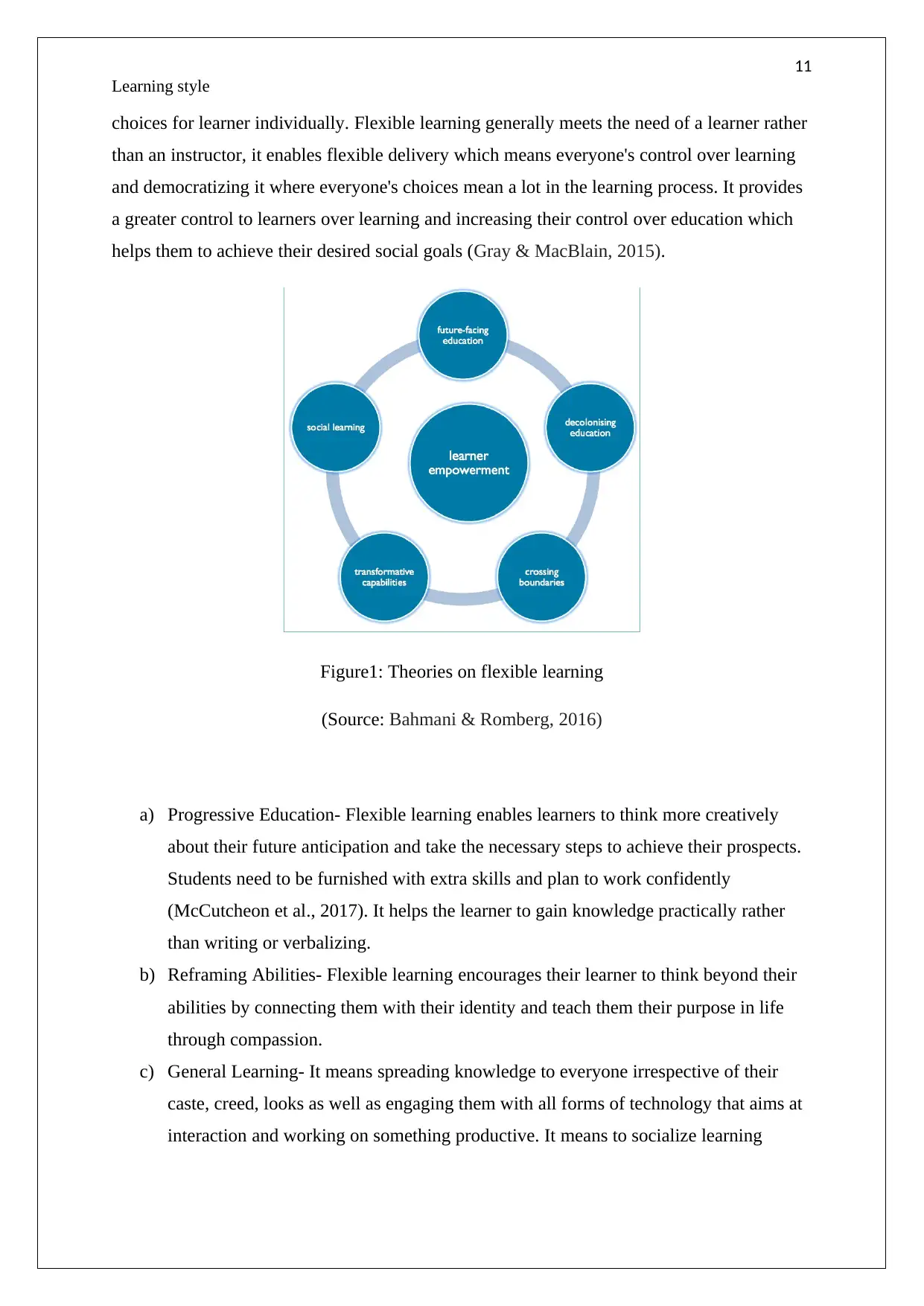
Figure1: Theories on flexible learning
(Source: Bahmani & Romberg, 2016)
a) Progressive Education- Flexible learning enables learners to think more creatively
about their future anticipation and take the necessary steps to achieve their prospects.
Students need to be furnished with extra skills and plan to work confidently
(McCutcheon et al., 2017). It helps the learner to gain knowledge practically rather
than writing or verbalizing.
b) Reframing Abilities- Flexible learning encourages their learner to think beyond their
abilities by connecting them with their identity and teach them their purpose in life
through compassion.
c) General Learning- It means spreading knowledge to everyone irrespective of their
caste, creed, looks as well as engaging them with all forms of technology that aims at
interaction and working on something productive. It means to socialize learning
Learning style
choices for learner individually. Flexible learning generally meets the need of a learner rather
than an instructor, it enables flexible delivery which means everyone's control over learning
and democratizing it where everyone's choices mean a lot in the learning process. It provides
a greater control to learners over learning and increasing their control over education which
helps them to achieve their desired social goals (Gray & MacBlain, 2015).
Figure1: Theories on flexible learning
(Source: Bahmani & Romberg, 2016)
a) Progressive Education- Flexible learning enables learners to think more creatively
about their future anticipation and take the necessary steps to achieve their prospects.
Students need to be furnished with extra skills and plan to work confidently
(McCutcheon et al., 2017). It helps the learner to gain knowledge practically rather
than writing or verbalizing.
b) Reframing Abilities- Flexible learning encourages their learner to think beyond their
abilities by connecting them with their identity and teach them their purpose in life
through compassion.
c) General Learning- It means spreading knowledge to everyone irrespective of their
caste, creed, looks as well as engaging them with all forms of technology that aims at
interaction and working on something productive. It means to socialize learning
⊘ This is a preview!⊘
Do you want full access?
Subscribe today to unlock all pages.
Trusted by 1+ million students worldwide

1 out of 31


Related Documents
![A Study on Flipped Classroom Implementation at [School Name]](/_next/image/?url=https%3A%2F%2Fdesklib.com%2Fmedia%2Fimages%2Fsc%2Fccace13048cb4bb49422aeeef0a235b4.jpg&w=256&q=75)


Your All-in-One AI-Powered Toolkit for Academic Success.
+13062052269
info@desklib.com
Available 24*7 on WhatsApp / Email
![[object Object]](/_next/static/media/star-bottom.7253800d.svg)
Unlock your academic potential
Copyright © 2020–2026 A2Z Services. All Rights Reserved. Developed and managed by ZUCOL.