An Analysis of Bluffing and Its Ethics in the Business Context
VerifiedAdded on 2022/08/17
|9
|2691
|17
Essay
AI Summary
This essay delves into the ethical implications of bluffing in the business world, presenting a comprehensive analysis of whether bluffing is ethically permissible. The research begins by defining bluffing and its prevalence in business contexts, including advertising and negotiations. It then examines the ethical debate through the lenses of two prominent moral theories: Kant's deontology and consequentialism. The essay explores how Kant's theory of universalization and consequentialism's focus on outcomes apply to the practice of bluffing. It analyzes whether bluffing can be universally accepted without logical contradictions and assesses the overall consequences of bluffing in business. The essay concludes by offering insights into the complexities of bluffing, emphasizing its impact on trust, honesty, and manipulation within business interactions, and provides a nuanced perspective on its ethical standing based on different moral frameworks.
1 | P a g e
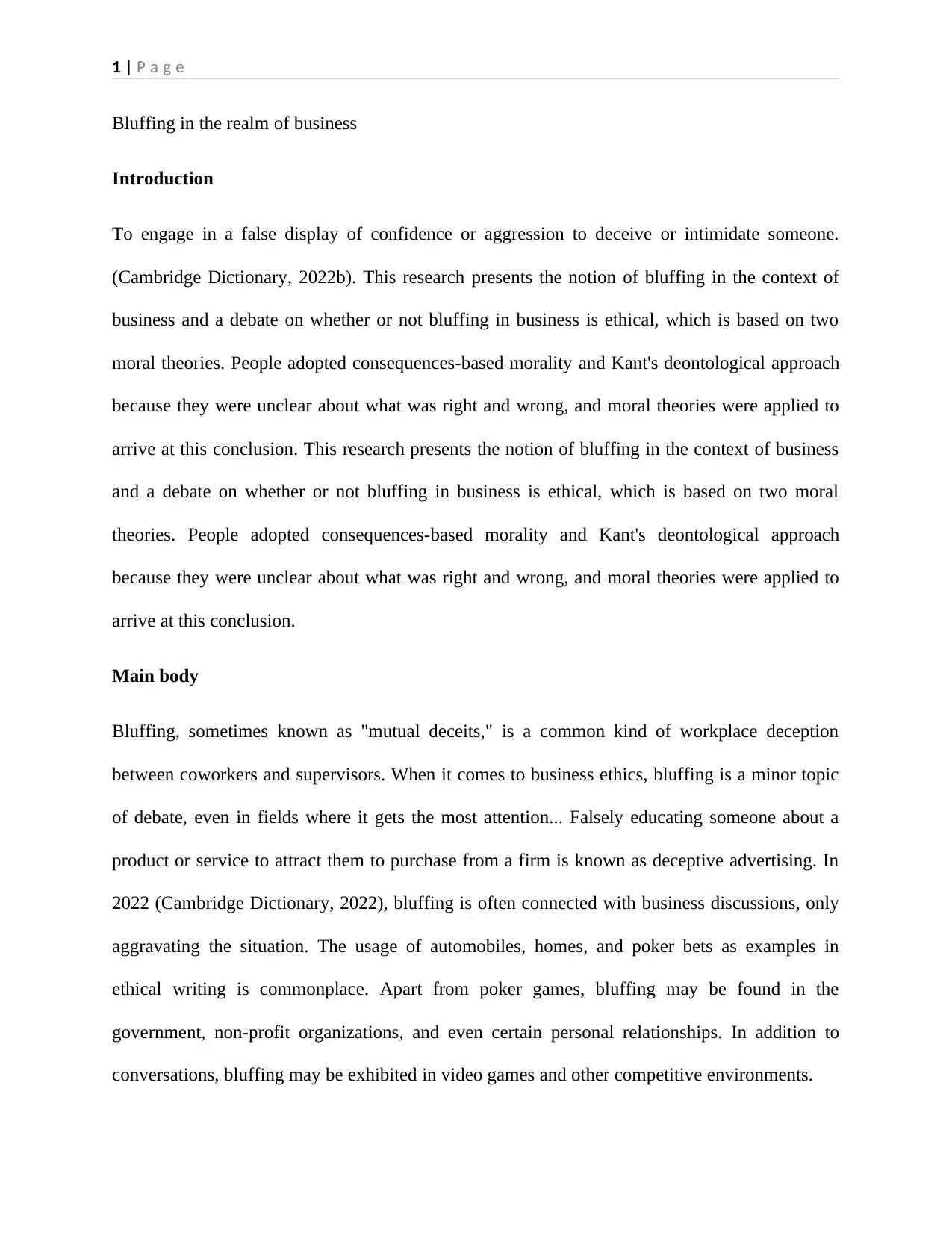
Bluffing in the realm of business
Introduction
To engage in a false display of confidence or aggression to deceive or intimidate someone.
(Cambridge Dictionary, 2022b). This research presents the notion of bluffing in the context of
business and a debate on whether or not bluffing in business is ethical, which is based on two
moral theories. People adopted consequences-based morality and Kant's deontological approach
because they were unclear about what was right and wrong, and moral theories were applied to
arrive at this conclusion. This research presents the notion of bluffing in the context of business
and a debate on whether or not bluffing in business is ethical, which is based on two moral
theories. People adopted consequences-based morality and Kant's deontological approach
because they were unclear about what was right and wrong, and moral theories were applied to
arrive at this conclusion.
Main body
Bluffing, sometimes known as "mutual deceits," is a common kind of workplace deception
between coworkers and supervisors. When it comes to business ethics, bluffing is a minor topic
of debate, even in fields where it gets the most attention... Falsely educating someone about a
product or service to attract them to purchase from a firm is known as deceptive advertising. In
2022 (Cambridge Dictionary, 2022), bluffing is often connected with business discussions, only
aggravating the situation. The usage of automobiles, homes, and poker bets as examples in
ethical writing is commonplace. Apart from poker games, bluffing may be found in the
government, non-profit organizations, and even certain personal relationships. In addition to
conversations, bluffing may be exhibited in video games and other competitive environments.
Bluffing in the realm of business
Introduction
To engage in a false display of confidence or aggression to deceive or intimidate someone.
(Cambridge Dictionary, 2022b). This research presents the notion of bluffing in the context of
business and a debate on whether or not bluffing in business is ethical, which is based on two
moral theories. People adopted consequences-based morality and Kant's deontological approach
because they were unclear about what was right and wrong, and moral theories were applied to
arrive at this conclusion. This research presents the notion of bluffing in the context of business
and a debate on whether or not bluffing in business is ethical, which is based on two moral
theories. People adopted consequences-based morality and Kant's deontological approach
because they were unclear about what was right and wrong, and moral theories were applied to
arrive at this conclusion.
Main body
Bluffing, sometimes known as "mutual deceits," is a common kind of workplace deception
between coworkers and supervisors. When it comes to business ethics, bluffing is a minor topic
of debate, even in fields where it gets the most attention... Falsely educating someone about a
product or service to attract them to purchase from a firm is known as deceptive advertising. In
2022 (Cambridge Dictionary, 2022), bluffing is often connected with business discussions, only
aggravating the situation. The usage of automobiles, homes, and poker bets as examples in
ethical writing is commonplace. Apart from poker games, bluffing may be found in the
government, non-profit organizations, and even certain personal relationships. In addition to
conversations, bluffing may be exhibited in video games and other competitive environments.

Paraphrase This Document
Need a fresh take? Get an instant paraphrase of this document with our AI Paraphraser
2 | P a g e
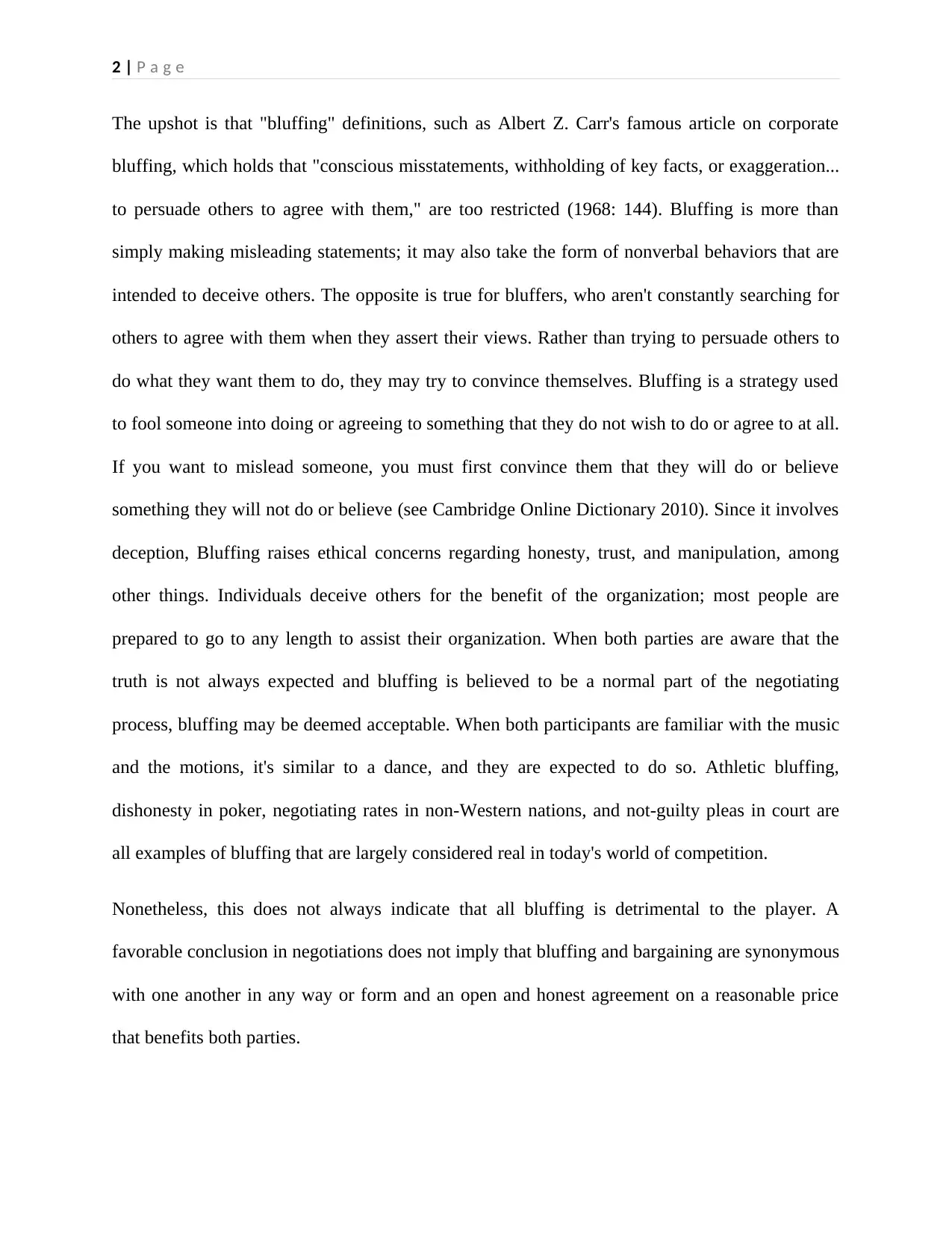
The upshot is that "bluffing" definitions, such as Albert Z. Carr's famous article on corporate
bluffing, which holds that "conscious misstatements, withholding of key facts, or exaggeration...
to persuade others to agree with them," are too restricted (1968: 144). Bluffing is more than
simply making misleading statements; it may also take the form of nonverbal behaviors that are
intended to deceive others. The opposite is true for bluffers, who aren't constantly searching for
others to agree with them when they assert their views. Rather than trying to persuade others to
do what they want them to do, they may try to convince themselves. Bluffing is a strategy used
to fool someone into doing or agreeing to something that they do not wish to do or agree to at all.
If you want to mislead someone, you must first convince them that they will do or believe
something they will not do or believe (see Cambridge Online Dictionary 2010). Since it involves
deception, Bluffing raises ethical concerns regarding honesty, trust, and manipulation, among
other things. Individuals deceive others for the benefit of the organization; most people are
prepared to go to any length to assist their organization. When both parties are aware that the
truth is not always expected and bluffing is believed to be a normal part of the negotiating
process, bluffing may be deemed acceptable. When both participants are familiar with the music
and the motions, it's similar to a dance, and they are expected to do so. Athletic bluffing,
dishonesty in poker, negotiating rates in non-Western nations, and not-guilty pleas in court are
all examples of bluffing that are largely considered real in today's world of competition.
Nonetheless, this does not always indicate that all bluffing is detrimental to the player. A
favorable conclusion in negotiations does not imply that bluffing and bargaining are synonymous
with one another in any way or form and an open and honest agreement on a reasonable price
that benefits both parties.
The upshot is that "bluffing" definitions, such as Albert Z. Carr's famous article on corporate
bluffing, which holds that "conscious misstatements, withholding of key facts, or exaggeration...
to persuade others to agree with them," are too restricted (1968: 144). Bluffing is more than
simply making misleading statements; it may also take the form of nonverbal behaviors that are
intended to deceive others. The opposite is true for bluffers, who aren't constantly searching for
others to agree with them when they assert their views. Rather than trying to persuade others to
do what they want them to do, they may try to convince themselves. Bluffing is a strategy used
to fool someone into doing or agreeing to something that they do not wish to do or agree to at all.
If you want to mislead someone, you must first convince them that they will do or believe
something they will not do or believe (see Cambridge Online Dictionary 2010). Since it involves
deception, Bluffing raises ethical concerns regarding honesty, trust, and manipulation, among
other things. Individuals deceive others for the benefit of the organization; most people are
prepared to go to any length to assist their organization. When both parties are aware that the
truth is not always expected and bluffing is believed to be a normal part of the negotiating
process, bluffing may be deemed acceptable. When both participants are familiar with the music
and the motions, it's similar to a dance, and they are expected to do so. Athletic bluffing,
dishonesty in poker, negotiating rates in non-Western nations, and not-guilty pleas in court are
all examples of bluffing that are largely considered real in today's world of competition.
Nonetheless, this does not always indicate that all bluffing is detrimental to the player. A
favorable conclusion in negotiations does not imply that bluffing and bargaining are synonymous
with one another in any way or form and an open and honest agreement on a reasonable price
that benefits both parties.
3 | P a g e
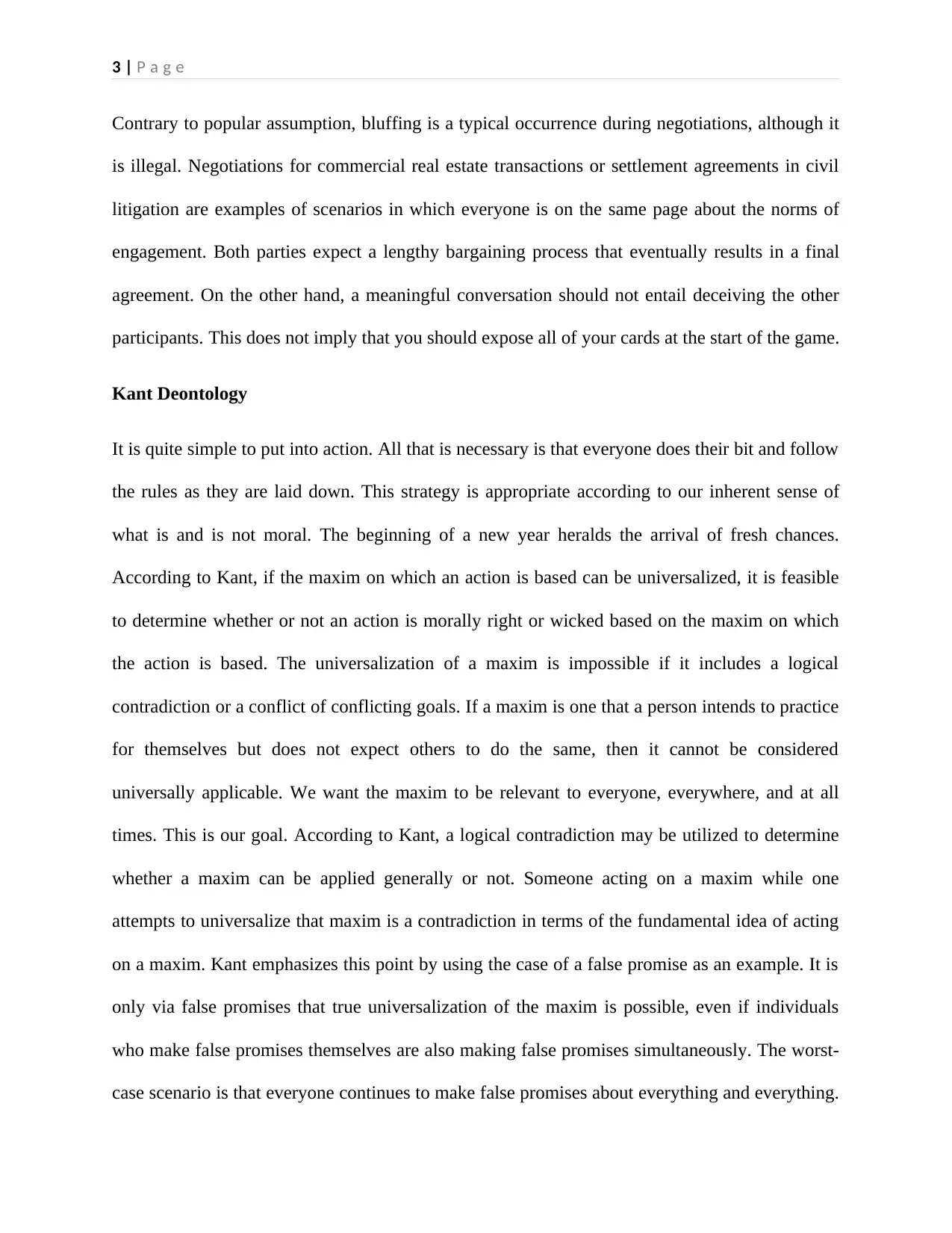
Contrary to popular assumption, bluffing is a typical occurrence during negotiations, although it
is illegal. Negotiations for commercial real estate transactions or settlement agreements in civil
litigation are examples of scenarios in which everyone is on the same page about the norms of
engagement. Both parties expect a lengthy bargaining process that eventually results in a final
agreement. On the other hand, a meaningful conversation should not entail deceiving the other
participants. This does not imply that you should expose all of your cards at the start of the game.
Kant Deontology
It is quite simple to put into action. All that is necessary is that everyone does their bit and follow
the rules as they are laid down. This strategy is appropriate according to our inherent sense of
what is and is not moral. The beginning of a new year heralds the arrival of fresh chances.
According to Kant, if the maxim on which an action is based can be universalized, it is feasible
to determine whether or not an action is morally right or wicked based on the maxim on which
the action is based. The universalization of a maxim is impossible if it includes a logical
contradiction or a conflict of conflicting goals. If a maxim is one that a person intends to practice
for themselves but does not expect others to do the same, then it cannot be considered
universally applicable. We want the maxim to be relevant to everyone, everywhere, and at all
times. This is our goal. According to Kant, a logical contradiction may be utilized to determine
whether a maxim can be applied generally or not. Someone acting on a maxim while one
attempts to universalize that maxim is a contradiction in terms of the fundamental idea of acting
on a maxim. Kant emphasizes this point by using the case of a false promise as an example. It is
only via false promises that true universalization of the maxim is possible, even if individuals
who make false promises themselves are also making false promises simultaneously. The worst-
case scenario is that everyone continues to make false promises about everything and everything.
Contrary to popular assumption, bluffing is a typical occurrence during negotiations, although it
is illegal. Negotiations for commercial real estate transactions or settlement agreements in civil
litigation are examples of scenarios in which everyone is on the same page about the norms of
engagement. Both parties expect a lengthy bargaining process that eventually results in a final
agreement. On the other hand, a meaningful conversation should not entail deceiving the other
participants. This does not imply that you should expose all of your cards at the start of the game.
Kant Deontology
It is quite simple to put into action. All that is necessary is that everyone does their bit and follow
the rules as they are laid down. This strategy is appropriate according to our inherent sense of
what is and is not moral. The beginning of a new year heralds the arrival of fresh chances.
According to Kant, if the maxim on which an action is based can be universalized, it is feasible
to determine whether or not an action is morally right or wicked based on the maxim on which
the action is based. The universalization of a maxim is impossible if it includes a logical
contradiction or a conflict of conflicting goals. If a maxim is one that a person intends to practice
for themselves but does not expect others to do the same, then it cannot be considered
universally applicable. We want the maxim to be relevant to everyone, everywhere, and at all
times. This is our goal. According to Kant, a logical contradiction may be utilized to determine
whether a maxim can be applied generally or not. Someone acting on a maxim while one
attempts to universalize that maxim is a contradiction in terms of the fundamental idea of acting
on a maxim. Kant emphasizes this point by using the case of a false promise as an example. It is
only via false promises that true universalization of the maxim is possible, even if individuals
who make false promises themselves are also making false promises simultaneously. The worst-
case scenario is that everyone continues to make false promises about everything and everything.
⊘ This is a preview!⊘
Do you want full access?
Subscribe today to unlock all pages.

Trusted by 1+ million students worldwide
4 | P a g e
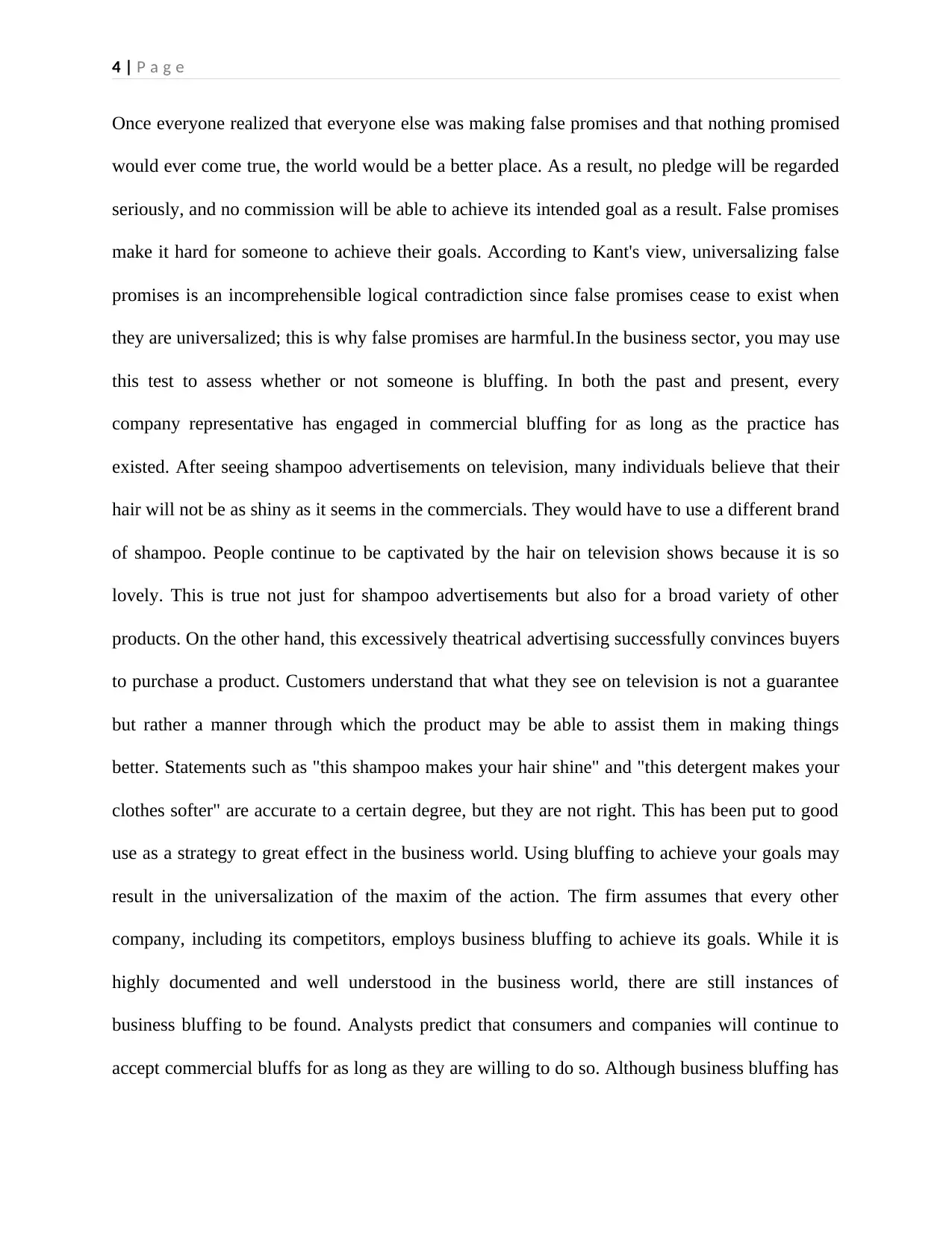
Once everyone realized that everyone else was making false promises and that nothing promised
would ever come true, the world would be a better place. As a result, no pledge will be regarded
seriously, and no commission will be able to achieve its intended goal as a result. False promises
make it hard for someone to achieve their goals. According to Kant's view, universalizing false
promises is an incomprehensible logical contradiction since false promises cease to exist when
they are universalized; this is why false promises are harmful.In the business sector, you may use
this test to assess whether or not someone is bluffing. In both the past and present, every
company representative has engaged in commercial bluffing for as long as the practice has
existed. After seeing shampoo advertisements on television, many individuals believe that their
hair will not be as shiny as it seems in the commercials. They would have to use a different brand
of shampoo. People continue to be captivated by the hair on television shows because it is so
lovely. This is true not just for shampoo advertisements but also for a broad variety of other
products. On the other hand, this excessively theatrical advertising successfully convinces buyers
to purchase a product. Customers understand that what they see on television is not a guarantee
but rather a manner through which the product may be able to assist them in making things
better. Statements such as "this shampoo makes your hair shine" and "this detergent makes your
clothes softer" are accurate to a certain degree, but they are not right. This has been put to good
use as a strategy to great effect in the business world. Using bluffing to achieve your goals may
result in the universalization of the maxim of the action. The firm assumes that every other
company, including its competitors, employs business bluffing to achieve its goals. While it is
highly documented and well understood in the business world, there are still instances of
business bluffing to be found. Analysts predict that consumers and companies will continue to
accept commercial bluffs for as long as they are willing to do so. Although business bluffing has
Once everyone realized that everyone else was making false promises and that nothing promised
would ever come true, the world would be a better place. As a result, no pledge will be regarded
seriously, and no commission will be able to achieve its intended goal as a result. False promises
make it hard for someone to achieve their goals. According to Kant's view, universalizing false
promises is an incomprehensible logical contradiction since false promises cease to exist when
they are universalized; this is why false promises are harmful.In the business sector, you may use
this test to assess whether or not someone is bluffing. In both the past and present, every
company representative has engaged in commercial bluffing for as long as the practice has
existed. After seeing shampoo advertisements on television, many individuals believe that their
hair will not be as shiny as it seems in the commercials. They would have to use a different brand
of shampoo. People continue to be captivated by the hair on television shows because it is so
lovely. This is true not just for shampoo advertisements but also for a broad variety of other
products. On the other hand, this excessively theatrical advertising successfully convinces buyers
to purchase a product. Customers understand that what they see on television is not a guarantee
but rather a manner through which the product may be able to assist them in making things
better. Statements such as "this shampoo makes your hair shine" and "this detergent makes your
clothes softer" are accurate to a certain degree, but they are not right. This has been put to good
use as a strategy to great effect in the business world. Using bluffing to achieve your goals may
result in the universalization of the maxim of the action. The firm assumes that every other
company, including its competitors, employs business bluffing to achieve its goals. While it is
highly documented and well understood in the business world, there are still instances of
business bluffing to be found. Analysts predict that consumers and companies will continue to
accept commercial bluffs for as long as they are willing to do so. Although business bluffing has
Paraphrase This Document
Need a fresh take? Get an instant paraphrase of this document with our AI Paraphraser
5 | P a g e
been universalized, it has not disappeared. Consequently, bluffing in trade does not violate Kant's
ethical theory, according to the philosopher. Despite the apparent rationality of this argument, it
is a well-known fact that people in business are content to let others bluff them and be bluffed by
others themselves. As a result, business bluffing has the potential to expand across the sector and
establish itself as a common practice. A businessman who exaggerates the advantages of a
product in advertising has a higher chance of convincing purchasers of his claims. Entrepreneurs
aren't bothered about being duped when it comes to economic transactions between firms. This is
a widely used manner of doing business. Everyone in the business world considers it a regular
part of conducting business, and it will continue in the future. Business bluffing isn't a significant
concern to the majority of the population. There is no contradiction in the widespread use of
commercial bluffing, legal in most jurisdictions. As a result, it is possible that bluffing in
business may be generally accepted. When business bluffing is seen through the lenses of the
two stakeholder theories, two distinct consequences result. When it comes to restricted
situations, bluffing is not immoral; nevertheless, when the owners of the company are bluffed, it
is immoral. Because bluffing is at the heart of the limited version, it would not be a problem to
use it to raise revenue.
Consequentialism
According to the concept of "consequentialism," all normative traits may be reduced to their
consequences (Sinnott-Armstrong, 2003). There is no question that lying is a morally repugnant
behavior that should be avoided. In this particular instance, consequentialism implies that telling
the truth is the wisest course of action. It is difficult, if not impossible, to foresee the result of an
action in advance, which causes some individuals to have a problem with the concept of
consequentialism. Indeed, no one can completely predict what will happen in the future. There
been universalized, it has not disappeared. Consequently, bluffing in trade does not violate Kant's
ethical theory, according to the philosopher. Despite the apparent rationality of this argument, it
is a well-known fact that people in business are content to let others bluff them and be bluffed by
others themselves. As a result, business bluffing has the potential to expand across the sector and
establish itself as a common practice. A businessman who exaggerates the advantages of a
product in advertising has a higher chance of convincing purchasers of his claims. Entrepreneurs
aren't bothered about being duped when it comes to economic transactions between firms. This is
a widely used manner of doing business. Everyone in the business world considers it a regular
part of conducting business, and it will continue in the future. Business bluffing isn't a significant
concern to the majority of the population. There is no contradiction in the widespread use of
commercial bluffing, legal in most jurisdictions. As a result, it is possible that bluffing in
business may be generally accepted. When business bluffing is seen through the lenses of the
two stakeholder theories, two distinct consequences result. When it comes to restricted
situations, bluffing is not immoral; nevertheless, when the owners of the company are bluffed, it
is immoral. Because bluffing is at the heart of the limited version, it would not be a problem to
use it to raise revenue.
Consequentialism
According to the concept of "consequentialism," all normative traits may be reduced to their
consequences (Sinnott-Armstrong, 2003). There is no question that lying is a morally repugnant
behavior that should be avoided. In this particular instance, consequentialism implies that telling
the truth is the wisest course of action. It is difficult, if not impossible, to foresee the result of an
action in advance, which causes some individuals to have a problem with the concept of
consequentialism. Indeed, no one can completely predict what will happen in the future. There
6 | P a g e
are instances when the results of choice are desired, but making a choice itself is unpalatable. In
certain cases, economic experts may demonstrate that slavery of merely 2 percent of the world's
population would have a favorable influence on the global economy and that most people would
be happier, healthier, and wealthier. Even though most people would benefit from this idea, they
would never support it because of the hostility it would almost certainly receive. However, if the
idea is examined only based on its effects, as classical consequentialism does, "the aim justifies
the means." Utilitarianism is one of the most widely accepted theories. Although it may be found
in the works of the ancient Greek philosopher Epicurus, Jeremy Bentham, an English
philosopher, is sometimes credited with popularising this concept. People's pleasure was at the
heart of Jeremy Bentham's utilitarian worldview. The most ethical actions a person might do
would be ones that bring them the greatest amount of pleasure while also minimizing their
chances of suffering. It is preferable to do something that has a bigger positive influence than to
do something that has a bad impact. The most well-known version of this idea is utilitarianism,
also known as the practical school of thought. Even though it may be found in the works of the
ancient Greek philosopher Epicurus, Jeremy Bentham, an English philosopher, is sometimes
credited with popularising this concept. People's pleasure was at the heart of Jeremy Bentham's
utilitarian worldview. The most ethical actions a person might do would be ones that bring them
the greatest amount of pleasure while also minimizing their chances of suffering. At the very
least, in situations when the outcome can be predicted, consequentialism is a valuable ethical
approach since it provides clear and practical guidance. The concept is also apolitical in its origin
and use. The fact that someone has asked us to maximize the benefit for the largest number of
persons causes us to set our own biases and self-interest aside to aid others (or, for Peter Singer
and other preference utilitarians, animals who have preferences). First and foremost, we must
are instances when the results of choice are desired, but making a choice itself is unpalatable. In
certain cases, economic experts may demonstrate that slavery of merely 2 percent of the world's
population would have a favorable influence on the global economy and that most people would
be happier, healthier, and wealthier. Even though most people would benefit from this idea, they
would never support it because of the hostility it would almost certainly receive. However, if the
idea is examined only based on its effects, as classical consequentialism does, "the aim justifies
the means." Utilitarianism is one of the most widely accepted theories. Although it may be found
in the works of the ancient Greek philosopher Epicurus, Jeremy Bentham, an English
philosopher, is sometimes credited with popularising this concept. People's pleasure was at the
heart of Jeremy Bentham's utilitarian worldview. The most ethical actions a person might do
would be ones that bring them the greatest amount of pleasure while also minimizing their
chances of suffering. It is preferable to do something that has a bigger positive influence than to
do something that has a bad impact. The most well-known version of this idea is utilitarianism,
also known as the practical school of thought. Even though it may be found in the works of the
ancient Greek philosopher Epicurus, Jeremy Bentham, an English philosopher, is sometimes
credited with popularising this concept. People's pleasure was at the heart of Jeremy Bentham's
utilitarian worldview. The most ethical actions a person might do would be ones that bring them
the greatest amount of pleasure while also minimizing their chances of suffering. At the very
least, in situations when the outcome can be predicted, consequentialism is a valuable ethical
approach since it provides clear and practical guidance. The concept is also apolitical in its origin
and use. The fact that someone has asked us to maximize the benefit for the largest number of
persons causes us to set our own biases and self-interest aside to aid others (or, for Peter Singer
and other preference utilitarians, animals who have preferences). First and foremost, we must
⊘ This is a preview!⊘
Do you want full access?
Subscribe today to unlock all pages.
Trusted by 1+ million students worldwide
7 | P a g e
assess the good and negative consequences of certain behavior. After that, we examine whether
the total number of favorable outcomes outweighs the total number of unfavorable outcomes.
Conclusion
Negotiation, another aspect of doing business, is something I've touched on in my discussion of
whether or not bluffing is ethical. While it's admirable to set one's own biases aside for the sake
of others, doing so in business increases the likelihood that one's company will fail. It is ethically
acceptable to do something if the favorable outcomes outweigh the bad ones. If the negative
repercussions outweigh the benefits, the behaviour is immoral. The maxim of action may
become universal if you use bluffing to attain your aims. Nonetheless, bluffing is not immoral
when it comes to confined scenarios; however, bluffing the owners of a firm is unethical.
References
assess the good and negative consequences of certain behavior. After that, we examine whether
the total number of favorable outcomes outweighs the total number of unfavorable outcomes.
Conclusion
Negotiation, another aspect of doing business, is something I've touched on in my discussion of
whether or not bluffing is ethical. While it's admirable to set one's own biases aside for the sake
of others, doing so in business increases the likelihood that one's company will fail. It is ethically
acceptable to do something if the favorable outcomes outweigh the bad ones. If the negative
repercussions outweigh the benefits, the behaviour is immoral. The maxim of action may
become universal if you use bluffing to attain your aims. Nonetheless, bluffing is not immoral
when it comes to confined scenarios; however, bluffing the owners of a firm is unethical.
References
Paraphrase This Document
Need a fresh take? Get an instant paraphrase of this document with our AI Paraphraser
8 | P a g e
Abid Mehmood (2021a). Dawn.com - A mob in Sialkot has tortured a man to death... [online]
www.facebook.com. Available at: https://web.facebook.com/watch/?v=1304596573313538
[Accessed 9 Mar. 2022].
Cambridge Dictionary (2022a). bluffing. [online] @CambridgeWords. Available at:
https://dictionary.cambridge.org/dictionary/english/bluffing [Accessed 26 Apr. 2022].
Cambridge Dictionary (2022b). bluffing. [online] @CambridgeWords. Available at:
https://dictionary.cambridge.org/dictionary/english/bluffing.
IPI-Admin (2021). The state of media freedom in Pakistan. [online] International Press Institute.
Available at: https://ipi.media/the-state-of-media-freedom-in-pakistan/ [Accessed 8 Mar. 2022].
Kranak, J. (2019). Kantian Deontology. [online] press.rebus.community. Available at:
https://press.rebus.community/intro-to-phil-ethics/chapter/kantian-deontology/.
Mehmood, A. (2021b). Ghastly murder of Lankan man in Sialkot shames nation. [online]
DAWN.COM. Available at: https://www.dawn.com/news/1661878/ghastly-murder-of-lankan-
man-in-sialkot-shames-nation.
Muhammad Naseem Anwar (2021). (PDF) Do International News Agencies set the Agenda of
Pakistani Newspapers? [online] ResearchGate. Available at:
https://www.researchgate.net/publication/351225619_Do_International_News_Agencies_set_the
_Agenda_of_Pakistani_Newspapers.
Shah Meer Baloch (2021). Man tortured and killed in Pakistan over alleged blasphemy. [online]
the Guardian. Available at: https://www.theguardian.com/world/2021/dec/03/pakistan-sri-
lankan-man-priyantha-diyawadana-tortured-killed-alleged-blasphemy-sialkot.
Sinnott-Armstrong, W. (2003). Consequentialism. [online] Stanford.edu. Available at:
https://plato.stanford.edu/entries/consequentialism/.
The Ethics Centre (2016). Ethics Explainer: What is Consequentialism? - The Ethics Centre.
[online] THE ETHICS CENTRE. Available at: https://ethics.org.au/ethics-explainer-
consequentialism/.
Abid Mehmood (2021a). Dawn.com - A mob in Sialkot has tortured a man to death... [online]
www.facebook.com. Available at: https://web.facebook.com/watch/?v=1304596573313538
[Accessed 9 Mar. 2022].
Cambridge Dictionary (2022a). bluffing. [online] @CambridgeWords. Available at:
https://dictionary.cambridge.org/dictionary/english/bluffing [Accessed 26 Apr. 2022].
Cambridge Dictionary (2022b). bluffing. [online] @CambridgeWords. Available at:
https://dictionary.cambridge.org/dictionary/english/bluffing.
IPI-Admin (2021). The state of media freedom in Pakistan. [online] International Press Institute.
Available at: https://ipi.media/the-state-of-media-freedom-in-pakistan/ [Accessed 8 Mar. 2022].
Kranak, J. (2019). Kantian Deontology. [online] press.rebus.community. Available at:
https://press.rebus.community/intro-to-phil-ethics/chapter/kantian-deontology/.
Mehmood, A. (2021b). Ghastly murder of Lankan man in Sialkot shames nation. [online]
DAWN.COM. Available at: https://www.dawn.com/news/1661878/ghastly-murder-of-lankan-
man-in-sialkot-shames-nation.
Muhammad Naseem Anwar (2021). (PDF) Do International News Agencies set the Agenda of
Pakistani Newspapers? [online] ResearchGate. Available at:
https://www.researchgate.net/publication/351225619_Do_International_News_Agencies_set_the
_Agenda_of_Pakistani_Newspapers.
Shah Meer Baloch (2021). Man tortured and killed in Pakistan over alleged blasphemy. [online]
the Guardian. Available at: https://www.theguardian.com/world/2021/dec/03/pakistan-sri-
lankan-man-priyantha-diyawadana-tortured-killed-alleged-blasphemy-sialkot.
Sinnott-Armstrong, W. (2003). Consequentialism. [online] Stanford.edu. Available at:
https://plato.stanford.edu/entries/consequentialism/.
The Ethics Centre (2016). Ethics Explainer: What is Consequentialism? - The Ethics Centre.
[online] THE ETHICS CENTRE. Available at: https://ethics.org.au/ethics-explainer-
consequentialism/.

9 | P a g e
⊘ This is a preview!⊘
Do you want full access?
Subscribe today to unlock all pages.
Trusted by 1+ million students worldwide

1 out of 9


Your All-in-One AI-Powered Toolkit for Academic Success.
+13062052269
info@desklib.com
Available 24*7 on WhatsApp / Email
![[object Object]](/_next/static/media/star-bottom.7253800d.svg)
Unlock your academic potential
Copyright © 2020–2026 A2Z Services. All Rights Reserved. Developed and managed by ZUCOL.