BMP4002 Business Law: Comprehensive Analysis of the UK Legal System
VerifiedAdded on 2023/06/18
|8
|2523
|445
Report
AI Summary
This report provides a comprehensive overview of the UK legal system, focusing on its classifications, sources, and application to employment law. It defines law and identifies the legal systems in the UK, explaining the differences between civil and criminal law with examples. The roles of the High Court and Supreme Court are detailed, followed by an explanation of case law and legislation as sources of law, including delegated legislation. The report further elaborates on the UK law-making process, specifically in the context of employment law, outlining statutory duties of employers to their employees and discussing wrongful and unfair dismissal actions. The analysis aims to clarify the legal framework governing businesses and employment in the UK.
BSc (Hons) Business Management
BMP4002 Business Law
Assessment 1
Legal System for Business
Law
Submitted by:
Name:
ID:
Contents
1
BMP4002 Business Law
Assessment 1
Legal System for Business
Law
Submitted by:
Name:
ID:
Contents
1

Paraphrase This Document
Need a fresh take? Get an instant paraphrase of this document with our AI Paraphraser
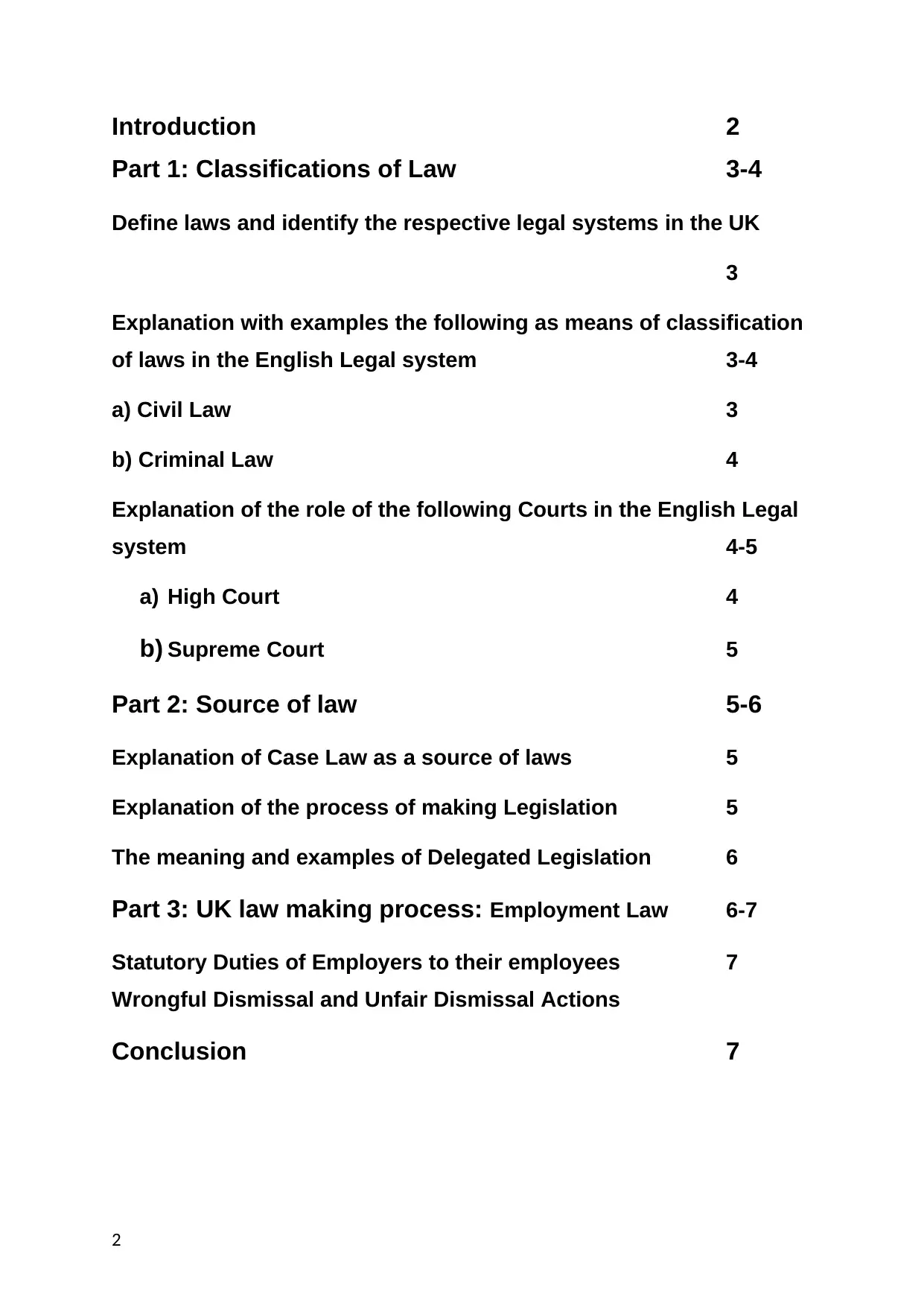
Introduction 2
Part 1: Classifications of Law 3-4
Define laws and identify the respective legal systems in the UK
3
Explanation with examples the following as means of classification
of laws in the English Legal system 3-4
a) Civil Law 3
b) Criminal Law 4
Explanation of the role of the following Courts in the English Legal
system 4-5
a) High Court 4
b) Supreme Court 5
Part 2: Source of law 5-6
Explanation of Case Law as a source of laws 5
Explanation of the process of making Legislation 5
The meaning and examples of Delegated Legislation 6
Part 3: UK law making process: Employment Law 6-7
Statutory Duties of Employers to their employees 7
Wrongful Dismissal and Unfair Dismissal Actions
Conclusion 7
2
Part 1: Classifications of Law 3-4
Define laws and identify the respective legal systems in the UK
3
Explanation with examples the following as means of classification
of laws in the English Legal system 3-4
a) Civil Law 3
b) Criminal Law 4
Explanation of the role of the following Courts in the English Legal
system 4-5
a) High Court 4
b) Supreme Court 5
Part 2: Source of law 5-6
Explanation of Case Law as a source of laws 5
Explanation of the process of making Legislation 5
The meaning and examples of Delegated Legislation 6
Part 3: UK law making process: Employment Law 6-7
Statutory Duties of Employers to their employees 7
Wrongful Dismissal and Unfair Dismissal Actions
Conclusion 7
2
Introduction
In today's time their seems to have the growth and the management in all the
command and superiority with the help of law. The legal system implies to manage all the
effective functions through which the outsourcing and the legal capabilities are being
considered. Law is the most important as it implies and provide the regulations and the
imposition rules through which the work and the acts can be applied on all the individual. UK
propose to have the effective legal system in which it is partly written and wholly codified. It
also manage the work and the general endurance through the nature and the functions for all
the legislative areas can be contemplated. It comprise of statutory and common law (Ila, and
Va, Hyman, 2019). In this report their will be discussion about the effective legal principles
with the sources of law, explanation about the criminal and the civil cases. Furthermore it will
also provide the statutory obligations in employment law.
Part 1: Classifications of Law
Define laws and identify the respective legal systems in the UK
Law provides the rules and the systems through which all the enforcement and their
general principles are carried out. This provides the management and the regulation of
different process of justice through which the growth is being embodied in all the areas. It
manages the customs, rules and the principles which will be implied to be managed and
create a binding effect on all. This provides the deviation of all the management and the
higher working nature. Law in UK is incorporated through different cultures and the statutory
and common law principles. In this the statutory law provides all the legal rules that are being
made by the parliamentary bodies which are namely the House of Commons and House of
lords (Lewsen, 2020). The initial one helps in effectively reflecting the general method of
working and also in implementation the laws and the abiding principles. The other which is
house of lords implies to manage and frame the investigation, inspection of the laws and the
working nature and framework. Their implies all the vary working through which the rules
can be made. The common law is the most important source of law where the judges use to
provide the effective judgment and their working nature. The laws can the judgment being
given by them creates a binding impact and an applicable rule for all.
Explanation with examples the following as means of classification
of laws in the English Legal system
3
In today's time their seems to have the growth and the management in all the
command and superiority with the help of law. The legal system implies to manage all the
effective functions through which the outsourcing and the legal capabilities are being
considered. Law is the most important as it implies and provide the regulations and the
imposition rules through which the work and the acts can be applied on all the individual. UK
propose to have the effective legal system in which it is partly written and wholly codified. It
also manage the work and the general endurance through the nature and the functions for all
the legislative areas can be contemplated. It comprise of statutory and common law (Ila, and
Va, Hyman, 2019). In this report their will be discussion about the effective legal principles
with the sources of law, explanation about the criminal and the civil cases. Furthermore it will
also provide the statutory obligations in employment law.
Part 1: Classifications of Law
Define laws and identify the respective legal systems in the UK
Law provides the rules and the systems through which all the enforcement and their
general principles are carried out. This provides the management and the regulation of
different process of justice through which the growth is being embodied in all the areas. It
manages the customs, rules and the principles which will be implied to be managed and
create a binding effect on all. This provides the deviation of all the management and the
higher working nature. Law in UK is incorporated through different cultures and the statutory
and common law principles. In this the statutory law provides all the legal rules that are being
made by the parliamentary bodies which are namely the House of Commons and House of
lords (Lewsen, 2020). The initial one helps in effectively reflecting the general method of
working and also in implementation the laws and the abiding principles. The other which is
house of lords implies to manage and frame the investigation, inspection of the laws and the
working nature and framework. Their implies all the vary working through which the rules
can be made. The common law is the most important source of law where the judges use to
provide the effective judgment and their working nature. The laws can the judgment being
given by them creates a binding impact and an applicable rule for all.
Explanation with examples the following as means of classification
of laws in the English Legal system
3
⊘ This is a preview!⊘
Do you want full access?
Subscribe today to unlock all pages.

Trusted by 1+ million students worldwide
a) Civil Law: This is the protection of all the rights which are being given to the
individuals for the property and their general nature of working. It provides and manages all
the rules and the nature through which the general protection and their enforcement can be
applied. All the matters which are being needed in the civil issues are generally being
analyzed and adjudicated by the county court, high court, supreme court. All these helps in
managing and implicating the rules and the proceedings for the civil law. Their can be seen
that some important remedies that are being used and managed in all the areas and the civil
matters are like damages, injunction, specific performance of contract and mangy more. The
civil issues mainly implies and manage the laws and the working nature through which the
general management and their nature can be implicated(Hayes, 2017).
b) Criminal Law: All such methods and the issues in which the individuals life and the
personal safety is carried out are mainly being managed under it. Criminal law manages all
the rights and the regulation through which safety concerns are managed and the resources
and the varied nature can generally being protected. This mainly manages all the heinous
crimes, issues and all the variable areas through which the society is there by being affected.
Some of the punishments that are being drawn in the criminal law are like death penalty,
imprisonment, fines and many more. Their main motive is to rehabilitate the nature of the
individual who has made the crime and also to prevent all the individuals from any kind of
crimes and their deviance(Pears, and Shields, 2019).
Explanation of the role of the following Courts in the English Legal
system
a) High Court: This manages all the general working on the original and the
appellate jurisdiction. It implies to frame all the civil and the criminal issues through
which the management and the adequate working nature can be seen. It provides to
the second highest court of appeal where all the decision making and the appeals are
begin raised in it. their provides so many different areas and the nature the divisions
in which the court will abruptly manage to work and provide effective judgment. The
high court have so many divisions according to the varied cases they are like the
county court, Queens bench, divisional bench, family division, youth court and many
more. They all manage and provide the adequate judgment as in regard to their nature
and working.
4
individuals for the property and their general nature of working. It provides and manages all
the rules and the nature through which the general protection and their enforcement can be
applied. All the matters which are being needed in the civil issues are generally being
analyzed and adjudicated by the county court, high court, supreme court. All these helps in
managing and implicating the rules and the proceedings for the civil law. Their can be seen
that some important remedies that are being used and managed in all the areas and the civil
matters are like damages, injunction, specific performance of contract and mangy more. The
civil issues mainly implies and manage the laws and the working nature through which the
general management and their nature can be implicated(Hayes, 2017).
b) Criminal Law: All such methods and the issues in which the individuals life and the
personal safety is carried out are mainly being managed under it. Criminal law manages all
the rights and the regulation through which safety concerns are managed and the resources
and the varied nature can generally being protected. This mainly manages all the heinous
crimes, issues and all the variable areas through which the society is there by being affected.
Some of the punishments that are being drawn in the criminal law are like death penalty,
imprisonment, fines and many more. Their main motive is to rehabilitate the nature of the
individual who has made the crime and also to prevent all the individuals from any kind of
crimes and their deviance(Pears, and Shields, 2019).
Explanation of the role of the following Courts in the English Legal
system
a) High Court: This manages all the general working on the original and the
appellate jurisdiction. It implies to frame all the civil and the criminal issues through
which the management and the adequate working nature can be seen. It provides to
the second highest court of appeal where all the decision making and the appeals are
begin raised in it. their provides so many different areas and the nature the divisions
in which the court will abruptly manage to work and provide effective judgment. The
high court have so many divisions according to the varied cases they are like the
county court, Queens bench, divisional bench, family division, youth court and many
more. They all manage and provide the adequate judgment as in regard to their nature
and working.
4
Paraphrase This Document
Need a fresh take? Get an instant paraphrase of this document with our AI Paraphraser
b) Supreme Court: Their is been analyses that it is the highest authority court
which helps in managing and effectively creating the all the work and their functions
in proper manner. It promotes and provides the final judgment in which all the public
importance are being incorporated. The supreme court are mainly the final arbitrator
which encompass and promote the judgment which will be according to the rules and
the working nature. SC manages all the facts, issues and the evidences to be properly
taken in order to manage all the records and their working nature. This is the final
court of appeal which implies that no argument can be raised for their decisions it will
be binding on all (Ferrey, 2017).
Part 2: Source of law
Explanation of Case Law as a source of laws
Common law or the judicial precedents are the most important law which promotes
and provide the doctrine of stare decisive. It provides that all the judgments and the case
when goes to the court will be recorded and heard by the judges in effective manner. They
after considering all the relevant facts and matters tries to provide the effective judgment
which will create a binding impact on citizens of UK and also on all such similar cases in
fu8ture. All the subordinate or the lower court can take the help of common law while
providing the judgment. It manages to create a positive impact and their main aim is to
promote Justice and also to provide a clarity in the mind of citizens regarding the laws which
are being made for all. These judgments are undertaken and written as the law reports which
will become the judicial precedents in future(Toolan, 2018).
Explanation of the process of making Legislation
This is the law making process where all the laws are being made and legislated in the
court. It protect the society by applying all the rules as legislation is mainly being enforced by
the parliament and their monarch is the most important areas which manages and validate all
the rules and their principles. For making and establishing any act or rule the Bill is
introduced in front of both the houses and that helps in providing and managing the rules and
their vary nature. Here both the house of commons and the house of lords use to sit and
discuss about the bill. It pass through different readings and procedure in which the
5
which helps in managing and effectively creating the all the work and their functions
in proper manner. It promotes and provides the final judgment in which all the public
importance are being incorporated. The supreme court are mainly the final arbitrator
which encompass and promote the judgment which will be according to the rules and
the working nature. SC manages all the facts, issues and the evidences to be properly
taken in order to manage all the records and their working nature. This is the final
court of appeal which implies that no argument can be raised for their decisions it will
be binding on all (Ferrey, 2017).
Part 2: Source of law
Explanation of Case Law as a source of laws
Common law or the judicial precedents are the most important law which promotes
and provide the doctrine of stare decisive. It provides that all the judgments and the case
when goes to the court will be recorded and heard by the judges in effective manner. They
after considering all the relevant facts and matters tries to provide the effective judgment
which will create a binding impact on citizens of UK and also on all such similar cases in
fu8ture. All the subordinate or the lower court can take the help of common law while
providing the judgment. It manages to create a positive impact and their main aim is to
promote Justice and also to provide a clarity in the mind of citizens regarding the laws which
are being made for all. These judgments are undertaken and written as the law reports which
will become the judicial precedents in future(Toolan, 2018).
Explanation of the process of making Legislation
This is the law making process where all the laws are being made and legislated in the
court. It protect the society by applying all the rules as legislation is mainly being enforced by
the parliament and their monarch is the most important areas which manages and validate all
the rules and their principles. For making and establishing any act or rule the Bill is
introduced in front of both the houses and that helps in providing and managing the rules and
their vary nature. Here both the house of commons and the house of lords use to sit and
discuss about the bill. It pass through different readings and procedure in which the
5
introduction of bill necessary amendments and the changes in the bill with the assigned
loopholes are managed and carry out. The bill embarks to manage all the nature and the
effective scenarios in which voting is being taken place. Once the bill is being amended then
it gives to the monarch and while the assent is being granted by them them it will turn into an
act that will be imposed and applied on all citizens in UK(Armaly, 2018).
The meaning and examples of Delegated Legislation
It is the well known subordinate legislation where the management and the rules are
being made with general nature and principles to incorporate and manage the effective
functions. This is the transferring of the power or the authority to nay other person in order to
make the work proper and effective. Mainly the power regarding the delegated legislation is
being given to all the person who have the expert knowledge and experience in all the areas.
This provides the nature and the methods in which the work and the power is issues to other
so as to get the effective laws. The example of the delegated legislation is order of council,
by-laws, regulations etc. their main aim id to establish and manage the justice in all the
persons(Walker, Reed, and Carey-Jenkins, 2017).
Part 3: UK law making process: Employment Law
Statutory Duties of Employers to their employees
Their are several rights in UK which are being given under Employment Act 1996 in
order to manage and effectively protect all the citizens in UK. Here the employees gain
certain laws and the obligations as in the working areas by the employers they are like:
All the salary, wages and the remuneration should be given according to the rules
which are being led in the national minimum wages. No discrimination can be made
by the organization by their employees regarding their payment or all other general
areas.
Their is needed that all the employers should manage and provide effective safe
environment in the workplace by providing the health and hygiene safety issues. All
the medical facilities are needed to to be given to all.
Training and supervision must be given to all the employees as that ill eventually
manage and maintain the work and also creates the nature through which all the
6
loopholes are managed and carry out. The bill embarks to manage all the nature and the
effective scenarios in which voting is being taken place. Once the bill is being amended then
it gives to the monarch and while the assent is being granted by them them it will turn into an
act that will be imposed and applied on all citizens in UK(Armaly, 2018).
The meaning and examples of Delegated Legislation
It is the well known subordinate legislation where the management and the rules are
being made with general nature and principles to incorporate and manage the effective
functions. This is the transferring of the power or the authority to nay other person in order to
make the work proper and effective. Mainly the power regarding the delegated legislation is
being given to all the person who have the expert knowledge and experience in all the areas.
This provides the nature and the methods in which the work and the power is issues to other
so as to get the effective laws. The example of the delegated legislation is order of council,
by-laws, regulations etc. their main aim id to establish and manage the justice in all the
persons(Walker, Reed, and Carey-Jenkins, 2017).
Part 3: UK law making process: Employment Law
Statutory Duties of Employers to their employees
Their are several rights in UK which are being given under Employment Act 1996 in
order to manage and effectively protect all the citizens in UK. Here the employees gain
certain laws and the obligations as in the working areas by the employers they are like:
All the salary, wages and the remuneration should be given according to the rules
which are being led in the national minimum wages. No discrimination can be made
by the organization by their employees regarding their payment or all other general
areas.
Their is needed that all the employers should manage and provide effective safe
environment in the workplace by providing the health and hygiene safety issues. All
the medical facilities are needed to to be given to all.
Training and supervision must be given to all the employees as that ill eventually
manage and maintain the work and also creates the nature through which all the
6
⊘ This is a preview!⊘
Do you want full access?
Subscribe today to unlock all pages.
Trusted by 1+ million students worldwide
accidents and the miss happening can be avoided. Employers should make the
training session to workforce so as to avoid all the accidents.
Maternity, paternity, sick leave etc. should always be given to the
employees(Williams, 2018).
Employers should not do any kind of discrimination on the basis of color, race, caste,
sex etc.
Wrongful Dismissal and Unfair Dismissal Actions
Wrongful discrimination is the mainly the termination which is given to the
employees by the company without acknowledging them about it and even without any
sub,mission pf the notice period. Their involves that all the employees have the right to get
the protection and the notice to be served before terminating them so in case this bis not made
this will be covered under the wrongful discrimination.
Unfair dismissal amounts to all the unfair trade practices through which the
employees are terminated and there is not given a proper ideas about the dismissal. This is
generally all the unfair practice being made by the organization and the employees. Some of
the unfair dismissals are like maternity leave, asking for flexible working shifts, trade unions
etc.
Conclusion
The summary pf this above analysis is that Law is generated in order to protect the
rights and the obligations of the society and it helps in effectively managing the culture and
their general work. Legislation is the law making authority which manages to make the law
through bill which is drafted in different houses. Supreme court considered to be the final
appellate court where all the decisions are taken for public importance and are binding on all.
Further it can also be concluded that, employers should provide proper training, medical and
equal pay facilities to all the employees in the company. Unfair dismissal is the dismissing of
employees through unfair practices without proper reason.
7
training session to workforce so as to avoid all the accidents.
Maternity, paternity, sick leave etc. should always be given to the
employees(Williams, 2018).
Employers should not do any kind of discrimination on the basis of color, race, caste,
sex etc.
Wrongful Dismissal and Unfair Dismissal Actions
Wrongful discrimination is the mainly the termination which is given to the
employees by the company without acknowledging them about it and even without any
sub,mission pf the notice period. Their involves that all the employees have the right to get
the protection and the notice to be served before terminating them so in case this bis not made
this will be covered under the wrongful discrimination.
Unfair dismissal amounts to all the unfair trade practices through which the
employees are terminated and there is not given a proper ideas about the dismissal. This is
generally all the unfair practice being made by the organization and the employees. Some of
the unfair dismissals are like maternity leave, asking for flexible working shifts, trade unions
etc.
Conclusion
The summary pf this above analysis is that Law is generated in order to protect the
rights and the obligations of the society and it helps in effectively managing the culture and
their general work. Legislation is the law making authority which manages to make the law
through bill which is drafted in different houses. Supreme court considered to be the final
appellate court where all the decisions are taken for public importance and are binding on all.
Further it can also be concluded that, employers should provide proper training, medical and
equal pay facilities to all the employees in the company. Unfair dismissal is the dismissing of
employees through unfair practices without proper reason.
7
Paraphrase This Document
Need a fresh take? Get an instant paraphrase of this document with our AI Paraphraser
References
Armaly, M.T., 2018. Politicized nominations and public attitudes toward the Supreme Court
in the polarization Era. Justice System Journal, 39(3), pp.193-209.
Ferrey, S., 2017. Supreme Court Strips States of Their Power over the World's Second Most
Important Technology. Baylor L. Rev., 69, p.315.
Hayes, L.J., 2017. Stories of Care: A labour of law: Gender and class at work. Springer.
Hyman, R., 2019. Afterword: What Went Wrong?. In British Trade Unions and Industrial
Politics (pp. 353-364). Routledge.
Ila, A. and Va, A., 2021Appendix 2 Legislation relating to the conservation of freshwater
fishes in Britain.
Lewsen, E., 2020. En Termes Pe´ dagogiques: The Supreme Court Issues a Long-Awaited
Ruling That Clarifies and Invigorates Minority Language Educational Rights.
Education & Law Journal, 29(2), pp.239-247.
Pears, R. and Shields, G.J., 2019. Cite them right: the essential referencing guide. Macmillan
International Higher Education.
Toolan, M., 2018. The Language of Inequality in the News. Cambridge University Press.
Walker, R., Reed, M. and Carey-Jenkins, D., 2017. Understanding and Using Policy and
Legislation.
Williams, M., 2018. How language works in politics: The impact of vague legislation on
policy. Policy Press.
8
Armaly, M.T., 2018. Politicized nominations and public attitudes toward the Supreme Court
in the polarization Era. Justice System Journal, 39(3), pp.193-209.
Ferrey, S., 2017. Supreme Court Strips States of Their Power over the World's Second Most
Important Technology. Baylor L. Rev., 69, p.315.
Hayes, L.J., 2017. Stories of Care: A labour of law: Gender and class at work. Springer.
Hyman, R., 2019. Afterword: What Went Wrong?. In British Trade Unions and Industrial
Politics (pp. 353-364). Routledge.
Ila, A. and Va, A., 2021Appendix 2 Legislation relating to the conservation of freshwater
fishes in Britain.
Lewsen, E., 2020. En Termes Pe´ dagogiques: The Supreme Court Issues a Long-Awaited
Ruling That Clarifies and Invigorates Minority Language Educational Rights.
Education & Law Journal, 29(2), pp.239-247.
Pears, R. and Shields, G.J., 2019. Cite them right: the essential referencing guide. Macmillan
International Higher Education.
Toolan, M., 2018. The Language of Inequality in the News. Cambridge University Press.
Walker, R., Reed, M. and Carey-Jenkins, D., 2017. Understanding and Using Policy and
Legislation.
Williams, M., 2018. How language works in politics: The impact of vague legislation on
policy. Policy Press.
8

1 out of 8


Related Documents


Your All-in-One AI-Powered Toolkit for Academic Success.
+13062052269
info@desklib.com
Available 24*7 on WhatsApp / Email
![[object Object]](/_next/static/media/star-bottom.7253800d.svg)
Unlock your academic potential
Copyright © 2020–2026 A2Z Services. All Rights Reserved. Developed and managed by ZUCOL.