BMP6001 Dissertation: Effectiveness of Motivation at Sainsbury's
VerifiedAdded on 2023/06/17
|8
|2054
|463
Report
AI Summary
This report investigates the effectiveness of motivation practices on improving employee engagement and business performance within Sainsbury's. It addresses the types of motivation practices used, their impact on engagement and performance, and the challenges faced during implementation. The research employs a deductive approach with a survey strategy, utilizing quantitative research methods and both primary (questionnaires) and secondary data collection. Probability sampling is used to select managers as respondents. Ethical considerations are addressed, including informed consent and confidentiality. Limitations include time constraints and source selection. The expected outcome is to highlight the importance of motivation in organizational success.
Business Management
BMP6001 DISSERTATION
Assessment 1 – Research Proposal
(Effectiveness of motivation practices on
improving employee engagement and
business performance)
Submitted by:
Name:
ID:
BMP6001 DISSERTATION
Assessment 1 – Research Proposal
(Effectiveness of motivation practices on
improving employee engagement and
business performance)
Submitted by:
Name:
ID:

Paraphrase This Document
Need a fresh take? Get an instant paraphrase of this document with our AI Paraphraser
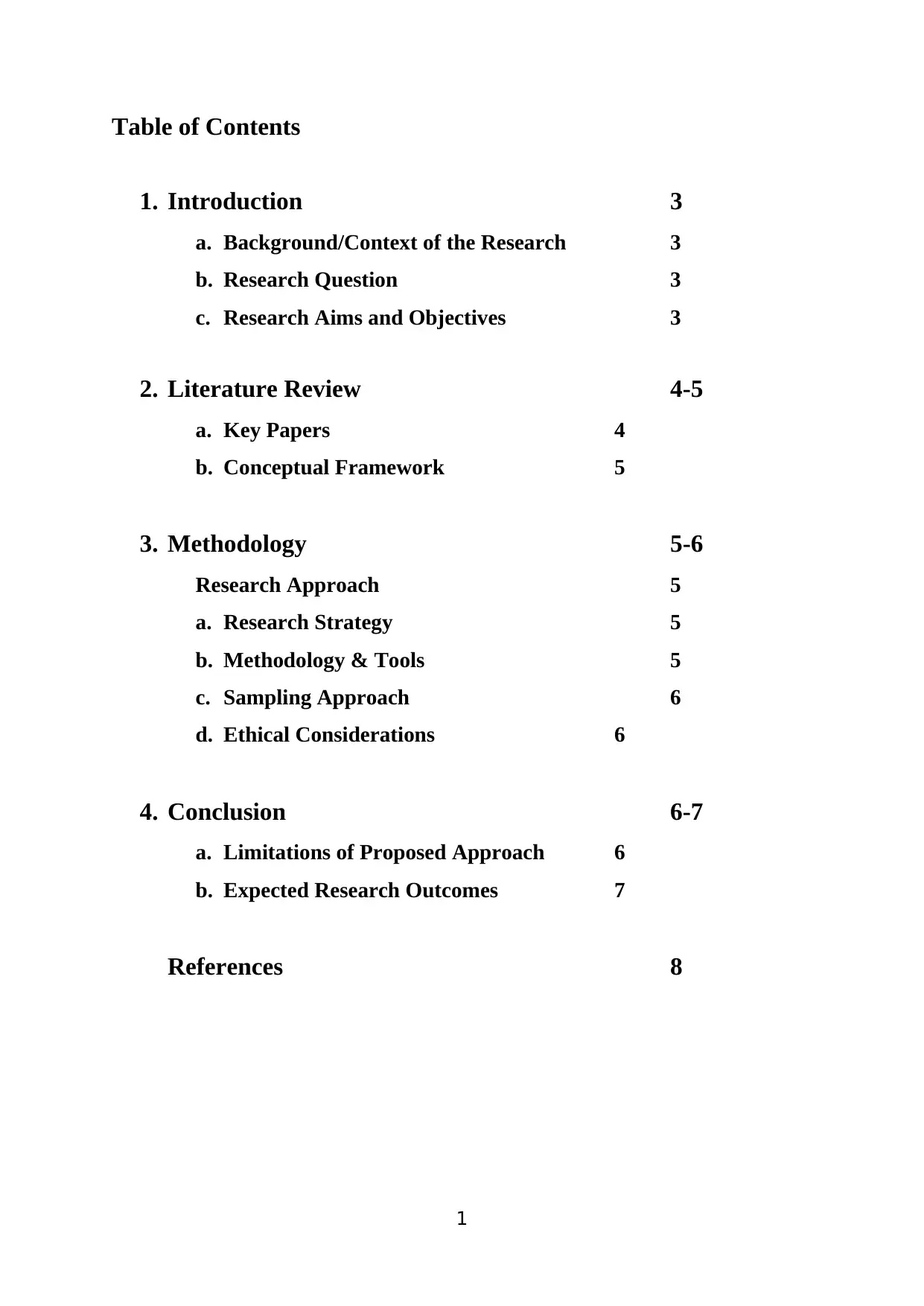
Table of Contents
1. Introduction 3
a. Background/Context of the Research 3
b. Research Question 3
c. Research Aims and Objectives 3
2. Literature Review 4-5
a. Key Papers 4
b. Conceptual Framework 5
3. Methodology 5-6
Research Approach 5
a. Research Strategy 5
b. Methodology & Tools 5
c. Sampling Approach 6
d. Ethical Considerations 6
4. Conclusion 6-7
a. Limitations of Proposed Approach 6
b. Expected Research Outcomes 7
References 8
1
1. Introduction 3
a. Background/Context of the Research 3
b. Research Question 3
c. Research Aims and Objectives 3
2. Literature Review 4-5
a. Key Papers 4
b. Conceptual Framework 5
3. Methodology 5-6
Research Approach 5
a. Research Strategy 5
b. Methodology & Tools 5
c. Sampling Approach 6
d. Ethical Considerations 6
4. Conclusion 6-7
a. Limitations of Proposed Approach 6
b. Expected Research Outcomes 7
References 8
1
1. Introduction
a. Background/Context of the Research
Motivation is known as a critical element of development and success in any organisation. It
increases productivity, a business could attain higher levels of result and output. It is
determined that motivated workforce always look for a better manner to complete an activity
and task. Workforce motivation is known as key to success of a company. It is the
commitment level, energy and drive that an organisation’s employees bring to the role every
day. If company does not develop motivation strategies, then they experience decreased
productivity and lower level of result. It is likely that the organisation would fall short of
reaching significant goals too (Jensen, 2018). Employee engagement is one of the concepts of
human resource which clearly defines the dedication and enthusiasm an employee feels
towards their job. Motivation assists in engaging employees towards their job and when
employees are engaged and motivated they contribute in increasing productivity of the
business. The selected company for the current investigation is Sainsbury’s.
b. Research Question
What are the different types of motivation practices used by Sainsbury’s?
What is the effectiveness of motivation practices on improving employee engagement
and business performance within Sainsbury’s?
What are the challenges faced by Sainsbury’s during developing motivational
practices within organisation?
c. Research Aims and Objectives
Research Aim:
To examine the effectiveness of motivation practices on improving employee engagement
and business performance within an organisation. A study on Sainsbury’s.
Research Objectives:
To investigate the different types of motivation practices used by Sainsbury’s.
To determine the effectiveness of motivation practices on improving employee
engagement and business performance within Sainsbury’s.
To discern the challenges faced by Sainsbury’s during developing motivational
practices within organisation
2
a. Background/Context of the Research
Motivation is known as a critical element of development and success in any organisation. It
increases productivity, a business could attain higher levels of result and output. It is
determined that motivated workforce always look for a better manner to complete an activity
and task. Workforce motivation is known as key to success of a company. It is the
commitment level, energy and drive that an organisation’s employees bring to the role every
day. If company does not develop motivation strategies, then they experience decreased
productivity and lower level of result. It is likely that the organisation would fall short of
reaching significant goals too (Jensen, 2018). Employee engagement is one of the concepts of
human resource which clearly defines the dedication and enthusiasm an employee feels
towards their job. Motivation assists in engaging employees towards their job and when
employees are engaged and motivated they contribute in increasing productivity of the
business. The selected company for the current investigation is Sainsbury’s.
b. Research Question
What are the different types of motivation practices used by Sainsbury’s?
What is the effectiveness of motivation practices on improving employee engagement
and business performance within Sainsbury’s?
What are the challenges faced by Sainsbury’s during developing motivational
practices within organisation?
c. Research Aims and Objectives
Research Aim:
To examine the effectiveness of motivation practices on improving employee engagement
and business performance within an organisation. A study on Sainsbury’s.
Research Objectives:
To investigate the different types of motivation practices used by Sainsbury’s.
To determine the effectiveness of motivation practices on improving employee
engagement and business performance within Sainsbury’s.
To discern the challenges faced by Sainsbury’s during developing motivational
practices within organisation
2
⊘ This is a preview!⊘
Do you want full access?
Subscribe today to unlock all pages.

Trusted by 1+ million students worldwide
2. Literature Review
Literature review is referred as the chapter in which different scholars is used to
collect information. Basically in this secondary sources are used like journals, articles,
government publications, newspapers etc.
What are the different types of motivation practices used by Sainsbury’s?
According to Hitka, Kozubíková and Potkány (2018), motivation is described as the
force that makes individuals act, determine goals and attain them. In the organisation like
Sainsbury’s it is essential to motivate employees. These are the organisation that work with
large workforce so there is great requirement of forming and developing motivation practices.
Sainsbury’s focus on adopting different kinds of motivation practices like offering training to
employees so that they could improve their skills in such a manner that could benefit
organisation as well as employees. The other motivation practice that is adopted by
Sainsbury’s is giving rewards and benefits to the employees on the basis of their performance
in the organisation. This encourages employees to accomplish their targets so that they can
earn and gain higher benefits and perks. In benefits and perks, the company provides
monetary as well as non-monetary benefits to the employees. Hence, motivation practices
hold great significance in encouraging employees towards the business objectives.
What is the effectiveness of motivation practices on improving employee engagement and
business performance within Sainsbury’s?
According to Ozkeser (2019), motivation practices have great importance in the
employee engagement and business performance. Sainsbury’s has also adopted multiple
practices of motivation to encourage employees in the workplace. It is being determined that
if an employee is motivated at workplace there are more chances that they will work harder
for the Sainsbury’s. There is positive impact of motivation practices to improve business
performance and employee engagement of Sainsbury’s because employees take more
participation in the activities. This helps in boosting confidence among employee, this makes
them to share their ideas because they generate mind-set that their ideas are being valued in
the workplace. When employees work with confidence and enthusiasm they assist in
improving the overall business performance.
What are the challenges faced by Sainsbury’s during developing motivational practices
within organisation?
According to van der Kolk and et. al., (2019), there are many challenges that have to
be faced by companies that do not form strategies to motivate employees in the workplace.
3
Literature review is referred as the chapter in which different scholars is used to
collect information. Basically in this secondary sources are used like journals, articles,
government publications, newspapers etc.
What are the different types of motivation practices used by Sainsbury’s?
According to Hitka, Kozubíková and Potkány (2018), motivation is described as the
force that makes individuals act, determine goals and attain them. In the organisation like
Sainsbury’s it is essential to motivate employees. These are the organisation that work with
large workforce so there is great requirement of forming and developing motivation practices.
Sainsbury’s focus on adopting different kinds of motivation practices like offering training to
employees so that they could improve their skills in such a manner that could benefit
organisation as well as employees. The other motivation practice that is adopted by
Sainsbury’s is giving rewards and benefits to the employees on the basis of their performance
in the organisation. This encourages employees to accomplish their targets so that they can
earn and gain higher benefits and perks. In benefits and perks, the company provides
monetary as well as non-monetary benefits to the employees. Hence, motivation practices
hold great significance in encouraging employees towards the business objectives.
What is the effectiveness of motivation practices on improving employee engagement and
business performance within Sainsbury’s?
According to Ozkeser (2019), motivation practices have great importance in the
employee engagement and business performance. Sainsbury’s has also adopted multiple
practices of motivation to encourage employees in the workplace. It is being determined that
if an employee is motivated at workplace there are more chances that they will work harder
for the Sainsbury’s. There is positive impact of motivation practices to improve business
performance and employee engagement of Sainsbury’s because employees take more
participation in the activities. This helps in boosting confidence among employee, this makes
them to share their ideas because they generate mind-set that their ideas are being valued in
the workplace. When employees work with confidence and enthusiasm they assist in
improving the overall business performance.
What are the challenges faced by Sainsbury’s during developing motivational practices
within organisation?
According to van der Kolk and et. al., (2019), there are many challenges that have to
be faced by companies that do not form strategies to motivate employees in the workplace.
3
Paraphrase This Document
Need a fresh take? Get an instant paraphrase of this document with our AI Paraphraser
Some of the challenges faced by Sainsbury’s while developing motivational practices are:
unachieved targets, it is the foremost challenge because employees are one of the important
assets to complete the target and when they are not motivated they do not contribute in
attaining objectives of the organisation. The other challenge faced by Sainsbury’s is high
employee turnover, when employees are not satisfied and motivated in the organisation they
move to the competitor’s company because there they get more ways to get motivated
towards their work.
3. Methodology
a. Research Approach
Research approach refers to the methodology that provides particular principles to
evaluate information. Deductive and inductive approach is the types of research approach.
Deductive approach will be considered by investigator because it focuses on evaluating
numeric information in the short time duration (Nayak and Singh, 2021). The biggest
advantage of choosing the deductive approach is it evaluates the validity and reliability of
statistical information.
b. Research Strategy
Research strategy is the research method that has the ability to accumulate
information in such a manner so that pre-defined objectives could be attained. Grounded
theory, survey, action research etc. are some of the examples of research strategies (Bairagi
and Munot, 2019). Survey will be chosen as research strategy because it helps in approaching
human participants so that numerical as well as first-hand information could be accumulated.
c. Methodology & Tools
Methodology is referred as one of the vital elements in conducting investigation.
Methodology has two main kinds that include: qualitative and quantitative research choice.
Investigator will choose quantitative research choice because it assists in the collection of all
the statistical information related to the topic of research. Quantitative research choice will
play very important role in the accomplishment of the defined aim and objectives. On the
other hand, investigator will not be choosing qualitative research choice because it focuses on
accumulating that is present in text and theoretical format (Ragab and Arisha, 2018).
Data collection is one of the significant procedures in the research because it assists in
the accumulation of apt data by following systematic path. The data collection is categorised
into two important types that are: primary and secondary data collection. Researcher will be
4
unachieved targets, it is the foremost challenge because employees are one of the important
assets to complete the target and when they are not motivated they do not contribute in
attaining objectives of the organisation. The other challenge faced by Sainsbury’s is high
employee turnover, when employees are not satisfied and motivated in the organisation they
move to the competitor’s company because there they get more ways to get motivated
towards their work.
3. Methodology
a. Research Approach
Research approach refers to the methodology that provides particular principles to
evaluate information. Deductive and inductive approach is the types of research approach.
Deductive approach will be considered by investigator because it focuses on evaluating
numeric information in the short time duration (Nayak and Singh, 2021). The biggest
advantage of choosing the deductive approach is it evaluates the validity and reliability of
statistical information.
b. Research Strategy
Research strategy is the research method that has the ability to accumulate
information in such a manner so that pre-defined objectives could be attained. Grounded
theory, survey, action research etc. are some of the examples of research strategies (Bairagi
and Munot, 2019). Survey will be chosen as research strategy because it helps in approaching
human participants so that numerical as well as first-hand information could be accumulated.
c. Methodology & Tools
Methodology is referred as one of the vital elements in conducting investigation.
Methodology has two main kinds that include: qualitative and quantitative research choice.
Investigator will choose quantitative research choice because it assists in the collection of all
the statistical information related to the topic of research. Quantitative research choice will
play very important role in the accomplishment of the defined aim and objectives. On the
other hand, investigator will not be choosing qualitative research choice because it focuses on
accumulating that is present in text and theoretical format (Ragab and Arisha, 2018).
Data collection is one of the significant procedures in the research because it assists in
the accumulation of apt data by following systematic path. The data collection is categorised
into two important types that are: primary and secondary data collection. Researcher will be
4
choosing both primary and secondary data collection methods because there is requirement of
both to attain objectives. Primary data collection will facilitate in accumulating and recording
first time carried out information. For fulfilling this motive researcher will be using
instrument called questionnaire in which some close-ended questions will be mentioned
(Coombes and Ryder, 2019).
Besides this, secondary data collection method will help in the accumulation of
published and used data. For this investigator will use journals, newspapers, articles, books
etc.
d. Sampling Approach
Sampling is explained as the approach that assists in selecting certain number of
participants so that apt data could be accumulated from them. This has two kinds that include:
probability and non-probability sampling. Researcher will be selecting probability sampling
because it assists in selecting large number of respondents. Under this random sampling will
be selecting because there is no requirement of choosing by particular criteria. 20 managers
from Sainsbury’s will be selecting as respondents (Newman and Gough, 2020).
e. Ethical Considerations
Investigator will focus on conducting investigation through ethical manner. For this
researcher will be taking consent from selected respondent, researcher will also make sure
that no respondents are harmed while gathering information from them, confidentiality of
information gathered from the organisation etc.
4. Conclusion
a. Limitations of Proposed Approach
While working for the research, there are certain limitations that are faced by
investigator. Some of the limitations include time, there is very limited time with researcher
in which information needs to be gathered as well as analysed. The other limitation may
include finding apt and relevant source to collect information (Hanaysha and Majid, 2018).
There are various sources to collect and it is tough to predict that which source will give great
piece of information.
b. Expected Research Outcomes
The expected research outcomes of the current investigation are that it will be
identified that motivation is essential element in the success of any organisation (Lorincová
and et. al., 2019). This will be recommended to companies that they must invest time and cost
5
both to attain objectives. Primary data collection will facilitate in accumulating and recording
first time carried out information. For fulfilling this motive researcher will be using
instrument called questionnaire in which some close-ended questions will be mentioned
(Coombes and Ryder, 2019).
Besides this, secondary data collection method will help in the accumulation of
published and used data. For this investigator will use journals, newspapers, articles, books
etc.
d. Sampling Approach
Sampling is explained as the approach that assists in selecting certain number of
participants so that apt data could be accumulated from them. This has two kinds that include:
probability and non-probability sampling. Researcher will be selecting probability sampling
because it assists in selecting large number of respondents. Under this random sampling will
be selecting because there is no requirement of choosing by particular criteria. 20 managers
from Sainsbury’s will be selecting as respondents (Newman and Gough, 2020).
e. Ethical Considerations
Investigator will focus on conducting investigation through ethical manner. For this
researcher will be taking consent from selected respondent, researcher will also make sure
that no respondents are harmed while gathering information from them, confidentiality of
information gathered from the organisation etc.
4. Conclusion
a. Limitations of Proposed Approach
While working for the research, there are certain limitations that are faced by
investigator. Some of the limitations include time, there is very limited time with researcher
in which information needs to be gathered as well as analysed. The other limitation may
include finding apt and relevant source to collect information (Hanaysha and Majid, 2018).
There are various sources to collect and it is tough to predict that which source will give great
piece of information.
b. Expected Research Outcomes
The expected research outcomes of the current investigation are that it will be
identified that motivation is essential element in the success of any organisation (Lorincová
and et. al., 2019). This will be recommended to companies that they must invest time and cost
5
⊘ This is a preview!⊘
Do you want full access?
Subscribe today to unlock all pages.
Trusted by 1+ million students worldwide

to form various strategies of motivation. It is also expected that defined research aim and
objectives could be accomplished in timely manner by investigator.
6
objectives could be accomplished in timely manner by investigator.
6
Paraphrase This Document
Need a fresh take? Get an instant paraphrase of this document with our AI Paraphraser
References
Books and Journals
Jensen, J.D., 2018. Employee motivation: A leadership imperative. International Journal of
Business Administration, 9(2), pp.93-98.
Hitka, M., Kozubíková, Ľ. and Potkány, M., 2018. Education and gender-based differences in
employee motivation. Journal of Business Economics and Management, 19(1), pp.80-
95.
Ozkeser, B., 2019. Impact of training on employee motivation in human resources
management. Procedia Computer Science, 158, pp.802-810.
van der Kolk and et. al., 2019. The impact of management control on employee motivation
and performance in the public sector. European Accounting Review, 28(5), pp.901-
928.
Lorincová and et. al., 2019. Employee motivation as a tool to achieve sustainability of
business processes. Sustainability, 11(13), p.3509.
Hanaysha, J.R. and Majid, M., 2018. Employee motivation and its role in improving the
productivity and organizational commitment at higher education institutions. Journal
of Entrepreneurship and Business, 6(1), pp.17-28.
Nayak, J.K. and Singh, P., 2021. Fundamentals of Research Methodology Problems and
Prospects. SSDN Publishers & Distributors.
Bairagi, V. and Munot, M.V. eds., 2019. Research methodology: A practical and scientific
approach. CRC Press.
Ragab, M.A. and Arisha, A., 2018. Research methodology in business: A starter’s
guide. Management and Organizational Studies, 5(1), pp.1-14.
Coombes, J. and Ryder, C., 2019. Walking together to create harmony in research: A Murri
woman’s approach to Indigenous research methodology. Qualitative Research in
Organizations and Management: An International Journal.
Newman, M. and Gough, D., 2020. Systematic reviews in educational research:
Methodology, perspectives and application. Systematic reviews in educational
research, pp.3-22.
7
Books and Journals
Jensen, J.D., 2018. Employee motivation: A leadership imperative. International Journal of
Business Administration, 9(2), pp.93-98.
Hitka, M., Kozubíková, Ľ. and Potkány, M., 2018. Education and gender-based differences in
employee motivation. Journal of Business Economics and Management, 19(1), pp.80-
95.
Ozkeser, B., 2019. Impact of training on employee motivation in human resources
management. Procedia Computer Science, 158, pp.802-810.
van der Kolk and et. al., 2019. The impact of management control on employee motivation
and performance in the public sector. European Accounting Review, 28(5), pp.901-
928.
Lorincová and et. al., 2019. Employee motivation as a tool to achieve sustainability of
business processes. Sustainability, 11(13), p.3509.
Hanaysha, J.R. and Majid, M., 2018. Employee motivation and its role in improving the
productivity and organizational commitment at higher education institutions. Journal
of Entrepreneurship and Business, 6(1), pp.17-28.
Nayak, J.K. and Singh, P., 2021. Fundamentals of Research Methodology Problems and
Prospects. SSDN Publishers & Distributors.
Bairagi, V. and Munot, M.V. eds., 2019. Research methodology: A practical and scientific
approach. CRC Press.
Ragab, M.A. and Arisha, A., 2018. Research methodology in business: A starter’s
guide. Management and Organizational Studies, 5(1), pp.1-14.
Coombes, J. and Ryder, C., 2019. Walking together to create harmony in research: A Murri
woman’s approach to Indigenous research methodology. Qualitative Research in
Organizations and Management: An International Journal.
Newman, M. and Gough, D., 2020. Systematic reviews in educational research:
Methodology, perspectives and application. Systematic reviews in educational
research, pp.3-22.
7

1 out of 8


Related Documents


Your All-in-One AI-Powered Toolkit for Academic Success.
+13062052269
info@desklib.com
Available 24*7 on WhatsApp / Email
![[object Object]](/_next/static/media/star-bottom.7253800d.svg)
Unlock your academic potential
Copyright © 2020–2026 A2Z Services. All Rights Reserved. Developed and managed by ZUCOL.