DBN608 Modern Business Practices: BNZ Case Study - Ethics & Goals
VerifiedAdded on 2023/06/10
|18
|3940
|178
Case Study
AI Summary
This case study analyzes Bank of New Zealand (BNZ) and its implementation of modern business practices, focusing on social ethics, organizational culture, and responses to the global economy. The study examines BNZ's challenges related to an aging workforce and other social issues in New Zealand, such as the gap between youth employment expectations and employer needs, as well as communication barriers faced by immigrants. Recommendations are provided to enhance organizational culture, improve communication, and better engage with the youth workforce. Furthermore, the analysis explores BNZ's adaptation to technological advancements, its organizational goals, and the impact of the global economy on its practices, including its response to events like Brexit. The report concludes by emphasizing the importance of ethical codes, policies, and continuous improvement to achieve organizational success.
Running head: MODERN BUSINESS PRACTICES
MODERN BUSINESS PRACTICES
Name of the Student:
Name of the University:
Author note:
MODERN BUSINESS PRACTICES
Name of the Student:
Name of the University:
Author note:

Paraphrase This Document
Need a fresh take? Get an instant paraphrase of this document with our AI Paraphraser
1MODERN BUSINESS PRACTICES
Executive Summary
Business management is referred as a procedure by which organizations motivate its
employee base to produce the most effective outcomes with minimum effort and time by
employing available resources. Businesses in recent times have been employing various unique
business techniques in order to enhance its organizational goals and effectiveness. The following
report has evaluate the way BNZ one of the leading financial organization has implemented
certain business techniques to improve its performance and effectively function in the global
economic sector with other organizations as well.
Executive Summary
Business management is referred as a procedure by which organizations motivate its
employee base to produce the most effective outcomes with minimum effort and time by
employing available resources. Businesses in recent times have been employing various unique
business techniques in order to enhance its organizational goals and effectiveness. The following
report has evaluate the way BNZ one of the leading financial organization has implemented
certain business techniques to improve its performance and effectively function in the global
economic sector with other organizations as well.
2MODERN BUSINESS PRACTICES
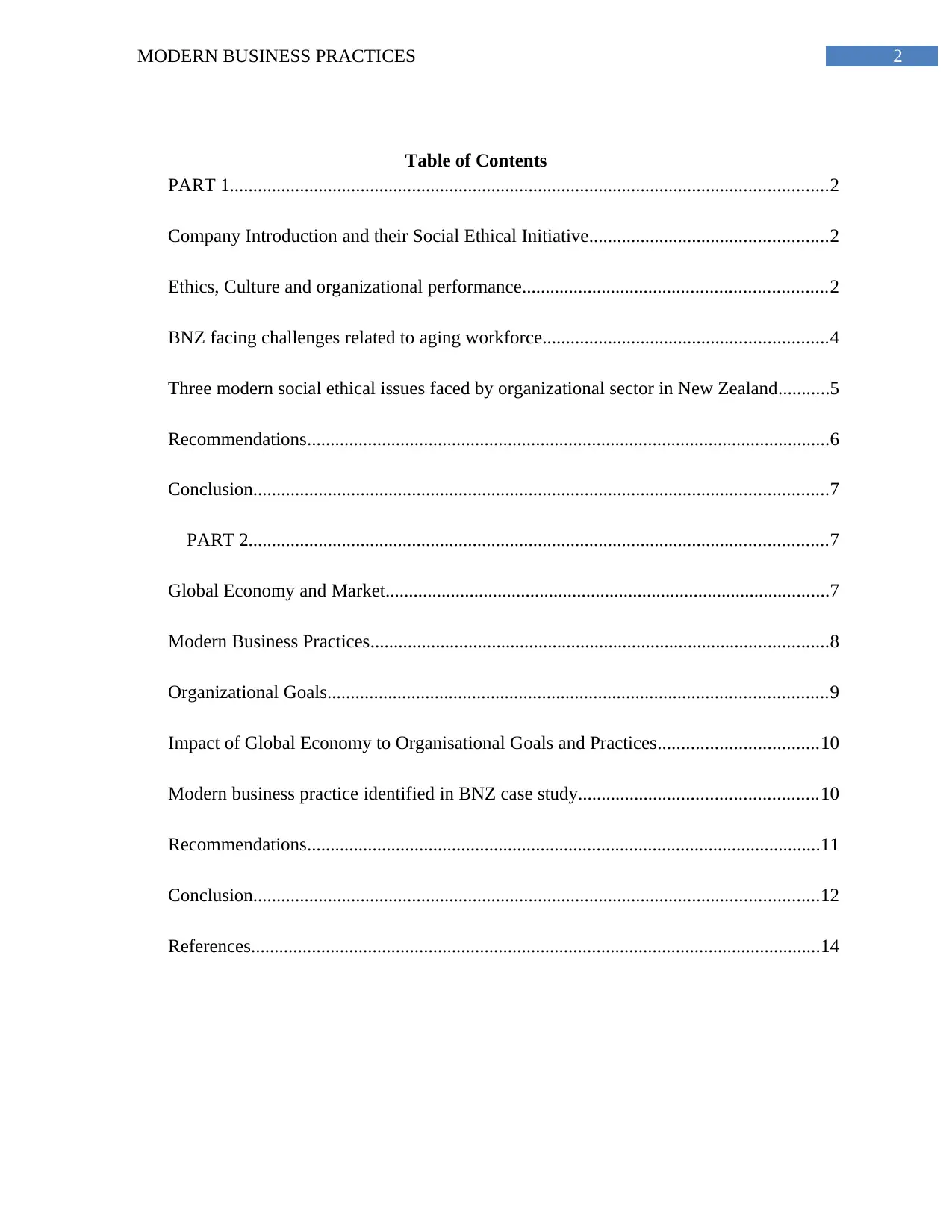
Table of Contents
PART 1................................................................................................................................2
Company Introduction and their Social Ethical Initiative...................................................2
Ethics, Culture and organizational performance.................................................................2
BNZ facing challenges related to aging workforce.............................................................4
Three modern social ethical issues faced by organizational sector in New Zealand...........5
Recommendations................................................................................................................6
Conclusion...........................................................................................................................7
PART 2............................................................................................................................7
Global Economy and Market...............................................................................................7
Modern Business Practices..................................................................................................8
Organizational Goals...........................................................................................................9
Impact of Global Economy to Organisational Goals and Practices..................................10
Modern business practice identified in BNZ case study...................................................10
Recommendations..............................................................................................................11
Conclusion.........................................................................................................................12
References..........................................................................................................................14
Table of Contents
PART 1................................................................................................................................2
Company Introduction and their Social Ethical Initiative...................................................2
Ethics, Culture and organizational performance.................................................................2
BNZ facing challenges related to aging workforce.............................................................4
Three modern social ethical issues faced by organizational sector in New Zealand...........5
Recommendations................................................................................................................6
Conclusion...........................................................................................................................7
PART 2............................................................................................................................7
Global Economy and Market...............................................................................................7
Modern Business Practices..................................................................................................8
Organizational Goals...........................................................................................................9
Impact of Global Economy to Organisational Goals and Practices..................................10
Modern business practice identified in BNZ case study...................................................10
Recommendations..............................................................................................................11
Conclusion.........................................................................................................................12
References..........................................................................................................................14
⊘ This is a preview!⊘
Do you want full access?
Subscribe today to unlock all pages.

Trusted by 1+ million students worldwide
3MODERN BUSINESS PRACTICES
PART 1
Company Introduction and their Social Ethical Initiative
Bank of New Zealand (BNZ), recognized as one of the leading financial organizations in
New Zealand has been successfully executing its banking operations since over 156 years. The
organization founded in the year 1861 in Auckland, New Zealand has been employing over 5000
employees and is currently headed by Angela Mentis (CEO). BNZ is known as the subsidiary of
the Australian bank following to the purchase by National Australia Bank (NAB) (Bnz.co.nz,
2018).
The company’s rationale for undertaking social ethical behaviour lies on the anticipation
that successful attainment of gender equity in NZ will facilitate the delivery of significant
achievements to the nation.
Ethics, Culture and organizational performance
Social ethics in organizations are regarded as policies, procedures as well as culture of
executing justifiable actions during challenging times and situations in business and further
acknowledge ethical actions in order to build constructive corporate culture. Social ethical
policies enhance the level of protection of the employees against any form of retaliation for
individualistic ideologies (Kolk, 2016). With effective implementation of social ethics
organizations can successfully retain their consumer and employee loyalty which aim to initiate
with fair and sincere treatments and authorities.
Organizational culture is referred to the system of collective ideologies and attitudes that
develop within an organization and further aids the employee behavioural patterns.
PART 1
Company Introduction and their Social Ethical Initiative
Bank of New Zealand (BNZ), recognized as one of the leading financial organizations in
New Zealand has been successfully executing its banking operations since over 156 years. The
organization founded in the year 1861 in Auckland, New Zealand has been employing over 5000
employees and is currently headed by Angela Mentis (CEO). BNZ is known as the subsidiary of
the Australian bank following to the purchase by National Australia Bank (NAB) (Bnz.co.nz,
2018).
The company’s rationale for undertaking social ethical behaviour lies on the anticipation
that successful attainment of gender equity in NZ will facilitate the delivery of significant
achievements to the nation.
Ethics, Culture and organizational performance
Social ethics in organizations are regarded as policies, procedures as well as culture of
executing justifiable actions during challenging times and situations in business and further
acknowledge ethical actions in order to build constructive corporate culture. Social ethical
policies enhance the level of protection of the employees against any form of retaliation for
individualistic ideologies (Kolk, 2016). With effective implementation of social ethics
organizations can successfully retain their consumer and employee loyalty which aim to initiate
with fair and sincere treatments and authorities.
Organizational culture is referred to the system of collective ideologies and attitudes that
develop within an organization and further aids the employee behavioural patterns.
Paraphrase This Document
Need a fresh take? Get an instant paraphrase of this document with our AI Paraphraser
4MODERN BUSINESS PRACTICES
Organizational culture focuses on the collectiveness of ethical norms and principles which assist
the way employees are to behave along with the anticipated code of conduct outside the
organization (Bolman & Deal, 2017).
Key characteristics of Organizational Culture
Individual Autonomy- The degree of accountability, autonomy and opportunities of executing
initiatives that employees have in the organization (Kolk, 2016).
Structure- The way organization creates distinctive targets and performance expectations. It
further incorporates the level of direct administration that is exercised in order to regulate
employee behaviour (Gasson et al., 2015).
Conflict Tolerance- The rate of conflicting associations among employees and stakeholders and
the degree to which employees are acknowledged to resolve such conflicting situations.
It is important to note that, organisational culture tends to vary from one organization to
another. Situations pertaining to dramatic crisis like major financial impediment in an
organization may compel the management to evaluate the relevance of its existing cultural
policies (Kolk, 2016). Furthermore, organizational culture can vary with the size and
significance of businesses whereby new business enterprises can effortlessly alter their cultural
patterns in comparison to the well-established organizations.
Several studies reveal that culture and social ethics alter organizational procedures which
further aids to create and amend cultural patterns of the organization. Modern theorists are of the
opinion that organizational culture effectively contributes to the performance level whereby,
Organizational culture focuses on the collectiveness of ethical norms and principles which assist
the way employees are to behave along with the anticipated code of conduct outside the
organization (Bolman & Deal, 2017).
Key characteristics of Organizational Culture
Individual Autonomy- The degree of accountability, autonomy and opportunities of executing
initiatives that employees have in the organization (Kolk, 2016).
Structure- The way organization creates distinctive targets and performance expectations. It
further incorporates the level of direct administration that is exercised in order to regulate
employee behaviour (Gasson et al., 2015).
Conflict Tolerance- The rate of conflicting associations among employees and stakeholders and
the degree to which employees are acknowledged to resolve such conflicting situations.
It is important to note that, organisational culture tends to vary from one organization to
another. Situations pertaining to dramatic crisis like major financial impediment in an
organization may compel the management to evaluate the relevance of its existing cultural
policies (Kolk, 2016). Furthermore, organizational culture can vary with the size and
significance of businesses whereby new business enterprises can effortlessly alter their cultural
patterns in comparison to the well-established organizations.
Several studies reveal that culture and social ethics alter organizational procedures which
further aids to create and amend cultural patterns of the organization. Modern theorists are of the
opinion that organizational culture effectively contributes to the performance level whereby,
5MODERN BUSINESS PRACTICES
Social ethics and culture are intensively predetermined with the degree of social
regulation which may influence decision making processes and behaviour of employees.
Organizational culture and social ethical policies functions as social bond in order to
create employee associations and thus enhance the rate of efficiency and employees
efficacy (Gasson et al., 2015).
Well-established social ethics effectively aids the sense making processes assists
employees to develop knowledge about organizational aims and objectives and retain the
most efficient employees of the workforce.
BNZ facing challenges related to aging workforce
BNZ has been persistently going beyond New Zealand's legislative demands and
requirements for workplace health and safety and has been functioning munificently in other
areas s well such as leave entitlement and providing welfare programs for employees and
catering for health necessities. However the company has been recently facing some social
ethical issues related to the aging workforce, a global issue which has been creating coercion to
the company’s operational activities (Gasson et al., 2015). However recent data reveals that the
persistent development in the rate of senior citizens with an increase of over 20% since 2016
along with the group which currently is comprising around 25% of the total population
(Diversity Case Study 2014, 2018). The persistence of this trend is anticipated which would led
the New Zealanders to continue to employ this age group further providing significance to the
segment in order to achieve greater organisational performance of the total talent pool
(Governance – BNZ, 2018). However the evaluation of these repercussions can be witnessed by
BNZ and its potential labour force, which is the reason the company, has effectively
implemented its operations on age and the work force. Furthermore BNZ has analysed the rate of
Social ethics and culture are intensively predetermined with the degree of social
regulation which may influence decision making processes and behaviour of employees.
Organizational culture and social ethical policies functions as social bond in order to
create employee associations and thus enhance the rate of efficiency and employees
efficacy (Gasson et al., 2015).
Well-established social ethics effectively aids the sense making processes assists
employees to develop knowledge about organizational aims and objectives and retain the
most efficient employees of the workforce.
BNZ facing challenges related to aging workforce
BNZ has been persistently going beyond New Zealand's legislative demands and
requirements for workplace health and safety and has been functioning munificently in other
areas s well such as leave entitlement and providing welfare programs for employees and
catering for health necessities. However the company has been recently facing some social
ethical issues related to the aging workforce, a global issue which has been creating coercion to
the company’s operational activities (Gasson et al., 2015). However recent data reveals that the
persistent development in the rate of senior citizens with an increase of over 20% since 2016
along with the group which currently is comprising around 25% of the total population
(Diversity Case Study 2014, 2018). The persistence of this trend is anticipated which would led
the New Zealanders to continue to employ this age group further providing significance to the
segment in order to achieve greater organisational performance of the total talent pool
(Governance – BNZ, 2018). However the evaluation of these repercussions can be witnessed by
BNZ and its potential labour force, which is the reason the company, has effectively
implemented its operations on age and the work force. Furthermore BNZ has analysed the rate of
⊘ This is a preview!⊘
Do you want full access?
Subscribe today to unlock all pages.
Trusted by 1+ million students worldwide
6MODERN BUSINESS PRACTICES
risk and complexities of losing intellectual revenues essential client associations and the areas
where they lack the constructive talent in the pipeline.
Three modern social ethical issues faced by organizational sector in New
Zealand
New Zealand is recognised by its distinctive youth work sector existing for over 30 years.
However in recent times it has revealed a lack of distinct and consistent recognition related to the
youth employment sector of the nation. However the recent ‘Attitude Gap Challenge’ report has
witnessed a significant gap which is considered to be more crucial than attitude of the young age
group. However it is it is regarded as a complex dispute of norms and expectations along with
the ethnic as well as generational disparities that occur throughout the employment course within
the organisation (Gasson et al., 2015). The Ministry Of Social Development has sponsored a co-
design challenge in order to comprehend the differences and dispute situation between young
aged employees and the level of expectations of the employers related to work inclination and
the significant impact of these differences on youth under employment in South Auckland.
Young age group in New Zealand has been experiencing long term unemployment.
Several reports have revealed risk management issues whereby the company cultural
patterns and codes of ethics in New Zealand have been showing significant ineptitude in
comparison to the other parts of the world. BNZ being the leading company financial company
along with other organisations in New Zealand have shown lack of competence in providing
separate governance committee in order to reflect the shifting perceptions of risk in the areas of
cultural organisation culture and codes of ethics (Drennan, McConnell & Stark, 2014). However
risk and complexities of losing intellectual revenues essential client associations and the areas
where they lack the constructive talent in the pipeline.
Three modern social ethical issues faced by organizational sector in New
Zealand
New Zealand is recognised by its distinctive youth work sector existing for over 30 years.
However in recent times it has revealed a lack of distinct and consistent recognition related to the
youth employment sector of the nation. However the recent ‘Attitude Gap Challenge’ report has
witnessed a significant gap which is considered to be more crucial than attitude of the young age
group. However it is it is regarded as a complex dispute of norms and expectations along with
the ethnic as well as generational disparities that occur throughout the employment course within
the organisation (Gasson et al., 2015). The Ministry Of Social Development has sponsored a co-
design challenge in order to comprehend the differences and dispute situation between young
aged employees and the level of expectations of the employers related to work inclination and
the significant impact of these differences on youth under employment in South Auckland.
Young age group in New Zealand has been experiencing long term unemployment.
Several reports have revealed risk management issues whereby the company cultural
patterns and codes of ethics in New Zealand have been showing significant ineptitude in
comparison to the other parts of the world. BNZ being the leading company financial company
along with other organisations in New Zealand have shown lack of competence in providing
separate governance committee in order to reflect the shifting perceptions of risk in the areas of
cultural organisation culture and codes of ethics (Drennan, McConnell & Stark, 2014). However
Paraphrase This Document
Need a fresh take? Get an instant paraphrase of this document with our AI Paraphraser
7MODERN BUSINESS PRACTICES
focusing on these internal drivers of the company and further in engaging with the executive is
still underdeveloped in the organisational sector of New Zealand (Gasson et al., 2015).
Another significant social issue faced by BNZ has been the lack of distinctive workplace
communication. Several immigrants have revealed the rising complexities and challenges they
have been experiencing in understanding the local kiwi accent. As in New Zealand the
employees tend to develop unless direct mannerism while speaking results in creating
obstructions to the productivity level of the new migrant employees along with posing risks to
the employees’ safety and welfare (Lee et al., 2014). The lack of effective business
communication today's ethical dilemmas and lacks confidence and the willingness to act in the
positive enthusiasm within the organisation.
Recommendations
In order to function in an effective manner to enhance the organisational cultural aspects
and social ethics effective clarification of some of the key behavioural expectations would need
to preserve the achievement and success of BNZ Company.
To mitigate the linguistic factors the company must evidently invest considerable time in
developing their codes and policies and further allowing the code to form an integral part
of the company's cultural patterns which has been loosened due to linguistic issues.
● Constructive employee behaviour effective codes and cultures can further enhance the
organisational performance of the company. Constructive investment in codes and
embedding it within the cultural programme of BNZ will further ensure the enhanced
reputation and well established behaviour within the organisation.
focusing on these internal drivers of the company and further in engaging with the executive is
still underdeveloped in the organisational sector of New Zealand (Gasson et al., 2015).
Another significant social issue faced by BNZ has been the lack of distinctive workplace
communication. Several immigrants have revealed the rising complexities and challenges they
have been experiencing in understanding the local kiwi accent. As in New Zealand the
employees tend to develop unless direct mannerism while speaking results in creating
obstructions to the productivity level of the new migrant employees along with posing risks to
the employees’ safety and welfare (Lee et al., 2014). The lack of effective business
communication today's ethical dilemmas and lacks confidence and the willingness to act in the
positive enthusiasm within the organisation.
Recommendations
In order to function in an effective manner to enhance the organisational cultural aspects
and social ethics effective clarification of some of the key behavioural expectations would need
to preserve the achievement and success of BNZ Company.
To mitigate the linguistic factors the company must evidently invest considerable time in
developing their codes and policies and further allowing the code to form an integral part
of the company's cultural patterns which has been loosened due to linguistic issues.
● Constructive employee behaviour effective codes and cultures can further enhance the
organisational performance of the company. Constructive investment in codes and
embedding it within the cultural programme of BNZ will further ensure the enhanced
reputation and well established behaviour within the organisation.
8MODERN BUSINESS PRACTICES
● Strong commitment along with sound practice among youth workers sector by
developing a national policy Framework would guide the direction of youth work and the
development of the workforce for the aging to the organisational performance and attract
the young work labour pool.
Conclusion
Therefore from the above discussion it can be stated that by adhering to well established
and effective codes ethics and policies BNZ along with the organisational sector in New Zealand
can achieve significant performance goals and further enhance the integrity level of the
employees association by effectively working on the social ethical initiatives which the
Company has proposed in recent times.
PART 2
Global Economy and Market
International forces in the new world economy have been effectively reforming the
business world by forming improved opportunities and an increase level of growth for business
enterprises. In today's global economy companies can effectively outsource any aspect of the
operational activities ranging from manufacturing to customer services through the effective
management purposes (Locke, 2013). However it has been anticipated that global productivity
from outsourcing can increase up to $510 million in 2010 (Governance – BNZ, 2018). It has
been noted that outsourcing and off shoring are considered as new traits of the today's world
economy. Several economists believe that the concept of globalisation does not encompass the
wide-ranging aspect of the modern business sector (Drucker, 2017). BNZ was evaluated the
● Strong commitment along with sound practice among youth workers sector by
developing a national policy Framework would guide the direction of youth work and the
development of the workforce for the aging to the organisational performance and attract
the young work labour pool.
Conclusion
Therefore from the above discussion it can be stated that by adhering to well established
and effective codes ethics and policies BNZ along with the organisational sector in New Zealand
can achieve significant performance goals and further enhance the integrity level of the
employees association by effectively working on the social ethical initiatives which the
Company has proposed in recent times.
PART 2
Global Economy and Market
International forces in the new world economy have been effectively reforming the
business world by forming improved opportunities and an increase level of growth for business
enterprises. In today's global economy companies can effectively outsource any aspect of the
operational activities ranging from manufacturing to customer services through the effective
management purposes (Locke, 2013). However it has been anticipated that global productivity
from outsourcing can increase up to $510 million in 2010 (Governance – BNZ, 2018). It has
been noted that outsourcing and off shoring are considered as new traits of the today's world
economy. Several economists believe that the concept of globalisation does not encompass the
wide-ranging aspect of the modern business sector (Drucker, 2017). BNZ was evaluated the
⊘ This is a preview!⊘
Do you want full access?
Subscribe today to unlock all pages.
Trusted by 1+ million students worldwide
9MODERN BUSINESS PRACTICES
impact of Brexit on global financial market. Though the US economic sector has been percent
persistently demonstrating a significant advancement, it does not seem to have been in direct
influence by Brexit (Locke, 2013). Similarly the effect of the exit of British Union on the New
Zealand economy has been negligible in comparison to the other parts of the world.
Modern Business Practices
The significant technological megatrends of advanced technologies such as mobile,
Cloud Computing, big data and social networking have altered the facet of traditional business
operations in recent years and have further encouraged a new wave of digitisation for modern
business enterprises (Drucker, 2017).
Some of the key characteristics of the digitalized business practices are:
Flexibility collaboration of various skill sets across the organisation
Empowered employee force encouraged decision making process
Customer centric business services
With the advent of advanced technologies, the collaboration across the business has been
rapid and time saving. Advanced technologies have enabled employees to work in seamless
manner in real time on significant business projects. Technology such as file sharing sites like
Dropbox further facilitates voluntary and effortless sharing of vital, confidential data and
information (Boons & Lüdeke-Freund, 2013). Traditional business practices have demonstrated
significant ineffectiveness in relevant decision making procedures. However enterprises in recent
times have been storing as well as safeguarding the data effectively with advanced technology
thus driving competitive advantage for the organisation.
impact of Brexit on global financial market. Though the US economic sector has been percent
persistently demonstrating a significant advancement, it does not seem to have been in direct
influence by Brexit (Locke, 2013). Similarly the effect of the exit of British Union on the New
Zealand economy has been negligible in comparison to the other parts of the world.
Modern Business Practices
The significant technological megatrends of advanced technologies such as mobile,
Cloud Computing, big data and social networking have altered the facet of traditional business
operations in recent years and have further encouraged a new wave of digitisation for modern
business enterprises (Drucker, 2017).
Some of the key characteristics of the digitalized business practices are:
Flexibility collaboration of various skill sets across the organisation
Empowered employee force encouraged decision making process
Customer centric business services
With the advent of advanced technologies, the collaboration across the business has been
rapid and time saving. Advanced technologies have enabled employees to work in seamless
manner in real time on significant business projects. Technology such as file sharing sites like
Dropbox further facilitates voluntary and effortless sharing of vital, confidential data and
information (Boons & Lüdeke-Freund, 2013). Traditional business practices have demonstrated
significant ineffectiveness in relevant decision making procedures. However enterprises in recent
times have been storing as well as safeguarding the data effectively with advanced technology
thus driving competitive advantage for the organisation.
Paraphrase This Document
Need a fresh take? Get an instant paraphrase of this document with our AI Paraphraser
10MODERN BUSINESS PRACTICES
Organizational Goals
Organizational goals are considered to be significant in order to regulate and control the
functioning of individuals as well as groups associated with the organisation. However it is
important to note that business enterprises that have distinctive organisational goals experience
an augmented level of competitive advantage and organisational success in comparison to the
ones who have ineffective or lack significant organisational aims and objectives (Upadhaya,
Munir & Blount, 2014).
Organisational goals provide a source of authority to action by organisation- specific
and distinctive organisational goal promotes greater degree of legitimacy and justification
to the action and decision making process of individuals or groups (Cummings &
Worley, 2014).
Serves as a standard of performance- Specific organisation goals direct the employers
to profitably enhance the performance level in the perspective of the established
organisational goals.
Business enterprises strong organisational goals can effectively retain the quality of
product of the company and further explain its stakeholders the whole range of business
phenomena in general statements by further enhancing the organisational performance.
As per the opinion of renowned marketing analyst Peter Drucker, organisational goals
must be formulated in a justifiable and pragmatic manner in order to comprehend the major
portion of the organisation's increasing revenues and further attaining focus to the wide range of
additional limitations operating through a network of decision making processes into the search
for lucrative course of organisational doings (Drucker, 2017). Furthermore organisation goals are
Organizational Goals
Organizational goals are considered to be significant in order to regulate and control the
functioning of individuals as well as groups associated with the organisation. However it is
important to note that business enterprises that have distinctive organisational goals experience
an augmented level of competitive advantage and organisational success in comparison to the
ones who have ineffective or lack significant organisational aims and objectives (Upadhaya,
Munir & Blount, 2014).
Organisational goals provide a source of authority to action by organisation- specific
and distinctive organisational goal promotes greater degree of legitimacy and justification
to the action and decision making process of individuals or groups (Cummings &
Worley, 2014).
Serves as a standard of performance- Specific organisation goals direct the employers
to profitably enhance the performance level in the perspective of the established
organisational goals.
Business enterprises strong organisational goals can effectively retain the quality of
product of the company and further explain its stakeholders the whole range of business
phenomena in general statements by further enhancing the organisational performance.
As per the opinion of renowned marketing analyst Peter Drucker, organisational goals
must be formulated in a justifiable and pragmatic manner in order to comprehend the major
portion of the organisation's increasing revenues and further attaining focus to the wide range of
additional limitations operating through a network of decision making processes into the search
for lucrative course of organisational doings (Drucker, 2017). Furthermore organisation goals are
11MODERN BUSINESS PRACTICES
formulated in order to raise the motivational factor of the employee with the enterprise’s growth,
revenue earnings and performance.
Impact of Global Economy to Organisational Goals and Practices
While evaluating the stabilizing factor of globalisation on the global economy, the rate of
trade insufficiency, petroleum pricing, accommodation crisis along with constricted measured
investments and the overall cost of living posing challenges can be witnessed in the modern
economics sector. However is must be noted that the impact of globalisation has resulted to the
emerging markets in several seasons of Eastern Europe, Latin America, China and the rest of
Asia for increase expansion on adjacent attuned basis (Gao & Bansal, 2013). With the
significance of global economy businesses in recent times it has been attempting to expand a
geographic trace and further advance this organisational value chain to the global level.
Moreover, the effect of global economy on business sector has witnessed a huge proliferation in
cross border transactions.
Modern business practice identified in BNZ case study
Several global and domestic investigations have revealed that with effective
implementation of diversity and work in organisations initiatives, business enterprises can
benefit in several areas such as intensification in employee motivation, enhanced rate of
engagement, attracting wide range of the most effective talent pool improving the productivity
level and further reducing employee attrition. BNZ with the modern global economy has been
providing its employees with flexible working conditions with real preferences in regulating
work as well as life balance (Diversity Case Study 2014, 2018). The company has implemented
formulated in order to raise the motivational factor of the employee with the enterprise’s growth,
revenue earnings and performance.
Impact of Global Economy to Organisational Goals and Practices
While evaluating the stabilizing factor of globalisation on the global economy, the rate of
trade insufficiency, petroleum pricing, accommodation crisis along with constricted measured
investments and the overall cost of living posing challenges can be witnessed in the modern
economics sector. However is must be noted that the impact of globalisation has resulted to the
emerging markets in several seasons of Eastern Europe, Latin America, China and the rest of
Asia for increase expansion on adjacent attuned basis (Gao & Bansal, 2013). With the
significance of global economy businesses in recent times it has been attempting to expand a
geographic trace and further advance this organisational value chain to the global level.
Moreover, the effect of global economy on business sector has witnessed a huge proliferation in
cross border transactions.
Modern business practice identified in BNZ case study
Several global and domestic investigations have revealed that with effective
implementation of diversity and work in organisations initiatives, business enterprises can
benefit in several areas such as intensification in employee motivation, enhanced rate of
engagement, attracting wide range of the most effective talent pool improving the productivity
level and further reducing employee attrition. BNZ with the modern global economy has been
providing its employees with flexible working conditions with real preferences in regulating
work as well as life balance (Diversity Case Study 2014, 2018). The company has implemented
⊘ This is a preview!⊘
Do you want full access?
Subscribe today to unlock all pages.
Trusted by 1+ million students worldwide

1 out of 18


Related Documents


Your All-in-One AI-Powered Toolkit for Academic Success.
+13062052269
info@desklib.com
Available 24*7 on WhatsApp / Email
![[object Object]](/_next/static/media/star-bottom.7253800d.svg)
Unlock your academic potential
Copyright © 2020–2026 A2Z Services. All Rights Reserved. Developed and managed by ZUCOL.