Business & Environment: Structure, Size, Scope of The Body Shop
VerifiedAdded on 2023/06/03
|26
|6310
|244
Report
AI Summary
This report provides a comprehensive analysis of The Body Shop's business environment, covering aspects such as organizational structure, size, scope, and the interplay between different organizational functions. It delves into the public and private sectors, examining various organizational types like sole traders, partnerships, companies, joint ventures, franchising, and licensing. The report also explores the voluntary sector, including NGOs and NPOs. Furthermore, it applies PESTEL and SWOT analyses to assess the macro and micro environmental factors influencing The Body Shop, highlighting the impact of these factors on business objectives and decision-making. The document also explains the relationship between different organizational functions and how they link to organizational objectives and structure.
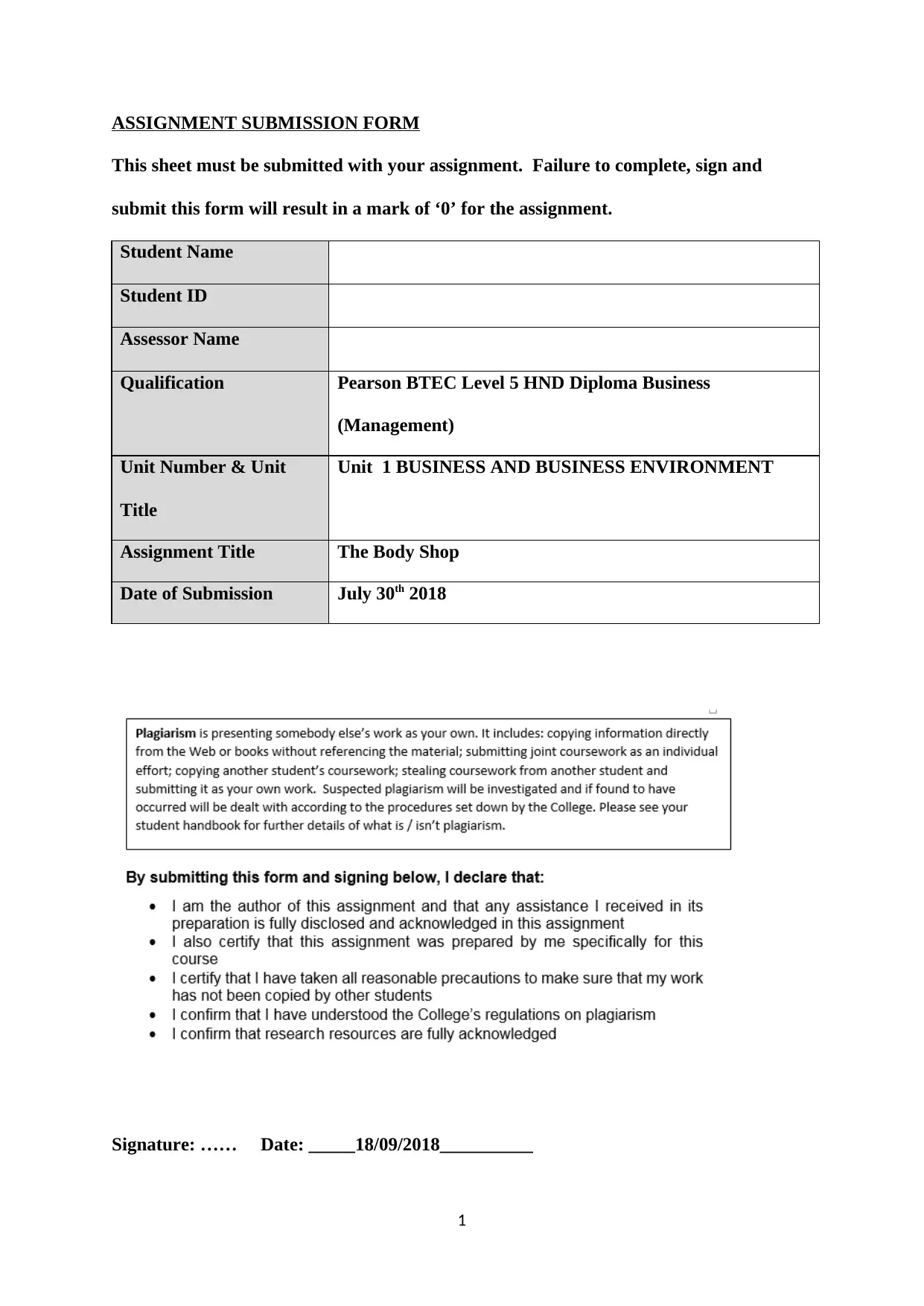
ASSIGNMENT SUBMISSION FORM
This sheet must be submitted with your assignment. Failure to complete, sign and
submit this form will result in a mark of ‘0’ for the assignment.
Student Name
Student ID
Assessor Name
Qualification Pearson BTEC Level 5 HND Diploma Business
(Management)
Unit Number & Unit
Title
Unit 1 BUSINESS AND BUSINESS ENVIRONMENT
Assignment Title The Body Shop
Date of Submission July 30th 2018
Signature: …… Date: _____18/09/2018__________
1
This sheet must be submitted with your assignment. Failure to complete, sign and
submit this form will result in a mark of ‘0’ for the assignment.
Student Name
Student ID
Assessor Name
Qualification Pearson BTEC Level 5 HND Diploma Business
(Management)
Unit Number & Unit
Title
Unit 1 BUSINESS AND BUSINESS ENVIRONMENT
Assignment Title The Body Shop
Date of Submission July 30th 2018
Signature: …… Date: _____18/09/2018__________
1

Paraphrase This Document
Need a fresh take? Get an instant paraphrase of this document with our AI Paraphraser
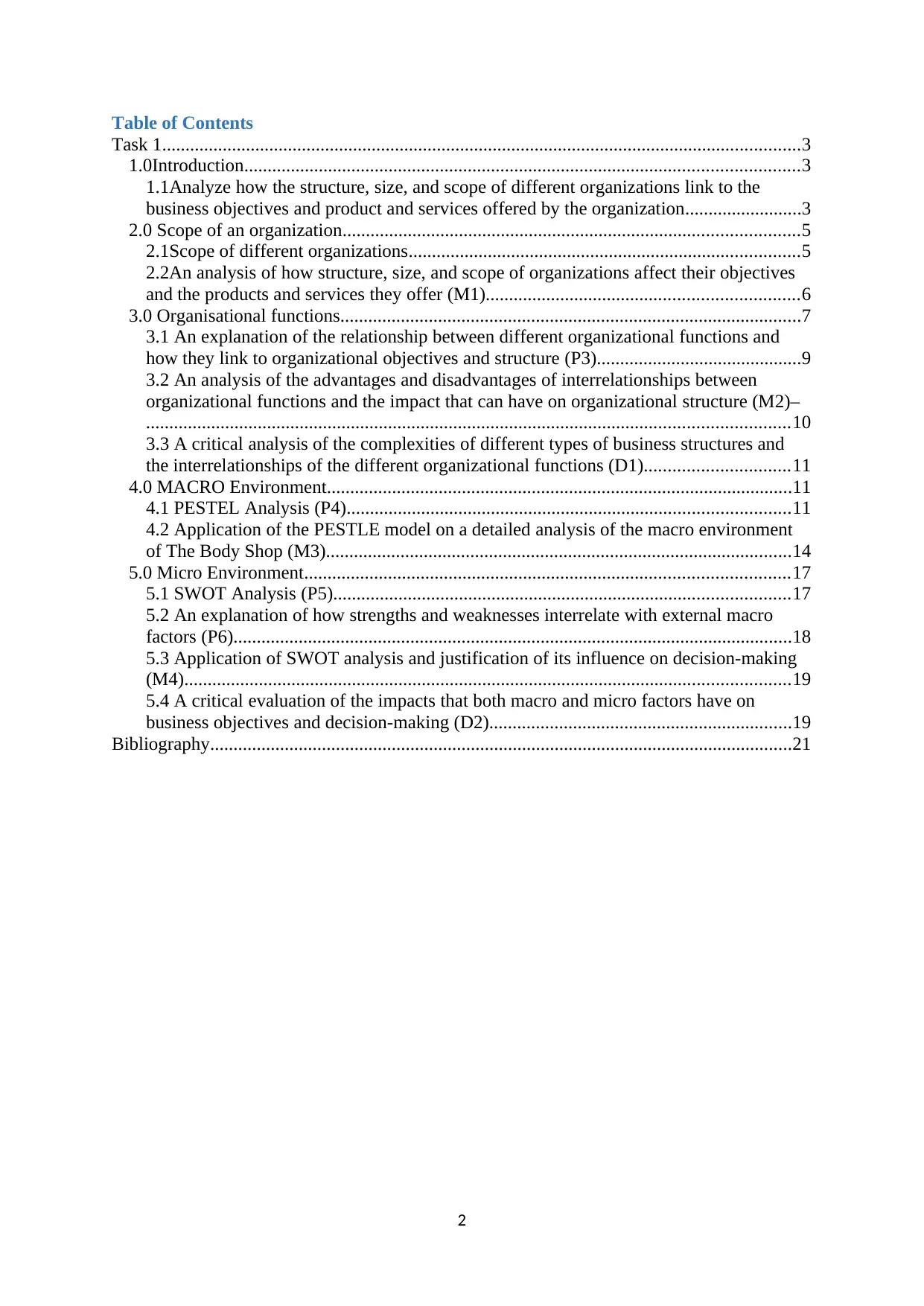
Table of Contents
Task 1.........................................................................................................................................3
1.0Introduction.......................................................................................................................3
1.1Analyze how the structure, size, and scope of different organizations link to the
business objectives and product and services offered by the organization.........................3
2.0 Scope of an organization..................................................................................................5
2.1Scope of different organizations....................................................................................5
2.2An analysis of how structure, size, and scope of organizations affect their objectives
and the products and services they offer (M1)...................................................................6
3.0 Organisational functions...................................................................................................7
3.1 An explanation of the relationship between different organizational functions and
how they link to organizational objectives and structure (P3)............................................9
3.2 An analysis of the advantages and disadvantages of interrelationships between
organizational functions and the impact that can have on organizational structure (M2)–
..........................................................................................................................................10
3.3 A critical analysis of the complexities of different types of business structures and
the interrelationships of the different organizational functions (D1)...............................11
4.0 MACRO Environment....................................................................................................11
4.1 PESTEL Analysis (P4)...............................................................................................11
4.2 Application of the PESTLE model on a detailed analysis of the macro environment
of The Body Shop (M3)....................................................................................................14
5.0 Micro Environment........................................................................................................17
5.1 SWOT Analysis (P5)..................................................................................................17
5.2 An explanation of how strengths and weaknesses interrelate with external macro
factors (P6)........................................................................................................................18
5.3 Application of SWOT analysis and justification of its influence on decision-making
(M4)..................................................................................................................................19
5.4 A critical evaluation of the impacts that both macro and micro factors have on
business objectives and decision-making (D2).................................................................19
Bibliography.............................................................................................................................21
2
Task 1.........................................................................................................................................3
1.0Introduction.......................................................................................................................3
1.1Analyze how the structure, size, and scope of different organizations link to the
business objectives and product and services offered by the organization.........................3
2.0 Scope of an organization..................................................................................................5
2.1Scope of different organizations....................................................................................5
2.2An analysis of how structure, size, and scope of organizations affect their objectives
and the products and services they offer (M1)...................................................................6
3.0 Organisational functions...................................................................................................7
3.1 An explanation of the relationship between different organizational functions and
how they link to organizational objectives and structure (P3)............................................9
3.2 An analysis of the advantages and disadvantages of interrelationships between
organizational functions and the impact that can have on organizational structure (M2)–
..........................................................................................................................................10
3.3 A critical analysis of the complexities of different types of business structures and
the interrelationships of the different organizational functions (D1)...............................11
4.0 MACRO Environment....................................................................................................11
4.1 PESTEL Analysis (P4)...............................................................................................11
4.2 Application of the PESTLE model on a detailed analysis of the macro environment
of The Body Shop (M3)....................................................................................................14
5.0 Micro Environment........................................................................................................17
5.1 SWOT Analysis (P5)..................................................................................................17
5.2 An explanation of how strengths and weaknesses interrelate with external macro
factors (P6)........................................................................................................................18
5.3 Application of SWOT analysis and justification of its influence on decision-making
(M4)..................................................................................................................................19
5.4 A critical evaluation of the impacts that both macro and micro factors have on
business objectives and decision-making (D2).................................................................19
Bibliography.............................................................................................................................21
2
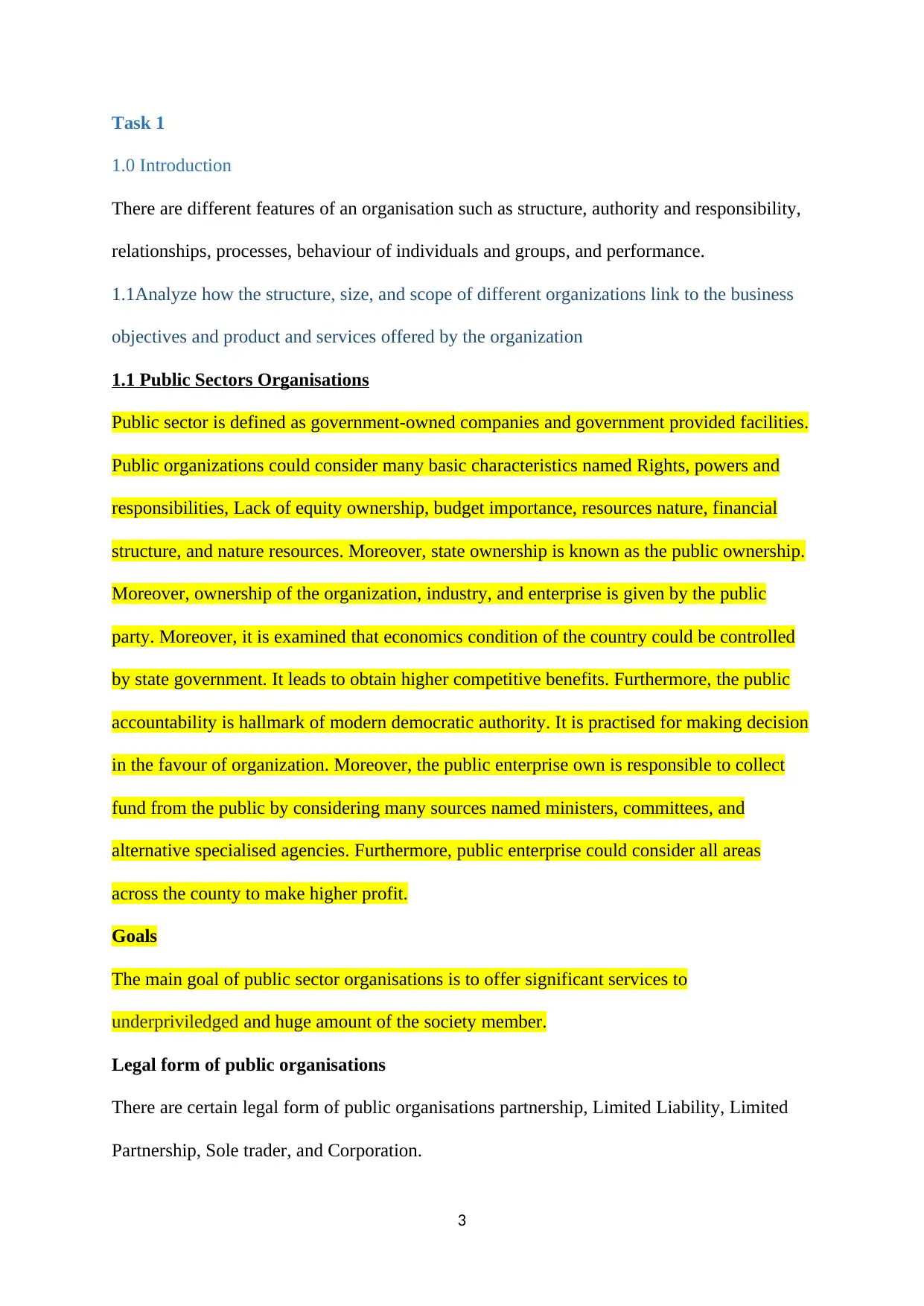
Task 1
1.0 Introduction
There are different features of an organisation such as structure, authority and responsibility,
relationships, processes, behaviour of individuals and groups, and performance.
1.1Analyze how the structure, size, and scope of different organizations link to the business
objectives and product and services offered by the organization
1.1 Public Sectors Organisations
Public sector is defined as government-owned companies and government provided facilities.
Public organizations could consider many basic characteristics named Rights, powers and
responsibilities, Lack of equity ownership, budget importance, resources nature, financial
structure, and nature resources. Moreover, state ownership is known as the public ownership.
Moreover, ownership of the organization, industry, and enterprise is given by the public
party. Moreover, it is examined that economics condition of the country could be controlled
by state government. It leads to obtain higher competitive benefits. Furthermore, the public
accountability is hallmark of modern democratic authority. It is practised for making decision
in the favour of organization. Moreover, the public enterprise own is responsible to collect
fund from the public by considering many sources named ministers, committees, and
alternative specialised agencies. Furthermore, public enterprise could consider all areas
across the county to make higher profit.
Goals
The main goal of public sector organisations is to offer significant services to
underpriviledged and huge amount of the society member.
Legal form of public organisations
There are certain legal form of public organisations partnership, Limited Liability, Limited
Partnership, Sole trader, and Corporation.
3
1.0 Introduction
There are different features of an organisation such as structure, authority and responsibility,
relationships, processes, behaviour of individuals and groups, and performance.
1.1Analyze how the structure, size, and scope of different organizations link to the business
objectives and product and services offered by the organization
1.1 Public Sectors Organisations
Public sector is defined as government-owned companies and government provided facilities.
Public organizations could consider many basic characteristics named Rights, powers and
responsibilities, Lack of equity ownership, budget importance, resources nature, financial
structure, and nature resources. Moreover, state ownership is known as the public ownership.
Moreover, ownership of the organization, industry, and enterprise is given by the public
party. Moreover, it is examined that economics condition of the country could be controlled
by state government. It leads to obtain higher competitive benefits. Furthermore, the public
accountability is hallmark of modern democratic authority. It is practised for making decision
in the favour of organization. Moreover, the public enterprise own is responsible to collect
fund from the public by considering many sources named ministers, committees, and
alternative specialised agencies. Furthermore, public enterprise could consider all areas
across the county to make higher profit.
Goals
The main goal of public sector organisations is to offer significant services to
underpriviledged and huge amount of the society member.
Legal form of public organisations
There are certain legal form of public organisations partnership, Limited Liability, Limited
Partnership, Sole trader, and Corporation.
3
⊘ This is a preview!⊘
Do you want full access?
Subscribe today to unlock all pages.

Trusted by 1+ million students worldwide
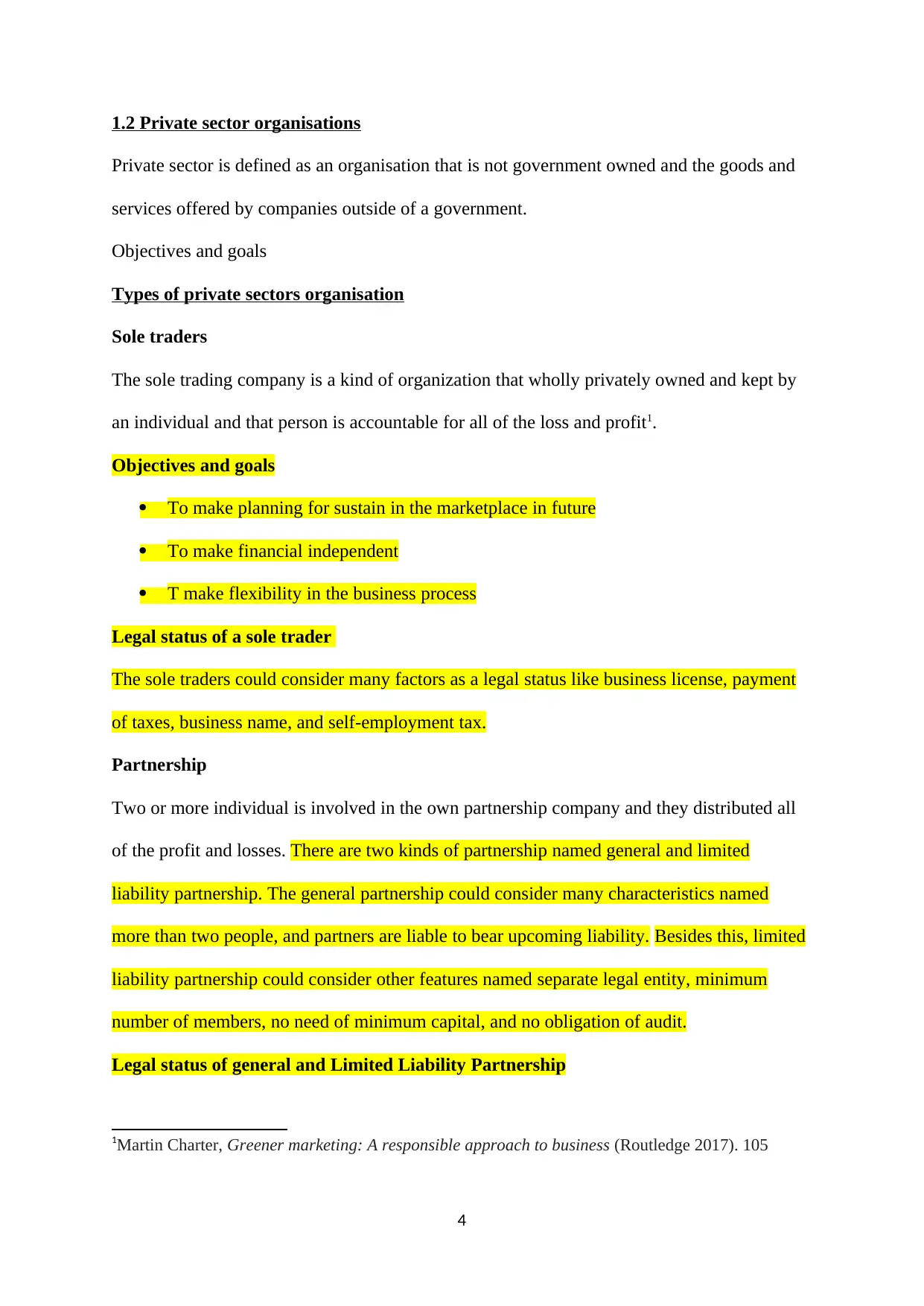
1.2 Private sector organisations
Private sector is defined as an organisation that is not government owned and the goods and
services offered by companies outside of a government.
Objectives and goals
Types of private sectors organisation
Sole traders
The sole trading company is a kind of organization that wholly privately owned and kept by
an individual and that person is accountable for all of the loss and profit1.
Objectives and goals
To make planning for sustain in the marketplace in future
To make financial independent
T make flexibility in the business process
Legal status of a sole trader
The sole traders could consider many factors as a legal status like business license, payment
of taxes, business name, and self-employment tax.
Partnership
Two or more individual is involved in the own partnership company and they distributed all
of the profit and losses. There are two kinds of partnership named general and limited
liability partnership. The general partnership could consider many characteristics named
more than two people, and partners are liable to bear upcoming liability. Besides this, limited
liability partnership could consider other features named separate legal entity, minimum
number of members, no need of minimum capital, and no obligation of audit.
Legal status of general and Limited Liability Partnership
1Martin Charter, Greener marketing: A responsible approach to business (Routledge 2017). 105
4
Private sector is defined as an organisation that is not government owned and the goods and
services offered by companies outside of a government.
Objectives and goals
Types of private sectors organisation
Sole traders
The sole trading company is a kind of organization that wholly privately owned and kept by
an individual and that person is accountable for all of the loss and profit1.
Objectives and goals
To make planning for sustain in the marketplace in future
To make financial independent
T make flexibility in the business process
Legal status of a sole trader
The sole traders could consider many factors as a legal status like business license, payment
of taxes, business name, and self-employment tax.
Partnership
Two or more individual is involved in the own partnership company and they distributed all
of the profit and losses. There are two kinds of partnership named general and limited
liability partnership. The general partnership could consider many characteristics named
more than two people, and partners are liable to bear upcoming liability. Besides this, limited
liability partnership could consider other features named separate legal entity, minimum
number of members, no need of minimum capital, and no obligation of audit.
Legal status of general and Limited Liability Partnership
1Martin Charter, Greener marketing: A responsible approach to business (Routledge 2017). 105
4
Paraphrase This Document
Need a fresh take? Get an instant paraphrase of this document with our AI Paraphraser
In the general partnership, the law doesn’t deliver responsibility to everyone like debts and
loss. The limited liability partnership facilitates firm to make one manager who manage each
activity of the business.
Objectives/Purpose of partnerships
To share networks, inventory, and other resources
Working with each other at same goal.
Companies
A limited company is that type of company in which the owner could be easily allocated and
it is owned by the board of directors. There are two kinds of companies that are operated in
the marketplace named public and private sector. The public sector company concentrates on
the making social relationship with people rather than wealth maximization. The private
sector organizations are focusing on wealth maximization.
Objectives of companies
The main objective of company is to deliver reliable services to the society for making higher
profit.
Legal status of a company
There are many company statuses who reflect the legal situation of the organization Sole
trader, Limited company, and partnerships.
Joint ventures
A joint venture is defined as business entity that is generated by two or more parties and
generally categorised by shared ownership, shared governance, and returns and risks.
Objectives/Purpose of joint ventures
To decline the risk factor for huge amount of the investment
To increase economics of scale
To accomplish synergy
5
loss. The limited liability partnership facilitates firm to make one manager who manage each
activity of the business.
Objectives/Purpose of partnerships
To share networks, inventory, and other resources
Working with each other at same goal.
Companies
A limited company is that type of company in which the owner could be easily allocated and
it is owned by the board of directors. There are two kinds of companies that are operated in
the marketplace named public and private sector. The public sector company concentrates on
the making social relationship with people rather than wealth maximization. The private
sector organizations are focusing on wealth maximization.
Objectives of companies
The main objective of company is to deliver reliable services to the society for making higher
profit.
Legal status of a company
There are many company statuses who reflect the legal situation of the organization Sole
trader, Limited company, and partnerships.
Joint ventures
A joint venture is defined as business entity that is generated by two or more parties and
generally categorised by shared ownership, shared governance, and returns and risks.
Objectives/Purpose of joint ventures
To decline the risk factor for huge amount of the investment
To increase economics of scale
To accomplish synergy
5
Legal status of a joint venture
There are certain activities that are considered in the joint venture named contracts, hire
employees, and own tax liabilities. These activities could be managed by co-venturers and
regulated by contract law.
Franchising
The size of the body shop is developed over 2,600+ franchised stores in more than
60 countries where, more than 17,000 employees are employed. Moreover, their revenue is
US$ 1.4 billion in 2017. The scope of their company is to deliver their products and services
to national with international customers with a different segment of business such as
Skincare, cosmetics, and fragrances.
Objectives of franchise
To deliver real value to their consumers in expected place
To offers Added services to potential consumers
Legal status of a franchise
Franchise law considers rules and regulation that is associated with the operating, making,
and ending franchise relationships.
Licensing
It is a procedure of generating and organising contracts amid the owner of brand and
individual who want to exercise the brand in association with product for an agreed period of
time and within agreed territory.
Objectives of licensing
To prevent the disorders and crime
To improve the public safety rules
To protect children from harm
Legal status of licensing
6
There are certain activities that are considered in the joint venture named contracts, hire
employees, and own tax liabilities. These activities could be managed by co-venturers and
regulated by contract law.
Franchising
The size of the body shop is developed over 2,600+ franchised stores in more than
60 countries where, more than 17,000 employees are employed. Moreover, their revenue is
US$ 1.4 billion in 2017. The scope of their company is to deliver their products and services
to national with international customers with a different segment of business such as
Skincare, cosmetics, and fragrances.
Objectives of franchise
To deliver real value to their consumers in expected place
To offers Added services to potential consumers
Legal status of a franchise
Franchise law considers rules and regulation that is associated with the operating, making,
and ending franchise relationships.
Licensing
It is a procedure of generating and organising contracts amid the owner of brand and
individual who want to exercise the brand in association with product for an agreed period of
time and within agreed territory.
Objectives of licensing
To prevent the disorders and crime
To improve the public safety rules
To protect children from harm
Legal status of licensing
6
⊘ This is a preview!⊘
Do you want full access?
Subscribe today to unlock all pages.
Trusted by 1+ million students worldwide
Section 4, 2003 act permits the organization to have services of licensing due to managing the
corporate functions and reach at the reliable conclusion.
1.3 Voluntary sector organisations
The voluntary sector contains different companies whose intention is to create benefits and
develops society without making profits with no intervention of government.
Objectives
To make investment in social activities rather than focusing on making profit.
To make environmental and social projects.
Types of voluntary organisations
NGOs
The NGO is defined as the non-governmental company. This company raise the fund by the
government; however it keeps a non-governmental position with no requirement for a council
of government.
The size of the body Lush UK is 4,057 employees in the UK together with 13,652 employees
internationally. Their scope of work is to serve different kinds of the cosmetic company to the
national customers and earns a large number of earnings from them2.
NPOs (Non-profit organization)
It is committed to furthering a specific social cause and advocating for a shared viewpoint.
NPOs could be charities, voluntary organizations, cooperatives, educational, professional,
religious, and public service objectives. Moreover, they offered many services to the society
member without making their own profit.
2.0 Scope of an organization
The scope is defined as the required procedure and resources for completing a project and
producing a product.
2Stefan Schaltegger, Florian Lüdeke-Freund, and Erik G. Hansen, ‘Business models for sustainability:
A co-evolutionary analysis of sustainable entrepreneurship, innovation, and transformation,’ (2016)
29 Organization & Environment 264.
7
corporate functions and reach at the reliable conclusion.
1.3 Voluntary sector organisations
The voluntary sector contains different companies whose intention is to create benefits and
develops society without making profits with no intervention of government.
Objectives
To make investment in social activities rather than focusing on making profit.
To make environmental and social projects.
Types of voluntary organisations
NGOs
The NGO is defined as the non-governmental company. This company raise the fund by the
government; however it keeps a non-governmental position with no requirement for a council
of government.
The size of the body Lush UK is 4,057 employees in the UK together with 13,652 employees
internationally. Their scope of work is to serve different kinds of the cosmetic company to the
national customers and earns a large number of earnings from them2.
NPOs (Non-profit organization)
It is committed to furthering a specific social cause and advocating for a shared viewpoint.
NPOs could be charities, voluntary organizations, cooperatives, educational, professional,
religious, and public service objectives. Moreover, they offered many services to the society
member without making their own profit.
2.0 Scope of an organization
The scope is defined as the required procedure and resources for completing a project and
producing a product.
2Stefan Schaltegger, Florian Lüdeke-Freund, and Erik G. Hansen, ‘Business models for sustainability:
A co-evolutionary analysis of sustainable entrepreneurship, innovation, and transformation,’ (2016)
29 Organization & Environment 264.
7
Paraphrase This Document
Need a fresh take? Get an instant paraphrase of this document with our AI Paraphraser
Factors that determine the size of an organisation
Size of any company are connecting with the objectives and the products and services offered
by the Body shop. It is assessed that the company determines a huge target as their objective
will be attained only while they have a good organizational structure. When the company has
few people in their organizational structure and no one has an understanding about their
subordinate and role, then it would not be possible for them to arrive at the target due to less
clarity in their role. In contrast to this, any business company develops their objective as per
their size. Hence, when the size of the company is enormous and invests the large amount
then, they set their big target according to business objectives3.
Small and medium sized enterprises
Small and medium-sized enterprises (SMEs) are non-subsidiary and independent companies
that employ less than a given number of workforces.
2.1: Scope of different organizations
There are different types of companies like local, national, international, multinational and
global company.
Local company
Scope of local company is to gain the awareness about the needs, wants and desire of
community and then the body shop can supplies its goods and services to that citizen of
community who can buy.
National company
The major scope of national company is to increase the understanding about the culture of
nation and produces products and services to satisfy its market.
International Company
3Stephen Fineman, The business of greening: an introduction (Routledge, 2017). 120
8
Size of any company are connecting with the objectives and the products and services offered
by the Body shop. It is assessed that the company determines a huge target as their objective
will be attained only while they have a good organizational structure. When the company has
few people in their organizational structure and no one has an understanding about their
subordinate and role, then it would not be possible for them to arrive at the target due to less
clarity in their role. In contrast to this, any business company develops their objective as per
their size. Hence, when the size of the company is enormous and invests the large amount
then, they set their big target according to business objectives3.
Small and medium sized enterprises
Small and medium-sized enterprises (SMEs) are non-subsidiary and independent companies
that employ less than a given number of workforces.
2.1: Scope of different organizations
There are different types of companies like local, national, international, multinational and
global company.
Local company
Scope of local company is to gain the awareness about the needs, wants and desire of
community and then the body shop can supplies its goods and services to that citizen of
community who can buy.
National company
The major scope of national company is to increase the understanding about the culture of
nation and produces products and services to satisfy its market.
International Company
3Stephen Fineman, The business of greening: an introduction (Routledge, 2017). 120
8
International company could be importers and exporters that they have no investment outside
of their habitat nation. The scope of international company is performed their business
activities in more than one nation.
Multinational Company
It has been pointed out that multinational company is directly managed by multi-national
entities4. In this way, it is assessed that the operation of Body shop runs in different countries.
Global company
The global company is related to ownership and controlling the organization. It is forced by
global individuals or group. The intention of this type of company is to make large amount of
profit. The Lush UK is considered as one of the key private global company.
2.2An analysis of how structure, size, and scope of organizations affect their objectives and
the products and services they offer (M1)
Every company has certain common objectives, which serves customers and makes
customers. However, the profit level fluctuates with the size. For instance, the body shop will
set small target according to their objectives but Lush UK will set the high target as per their
objectives. Companies develop their business objectives by assessing their business scope.
When the scope of any company is to serve national customers, then they will develop the
business objectives consequently. In contrast to this, when a company deals with international
customers the then it develops their business objectives accordingly5. Along with this, the
scope of any products with services is vast only when an organization has massive
4Robert Isaak, The making of the ecopreneur (Routledge, 2016). 63
5Bob Doppelt, Leading change toward sustainability: A change-management guide for business,
government, and civil society (Routledge, 2017). 205
9
of their habitat nation. The scope of international company is performed their business
activities in more than one nation.
Multinational Company
It has been pointed out that multinational company is directly managed by multi-national
entities4. In this way, it is assessed that the operation of Body shop runs in different countries.
Global company
The global company is related to ownership and controlling the organization. It is forced by
global individuals or group. The intention of this type of company is to make large amount of
profit. The Lush UK is considered as one of the key private global company.
2.2An analysis of how structure, size, and scope of organizations affect their objectives and
the products and services they offer (M1)
Every company has certain common objectives, which serves customers and makes
customers. However, the profit level fluctuates with the size. For instance, the body shop will
set small target according to their objectives but Lush UK will set the high target as per their
objectives. Companies develop their business objectives by assessing their business scope.
When the scope of any company is to serve national customers, then they will develop the
business objectives consequently. In contrast to this, when a company deals with international
customers the then it develops their business objectives accordingly5. Along with this, the
scope of any products with services is vast only when an organization has massive
4Robert Isaak, The making of the ecopreneur (Routledge, 2016). 63
5Bob Doppelt, Leading change toward sustainability: A change-management guide for business,
government, and civil society (Routledge, 2017). 205
9
⊘ This is a preview!⊘
Do you want full access?
Subscribe today to unlock all pages.
Trusted by 1+ million students worldwide
organization size with generates a high scaope, otherwise, the scope of products and services
will be for the small sized company.
3.0 Organisational functions
The function of the body shop relies on different functions like sales and marketing, human
resources, research and development, customer service, production and operations,
administration, IT, and finance and accounts. In this way, marketing is entailed as the bridge
of association with the market in order to satisfy the consumers. The marketing procedure is
advantageous for both suppliers and customers. The marketing helps the business such as the
body shop to deliver the customer’s information for building the new products. It would
support the quality life of the consumers6. It has been noticed that the body shop has gained
competitive benefits due to its competitive pricing strategy. The company has built a product
distribution system that permits the customers convenient access to product and services. The
increasing demand of the body shop products enables the company to grow and enlarge its
operation and gather more profits from the UK market. It has been observed that the company
provided the awareness message like or HIV and AIDS awareness as well as engaged in
developing carbon neutral and trusts in ethical trading. It contributes to developing awareness
among society7.
Finance is another function that is related to expenditure and practices of organizational
resources for a different process. The financial function offers valuable reports on financial
performance and position with respect to the business plan. The company has allocated the
funds to different parts of the company in budget allocation and assessing the practice of
6Bocken Nancy MP, Samuel W. Short, PadmakshiRana, and Steve Evans, ‘A literature and practice review to
develop sustainable business model archetypes’ (2014) 65 Journal of cleaner production 42.
7Chan W. Kim, and Renée A. Mauborgne, ‘Blue ocean strategy, expanded edition: How to create uncontested
market space and make the competition irrelevant’ (2014) Harvard business review Press, 3.
10
will be for the small sized company.
3.0 Organisational functions
The function of the body shop relies on different functions like sales and marketing, human
resources, research and development, customer service, production and operations,
administration, IT, and finance and accounts. In this way, marketing is entailed as the bridge
of association with the market in order to satisfy the consumers. The marketing procedure is
advantageous for both suppliers and customers. The marketing helps the business such as the
body shop to deliver the customer’s information for building the new products. It would
support the quality life of the consumers6. It has been noticed that the body shop has gained
competitive benefits due to its competitive pricing strategy. The company has built a product
distribution system that permits the customers convenient access to product and services. The
increasing demand of the body shop products enables the company to grow and enlarge its
operation and gather more profits from the UK market. It has been observed that the company
provided the awareness message like or HIV and AIDS awareness as well as engaged in
developing carbon neutral and trusts in ethical trading. It contributes to developing awareness
among society7.
Finance is another function that is related to expenditure and practices of organizational
resources for a different process. The financial function offers valuable reports on financial
performance and position with respect to the business plan. The company has allocated the
funds to different parts of the company in budget allocation and assessing the practice of
6Bocken Nancy MP, Samuel W. Short, PadmakshiRana, and Steve Evans, ‘A literature and practice review to
develop sustainable business model archetypes’ (2014) 65 Journal of cleaner production 42.
7Chan W. Kim, and Renée A. Mauborgne, ‘Blue ocean strategy, expanded edition: How to create uncontested
market space and make the competition irrelevant’ (2014) Harvard business review Press, 3.
10
Paraphrase This Document
Need a fresh take? Get an instant paraphrase of this document with our AI Paraphraser
financial resources in against the performance budget. For managing the cash flow of
business, the body shop ensures that there are adequate funds to attain business needs. The
financial performance of every team is assessed by the internal auditors. The finance of large
corporation was entailed in the investment of excess funds. It has been pointed out that
different corporations have generated the treasury fund to look after the business of the
company. Hence, the company can acquire the best return and declines the uncertainty from
the investment. Moreover, resources are entailed as a risk by different finance departments
such as cost improvement project, additional production lines, purchasing new technology to
assist quality and efficiency. It has been assessed that the financial report of the body shop
makes sure that the company attains the higher needs of UK8.
Accounting is another function of an organization such as the body shop will be tracking all
daily transaction of the sales, purchases, and utilizing the business resources externally and
internally to the company. The cash flow in the body shop makes sure that the company pays
adequate funds for maintaining their business liabilities while it needs to pay. It is evaluated
that the finance team is held accountable for sourcing the additional funding from different
sources in order to expand the business9.
The body shop has also entailed the role of the human resource management department to
take care of workforces by the company. The convex of the human resource management
department is used to manage the workforces for attaining 100% efficiency and good
performance. The human resource management department also creates an issue about the
policies and legislation. There are the different roles of human resource management in
practices of the body shop. These roles are job design, recruitment, employee relation,
8Samuel W., Short, Nancy MP Bocken, Claire Y. Barlow, and Marian R. Chertow, ‘From refining sugar to
growing tomatoes: Industrial ecology and business model evolution’ (2014) 18 Journal of Industrial
Ecology 603.
9RomanaRauter, Jan Jonker, and Rupert J. Baumgartner, ‘Going one's own way: drivers in developing
business models for sustainability’ (2017) 140 Journal of Cleaner Production 144.
11
business, the body shop ensures that there are adequate funds to attain business needs. The
financial performance of every team is assessed by the internal auditors. The finance of large
corporation was entailed in the investment of excess funds. It has been pointed out that
different corporations have generated the treasury fund to look after the business of the
company. Hence, the company can acquire the best return and declines the uncertainty from
the investment. Moreover, resources are entailed as a risk by different finance departments
such as cost improvement project, additional production lines, purchasing new technology to
assist quality and efficiency. It has been assessed that the financial report of the body shop
makes sure that the company attains the higher needs of UK8.
Accounting is another function of an organization such as the body shop will be tracking all
daily transaction of the sales, purchases, and utilizing the business resources externally and
internally to the company. The cash flow in the body shop makes sure that the company pays
adequate funds for maintaining their business liabilities while it needs to pay. It is evaluated
that the finance team is held accountable for sourcing the additional funding from different
sources in order to expand the business9.
The body shop has also entailed the role of the human resource management department to
take care of workforces by the company. The convex of the human resource management
department is used to manage the workforces for attaining 100% efficiency and good
performance. The human resource management department also creates an issue about the
policies and legislation. There are the different roles of human resource management in
practices of the body shop. These roles are job design, recruitment, employee relation,
8Samuel W., Short, Nancy MP Bocken, Claire Y. Barlow, and Marian R. Chertow, ‘From refining sugar to
growing tomatoes: Industrial ecology and business model evolution’ (2014) 18 Journal of Industrial
Ecology 603.
9RomanaRauter, Jan Jonker, and Rupert J. Baumgartner, ‘Going one's own way: drivers in developing
business models for sustainability’ (2017) 140 Journal of Cleaner Production 144.
11
maintaining employment law, administration, and training and development of employee’s
skills10.
3.1 An explanation of the relationship between different organizational functions and how
they link to organizational objectives and structure (P3)
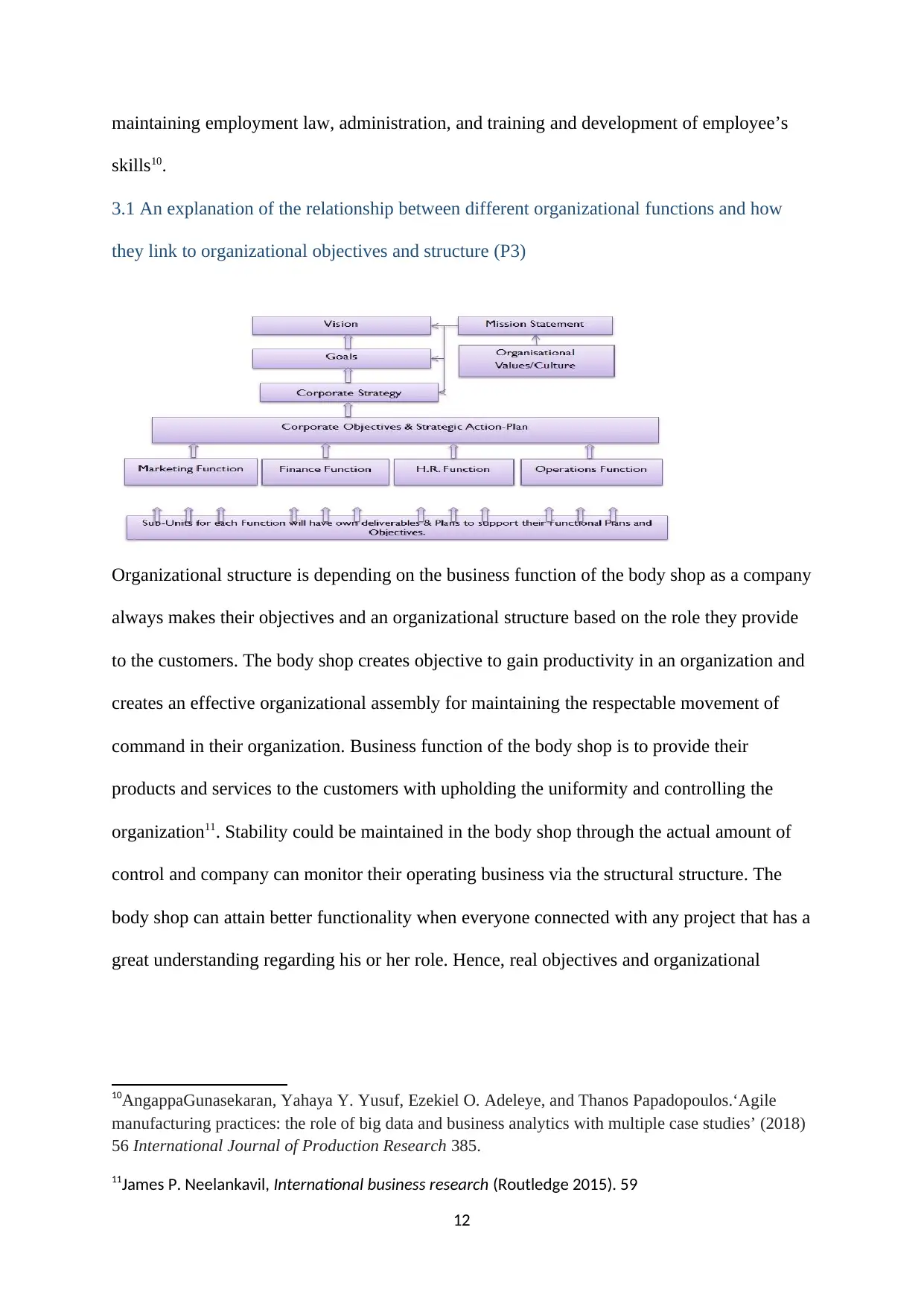
Organizational structure is depending on the business function of the body shop as a company
always makes their objectives and an organizational structure based on the role they provide
to the customers. The body shop creates objective to gain productivity in an organization and
creates an effective organizational assembly for maintaining the respectable movement of
command in their organization. Business function of the body shop is to provide their
products and services to the customers with upholding the uniformity and controlling the
organization11. Stability could be maintained in the body shop through the actual amount of
control and company can monitor their operating business via the structural structure. The
body shop can attain better functionality when everyone connected with any project that has a
great understanding regarding his or her role. Hence, real objectives and organizational
10AngappaGunasekaran, Yahaya Y. Yusuf, Ezekiel O. Adeleye, and Thanos Papadopoulos.‘Agile
manufacturing practices: the role of big data and business analytics with multiple case studies’ (2018)
56 International Journal of Production Research 385.
11James P. Neelankavil, International business research (Routledge 2015). 59
12
skills10.
3.1 An explanation of the relationship between different organizational functions and how
they link to organizational objectives and structure (P3)
Organizational structure is depending on the business function of the body shop as a company
always makes their objectives and an organizational structure based on the role they provide
to the customers. The body shop creates objective to gain productivity in an organization and
creates an effective organizational assembly for maintaining the respectable movement of
command in their organization. Business function of the body shop is to provide their
products and services to the customers with upholding the uniformity and controlling the
organization11. Stability could be maintained in the body shop through the actual amount of
control and company can monitor their operating business via the structural structure. The
body shop can attain better functionality when everyone connected with any project that has a
great understanding regarding his or her role. Hence, real objectives and organizational
10AngappaGunasekaran, Yahaya Y. Yusuf, Ezekiel O. Adeleye, and Thanos Papadopoulos.‘Agile
manufacturing practices: the role of big data and business analytics with multiple case studies’ (2018)
56 International Journal of Production Research 385.
11James P. Neelankavil, International business research (Routledge 2015). 59
12
⊘ This is a preview!⊘
Do you want full access?
Subscribe today to unlock all pages.
Trusted by 1+ million students worldwide

1 out of 26


Related Documents


Your All-in-One AI-Powered Toolkit for Academic Success.
+13062052269
info@desklib.com
Available 24*7 on WhatsApp / Email
![[object Object]](/_next/static/media/star-bottom.7253800d.svg)
Unlock your academic potential
Copyright © 2020–2026 A2Z Services. All Rights Reserved. Developed and managed by ZUCOL.