Boeing: Operations and Logistics Management Detailed Report
VerifiedAdded on 2020/04/21
|28
|5454
|274
Report
AI Summary
This report provides a comprehensive analysis of Boeing's operations and logistics management. It begins with a historical overview of the company and its market competition, followed by an examination of core operations management principles and their application within Boeing. The report delves into quality management strategies, addressing challenges and exploring the impact of supply chain strategies on quality, lead time, and supplier reliability. Furthermore, it analyzes the benefits and challenges of implementing AI and robotics in Boeing's operations. A significant portion of the report focuses on project management, including risk assessment, goal setting, roles and responsibilities, budgeting, work breakdown structure, stakeholder management, project life cycle, and Gantt chart creation for the 777X project. Finally, it addresses problem management and concludes with recommendations for future operational success. The report emphasizes the importance of adapting to industry changes, leveraging quality management systems, and strategically integrating technology to maintain Boeing's position as a global leader in the aviation industry.
Running head: LOGISTICS AND OPERATIONS MANAGEMENT
Logistics and Operations Management
Name of Student:
Name of University:
Author’s Note:
Logistics and Operations Management
Name of Student:
Name of University:
Author’s Note:

Paraphrase This Document
Need a fresh take? Get an instant paraphrase of this document with our AI Paraphraser
1LOGISTICS AND OPERATIONS MANAGEEMNT
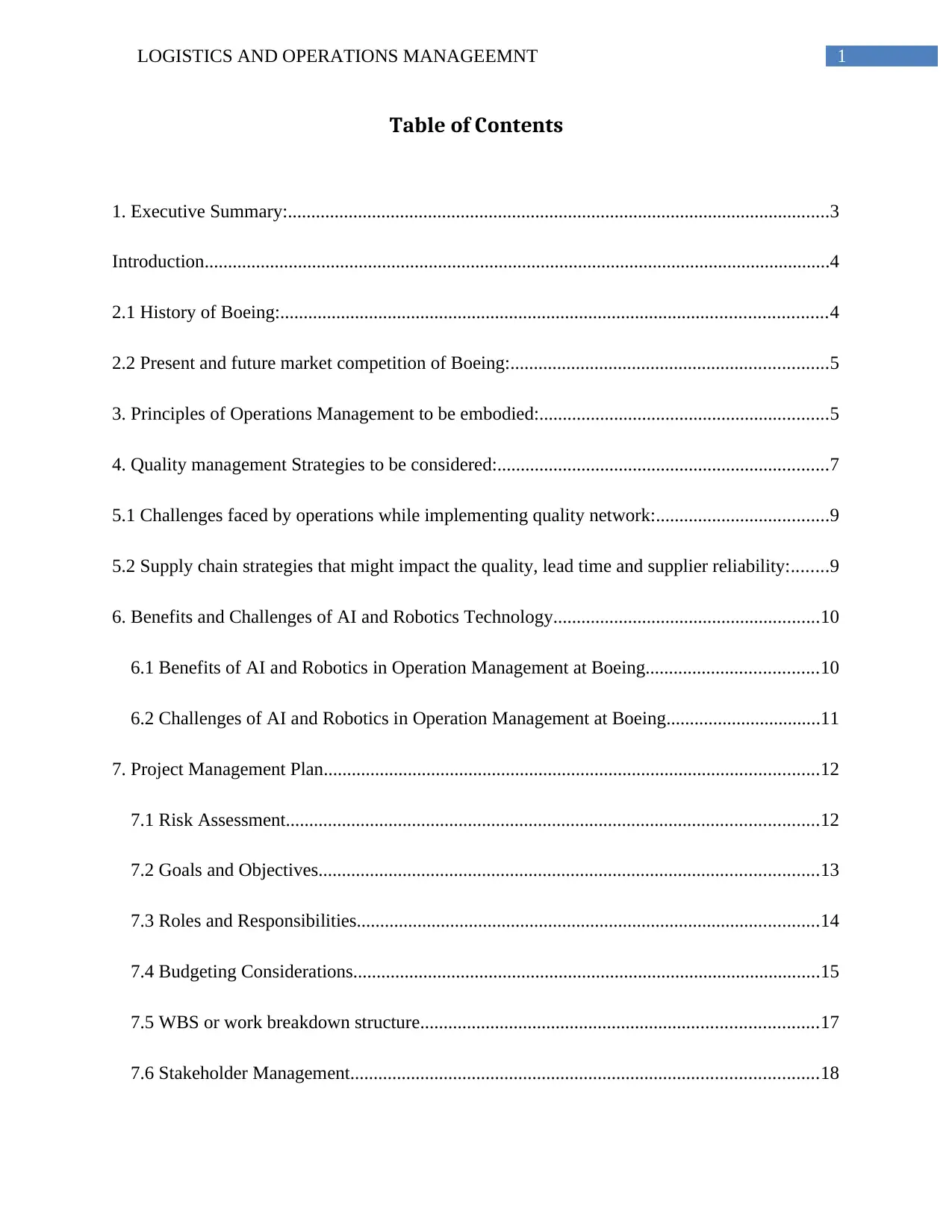
Table of Contents
1. Executive Summary:....................................................................................................................3
Introduction......................................................................................................................................4
2.1 History of Boeing:.....................................................................................................................4
2.2 Present and future market competition of Boeing:....................................................................5
3. Principles of Operations Management to be embodied:..............................................................5
4. Quality management Strategies to be considered:.......................................................................7
5.1 Challenges faced by operations while implementing quality network:.....................................9
5.2 Supply chain strategies that might impact the quality, lead time and supplier reliability:........9
6. Benefits and Challenges of AI and Robotics Technology.........................................................10
6.1 Benefits of AI and Robotics in Operation Management at Boeing.....................................10
6.2 Challenges of AI and Robotics in Operation Management at Boeing.................................11
7. Project Management Plan..........................................................................................................12
7.1 Risk Assessment..................................................................................................................12
7.2 Goals and Objectives...........................................................................................................13
7.3 Roles and Responsibilities...................................................................................................14
7.4 Budgeting Considerations....................................................................................................15
7.5 WBS or work breakdown structure.....................................................................................17
7.6 Stakeholder Management....................................................................................................18
Table of Contents
1. Executive Summary:....................................................................................................................3
Introduction......................................................................................................................................4
2.1 History of Boeing:.....................................................................................................................4
2.2 Present and future market competition of Boeing:....................................................................5
3. Principles of Operations Management to be embodied:..............................................................5
4. Quality management Strategies to be considered:.......................................................................7
5.1 Challenges faced by operations while implementing quality network:.....................................9
5.2 Supply chain strategies that might impact the quality, lead time and supplier reliability:........9
6. Benefits and Challenges of AI and Robotics Technology.........................................................10
6.1 Benefits of AI and Robotics in Operation Management at Boeing.....................................10
6.2 Challenges of AI and Robotics in Operation Management at Boeing.................................11
7. Project Management Plan..........................................................................................................12
7.1 Risk Assessment..................................................................................................................12
7.2 Goals and Objectives...........................................................................................................13
7.3 Roles and Responsibilities...................................................................................................14
7.4 Budgeting Considerations....................................................................................................15
7.5 WBS or work breakdown structure.....................................................................................17
7.6 Stakeholder Management....................................................................................................18
2LOGISTICS AND OPERATIONS MANAGEEMNT
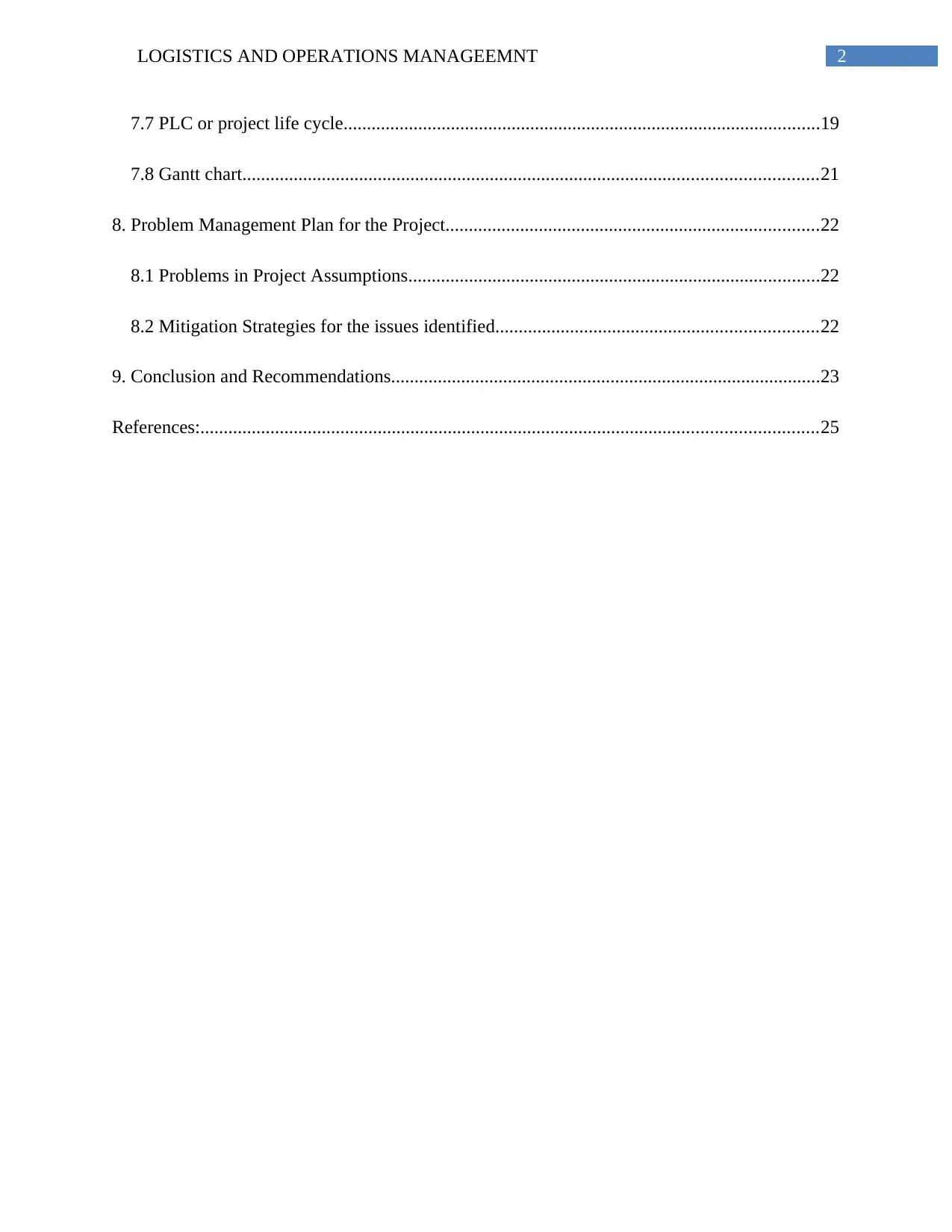
7.7 PLC or project life cycle......................................................................................................19
7.8 Gantt chart...........................................................................................................................21
8. Problem Management Plan for the Project................................................................................22
8.1 Problems in Project Assumptions........................................................................................22
8.2 Mitigation Strategies for the issues identified.....................................................................22
9. Conclusion and Recommendations............................................................................................23
References:....................................................................................................................................25
7.7 PLC or project life cycle......................................................................................................19
7.8 Gantt chart...........................................................................................................................21
8. Problem Management Plan for the Project................................................................................22
8.1 Problems in Project Assumptions........................................................................................22
8.2 Mitigation Strategies for the issues identified.....................................................................22
9. Conclusion and Recommendations............................................................................................23
References:....................................................................................................................................25
⊘ This is a preview!⊘
Do you want full access?
Subscribe today to unlock all pages.

Trusted by 1+ million students worldwide
3LOGISTICS AND OPERATIONS MANAGEEMNT
1. Executive Summary:
The aim of the report is to provide a brief history of the Boeing Company and the present and
future market competition of the company. The state from which the Company started to where it
is at present has been discussed. The different competitors of the Boeing Company in different
fields are discussed. The fundamental principles of operations management are discussed in
detail. The embodiment of the principles crucial for the company and its success in the global
aircraft market are discussed in detail. The importance of quality management is discussed and in
connection to this the quality management principles and strategies that need to be adopted are
also discussed. The challenges faced and overcome are discussed with reference to the Boeing
Company. The analysis of the benefits and issues of the implementation of the AI and robotics
for the automatic Airplane manufacturing process of Boeing had been done in the following
report. The report had covered the project scheduling methods, work breakdown structure, risk
assessment process, and stakeholder management process for the project of Development and
Production of Boeing’s 777x in Everett factory. It had helped in forming an effective project
management plan that could help the organization for developing future projects as well. The
report is concluded with the suitable conclusion on the desired operations and proper
recommendations for its success. It is desirable that the company abides by the said policies and
recommendations in order to emerge as a global superpower in the aviation industry.
1. Executive Summary:
The aim of the report is to provide a brief history of the Boeing Company and the present and
future market competition of the company. The state from which the Company started to where it
is at present has been discussed. The different competitors of the Boeing Company in different
fields are discussed. The fundamental principles of operations management are discussed in
detail. The embodiment of the principles crucial for the company and its success in the global
aircraft market are discussed in detail. The importance of quality management is discussed and in
connection to this the quality management principles and strategies that need to be adopted are
also discussed. The challenges faced and overcome are discussed with reference to the Boeing
Company. The analysis of the benefits and issues of the implementation of the AI and robotics
for the automatic Airplane manufacturing process of Boeing had been done in the following
report. The report had covered the project scheduling methods, work breakdown structure, risk
assessment process, and stakeholder management process for the project of Development and
Production of Boeing’s 777x in Everett factory. It had helped in forming an effective project
management plan that could help the organization for developing future projects as well. The
report is concluded with the suitable conclusion on the desired operations and proper
recommendations for its success. It is desirable that the company abides by the said policies and
recommendations in order to emerge as a global superpower in the aviation industry.
Paraphrase This Document
Need a fresh take? Get an instant paraphrase of this document with our AI Paraphraser
4LOGISTICS AND OPERATIONS MANAGEEMNT
Introduction
As stated by Nicholas and Steyn (2017), the project management tools and techniques
play a crucial role for ensuring that the project of development of the Boeing’s advanced
automated aircraft development process. The automation of the manufacturing process requires
the correct implication of the technology and the analysis of the improved processes would allow
the implication of the improved operations. The use of project scheduling methods, work
breakdown structure, risk assessment process, and stakeholder management process would allow
the implication of the successive project management plan for the project of Development and
Production of Boeing’s 777x in Everett factory.
2.1 History of Boeing:
The origin of the Boeing Company can be traced back to 1916, at the time when
American Timber merchant William Boeing which founded the Aero Products Company after
developing a single engine two seat sea plane. The Boeing Company, an American Aerospace
Company, the world’s largest and earliest manufacturer of the commercial jet transports is also a
sole manufacturer of commercial jet transports, helicopters, space vehicles and missiles. It was
also improved with the company’s attainment of the aerospace and the units of defence of the
Rockwell International Corporation in the year 1996. The company merged with the Mc Donnell
Douglas Foundation in the following year. It was formerly known as the Boeing Airplane
Company, the present name was assumed by the firm in the year 1961 to reflect the expansion of
the company in the fields which did not only focus on the manufacture of the aircraft.
Introduction
As stated by Nicholas and Steyn (2017), the project management tools and techniques
play a crucial role for ensuring that the project of development of the Boeing’s advanced
automated aircraft development process. The automation of the manufacturing process requires
the correct implication of the technology and the analysis of the improved processes would allow
the implication of the improved operations. The use of project scheduling methods, work
breakdown structure, risk assessment process, and stakeholder management process would allow
the implication of the successive project management plan for the project of Development and
Production of Boeing’s 777x in Everett factory.
2.1 History of Boeing:
The origin of the Boeing Company can be traced back to 1916, at the time when
American Timber merchant William Boeing which founded the Aero Products Company after
developing a single engine two seat sea plane. The Boeing Company, an American Aerospace
Company, the world’s largest and earliest manufacturer of the commercial jet transports is also a
sole manufacturer of commercial jet transports, helicopters, space vehicles and missiles. It was
also improved with the company’s attainment of the aerospace and the units of defence of the
Rockwell International Corporation in the year 1996. The company merged with the Mc Donnell
Douglas Foundation in the following year. It was formerly known as the Boeing Airplane
Company, the present name was assumed by the firm in the year 1961 to reflect the expansion of
the company in the fields which did not only focus on the manufacture of the aircraft.
5LOGISTICS AND OPERATIONS MANAGEEMNT
The main business constituents are organised into three major groups of products and
services which are that of commercial airplanes, military aircraft and missiles along with
communications and space. The company’s military concerned activities are concentrated on the
design, manufacture and support of fighter aircraft, bombers, transports, helicopters and missiles.
2.2 Present and future market competition of Boeing:
The commercial market of the jet aircrafts and the airline industry are extremely
competitive and Boeing Company faces extensive competition and aggressive international
competitors like Airbus, Embraer and Bombardier and even from the entrants like Irkut- United
Aircraft Corporation from Russia, the COMAC from China and Mitsubishi Aircraft from Japan.
The company desires to continue its competition with the manufacturers of other aircrafts
by providing the customers with products of greater value, support and services. The company
continues to leverage its existent extensive customer support service and airplane’s life cycle.
This comprises of aircraft acquisition, readying for service, maintenance, enhancing and
upgrading and also transitioning into the next model. This allows the organisation to enjoy a high
customer productivity level. The Boeing Defence, Space and Security also experiences
significant competition in all the market segments form Lockheed martin, Raytheon Company,
Northrop Grumman, General Dynamics. The companies like BAE Systems Airbus Group
continue to build a strategic presence.
3. Principles of Operations Management to be embodied:
Operations management is one of the aspects of business which needs to be addressed
properly as it is crucial for the company’s success. The operations of the business need to be
The main business constituents are organised into three major groups of products and
services which are that of commercial airplanes, military aircraft and missiles along with
communications and space. The company’s military concerned activities are concentrated on the
design, manufacture and support of fighter aircraft, bombers, transports, helicopters and missiles.
2.2 Present and future market competition of Boeing:
The commercial market of the jet aircrafts and the airline industry are extremely
competitive and Boeing Company faces extensive competition and aggressive international
competitors like Airbus, Embraer and Bombardier and even from the entrants like Irkut- United
Aircraft Corporation from Russia, the COMAC from China and Mitsubishi Aircraft from Japan.
The company desires to continue its competition with the manufacturers of other aircrafts
by providing the customers with products of greater value, support and services. The company
continues to leverage its existent extensive customer support service and airplane’s life cycle.
This comprises of aircraft acquisition, readying for service, maintenance, enhancing and
upgrading and also transitioning into the next model. This allows the organisation to enjoy a high
customer productivity level. The Boeing Defence, Space and Security also experiences
significant competition in all the market segments form Lockheed martin, Raytheon Company,
Northrop Grumman, General Dynamics. The companies like BAE Systems Airbus Group
continue to build a strategic presence.
3. Principles of Operations Management to be embodied:
Operations management is one of the aspects of business which needs to be addressed
properly as it is crucial for the company’s success. The operations of the business need to be
⊘ This is a preview!⊘
Do you want full access?
Subscribe today to unlock all pages.
Trusted by 1+ million students worldwide
6LOGISTICS AND OPERATIONS MANAGEEMNT
handled properly when any issue occurs. The strength is to be measured to all the strategies that
it has encountered. The Boeing Company remains tough even with all the struggles which have
been faced by them.
A part of the operations management at Boeing Company for reaching its goals in a
specific manner is to make their aircrafts on the major commercial aircraft front. This is achieved
by getting the correct product mix, formulation and application of right market strategies and
system of production. The system of operations management at Boeing comprises the avoidance
of problems or difficulties by the avoidance of problems and difficulties by looking into them
from before and forming solutions such that the problems can arise that the operations
management will only have to perform them. The company always utilizes the pathways of
production and manufacturing. The company was also able to get a better result in the
maintenance routes of airlines which was possible by the management of all the costs that the
company incurs with respect to the revenue it is earning.
The company also utilizes the tools and models which specifically addresses and reduces
the problems which might be faced in terms of the size design of the aircrafts.
The operations management at Boeing is to utilize the support system and the tackling of
the exact deployment times in order to increase the overall effectiveness of the operational
effectiveness of the decisions involving the planes.
One of the most important duties of the Boeing’s operations management is to consider
and be aware of all the accounting rules and taxation rules being performed in the several
countries. Regarding the safety operation of the Boeing Air crafts the company has looked into
handled properly when any issue occurs. The strength is to be measured to all the strategies that
it has encountered. The Boeing Company remains tough even with all the struggles which have
been faced by them.
A part of the operations management at Boeing Company for reaching its goals in a
specific manner is to make their aircrafts on the major commercial aircraft front. This is achieved
by getting the correct product mix, formulation and application of right market strategies and
system of production. The system of operations management at Boeing comprises the avoidance
of problems or difficulties by the avoidance of problems and difficulties by looking into them
from before and forming solutions such that the problems can arise that the operations
management will only have to perform them. The company always utilizes the pathways of
production and manufacturing. The company was also able to get a better result in the
maintenance routes of airlines which was possible by the management of all the costs that the
company incurs with respect to the revenue it is earning.
The company also utilizes the tools and models which specifically addresses and reduces
the problems which might be faced in terms of the size design of the aircrafts.
The operations management at Boeing is to utilize the support system and the tackling of
the exact deployment times in order to increase the overall effectiveness of the operational
effectiveness of the decisions involving the planes.
One of the most important duties of the Boeing’s operations management is to consider
and be aware of all the accounting rules and taxation rules being performed in the several
countries. Regarding the safety operation of the Boeing Air crafts the company has looked into
Paraphrase This Document
Need a fresh take? Get an instant paraphrase of this document with our AI Paraphraser
7LOGISTICS AND OPERATIONS MANAGEEMNT
and started the strategy of the reduction of the capacity limits and the speed of the air for
prevention of the aircrafts facing any major problems especially during the periods of the flight.
The operations management principles that the company should ensure comprises of the
proper operational planning. It should focus on a plan or a schedule which is achievable
operationally and is also recoverable and amendable at the lowest cost possible. The aircraft
assignment and utilization need to be kept in mind. The maintenance requirements of the aircraft
need to be kept in mind (Christopher 2016).
The operational plan of the company needs to be kept in mind properly by the Boeing
Company so that the new aircraft to be launched does not. The efficiency of the new model
Boeing 777X needs to be understood properly by the company in terms of its strengths and
weaknesses.
4. Quality management Strategies to be considered:
The concept of quality management is extremely important in the aerospace industry
more so in comparison to the manufacture and services industry. The changes in the market are
inevitable and this is responsible for making the quality management a crucial component for the
success of any business in the aerospace industry.
One of the most important strategies that need to be considered by the Aerospace industry
is to be responsive to the changes in the industry. The aerospace industry faces several
challenges in the wake of an unstable financial climate. The concept of total quality management
allows the aerospace industries to stay crucial in a world that is very competitive and ever-
growing amidst certain changes and learn to remain responsive to the changes in the industry.
The services provided by them must ensure a certain amount of customer satisfaction for
and started the strategy of the reduction of the capacity limits and the speed of the air for
prevention of the aircrafts facing any major problems especially during the periods of the flight.
The operations management principles that the company should ensure comprises of the
proper operational planning. It should focus on a plan or a schedule which is achievable
operationally and is also recoverable and amendable at the lowest cost possible. The aircraft
assignment and utilization need to be kept in mind. The maintenance requirements of the aircraft
need to be kept in mind (Christopher 2016).
The operational plan of the company needs to be kept in mind properly by the Boeing
Company so that the new aircraft to be launched does not. The efficiency of the new model
Boeing 777X needs to be understood properly by the company in terms of its strengths and
weaknesses.
4. Quality management Strategies to be considered:
The concept of quality management is extremely important in the aerospace industry
more so in comparison to the manufacture and services industry. The changes in the market are
inevitable and this is responsible for making the quality management a crucial component for the
success of any business in the aerospace industry.
One of the most important strategies that need to be considered by the Aerospace industry
is to be responsive to the changes in the industry. The aerospace industry faces several
challenges in the wake of an unstable financial climate. The concept of total quality management
allows the aerospace industries to stay crucial in a world that is very competitive and ever-
growing amidst certain changes and learn to remain responsive to the changes in the industry.
The services provided by them must ensure a certain amount of customer satisfaction for
8LOGISTICS AND OPERATIONS MANAGEEMNT
increasing their profits over time. The safety, maintenance and the regulatory compliance must
be looked into in order to deal with the situations (Goetsch and Davis 2014).
The factors which influence the quality management comprise the pats and materials
failure, the maintenance, repair and also that of supply chains. The aerospace products possess
unique life cycles and must be understood in systems of total quality management.
Implementation of the systems for the total quality management allows the person to address the
issues related to the verification, availability, records and the traceability. Possessing the right
systems will provide greater amount of efficiency within the company (Seuring 2013).
The companies who implement the quality management systems obtain a large range of
benefits at the time of meeting customer expectations of both the customers as well as the
investors. They possess greater amount of awareness of the needs of their interior processes. The
total quality management also assists the organisations in the identification of the many
operational improvement opportunities which might be overlooked otherwise. This can
contribute to the removal of unnecessary costs and lead to the bettered performance over a span
of time (Christopher 2016).
By the procedure of leveraging the quality management systems the organisation can
optimize the products and services which the customers receive. The satisfaction level of the
customers is increased and hence their satisfaction level and business growth is ensured. It also
ensures total compliance to the standards within the industry and hence there is a better
understanding of the improvement of operations and reduction of waste.
increasing their profits over time. The safety, maintenance and the regulatory compliance must
be looked into in order to deal with the situations (Goetsch and Davis 2014).
The factors which influence the quality management comprise the pats and materials
failure, the maintenance, repair and also that of supply chains. The aerospace products possess
unique life cycles and must be understood in systems of total quality management.
Implementation of the systems for the total quality management allows the person to address the
issues related to the verification, availability, records and the traceability. Possessing the right
systems will provide greater amount of efficiency within the company (Seuring 2013).
The companies who implement the quality management systems obtain a large range of
benefits at the time of meeting customer expectations of both the customers as well as the
investors. They possess greater amount of awareness of the needs of their interior processes. The
total quality management also assists the organisations in the identification of the many
operational improvement opportunities which might be overlooked otherwise. This can
contribute to the removal of unnecessary costs and lead to the bettered performance over a span
of time (Christopher 2016).
By the procedure of leveraging the quality management systems the organisation can
optimize the products and services which the customers receive. The satisfaction level of the
customers is increased and hence their satisfaction level and business growth is ensured. It also
ensures total compliance to the standards within the industry and hence there is a better
understanding of the improvement of operations and reduction of waste.
⊘ This is a preview!⊘
Do you want full access?
Subscribe today to unlock all pages.
Trusted by 1+ million students worldwide
9LOGISTICS AND OPERATIONS MANAGEEMNT
Thus by being receptive to the industry changes and applying the quality management
systems the long term triumph of the organisation is ensured. The benefit leveraging is ensured
by keeping the system at the forefront of the aerospace industry.
5.1 Challenges faced by operations while implementing quality network:
It is the duty of the aviation company to ensure that the customers are taken care of
properly. Quality of service which is provided should be high and there might be certain
problems faced. The customers might be dissatisfied with the service. The safety implementation
of the customers while they board the aircraft is a much serious issue. Hence it is desirable that
they problems will be solved suitably. There are problems faced such as the challenges faced by
the customers in the communication of the problems they are facing and the issues of messaging
the issues they are facing.
5.2 Supply chain strategies that might impact the quality, lead time and supplier reliability:
There have been plenty of setbacks which have been experienced by Boeing with regard
to the new 787 Dreamliner in the recent past. Some of the problems faced have a chance of being
related to the attempts of the organization to outsource and modify the supply chain in order to
produce the jets. The Planes have been grounded due to the issues with their electrical systems,
unexpected fires and issues related to the battery. The majority of the problems were
unanticipated and therefore the company tried hard to solve the problems. The outsourced supply
chain which has been blamed needs to be resolved in case of the new 777X airlines.
The changing requirement of the passengers and emerging technologies are responsible
for the aircraft companies to receive a bigger share of the market of the aerospace. The strategies
Thus by being receptive to the industry changes and applying the quality management
systems the long term triumph of the organisation is ensured. The benefit leveraging is ensured
by keeping the system at the forefront of the aerospace industry.
5.1 Challenges faced by operations while implementing quality network:
It is the duty of the aviation company to ensure that the customers are taken care of
properly. Quality of service which is provided should be high and there might be certain
problems faced. The customers might be dissatisfied with the service. The safety implementation
of the customers while they board the aircraft is a much serious issue. Hence it is desirable that
they problems will be solved suitably. There are problems faced such as the challenges faced by
the customers in the communication of the problems they are facing and the issues of messaging
the issues they are facing.
5.2 Supply chain strategies that might impact the quality, lead time and supplier reliability:
There have been plenty of setbacks which have been experienced by Boeing with regard
to the new 787 Dreamliner in the recent past. Some of the problems faced have a chance of being
related to the attempts of the organization to outsource and modify the supply chain in order to
produce the jets. The Planes have been grounded due to the issues with their electrical systems,
unexpected fires and issues related to the battery. The majority of the problems were
unanticipated and therefore the company tried hard to solve the problems. The outsourced supply
chain which has been blamed needs to be resolved in case of the new 777X airlines.
The changing requirement of the passengers and emerging technologies are responsible
for the aircraft companies to receive a bigger share of the market of the aerospace. The strategies
Paraphrase This Document
Need a fresh take? Get an instant paraphrase of this document with our AI Paraphraser
10LOGISTICS AND OPERATIONS MANAGEEMNT
have led to the complexities of the design of the aircraft, processes and the supply chain
management (Iden 2012).
A plan needs to be devised such that the raw materials can be properly sourced. The
procurement managers should be properly selected so that they accurately deal with the decisions
of finding suppliers which are based on the clear cut specifications materialistically, the modes
of transportation, and the timelines of delivery.
There is also an inherent risk of the supply being constrained due to improper prediction
of the future demand, the inaccurate projections of pricing, the change in design and also the
political disruptions. The supplier’s business context also needs to be understood. The company
is required to work at close quarters with the suppliers and review the drivers of cost and the
market trends for the mitigation of the risks that rise against inflation. The buyers should also
review the present and future requirements in order to understand the availability of the materials
and sources (Tayur, Ganeshan and Magazine 2012).
The plan should be built in such a way so as to cope with the new and innovative
technologies based on the military aircraft and the commercial projects. These are the external
influences on the success of the aircraft organisation (Haimes 2015).
The shortage of skilled workers should also be looked into so that no problem arises with
regard to the development and building stage in the aircraft situation.
have led to the complexities of the design of the aircraft, processes and the supply chain
management (Iden 2012).
A plan needs to be devised such that the raw materials can be properly sourced. The
procurement managers should be properly selected so that they accurately deal with the decisions
of finding suppliers which are based on the clear cut specifications materialistically, the modes
of transportation, and the timelines of delivery.
There is also an inherent risk of the supply being constrained due to improper prediction
of the future demand, the inaccurate projections of pricing, the change in design and also the
political disruptions. The supplier’s business context also needs to be understood. The company
is required to work at close quarters with the suppliers and review the drivers of cost and the
market trends for the mitigation of the risks that rise against inflation. The buyers should also
review the present and future requirements in order to understand the availability of the materials
and sources (Tayur, Ganeshan and Magazine 2012).
The plan should be built in such a way so as to cope with the new and innovative
technologies based on the military aircraft and the commercial projects. These are the external
influences on the success of the aircraft organisation (Haimes 2015).
The shortage of skilled workers should also be looked into so that no problem arises with
regard to the development and building stage in the aircraft situation.
11LOGISTICS AND OPERATIONS MANAGEEMNT
6. Benefits and Challenges of AI and Robotics Technology
6.1 Benefits of AI and Robotics in Operation Management at Boeing
Many of the jobs present inside the factory might require training in a specialised way for
the safe completion of different tasks. For this reason, it can be stated that by making this
repetitive and difficult tasks automated the safety can be improved a lot. Along with safety the
productivity as well as the quality can also be improved. This automation technique will make
use of the combination of human as well as machine robotics (The Seattle Times 2017). The
“deep learning model” is an advances AI technique which is used for the purpose of addressing
the non-linear interactions of the work. This includes things like the conditions for safety,
training, availability of the tools of parts along with the priorities for work. This provides a huge
opportunity for the company. So the complex jobs will get automated which will be improving
the productivity, quality and the safety which will be greatly helping in the meeting of the
schedules. For the purpose of automating and leveraging the AI, the data collected from the
sensors are connected to the machines traditional data like the design, inventory and the safety
record so as to optimize the tasks (Chisholm et al. 2016). So instead of identification of the tasks
that are to be automated, a data analysing model can be used for the purpose of analysing the
data along with the determination of the patterns and recommendations of the best task that are to
be automated.
6.2 Challenges of AI and Robotics in Operation Management at Boeing
According to Balogun (2015), various challenges might exist during the implementation
of AI in the operational management system of Boeing and this potential challenges are listed
below:
6. Benefits and Challenges of AI and Robotics Technology
6.1 Benefits of AI and Robotics in Operation Management at Boeing
Many of the jobs present inside the factory might require training in a specialised way for
the safe completion of different tasks. For this reason, it can be stated that by making this
repetitive and difficult tasks automated the safety can be improved a lot. Along with safety the
productivity as well as the quality can also be improved. This automation technique will make
use of the combination of human as well as machine robotics (The Seattle Times 2017). The
“deep learning model” is an advances AI technique which is used for the purpose of addressing
the non-linear interactions of the work. This includes things like the conditions for safety,
training, availability of the tools of parts along with the priorities for work. This provides a huge
opportunity for the company. So the complex jobs will get automated which will be improving
the productivity, quality and the safety which will be greatly helping in the meeting of the
schedules. For the purpose of automating and leveraging the AI, the data collected from the
sensors are connected to the machines traditional data like the design, inventory and the safety
record so as to optimize the tasks (Chisholm et al. 2016). So instead of identification of the tasks
that are to be automated, a data analysing model can be used for the purpose of analysing the
data along with the determination of the patterns and recommendations of the best task that are to
be automated.
6.2 Challenges of AI and Robotics in Operation Management at Boeing
According to Balogun (2015), various challenges might exist during the implementation
of AI in the operational management system of Boeing and this potential challenges are listed
below:
⊘ This is a preview!⊘
Do you want full access?
Subscribe today to unlock all pages.
Trusted by 1+ million students worldwide

1 out of 28


Related Documents


Your All-in-One AI-Powered Toolkit for Academic Success.
+13062052269
info@desklib.com
Available 24*7 on WhatsApp / Email
![[object Object]](/_next/static/media/star-bottom.7253800d.svg)
Unlock your academic potential
Copyright © 2020–2026 A2Z Services. All Rights Reserved. Developed and managed by ZUCOL.