Corporate Bonds, Macroeconomic News, Investor Flows Case Study

Verified

Added on  2019/09/26

|10
|1586
|186
Case Study
AI Summary
This case study examines the influence of macroeconomic news announcements on the yields and yield spreads of high-yield and investment-grade corporate bonds between 2005 and 2009. The analysis addresses key questions regarding the impact of economic announcements on corporate bond yields, the differential effects on speculative-grade versus investment-grade bonds, and the role of investor flows. The study uses data from the FINRA's TRACE corporate bonds database, focusing on 19 types of macroeconomic news surprises. It employs multivariate and pooled regression models to assess the marginal impact of macroeconomic news on bond yields and yield spreads, and considers the effects of positive and negative economic surprises. The findings reveal that high-yield bonds are more sensitive to macroeconomic news than investment-grade bonds, and that negative news has a greater impact on yield spreads than positive news. Control variables and Wald tests further validate these conclusions, highlighting an asymmetry in the impact of news on yield spreads and the importance of bond characteristics in the analysis.
Document Page
Case study: 2
JULY 7, 2016
tabler-icon-diamond-filled.svg

Paraphrase This Document

Need a fresh take? Get an instant paraphrase of this document with our AI Paraphraser
Document Page
2 Case study: 2
Executive Summary
The assignment contains a case study on Corporate Bonds, Macroeconomic News, and Investor Flows. The
case was deeply studied and analyzed. A comprehensive summary, methodology and conclusion have been
written down the each case.
2
Document Page
Corporate Bonds, Macroeconomic news, and investor flows
Table of Contents
Summary………………………..………………………………………………..4
Methodology…………………………………………………………….………7
Conclusion………………………………………………………………………..8
References………………………………………………………………………...9
Case study analysis 3
Document Page
4 Case study: 2
Case study 2: Corporate Bonds, Macroeconomic News, and Investor Flows
Summary
In the present case author is trying to explain the impact of the microeconomic news announcements on the
yields and the yield spreads of the top-fifty most liquid high-yield investment-grade bonds during 2005-
2009. Initially, the author poses three major questions in the beginning of the case study:
Do corporate bond respond to macroeconomic news announcements in an economically meaningful
manner?
Does economic announcements have impact on yields of corporate bonds and in response to the
macro news do speculative-grade bonds?
Do investment grade bonds have same or different implications?
To get the answers for these questions author collected the required data from Financial Industry
Regulatory Authority’s (FINRA)’s TRACE corporate bands database. There are 19 types of
macroeconomic news surprises. This are the news announcement surprises due to which the yields and
yield spread(“A form of compensation”,2016,n.p.) are highly affected. In the present model author
explains that there are two types of news: Positive and Negative. Thus positive surprises indicate dearer
than expected economic growth and Negative surprises indicates poorer than the expected economic
growth rate. During the analysis of the Positive surprise it was found that there is a strong evidence for
the contraction of the yield spread on the days when there is better than expected news associated along
with other several announcements. Also, the Negative surprise associates with the higher junk bonds(“A
junk bond”,2016,n.p.) and investment yields also lower treasury yields and wider yield spread. Hence,
we can deduce that magnitude of the corporate yield and yield spread that the negative news brings is
4
tabler-icon-diamond-filled.svg

Paraphrase This Document

Need a fresh take? Get an instant paraphrase of this document with our AI Paraphraser
Document Page
Corporate Bonds, Macroeconomic news, and investor flows
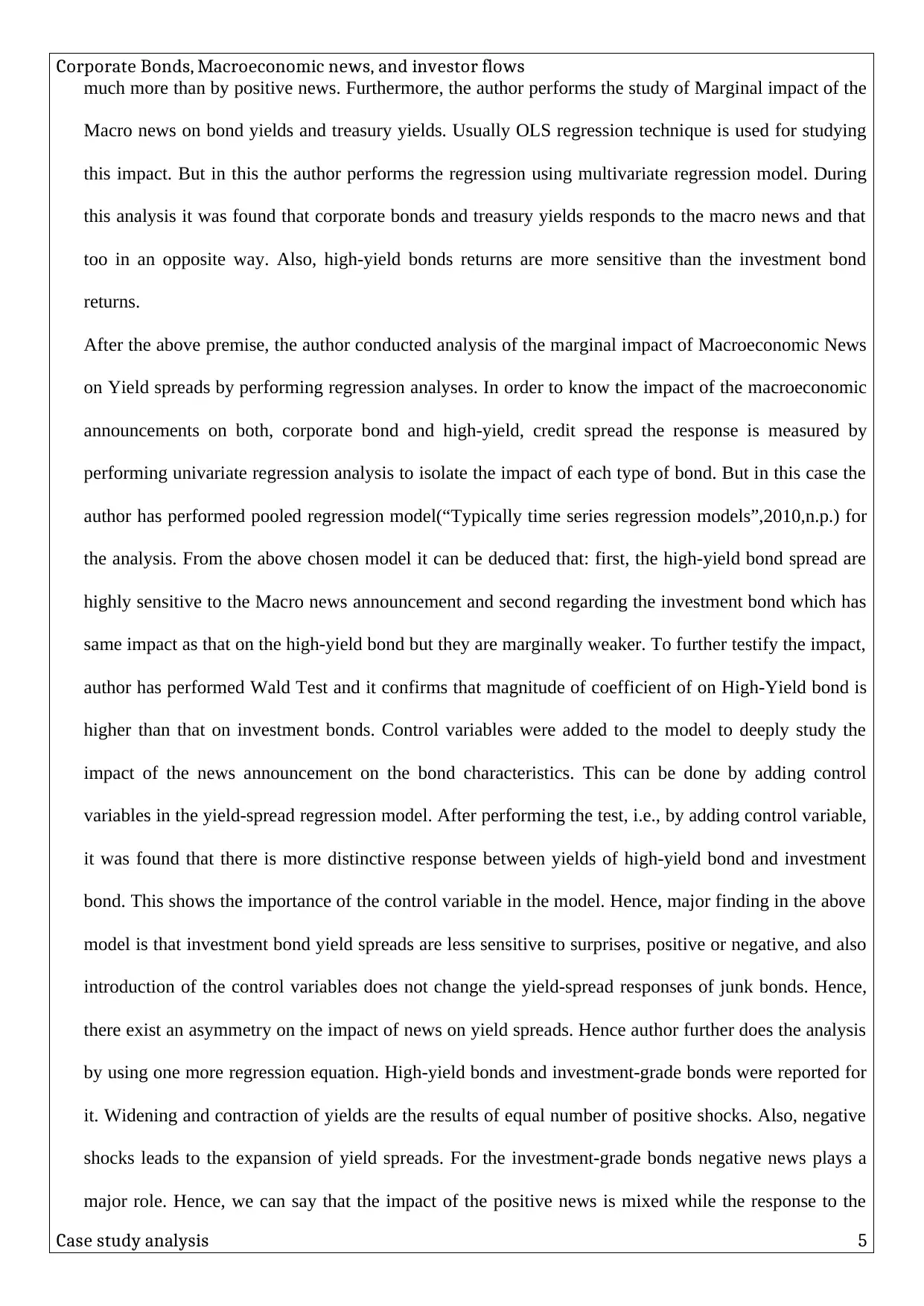
much more than by positive news. Furthermore, the author performs the study of Marginal impact of the
Macro news on bond yields and treasury yields. Usually OLS regression technique is used for studying
this impact. But in this the author performs the regression using multivariate regression model. During
this analysis it was found that corporate bonds and treasury yields responds to the macro news and that
too in an opposite way. Also, high-yield bonds returns are more sensitive than the investment bond
returns.
After the above premise, the author conducted analysis of the marginal impact of Macroeconomic News
on Yield spreads by performing regression analyses. In order to know the impact of the macroeconomic
announcements on both, corporate bond and high-yield, credit spread the response is measured by
performing univariate regression analysis to isolate the impact of each type of bond. But in this case the
author has performed pooled regression model(“Typically time series regression models”,2010,n.p.) for
the analysis. From the above chosen model it can be deduced that: first, the high-yield bond spread are
highly sensitive to the Macro news announcement and second regarding the investment bond which has
same impact as that on the high-yield bond but they are marginally weaker. To further testify the impact,
author has performed Wald Test and it confirms that magnitude of coefficient of on High-Yield bond is
higher than that on investment bonds. Control variables were added to the model to deeply study the
impact of the news announcement on the bond characteristics. This can be done by adding control
variables in the yield-spread regression model. After performing the test, i.e., by adding control variable,
it was found that there is more distinctive response between yields of high-yield bond and investment
bond. This shows the importance of the control variable in the model. Hence, major finding in the above
model is that investment bond yield spreads are less sensitive to surprises, positive or negative, and also
introduction of the control variables does not change the yield-spread responses of junk bonds. Hence,
there exist an asymmetry on the impact of news on yield spreads. Hence author further does the analysis
by using one more regression equation. High-yield bonds and investment-grade bonds were reported for
it. Widening and contraction of yields are the results of equal number of positive shocks. Also, negative
shocks leads to the expansion of yield spreads. For the investment-grade bonds negative news plays a
major role. Hence, we can say that the impact of the positive news is mixed while the response to the
Case study analysis 5
Document Page
6 Case study: 2
negative news is unambiguous. Furthermore in this analysis Wald test was performed. In that it was
found that the magnitudes and signs of the coefficients are different in majority of the macroeconomic
announcements.
6
Document Page
Corporate Bonds, Macroeconomic news, and investor flows
Methodology
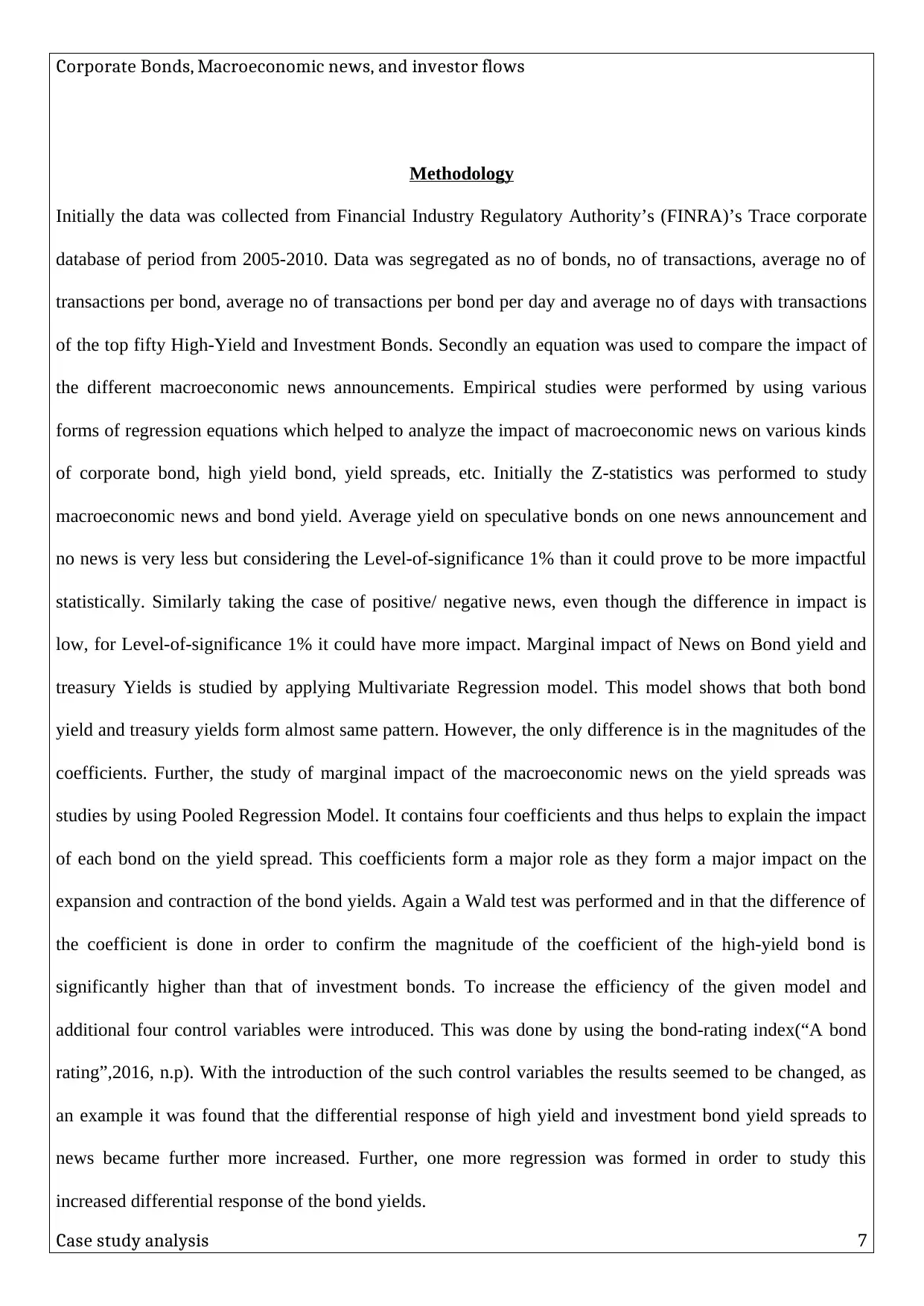
Initially the data was collected from Financial Industry Regulatory Authority’s (FINRA)’s Trace corporate
database of period from 2005-2010. Data was segregated as no of bonds, no of transactions, average no of
transactions per bond, average no of transactions per bond per day and average no of days with transactions
of the top fifty High-Yield and Investment Bonds. Secondly an equation was used to compare the impact of
the different macroeconomic news announcements. Empirical studies were performed by using various
forms of regression equations which helped to analyze the impact of macroeconomic news on various kinds
of corporate bond, high yield bond, yield spreads, etc. Initially the Z-statistics was performed to study
macroeconomic news and bond yield. Average yield on speculative bonds on one news announcement and
no news is very less but considering the Level-of-significance 1% than it could prove to be more impactful
statistically. Similarly taking the case of positive/ negative news, even though the difference in impact is
low, for Level-of-significance 1% it could have more impact. Marginal impact of News on Bond yield and
treasury Yields is studied by applying Multivariate Regression model. This model shows that both bond
yield and treasury yields form almost same pattern. However, the only difference is in the magnitudes of the
coefficients. Further, the study of marginal impact of the macroeconomic news on the yield spreads was
studies by using Pooled Regression Model. It contains four coefficients and thus helps to explain the impact
of each bond on the yield spread. This coefficients form a major role as they form a major impact on the
expansion and contraction of the bond yields. Again a Wald test was performed and in that the difference of
the coefficient is done in order to confirm the magnitude of the coefficient of the high-yield bond is
significantly higher than that of investment bonds. To increase the efficiency of the given model and
additional four control variables were introduced. This was done by using the bond-rating index(“A bond
rating”,2016, n.p). With the introduction of the such control variables the results seemed to be changed, as
an example it was found that the differential response of high yield and investment bond yield spreads to
news became further more increased. Further, one more regression was formed in order to study this
increased differential response of the bond yields.
Case study analysis 7
tabler-icon-diamond-filled.svg

Paraphrase This Document

Need a fresh take? Get an instant paraphrase of this document with our AI Paraphraser
Document Page
8 Case study: 2
Conclusion
The above case study helps us to understand the impact of the macroeconomics news announcements on the
yields of different kinds of bonds and also yields spread. Also, the current case consists of the data of top-
fifty most liquid high-yield and investment-grade bonds. The author tried to get the answers of the questions
that were posed in the starting of the case. Various models were used in order to get the results. It can be
seen that when the macro news are positive, the investors lean more towards high-yield corporate bonds and
when the news are negative they tend to shift to Treasury bonds, which are safer. It can be said that high-
yields bonds are more sensitive to macro news than investment-grade bonds. Along with it, the bond level
control variables stimulate the yield-spread response of junk-grade bonds to macro news.
8
Document Page
Corporate Bonds, Macroeconomic news, and investor flows
References
Pooled regression (2010). MetriScient. Retrieved from: http://metriscient.com/pooledreg.htm
Bond Rating (2016). Investopedia. Retrieved from: http://www.investopedia.com/terms/b/bondrating.asp
Junk Bond (2016). Investopedia. Retrieved from: http://www.investopedia.com/terms/j/junkbond.asp
Yield spread premium (2016). Investopedia. Retrieved from:
http://www.investopedia.com/terms/y/yield_spread_premium.asp?
ad=dirN&qo=investopediaSiteSearch&qsrc=0&o=40186
Broadie .M, Kaya O.(2007) A binomial lattice method for pricing corporate debt and modeling.Journal of
financial and quantitative analysis. Retrieved from: http://www.columbia.edu/~mnb2/broadie/Assets/JFQA-
422-Broadie-Kaya-Proofs.pdf
Case study analysis 9
Document Page
1
0
Case study: 2
10
chevron_up_icon
1 out of 10
circle_padding
hide_on_mobile
zoom_out_icon
[object Object]