Book Review: Philosophy of Science - Theories, Science, and Future

Verified

Added on  2022/10/17

|3
|591
|18
Homework Assignment
AI Summary
This assignment provides a comprehensive book review of 'Philosophy of Science: Very Short Introduction' by Samir Okasha. The review delves into the core concepts presented in the book, starting with the origins of science, as discussed from a historical perspective, and the evolution of scientific thought. It examines how science differs from other forms of knowledge, emphasizing its reliance on evidence, logic, and the collaborative nature of scientific inquiry. The review further explores the role of science in society, the nature of scientific theories, and the processes of deduction and induction. Finally, it concludes with an outlook on the future of science and the author's perspective on the collective and complex nature of scientific endeavors. The review provides a thorough analysis of the book's key arguments and its relevance to understanding the philosophy of science.
Document Page
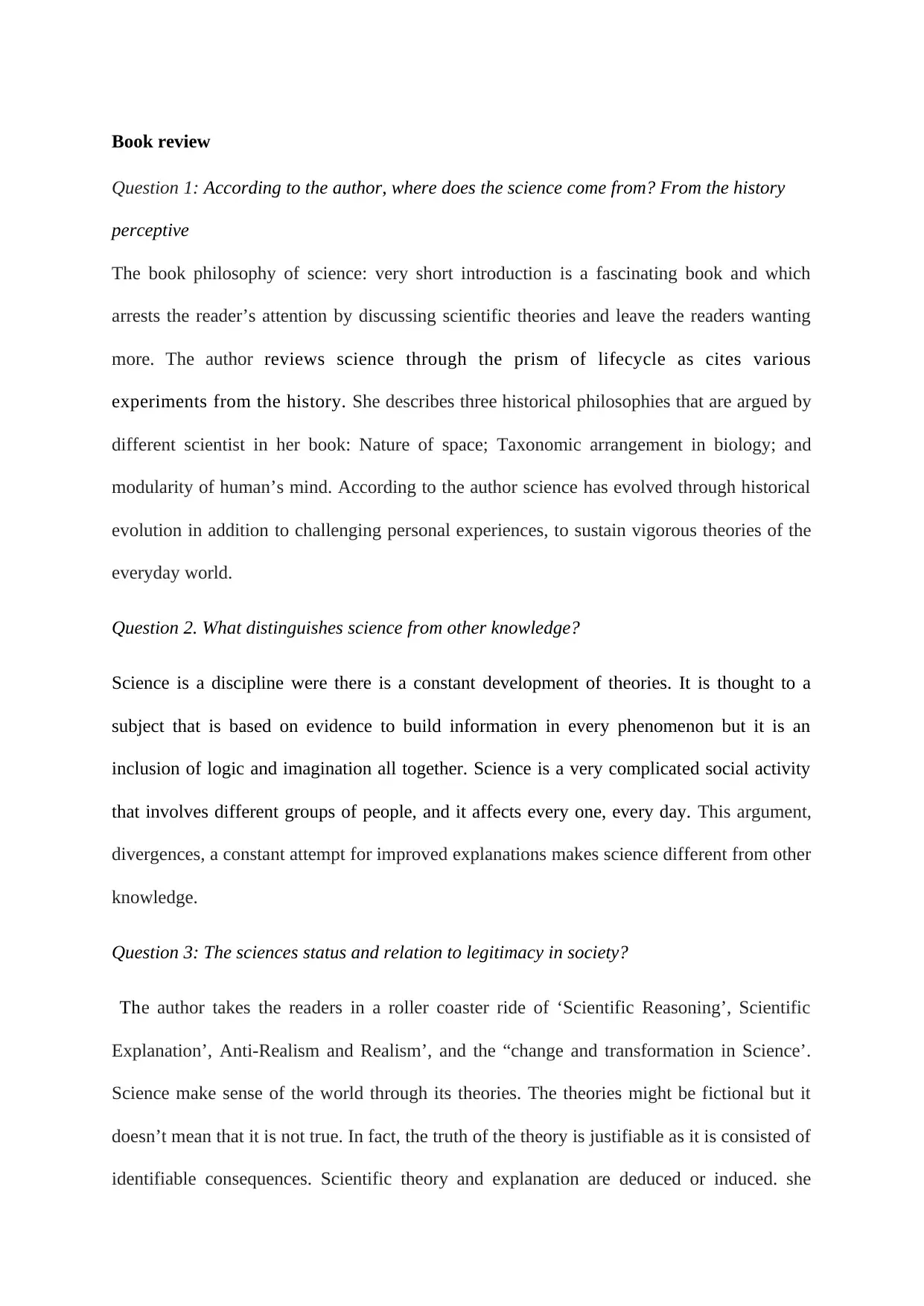
Book review
Question 1: According to the author, where does the science come from? From the history
perceptive
The book philosophy of science: very short introduction is a fascinating book and which
arrests the reader’s attention by discussing scientific theories and leave the readers wanting
more. The author reviews science through the prism of lifecycle as cites various
experiments from the history. She describes three historical philosophies that are argued by
different scientist in her book: Nature of space; Taxonomic arrangement in biology; and
modularity of human’s mind. According to the author science has evolved through historical
evolution in addition to challenging personal experiences, to sustain vigorous theories of the
everyday world.
Question 2. What distinguishes science from other knowledge?
Science is a discipline were there is a constant development of theories. It is thought to a
subject that is based on evidence to build information in every phenomenon but it is an
inclusion of logic and imagination all together. Science is a very complicated social activity
that involves different groups of people, and it affects every one, every day. This argument,
divergences, a constant attempt for improved explanations makes science different from other
knowledge.
Question 3: The sciences status and relation to legitimacy in society?
The author takes the readers in a roller coaster ride of ‘Scientific Reasoning’, Scientific
Explanation’, Anti-Realism and Realism’, and the “change and transformation in Science’.
Science make sense of the world through its theories. The theories might be fictional but it
doesn’t mean that it is not true. In fact, the truth of the theory is justifiable as it is consisted of
identifiable consequences. Scientific theory and explanation are deduced or induced. she
tabler-icon-diamond-filled.svg

Paraphrase This Document

Need a fresh take? Get an instant paraphrase of this document with our AI Paraphraser
Document Page
describes this by giving examples and coming to conclusion that, deducing a particular theory
can be difficult as it cannot scrutinize every object. Although, inducing is used mostly in
science as it is sensible but one problem is that it depends highly on the Uniformity of Nature.
Question 4: Outlook, what does the future of science look like?
The future of science is said to be of broad reach and is considered to take a new modern
outlook. The future is filled with new innovations and technological outcome done by young
scientist to explore all the things which was not explained properly.
Question 5. Summary question: What does the word science really mean in the book and the
authors point of view?
In this book science is said to be a collective enterprise. Like it’s impossible for a single
person to play chess similarly it is difficult for a single individual to produce any scientific
result. It is because a single mind is not sufficient enough or not powerful to perform
necessary tests to produce desired result. Thus, according to the Author philosophy of
science is an esoteric subject. Hence this book is a short introduction which can be
understood by any one and its long-term scientific theories and experiments are applicable in
all the arenas of academia which makes us wonder every day.
Document Page
Reference List
Okasha, S., 2016. Philosophy of Science: Very Short Introduction. London: Oxford
University Press.
chevron_up_icon
1 out of 3
circle_padding
hide_on_mobile
zoom_out_icon
[object Object]