Sociology Report: Boost Juice's Bahrain Market Penetration Strategy
VerifiedAdded on 2023/01/06
|12
|3619
|2
Report
AI Summary
This report provides a comprehensive analysis of Boost Juice's planned expansion into Bahrain. It begins with an introduction outlining the scope and objectives, followed by an examination of country-specific factors, including Bahrain's economy, business environment, and legal framework. Industry-specific factors related to the food industry in Bahrain are then explored, considering government incentives, HACCP certification, and market trends. The report delves into cultural factors, such as language differences, staffing considerations, and safety regulations, highlighting the differences between Australian and Bahraini cultures. It outlines steps for effective negotiations and intercultural communication, along with strategies for merging HRM practices. Furthermore, the report identifies the most significant cultural challenges, including communication gaps and generation gaps, and concludes with considerations for engaging the board in the investment decision. The report emphasizes the importance of understanding the local context and adapting business practices to ensure successful market penetration.
RUNNING HEAD: Sociology 0
boost juice
Working Across Cultures
boost juice
Working Across Cultures

Paraphrase This Document
Need a fresh take? Get an instant paraphrase of this document with our AI Paraphraser
Sociology 1
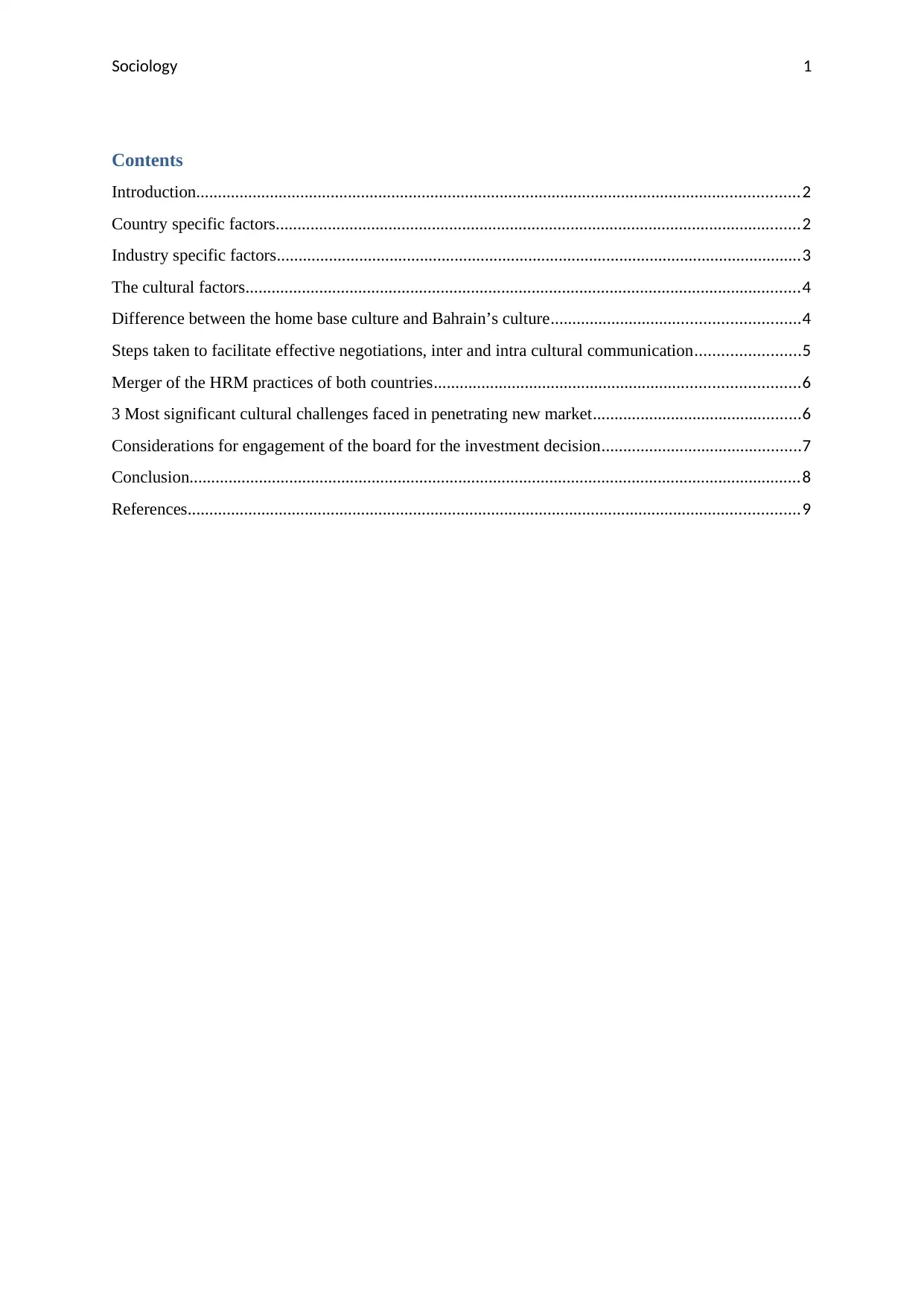
Contents
Introduction...........................................................................................................................................2
Country specific factors.........................................................................................................................2
Industry specific factors.........................................................................................................................3
The cultural factors................................................................................................................................4
Difference between the home base culture and Bahrain’s culture.........................................................4
Steps taken to facilitate effective negotiations, inter and intra cultural communication........................5
Merger of the HRM practices of both countries....................................................................................6
3 Most significant cultural challenges faced in penetrating new market................................................6
Considerations for engagement of the board for the investment decision..............................................7
Conclusion.............................................................................................................................................8
References.............................................................................................................................................9
Contents
Introduction...........................................................................................................................................2
Country specific factors.........................................................................................................................2
Industry specific factors.........................................................................................................................3
The cultural factors................................................................................................................................4
Difference between the home base culture and Bahrain’s culture.........................................................4
Steps taken to facilitate effective negotiations, inter and intra cultural communication........................5
Merger of the HRM practices of both countries....................................................................................6
3 Most significant cultural challenges faced in penetrating new market................................................6
Considerations for engagement of the board for the investment decision..............................................7
Conclusion.............................................................................................................................................8
References.............................................................................................................................................9
Sociology 2
Introduction
This report includes the analysis on the expansion of Boost Juices. Boost Juices is an
Australian based company. The company was established back in 2000 with the idea of
making life healthy accompanied by taste and fun. Boost juice is one of the most popular and
loved juice with 500 stores operating in 13 countries. Now the company has decided to
expand its business in Bahrain. In order to expand the business, a report is prepared for the
board to address the specific factors of Bahrain. The industry specific factors are also taken
into account along with the cultural factors required in the expansion project. The difference
between the home base culture and the host country is also discussed in the report. The report
discusses the effective negotiations, inter and intracultural communication. The way to merge
the HRM practices of two countries has been discussed in the report. Further, the cultural
challenges to be faced by the company in penetrating the new market are detailed. Finally,
the way to engage the board in making an investment decision is illuminated.
Country-specific factors
The economy of Bahrain is dominated by the industrial sector. The industries collectively
contribute 52.4% to total GDP. The country has strong international assessments of the
business environment. There is skilled labor in Bahrain which is beneficial for companies like
Boost juices. The country imposes no taxes on the personal income and the companies except
oil companies are not subject to the corporate tax. The regulatory framework in the country is
comparatively streamlined. The minimum capital necessitated for starting a company is
higher than the level of average annual income. There is no minimum wage condition by set
by the local government in the country but wage increases have exceeded the overall
productivity growth.
The legal system in Bahrain protects and facilitates acquisition and disposition of the
property rights. The workforce here is skilled and well educated. It minimizes the burden of
recruiting expertise from the home country. On the other side, the country is united with
nationwide agencies which are comprised of the international agreements. The country has a
new development plan, vision 2030 with the main objective of reforming the economic
infrastructure and diversify the economy. The food industry is anticipated to drive economic
growth in the forecast period. There is a systematic broadening of revenue streams to make
economy self-independent (Almuslamanis & Daud, 2018).
Introduction
This report includes the analysis on the expansion of Boost Juices. Boost Juices is an
Australian based company. The company was established back in 2000 with the idea of
making life healthy accompanied by taste and fun. Boost juice is one of the most popular and
loved juice with 500 stores operating in 13 countries. Now the company has decided to
expand its business in Bahrain. In order to expand the business, a report is prepared for the
board to address the specific factors of Bahrain. The industry specific factors are also taken
into account along with the cultural factors required in the expansion project. The difference
between the home base culture and the host country is also discussed in the report. The report
discusses the effective negotiations, inter and intracultural communication. The way to merge
the HRM practices of two countries has been discussed in the report. Further, the cultural
challenges to be faced by the company in penetrating the new market are detailed. Finally,
the way to engage the board in making an investment decision is illuminated.
Country-specific factors
The economy of Bahrain is dominated by the industrial sector. The industries collectively
contribute 52.4% to total GDP. The country has strong international assessments of the
business environment. There is skilled labor in Bahrain which is beneficial for companies like
Boost juices. The country imposes no taxes on the personal income and the companies except
oil companies are not subject to the corporate tax. The regulatory framework in the country is
comparatively streamlined. The minimum capital necessitated for starting a company is
higher than the level of average annual income. There is no minimum wage condition by set
by the local government in the country but wage increases have exceeded the overall
productivity growth.
The legal system in Bahrain protects and facilitates acquisition and disposition of the
property rights. The workforce here is skilled and well educated. It minimizes the burden of
recruiting expertise from the home country. On the other side, the country is united with
nationwide agencies which are comprised of the international agreements. The country has a
new development plan, vision 2030 with the main objective of reforming the economic
infrastructure and diversify the economy. The food industry is anticipated to drive economic
growth in the forecast period. There is a systematic broadening of revenue streams to make
economy self-independent (Almuslamanis & Daud, 2018).
⊘ This is a preview!⊘
Do you want full access?
Subscribe today to unlock all pages.

Trusted by 1+ million students worldwide
Sociology 3
The political system of the country lies within the context of a constitutional monarchy. The
country has robust international assessments of the business environment. Along with this,
the country is facing social challenges which comprise increasing criminal rates causing an
increase in corruption. Bahrain is having a member in the GCC common market which
guarantees the implementation of the free trade agreement. Round the clock electricity, well-
connected transportation network has assisted the country to ameliorate the ease of doing
business (Binder, 2016).
Industry-specific factors
Boost juices belong to the food industry. The food industry in Bahrain is ranked third in the
Islamic economic indicator as food industries and serving. Bahrain is increasingly identified
as a base for food manufacturing facilities. The food industry in the country is driven by
substantial subsidies. The urban lifestyle of the people now days have raised the standard of
the living of people and the diet preference of the people has shifted to the packaged food and
healthy drinks like Boost Juice. The Bahrain government have a liberal approach toward
foreign investment in order to diversify the economy. The government actively boosts foreign
private investment mainly the enterprises which do not compete with the local enterprises
(Altaee & Al-Jafari, 2015). A couple of incentives are also provided to foreign investors like
zero taxation for private companies and free repatriation of capital. The fruits and vegetables
used by the Boost juices are totally exempt from the customs duty in Bahrain. The food
industry is even exempt from sales tax on goods and services (Almeida, Grant & Phene,
2017). There is duty-free import of material and machinery for manufacturing in the country
along with the duty-free merchandise for re-export.
HACCP certification is the systematic preventive approach for food safety. This certificate
addresses chemical, physical and biological hazards. Such an approach has several benefits to
the companies working in the food industry of Bahrain. It has control on the processes,
resources, and activities which are critical for food safety. The training is also provided in the
industry concerning nutrition and food security. The food security amendments of the
industry ensure attainable and affordable food which is quite affordable as well (Bond, 2015)
The political system of the country lies within the context of a constitutional monarchy. The
country has robust international assessments of the business environment. Along with this,
the country is facing social challenges which comprise increasing criminal rates causing an
increase in corruption. Bahrain is having a member in the GCC common market which
guarantees the implementation of the free trade agreement. Round the clock electricity, well-
connected transportation network has assisted the country to ameliorate the ease of doing
business (Binder, 2016).
Industry-specific factors
Boost juices belong to the food industry. The food industry in Bahrain is ranked third in the
Islamic economic indicator as food industries and serving. Bahrain is increasingly identified
as a base for food manufacturing facilities. The food industry in the country is driven by
substantial subsidies. The urban lifestyle of the people now days have raised the standard of
the living of people and the diet preference of the people has shifted to the packaged food and
healthy drinks like Boost Juice. The Bahrain government have a liberal approach toward
foreign investment in order to diversify the economy. The government actively boosts foreign
private investment mainly the enterprises which do not compete with the local enterprises
(Altaee & Al-Jafari, 2015). A couple of incentives are also provided to foreign investors like
zero taxation for private companies and free repatriation of capital. The fruits and vegetables
used by the Boost juices are totally exempt from the customs duty in Bahrain. The food
industry is even exempt from sales tax on goods and services (Almeida, Grant & Phene,
2017). There is duty-free import of material and machinery for manufacturing in the country
along with the duty-free merchandise for re-export.
HACCP certification is the systematic preventive approach for food safety. This certificate
addresses chemical, physical and biological hazards. Such an approach has several benefits to
the companies working in the food industry of Bahrain. It has control on the processes,
resources, and activities which are critical for food safety. The training is also provided in the
industry concerning nutrition and food security. The food security amendments of the
industry ensure attainable and affordable food which is quite affordable as well (Bond, 2015)
Paraphrase This Document
Need a fresh take? Get an instant paraphrase of this document with our AI Paraphraser
Sociology 4
The cultural factors
The culture in Bahrain is regarded as the part of the historical region of Eastern Arabia. It is
similar to the Arab neighbors. The citizens are ethnically diverse here. The cultural factors
include the following:
Understanding and language differences: There are quite differences between Australia and
Bahrain when it comes to language. The official language in Bahrain is Arabic whereas in -
Bahrain population speak Farsi. On the other side, English is widely used in Australia. Boost
Juices need to consider language as the most critical factor for expanding its operations in
Bahrain. For this, the company is required to hire local staff who can interact with the local
public in an efficient manner (Al Khalifa, 2015).
Staffing considerations: Boost Juices has wide operations in the home country and has ample
of employees engaged in the business activities there. But when it comes to setting business
in Bahrain then there is going to be a requirement of few numbers of employees like 7 to 8
who will be handling producing and customer handling activities. There is ample of
professionals available in the country who are capable and skilled.
Safety and legalities: When it comes to safety and legality, it is handled by the Civic code for
the protection of the customers. The country authorizes 100% foreign ownership of the
business even without the requirement of any local partner (Fiske, Hodge & Turner, 2016).
The country has even no restriction on the repatriation of capital, profits or dividends. Boost
juices have a great scope in Bahrain as the government looks for the developmental activities
from time to time. The companies producing quality manufactured products in Bahrain can
easily attain access in the Gulf Cooperation Council (GCC) markets duty-free under GCC
customs union.
Difference between the home base culture and Bahrain’s culture
As it was discussed earlier that there is quite a difference between the Australian and
Bahrain’s culture. There is more of western culture in Australia which is influenced by the
unique geography of the country. The Christians have attained dominance in Australia and
the majority of the population speaks English. Other languages spoken in the country are
Italian, Arabic, Greek, Mandarin and Cantonese. People here are clear cut when it comes to
communication. The major difference realized between the cultures of both countries is that
The cultural factors
The culture in Bahrain is regarded as the part of the historical region of Eastern Arabia. It is
similar to the Arab neighbors. The citizens are ethnically diverse here. The cultural factors
include the following:
Understanding and language differences: There are quite differences between Australia and
Bahrain when it comes to language. The official language in Bahrain is Arabic whereas in -
Bahrain population speak Farsi. On the other side, English is widely used in Australia. Boost
Juices need to consider language as the most critical factor for expanding its operations in
Bahrain. For this, the company is required to hire local staff who can interact with the local
public in an efficient manner (Al Khalifa, 2015).
Staffing considerations: Boost Juices has wide operations in the home country and has ample
of employees engaged in the business activities there. But when it comes to setting business
in Bahrain then there is going to be a requirement of few numbers of employees like 7 to 8
who will be handling producing and customer handling activities. There is ample of
professionals available in the country who are capable and skilled.
Safety and legalities: When it comes to safety and legality, it is handled by the Civic code for
the protection of the customers. The country authorizes 100% foreign ownership of the
business even without the requirement of any local partner (Fiske, Hodge & Turner, 2016).
The country has even no restriction on the repatriation of capital, profits or dividends. Boost
juices have a great scope in Bahrain as the government looks for the developmental activities
from time to time. The companies producing quality manufactured products in Bahrain can
easily attain access in the Gulf Cooperation Council (GCC) markets duty-free under GCC
customs union.
Difference between the home base culture and Bahrain’s culture
As it was discussed earlier that there is quite a difference between the Australian and
Bahrain’s culture. There is more of western culture in Australia which is influenced by the
unique geography of the country. The Christians have attained dominance in Australia and
the majority of the population speaks English. Other languages spoken in the country are
Italian, Arabic, Greek, Mandarin and Cantonese. People here are clear cut when it comes to
communication. The major difference realized between the cultures of both countries is that
Sociology 5
people in Australia are used more advanced economic conditions (Holes, 2016). There are
already established companies in Australia and Bahrain is comparatively new. The
government is taking initiatives for foreign companies to make an investment which is also
100%. The Australians have a strong sense of self-reliance and the business culture reflects
this. On the other side, Bahrain has a well acquainted influenced business culture. The 50%
population of Bahrain is made up of foreigners who take time to familiarize with the
appropriate customs and practices. People are advanced in Australia are advanced due to
western impact whereas people in Bahrain moves slowly in order to build personal
relationships (Hutchison, 2015).
Steps were taken to facilitate effective negotiations, inter and intra cultural
communication
The negotiations are one of the routine activities for business organizations. Boost juices have
decided to enter negotiations with the Fresco juice bar. The steps taken to enter for the
negotiations along with inter and intra cultural communications are:
Preparation and planning: The preparation and planning are the initiation step in the
negotiation process to be undertaken by Boost juices. Both the organizations are going to
organize and accumulate information required to have effective communication (Karolak,
2016). Boost juices are required to investigate Fresco’s history.
Definition of ground rules: This step has a role in establishing rules and procedures for the
planned negotiation. The considerations are going to include information like, where will
negotiations take place, will time constraints exist, will be there any issues which are off
limits and what is going to happen when there will be no agreement. Add on, both the
companies will figure out the prices to be charged initially.
Clarification and justification: Once the rules are established, the discussion will take place
concerning the specifics of the company.
Bargaining and problem solving: This step requires self-awareness, preparation, and practice.
All the important aspects will take place in this step.
Closure and implementation: Finally after undertaking all the important aspects it comes to
closing the deal and implementation (Mejía, 2016).
people in Australia are used more advanced economic conditions (Holes, 2016). There are
already established companies in Australia and Bahrain is comparatively new. The
government is taking initiatives for foreign companies to make an investment which is also
100%. The Australians have a strong sense of self-reliance and the business culture reflects
this. On the other side, Bahrain has a well acquainted influenced business culture. The 50%
population of Bahrain is made up of foreigners who take time to familiarize with the
appropriate customs and practices. People are advanced in Australia are advanced due to
western impact whereas people in Bahrain moves slowly in order to build personal
relationships (Hutchison, 2015).
Steps were taken to facilitate effective negotiations, inter and intra cultural
communication
The negotiations are one of the routine activities for business organizations. Boost juices have
decided to enter negotiations with the Fresco juice bar. The steps taken to enter for the
negotiations along with inter and intra cultural communications are:
Preparation and planning: The preparation and planning are the initiation step in the
negotiation process to be undertaken by Boost juices. Both the organizations are going to
organize and accumulate information required to have effective communication (Karolak,
2016). Boost juices are required to investigate Fresco’s history.
Definition of ground rules: This step has a role in establishing rules and procedures for the
planned negotiation. The considerations are going to include information like, where will
negotiations take place, will time constraints exist, will be there any issues which are off
limits and what is going to happen when there will be no agreement. Add on, both the
companies will figure out the prices to be charged initially.
Clarification and justification: Once the rules are established, the discussion will take place
concerning the specifics of the company.
Bargaining and problem solving: This step requires self-awareness, preparation, and practice.
All the important aspects will take place in this step.
Closure and implementation: Finally after undertaking all the important aspects it comes to
closing the deal and implementation (Mejía, 2016).
⊘ This is a preview!⊘
Do you want full access?
Subscribe today to unlock all pages.
Trusted by 1+ million students worldwide
Sociology 6
The merger of the HRM practices of both countries
The human resource practices are considered the main engine of the physical capital of the
enterprises. These are the skills, abilities, propensities, and values of the employees within
the organization. The HRM practices are the combined policies and practices for enhancing
human capital in order to reach organizational goals (Moukarzel & Steelman, 2015). It even
makes use of the comprehensive approach as a part of focusing on the implementation of
strategic change. HRM practices in Australia are more competitive and global. These
practices will be merged with the distinctive approach of employment management in
Bahrain. Australia’s HRM practice like fair and reasonable wages will be implemented by the
company in Bahrain to ensure smooth working of the organization. It will company to
enhance its organizational behavior in the concerns like staff commitment, competency along
with the competency (Donate, Peña & Sanchez de Pablo, 2016).
The compensation will be merged with the benefits to view the way employers reward their
employees. The compensation presents a clear picture of HR management practices. It is
because total employee wages comprising benefits, salary and concerning taxes can comprise
70% of the company’s cost. The benefits alone accounts for 30% labor costs.
3 Most significant cultural challenges faced in penetrating new market
Communication flows up not down: The communication is a challenge which is faced in
penetrating a new market. The unhealthy culture is represented by the communication which
flows down but doesn’t go up and across (Peltoniemi, 2015). There is more trend in such type
of communication in Bahrain. On the other side, Australia is enabled with the same flow of
communication at every level in the organization. So, communication can represent a great
challenge to the company. Giving significance to the communication at a very initial level
can ignore such challenges (Dune, Perz, Mengesha & Ayika, 2017).
Generation gap: It is believed that the multi-generational workforce can cause adverse
effects. Bridging the generation gap represents a challenge to the company in penetrating a
new market. As the company will be hiring an increasing number of millennial and it will
lead to much more digitally diverse demographic. Boost juices will be in need to embrace the
changing environment by endorsing digital learning and communication. The workforce in
The merger of the HRM practices of both countries
The human resource practices are considered the main engine of the physical capital of the
enterprises. These are the skills, abilities, propensities, and values of the employees within
the organization. The HRM practices are the combined policies and practices for enhancing
human capital in order to reach organizational goals (Moukarzel & Steelman, 2015). It even
makes use of the comprehensive approach as a part of focusing on the implementation of
strategic change. HRM practices in Australia are more competitive and global. These
practices will be merged with the distinctive approach of employment management in
Bahrain. Australia’s HRM practice like fair and reasonable wages will be implemented by the
company in Bahrain to ensure smooth working of the organization. It will company to
enhance its organizational behavior in the concerns like staff commitment, competency along
with the competency (Donate, Peña & Sanchez de Pablo, 2016).
The compensation will be merged with the benefits to view the way employers reward their
employees. The compensation presents a clear picture of HR management practices. It is
because total employee wages comprising benefits, salary and concerning taxes can comprise
70% of the company’s cost. The benefits alone accounts for 30% labor costs.
3 Most significant cultural challenges faced in penetrating new market
Communication flows up not down: The communication is a challenge which is faced in
penetrating a new market. The unhealthy culture is represented by the communication which
flows down but doesn’t go up and across (Peltoniemi, 2015). There is more trend in such type
of communication in Bahrain. On the other side, Australia is enabled with the same flow of
communication at every level in the organization. So, communication can represent a great
challenge to the company. Giving significance to the communication at a very initial level
can ignore such challenges (Dune, Perz, Mengesha & Ayika, 2017).
Generation gap: It is believed that the multi-generational workforce can cause adverse
effects. Bridging the generation gap represents a challenge to the company in penetrating a
new market. As the company will be hiring an increasing number of millennial and it will
lead to much more digitally diverse demographic. Boost juices will be in need to embrace the
changing environment by endorsing digital learning and communication. The workforce in
Paraphrase This Document
Need a fresh take? Get an instant paraphrase of this document with our AI Paraphraser
Sociology 7
the organization will be necessitated to stay connected so that gaps can be bridged (Sullivan
& Skelcher, 2017). It will require finding a way to link to the new generation and inspire the
establishment of an environment which can be linked.
Work patterns: There is a shift in the traditional nine to five working environment which is
driven by a new way of changing technology. There is an unclear line between traditional
work life and personal life. People work in different hours in order to gain satisfaction which
can create a challenge for the company to operate in the odd hours (Sharara, et al. 2018).
Considerations for engagement of the board for the investment decision
The investment decision of the Boost juices is to pursue the highest return for the capital. The
considerations undertaken by the company for the engaging board in the investment decision
are:
The Bahrain government has a liberal approach towards the foreign direct investment
and allows 100% foreign ownership of the business which is really a big dig for the
company to make investment decision (Tzabbar, Tzafrir & Baruch, 2017).
Bahrain provides MNCs with an open and attractive economic and regulatory
environment. There is lowest corporate and personal taxes and do not have any
restriction on the free trade zones which inspires board to engage in the investment
decision n in the country (Estrin, Meyer, Nielsen & Nielsen, 2016).
There is even availability of the highly skilled and efficient labor in the country which
reduces the need for importing labor from the home country. The board considers it as
an important element for making an investment in the foreign country.
The excellent logical infrastructure of the country attracts to the companies to make
an investment. It makes easy or smooth delivery of the products in the country
(Fernández-Giménez, et al. 2019).
The motives explained above are sufficient enough to engage the board in the investment
decision. This determines the intention of the company in the host country.
the organization will be necessitated to stay connected so that gaps can be bridged (Sullivan
& Skelcher, 2017). It will require finding a way to link to the new generation and inspire the
establishment of an environment which can be linked.
Work patterns: There is a shift in the traditional nine to five working environment which is
driven by a new way of changing technology. There is an unclear line between traditional
work life and personal life. People work in different hours in order to gain satisfaction which
can create a challenge for the company to operate in the odd hours (Sharara, et al. 2018).
Considerations for engagement of the board for the investment decision
The investment decision of the Boost juices is to pursue the highest return for the capital. The
considerations undertaken by the company for the engaging board in the investment decision
are:
The Bahrain government has a liberal approach towards the foreign direct investment
and allows 100% foreign ownership of the business which is really a big dig for the
company to make investment decision (Tzabbar, Tzafrir & Baruch, 2017).
Bahrain provides MNCs with an open and attractive economic and regulatory
environment. There is lowest corporate and personal taxes and do not have any
restriction on the free trade zones which inspires board to engage in the investment
decision n in the country (Estrin, Meyer, Nielsen & Nielsen, 2016).
There is even availability of the highly skilled and efficient labor in the country which
reduces the need for importing labor from the home country. The board considers it as
an important element for making an investment in the foreign country.
The excellent logical infrastructure of the country attracts to the companies to make
an investment. It makes easy or smooth delivery of the products in the country
(Fernández-Giménez, et al. 2019).
The motives explained above are sufficient enough to engage the board in the investment
decision. This determines the intention of the company in the host country.
Sociology 8
Conclusion
Working across cultures creates opportunities for the company. Boost juices have analyzed
the environment of Bahrain in order to operate activities. Bahrain has specific factors like
economic, technological and technological factors which attract to the companies for making
an investment. The country has strong international assessments of the business environment.
The regulatory framework in the country is comparatively streamlined. The government
actively boosts foreign private investment in the country. A couple of incentives are also
provided to foreign investors like zero taxation forprivate companies and free repatriation of
capital. The culture factors in Bahrain include the staffing considerations, understanding and
language differences along with the safeties and legalities. The report has found out the
difference between the culture of Australia and Bahrain. The negotiations are also done by
the Boost juices with the Fresco juice bar in Bahrain. The steps required for the negotiation
are preparation and planning, the definition of ground roles, bargaining and problem solving,
clarification and justification and Closure and implementation. The HRM practices of both
countries are also combined for the smooth operations of the company. The cultural
challenges find out by the company in penetrating new markets like communication,
generation gap and work patterns. There are some motives offered by Bahrain to engage the
board of the company in the important decision like 100% ownership, skilled labor and no
corporate and personal tax.
Conclusion
Working across cultures creates opportunities for the company. Boost juices have analyzed
the environment of Bahrain in order to operate activities. Bahrain has specific factors like
economic, technological and technological factors which attract to the companies for making
an investment. The country has strong international assessments of the business environment.
The regulatory framework in the country is comparatively streamlined. The government
actively boosts foreign private investment in the country. A couple of incentives are also
provided to foreign investors like zero taxation forprivate companies and free repatriation of
capital. The culture factors in Bahrain include the staffing considerations, understanding and
language differences along with the safeties and legalities. The report has found out the
difference between the culture of Australia and Bahrain. The negotiations are also done by
the Boost juices with the Fresco juice bar in Bahrain. The steps required for the negotiation
are preparation and planning, the definition of ground roles, bargaining and problem solving,
clarification and justification and Closure and implementation. The HRM practices of both
countries are also combined for the smooth operations of the company. The cultural
challenges find out by the company in penetrating new markets like communication,
generation gap and work patterns. There are some motives offered by Bahrain to engage the
board of the company in the important decision like 100% ownership, skilled labor and no
corporate and personal tax.
⊘ This is a preview!⊘
Do you want full access?
Subscribe today to unlock all pages.
Trusted by 1+ million students worldwide
Sociology 9
References
Al Khalifa, F. (2015). Urban Sustainability and Transforming Culture in the Arabian Gulf:
The Case of Bahrain (Doctoral dissertation, University of Sheffield).
Almeida, P., Grant, R., & Phene, A. (2017). Knowledge acquisition through alliances:
Opportunities and challenges. The Blackwell Handbook of Cross
‐Cultural Management, 67-
77.
Almuslamani, H. A., & Daud, S. (2018). Organizational Culture and Sustainable Competitive
Advantage in Manufacturing Companies in Bahrain. Appl. Math, 12(2), 431-440.
Altaee, H. H. A., & Al-Jafari, M. K. (2015). Financial development, trade openness and
economic growth: A trilateral analysis of Bahrain. International Journal of Economics and
Finance, 7(1), 241-254.
Binder, J. (2016). Global project management: communication, collaboration and
management across borders. Routledge.
Bond, M. H. (2015). Working at the interface of cultures: Eighteen lives in social science.
Routledge.
Donate, M. J., Peña, I., & Sanchez de Pablo, J. D. (2016). HRM practices for human and
social capital development: effects on innovation capabilities. The International Journal of
Human Resource Management, 27(9), 928-953.
Dune, T., Perz, J., Mengesha, Z., & Ayika, D. (2017). Culture Clash? Investigating
constructions of sexual and reproductive health from the perspective of 1.5 generation
migrants in Australia using Q methodology. Reproductive health, 14(1), 50.
Estrin, S., Meyer, K. E., Nielsen, B. B., & Nielsen, S. (2016). Home country institutions and
the internationalization of state owned enterprises: A cross-country analysis. Journal of
World Business, 51(2), 294-307
Fernández-Giménez, M. E., Allegretti, A., Angerer, J., Baival, B., Batjav, B., Fassnacht,
S., ... & Thompson, J. (2019). Sustaining Interdisciplinary Collaboration Across Continents
and Cultures: Lessons from the Mongolian Rangelands and Resilience Project.
References
Al Khalifa, F. (2015). Urban Sustainability and Transforming Culture in the Arabian Gulf:
The Case of Bahrain (Doctoral dissertation, University of Sheffield).
Almeida, P., Grant, R., & Phene, A. (2017). Knowledge acquisition through alliances:
Opportunities and challenges. The Blackwell Handbook of Cross
‐Cultural Management, 67-
77.
Almuslamani, H. A., & Daud, S. (2018). Organizational Culture and Sustainable Competitive
Advantage in Manufacturing Companies in Bahrain. Appl. Math, 12(2), 431-440.
Altaee, H. H. A., & Al-Jafari, M. K. (2015). Financial development, trade openness and
economic growth: A trilateral analysis of Bahrain. International Journal of Economics and
Finance, 7(1), 241-254.
Binder, J. (2016). Global project management: communication, collaboration and
management across borders. Routledge.
Bond, M. H. (2015). Working at the interface of cultures: Eighteen lives in social science.
Routledge.
Donate, M. J., Peña, I., & Sanchez de Pablo, J. D. (2016). HRM practices for human and
social capital development: effects on innovation capabilities. The International Journal of
Human Resource Management, 27(9), 928-953.
Dune, T., Perz, J., Mengesha, Z., & Ayika, D. (2017). Culture Clash? Investigating
constructions of sexual and reproductive health from the perspective of 1.5 generation
migrants in Australia using Q methodology. Reproductive health, 14(1), 50.
Estrin, S., Meyer, K. E., Nielsen, B. B., & Nielsen, S. (2016). Home country institutions and
the internationalization of state owned enterprises: A cross-country analysis. Journal of
World Business, 51(2), 294-307
Fernández-Giménez, M. E., Allegretti, A., Angerer, J., Baival, B., Batjav, B., Fassnacht,
S., ... & Thompson, J. (2019). Sustaining Interdisciplinary Collaboration Across Continents
and Cultures: Lessons from the Mongolian Rangelands and Resilience Project.
Paraphrase This Document
Need a fresh take? Get an instant paraphrase of this document with our AI Paraphraser
Sociology 10
In Collaboration Across Boundaries for Social-Ecological Systems Science (pp. 185-225).
Palgrave Macmillan, Cham.
Fiske, J., Hodge, B., & Turner, G. (2016). Myths of Oz: reading Australian popular culture.
Routledge.
Holes, C. (2016). Language, Culture, and Identity. The Emergence of the Gulf States.
London: Bloomsbury, 263-287.
Hutchison, C. B. (2015). Experiences of Immigrant Professors: Challenges, Cross-Cultural
Differences, and Lessons for Success. Routledge.
Karolak, M. (2016). Quality-oriented education and workforce reform: the impact of wasta
(Case study of Bahrain). In The Political Economy of Wasta: Use and Abuse of Social
Capital Networking (pp. 145-158). Springer, Cham.
Mejía, G. (2016). Language usage and culture maintenance: a study of Spanish-speaking
immigrant mothers in Australia. Journal of Multilingual and Multicultural
Development, 37(1), 23-39.
Moukarzel, R., & Steelman, L. A. (2015). Navigating multicultural teams: a road map to
feedback across cultures. In Leading global teams (pp. 169-192). Springer, New York, NY.
Peltoniemi, M. (2015). Cultural industries: Product–market characteristics, management
challenges and industry dynamics. International journal of management reviews, 17(1), 41-
68.
Sharara, E., Akik, C., Ghattas, H., & Obermeyer, C. M. (2018). Physical inactivity, gender
and culture in Arab countries: a systematic assessment of the literature. BMC public
health, 18(1), 639.
Sullivan, H., & Skelcher, C. (2017). Working across boundaries: collaboration in public
services. Macmillan International Higher Education.
Tzabbar, D., Tzafrir, S., & Baruch, Y. (2017). A bridge over troubled water: Replication,
integration and extension of the relationship between HRM practices and organizational
performance using moderating meta-analysis. Human Resource Management Review, 27(1),
134-148.
In Collaboration Across Boundaries for Social-Ecological Systems Science (pp. 185-225).
Palgrave Macmillan, Cham.
Fiske, J., Hodge, B., & Turner, G. (2016). Myths of Oz: reading Australian popular culture.
Routledge.
Holes, C. (2016). Language, Culture, and Identity. The Emergence of the Gulf States.
London: Bloomsbury, 263-287.
Hutchison, C. B. (2015). Experiences of Immigrant Professors: Challenges, Cross-Cultural
Differences, and Lessons for Success. Routledge.
Karolak, M. (2016). Quality-oriented education and workforce reform: the impact of wasta
(Case study of Bahrain). In The Political Economy of Wasta: Use and Abuse of Social
Capital Networking (pp. 145-158). Springer, Cham.
Mejía, G. (2016). Language usage and culture maintenance: a study of Spanish-speaking
immigrant mothers in Australia. Journal of Multilingual and Multicultural
Development, 37(1), 23-39.
Moukarzel, R., & Steelman, L. A. (2015). Navigating multicultural teams: a road map to
feedback across cultures. In Leading global teams (pp. 169-192). Springer, New York, NY.
Peltoniemi, M. (2015). Cultural industries: Product–market characteristics, management
challenges and industry dynamics. International journal of management reviews, 17(1), 41-
68.
Sharara, E., Akik, C., Ghattas, H., & Obermeyer, C. M. (2018). Physical inactivity, gender
and culture in Arab countries: a systematic assessment of the literature. BMC public
health, 18(1), 639.
Sullivan, H., & Skelcher, C. (2017). Working across boundaries: collaboration in public
services. Macmillan International Higher Education.
Tzabbar, D., Tzafrir, S., & Baruch, Y. (2017). A bridge over troubled water: Replication,
integration and extension of the relationship between HRM practices and organizational
performance using moderating meta-analysis. Human Resource Management Review, 27(1),
134-148.

Sociology 11
⊘ This is a preview!⊘
Do you want full access?
Subscribe today to unlock all pages.
Trusted by 1+ million students worldwide

1 out of 12


Related Documents


Your All-in-One AI-Powered Toolkit for Academic Success.
+13062052269
info@desklib.com
Available 24*7 on WhatsApp / Email
![[object Object]](/_next/static/media/star-bottom.7253800d.svg)
Unlock your academic potential
Copyright © 2020–2026 A2Z Services. All Rights Reserved. Developed and managed by ZUCOL.