Exploiting BOP Opportunities: Strategies for Serving the World's Poor
VerifiedAdded on 2020/03/28
|9
|2035
|68
Report
AI Summary
This report provides an in-depth analysis of the Bottom of the Pyramid (BOP) market, highlighting its potential for businesses and the challenges associated with serving this segment. It examines the reasons why multinational corporations often overlook the BOP market, such as poor infrastructure and distribution channels, and emphasizes the significant business opportunities that exist. The report discusses the importance of viewing the poor as potential entrepreneurs and consumers, advocating for innovative and sustainable products and services. It outlines strategies for successful market entry, including smaller packaging, affordable pricing, and the adoption of the 6 As framework (availability, affordability, acceptability, awareness, adaptability, and active absorption). The report concludes that serving the BOP market can be profitable for businesses while simultaneously improving the living standards of the poor by providing economic opportunities and access to quality products and services, with a focus on innovation and cost reduction. The report also emphasizes the importance of creating employment opportunities for the poor and empowering them to improve their standards of living.

1
Running head: Serving the World’s Poor, Profitably
Student
Institution
Serving the World’s Poor, Profitably
Running head: Serving the World’s Poor, Profitably
Student
Institution
Serving the World’s Poor, Profitably
Paraphrase This Document
Need a fresh take? Get an instant paraphrase of this document with our AI Paraphraser

2
Serving the World’s Poor, Profitably
Introduction
The population at the bottom of the economic pyramid (BOP) is estimated at 4 billion
people presenting a huge market for businesses. Most businesses have however opted to neglect
this market focusing on the middle class and upper segments of the market (Anderson & Billou,
2007). Businesses should however not shy away from investing in the bottom of the pyramid as
sometimes the returns are higher in these markets (Prahalad & Hammond, 2002). It is also
cheaper to market to the world’s poor because most of them live in concentrated places in low
cost housing or slums in most of the cities in the world. These people at the BOP continue to
grow in numbers presenting an opportunity for new customers for companies that are willing to
take advantage of this segment. Currently most of these people are served by informal economies
yet they are actually a big business opportunity for the multinational companies that are ready to
market to them by offering quality at cheaper prices and thus taking advantage of the economies
of scale. This paper will agree with the notion that exploiting the opportunities at the BOP will
lead to success for those businesses that are willing to get in to this market.
Challenges in Serving the BOP
There are a number of reasons why businesses especially multi nationals leave out
customers at the BOP and focus only on the other segments, the middle and upper class
customers. Some of these include poor infrastructure in the areas where these people live.
Another reason is the poor or nonexistent distribution channels making it difficult for them to
deliver the goods to the customers. Another reason is conflict in these areas which could be
religious, racial and ethnic or any other kind of war. These customers also lack proper education
Serving the World’s Poor, Profitably
Introduction
The population at the bottom of the economic pyramid (BOP) is estimated at 4 billion
people presenting a huge market for businesses. Most businesses have however opted to neglect
this market focusing on the middle class and upper segments of the market (Anderson & Billou,
2007). Businesses should however not shy away from investing in the bottom of the pyramid as
sometimes the returns are higher in these markets (Prahalad & Hammond, 2002). It is also
cheaper to market to the world’s poor because most of them live in concentrated places in low
cost housing or slums in most of the cities in the world. These people at the BOP continue to
grow in numbers presenting an opportunity for new customers for companies that are willing to
take advantage of this segment. Currently most of these people are served by informal economies
yet they are actually a big business opportunity for the multinational companies that are ready to
market to them by offering quality at cheaper prices and thus taking advantage of the economies
of scale. This paper will agree with the notion that exploiting the opportunities at the BOP will
lead to success for those businesses that are willing to get in to this market.
Challenges in Serving the BOP
There are a number of reasons why businesses especially multi nationals leave out
customers at the BOP and focus only on the other segments, the middle and upper class
customers. Some of these include poor infrastructure in the areas where these people live.
Another reason is the poor or nonexistent distribution channels making it difficult for them to
deliver the goods to the customers. Another reason is conflict in these areas which could be
religious, racial and ethnic or any other kind of war. These customers also lack proper education

3
Serving the World’s Poor, Profitably
on products and services and thus need to be informed about the benefits of products and
services. The companies also need to adopt the local needs in their products and services to
appeal to this segment. These and other reasons make the big companies leave it to the local
businesses or government agencies to serve the poor people (Anderson & Billou, 2007).
Despite these challenges, there is still so much potential that can be tapped to become
profitable while serving this segment. Business enterprises need to establish new and cheap ways
to establish distribution channels in these areas, by using available technology or being
innovative. These new innovations can be replicated across other markets with similar
characteristics on other areas. The innovations might also become applicable even in other
developed markets thus useful. The lessons learnt from these markets may also be useful to
influence decisions by the big firms for their benefit (Prahalad, 2005).
While some companies have seen these challenges and shied away, there are those that
have faced these challenges and ventured in to this segment to become successful. Some have
implemented strategies in unique product development and service propositions to the poor
people and served them successfully while also making business profits (Anderson & Billou,
2007). Demand for quality but low priced products and affordable services is high by this
segment (Prahalad & Hammond, 2002). It is definite that new business models and strategies
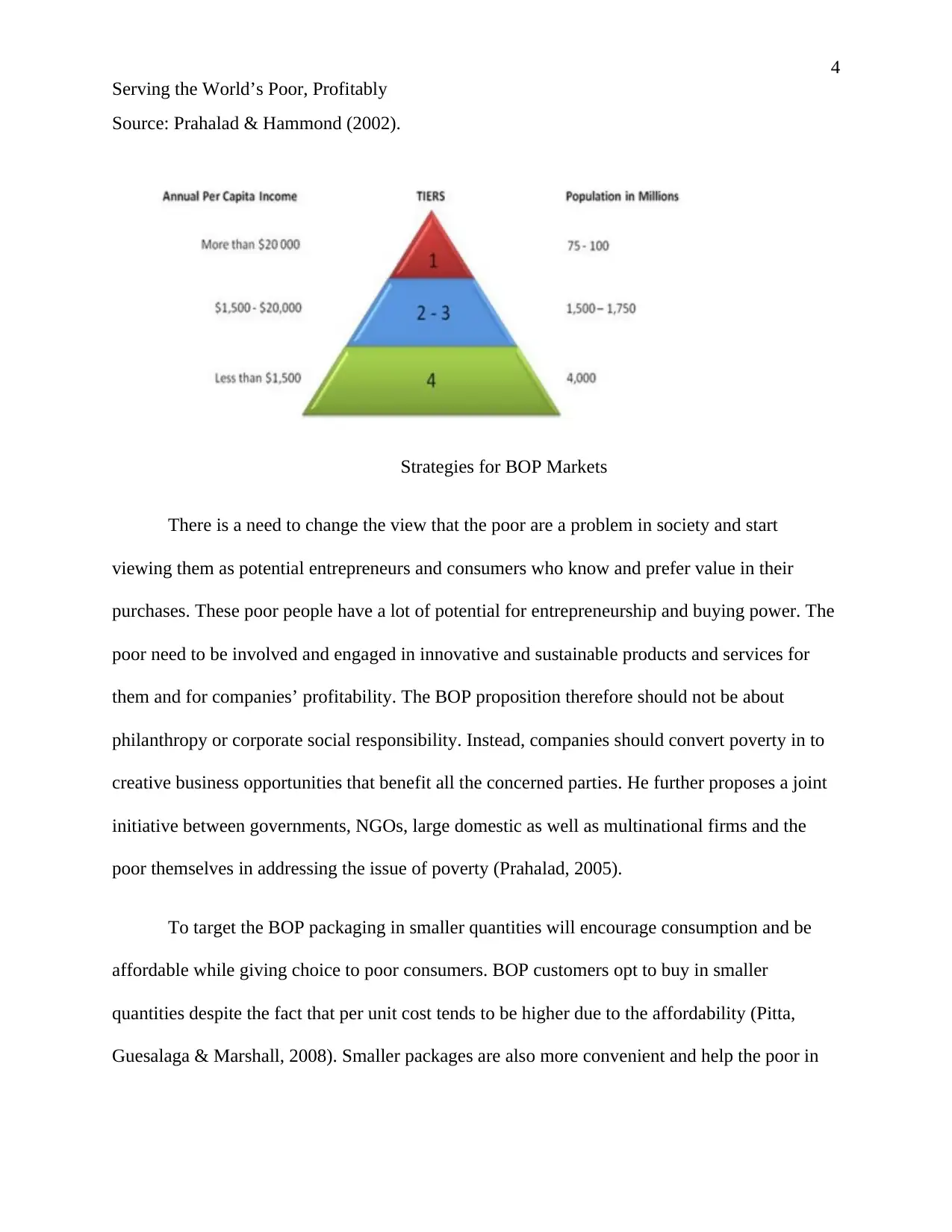
need to be adopted to tap in to the potential of the BOP market. The numbers of customers are
huge enough for companies to dedicate in serving this segment as per the figure below which
shows the number of customers in the four consumer tiers of the economic pyramid and their
incomes.
Figure 1: The Economic Pyramid
Serving the World’s Poor, Profitably
on products and services and thus need to be informed about the benefits of products and
services. The companies also need to adopt the local needs in their products and services to
appeal to this segment. These and other reasons make the big companies leave it to the local
businesses or government agencies to serve the poor people (Anderson & Billou, 2007).
Despite these challenges, there is still so much potential that can be tapped to become
profitable while serving this segment. Business enterprises need to establish new and cheap ways
to establish distribution channels in these areas, by using available technology or being
innovative. These new innovations can be replicated across other markets with similar
characteristics on other areas. The innovations might also become applicable even in other
developed markets thus useful. The lessons learnt from these markets may also be useful to
influence decisions by the big firms for their benefit (Prahalad, 2005).
While some companies have seen these challenges and shied away, there are those that
have faced these challenges and ventured in to this segment to become successful. Some have
implemented strategies in unique product development and service propositions to the poor
people and served them successfully while also making business profits (Anderson & Billou,
2007). Demand for quality but low priced products and affordable services is high by this
segment (Prahalad & Hammond, 2002). It is definite that new business models and strategies
need to be adopted to tap in to the potential of the BOP market. The numbers of customers are
huge enough for companies to dedicate in serving this segment as per the figure below which
shows the number of customers in the four consumer tiers of the economic pyramid and their
incomes.
Figure 1: The Economic Pyramid
⊘ This is a preview!⊘
Do you want full access?
Subscribe today to unlock all pages.

Trusted by 1+ million students worldwide

4
Serving the World’s Poor, Profitably
Source: Prahalad & Hammond (2002).
Strategies for BOP Markets
There is a need to change the view that the poor are a problem in society and start
viewing them as potential entrepreneurs and consumers who know and prefer value in their
purchases. These poor people have a lot of potential for entrepreneurship and buying power. The
poor need to be involved and engaged in innovative and sustainable products and services for
them and for companies’ profitability. The BOP proposition therefore should not be about
philanthropy or corporate social responsibility. Instead, companies should convert poverty in to
creative business opportunities that benefit all the concerned parties. He further proposes a joint
initiative between governments, NGOs, large domestic as well as multinational firms and the
poor themselves in addressing the issue of poverty (Prahalad, 2005).
To target the BOP packaging in smaller quantities will encourage consumption and be
affordable while giving choice to poor consumers. BOP customers opt to buy in smaller
quantities despite the fact that per unit cost tends to be higher due to the affordability (Pitta,
Guesalaga & Marshall, 2008). Smaller packages are also more convenient and help the poor in
Serving the World’s Poor, Profitably
Source: Prahalad & Hammond (2002).
Strategies for BOP Markets
There is a need to change the view that the poor are a problem in society and start
viewing them as potential entrepreneurs and consumers who know and prefer value in their
purchases. These poor people have a lot of potential for entrepreneurship and buying power. The
poor need to be involved and engaged in innovative and sustainable products and services for
them and for companies’ profitability. The BOP proposition therefore should not be about
philanthropy or corporate social responsibility. Instead, companies should convert poverty in to
creative business opportunities that benefit all the concerned parties. He further proposes a joint
initiative between governments, NGOs, large domestic as well as multinational firms and the
poor themselves in addressing the issue of poverty (Prahalad, 2005).
To target the BOP packaging in smaller quantities will encourage consumption and be
affordable while giving choice to poor consumers. BOP customers opt to buy in smaller
quantities despite the fact that per unit cost tends to be higher due to the affordability (Pitta,
Guesalaga & Marshall, 2008). Smaller packages are also more convenient and help the poor in
Paraphrase This Document
Need a fresh take? Get an instant paraphrase of this document with our AI Paraphraser

5
Serving the World’s Poor, Profitably
management of their cash flows. Smaller unit packaging however has the disadvantage of
increased pollution to the environment which can be tackled by creative initiatives
Reasons for BOP Proposition
According to Prahalad and Hart (2002), the MNCs need a proposition for the BOP
market for the following reasons. First, there is a huge untapped market and purchasing power at
the bottom of the economic pyramid. Businesses can tap in to this market and sell their goods
and services thus making profits. This also creates employment for the poor thus helping to
reduce the poverty by empowering the poor people and allowing them live with dignity. This
population accounts for about a third of the global population and the large Multinational
companies should be at the forefront of commercializing this huge segment.
If MNCs refuse to sell to the poor, they disadvantage them and thus they have to keep
buying for higher prices from local monopolies. MNCs with their huge operations and expertise
should offer the poor with variety they can choose from (Prahalad, 2005). Poor people do in fact
buy purchase luxury products and non items that are not very essential in order to keep up with
society or satisfy some customs Subrahmanyan and Gomez-Arias (2008). According to Karnani
(2007), the poor people desire quality products at an affordable price, they lack control and
easily get in to temptation in their purchases. It is therefore important to sell high quality
products at a cheaper price and take advantage of their numbers.
According to Jaiswal (2007), BOP consumers should be considered as producers and not
just buyers of products. One way to reduce poverty is by raising their earnings and focusing
more on buying from them rather than selling to them, for example buying milk which they
produce from their small farms which can be processed in to other products for sale. Davidson
Serving the World’s Poor, Profitably
management of their cash flows. Smaller unit packaging however has the disadvantage of
increased pollution to the environment which can be tackled by creative initiatives
Reasons for BOP Proposition
According to Prahalad and Hart (2002), the MNCs need a proposition for the BOP
market for the following reasons. First, there is a huge untapped market and purchasing power at
the bottom of the economic pyramid. Businesses can tap in to this market and sell their goods
and services thus making profits. This also creates employment for the poor thus helping to
reduce the poverty by empowering the poor people and allowing them live with dignity. This
population accounts for about a third of the global population and the large Multinational
companies should be at the forefront of commercializing this huge segment.
If MNCs refuse to sell to the poor, they disadvantage them and thus they have to keep
buying for higher prices from local monopolies. MNCs with their huge operations and expertise
should offer the poor with variety they can choose from (Prahalad, 2005). Poor people do in fact
buy purchase luxury products and non items that are not very essential in order to keep up with
society or satisfy some customs Subrahmanyan and Gomez-Arias (2008). According to Karnani
(2007), the poor people desire quality products at an affordable price, they lack control and
easily get in to temptation in their purchases. It is therefore important to sell high quality
products at a cheaper price and take advantage of their numbers.
According to Jaiswal (2007), BOP consumers should be considered as producers and not
just buyers of products. One way to reduce poverty is by raising their earnings and focusing
more on buying from them rather than selling to them, for example buying milk which they
produce from their small farms which can be processed in to other products for sale. Davidson

6
Serving the World’s Poor, Profitably
(2009) argues that the focus should be incorporation of the social responsibility concepts in to
the BOP strategy form the very beginning. BOP proposition improves the living standards of the
poor by alleviating poverty while at the same time earning profits for firms.
Firms that want to target the over 4 billion customers at the bottom of the pyramid must
depart from the conventional 4Ps (product, price, place and promotion) of marketing as it is not
adequate while marketing to BOP customers because it focuses on internal firm management and
not the needs of this segment of customers. The proposal is to shift focus to the 6 As namely
availability, affordability, acceptability and awareness, adaptability and active absorption
(Oodith & Parumasur, 2013). The 6 As are shown in the framework in the figure below.
Figure 2: The 6As Framework. Source: (Oodith & Parumasur, 2013).
To be profitable, firms must cut on their costs, manufacture simpler products and be
flexible in payments (Pitta et al., 2008). The firms must also employ low margins and high
Serving the World’s Poor, Profitably
(2009) argues that the focus should be incorporation of the social responsibility concepts in to
the BOP strategy form the very beginning. BOP proposition improves the living standards of the
poor by alleviating poverty while at the same time earning profits for firms.
Firms that want to target the over 4 billion customers at the bottom of the pyramid must
depart from the conventional 4Ps (product, price, place and promotion) of marketing as it is not
adequate while marketing to BOP customers because it focuses on internal firm management and
not the needs of this segment of customers. The proposal is to shift focus to the 6 As namely
availability, affordability, acceptability and awareness, adaptability and active absorption
(Oodith & Parumasur, 2013). The 6 As are shown in the framework in the figure below.
Figure 2: The 6As Framework. Source: (Oodith & Parumasur, 2013).
To be profitable, firms must cut on their costs, manufacture simpler products and be
flexible in payments (Pitta et al., 2008). The firms must also employ low margins and high
⊘ This is a preview!⊘
Do you want full access?
Subscribe today to unlock all pages.

Trusted by 1+ million students worldwide

7
Serving the World’s Poor, Profitably
volumes for them to afford lowering of process and still make profits. The products must also
deliver both tangible and non tangible benefits. The tangible benefits will include value for
money while the non tangible include esteem and also independence. Products that can be used
for many purposes will appeal more to this segment as they seek value for their money (Oodith
& Parumasur, 2013).
Conclusion
In conclusion, marketing to the customers at the bottom segment of the economic
pyramid can bring benefits to the firms that choose to venture in selling goods and services to
this segment. The firms will make profits from the estimated over 4 billion consumers globally if
they produce quality products at an affordable price and also benefit from advantages of
economies of scale. They will also help to raise the standards of living of the poor people by
giving them a means of livelihood as they engage them economically while at the same giving
them choice of products and services. This further stops them from exploitation by monopoly of
domestic companies. They can achieve this by reducing costs and by being innovative.
Companies that have focused on the BOP segment have been successful and made profits as the
number of people continue to grow for future markets. This paper has discussed ways in which
firms that do business with the BOP segment can improve the lives of the many people living at
the bottom of the pyramid by economic engagement and serve this segment profitably.
Serving the World’s Poor, Profitably
volumes for them to afford lowering of process and still make profits. The products must also
deliver both tangible and non tangible benefits. The tangible benefits will include value for
money while the non tangible include esteem and also independence. Products that can be used
for many purposes will appeal more to this segment as they seek value for their money (Oodith
& Parumasur, 2013).
Conclusion
In conclusion, marketing to the customers at the bottom segment of the economic
pyramid can bring benefits to the firms that choose to venture in selling goods and services to
this segment. The firms will make profits from the estimated over 4 billion consumers globally if
they produce quality products at an affordable price and also benefit from advantages of
economies of scale. They will also help to raise the standards of living of the poor people by
giving them a means of livelihood as they engage them economically while at the same giving
them choice of products and services. This further stops them from exploitation by monopoly of
domestic companies. They can achieve this by reducing costs and by being innovative.
Companies that have focused on the BOP segment have been successful and made profits as the
number of people continue to grow for future markets. This paper has discussed ways in which
firms that do business with the BOP segment can improve the lives of the many people living at
the bottom of the pyramid by economic engagement and serve this segment profitably.
Paraphrase This Document
Need a fresh take? Get an instant paraphrase of this document with our AI Paraphraser

8
Serving the World’s Poor, Profitably
References
Anderson, J., & Billou, N. (2007). Serving the World's Poor: Innovation at the Base of the
Economic Pyramid. Journal of Business Strategy, 28(2), 14-21.
Davidson, K. (2009). Ethical Concerns at the Bottom of the Pyramid: where CSR Meets BOP.
Journal of International Business Ethics.
Jaiswal, A. K. (2007). Fortune at the Bottom of the Pyramid: An Alternate Perspective. Indian
Institute of Management. Retrieved Sept 21, 2017 from:
https://core.ac.uk/download/pdf/6443728.pdf
Karnani, A. (2007). The Mirage of Marketing to the Bottom of the Pyramid: How the Private
Sector can Help Alleviate Poverty. California Management Review, 49(4), 90-111.
Pitta, D., Guesalaga, R. & Marshall, P. (2008). The Quest for the Fortune at the Bottom of the
Pyramid: Potential and Challenges. Journal of Consumer Marketing, 25(7), 393-401.
Prahalad, C. K. (2005). The Fortune at the Bottom of the Pyramid: Eradicating Poverty through
Profits. Vikalpa, 30(2), 149.
Prahalad, C. & Hammond, A. (2002). Serving the World's Poor, Profitably. Harvard Business
Review, 80(9), 48-59.
Oodith, P. & Parumasur, S. (2013). Tapping in to the Bottom of the Pyramid (Bop) Market in
South Africa: Possible? And How?. Corporate Ownership and Control, 11(1), 280-294.
Serving the World’s Poor, Profitably
References
Anderson, J., & Billou, N. (2007). Serving the World's Poor: Innovation at the Base of the
Economic Pyramid. Journal of Business Strategy, 28(2), 14-21.
Davidson, K. (2009). Ethical Concerns at the Bottom of the Pyramid: where CSR Meets BOP.
Journal of International Business Ethics.
Jaiswal, A. K. (2007). Fortune at the Bottom of the Pyramid: An Alternate Perspective. Indian
Institute of Management. Retrieved Sept 21, 2017 from:
https://core.ac.uk/download/pdf/6443728.pdf
Karnani, A. (2007). The Mirage of Marketing to the Bottom of the Pyramid: How the Private
Sector can Help Alleviate Poverty. California Management Review, 49(4), 90-111.
Pitta, D., Guesalaga, R. & Marshall, P. (2008). The Quest for the Fortune at the Bottom of the
Pyramid: Potential and Challenges. Journal of Consumer Marketing, 25(7), 393-401.
Prahalad, C. K. (2005). The Fortune at the Bottom of the Pyramid: Eradicating Poverty through
Profits. Vikalpa, 30(2), 149.
Prahalad, C. & Hammond, A. (2002). Serving the World's Poor, Profitably. Harvard Business
Review, 80(9), 48-59.
Oodith, P. & Parumasur, S. (2013). Tapping in to the Bottom of the Pyramid (Bop) Market in
South Africa: Possible? And How?. Corporate Ownership and Control, 11(1), 280-294.

9
Serving the World’s Poor, Profitably
Subrahmanyan, S. & Tomas Gomez-Arias, J. (2008). Integrated Approach to Understanding
Consumer Behavior at Bottom of Pyramid. Journal of Consumer Marketing, 25(7), 402-
412.
Serving the World’s Poor, Profitably
Subrahmanyan, S. & Tomas Gomez-Arias, J. (2008). Integrated Approach to Understanding
Consumer Behavior at Bottom of Pyramid. Journal of Consumer Marketing, 25(7), 402-
412.
⊘ This is a preview!⊘
Do you want full access?
Subscribe today to unlock all pages.

Trusted by 1+ million students worldwide
1 out of 9
Related Documents
Your All-in-One AI-Powered Toolkit for Academic Success.
+13062052269
info@desklib.com
Available 24*7 on WhatsApp / Email
Unlock your academic potential
Copyright © 2020–2026 A2Z Services. All Rights Reserved. Developed and managed by ZUCOL.