BP's Corporate Governance, Ethics, and Social Responsibility Analysis
VerifiedAdded on 2023/05/26
|8
|1708
|101
Report
AI Summary
This report provides an analysis of corporate governance and corporate social responsibility (CSR), focusing on British Petroleum (BP). It begins by defining corporate governance and outlining its key principles, including shareholder rights, equitable treatment, stakeholder roles, transparency, and board responsibilities. The report then discusses CSR, emphasizing its role in sustainable development and ethical practices, and highlights ethical issues within CSR objectives. Archie Carroll's Pyramid of CSR is introduced as a framework for assessing BP's CSR efforts, examining economic, legal, ethical, and philanthropic responsibilities. The analysis includes BP's financial performance, compliance with laws, ethical practices such as employee safety and climate change initiatives, and philanthropic contributions. The report concludes that CSR, ethics, and governance are crucial for business operations, applying these concepts to BP and evaluating the company's performance against Carroll's Pyramid.

14 December 2018
BUSINESS AND ENVIRONMENT
BRITISH PETROLEUM
BUSINESS AND ENVIRONMENT
BRITISH PETROLEUM
Paraphrase This Document
Need a fresh take? Get an instant paraphrase of this document with our AI Paraphraser

TASK 2, QUESTION 1
INTRODUCTION
The term corporate governance is defined as the overall framework of the policies,
procedures, regulations, activities and the conduct of an entity and its members, while
carrying out the varied range of business activities, in order to serves the stakeholders such as
shareholders, customers, clients, suppliers, regulators and others (Tricker, 2015). The
Committee on the Financial Aspects of Corporate Governance, known as the Cadbury
Committee in the year 1992, initially and majorly highlighted the principles of corporate
governance in the UK (Cheffins, 2015). The committee regarded corporate governance as the
system of directing and controlling the corporations. Over the years, the corporate
governance practices and principles have evolved in the nation, with a recent development in
the UK Corporate Governance Code. The present code covers the application and reporting
of the principles stated therein (FRC, 2018). Thus, while good governance practices include
the disclosures in the annual report of the application of the principles, the bad governance
practices include corruption, receipt of bribe and others.
FIVE BASIC PRINCIPLES OF CORPORATE GOVERNANCE
The rights of shareholders: The rights of the shareholders are extremely important as they
determine the critical relationships within the organisation. Primarily shareholders have the
rights in the income of the entity, have decision-making rights, have the right to approve
certain transactions in the company and others. Thus, it is the duty of the organisations to
prepare and present the annual financial results to such shareholders.
The equitable treatment of the shareholders: The corporate governance framework of an
entity should ensure that there should be an equitable treatment to all the shareholders of the
entity, including the minority and the foreign shareholders. The framework should, in
addition, ensure that all the shares are equal in terms of the right to attend the meeting and
earn dividends thereon.
The role of stakeholders in corporate governance: As per the stakeholder approach, the
corporate governance framework must ensure that the economic benefits arising out of the
business operations are shared by the entity among the various stakeholders. This is in
addition to the better transfer of information among various members such as customers,
regulators, investors and others.
INTRODUCTION
The term corporate governance is defined as the overall framework of the policies,
procedures, regulations, activities and the conduct of an entity and its members, while
carrying out the varied range of business activities, in order to serves the stakeholders such as
shareholders, customers, clients, suppliers, regulators and others (Tricker, 2015). The
Committee on the Financial Aspects of Corporate Governance, known as the Cadbury
Committee in the year 1992, initially and majorly highlighted the principles of corporate
governance in the UK (Cheffins, 2015). The committee regarded corporate governance as the
system of directing and controlling the corporations. Over the years, the corporate
governance practices and principles have evolved in the nation, with a recent development in
the UK Corporate Governance Code. The present code covers the application and reporting
of the principles stated therein (FRC, 2018). Thus, while good governance practices include
the disclosures in the annual report of the application of the principles, the bad governance
practices include corruption, receipt of bribe and others.
FIVE BASIC PRINCIPLES OF CORPORATE GOVERNANCE
The rights of shareholders: The rights of the shareholders are extremely important as they
determine the critical relationships within the organisation. Primarily shareholders have the
rights in the income of the entity, have decision-making rights, have the right to approve
certain transactions in the company and others. Thus, it is the duty of the organisations to
prepare and present the annual financial results to such shareholders.
The equitable treatment of the shareholders: The corporate governance framework of an
entity should ensure that there should be an equitable treatment to all the shareholders of the
entity, including the minority and the foreign shareholders. The framework should, in
addition, ensure that all the shares are equal in terms of the right to attend the meeting and
earn dividends thereon.
The role of stakeholders in corporate governance: As per the stakeholder approach, the
corporate governance framework must ensure that the economic benefits arising out of the
business operations are shared by the entity among the various stakeholders. This is in
addition to the better transfer of information among various members such as customers,
regulators, investors and others.

Disclosure and Transparency: These are essential elements of the robust corporate
governance practices of an enterprise. The management of the entity must ensure that
shareholders, investors, and other stakeholders are timely and adequately informed about the
corporate transactions, capital allocations, financial performance and other parameters of
entity’s business (Fung, 2014).
Responsibilities of the board: It is the responsibility of the board of directors of the
organisation to ensure that the corporate governance framework is in place and is followed by
the members of the entity. This must be done by the formulation of suitable policies and
internal control system.
TASK 2, QUESTION 2
Corporate Social Responsibility (CSR) is an essential component of the corporate governance
framework and is referred to as the overall conduct and contribution of the entities towards
the sustainable development, environmental preservation, inclusion of ethical practices and
positive impact on society (Zientara, 2017). Thus, the corporate social responsibility can be
referred to as the means to identify the issues of the society and paying back to the members
of the society and all the concerned stakeholders. Hence, the practice not only aids in
achieving the organisational goals but also assists in building a large base of loyal customers,
suppliers, together with the goodwill and long-term growth. The various ethical issues that
form the part of CSR objectives of an organisation are employee conflicts of interest,
environmental issues, unauthorized payments, insider trading and others (Katamba, et. al,
2012).
On lines of the above, the three popular of the many companies that have been socially
irresponsible are Enron, Rolls Royce and MG Rover Group.
The company British Petroleum defines its corporate social responsibility as a practice to
create long-term value for the shareholders, society, and the partners of the entity. The
practice is further stated to be supported by meeting growing energy demands across the
globe, in a safe and responsible manner (British Petroleum, 2017).
governance practices of an enterprise. The management of the entity must ensure that
shareholders, investors, and other stakeholders are timely and adequately informed about the
corporate transactions, capital allocations, financial performance and other parameters of
entity’s business (Fung, 2014).
Responsibilities of the board: It is the responsibility of the board of directors of the
organisation to ensure that the corporate governance framework is in place and is followed by
the members of the entity. This must be done by the formulation of suitable policies and
internal control system.
TASK 2, QUESTION 2
Corporate Social Responsibility (CSR) is an essential component of the corporate governance
framework and is referred to as the overall conduct and contribution of the entities towards
the sustainable development, environmental preservation, inclusion of ethical practices and
positive impact on society (Zientara, 2017). Thus, the corporate social responsibility can be
referred to as the means to identify the issues of the society and paying back to the members
of the society and all the concerned stakeholders. Hence, the practice not only aids in
achieving the organisational goals but also assists in building a large base of loyal customers,
suppliers, together with the goodwill and long-term growth. The various ethical issues that
form the part of CSR objectives of an organisation are employee conflicts of interest,
environmental issues, unauthorized payments, insider trading and others (Katamba, et. al,
2012).
On lines of the above, the three popular of the many companies that have been socially
irresponsible are Enron, Rolls Royce and MG Rover Group.
The company British Petroleum defines its corporate social responsibility as a practice to
create long-term value for the shareholders, society, and the partners of the entity. The
practice is further stated to be supported by meeting growing energy demands across the
globe, in a safe and responsible manner (British Petroleum, 2017).
⊘ This is a preview!⊘
Do you want full access?
Subscribe today to unlock all pages.

Trusted by 1+ million students worldwide

ARCHIE CARROLL’S PYRAMID
Over the years, a number of models have been developed by various experts around the globe
to assess the corporate social responsibility framework of the organisations. One such popular
technique is Carroll’s Pyramid. Archie B. Carroll was the developer of the Pyramid of CSR,
to study the various aspects of the corporate social responsibilities and social issues in the
management of the companies (Schwartz, 2011). The tool takes into consideration the
definition of the Corporate Social Responsibility, which was laid down by Archie B. Carroll
himself. According to Carroll, the CSR activities of an enterprise are narrowed down to the
four different kinds of societal expectations, namely the economic, legal, ethical and
discretionary. The following diagram describes Carroll’s Pyramid.
(Source: Schwartz, 2011)
According to the model, an entity must be economically responsible by earning and
distributing profits to the shareholders and must ensure that quality products are provided to
the society at competitive prices. The economic benefits can be assessed by evaluating the
share value in the market at present and the overall long-term economic returns.
Over the years, a number of models have been developed by various experts around the globe
to assess the corporate social responsibility framework of the organisations. One such popular
technique is Carroll’s Pyramid. Archie B. Carroll was the developer of the Pyramid of CSR,
to study the various aspects of the corporate social responsibilities and social issues in the
management of the companies (Schwartz, 2011). The tool takes into consideration the
definition of the Corporate Social Responsibility, which was laid down by Archie B. Carroll
himself. According to Carroll, the CSR activities of an enterprise are narrowed down to the
four different kinds of societal expectations, namely the economic, legal, ethical and
discretionary. The following diagram describes Carroll’s Pyramid.
(Source: Schwartz, 2011)
According to the model, an entity must be economically responsible by earning and
distributing profits to the shareholders and must ensure that quality products are provided to
the society at competitive prices. The economic benefits can be assessed by evaluating the
share value in the market at present and the overall long-term economic returns.
Paraphrase This Document
Need a fresh take? Get an instant paraphrase of this document with our AI Paraphraser

(Source: London Stock Exchange, 2018)
The above graph shows the growth and consistency of the prices of the shares in the market
for the company British Petroleum.
The legal expectation deals with the compliance of the various laws and follows up of the
applicable regulatory requirements in the industry of operations of the company. On
application of the same on the company British Petroleum it can be stated that company
complies with the tax laws, environmental protection laws, anti-money laundering laws,
competition laws, employee safety and working conditions, anti-fraud laws, UK company
law, EU laws and others (British Petroleum, 2017). In addition, the company follows the
International Financial Reporting Standards for the preparation of the financial statements.
Ethical responsibilities of Carroll’s pyramid are referred to as the adoption of moral
principles and ethically viable principles and conduct while performing business functions.
According to the annual report of British Petroleum for the year 2017, the company has
engaged in various practices such as employee safety, climate change, human rights,
managing environmental and social impacts and many more (British Petroleum, 2017).
Lastly, the philanthropic responsibilities as stated in the pyramid deal with the contribution of
an entity towards various societal issues. It further includes the engagement in practices
towards the overall improvement of the overall environment within which the company
The above graph shows the growth and consistency of the prices of the shares in the market
for the company British Petroleum.
The legal expectation deals with the compliance of the various laws and follows up of the
applicable regulatory requirements in the industry of operations of the company. On
application of the same on the company British Petroleum it can be stated that company
complies with the tax laws, environmental protection laws, anti-money laundering laws,
competition laws, employee safety and working conditions, anti-fraud laws, UK company
law, EU laws and others (British Petroleum, 2017). In addition, the company follows the
International Financial Reporting Standards for the preparation of the financial statements.
Ethical responsibilities of Carroll’s pyramid are referred to as the adoption of moral
principles and ethically viable principles and conduct while performing business functions.
According to the annual report of British Petroleum for the year 2017, the company has
engaged in various practices such as employee safety, climate change, human rights,
managing environmental and social impacts and many more (British Petroleum, 2017).
Lastly, the philanthropic responsibilities as stated in the pyramid deal with the contribution of
an entity towards various societal issues. It further includes the engagement in practices
towards the overall improvement of the overall environment within which the company

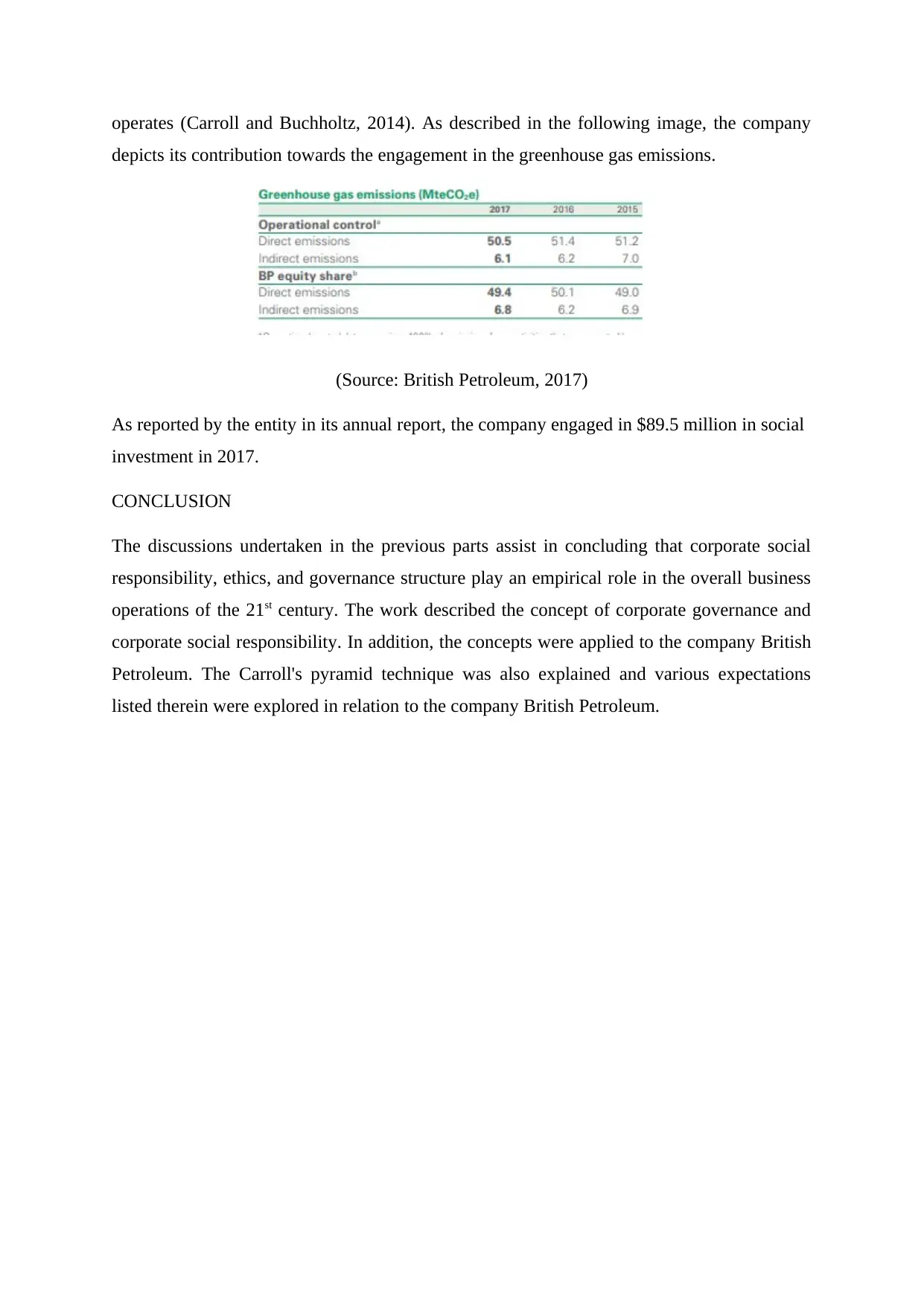
operates (Carroll and Buchholtz, 2014). As described in the following image, the company
depicts its contribution towards the engagement in the greenhouse gas emissions.
(Source: British Petroleum, 2017)
As reported by the entity in its annual report, the company engaged in $89.5 million in social
investment in 2017.
CONCLUSION
The discussions undertaken in the previous parts assist in concluding that corporate social
responsibility, ethics, and governance structure play an empirical role in the overall business
operations of the 21st century. The work described the concept of corporate governance and
corporate social responsibility. In addition, the concepts were applied to the company British
Petroleum. The Carroll's pyramid technique was also explained and various expectations
listed therein were explored in relation to the company British Petroleum.
depicts its contribution towards the engagement in the greenhouse gas emissions.
(Source: British Petroleum, 2017)
As reported by the entity in its annual report, the company engaged in $89.5 million in social
investment in 2017.
CONCLUSION
The discussions undertaken in the previous parts assist in concluding that corporate social
responsibility, ethics, and governance structure play an empirical role in the overall business
operations of the 21st century. The work described the concept of corporate governance and
corporate social responsibility. In addition, the concepts were applied to the company British
Petroleum. The Carroll's pyramid technique was also explained and various expectations
listed therein were explored in relation to the company British Petroleum.
⊘ This is a preview!⊘
Do you want full access?
Subscribe today to unlock all pages.

Trusted by 1+ million students worldwide

References
British Petroleum. (2017) Annual Report 2017. [online] Available from:
https://www.bp.com/content/dam/bp/business-sites/en/global/corporate/pdfs/investors/bp-
annual-report-and-form-20f-2017.pdf [Accessed on 14 December 2018].
Carroll, A. B., and Buccholtz, A. K. (2014) Business and Society: Ethics, Sustainability, and
Stakeholder Management. 9th ed. Boston, MA: Cengage Learning.
Cheffins, B. R. (2015) The Rise of Corporate Governance in the UK: When and Why.
Current Legal Problems, 68(1), pp. 387-429.
Financial Reporting Council. (2018) The UK Corporate Governance Code July 2018.
[online] Available from: https://www.frc.org.uk/getattachment/88bd8c45-50ea-4841-95b0-
d2f4f48069a2/2018-UK-Corporate-Governance-Code-FINAL.PDF [Accessed on 14
December 2018].
Fung, B. (2014). The demand and need for transparency and disclosure in corporate
governance. Universal Journal of Management, 2(2), pp. 72-80.
Katamba, D., Zipfel, C., Haag, D., and Kazooba, C. T. (2012) Principles of Corporate Social
Responsibility (CSR): A Guide for students and practising managers in developing and
emerging countries. Houston: Strategic Book Publishing and Rights Co.
London Stock Exchange. (2018) BP PLC. [online] Available from:
https://www.londonstockexchange.com/exchange/prices-and-markets/stocks/summary/
company-summary-chart.html?fourWayKey=GB0007980591GBGBXSET1 [Accessed on 14
December 2018].
Schwartz, M. S. (2011) Corporate Social Responsibility: An Ethical Approach. New York:
Broadview Press.
Tricker, B. (2015) Corporate Governance: Principle, Policies and Practices. 3rd ed. Oxford:
Oxford University Press.
British Petroleum. (2017) Annual Report 2017. [online] Available from:
https://www.bp.com/content/dam/bp/business-sites/en/global/corporate/pdfs/investors/bp-
annual-report-and-form-20f-2017.pdf [Accessed on 14 December 2018].
Carroll, A. B., and Buccholtz, A. K. (2014) Business and Society: Ethics, Sustainability, and
Stakeholder Management. 9th ed. Boston, MA: Cengage Learning.
Cheffins, B. R. (2015) The Rise of Corporate Governance in the UK: When and Why.
Current Legal Problems, 68(1), pp. 387-429.
Financial Reporting Council. (2018) The UK Corporate Governance Code July 2018.
[online] Available from: https://www.frc.org.uk/getattachment/88bd8c45-50ea-4841-95b0-
d2f4f48069a2/2018-UK-Corporate-Governance-Code-FINAL.PDF [Accessed on 14
December 2018].
Fung, B. (2014). The demand and need for transparency and disclosure in corporate
governance. Universal Journal of Management, 2(2), pp. 72-80.
Katamba, D., Zipfel, C., Haag, D., and Kazooba, C. T. (2012) Principles of Corporate Social
Responsibility (CSR): A Guide for students and practising managers in developing and
emerging countries. Houston: Strategic Book Publishing and Rights Co.
London Stock Exchange. (2018) BP PLC. [online] Available from:
https://www.londonstockexchange.com/exchange/prices-and-markets/stocks/summary/
company-summary-chart.html?fourWayKey=GB0007980591GBGBXSET1 [Accessed on 14
December 2018].
Schwartz, M. S. (2011) Corporate Social Responsibility: An Ethical Approach. New York:
Broadview Press.
Tricker, B. (2015) Corporate Governance: Principle, Policies and Practices. 3rd ed. Oxford:
Oxford University Press.
Paraphrase This Document
Need a fresh take? Get an instant paraphrase of this document with our AI Paraphraser

Zientara, P. (2017) Socioemotional Wealth and Corporate Social Responsibility: A Critical
Analysis. Journal of Business Ethics, 144(1), pp. 185–186.
1 out of 8
Related Documents
Your All-in-One AI-Powered Toolkit for Academic Success.
+13062052269
info@desklib.com
Available 24*7 on WhatsApp / Email
Unlock your academic potential
Copyright © 2020–2025 A2Z Services. All Rights Reserved. Developed and managed by ZUCOL.