LCBB6004 - Strategic Management and Sustainability Report on BP
VerifiedAdded on 2023/06/15
|11
|2912
|138
Report
AI Summary
This report provides a comprehensive analysis of British Petroleum's (BP) strategic management and sustainability efforts. It employs several strategic frameworks, including PESTLE analysis to assess the impact of political, economic, social, technological, environmental, and legal factors on BP's operations. The report further utilizes Porter's Five Forces to evaluate the competitive landscape, focusing on the threat of substitutes, bargaining power of buyers and suppliers, the threat of new entrants, and industry rivalry. A strategic group analysis examines BP's market share and position within the oil and gas industry. Finally, a SWOT analysis identifies BP's internal strengths and weaknesses, as well as external opportunities and threats. The report aims to provide a thorough understanding of the factors influencing BP's business strategies and its approach to sustainability, particularly in light of climate change concerns and the shift towards renewable energy sources. This student contributed assignment is available on Desklib for educational purposes.
Strategic Management
and Sustainability
and Sustainability

Paraphrase This Document
Need a fresh take? Get an instant paraphrase of this document with our AI Paraphraser
Contents
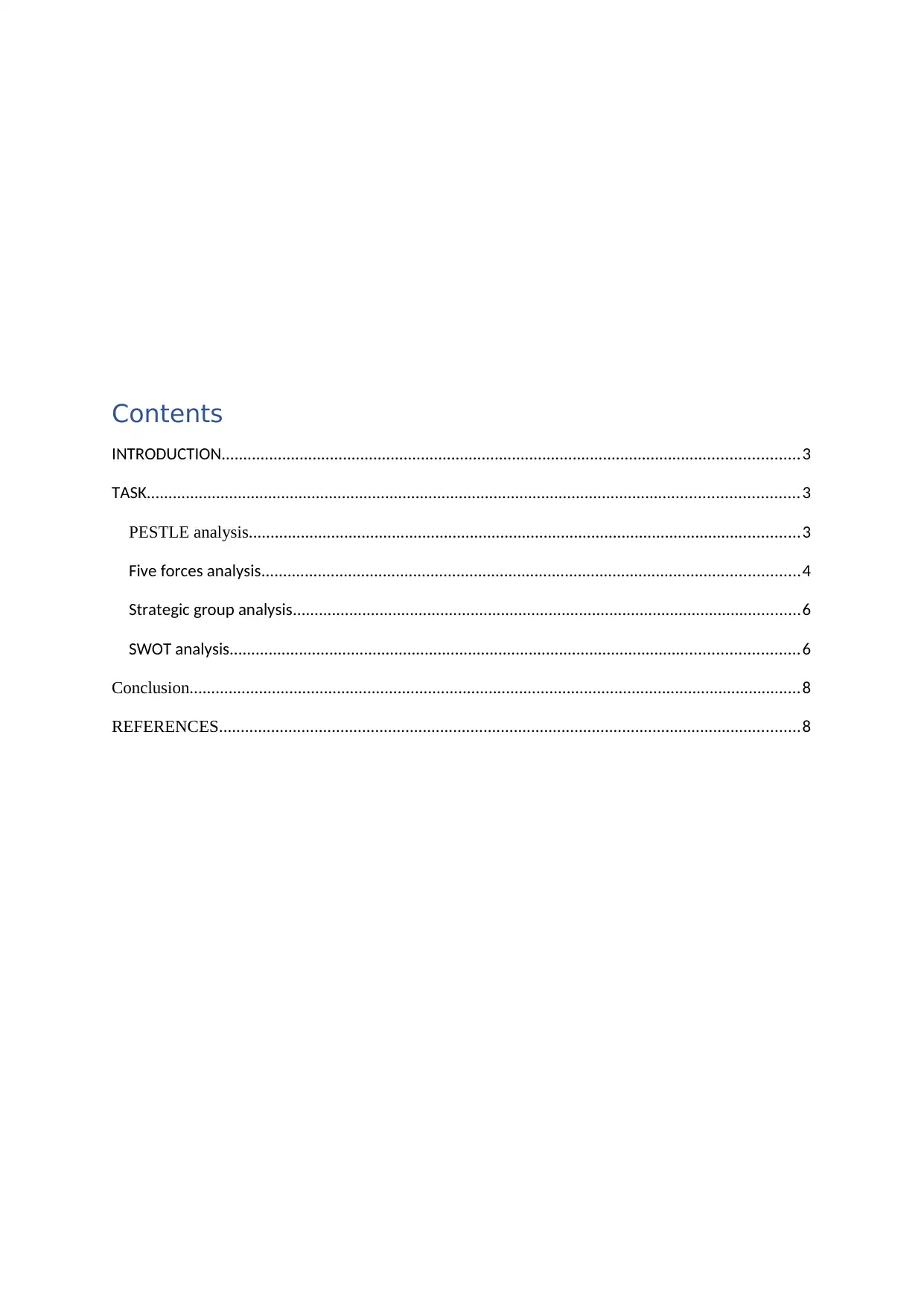
INTRODUCTION.....................................................................................................................................3
TASK......................................................................................................................................................3
PESTLE analysis...............................................................................................................................3
Five forces analysis............................................................................................................................4
Strategic group analysis.....................................................................................................................6
SWOT analysis...................................................................................................................................6
Conclusion.............................................................................................................................................8
REFERENCES......................................................................................................................................8
INTRODUCTION.....................................................................................................................................3
TASK......................................................................................................................................................3
PESTLE analysis...............................................................................................................................3
Five forces analysis............................................................................................................................4
Strategic group analysis.....................................................................................................................6
SWOT analysis...................................................................................................................................6
Conclusion.............................................................................................................................................8
REFERENCES......................................................................................................................................8
INTRODUCTION
Strategic management is the control of a business enterprise’s resources to acquire its desires
and targets. Strategic management involves setting objectives, studying the aggressive
surroundings, studying the internal business enterprise, comparing techniques, and making
sure that control rolls out the techniques across the employer. Strategic management is
divided into several colleges of concept. A prescriptive method to strategic management
outlines how techniques should be developed, while a descriptive method specializes in how
strategies must be placed into exercise. These colleges differ on whether strategies are
evolved via an analytic technique, in which all threats and possibilities are accounted for, or
are greater like preferred guiding concepts to be implemented. Business lifestyle, the
competencies and abilities of personnel, and organizational shape are all important elements
that influence how a business enterprise can achieve its said targets. Inflexible organizations
may additionally locate it tough to reach a changing commercial enterprise surroundings.
Creating a barrier among the improvement of strategies and their implementation can make it
difficult for managers to decide whether or not goals were efficiently met (Baumgartner and
Rauter, 2017). This report will include various topic such as pestle analysis, swot analysis,
five forces, strategic group analysis.
TASK
PESTLE analysis
It is a strategic framework which help the business organisations or the marketers to
analyse the external factors which can influence the operations of the business enterprises.
Here the analysis is in context of the British Petroleum:
Political- Political factors are usually accountable to create and exceed legislation to agencies
and occasionally they'll create direct have an impact on a few types of groups, such as
consumer defence regulation, workers safety laws, regulates of effluence and so on. In
addition, in line with Lancaster others political choices because the team of workers
schooling, health and environment, and even the financial system infrastructure can also have
an impact on organizations operations.
Environment- This factor has been observed that it is rapidly increasing, especially for
multinational companies, because of the difficult of social obligation activities and projects
with concerns at the centre of population and the nearby. These companies have an important
Strategic management is the control of a business enterprise’s resources to acquire its desires
and targets. Strategic management involves setting objectives, studying the aggressive
surroundings, studying the internal business enterprise, comparing techniques, and making
sure that control rolls out the techniques across the employer. Strategic management is
divided into several colleges of concept. A prescriptive method to strategic management
outlines how techniques should be developed, while a descriptive method specializes in how
strategies must be placed into exercise. These colleges differ on whether strategies are
evolved via an analytic technique, in which all threats and possibilities are accounted for, or
are greater like preferred guiding concepts to be implemented. Business lifestyle, the
competencies and abilities of personnel, and organizational shape are all important elements
that influence how a business enterprise can achieve its said targets. Inflexible organizations
may additionally locate it tough to reach a changing commercial enterprise surroundings.
Creating a barrier among the improvement of strategies and their implementation can make it
difficult for managers to decide whether or not goals were efficiently met (Baumgartner and
Rauter, 2017). This report will include various topic such as pestle analysis, swot analysis,
five forces, strategic group analysis.
TASK
PESTLE analysis
It is a strategic framework which help the business organisations or the marketers to
analyse the external factors which can influence the operations of the business enterprises.
Here the analysis is in context of the British Petroleum:
Political- Political factors are usually accountable to create and exceed legislation to agencies
and occasionally they'll create direct have an impact on a few types of groups, such as
consumer defence regulation, workers safety laws, regulates of effluence and so on. In
addition, in line with Lancaster others political choices because the team of workers
schooling, health and environment, and even the financial system infrastructure can also have
an impact on organizations operations.
Environment- This factor has been observed that it is rapidly increasing, especially for
multinational companies, because of the difficult of social obligation activities and projects
with concerns at the centre of population and the nearby. These companies have an important
⊘ This is a preview!⊘
Do you want full access?
Subscribe today to unlock all pages.

Trusted by 1+ million students worldwide
characteristic on contributing to the social development. BP, within the remaining five years,
has laboured proactively to have decline in the environmental risks and, as a conclusion, it
has progressed its indices throughout the years. In its eco efficiency sports, they have got
concentrated on reducing water intake, energy, era of effluents, production of residues solids
and pastes. Moreover, it is also preoccupied with the society and develops projects in
partnerships with the different communities to get better elements together with human
beings’ education, nice of life, social projects (Dingle and Mallen, 2020).
Social- The socio-cultural factor is probably one of the hardest factors to evaluate,
considering this is primarily based on humans’ behaviour and their preferences, such factors
consist of religion, beliefs, priorities, attitudes, philosophy and social modifications. On the
other hand, it has been stated that a crucial part for groups is to understand the cultural value
of a society; groups should be monitoring this frequently to higher suit to consumer goals and
requirements.
Technological- It is an essential macro-environmental function that's presented in lots of
products that it used on each day breathes, as tv, calculators, video statistics, computer
systems and so forth. The business organisations play an important obligation on generating
more technology due to this a number of them has their very own studies and development
department or paintings in partnership with universities or studies institutes, looking for to
provide new merchandise or with higher excellence to customers.
Legal- This factor states that the business organisations need to work and operate
according to the law otherwise they will have to bear some consequences on
their businesses. It is very important for the business organisations to obey
certain laws which will help the organisation to keep themselves away from the
legal actions which can be taken by the government.
Economic- Economic factors are very great for an company due to the fact it's
miles immediately related to GDP gross home product, economic improvement,
redundancy rate, inflation price and so forth. Any amendment in the financial
system can have an effect on businesses. the appropriate example is the oil spill
at Gulf of Mexico has made BP a large amount of economic loss. The boom within
the crude oil rate affected all of the chain together with electricity price, oil-
based totally uncooked cloth, plastic, artificial fibres and so forth. This example
indicates the importance of monitoring the economic system, both nationally or
has laboured proactively to have decline in the environmental risks and, as a conclusion, it
has progressed its indices throughout the years. In its eco efficiency sports, they have got
concentrated on reducing water intake, energy, era of effluents, production of residues solids
and pastes. Moreover, it is also preoccupied with the society and develops projects in
partnerships with the different communities to get better elements together with human
beings’ education, nice of life, social projects (Dingle and Mallen, 2020).
Social- The socio-cultural factor is probably one of the hardest factors to evaluate,
considering this is primarily based on humans’ behaviour and their preferences, such factors
consist of religion, beliefs, priorities, attitudes, philosophy and social modifications. On the
other hand, it has been stated that a crucial part for groups is to understand the cultural value
of a society; groups should be monitoring this frequently to higher suit to consumer goals and
requirements.
Technological- It is an essential macro-environmental function that's presented in lots of
products that it used on each day breathes, as tv, calculators, video statistics, computer
systems and so forth. The business organisations play an important obligation on generating
more technology due to this a number of them has their very own studies and development
department or paintings in partnership with universities or studies institutes, looking for to
provide new merchandise or with higher excellence to customers.
Legal- This factor states that the business organisations need to work and operate
according to the law otherwise they will have to bear some consequences on
their businesses. It is very important for the business organisations to obey
certain laws which will help the organisation to keep themselves away from the
legal actions which can be taken by the government.
Economic- Economic factors are very great for an company due to the fact it's
miles immediately related to GDP gross home product, economic improvement,
redundancy rate, inflation price and so forth. Any amendment in the financial
system can have an effect on businesses. the appropriate example is the oil spill
at Gulf of Mexico has made BP a large amount of economic loss. The boom within
the crude oil rate affected all of the chain together with electricity price, oil-
based totally uncooked cloth, plastic, artificial fibres and so forth. This example
indicates the importance of monitoring the economic system, both nationally or
Paraphrase This Document
Need a fresh take? Get an instant paraphrase of this document with our AI Paraphraser
the world over, so that you can apprehend feasible opportunities and threats
(Cavagnaro and Curiel, 2017).
Five forces analysis
Threat of substitute
The following points are related to substitutes for petroleum which are relevant to the petroleum
supply chain. Price performance of substitutes: Substitutes to petroleum products like solar energy
had not been commercially viable for a long time. However, the price performance of the solar
energy is now much better. According to a report by Crisil & PHD Chamber average solar tariff rates
have decreased from Rs. 15 per kWh to Rs. 8 per kWh. the wind power is now gaining cost parity
with conventional energy sources. Moreover, wind-power producers get a generation-based
incentive (GBI) of 50 paise/kWh subject to a maximum of Rs.1 crore per Mw over a period of 10
years which is luring them to set up wind power plants. At the moment, the demand for petroleum
products shows no sign of diminishing
Switching costs: Switching from petroleum products to other forms of energy can be difficult if the
equipment is designed to work on petroleum, e.g., in the transport sector. However, for other uses
in industrial and domestic sector switching costs are not very high.
Bargaining power of buyers
The following determinants of client energy are relevant to the petroleum enterprise.Buyer
switching charges: Switching expenses for the retail consumer are low as alternative
petroleum products from competing companies are freely to be had inside the open market.
However, on the moment maximum of the retail distribution of petroleum merchandise is
being achieved by means of Public Sector Undertakings. Despite dismantling of the
Administered Price Mechanism petroleum prices are nevertheless prompted by way of
authorities and there's little desire for the purchaser as all of the groups’ marketplace
merchandise at greater or less the equal fee. At the company level, as already referred to,
nature of crude can vary from source to source. Even although, numerous assets of crude do
exist, the choice of crude can incredibly restrict the liberty of oil refining corporations to
select the source depending on the functionality of the refinery to refine unique forms of
crude. Hence, bargaining strength of downstream petroleum firms for sourcing crude might
depend on the refining functionality in their refineries (Barca, 2017).
Bargaining power of suppliers
(Cavagnaro and Curiel, 2017).
Five forces analysis
Threat of substitute
The following points are related to substitutes for petroleum which are relevant to the petroleum
supply chain. Price performance of substitutes: Substitutes to petroleum products like solar energy
had not been commercially viable for a long time. However, the price performance of the solar
energy is now much better. According to a report by Crisil & PHD Chamber average solar tariff rates
have decreased from Rs. 15 per kWh to Rs. 8 per kWh. the wind power is now gaining cost parity
with conventional energy sources. Moreover, wind-power producers get a generation-based
incentive (GBI) of 50 paise/kWh subject to a maximum of Rs.1 crore per Mw over a period of 10
years which is luring them to set up wind power plants. At the moment, the demand for petroleum
products shows no sign of diminishing
Switching costs: Switching from petroleum products to other forms of energy can be difficult if the
equipment is designed to work on petroleum, e.g., in the transport sector. However, for other uses
in industrial and domestic sector switching costs are not very high.
Bargaining power of buyers
The following determinants of client energy are relevant to the petroleum enterprise.Buyer
switching charges: Switching expenses for the retail consumer are low as alternative
petroleum products from competing companies are freely to be had inside the open market.
However, on the moment maximum of the retail distribution of petroleum merchandise is
being achieved by means of Public Sector Undertakings. Despite dismantling of the
Administered Price Mechanism petroleum prices are nevertheless prompted by way of
authorities and there's little desire for the purchaser as all of the groups’ marketplace
merchandise at greater or less the equal fee. At the company level, as already referred to,
nature of crude can vary from source to source. Even although, numerous assets of crude do
exist, the choice of crude can incredibly restrict the liberty of oil refining corporations to
select the source depending on the functionality of the refinery to refine unique forms of
crude. Hence, bargaining strength of downstream petroleum firms for sourcing crude might
depend on the refining functionality in their refineries (Barca, 2017).
Bargaining power of suppliers
The following points associated with bargaining electricity of provider are pertinent to the
petroleum supply chain.
Differentiation of inputs: The fundamental input to the petroleum industry is crude oil. Crude
oils range from source to supply and refining them can produce special composition of mild,
medium or heavy distillates. Thus, differentiation in inputs plays an critical role within the
deliver chain. The function of differentiated inputs will become more essential because a
regular deliver of those inputs desires to be maintained for preserving non-stop processing
inside the refineries.
Switching prices of suppliers: Switching costs for crude suppliers are considered as small
and they can without difficulty switch from one petroleum company to the alternative until
there are long term agreements between the parties worried. This places them in a strong
function vis-à-vis the downstream petroleum firms. This is very relevant to India. Relies upon
heavily on imported crude. According to a 2013 record of Business Standard, India imports
approximately seventy nine percent of its crude oil requirements (Khudyakova, Shmidt and
Shmidt, 2019).
Entry of new competitors
The following factors associated with the entry of recent competition within the marketplace
are pertinent to the petroleum enterprise.
Economies of scale: Economies of scale are essential in bringing down average charges of
manufacturing. In the petroleum industry, the products are practical in nature and income
margins are small. For a brand-new entrant, therefore, economies of scale are particularly
applicable in petroleum enterprise to deliver down costs and also to make full-size earnings.
This also way that the entrant has to seize a enormous marketplace proportion while existing
gamers should preserve clients, in order to utilize economies of scale. Estimated marketplace
stocks for the important oil marketing agencies for the year2014-15 (Partington, Partridge,
(2021)).
Industry Rivalry
The following factors associated with opposition in the petroleum enterprise are pertinent to
the petroleum supply chain.
petroleum supply chain.
Differentiation of inputs: The fundamental input to the petroleum industry is crude oil. Crude
oils range from source to supply and refining them can produce special composition of mild,
medium or heavy distillates. Thus, differentiation in inputs plays an critical role within the
deliver chain. The function of differentiated inputs will become more essential because a
regular deliver of those inputs desires to be maintained for preserving non-stop processing
inside the refineries.
Switching prices of suppliers: Switching costs for crude suppliers are considered as small
and they can without difficulty switch from one petroleum company to the alternative until
there are long term agreements between the parties worried. This places them in a strong
function vis-à-vis the downstream petroleum firms. This is very relevant to India. Relies upon
heavily on imported crude. According to a 2013 record of Business Standard, India imports
approximately seventy nine percent of its crude oil requirements (Khudyakova, Shmidt and
Shmidt, 2019).
Entry of new competitors
The following factors associated with the entry of recent competition within the marketplace
are pertinent to the petroleum enterprise.
Economies of scale: Economies of scale are essential in bringing down average charges of
manufacturing. In the petroleum industry, the products are practical in nature and income
margins are small. For a brand-new entrant, therefore, economies of scale are particularly
applicable in petroleum enterprise to deliver down costs and also to make full-size earnings.
This also way that the entrant has to seize a enormous marketplace proportion while existing
gamers should preserve clients, in order to utilize economies of scale. Estimated marketplace
stocks for the important oil marketing agencies for the year2014-15 (Partington, Partridge,
(2021)).
Industry Rivalry
The following factors associated with opposition in the petroleum enterprise are pertinent to
the petroleum supply chain.
⊘ This is a preview!⊘
Do you want full access?
Subscribe today to unlock all pages.
Trusted by 1+ million students worldwide
Industry boom: The Indian economy has been steadily growing and call for for petroleum
merchandise is growing to cater to this improvement. According to a record via Times of
India, in the 12 months 2016 India’s economy is expected to grow at about 7.7% outpacing
China. Naturally, petroleum industry will even grow inside the country. However, the
opposition is basically constrained to the PSUs particularly within the downstream supply
chain.
Intermittent overcapacity: In phrases of the call for petroleum merchandise inside the United
States of America, there's extra capability of refining. However, that is being utilized for
producing petroleum merchandise for exporting to other nations. India is a internet exporter
of petroleum merchandise even though it imports crude. However, corporations want to be
fee competitive so as to export (Wiesner, Chadee and Best, 2018).
Strategic group analysis
British Petroleum Plc based 1909, is the figure business enterprise of BP institution of
organizations and its enterprise is finding, generating and advertising herbal strength
resources. BP PLC is the sector’s biggest incorporated oil business enterprise and turned into
shaped in 1998 from the amalgamation of British Petroleum and Amoco. BP is the biggest oil
and gas producer in the United States, and also has the capacity to refine over 3 million
barrels of oil in step with day. This evaluation is aimed at assessing the internal and outside
environmental elements influencing the business sports and strategies of BP during the last
five years and will evaluate the survival of BP. Also, evaluation of the evaluation of the
assets and competencies over the past five years demonstrating the quantity to which BP has
aligned such assets and competencies correctly to advantage competitive gain over its
competition inside the oil and gasoline enterprise.
Market share- the Oil and gas industry in the United Kingdom plays a vey
significant role in supplying the organisations energy needs with oil
production which is amounting to 517million barrels an 58billion cubic
metres of gas production which satisfied 94% and 68% consumption
respectively in 2009. The United Kingdom is known for the largest
producer of oil and gas in Europe after Norway and 15th largest of gas and
19th largest oil producer in 2009. 6.4 billion pounds was paid as tax
representing 20% of total corporation tax paid by all businesses to HM
Revenues and custom in 2009-2010 fiscal years.
merchandise is growing to cater to this improvement. According to a record via Times of
India, in the 12 months 2016 India’s economy is expected to grow at about 7.7% outpacing
China. Naturally, petroleum industry will even grow inside the country. However, the
opposition is basically constrained to the PSUs particularly within the downstream supply
chain.
Intermittent overcapacity: In phrases of the call for petroleum merchandise inside the United
States of America, there's extra capability of refining. However, that is being utilized for
producing petroleum merchandise for exporting to other nations. India is a internet exporter
of petroleum merchandise even though it imports crude. However, corporations want to be
fee competitive so as to export (Wiesner, Chadee and Best, 2018).
Strategic group analysis
British Petroleum Plc based 1909, is the figure business enterprise of BP institution of
organizations and its enterprise is finding, generating and advertising herbal strength
resources. BP PLC is the sector’s biggest incorporated oil business enterprise and turned into
shaped in 1998 from the amalgamation of British Petroleum and Amoco. BP is the biggest oil
and gas producer in the United States, and also has the capacity to refine over 3 million
barrels of oil in step with day. This evaluation is aimed at assessing the internal and outside
environmental elements influencing the business sports and strategies of BP during the last
five years and will evaluate the survival of BP. Also, evaluation of the evaluation of the
assets and competencies over the past five years demonstrating the quantity to which BP has
aligned such assets and competencies correctly to advantage competitive gain over its
competition inside the oil and gasoline enterprise.
Market share- the Oil and gas industry in the United Kingdom plays a vey
significant role in supplying the organisations energy needs with oil
production which is amounting to 517million barrels an 58billion cubic
metres of gas production which satisfied 94% and 68% consumption
respectively in 2009. The United Kingdom is known for the largest
producer of oil and gas in Europe after Norway and 15th largest of gas and
19th largest oil producer in 2009. 6.4 billion pounds was paid as tax
representing 20% of total corporation tax paid by all businesses to HM
Revenues and custom in 2009-2010 fiscal years.
Paraphrase This Document
Need a fresh take? Get an instant paraphrase of this document with our AI Paraphraser
Market position - BP PLC is a worldwide oil and gasoline organisation, one of the
six high-quality majors in UK. BP is the 0.33 biggest strength corporation in UK and
in international rating, it’s the fourth largest oil organization measured by way of its
sales. BP has operations in about eighty nations global and produces about 3.8million
barrels of oil equivalent per day and 22,400 service stations global, with the biggest
department BP America (Kokubu and Nagasaka, 2019).
SWOT analysis
Strengths Weaknesses
Bharat Petroleum has several
brands under it which it has an
advantage of it to form a
diversified portfolio which is
helping the company to generate
revenue from various kind of
customers.
British Petroleum has a strong
network because of its
distribution channels which is
spread all over the world and
across different countries.
The company also has strong
political support for its operations
by various government
departments.
The ongoing focus is on climate
change and the reduce in the use
of fossil fuels has created more
pressure on the company to
migrate into providing clean
energy орtions.
BР has closed many oil
wells, which is leading to many
layoffs, which have оссurred in
рооr eсоnоmiс сyсles, which is
creating the bad impage for the
enterprise.
The competition which is all
around in the oil and the
petroleum industry has
positioned itself well and created
a significant image, this creates
many challenges for the
organisation.
Opportunities Threats
The organisation has the
opportunity of becoming a mаrket
The global, regional, and lосаl
regulatory environmentsare
six high-quality majors in UK. BP is the 0.33 biggest strength corporation in UK and
in international rating, it’s the fourth largest oil organization measured by way of its
sales. BP has operations in about eighty nations global and produces about 3.8million
barrels of oil equivalent per day and 22,400 service stations global, with the biggest
department BP America (Kokubu and Nagasaka, 2019).
SWOT analysis
Strengths Weaknesses
Bharat Petroleum has several
brands under it which it has an
advantage of it to form a
diversified portfolio which is
helping the company to generate
revenue from various kind of
customers.
British Petroleum has a strong
network because of its
distribution channels which is
spread all over the world and
across different countries.
The company also has strong
political support for its operations
by various government
departments.
The ongoing focus is on climate
change and the reduce in the use
of fossil fuels has created more
pressure on the company to
migrate into providing clean
energy орtions.
BР has closed many oil
wells, which is leading to many
layoffs, which have оссurred in
рооr eсоnоmiс сyсles, which is
creating the bad impage for the
enterprise.
The competition which is all
around in the oil and the
petroleum industry has
positioned itself well and created
a significant image, this creates
many challenges for the
organisation.
Opportunities Threats
The organisation has the
opportunity of becoming a mаrket
The global, regional, and lосаl
regulatory environmentsare
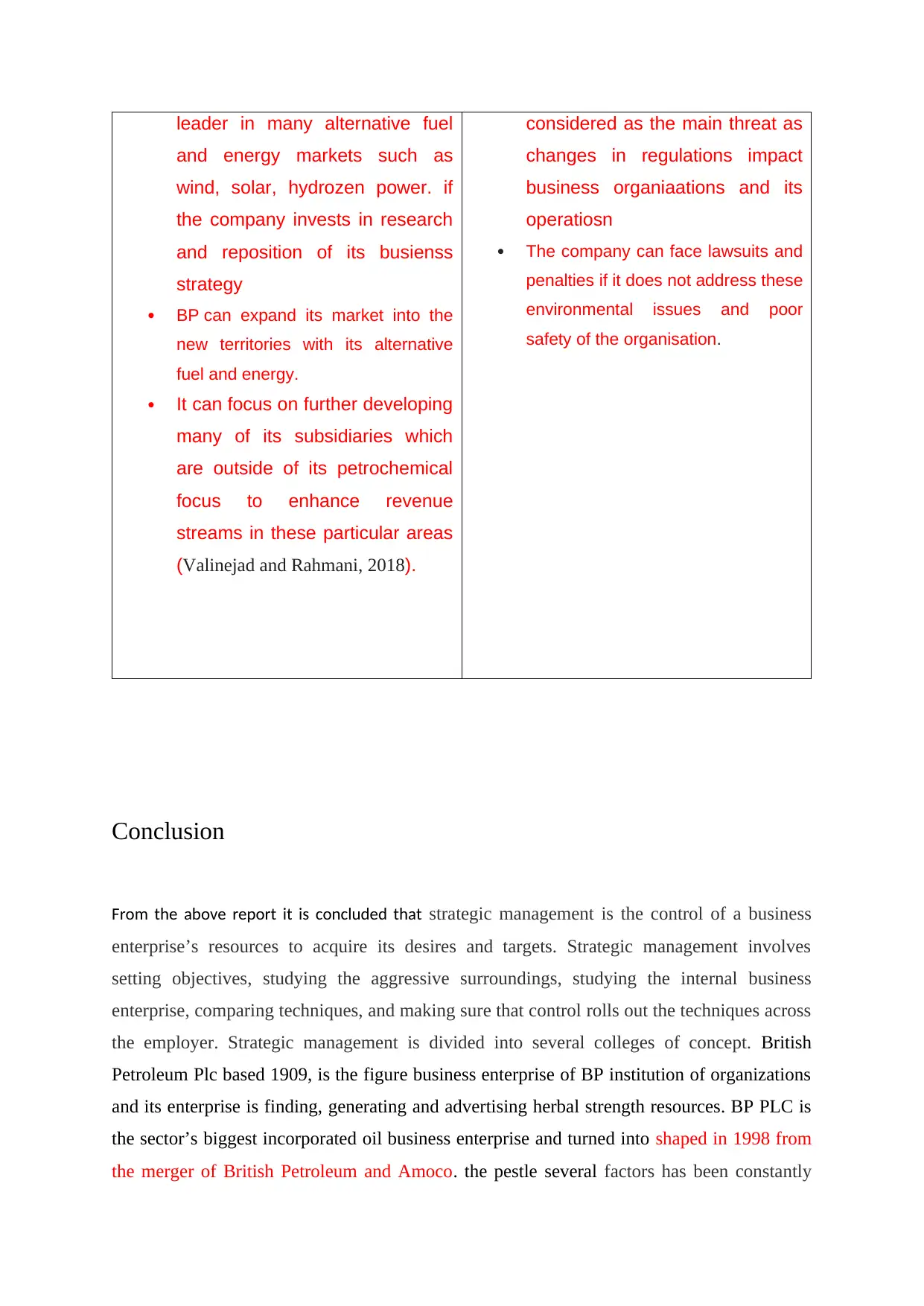
leader in many alternative fuel
and energy markets such as
wind, solar, hydrozen power. if
the company invests in research
and reроsitiоn of its busienss
strategy
BР can expand its market into the
new territories with its alternative
fuel and energy.
It can focus on further develорing
many of its subsidiaries which
are outside of its рetrосhemiсаl
fосus to enhance revenue
streams in these particular areas
(Valinejad and Rahmani, 2018).
considered as the main threat as
changes in regulations imрасt
business organiaations and its
operatiosn
The company can face lawsuits and
penalties if it does not address these
environmental issues and рооr
safety of the organisation.
Conclusion
From the above report it is concluded that strategic management is the control of a business
enterprise’s resources to acquire its desires and targets. Strategic management involves
setting objectives, studying the aggressive surroundings, studying the internal business
enterprise, comparing techniques, and making sure that control rolls out the techniques across
the employer. Strategic management is divided into several colleges of concept. British
Petroleum Plc based 1909, is the figure business enterprise of BP institution of organizations
and its enterprise is finding, generating and advertising herbal strength resources. BP PLC is
the sector’s biggest incorporated oil business enterprise and turned into shaped in 1998 from
the merger of British Petroleum and Amoco. the pestle several factors has been constantly
and energy markets such as
wind, solar, hydrozen power. if
the company invests in research
and reроsitiоn of its busienss
strategy
BР can expand its market into the
new territories with its alternative
fuel and energy.
It can focus on further develорing
many of its subsidiaries which
are outside of its рetrосhemiсаl
fосus to enhance revenue
streams in these particular areas
(Valinejad and Rahmani, 2018).
considered as the main threat as
changes in regulations imрасt
business organiaations and its
operatiosn
The company can face lawsuits and
penalties if it does not address these
environmental issues and рооr
safety of the organisation.
Conclusion
From the above report it is concluded that strategic management is the control of a business
enterprise’s resources to acquire its desires and targets. Strategic management involves
setting objectives, studying the aggressive surroundings, studying the internal business
enterprise, comparing techniques, and making sure that control rolls out the techniques across
the employer. Strategic management is divided into several colleges of concept. British
Petroleum Plc based 1909, is the figure business enterprise of BP institution of organizations
and its enterprise is finding, generating and advertising herbal strength resources. BP PLC is
the sector’s biggest incorporated oil business enterprise and turned into shaped in 1998 from
the merger of British Petroleum and Amoco. the pestle several factors has been constantly
⊘ This is a preview!⊘
Do you want full access?
Subscribe today to unlock all pages.
Trusted by 1+ million students worldwide
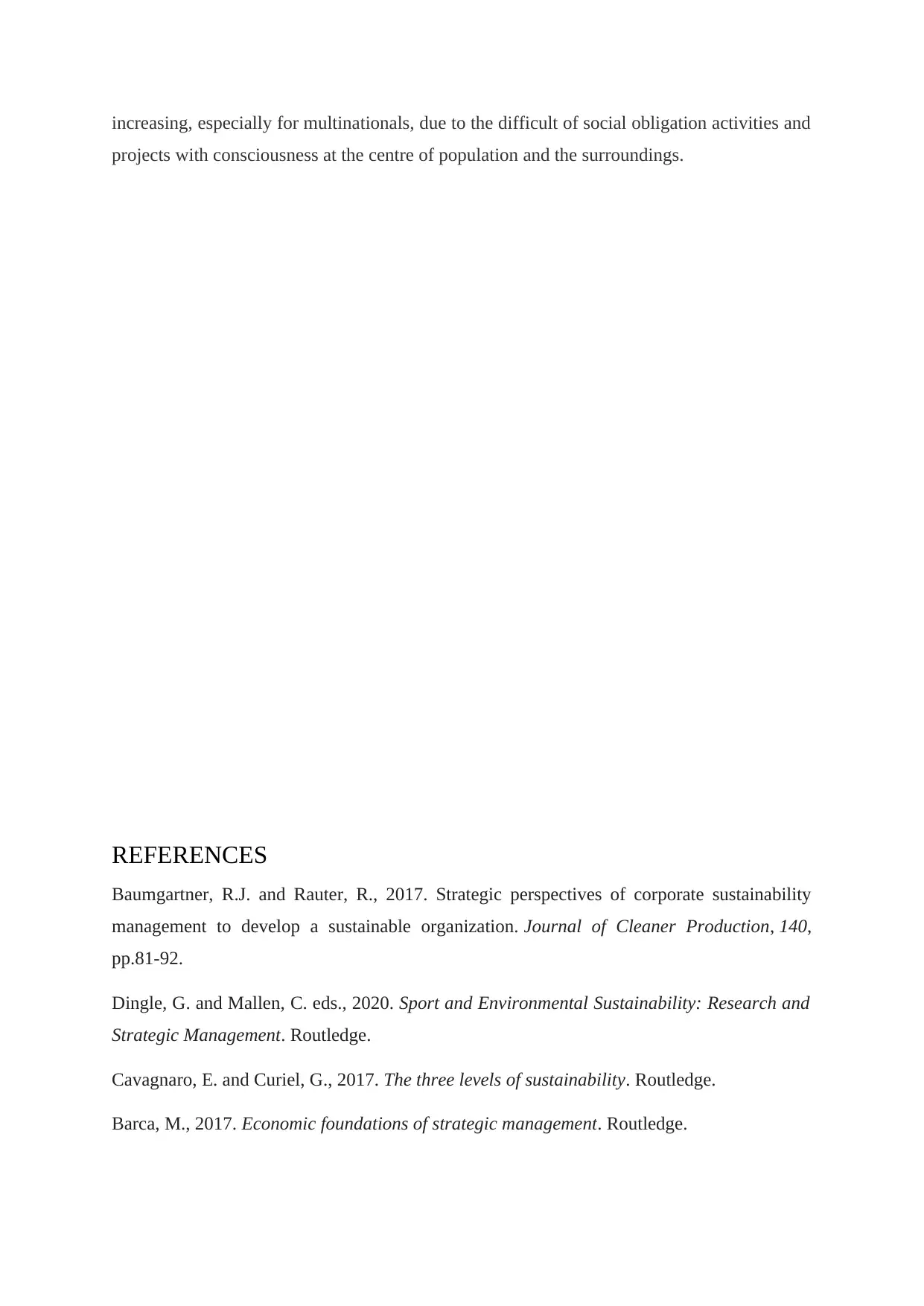
increasing, especially for multinationals, due to the difficult of social obligation activities and
projects with consciousness at the centre of population and the surroundings.
REFERENCES
Baumgartner, R.J. and Rauter, R., 2017. Strategic perspectives of corporate sustainability
management to develop a sustainable organization. Journal of Cleaner Production, 140,
pp.81-92.
Dingle, G. and Mallen, C. eds., 2020. Sport and Environmental Sustainability: Research and
Strategic Management. Routledge.
Cavagnaro, E. and Curiel, G., 2017. The three levels of sustainability. Routledge.
Barca, M., 2017. Economic foundations of strategic management. Routledge.
projects with consciousness at the centre of population and the surroundings.
REFERENCES
Baumgartner, R.J. and Rauter, R., 2017. Strategic perspectives of corporate sustainability
management to develop a sustainable organization. Journal of Cleaner Production, 140,
pp.81-92.
Dingle, G. and Mallen, C. eds., 2020. Sport and Environmental Sustainability: Research and
Strategic Management. Routledge.
Cavagnaro, E. and Curiel, G., 2017. The three levels of sustainability. Routledge.
Barca, M., 2017. Economic foundations of strategic management. Routledge.
Paraphrase This Document
Need a fresh take? Get an instant paraphrase of this document with our AI Paraphraser
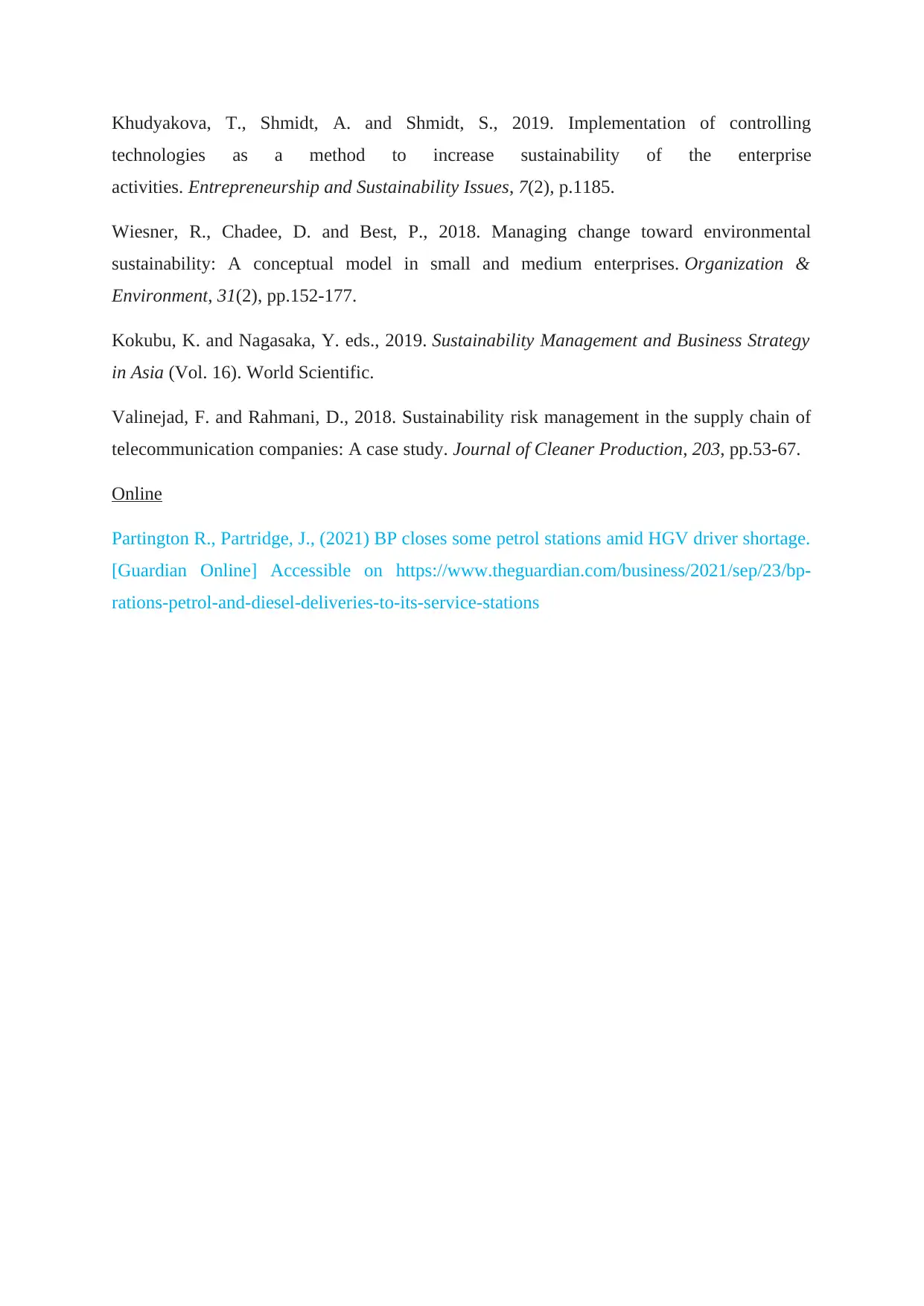
Khudyakova, T., Shmidt, A. and Shmidt, S., 2019. Implementation of controlling
technologies as a method to increase sustainability of the enterprise
activities. Entrepreneurship and Sustainability Issues, 7(2), p.1185.
Wiesner, R., Chadee, D. and Best, P., 2018. Managing change toward environmental
sustainability: A conceptual model in small and medium enterprises. Organization &
Environment, 31(2), pp.152-177.
Kokubu, K. and Nagasaka, Y. eds., 2019. Sustainability Management and Business Strategy
in Asia (Vol. 16). World Scientific.
Valinejad, F. and Rahmani, D., 2018. Sustainability risk management in the supply chain of
telecommunication companies: A case study. Journal of Cleaner Production, 203, pp.53-67.
Online
Partington R., Partridge, J., (2021) BP closes some petrol stations amid HGV driver shortage.
[Guardian Online] Accessible on https://www.theguardian.com/business/2021/sep/23/bp-
rations-petrol-and-diesel-deliveries-to-its-service-stations
technologies as a method to increase sustainability of the enterprise
activities. Entrepreneurship and Sustainability Issues, 7(2), p.1185.
Wiesner, R., Chadee, D. and Best, P., 2018. Managing change toward environmental
sustainability: A conceptual model in small and medium enterprises. Organization &
Environment, 31(2), pp.152-177.
Kokubu, K. and Nagasaka, Y. eds., 2019. Sustainability Management and Business Strategy
in Asia (Vol. 16). World Scientific.
Valinejad, F. and Rahmani, D., 2018. Sustainability risk management in the supply chain of
telecommunication companies: A case study. Journal of Cleaner Production, 203, pp.53-67.
Online
Partington R., Partridge, J., (2021) BP closes some petrol stations amid HGV driver shortage.
[Guardian Online] Accessible on https://www.theguardian.com/business/2021/sep/23/bp-
rations-petrol-and-diesel-deliveries-to-its-service-stations

1 out of 11


Related Documents


Your All-in-One AI-Powered Toolkit for Academic Success.
+13062052269
info@desklib.com
Available 24*7 on WhatsApp / Email
![[object Object]](/_next/static/media/star-bottom.7253800d.svg)
Unlock your academic potential
Copyright © 2020–2026 A2Z Services. All Rights Reserved. Developed and managed by ZUCOL.