In-Depth Case Study: Brady v. National Football League Analysis

Verified

Added on  2023/06/10

|7
|1504
|234
Case Study
AI Summary
This case study delves into the legal battle of Brady v. National Football League, dissecting the complexities of labor law and antitrust implications. The central issue revolves around whether the NFL players' decertification tactic was sufficient to halt the lockout and reinstate the players, further questioning if the lockout violated the Sherman Act. The court ruled that the Norris-LaGuardia Act (NLGA) did not apply since the NFL players were not unionized, thus not constituting a labor dispute under the NLGA's stipulations. The court also declined to use the non-statutory labor exception, as it only applies to contracts regarding compulsory subjects of collective bargaining agreements. The case study also includes a commentary section that supports the court's verdict, stating that the NLGA was not applicable since the defendant was not unionized, making the court’s decision fair and within the confines of the law. Desklib provides access to this case study along with a wide array of solved assignments and past papers for students.
Document Page
Brady v. National Football League 1
Brady v. National Football League
Name
Institution
Date
tabler-icon-diamond-filled.svg

Paraphrase This Document

Need a fresh take? Get an instant paraphrase of this document with our AI Paraphraser
Document Page
Brady v. National Football League 2
Brady v. National Football League
Name
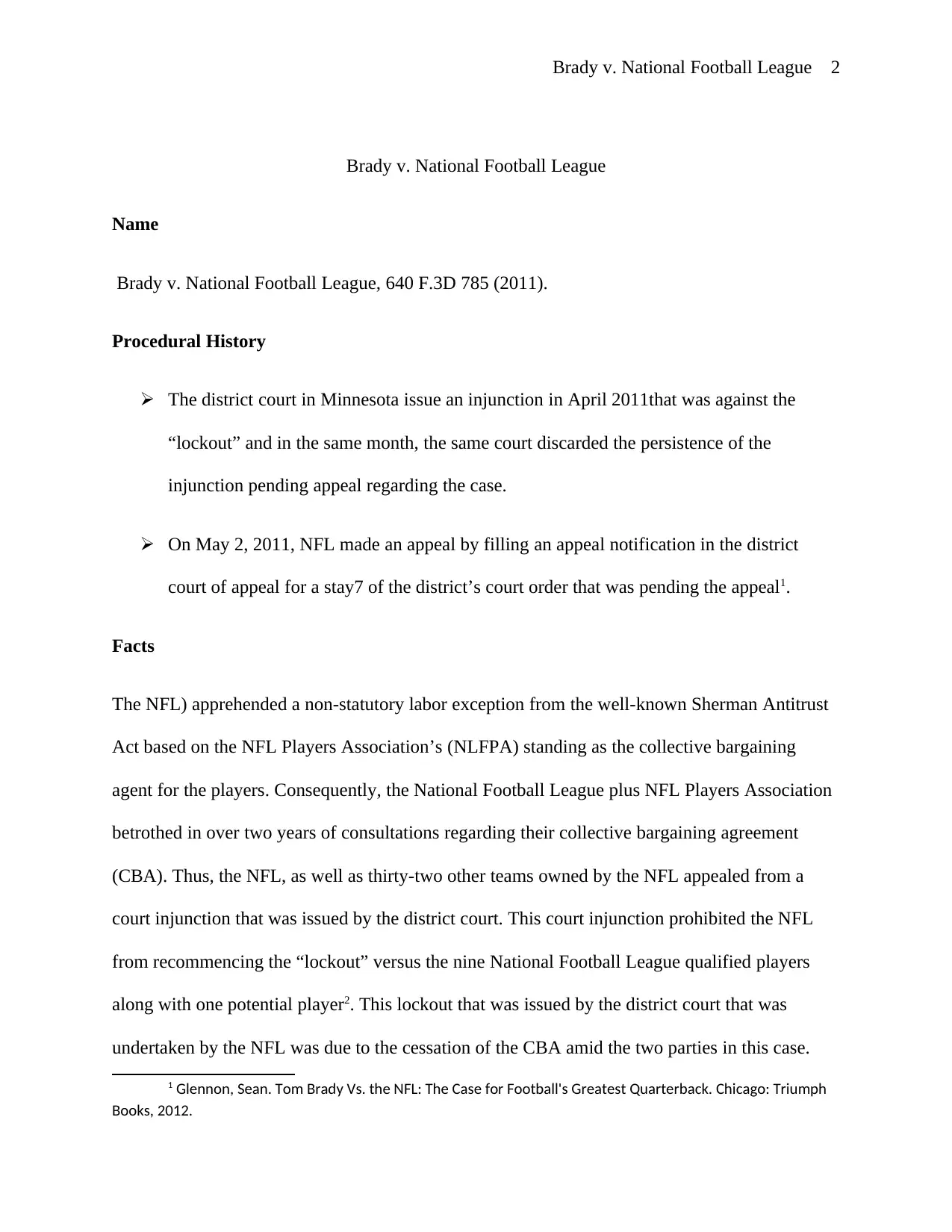
Brady v. National Football League, 640 F.3D 785 (2011).
Procedural History
The district court in Minnesota issue an injunction in April 2011that was against the
“lockout” and in the same month, the same court discarded the persistence of the
injunction pending appeal regarding the case.
On May 2, 2011, NFL made an appeal by filling an appeal notification in the district
court of appeal for a stay7 of the district’s court order that was pending the appeal1.
Facts
The NFL) apprehended a non-statutory labor exception from the well-known Sherman Antitrust
Act based on the NFL Players Association’s (NLFPA) standing as the collective bargaining
agent for the players. Consequently, the National Football League plus NFL Players Association
betrothed in over two years of consultations regarding their collective bargaining agreement
(CBA). Thus, the NFL, as well as thirty-two other teams owned by the NFL appealed from a
court injunction that was issued by the district court. This court injunction prohibited the NFL
from recommencing the “lockout” versus the nine National Football League qualified players
along with one potential player2. This lockout that was issued by the district court that was
undertaken by the NFL was due to the cessation of the CBA amid the two parties in this case.
1 Glennon, Sean. Tom Brady Vs. the NFL: The Case for Football's Greatest Quarterback. Chicago: Triumph
Books, 2012.
Document Page
Brady v. National Football League 3
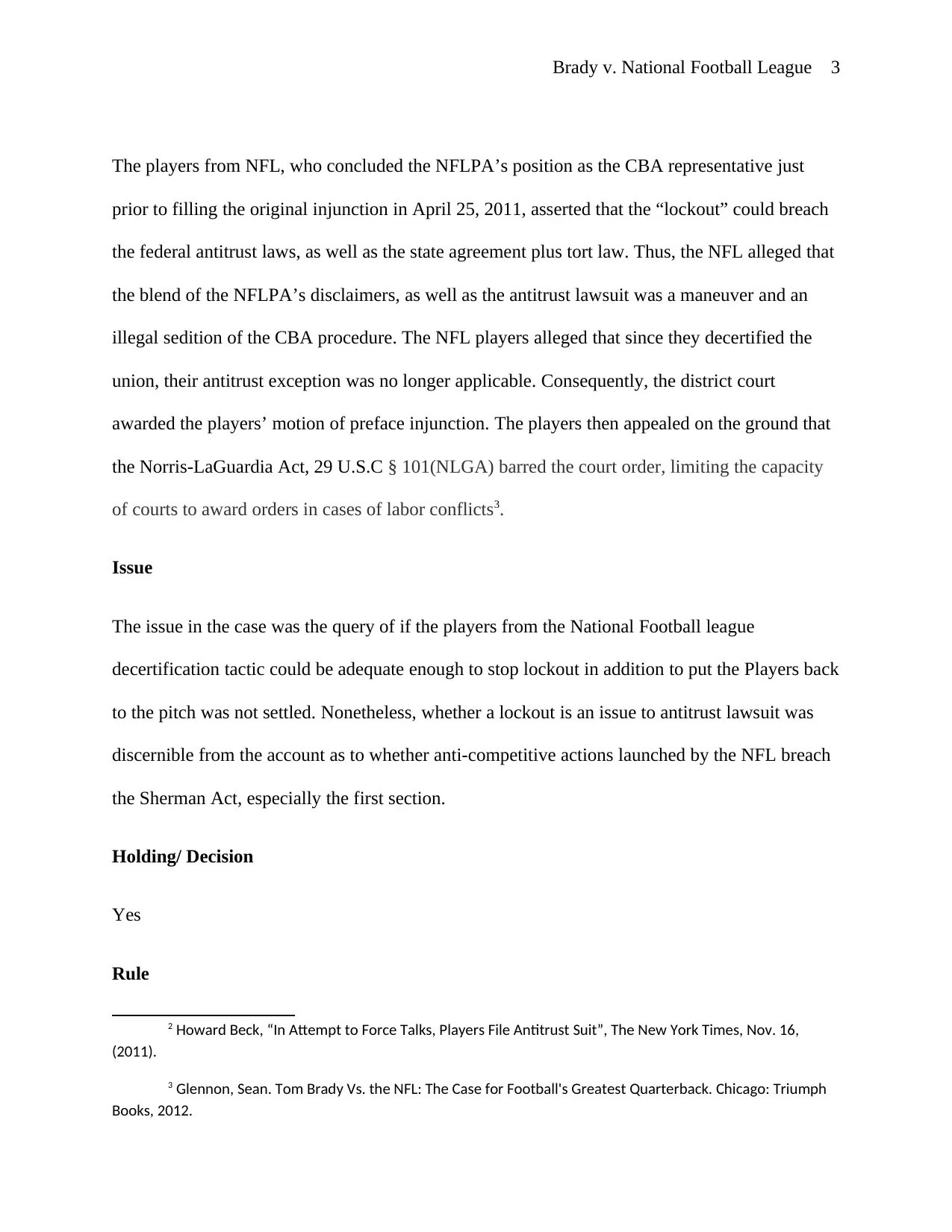
The players from NFL, who concluded the NFLPA’s position as the CBA representative just
prior to filling the original injunction in April 25, 2011, asserted that the “lockout” could breach
the federal antitrust laws, as well as the state agreement plus tort law. Thus, the NFL alleged that
the blend of the NFLPA’s disclaimers, as well as the antitrust lawsuit was a maneuver and an
illegal sedition of the CBA procedure. The NFL players alleged that since they decertified the
union, their antitrust exception was no longer applicable. Consequently, the district court
awarded the players’ motion of preface injunction. The players then appealed on the ground that
the Norris-LaGuardia Act, 29 U.S.C § 101(NLGA) barred the court order, limiting the capacity
of courts to award orders in cases of labor conflicts3.
Issue
The issue in the case was the query of if the players from the National Football league
decertification tactic could be adequate enough to stop lockout in addition to put the Players back
to the pitch was not settled. Nonetheless, whether a lockout is an issue to antitrust lawsuit was
discernible from the account as to whether anti-competitive actions launched by the NFL breach
the Sherman Act, especially the first section.
Holding/ Decision
Yes
Rule
2 Howard Beck, “In Attempt to Force Talks, Players File Antitrust Suit”, The New York Times, Nov. 16,
(2011).
3 Glennon, Sean. Tom Brady Vs. the NFL: The Case for Football's Greatest Quarterback. Chicago: Triumph
Books, 2012.
Document Page
Brady v. National Football League 4
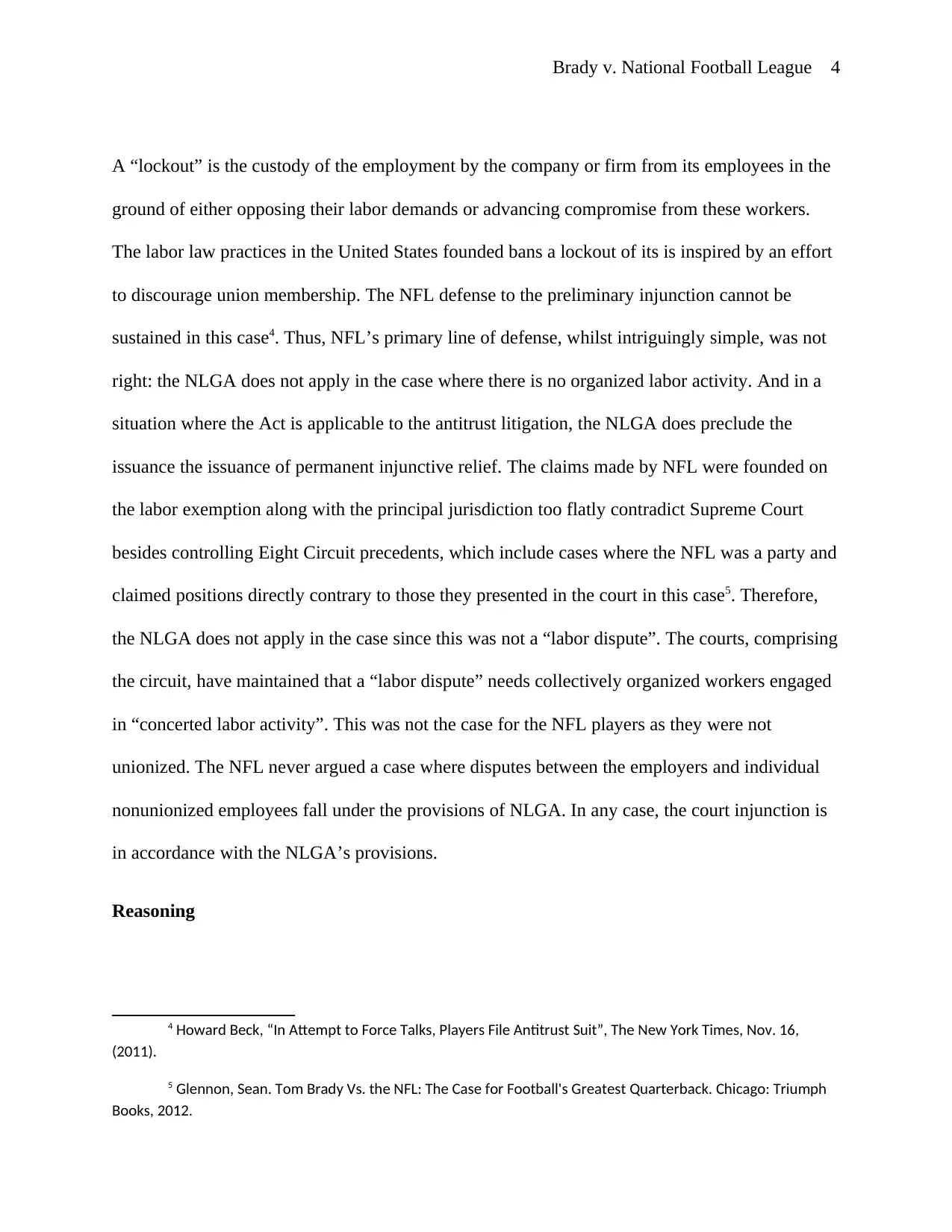
A “lockout” is the custody of the employment by the company or firm from its employees in the
ground of either opposing their labor demands or advancing compromise from these workers.
The labor law practices in the United States founded bans a lockout of its is inspired by an effort
to discourage union membership. The NFL defense to the preliminary injunction cannot be
sustained in this case4. Thus, NFL’s primary line of defense, whilst intriguingly simple, was not
right: the NLGA does not apply in the case where there is no organized labor activity. And in a
situation where the Act is applicable to the antitrust litigation, the NLGA does preclude the
issuance the issuance of permanent injunctive relief. The claims made by NFL were founded on
the labor exemption along with the principal jurisdiction too flatly contradict Supreme Court
besides controlling Eight Circuit precedents, which include cases where the NFL was a party and
claimed positions directly contrary to those they presented in the court in this case5. Therefore,
the NLGA does not apply in the case since this was not a “labor dispute”. The courts, comprising
the circuit, have maintained that a “labor dispute” needs collectively organized workers engaged
in “concerted labor activity”. This was not the case for the NFL players as they were not
unionized. The NFL never argued a case where disputes between the employers and individual
nonunionized employees fall under the provisions of NLGA. In any case, the court injunction is
in accordance with the NLGA’s provisions.
Reasoning
4 Howard Beck, “In Attempt to Force Talks, Players File Antitrust Suit”, The New York Times, Nov. 16,
(2011).
5 Glennon, Sean. Tom Brady Vs. the NFL: The Case for Football's Greatest Quarterback. Chicago: Triumph
Books, 2012.
tabler-icon-diamond-filled.svg

Paraphrase This Document

Need a fresh take? Get an instant paraphrase of this document with our AI Paraphraser
Document Page
Brady v. National Football League 5
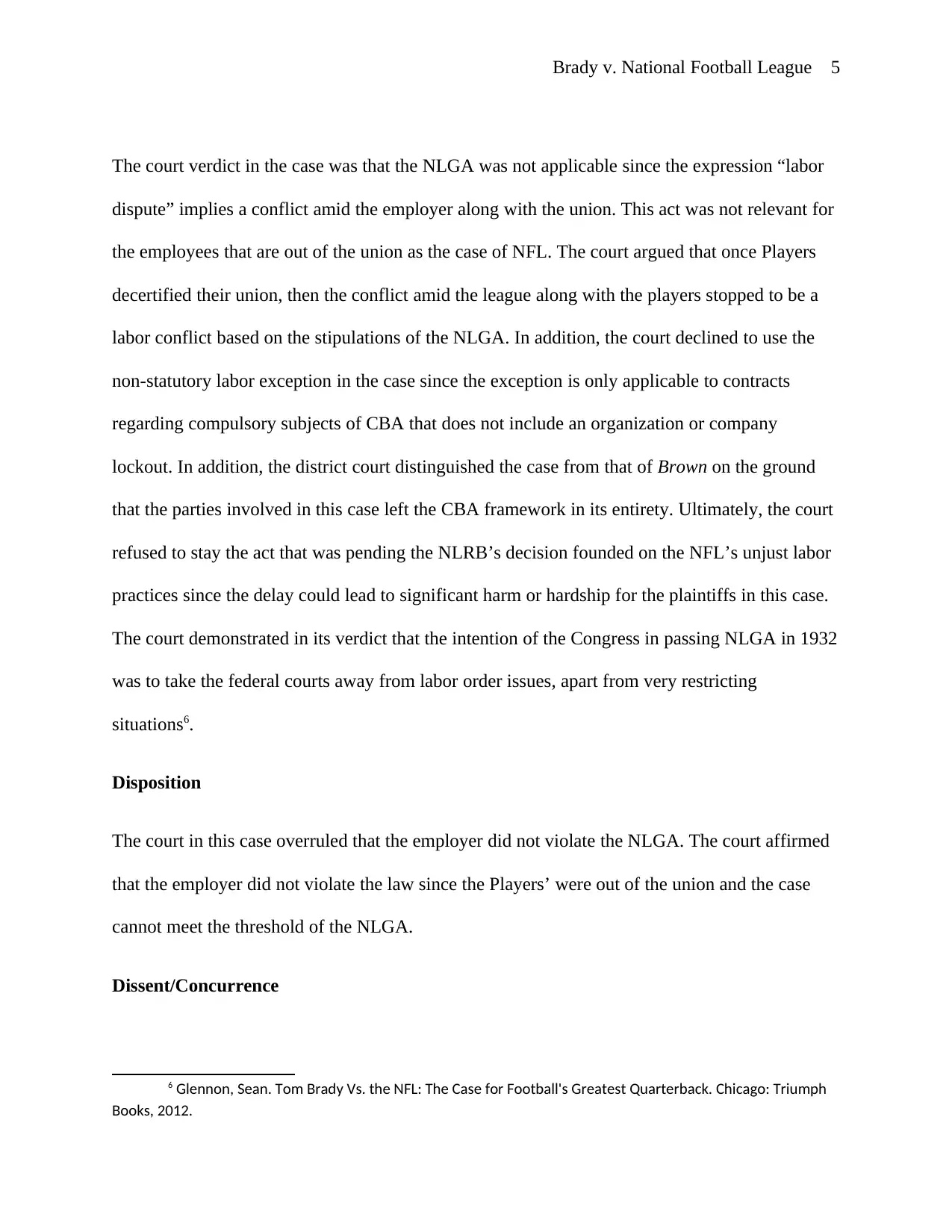
The court verdict in the case was that the NLGA was not applicable since the expression “labor
dispute” implies a conflict amid the employer along with the union. This act was not relevant for
the employees that are out of the union as the case of NFL. The court argued that once Players
decertified their union, then the conflict amid the league along with the players stopped to be a
labor conflict based on the stipulations of the NLGA. In addition, the court declined to use the
non-statutory labor exception in the case since the exception is only applicable to contracts
regarding compulsory subjects of CBA that does not include an organization or company
lockout. In addition, the district court distinguished the case from that of Brown on the ground
that the parties involved in this case left the CBA framework in its entirety. Ultimately, the court
refused to stay the act that was pending the NLRB’s decision founded on the NFL’s unjust labor
practices since the delay could lead to significant harm or hardship for the plaintiffs in this case.
The court demonstrated in its verdict that the intention of the Congress in passing NLGA in 1932
was to take the federal courts away from labor order issues, apart from very restricting
situations6.
Disposition
The court in this case overruled that the employer did not violate the NLGA. The court affirmed
that the employer did not violate the law since the Players’ were out of the union and the case
cannot meet the threshold of the NLGA.
Dissent/Concurrence
6 Glennon, Sean. Tom Brady Vs. the NFL: The Case for Football's Greatest Quarterback. Chicago: Triumph
Books, 2012.
Document Page
Brady v. National Football League 6
In the case, it was evident that there was concurrence because the law was very clear on the issue
regarding labor dispute under the question7.
Comment
In my view, the verdict of the case was reasonable and within the confines of the law. The Norris
LaGuardia Act (NLGA) was not applicable in the case since the defendant was not unionized
and the claims could not have met the threshold of this law. Therefore, the employer did not
violate any law as far as the case is concerned and the verdict by the court was fair and within the
law8.
7 Glennon, Sean. Tom Brady Vs. the NFL: The Case for Football's Greatest Quarterback. Chicago: Triumph
Books, 2012.
8 Oriard, Michael. Brand NFL: Making and Selling America's Favorite Sport. Chapel Hill: University of North
Carolina Press, 2007.
Document Page
Brady v. National Football League 7
References
Glennon, Sean. Tom Brady Vs. the NFL: The Case for Football's Greatest Quarterback.
Chicago: Triumph Books, 2012.
Howard Beck, “In Attempt to Force Talks, Players File Antitrust Suit”, The New York Times,
Nov. 16, (2011).
Oriard, Michael. Brand NFL: Making and Selling America's Favorite Sport. Chapel Hill:
University of North Carolina Press, 2007.
chevron_up_icon
1 out of 7
circle_padding
hide_on_mobile
zoom_out_icon
[object Object]