Exploring Women and Sexuality in Bram Stoker's Dracula: A Deep Dive
VerifiedAdded on 2022/08/20
|8
|2106
|16
Essay
AI Summary
This essay provides an in-depth analysis of the portrayal of women and sexuality in Bram Stoker's Dracula, exploring the social and sexual dynamics within the Victorian era. The essay examines the contrasting characters of Mina and Lucy, representing the demure and rebellious female archetypes, respectively, and how they reflect the societal expectations and constraints placed upon women. The author highlights the patriarchal dominance and the suppression of female desires, as well as the societal taboos surrounding female sexuality. The essay delves into the sexual undertones and the exploration of female desires, providing a comprehensive understanding of the novel's exploration of gender roles and societal norms. The essay references various scholarly sources to support its arguments, making a compelling case for how Dracula effectively explores female sexuality within the context of the Victorian era.
Running head: WOMEN AND SEXUALITY IN BRAM STROKER'S DRACULA
WOMEN AND SEXUALITY IN BRAM STROKER'S DRACULA
Name of the Student
Name of the University
Author Note
WOMEN AND SEXUALITY IN BRAM STROKER'S DRACULA
Name of the Student
Name of the University
Author Note

Paraphrase This Document
Need a fresh take? Get an instant paraphrase of this document with our AI Paraphraser
1WOMEN AND SEXUALITY IN BRAM STROKER'S DRACULA
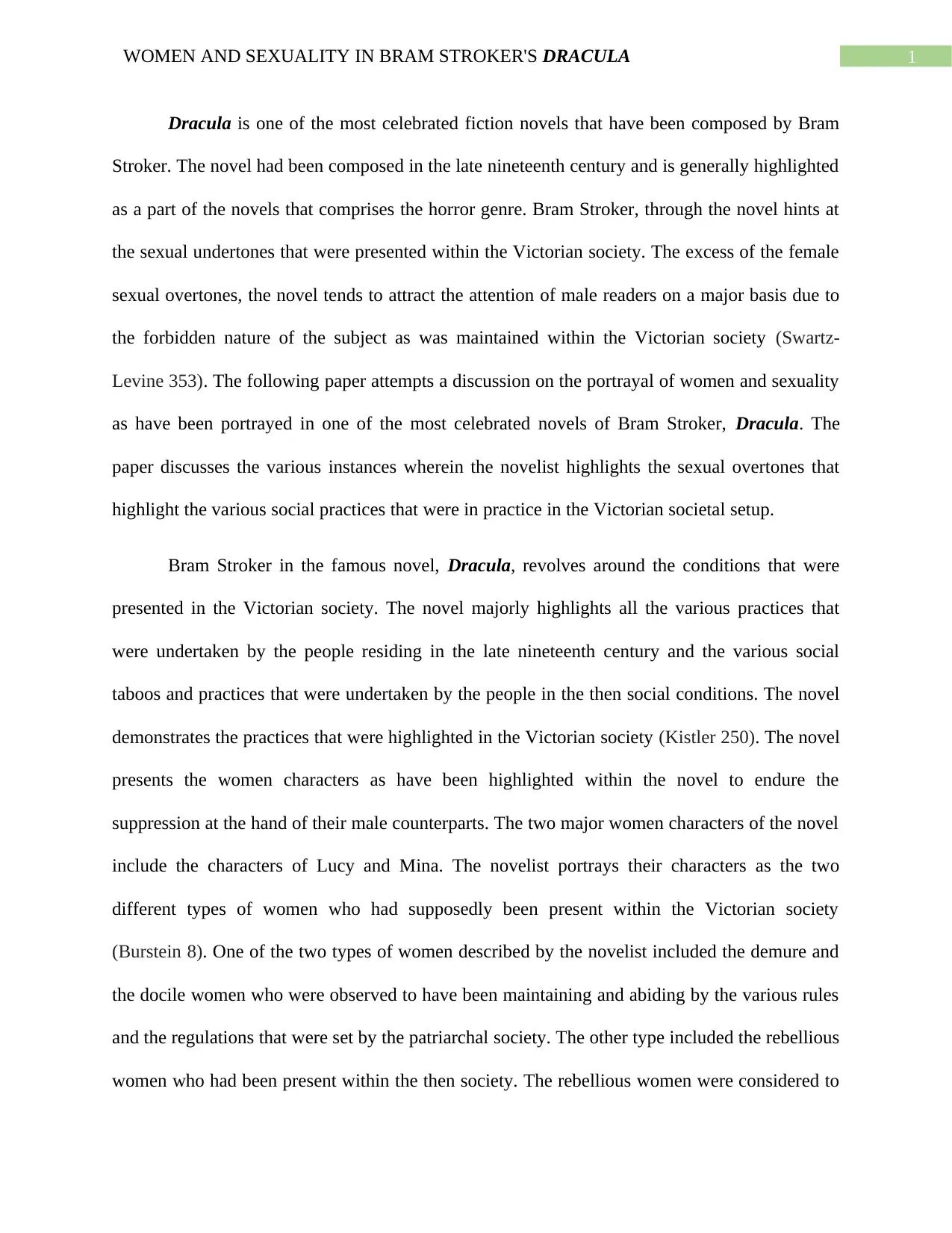
Dracula is one of the most celebrated fiction novels that have been composed by Bram
Stroker. The novel had been composed in the late nineteenth century and is generally highlighted
as a part of the novels that comprises the horror genre. Bram Stroker, through the novel hints at
the sexual undertones that were presented within the Victorian society. The excess of the female
sexual overtones, the novel tends to attract the attention of male readers on a major basis due to
the forbidden nature of the subject as was maintained within the Victorian society (Swartz-
Levine 353). The following paper attempts a discussion on the portrayal of women and sexuality
as have been portrayed in one of the most celebrated novels of Bram Stroker, Dracula. The
paper discusses the various instances wherein the novelist highlights the sexual overtones that
highlight the various social practices that were in practice in the Victorian societal setup.
Bram Stroker in the famous novel, Dracula, revolves around the conditions that were
presented in the Victorian society. The novel majorly highlights all the various practices that
were undertaken by the people residing in the late nineteenth century and the various social
taboos and practices that were undertaken by the people in the then social conditions. The novel
demonstrates the practices that were highlighted in the Victorian society (Kistler 250). The novel
presents the women characters as have been highlighted within the novel to endure the
suppression at the hand of their male counterparts. The two major women characters of the novel
include the characters of Lucy and Mina. The novelist portrays their characters as the two
different types of women who had supposedly been present within the Victorian society
(Burstein 8). One of the two types of women described by the novelist included the demure and
the docile women who were observed to have been maintaining and abiding by the various rules
and the regulations that were set by the patriarchal society. The other type included the rebellious
women who had been present within the then society. The rebellious women were considered to
Dracula is one of the most celebrated fiction novels that have been composed by Bram
Stroker. The novel had been composed in the late nineteenth century and is generally highlighted
as a part of the novels that comprises the horror genre. Bram Stroker, through the novel hints at
the sexual undertones that were presented within the Victorian society. The excess of the female
sexual overtones, the novel tends to attract the attention of male readers on a major basis due to
the forbidden nature of the subject as was maintained within the Victorian society (Swartz-
Levine 353). The following paper attempts a discussion on the portrayal of women and sexuality
as have been portrayed in one of the most celebrated novels of Bram Stroker, Dracula. The
paper discusses the various instances wherein the novelist highlights the sexual overtones that
highlight the various social practices that were in practice in the Victorian societal setup.
Bram Stroker in the famous novel, Dracula, revolves around the conditions that were
presented in the Victorian society. The novel majorly highlights all the various practices that
were undertaken by the people residing in the late nineteenth century and the various social
taboos and practices that were undertaken by the people in the then social conditions. The novel
demonstrates the practices that were highlighted in the Victorian society (Kistler 250). The novel
presents the women characters as have been highlighted within the novel to endure the
suppression at the hand of their male counterparts. The two major women characters of the novel
include the characters of Lucy and Mina. The novelist portrays their characters as the two
different types of women who had supposedly been present within the Victorian society
(Burstein 8). One of the two types of women described by the novelist included the demure and
the docile women who were observed to have been maintaining and abiding by the various rules
and the regulations that were set by the patriarchal society. The other type included the rebellious
women who had been present within the then society. The rebellious women were considered to
2WOMEN AND SEXUALITY IN BRAM STROKER'S DRACULA
be threats to the maintenance of the proper patriarchy within the society. The novelist is observed
to have demonstrated the fact that the women of the Victorian though had their own opinions
regarding the empowerment of the female members of the society, they however agreed on the
common fact that the Victorian society had been highly patriarchal in nature (Lasa 6). The
dominance that was maintained by the male members of the Victorian society can be highlighted
through the statement “My dear Mina, why are men so noble when we women are so little
worthy of them?” (Stoker 86).
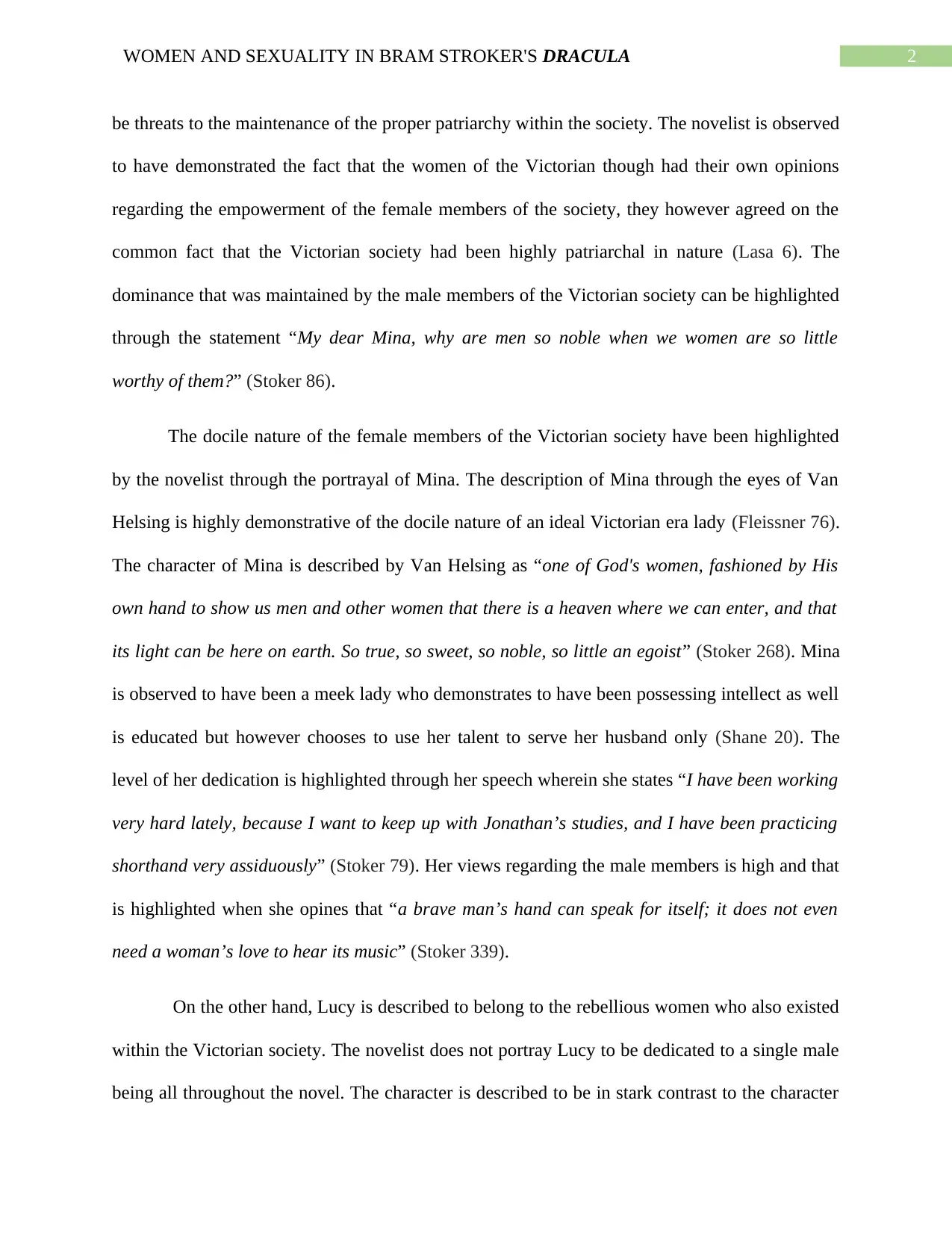
The docile nature of the female members of the Victorian society have been highlighted
by the novelist through the portrayal of Mina. The description of Mina through the eyes of Van
Helsing is highly demonstrative of the docile nature of an ideal Victorian era lady (Fleissner 76).
The character of Mina is described by Van Helsing as “one of God's women, fashioned by His
own hand to show us men and other women that there is a heaven where we can enter, and that
its light can be here on earth. So true, so sweet, so noble, so little an egoist” (Stoker 268). Mina
is observed to have been a meek lady who demonstrates to have been possessing intellect as well
is educated but however chooses to use her talent to serve her husband only (Shane 20). The
level of her dedication is highlighted through her speech wherein she states “I have been working
very hard lately, because I want to keep up with Jonathan’s studies, and I have been practicing
shorthand very assiduously” (Stoker 79). Her views regarding the male members is high and that
is highlighted when she opines that “a brave man’s hand can speak for itself; it does not even
need a woman’s love to hear its music” (Stoker 339).
On the other hand, Lucy is described to belong to the rebellious women who also existed
within the Victorian society. The novelist does not portray Lucy to be dedicated to a single male
being all throughout the novel. The character is described to be in stark contrast to the character
be threats to the maintenance of the proper patriarchy within the society. The novelist is observed
to have demonstrated the fact that the women of the Victorian though had their own opinions
regarding the empowerment of the female members of the society, they however agreed on the
common fact that the Victorian society had been highly patriarchal in nature (Lasa 6). The
dominance that was maintained by the male members of the Victorian society can be highlighted
through the statement “My dear Mina, why are men so noble when we women are so little
worthy of them?” (Stoker 86).
The docile nature of the female members of the Victorian society have been highlighted
by the novelist through the portrayal of Mina. The description of Mina through the eyes of Van
Helsing is highly demonstrative of the docile nature of an ideal Victorian era lady (Fleissner 76).
The character of Mina is described by Van Helsing as “one of God's women, fashioned by His
own hand to show us men and other women that there is a heaven where we can enter, and that
its light can be here on earth. So true, so sweet, so noble, so little an egoist” (Stoker 268). Mina
is observed to have been a meek lady who demonstrates to have been possessing intellect as well
is educated but however chooses to use her talent to serve her husband only (Shane 20). The
level of her dedication is highlighted through her speech wherein she states “I have been working
very hard lately, because I want to keep up with Jonathan’s studies, and I have been practicing
shorthand very assiduously” (Stoker 79). Her views regarding the male members is high and that
is highlighted when she opines that “a brave man’s hand can speak for itself; it does not even
need a woman’s love to hear its music” (Stoker 339).
On the other hand, Lucy is described to belong to the rebellious women who also existed
within the Victorian society. The novelist does not portray Lucy to be dedicated to a single male
being all throughout the novel. The character is described to be in stark contrast to the character
⊘ This is a preview!⊘
Do you want full access?
Subscribe today to unlock all pages.

Trusted by 1+ million students worldwide
3WOMEN AND SEXUALITY IN BRAM STROKER'S DRACULA
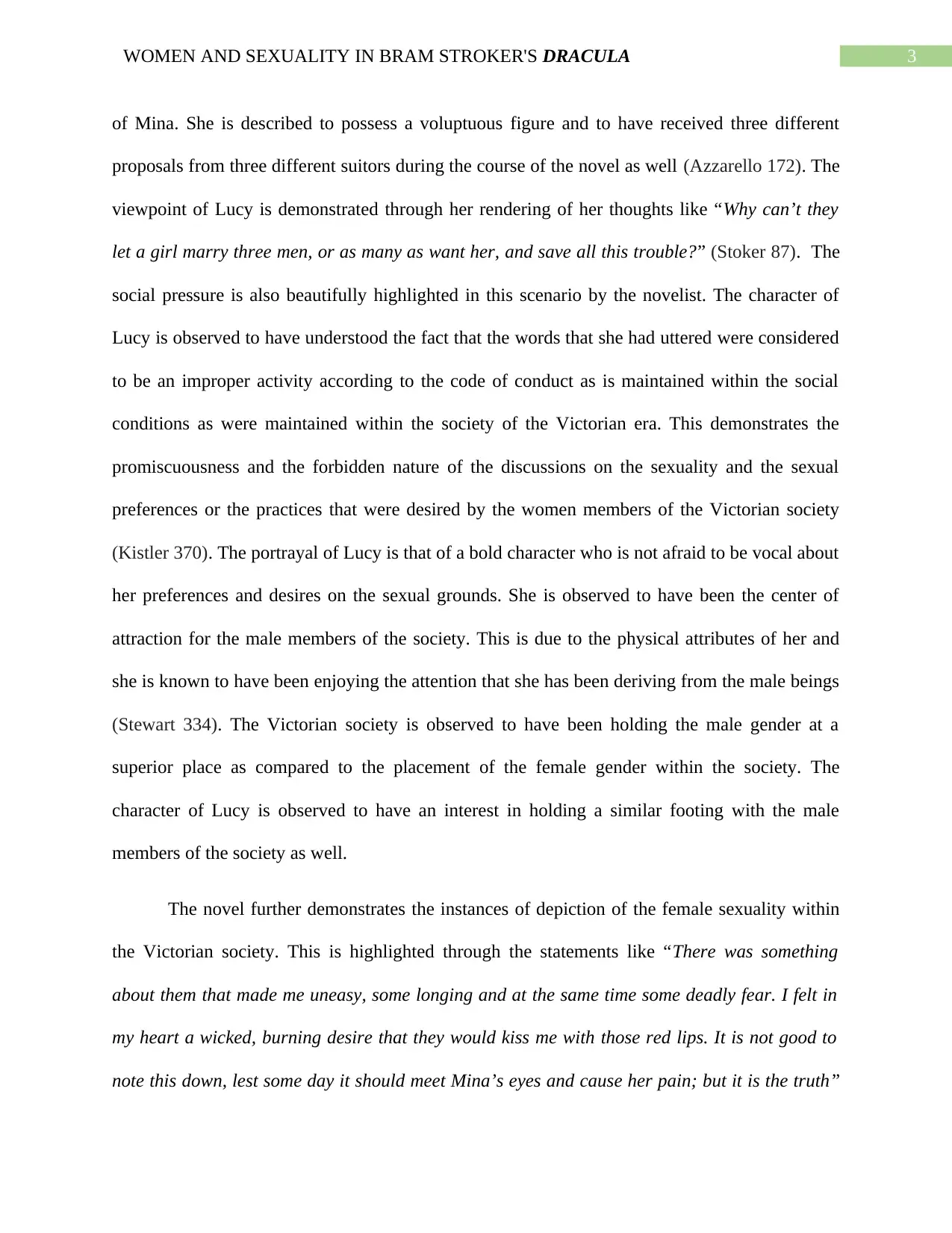
of Mina. She is described to possess a voluptuous figure and to have received three different
proposals from three different suitors during the course of the novel as well (Azzarello 172). The
viewpoint of Lucy is demonstrated through her rendering of her thoughts like “Why can’t they
let a girl marry three men, or as many as want her, and save all this trouble?” (Stoker 87). The
social pressure is also beautifully highlighted in this scenario by the novelist. The character of
Lucy is observed to have understood the fact that the words that she had uttered were considered
to be an improper activity according to the code of conduct as is maintained within the social
conditions as were maintained within the society of the Victorian era. This demonstrates the
promiscuousness and the forbidden nature of the discussions on the sexuality and the sexual
preferences or the practices that were desired by the women members of the Victorian society
(Kistler 370). The portrayal of Lucy is that of a bold character who is not afraid to be vocal about
her preferences and desires on the sexual grounds. She is observed to have been the center of
attraction for the male members of the society. This is due to the physical attributes of her and
she is known to have been enjoying the attention that she has been deriving from the male beings
(Stewart 334). The Victorian society is observed to have been holding the male gender at a
superior place as compared to the placement of the female gender within the society. The
character of Lucy is observed to have an interest in holding a similar footing with the male
members of the society as well.
The novel further demonstrates the instances of depiction of the female sexuality within
the Victorian society. This is highlighted through the statements like “There was something
about them that made me uneasy, some longing and at the same time some deadly fear. I felt in
my heart a wicked, burning desire that they would kiss me with those red lips. It is not good to
note this down, lest some day it should meet Mina’s eyes and cause her pain; but it is the truth ”
of Mina. She is described to possess a voluptuous figure and to have received three different
proposals from three different suitors during the course of the novel as well (Azzarello 172). The
viewpoint of Lucy is demonstrated through her rendering of her thoughts like “Why can’t they
let a girl marry three men, or as many as want her, and save all this trouble?” (Stoker 87). The
social pressure is also beautifully highlighted in this scenario by the novelist. The character of
Lucy is observed to have understood the fact that the words that she had uttered were considered
to be an improper activity according to the code of conduct as is maintained within the social
conditions as were maintained within the society of the Victorian era. This demonstrates the
promiscuousness and the forbidden nature of the discussions on the sexuality and the sexual
preferences or the practices that were desired by the women members of the Victorian society
(Kistler 370). The portrayal of Lucy is that of a bold character who is not afraid to be vocal about
her preferences and desires on the sexual grounds. She is observed to have been the center of
attraction for the male members of the society. This is due to the physical attributes of her and
she is known to have been enjoying the attention that she has been deriving from the male beings
(Stewart 334). The Victorian society is observed to have been holding the male gender at a
superior place as compared to the placement of the female gender within the society. The
character of Lucy is observed to have an interest in holding a similar footing with the male
members of the society as well.
The novel further demonstrates the instances of depiction of the female sexuality within
the Victorian society. This is highlighted through the statements like “There was something
about them that made me uneasy, some longing and at the same time some deadly fear. I felt in
my heart a wicked, burning desire that they would kiss me with those red lips. It is not good to
note this down, lest some day it should meet Mina’s eyes and cause her pain; but it is the truth ”
Paraphrase This Document
Need a fresh take? Get an instant paraphrase of this document with our AI Paraphraser
4WOMEN AND SEXUALITY IN BRAM STROKER'S DRACULA
(Stoker 55). This statemen t highlights the fact that the female sexual desires as were portrayed
within the then society. The novelist further demonstrates the taboo regarding the sexuality
especially of the women in similar instances like the description of a female vampire in the novel
which has been penned down as “The fair girl went on her knees, and bent over me, fairly
gloating. There was a deliberate voluptuousness which was both thrilling and repulsive, and as
she arched her neck she actually licked her lips like an animal, till I could see in the moonlight
the moisture shining on the scarlet lips and on the red tongue as it lapped the white sharp teeth”
(Stoker 55-6). The novelist further induces the sexual overtones within the novel while
describing the attack on Mrs. Harker (Straight 390). The author describes the situation in a vivid
manner and states “With his left hand he held both Mrs Harker’s hands, keeping them away with
her arms at full tension; his right hand gripped her by the back of the neck, forcing her face
down on his bosom. Her white nightdress was smeared with blood, and a thin stream trickled
down the man’s bare breast which was shown by his torn-open dress” (Stoker 404). These words
however, according to some experts highlight a rape innuendo within the novel. The choice of
words in this regard highlights the fact that the act has been a forceful act on the part of the male
vampire who has been forcing himself on the lady (Hobson 17). Another similar instance is
observed wherein the author states the view as justified through the eyes of the attacker. This has
been highlighted through the narration which states that “Then the beautiful eyes of the fair
woman open and look love, and the voluptuous mouth present to a kiss – and man is weak”
(Stoker 529). The lines and the choice of words on the part of the novelist highlights the fact that
the novel had been exploring the female sexuality and the desires throughout its trajectory.
In lieu of the above discussion, it might be stated that the novel highlights the female
sexuality as was present within the boundaries of the Victorian era. The novel presents the
(Stoker 55). This statemen t highlights the fact that the female sexual desires as were portrayed
within the then society. The novelist further demonstrates the taboo regarding the sexuality
especially of the women in similar instances like the description of a female vampire in the novel
which has been penned down as “The fair girl went on her knees, and bent over me, fairly
gloating. There was a deliberate voluptuousness which was both thrilling and repulsive, and as
she arched her neck she actually licked her lips like an animal, till I could see in the moonlight
the moisture shining on the scarlet lips and on the red tongue as it lapped the white sharp teeth”
(Stoker 55-6). The novelist further induces the sexual overtones within the novel while
describing the attack on Mrs. Harker (Straight 390). The author describes the situation in a vivid
manner and states “With his left hand he held both Mrs Harker’s hands, keeping them away with
her arms at full tension; his right hand gripped her by the back of the neck, forcing her face
down on his bosom. Her white nightdress was smeared with blood, and a thin stream trickled
down the man’s bare breast which was shown by his torn-open dress” (Stoker 404). These words
however, according to some experts highlight a rape innuendo within the novel. The choice of
words in this regard highlights the fact that the act has been a forceful act on the part of the male
vampire who has been forcing himself on the lady (Hobson 17). Another similar instance is
observed wherein the author states the view as justified through the eyes of the attacker. This has
been highlighted through the narration which states that “Then the beautiful eyes of the fair
woman open and look love, and the voluptuous mouth present to a kiss – and man is weak”
(Stoker 529). The lines and the choice of words on the part of the novelist highlights the fact that
the novel had been exploring the female sexuality and the desires throughout its trajectory.
In lieu of the above discussion, it might be stated that the novel highlights the female
sexuality as was present within the boundaries of the Victorian era. The novel presents the
5WOMEN AND SEXUALITY IN BRAM STROKER'S DRACULA
women characters as have been highlighted within the novel to endure the suppression at the
hand of their male counterparts. The novelist is observed to have demonstrated the fact that the
women of the Victorian though had their own opinions regarding the empowerment of the
female members of the society, they however agreed on the common fact that the Victorian
society had been highly patriarchal in nature. Thus, in conclusion it can be stated that the
Dracula, one of the most celebrated novels of Bram Stroker is effective in exploring the female
sexuality of the Victorian era.
women characters as have been highlighted within the novel to endure the suppression at the
hand of their male counterparts. The novelist is observed to have demonstrated the fact that the
women of the Victorian though had their own opinions regarding the empowerment of the
female members of the society, they however agreed on the common fact that the Victorian
society had been highly patriarchal in nature. Thus, in conclusion it can be stated that the
Dracula, one of the most celebrated novels of Bram Stroker is effective in exploring the female
sexuality of the Victorian era.
⊘ This is a preview!⊘
Do you want full access?
Subscribe today to unlock all pages.
Trusted by 1+ million students worldwide
6WOMEN AND SEXUALITY IN BRAM STROKER'S DRACULA
References
Azzarello, Robert. "Unnatural predators: Queer theory meets environmental studies in Bram
Stoker’s Dracula." Queering the Non/human. Routledge, 2016. 165-186.
Burstein, Miriam Elizabeth. "Thoroughly Modern Mina: Romance, History, and the Dracula
Pastiche." Journal of Popular Romance Studies (2019): 8.
Fleissner, Jennifer L. "Dictation Anxiety: The Stenographer’s Stake in Dracula." Literary
Secretaries/Secretarial Culture. Routledge, 2017. 63-90.
Hobson, Amanda. "Dark Seductress: The Hypersexualization of the Female Vampire." Gender
in the Vampire Narrative. Brill Sense, 2016. 9-27.
Kistler, Jordan. "Mesmeric Rapport: the power of female sympathy in Bram Stoker’s
Dracula." Journal of Victorian Culture 23.3 (2018): 366-380.
Kistler, Jordan. "Rethinking the New Woman in Dracula." Gothic Studies 20.1-2 (2018): 244-
256.
Lasa, Cecilia. "The vampirisation of the novel: narrative crises in Dracula." Palgrave
Communications 4.1 (2018): 1-11.
Shane, Beth. "‘Your Girls That You All Love Are Mine Already’: Criminal Female Sexuality in
Bram Stoker's Dracula." Gothic Studies 18.1 (2016): 16-33.
Stewart, Jemma. "Blooming Marvel: The Garlic Flower in Bram Stoker's Hermeneutic
Garden." Gothic Studies 20.1-2 (2018): 326-345.
Stoker, Bram. Dracula. Broadview Press, 1997.
References
Azzarello, Robert. "Unnatural predators: Queer theory meets environmental studies in Bram
Stoker’s Dracula." Queering the Non/human. Routledge, 2016. 165-186.
Burstein, Miriam Elizabeth. "Thoroughly Modern Mina: Romance, History, and the Dracula
Pastiche." Journal of Popular Romance Studies (2019): 8.
Fleissner, Jennifer L. "Dictation Anxiety: The Stenographer’s Stake in Dracula." Literary
Secretaries/Secretarial Culture. Routledge, 2017. 63-90.
Hobson, Amanda. "Dark Seductress: The Hypersexualization of the Female Vampire." Gender
in the Vampire Narrative. Brill Sense, 2016. 9-27.
Kistler, Jordan. "Mesmeric Rapport: the power of female sympathy in Bram Stoker’s
Dracula." Journal of Victorian Culture 23.3 (2018): 366-380.
Kistler, Jordan. "Rethinking the New Woman in Dracula." Gothic Studies 20.1-2 (2018): 244-
256.
Lasa, Cecilia. "The vampirisation of the novel: narrative crises in Dracula." Palgrave
Communications 4.1 (2018): 1-11.
Shane, Beth. "‘Your Girls That You All Love Are Mine Already’: Criminal Female Sexuality in
Bram Stoker's Dracula." Gothic Studies 18.1 (2016): 16-33.
Stewart, Jemma. "Blooming Marvel: The Garlic Flower in Bram Stoker's Hermeneutic
Garden." Gothic Studies 20.1-2 (2018): 326-345.
Stoker, Bram. Dracula. Broadview Press, 1997.
Paraphrase This Document
Need a fresh take? Get an instant paraphrase of this document with our AI Paraphraser
7WOMEN AND SEXUALITY IN BRAM STROKER'S DRACULA
Straight, Alyssa. "Giving Birth To A New Nation: Female Mediation And The Spread Of
Textual Knowledge In Dracula." Victorian Literature and Culture 45.2 (2017): 381-394.
Swartz-Levine, Jennifer A. "Staking salvation: The Reclamation of the monstrous female in
Dracula." Midwest Quarterly 57.4 (2016): 345-361.
Straight, Alyssa. "Giving Birth To A New Nation: Female Mediation And The Spread Of
Textual Knowledge In Dracula." Victorian Literature and Culture 45.2 (2017): 381-394.
Swartz-Levine, Jennifer A. "Staking salvation: The Reclamation of the monstrous female in
Dracula." Midwest Quarterly 57.4 (2016): 345-361.

1 out of 8


Related Documents


Your All-in-One AI-Powered Toolkit for Academic Success.
+13062052269
info@desklib.com
Available 24*7 on WhatsApp / Email
![[object Object]](/_next/static/media/star-bottom.7253800d.svg)
Unlock your academic potential
Copyright © 2020–2026 A2Z Services. All Rights Reserved. Developed and managed by ZUCOL.