LB5202 Marketing Management: Brands, Communities & Online Retailers
VerifiedAdded on 2023/05/29
|12
|2337
|367
Case Study
AI Summary
This case study explores the impact of e-commerce giants like Amazon, Alibaba, and eBay on brand communities and traditional marketing strategies. It discusses how these platforms are challenging brand governance, shifting consumer behavior towards price and product features over brand loyalty. The analysis incorporates the Brand Community Model and the Theory of Reasoned Action to explain these changes. The case highlights how major brands are adapting their strategies to compete in this new landscape, including focusing on bottom-line protection and exploring partnerships with e-commerce companies. The study also examines the marketing strategies employed by Amazon, Alibaba, and eBay, including product diversification, customer segmentation, and promotional events. Ultimately, the case concludes that e-commerce platforms have significantly altered the retail market, forcing brands to adapt and prioritize customer choice and value.
Running head: MARKETING MANAGEMENT
Report Title: An examination of ……..in relation to brands/brand communities and
online retailers (Alibaba, Amazon & eBay)
Student Name and Number:
Subject Assessment: Marketing Management (LB5202) – TASK 1 – SP23 - 2017
Date Submitted:
Report Title: An examination of ……..in relation to brands/brand communities and
online retailers (Alibaba, Amazon & eBay)
Student Name and Number:
Subject Assessment: Marketing Management (LB5202) – TASK 1 – SP23 - 2017
Date Submitted:

Paraphrase This Document
Need a fresh take? Get an instant paraphrase of this document with our AI Paraphraser
2MARKETING MANAGEMENT
Introduction
This essay will discuss the brand community issues that are arising as an impact of the
emerging prominence of the ecommerce sites of Amazon, Alibaba and so on. As an impact,
the big brands are losing control over their base of loyal customers. Other than that, the big
brands are also losing their business in the physical stores as an emergence of the ecommerce
sites. The ways in which the brand marketing strategy have been implemented by the
ecommerce sites and basically the impact of the emergence of the ecommerce enterprises on
the major brands would be discussed herein.
Discussion
In order to highlight the issue that is changing the ways of brand governance in
today’s world, the Brand Community Model can be highlighted. The general polity of Brand
Governance forbids that there should be a consistency in the presentation of the brands and it
also requires that the brands should properly execute their marketing guidelines. The recent
business patterns of the global ecommerce business and the emerging giants like Amazon
are challenging the adaptive agility of the major retail business brands. As Al‐imam et al.
(2017), the emergence of the business of the ecommerce brands are showing that the people
are now influencing the brands to develop a marketing strategy rather than the brands in turn
manipulating their target customers.
In the changed context, another potential marketing theory, namely the Theory of
Reasoned Action can be highlighted. This theory reflects that marketing behaviours of the big
product brands mainly depend on the attitudes and purchasing behaviour of the customers of
a certain demographic base. The decision of an individual customer to engage in a purchasing
behaviour depends on the individual expectations out of practising the purchasing trend
(Wang, 2012). Here in comes the sway of the business model of the Amazon Inc. company.
Introduction
This essay will discuss the brand community issues that are arising as an impact of the
emerging prominence of the ecommerce sites of Amazon, Alibaba and so on. As an impact,
the big brands are losing control over their base of loyal customers. Other than that, the big
brands are also losing their business in the physical stores as an emergence of the ecommerce
sites. The ways in which the brand marketing strategy have been implemented by the
ecommerce sites and basically the impact of the emergence of the ecommerce enterprises on
the major brands would be discussed herein.
Discussion
In order to highlight the issue that is changing the ways of brand governance in
today’s world, the Brand Community Model can be highlighted. The general polity of Brand
Governance forbids that there should be a consistency in the presentation of the brands and it
also requires that the brands should properly execute their marketing guidelines. The recent
business patterns of the global ecommerce business and the emerging giants like Amazon
are challenging the adaptive agility of the major retail business brands. As Al‐imam et al.
(2017), the emergence of the business of the ecommerce brands are showing that the people
are now influencing the brands to develop a marketing strategy rather than the brands in turn
manipulating their target customers.
In the changed context, another potential marketing theory, namely the Theory of
Reasoned Action can be highlighted. This theory reflects that marketing behaviours of the big
product brands mainly depend on the attitudes and purchasing behaviour of the customers of
a certain demographic base. The decision of an individual customer to engage in a purchasing
behaviour depends on the individual expectations out of practising the purchasing trend
(Wang, 2012). Here in comes the sway of the business model of the Amazon Inc. company.
3MARKETING MANAGEMENT
Before its market entry, the individual product brands could emphasise a lot of influence on
the purchasing behaviour of the customers.
In the physical stores, the customers did not have the access to all the brands and the
product specifications including the benefits and the disadvantages of each of the products.
That is why they feel that the most feasible products pertain to the most discussed brands that
at customers. The shoppers are now picking the items based on the process rather than the
brand name. Now they are understanding that they can analyse the other parameters before
buying the product. An example can be provided. A person who had the intension of
purchasing a shirt of Levi Strauss realises after searching the product on the Amazon
application that another product with the same fabric quality and texture exists. However the
brand fame of the product is only low. Here the major difference they are observing is that
the price of the same shirt pertaining to the other brand is priced at USD $10 to $12 lesser
(Borsenberger, 2015). As an outcome they are gradually subsiding their brand loyalty.
As an outcome of this, the product sales in the physical stores is also getting
hampered. Customers in the physical retail stores are looking for an alternative product line.
In fact, Lu, Zhao and Wang (2010), states that the market performance of Amazon AMZN,
+5.28% as well as Wal-Mart Stores Inc. WMT, +0.05%, are now pushing deeper in to the
categories of packaged goods also. AS the product brands are observing that they product
marketing and brand marketing are not able to entice the customers, they are now forced to
move away from their original business models.
As, Hsu Westland and Chiang (2015), states, previously, the companies concentrated
20 to 25% of their operational budget on the marketing activities. Now, instead of attempting
to occupy the prime spot in the store shelves, the product brands are emphasising on
protecting their bottom line. In assessing the impact of the shift in purchasing trends of the
Before its market entry, the individual product brands could emphasise a lot of influence on
the purchasing behaviour of the customers.
In the physical stores, the customers did not have the access to all the brands and the
product specifications including the benefits and the disadvantages of each of the products.
That is why they feel that the most feasible products pertain to the most discussed brands that
at customers. The shoppers are now picking the items based on the process rather than the
brand name. Now they are understanding that they can analyse the other parameters before
buying the product. An example can be provided. A person who had the intension of
purchasing a shirt of Levi Strauss realises after searching the product on the Amazon
application that another product with the same fabric quality and texture exists. However the
brand fame of the product is only low. Here the major difference they are observing is that
the price of the same shirt pertaining to the other brand is priced at USD $10 to $12 lesser
(Borsenberger, 2015). As an outcome they are gradually subsiding their brand loyalty.
As an outcome of this, the product sales in the physical stores is also getting
hampered. Customers in the physical retail stores are looking for an alternative product line.
In fact, Lu, Zhao and Wang (2010), states that the market performance of Amazon AMZN,
+5.28% as well as Wal-Mart Stores Inc. WMT, +0.05%, are now pushing deeper in to the
categories of packaged goods also. AS the product brands are observing that they product
marketing and brand marketing are not able to entice the customers, they are now forced to
move away from their original business models.
As, Hsu Westland and Chiang (2015), states, previously, the companies concentrated
20 to 25% of their operational budget on the marketing activities. Now, instead of attempting
to occupy the prime spot in the store shelves, the product brands are emphasising on
protecting their bottom line. In assessing the impact of the shift in purchasing trends of the
⊘ This is a preview!⊘
Do you want full access?
Subscribe today to unlock all pages.

Trusted by 1+ million students worldwide
4MARKETING MANAGEMENT
customers, the condition of the customer brands like Nestle and General Mills can be
highlighted. These two companies are attempting to sell their US based confectionery
business to the local companies. This shows that operating in the American market, the two
companies could not afford operating on the bottom line of sales. In this context, the words of
the Operating Manager of Nestle can be highlighted:
“We don’t know where the bottom is, but it’s not looking good,”
The case of other important ecommerce sites like Alibaba can also be highlighted.
The basic factors that has helped the company to emerge as a global brand is their capacity to
think of a global business domain from the start. Founder of Alibaba Jack Ma had already
noticed that the internal scope of business expansion in the Chinese territory is very less (Lee
& TEO, 2015). There are three global level companies of China namely Huawei, Xiaomi and
Haier. However, in spite of the finesse of their product quality, the companies have not been
able to emerge in the global market. This is another proof that high brand equity is not the
weapon that the companies can use to achieve success outside a selective domain. After the
company made an initial public offering of USD $25 billion in New York, there are native
Chinese companies that are willing to tie up with Alibaba to spread their business domain.
The primary issues that the major product brands have realised that:
Based on product marketing in a specified territory it would be impossible to target a
high sales rate
Besides owing to the emergence of companies like Amazon or Alibaba, it is
impossible to dominate any specific business domain as a whole
In case if they tie up with the ecommerce companies, they would get a better and
larger market exposure
customers, the condition of the customer brands like Nestle and General Mills can be
highlighted. These two companies are attempting to sell their US based confectionery
business to the local companies. This shows that operating in the American market, the two
companies could not afford operating on the bottom line of sales. In this context, the words of
the Operating Manager of Nestle can be highlighted:
“We don’t know where the bottom is, but it’s not looking good,”
The case of other important ecommerce sites like Alibaba can also be highlighted.
The basic factors that has helped the company to emerge as a global brand is their capacity to
think of a global business domain from the start. Founder of Alibaba Jack Ma had already
noticed that the internal scope of business expansion in the Chinese territory is very less (Lee
& TEO, 2015). There are three global level companies of China namely Huawei, Xiaomi and
Haier. However, in spite of the finesse of their product quality, the companies have not been
able to emerge in the global market. This is another proof that high brand equity is not the
weapon that the companies can use to achieve success outside a selective domain. After the
company made an initial public offering of USD $25 billion in New York, there are native
Chinese companies that are willing to tie up with Alibaba to spread their business domain.
The primary issues that the major product brands have realised that:
Based on product marketing in a specified territory it would be impossible to target a
high sales rate
Besides owing to the emergence of companies like Amazon or Alibaba, it is
impossible to dominate any specific business domain as a whole
In case if they tie up with the ecommerce companies, they would get a better and
larger market exposure
Paraphrase This Document
Need a fresh take? Get an instant paraphrase of this document with our AI Paraphraser
5MARKETING MANAGEMENT
Alibaba have such a big business domain that maximum foreign customers (B2B or B2C) are
always purchasing something or other from any of the platforms of the company and as an
outcome the market share of the company is always on the rise.
The third leader of global ecommerce business is eBay. The fact that global
ecommerce retailers need to be high on the agility index, is evident from the business
strategies of eBay in the Australian market. Since the announcement of the market entry of
Amazon in the Australian market, the strategic war to develop brand loyalty has started.
EBay has launched a major campaign in order to celebrate the major shopping trends of the
Australians (Donald, 2014). In doing so, the company have made a subtle publicity of the role
of the company in the retail market of Australia. The company has helped 40000 small
product brands to capture the Australian market (Huston, 2017). This has caused ample
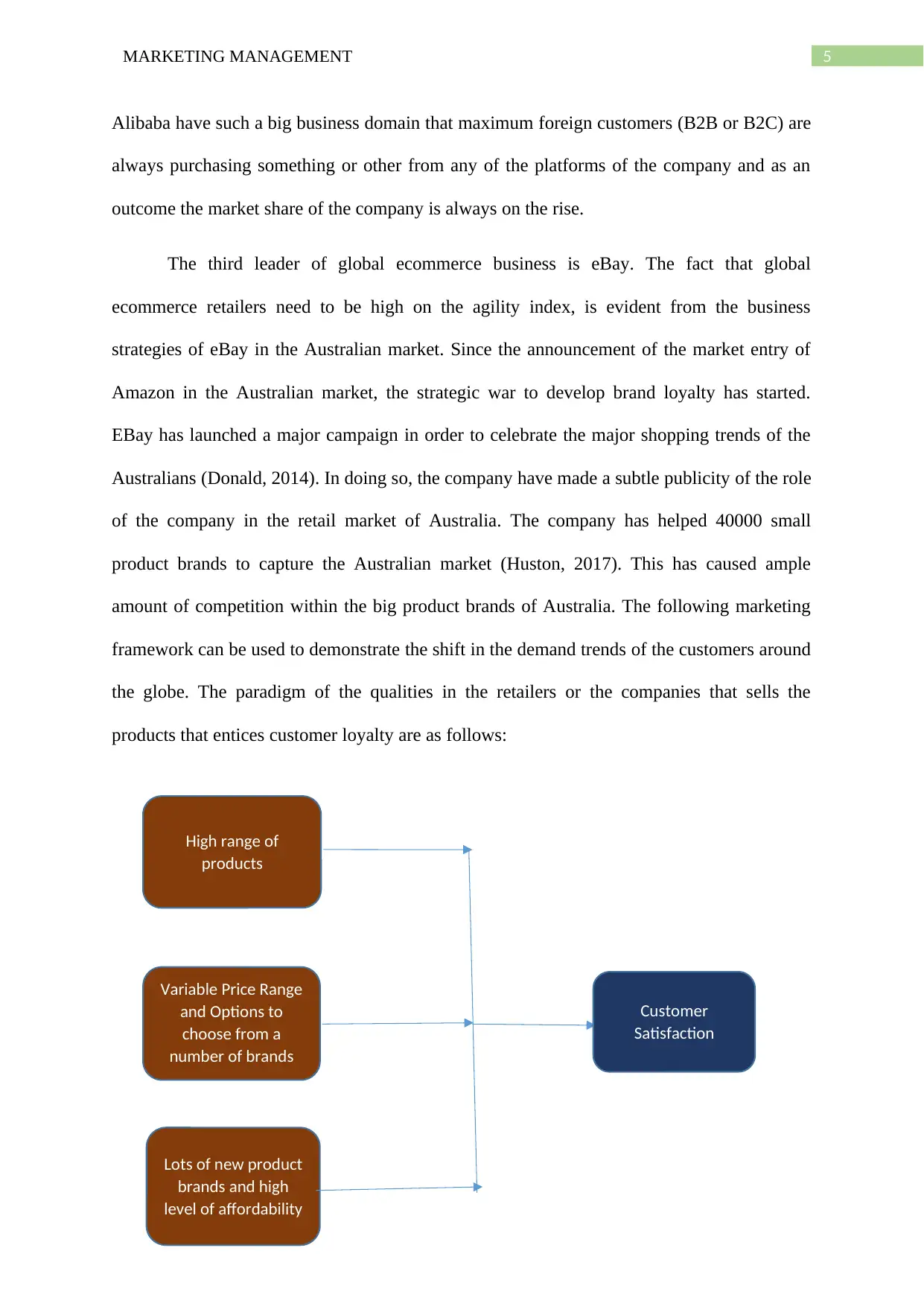
amount of competition within the big product brands of Australia. The following marketing
framework can be used to demonstrate the shift in the demand trends of the customers around
the globe. The paradigm of the qualities in the retailers or the companies that sells the
products that entices customer loyalty are as follows:
High range of
products
Variable Price Range
and Options to
choose from a
number of brands
Lots of new product
brands and high
level of affordability
Customer
Satisfaction
Alibaba have such a big business domain that maximum foreign customers (B2B or B2C) are
always purchasing something or other from any of the platforms of the company and as an
outcome the market share of the company is always on the rise.
The third leader of global ecommerce business is eBay. The fact that global
ecommerce retailers need to be high on the agility index, is evident from the business
strategies of eBay in the Australian market. Since the announcement of the market entry of
Amazon in the Australian market, the strategic war to develop brand loyalty has started.
EBay has launched a major campaign in order to celebrate the major shopping trends of the
Australians (Donald, 2014). In doing so, the company have made a subtle publicity of the role
of the company in the retail market of Australia. The company has helped 40000 small
product brands to capture the Australian market (Huston, 2017). This has caused ample
amount of competition within the big product brands of Australia. The following marketing
framework can be used to demonstrate the shift in the demand trends of the customers around
the globe. The paradigm of the qualities in the retailers or the companies that sells the
products that entices customer loyalty are as follows:
High range of
products
Variable Price Range
and Options to
choose from a
number of brands
Lots of new product
brands and high
level of affordability
Customer
Satisfaction
6MARKETING MANAGEMENT
The Paradigm of the Customer’s behaviour framework
(Source: Long, 2017)
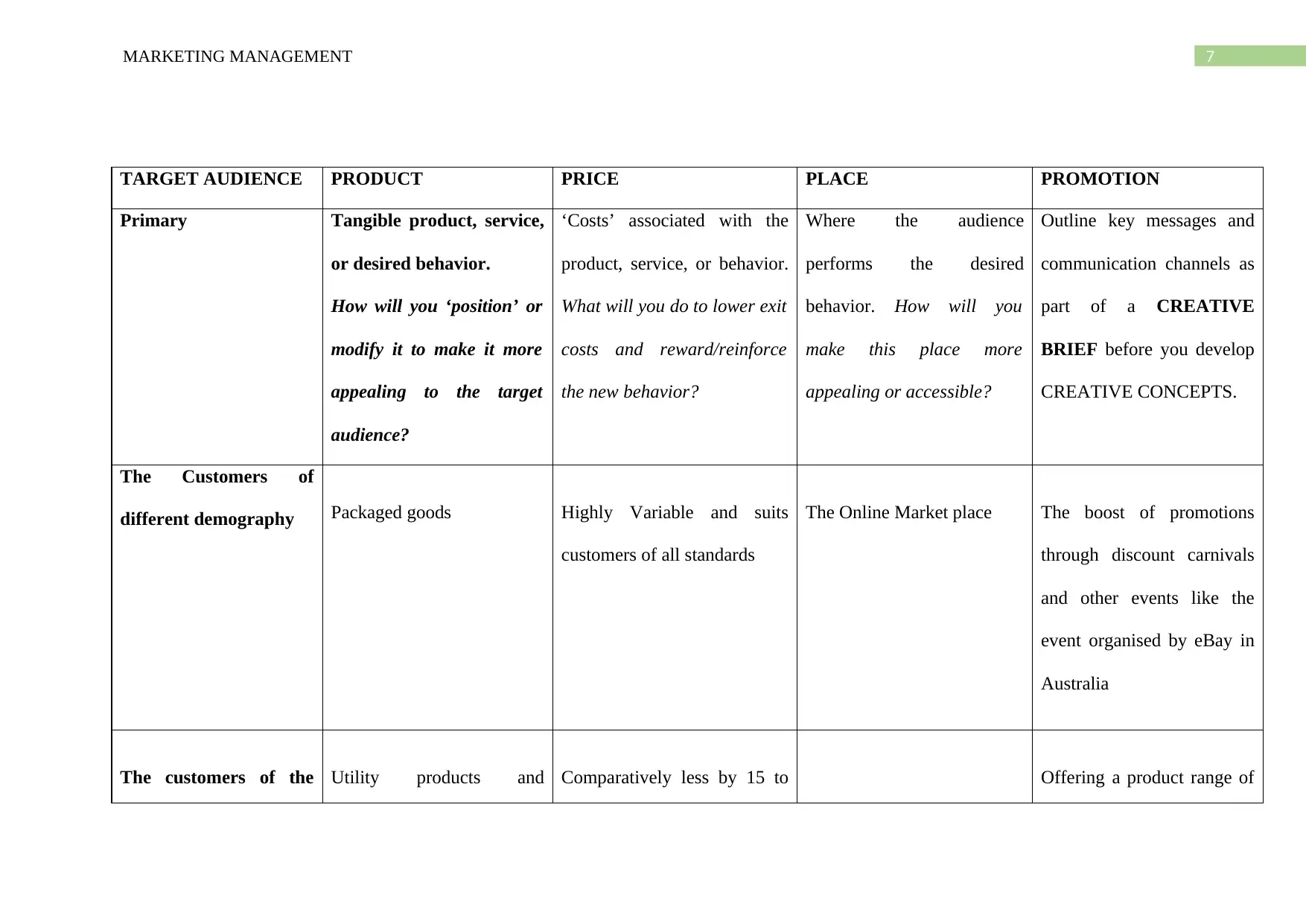
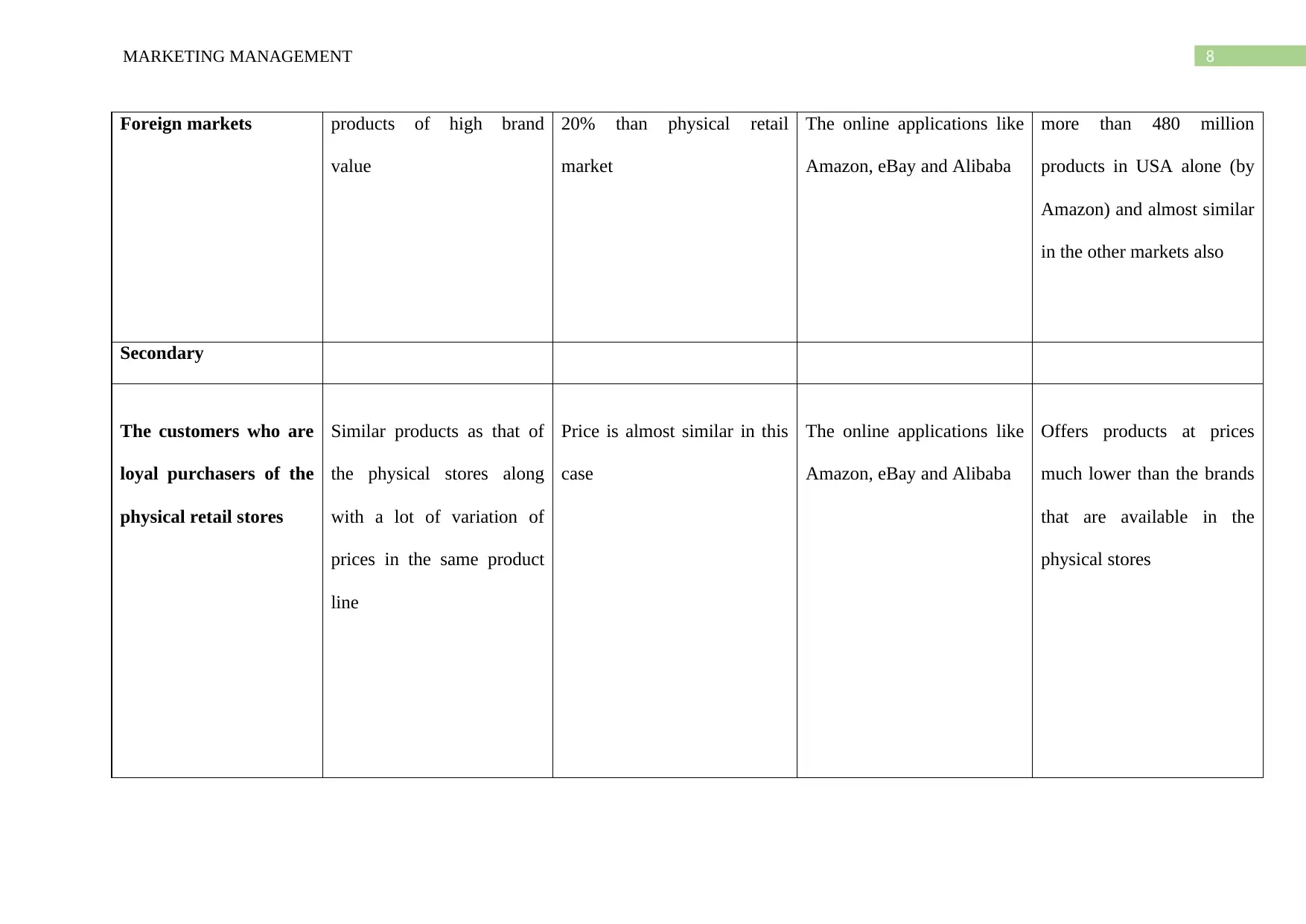
The 4Ps of Marketing can also be applied in order to make a descriptive analysis of the
marketing position of the big brands in the market.
The Paradigm of the Customer’s behaviour framework
(Source: Long, 2017)
The 4Ps of Marketing can also be applied in order to make a descriptive analysis of the
marketing position of the big brands in the market.
⊘ This is a preview!⊘
Do you want full access?
Subscribe today to unlock all pages.
Trusted by 1+ million students worldwide
7MARKETING MANAGEMENT
TARGET AUDIENCE PRODUCT PRICE PLACE PROMOTION
Primary Tangible product, service,
or desired behavior.
How will you ‘position’ or
modify it to make it more
appealing to the target
audience?
‘Costs’ associated with the
product, service, or behavior.
What will you do to lower exit
costs and reward/reinforce
the new behavior?
Where the audience
performs the desired
behavior. How will you
make this place more
appealing or accessible?
Outline key messages and
communication channels as
part of a CREATIVE
BRIEF before you develop
CREATIVE CONCEPTS.
The Customers of
different demography Packaged goods Highly Variable and suits
customers of all standards
The Online Market place The boost of promotions
through discount carnivals
and other events like the
event organised by eBay in
Australia
The customers of the Utility products and Comparatively less by 15 to Offering a product range of
TARGET AUDIENCE PRODUCT PRICE PLACE PROMOTION
Primary Tangible product, service,
or desired behavior.
How will you ‘position’ or
modify it to make it more
appealing to the target
audience?
‘Costs’ associated with the
product, service, or behavior.
What will you do to lower exit
costs and reward/reinforce
the new behavior?
Where the audience
performs the desired
behavior. How will you
make this place more
appealing or accessible?
Outline key messages and
communication channels as
part of a CREATIVE
BRIEF before you develop
CREATIVE CONCEPTS.
The Customers of
different demography Packaged goods Highly Variable and suits
customers of all standards
The Online Market place The boost of promotions
through discount carnivals
and other events like the
event organised by eBay in
Australia
The customers of the Utility products and Comparatively less by 15 to Offering a product range of
Paraphrase This Document
Need a fresh take? Get an instant paraphrase of this document with our AI Paraphraser
8MARKETING MANAGEMENT
Foreign markets products of high brand
value
20% than physical retail
market
The online applications like
Amazon, eBay and Alibaba
more than 480 million
products in USA alone (by
Amazon) and almost similar
in the other markets also
Secondary
The customers who are
loyal purchasers of the
physical retail stores
Similar products as that of
the physical stores along
with a lot of variation of
prices in the same product
line
Price is almost similar in this
case
The online applications like
Amazon, eBay and Alibaba
Offers products at prices
much lower than the brands
that are available in the
physical stores
Foreign markets products of high brand
value
20% than physical retail
market
The online applications like
Amazon, eBay and Alibaba
more than 480 million
products in USA alone (by
Amazon) and almost similar
in the other markets also
Secondary
The customers who are
loyal purchasers of the
physical retail stores
Similar products as that of
the physical stores along
with a lot of variation of
prices in the same product
line
Price is almost similar in this
case
The online applications like
Amazon, eBay and Alibaba
Offers products at prices
much lower than the brands
that are available in the
physical stores
9MARKETING MANAGEMENT
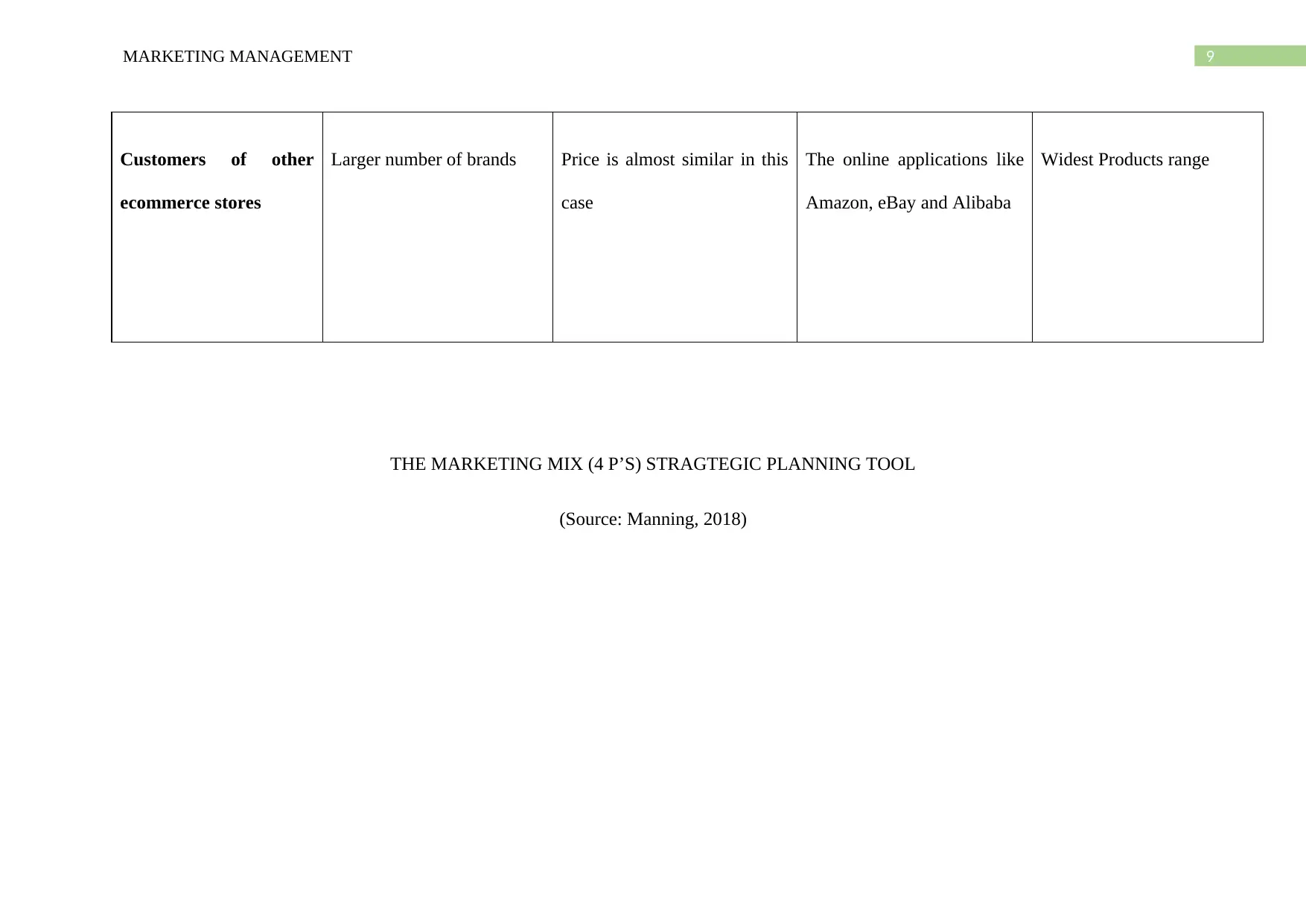
Customers of other
ecommerce stores
Larger number of brands Price is almost similar in this
case
The online applications like
Amazon, eBay and Alibaba
Widest Products range
THE MARKETING MIX (4 P’S) STRAGTEGIC PLANNING TOOL
(Source: Manning, 2018)
Customers of other
ecommerce stores
Larger number of brands Price is almost similar in this
case
The online applications like
Amazon, eBay and Alibaba
Widest Products range
THE MARKETING MIX (4 P’S) STRAGTEGIC PLANNING TOOL
(Source: Manning, 2018)
⊘ This is a preview!⊘
Do you want full access?
Subscribe today to unlock all pages.
Trusted by 1+ million students worldwide
10MARKETING MANAGEMENT
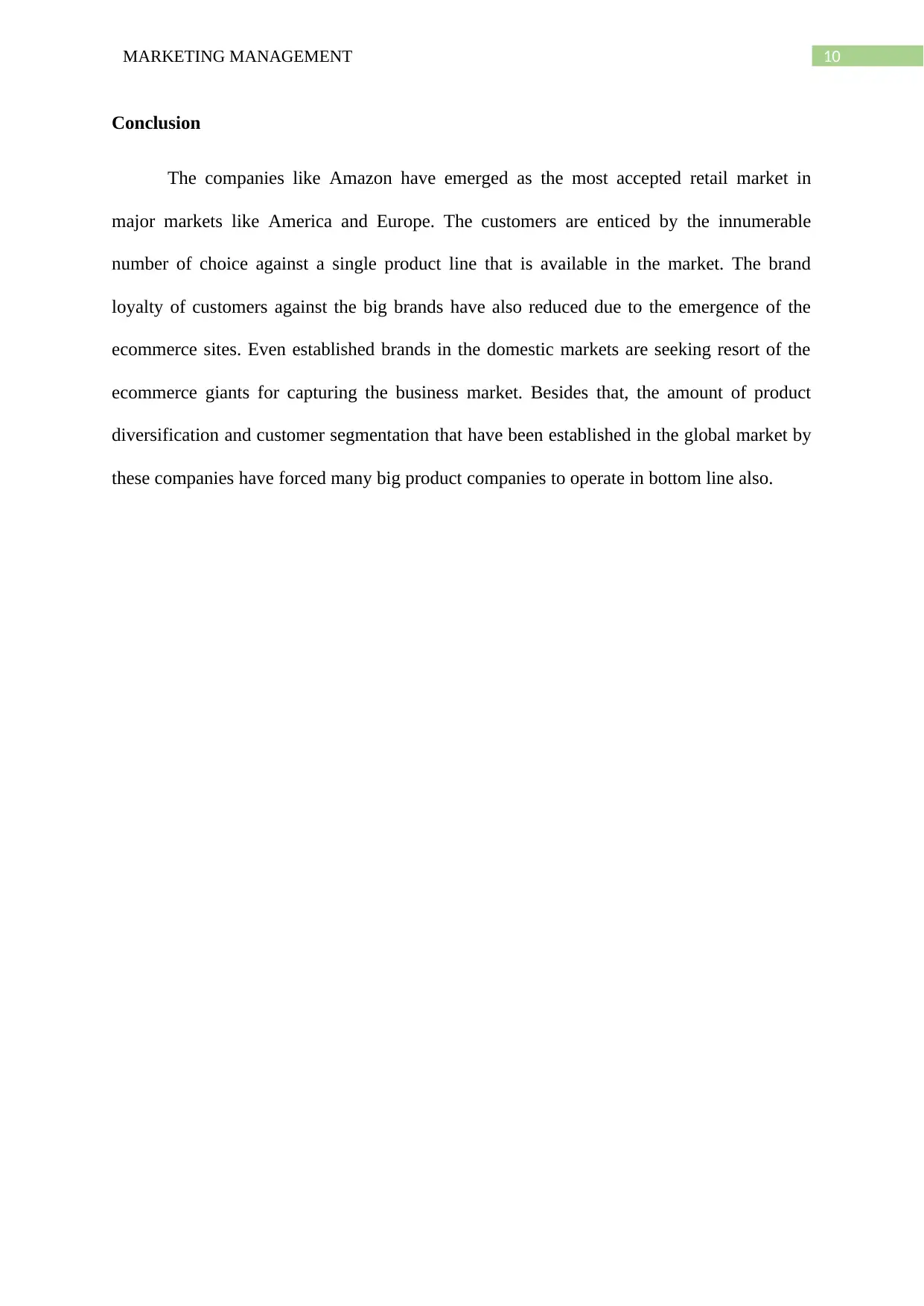
Conclusion
The companies like Amazon have emerged as the most accepted retail market in
major markets like America and Europe. The customers are enticed by the innumerable
number of choice against a single product line that is available in the market. The brand
loyalty of customers against the big brands have also reduced due to the emergence of the
ecommerce sites. Even established brands in the domestic markets are seeking resort of the
ecommerce giants for capturing the business market. Besides that, the amount of product
diversification and customer segmentation that have been established in the global market by
these companies have forced many big product companies to operate in bottom line also.
Conclusion
The companies like Amazon have emerged as the most accepted retail market in
major markets like America and Europe. The customers are enticed by the innumerable
number of choice against a single product line that is available in the market. The brand
loyalty of customers against the big brands have also reduced due to the emergence of the
ecommerce sites. Even established brands in the domestic markets are seeking resort of the
ecommerce giants for capturing the business market. Besides that, the amount of product
diversification and customer segmentation that have been established in the global market by
these companies have forced many big product companies to operate in bottom line also.
Paraphrase This Document
Need a fresh take? Get an instant paraphrase of this document with our AI Paraphraser
11MARKETING MANAGEMENT
Reference List
Al‐imam, A., Santacroce, R., Roman‐Urrestarazu, A., Chilcott, R., Bersani, G., Martinotti,
G., & Corazza, O. (2017). Captagon: use and trade in the Middle East. Human
Psychopharmacology: Clinical and Experimental, 32(3), e2548. Retrieved on 27th
November 2018. Retrieved from
https://onlinelibrary.wiley.com/doi/pdf/10.1002/hup.2548
Borsenberger, C. (2015). The concentration phenomenon in e-commerce. In Postal and
delivery innovation in the digital economy (pp. 31-41). Springer, Cham. Retrieved on
27th November 2018. Retrieved from https://link.springer.com/chapter/10.1007/978-3-
319-12874-0_3
Donald, A, (2014). Branding Lessons from China's Alibaba. (Online). Retrieved on 27th
November 2018. Retrieved from https://adage.com/article/global-news/alibaba-teach-
chinese-brands/295115/
Hsu, C. L., Westland, J. C., & Chiang, C. H. (2015). Electronic Commerce Research in seven
maps. Electronic Commerce Research, 15(2), 147-158. Retrieved on 27th November
2018. Retrieved from https://link.springer.com/article/10.1007/s10660-015-9181-8
Huston, C, (2017). Amazon is taking away the power of brand names, throwing another
industry into turmoil. Market Watch. (Online).Retrieved on 27th November 2018.
Retrieved from https://www.marketwatch.com/story/amazon-is-taking-away-the-
power-of-brand-names-throwing-another-industry-into-turmoil-2017-07-10
Lee, D. K. C., & TEO, G. S. Z. J. (2015). Emergence of FinTech and the LASIC principles.
Journal of Financial Perspectives, 3(3), 1. Retrieved on 27th November 2018.
Retrieved from http://ink.library.smu.edu.sg/cgi/viewcontent.cgi?
article=6071&context=lkcsb_research
Reference List
Al‐imam, A., Santacroce, R., Roman‐Urrestarazu, A., Chilcott, R., Bersani, G., Martinotti,
G., & Corazza, O. (2017). Captagon: use and trade in the Middle East. Human
Psychopharmacology: Clinical and Experimental, 32(3), e2548. Retrieved on 27th
November 2018. Retrieved from
https://onlinelibrary.wiley.com/doi/pdf/10.1002/hup.2548
Borsenberger, C. (2015). The concentration phenomenon in e-commerce. In Postal and
delivery innovation in the digital economy (pp. 31-41). Springer, Cham. Retrieved on
27th November 2018. Retrieved from https://link.springer.com/chapter/10.1007/978-3-
319-12874-0_3
Donald, A, (2014). Branding Lessons from China's Alibaba. (Online). Retrieved on 27th
November 2018. Retrieved from https://adage.com/article/global-news/alibaba-teach-
chinese-brands/295115/
Hsu, C. L., Westland, J. C., & Chiang, C. H. (2015). Electronic Commerce Research in seven
maps. Electronic Commerce Research, 15(2), 147-158. Retrieved on 27th November
2018. Retrieved from https://link.springer.com/article/10.1007/s10660-015-9181-8
Huston, C, (2017). Amazon is taking away the power of brand names, throwing another
industry into turmoil. Market Watch. (Online).Retrieved on 27th November 2018.
Retrieved from https://www.marketwatch.com/story/amazon-is-taking-away-the-
power-of-brand-names-throwing-another-industry-into-turmoil-2017-07-10
Lee, D. K. C., & TEO, G. S. Z. J. (2015). Emergence of FinTech and the LASIC principles.
Journal of Financial Perspectives, 3(3), 1. Retrieved on 27th November 2018.
Retrieved from http://ink.library.smu.edu.sg/cgi/viewcontent.cgi?
article=6071&context=lkcsb_research
12MARKETING MANAGEMENT
Long, D, (2017). eBay Australia launches major brand campaign as it readies for Amazon
arrival. thedrum.com. (Online). Retrieved on 27th November 2018. Retrieved from
https://www.thedrum.com/news/2017/09/04/ebay-australia-launches-major-brand-
campaign-it-readies-amazon-arrival
Lu, Y., Zhao, L., & Wang, B. (2010). From virtual community members to C2C e-commerce
buyers: Trust in virtual communities and its effect on consumers’ purchase intention.
Electronic Commerce Research and Applications, 9(4), 346-360. Retrieved on 27th
November 2018. Retrieved from
https://www.sciencedirect.com/science/article/pii/S1567422309000404
Manning, B, (2018). Amazon.com’s Integrated Marketing Communications. Medium.com.
Retrieved on 27th November 2018. Retrieved from
https://medium.com/@michaelangelo_q/amazon-coms-integrated-marketing-
communications-901a6a2a77ef
Wang, X. (2012). Foreign direct investment and innovation in China's e-commerce sector.
Journal of Asian Economics, 23(3), 288-301. Retrieved on 27th November 2018.
Retrieved from
https://www.sciencedirect.com/science/article/pii/S1049007810001065
Long, D, (2017). eBay Australia launches major brand campaign as it readies for Amazon
arrival. thedrum.com. (Online). Retrieved on 27th November 2018. Retrieved from
https://www.thedrum.com/news/2017/09/04/ebay-australia-launches-major-brand-
campaign-it-readies-amazon-arrival
Lu, Y., Zhao, L., & Wang, B. (2010). From virtual community members to C2C e-commerce
buyers: Trust in virtual communities and its effect on consumers’ purchase intention.
Electronic Commerce Research and Applications, 9(4), 346-360. Retrieved on 27th
November 2018. Retrieved from
https://www.sciencedirect.com/science/article/pii/S1567422309000404
Manning, B, (2018). Amazon.com’s Integrated Marketing Communications. Medium.com.
Retrieved on 27th November 2018. Retrieved from
https://medium.com/@michaelangelo_q/amazon-coms-integrated-marketing-
communications-901a6a2a77ef
Wang, X. (2012). Foreign direct investment and innovation in China's e-commerce sector.
Journal of Asian Economics, 23(3), 288-301. Retrieved on 27th November 2018.
Retrieved from
https://www.sciencedirect.com/science/article/pii/S1049007810001065
⊘ This is a preview!⊘
Do you want full access?
Subscribe today to unlock all pages.
Trusted by 1+ million students worldwide

1 out of 12


Related Documents


Your All-in-One AI-Powered Toolkit for Academic Success.
+13062052269
info@desklib.com
Available 24*7 on WhatsApp / Email
![[object Object]](/_next/static/media/star-bottom.7253800d.svg)
Unlock your academic potential
Copyright © 2020–2026 A2Z Services. All Rights Reserved. Developed and managed by ZUCOL.