Research Proposal: Brand Loyalty Influence on Customer Behaviour
VerifiedAdded on 2023/06/09
|24
|4755
|134
Report
AI Summary
This research proposal investigates the impact of brand loyalty on consumer behavior within the UK fashion industry. It begins with an introduction outlining the research's background, rationale, aims, objectives, and research questions. The literature review explores the concept of brand loyalty, its theoretical underpinnings, and the concept of customer behavior. It examines the impact of brand loyalty on customer behavior and develops a conceptual framework and hypothesis. The methodology section details the research philosophy (positivism), research logic (deductive), research approach, data collection methods, and data analysis techniques. It also addresses potential challenges, limitations, and ethical considerations. The research aims to explore the driving elements of brand loyalty, identify factors influencing consumer buying behavior, highlight the influence of brand loyalty on consumer behavior, and recommend solutions for developing brand loyalty in the UK fashion industry. The research employs a deductive approach, developing hypotheses based on existing theories to investigate the relationship between brand loyalty and consumer behavior.
Running head: RESEARCH PROPOSAL
Research Proposal
How Does Brand Loyalty Influence Customer Behaviour? A study based on Fashion Market in
the UK
Student’s Name:
Name of the university:
Author’s note:
Research Proposal
How Does Brand Loyalty Influence Customer Behaviour? A study based on Fashion Market in
the UK
Student’s Name:
Name of the university:
Author’s note:

Paraphrase This Document
Need a fresh take? Get an instant paraphrase of this document with our AI Paraphraser
1RESEARCH PROPOSAL
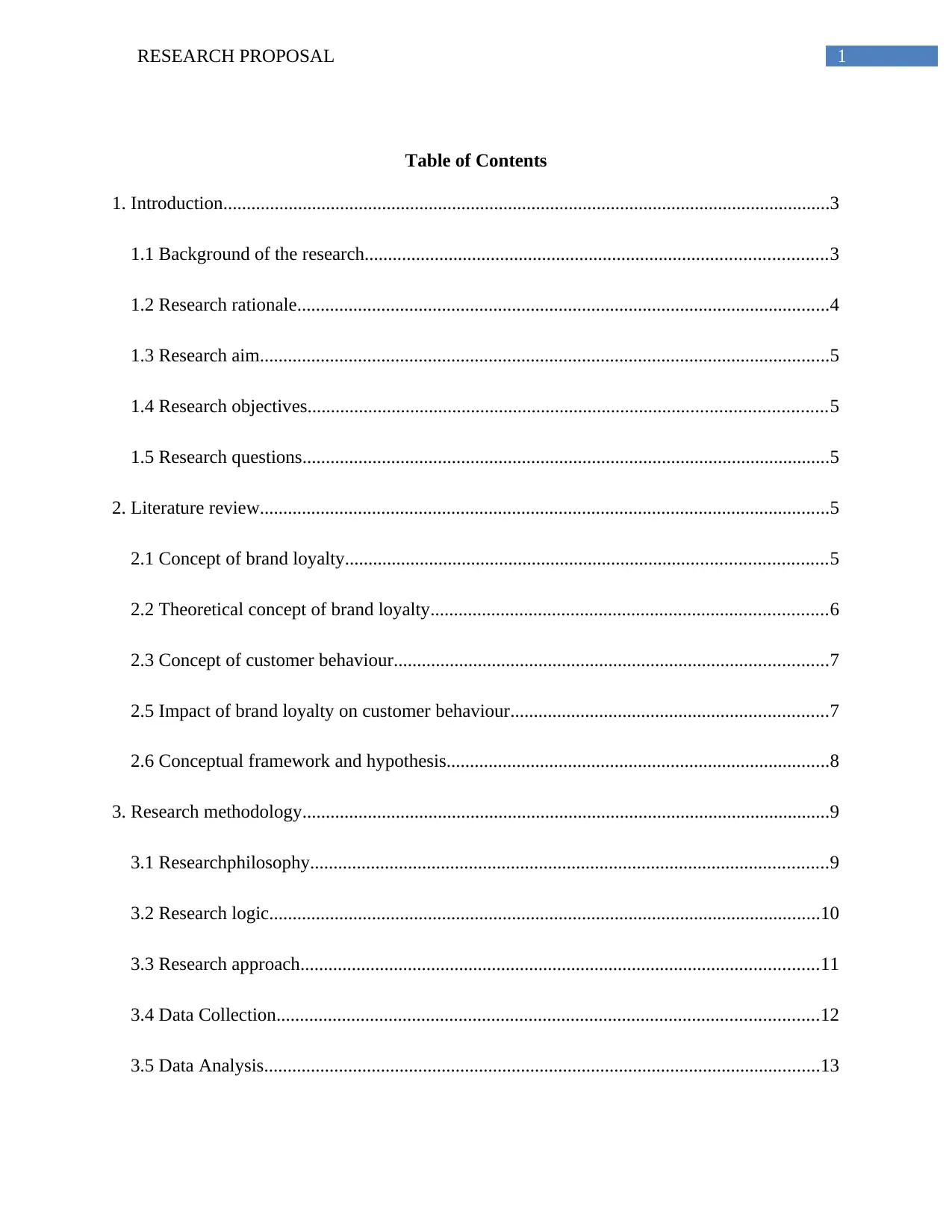
Table of Contents
1. Introduction..................................................................................................................................3
1.1 Background of the research...................................................................................................3
1.2 Research rationale..................................................................................................................4
1.3 Research aim..........................................................................................................................5
1.4 Research objectives...............................................................................................................5
1.5 Research questions.................................................................................................................5
2. Literature review..........................................................................................................................5
2.1 Concept of brand loyalty.......................................................................................................5
2.2 Theoretical concept of brand loyalty.....................................................................................6
2.3 Concept of customer behaviour.............................................................................................7
2.5 Impact of brand loyalty on customer behaviour....................................................................7
2.6 Conceptual framework and hypothesis..................................................................................8
3. Research methodology.................................................................................................................9
3.1 Researchphilosophy...............................................................................................................9
3.2 Research logic......................................................................................................................10
3.3 Research approach...............................................................................................................11
3.4 Data Collection....................................................................................................................12
3.5 Data Analysis.......................................................................................................................13
Table of Contents
1. Introduction..................................................................................................................................3
1.1 Background of the research...................................................................................................3
1.2 Research rationale..................................................................................................................4
1.3 Research aim..........................................................................................................................5
1.4 Research objectives...............................................................................................................5
1.5 Research questions.................................................................................................................5
2. Literature review..........................................................................................................................5
2.1 Concept of brand loyalty.......................................................................................................5
2.2 Theoretical concept of brand loyalty.....................................................................................6
2.3 Concept of customer behaviour.............................................................................................7
2.5 Impact of brand loyalty on customer behaviour....................................................................7
2.6 Conceptual framework and hypothesis..................................................................................8
3. Research methodology.................................................................................................................9
3.1 Researchphilosophy...............................................................................................................9
3.2 Research logic......................................................................................................................10
3.3 Research approach...............................................................................................................11
3.4 Data Collection....................................................................................................................12
3.5 Data Analysis.......................................................................................................................13
2RESEARCH PROPOSAL
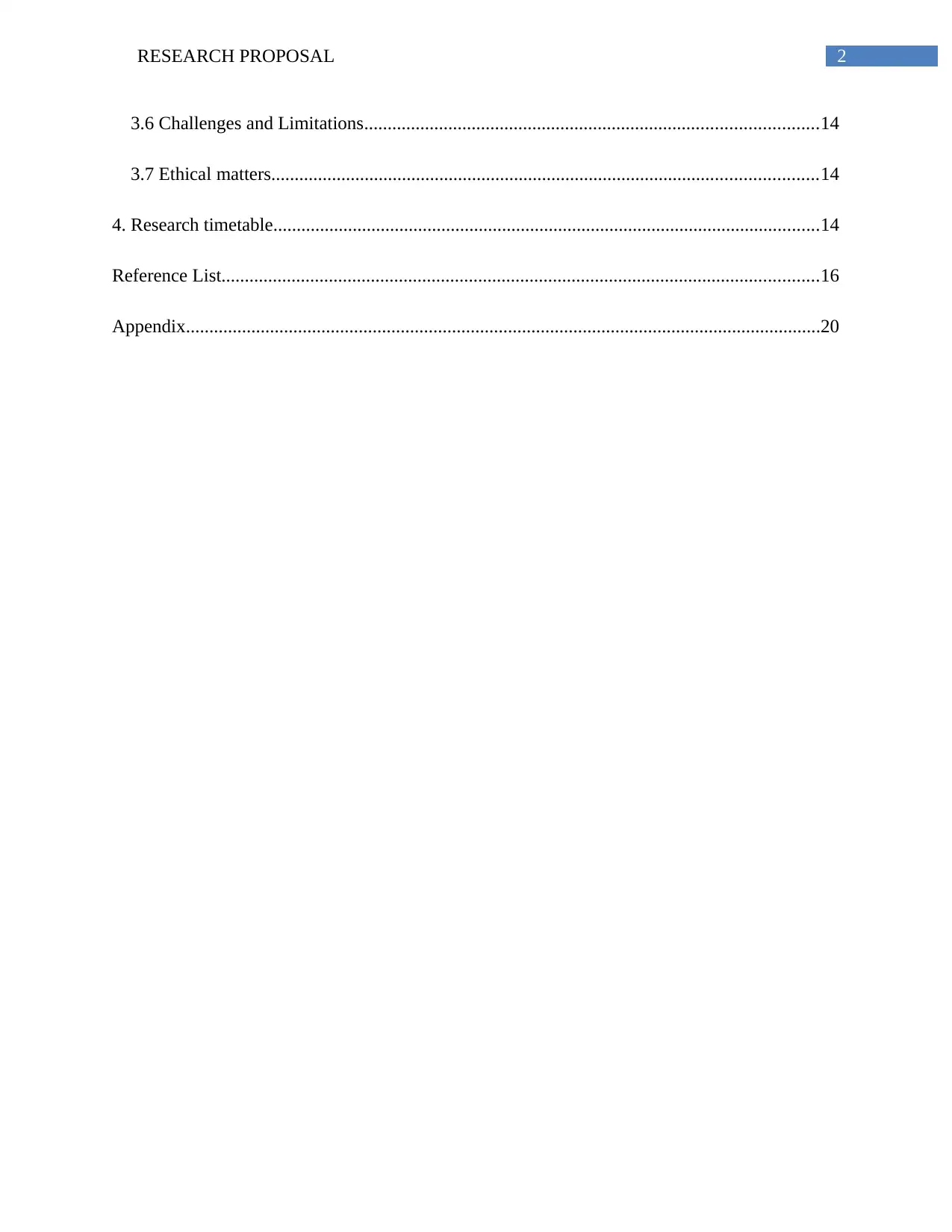
3.6 Challenges and Limitations.................................................................................................14
3.7 Ethical matters.....................................................................................................................14
4. Research timetable.....................................................................................................................14
Reference List................................................................................................................................16
Appendix........................................................................................................................................20
3.6 Challenges and Limitations.................................................................................................14
3.7 Ethical matters.....................................................................................................................14
4. Research timetable.....................................................................................................................14
Reference List................................................................................................................................16
Appendix........................................................................................................................................20
⊘ This is a preview!⊘
Do you want full access?
Subscribe today to unlock all pages.

Trusted by 1+ million students worldwide
3RESEARCH PROPOSAL
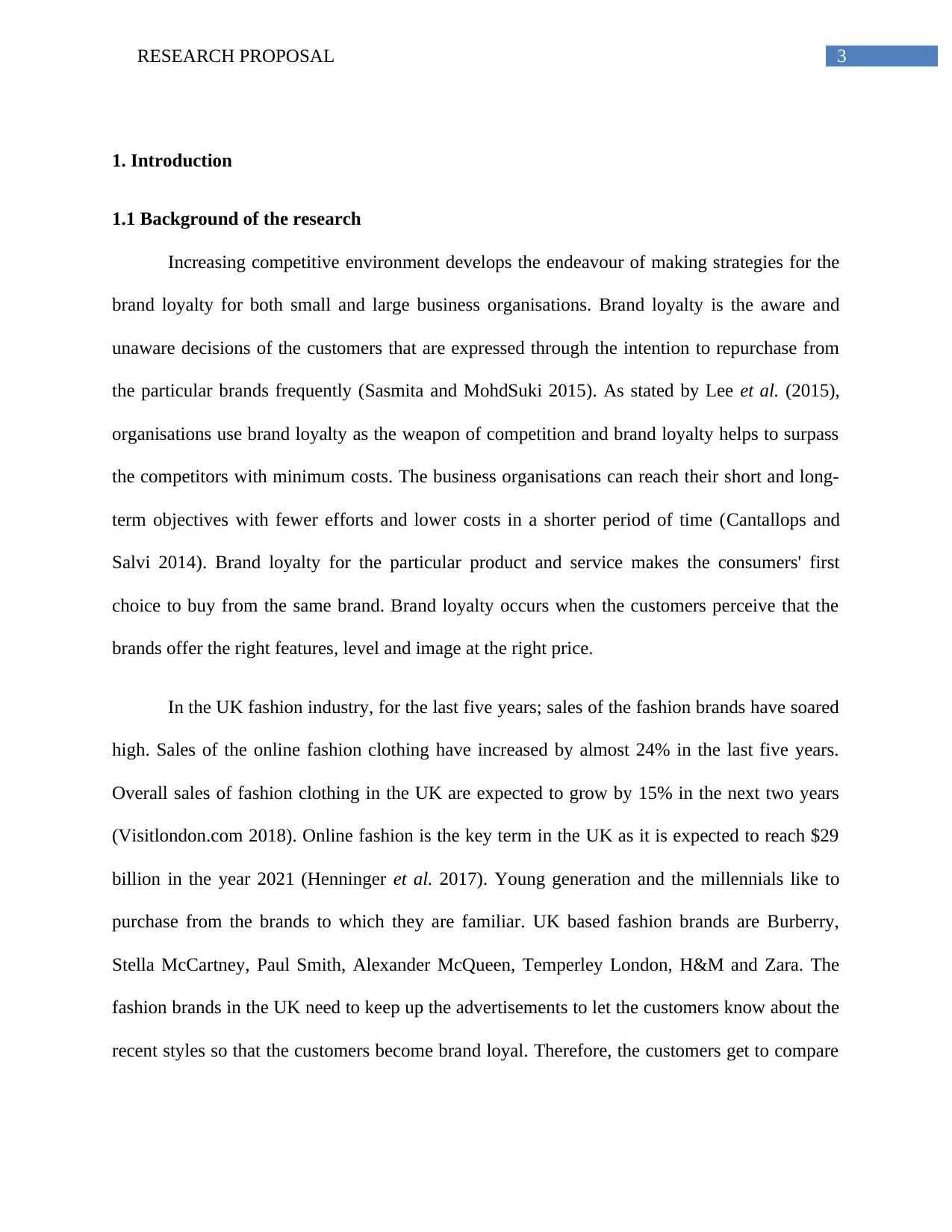
1. Introduction
1.1 Background of the research
Increasing competitive environment develops the endeavour of making strategies for the
brand loyalty for both small and large business organisations. Brand loyalty is the aware and
unaware decisions of the customers that are expressed through the intention to repurchase from
the particular brands frequently (Sasmita and MohdSuki 2015). As stated by Lee et al. (2015),
organisations use brand loyalty as the weapon of competition and brand loyalty helps to surpass
the competitors with minimum costs. The business organisations can reach their short and long-
term objectives with fewer efforts and lower costs in a shorter period of time (Cantallops and
Salvi 2014). Brand loyalty for the particular product and service makes the consumers' first
choice to buy from the same brand. Brand loyalty occurs when the customers perceive that the
brands offer the right features, level and image at the right price.
In the UK fashion industry, for the last five years; sales of the fashion brands have soared
high. Sales of the online fashion clothing have increased by almost 24% in the last five years.
Overall sales of fashion clothing in the UK are expected to grow by 15% in the next two years
(Visitlondon.com 2018). Online fashion is the key term in the UK as it is expected to reach $29
billion in the year 2021 (Henninger et al. 2017). Young generation and the millennials like to
purchase from the brands to which they are familiar. UK based fashion brands are Burberry,
Stella McCartney, Paul Smith, Alexander McQueen, Temperley London, H&M and Zara. The
fashion brands in the UK need to keep up the advertisements to let the customers know about the
recent styles so that the customers become brand loyal. Therefore, the customers get to compare
1. Introduction
1.1 Background of the research
Increasing competitive environment develops the endeavour of making strategies for the
brand loyalty for both small and large business organisations. Brand loyalty is the aware and
unaware decisions of the customers that are expressed through the intention to repurchase from
the particular brands frequently (Sasmita and MohdSuki 2015). As stated by Lee et al. (2015),
organisations use brand loyalty as the weapon of competition and brand loyalty helps to surpass
the competitors with minimum costs. The business organisations can reach their short and long-
term objectives with fewer efforts and lower costs in a shorter period of time (Cantallops and
Salvi 2014). Brand loyalty for the particular product and service makes the consumers' first
choice to buy from the same brand. Brand loyalty occurs when the customers perceive that the
brands offer the right features, level and image at the right price.
In the UK fashion industry, for the last five years; sales of the fashion brands have soared
high. Sales of the online fashion clothing have increased by almost 24% in the last five years.
Overall sales of fashion clothing in the UK are expected to grow by 15% in the next two years
(Visitlondon.com 2018). Online fashion is the key term in the UK as it is expected to reach $29
billion in the year 2021 (Henninger et al. 2017). Young generation and the millennials like to
purchase from the brands to which they are familiar. UK based fashion brands are Burberry,
Stella McCartney, Paul Smith, Alexander McQueen, Temperley London, H&M and Zara. The
fashion brands in the UK need to keep up the advertisements to let the customers know about the
recent styles so that the customers become brand loyal. Therefore, the customers get to compare
Paraphrase This Document
Need a fresh take? Get an instant paraphrase of this document with our AI Paraphraser
4RESEARCH PROPOSAL
and contrast the different types of products and the services like discounts, free shipping and cost
offered by the organisations.
1.2 Research rationale
What is the issue?
Fashion brands need to make a good brand image and brand awareness so that the
customer becomes loyal to the brands (Turker and Altuntas 2016). Lack of brand loyalty can
negatively impact on the consumers’ buying behaviour.
Why is it an issue?
If the customers are not loyal to the brands, the customers may go to the different brands.
Therefore, lack of loyal customers may hamper the revenue and profitability of the fashion
brands.
Why is it an issue now?
In the fashion industry in the UK, the rise of online selling of the fashion brands has
been increased. The customers are now exposed to many new fashion brands and the customers
make a purchase from these brands as well (Battaglia et al. 2016). If the renowned fashion
brands do not opt to take measure to make a brand image, the fashion brands tend to lose the
competitive advantage and the existence of the brands will be threatened in the industry.
What does the research shed light on?
This research will shed light on the influence on brand loyalty on the consumers' buying
behaviour as this provides an advantage for the fashion brands to gain knowledge to heed on the
consumers' behaviour.
and contrast the different types of products and the services like discounts, free shipping and cost
offered by the organisations.
1.2 Research rationale
What is the issue?
Fashion brands need to make a good brand image and brand awareness so that the
customer becomes loyal to the brands (Turker and Altuntas 2016). Lack of brand loyalty can
negatively impact on the consumers’ buying behaviour.
Why is it an issue?
If the customers are not loyal to the brands, the customers may go to the different brands.
Therefore, lack of loyal customers may hamper the revenue and profitability of the fashion
brands.
Why is it an issue now?
In the fashion industry in the UK, the rise of online selling of the fashion brands has
been increased. The customers are now exposed to many new fashion brands and the customers
make a purchase from these brands as well (Battaglia et al. 2016). If the renowned fashion
brands do not opt to take measure to make a brand image, the fashion brands tend to lose the
competitive advantage and the existence of the brands will be threatened in the industry.
What does the research shed light on?
This research will shed light on the influence on brand loyalty on the consumers' buying
behaviour as this provides an advantage for the fashion brands to gain knowledge to heed on the
consumers' behaviour.
5RESEARCH PROPOSAL
1.3 Research aim
The aim of the research is to explore the influence of brand loyalty on the consumers’
buying behaviour. This research aims to focus on the fashion brands of the UK.
1.4 Research objectives
The objectives of the research are:
To explore the driving elements of brand loyalty in fashion industry
To find out the factors regarding the consumers’ buying behaviour
To highlight the influence of brand loyalty on the consumers’ behaviour in the fashion
industry of the UK
To recommend some possible solutions for developing the brand loyalty in the fashion
brands of the UK to impact on consumers’ behaviour
1.5 Research questions
Primary research question:
What is the impact of brand loyalty on the consumers’ behaviour in the fashion brands of the
UK?
2. Literature review
2.1 Concept of brand loyalty
As stated by Lim et al. (2017), brand loyalty is the behaviour pattern of the customers
when the customers become committed towards any particular brand and the customers make a
purchase from the brands time and again. The authors further stated that the organisations make
creative strategies so that the customers can be loyal towards the brands through rewards
1.3 Research aim
The aim of the research is to explore the influence of brand loyalty on the consumers’
buying behaviour. This research aims to focus on the fashion brands of the UK.
1.4 Research objectives
The objectives of the research are:
To explore the driving elements of brand loyalty in fashion industry
To find out the factors regarding the consumers’ buying behaviour
To highlight the influence of brand loyalty on the consumers’ behaviour in the fashion
industry of the UK
To recommend some possible solutions for developing the brand loyalty in the fashion
brands of the UK to impact on consumers’ behaviour
1.5 Research questions
Primary research question:
What is the impact of brand loyalty on the consumers’ behaviour in the fashion brands of the
UK?
2. Literature review
2.1 Concept of brand loyalty
As stated by Lim et al. (2017), brand loyalty is the behaviour pattern of the customers
when the customers become committed towards any particular brand and the customers make a
purchase from the brands time and again. The authors further stated that the organisations make
creative strategies so that the customers can be loyal towards the brands through rewards
⊘ This is a preview!⊘
Do you want full access?
Subscribe today to unlock all pages.
Trusted by 1+ million students worldwide
6RESEARCH PROPOSAL
programme, brand ambassadors, trials and incentives. According to Pappu and Quester (2016),
brand loyalty is based on the emotional dependence of the customers and it's the reliance of the
customers on the organisations to support, making decisions and guidance. The authors further
stated that the emotional dependence of the customers is associated with the reliability, integrity,
empathy and depth of the customers. In addition, brand loyalty is also based on the customer
satisfaction as customer satisfaction is included with the delivery and the support of the products
and services (Haryanto et al. 2016). Brand loyalty for particular services and products depends
on the performance of the organisation. In fashion industry, the satisfaction of the customers
regarding the accessories and the clothes is important along with the economic value proposition
of the products.
2.2 Theoretical concept of brand loyalty
In theory of Reasoned Action, the first part of the reasoned action is based on the element
of persuasion and the behavioural intention. As stated by Montano and Kasprzyk (2015), the
reasoned action is concerned with the behaviour of the customers and the influence of the people.
Reasoned action describes the factors which limit the impact of the customers' attitude on the
behaviour.
Aaker Model of brand equity is based on the five categories which describe the brand's
liability and assets. As stated by Aaker (1991), brand loyalty assists the organisations to decrease
the marketing costs and brand loyalty defines the brand equity also. In addition, brand loyalty
cannot be imitated by the competitors and it gives time to the organisations to respond on move
by the competitors. Brand awareness is the beginning of the brand equity and this awareness
assists to get the consideration of the customers' purchase.
programme, brand ambassadors, trials and incentives. According to Pappu and Quester (2016),
brand loyalty is based on the emotional dependence of the customers and it's the reliance of the
customers on the organisations to support, making decisions and guidance. The authors further
stated that the emotional dependence of the customers is associated with the reliability, integrity,
empathy and depth of the customers. In addition, brand loyalty is also based on the customer
satisfaction as customer satisfaction is included with the delivery and the support of the products
and services (Haryanto et al. 2016). Brand loyalty for particular services and products depends
on the performance of the organisation. In fashion industry, the satisfaction of the customers
regarding the accessories and the clothes is important along with the economic value proposition
of the products.
2.2 Theoretical concept of brand loyalty
In theory of Reasoned Action, the first part of the reasoned action is based on the element
of persuasion and the behavioural intention. As stated by Montano and Kasprzyk (2015), the
reasoned action is concerned with the behaviour of the customers and the influence of the people.
Reasoned action describes the factors which limit the impact of the customers' attitude on the
behaviour.
Aaker Model of brand equity is based on the five categories which describe the brand's
liability and assets. As stated by Aaker (1991), brand loyalty assists the organisations to decrease
the marketing costs and brand loyalty defines the brand equity also. In addition, brand loyalty
cannot be imitated by the competitors and it gives time to the organisations to respond on move
by the competitors. Brand awareness is the beginning of the brand equity and this awareness
assists to get the consideration of the customers' purchase.
Paraphrase This Document
Need a fresh take? Get an instant paraphrase of this document with our AI Paraphraser
7RESEARCH PROPOSAL
2.3 Concept of customer behaviour
According to Solomon et al. (2014), buying behaviour is the process of decision-making
which is involved in purchasing and using of the products. The organisations need to understand
why the customers make a purchase of the products and which factors trigger to purchase the
products. As stated by Xiang et al. (2015), consumers’ behaviour means the reaction of the
customers to the organisations’ marketing strategy which can impact on the firms’ success.
Marketers of the organisations can predict how the customers can respond to marketing
strategies (Cantallops and Salvi 2014). There are five stages in consumers' buying behaviour
process and it starts with problem recognition and the customers understand the actual state of
desires. Then the customer's search for the information and the information can be two types;
internal search and external search. As stated by Ordun (2015), the customers need to create the
criteria for the evaluation in the ‘evaluation of alternative' where the customers evaluate the
alternative in the industry. Then, the customers decided to purchase the products and in last
stage, the post-purchase evaluation is made by the customers after an understanding of the after
sales communication and warranties period.
2.5 Impact of brand loyalty on customer behaviour
It is the first choice of the consumer to purchase from the particular brand and it only
occurs when the brand offers the perfect or right product features. Brand loyalty has some
features which the organisations need to follow and these elements of brand loyalty are
behavioural, biased, expressed and decision making of the customers. Customers can be loyal to
a particular brand when there is a high switching cost or there can be economical, technical and
psychological factors which make the process difficult (Haryanto et al. 2016). The customers can
be brand loyal as it is associated with product quality, promotions of the organisations and the
2.3 Concept of customer behaviour
According to Solomon et al. (2014), buying behaviour is the process of decision-making
which is involved in purchasing and using of the products. The organisations need to understand
why the customers make a purchase of the products and which factors trigger to purchase the
products. As stated by Xiang et al. (2015), consumers’ behaviour means the reaction of the
customers to the organisations’ marketing strategy which can impact on the firms’ success.
Marketers of the organisations can predict how the customers can respond to marketing
strategies (Cantallops and Salvi 2014). There are five stages in consumers' buying behaviour
process and it starts with problem recognition and the customers understand the actual state of
desires. Then the customer's search for the information and the information can be two types;
internal search and external search. As stated by Ordun (2015), the customers need to create the
criteria for the evaluation in the ‘evaluation of alternative' where the customers evaluate the
alternative in the industry. Then, the customers decided to purchase the products and in last
stage, the post-purchase evaluation is made by the customers after an understanding of the after
sales communication and warranties period.
2.5 Impact of brand loyalty on customer behaviour
It is the first choice of the consumer to purchase from the particular brand and it only
occurs when the brand offers the perfect or right product features. Brand loyalty has some
features which the organisations need to follow and these elements of brand loyalty are
behavioural, biased, expressed and decision making of the customers. Customers can be loyal to
a particular brand when there is a high switching cost or there can be economical, technical and
psychological factors which make the process difficult (Haryanto et al. 2016). The customers can
be brand loyal as it is associated with product quality, promotions of the organisations and the
8RESEARCH PROPOSAL
price of the actual products (Godey et al. 2016). In addition, as opined by Xiang et al. (2015),
loyal customers love the brand because it raises positive emotions in them as they have a positive
experience with it.
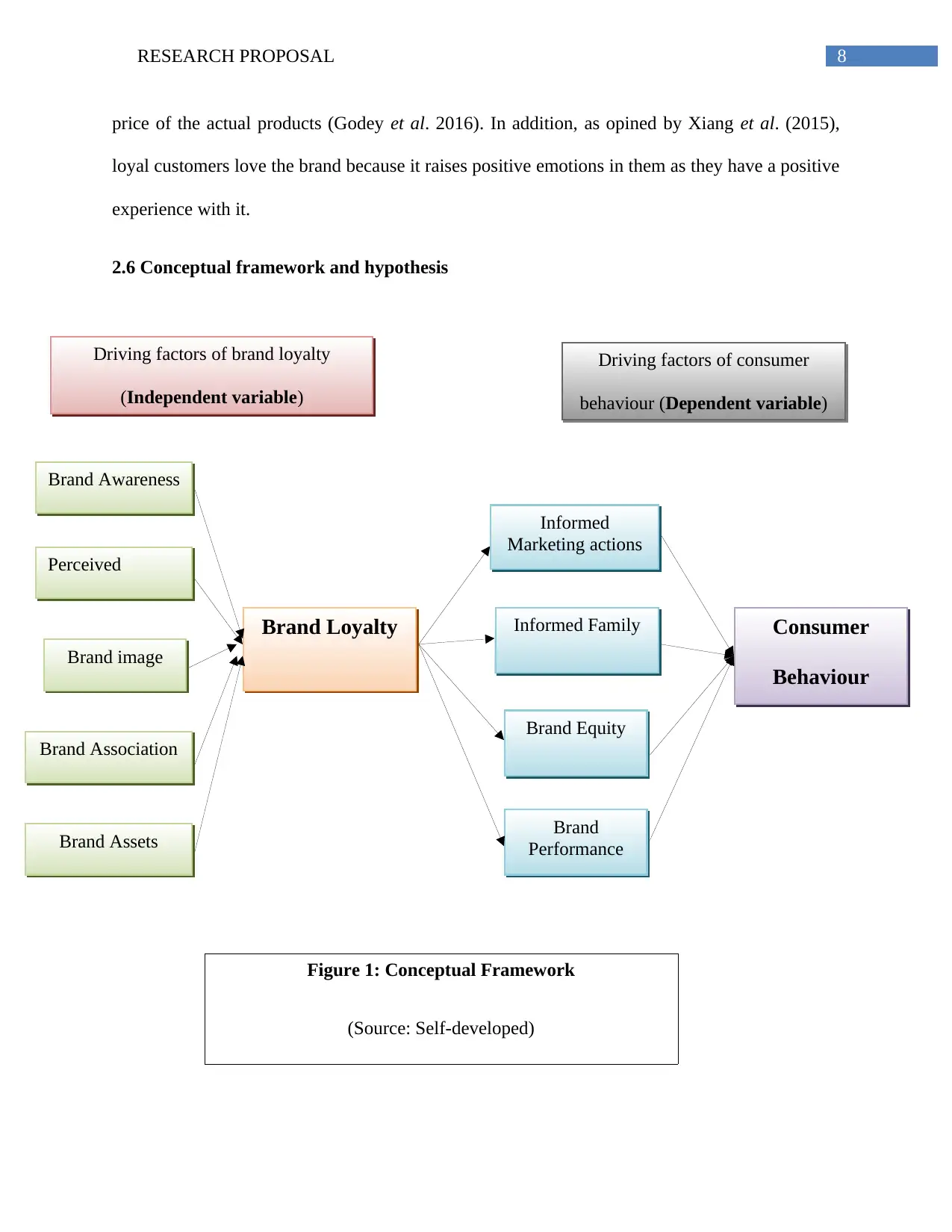
2.6 Conceptual framework and hypothesis
Brand Awareness
Brand Assets
Perceived
Quality
Brand image
Brand Association
Brand Loyalty Informed Family
Informed
Marketing actions
Brand
Performance
Brand Equity
Consumer
Behaviour
Figure 1: Conceptual Framework
(Source: Self-developed)
Driving factors of brand loyalty
(Independent variable)
Driving factors of consumer
behaviour (Dependent variable)
price of the actual products (Godey et al. 2016). In addition, as opined by Xiang et al. (2015),
loyal customers love the brand because it raises positive emotions in them as they have a positive
experience with it.
2.6 Conceptual framework and hypothesis
Brand Awareness
Brand Assets
Perceived
Quality
Brand image
Brand Association
Brand Loyalty Informed Family
Informed
Marketing actions
Brand
Performance
Brand Equity
Consumer
Behaviour
Figure 1: Conceptual Framework
(Source: Self-developed)
Driving factors of brand loyalty
(Independent variable)
Driving factors of consumer
behaviour (Dependent variable)
⊘ This is a preview!⊘
Do you want full access?
Subscribe today to unlock all pages.
Trusted by 1+ million students worldwide
9RESEARCH PROPOSAL
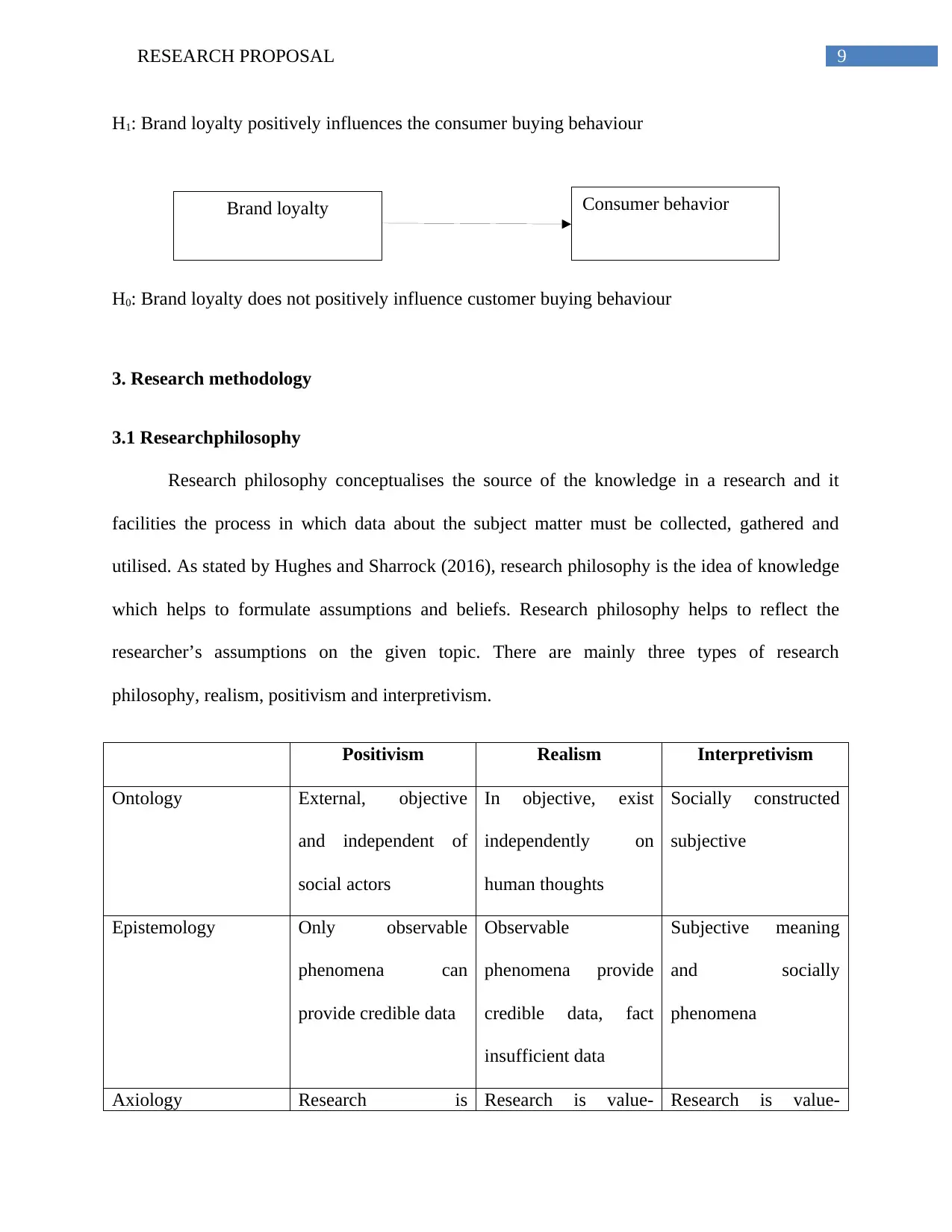
Brand loyalty Consumer behavior
H1: Brand loyalty positively influences the consumer buying behaviour
H0: Brand loyalty does not positively influence customer buying behaviour
3. Research methodology
3.1 Researchphilosophy
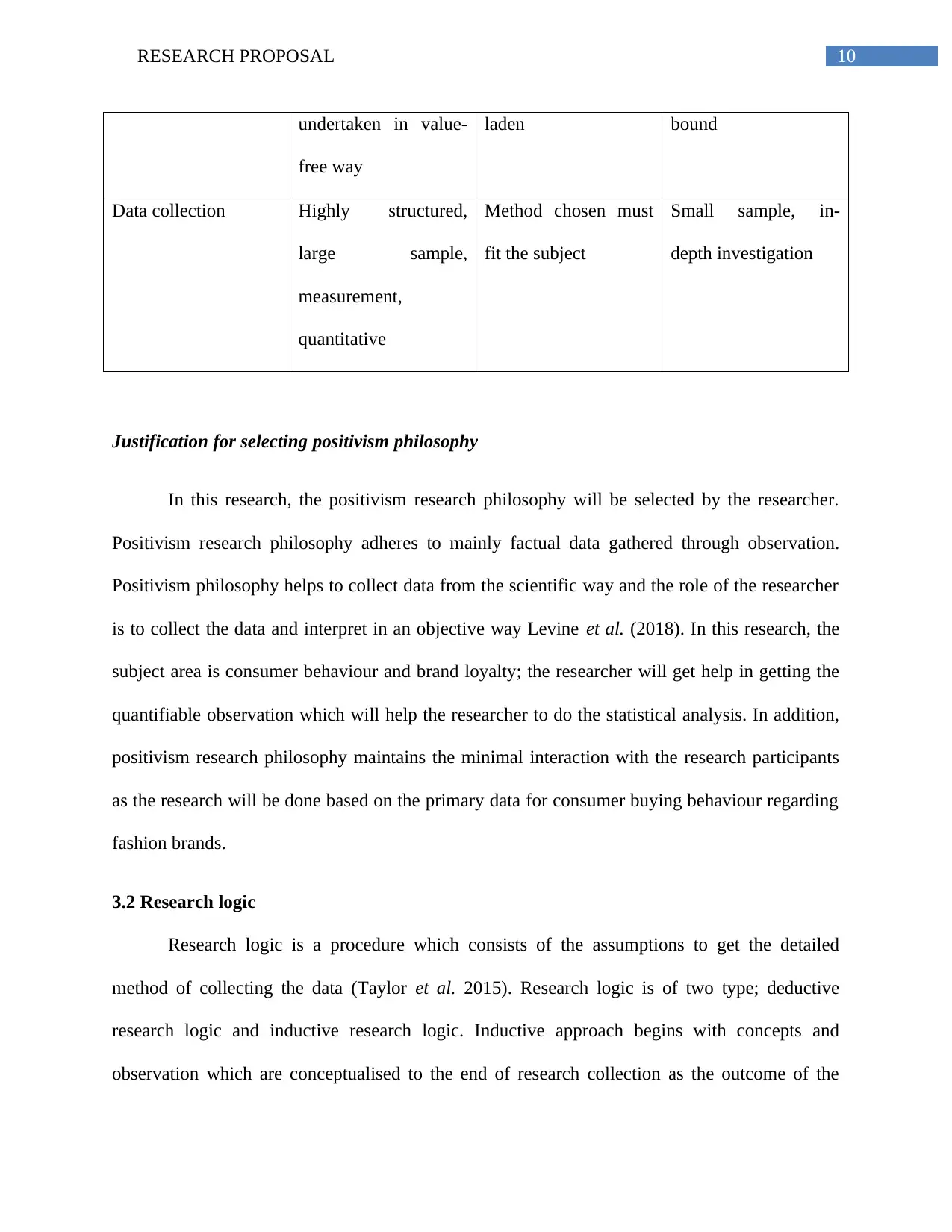
Research philosophy conceptualises the source of the knowledge in a research and it
facilities the process in which data about the subject matter must be collected, gathered and
utilised. As stated by Hughes and Sharrock (2016), research philosophy is the idea of knowledge
which helps to formulate assumptions and beliefs. Research philosophy helps to reflect the
researcher’s assumptions on the given topic. There are mainly three types of research
philosophy, realism, positivism and interpretivism.
Positivism Realism Interpretivism
Ontology External, objective
and independent of
social actors
In objective, exist
independently on
human thoughts
Socially constructed
subjective
Epistemology Only observable
phenomena can
provide credible data
Observable
phenomena provide
credible data, fact
insufficient data
Subjective meaning
and socially
phenomena
Axiology Research is Research is value- Research is value-
Brand loyalty Consumer behavior
H1: Brand loyalty positively influences the consumer buying behaviour
H0: Brand loyalty does not positively influence customer buying behaviour
3. Research methodology
3.1 Researchphilosophy
Research philosophy conceptualises the source of the knowledge in a research and it
facilities the process in which data about the subject matter must be collected, gathered and
utilised. As stated by Hughes and Sharrock (2016), research philosophy is the idea of knowledge
which helps to formulate assumptions and beliefs. Research philosophy helps to reflect the
researcher’s assumptions on the given topic. There are mainly three types of research
philosophy, realism, positivism and interpretivism.
Positivism Realism Interpretivism
Ontology External, objective
and independent of
social actors
In objective, exist
independently on
human thoughts
Socially constructed
subjective
Epistemology Only observable
phenomena can
provide credible data
Observable
phenomena provide
credible data, fact
insufficient data
Subjective meaning
and socially
phenomena
Axiology Research is Research is value- Research is value-
Paraphrase This Document
Need a fresh take? Get an instant paraphrase of this document with our AI Paraphraser
10RESEARCH PROPOSAL
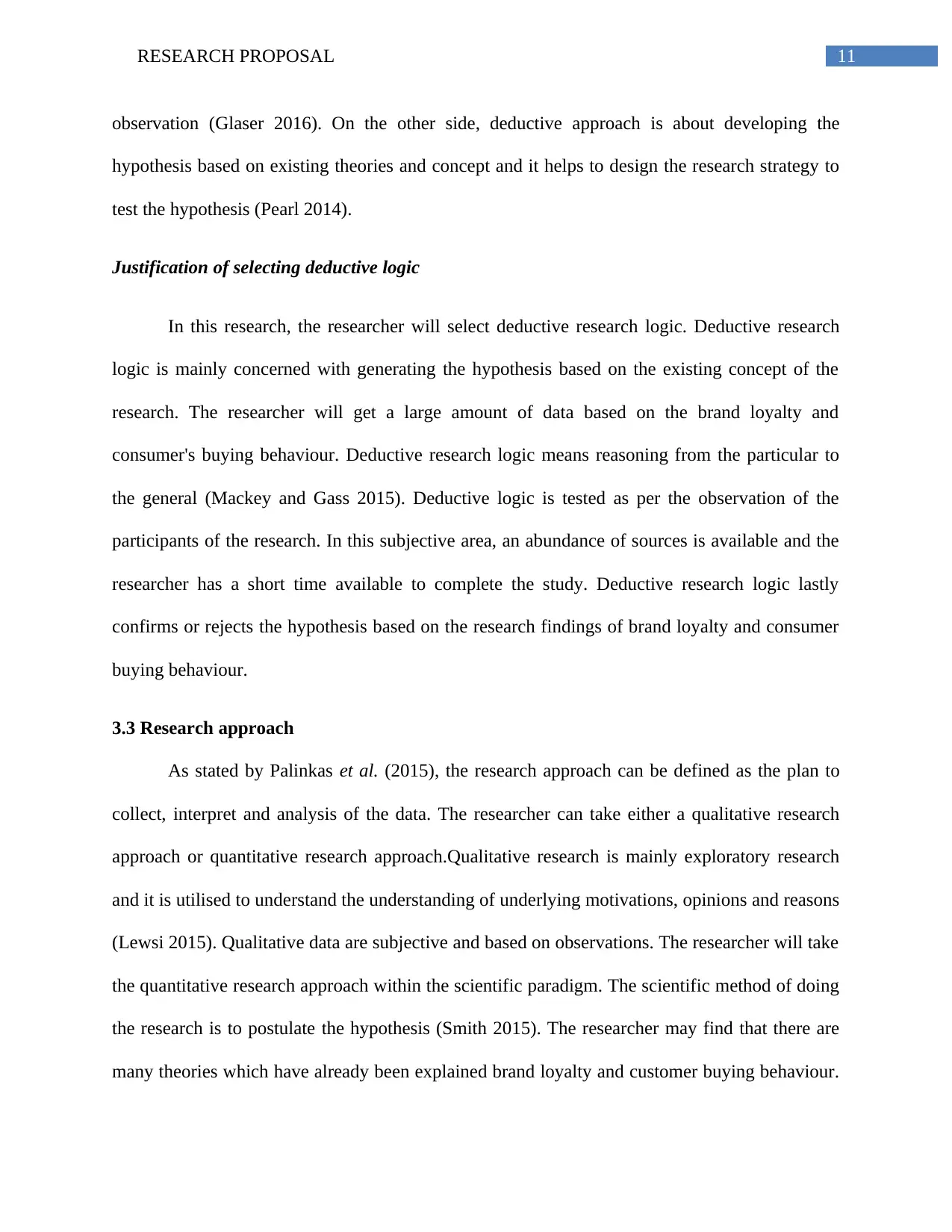
undertaken in value-
free way
laden bound
Data collection Highly structured,
large sample,
measurement,
quantitative
Method chosen must
fit the subject
Small sample, in-
depth investigation
Justification for selecting positivism philosophy
In this research, the positivism research philosophy will be selected by the researcher.
Positivism research philosophy adheres to mainly factual data gathered through observation.
Positivism philosophy helps to collect data from the scientific way and the role of the researcher
is to collect the data and interpret in an objective way Levine et al. (2018). In this research, the
subject area is consumer behaviour and brand loyalty; the researcher will get help in getting the
quantifiable observation which will help the researcher to do the statistical analysis. In addition,
positivism research philosophy maintains the minimal interaction with the research participants
as the research will be done based on the primary data for consumer buying behaviour regarding
fashion brands.
3.2 Research logic
Research logic is a procedure which consists of the assumptions to get the detailed
method of collecting the data (Taylor et al. 2015). Research logic is of two type; deductive
research logic and inductive research logic. Inductive approach begins with concepts and
observation which are conceptualised to the end of research collection as the outcome of the
undertaken in value-
free way
laden bound
Data collection Highly structured,
large sample,
measurement,
quantitative
Method chosen must
fit the subject
Small sample, in-
depth investigation
Justification for selecting positivism philosophy
In this research, the positivism research philosophy will be selected by the researcher.
Positivism research philosophy adheres to mainly factual data gathered through observation.
Positivism philosophy helps to collect data from the scientific way and the role of the researcher
is to collect the data and interpret in an objective way Levine et al. (2018). In this research, the
subject area is consumer behaviour and brand loyalty; the researcher will get help in getting the
quantifiable observation which will help the researcher to do the statistical analysis. In addition,
positivism research philosophy maintains the minimal interaction with the research participants
as the research will be done based on the primary data for consumer buying behaviour regarding
fashion brands.
3.2 Research logic
Research logic is a procedure which consists of the assumptions to get the detailed
method of collecting the data (Taylor et al. 2015). Research logic is of two type; deductive
research logic and inductive research logic. Inductive approach begins with concepts and
observation which are conceptualised to the end of research collection as the outcome of the
11RESEARCH PROPOSAL
observation (Glaser 2016). On the other side, deductive approach is about developing the
hypothesis based on existing theories and concept and it helps to design the research strategy to
test the hypothesis (Pearl 2014).
Justification of selecting deductive logic
In this research, the researcher will select deductive research logic. Deductive research
logic is mainly concerned with generating the hypothesis based on the existing concept of the
research. The researcher will get a large amount of data based on the brand loyalty and
consumer's buying behaviour. Deductive research logic means reasoning from the particular to
the general (Mackey and Gass 2015). Deductive logic is tested as per the observation of the
participants of the research. In this subjective area, an abundance of sources is available and the
researcher has a short time available to complete the study. Deductive research logic lastly
confirms or rejects the hypothesis based on the research findings of brand loyalty and consumer
buying behaviour.
3.3 Research approach
As stated by Palinkas et al. (2015), the research approach can be defined as the plan to
collect, interpret and analysis of the data. The researcher can take either a qualitative research
approach or quantitative research approach.Qualitative research is mainly exploratory research
and it is utilised to understand the understanding of underlying motivations, opinions and reasons
(Lewsi 2015). Qualitative data are subjective and based on observations. The researcher will take
the quantitative research approach within the scientific paradigm. The scientific method of doing
the research is to postulate the hypothesis (Smith 2015). The researcher may find that there are
many theories which have already been explained brand loyalty and customer buying behaviour.
observation (Glaser 2016). On the other side, deductive approach is about developing the
hypothesis based on existing theories and concept and it helps to design the research strategy to
test the hypothesis (Pearl 2014).
Justification of selecting deductive logic
In this research, the researcher will select deductive research logic. Deductive research
logic is mainly concerned with generating the hypothesis based on the existing concept of the
research. The researcher will get a large amount of data based on the brand loyalty and
consumer's buying behaviour. Deductive research logic means reasoning from the particular to
the general (Mackey and Gass 2015). Deductive logic is tested as per the observation of the
participants of the research. In this subjective area, an abundance of sources is available and the
researcher has a short time available to complete the study. Deductive research logic lastly
confirms or rejects the hypothesis based on the research findings of brand loyalty and consumer
buying behaviour.
3.3 Research approach
As stated by Palinkas et al. (2015), the research approach can be defined as the plan to
collect, interpret and analysis of the data. The researcher can take either a qualitative research
approach or quantitative research approach.Qualitative research is mainly exploratory research
and it is utilised to understand the understanding of underlying motivations, opinions and reasons
(Lewsi 2015). Qualitative data are subjective and based on observations. The researcher will take
the quantitative research approach within the scientific paradigm. The scientific method of doing
the research is to postulate the hypothesis (Smith 2015). The researcher may find that there are
many theories which have already been explained brand loyalty and customer buying behaviour.
⊘ This is a preview!⊘
Do you want full access?
Subscribe today to unlock all pages.
Trusted by 1+ million students worldwide

1 out of 24


Related Documents


Your All-in-One AI-Powered Toolkit for Academic Success.
+13062052269
info@desklib.com
Available 24*7 on WhatsApp / Email
![[object Object]](/_next/static/media/star-bottom.7253800d.svg)
Unlock your academic potential
Copyright © 2020–2026 A2Z Services. All Rights Reserved. Developed and managed by ZUCOL.