Unilever Brand Management: Brand Equity, Hierarchy, and Portfolio
VerifiedAdded on 2023/06/17
|14
|3520
|56
Report
AI Summary
This report provides a comprehensive overview of brand management, focusing on its importance as a marketing tool and its evolution in business practice. It examines the core elements of a successful brand strategy for building and managing brand equity, using Unilever as a primary example. The report delves into various strategies for portfolio management, brand hierarchy, and brand equity management, critically assessing these concepts through established theories, models, and frameworks. Furthermore, it explores how brands are successfully managed over time, highlighting the role of innovation and marketing programs in strengthening brand equity and ensuring brand effectiveness. The analysis emphasizes Unilever's strong brand image and its impact on competitive advantage and market share, illustrating the practical application of brand management principles in a real-world organizational context. Desklib provides access to this and other solved assignments for students.

Brand Management

Paraphrase This Document
Need a fresh take? Get an instant paraphrase of this document with our AI Paraphraser
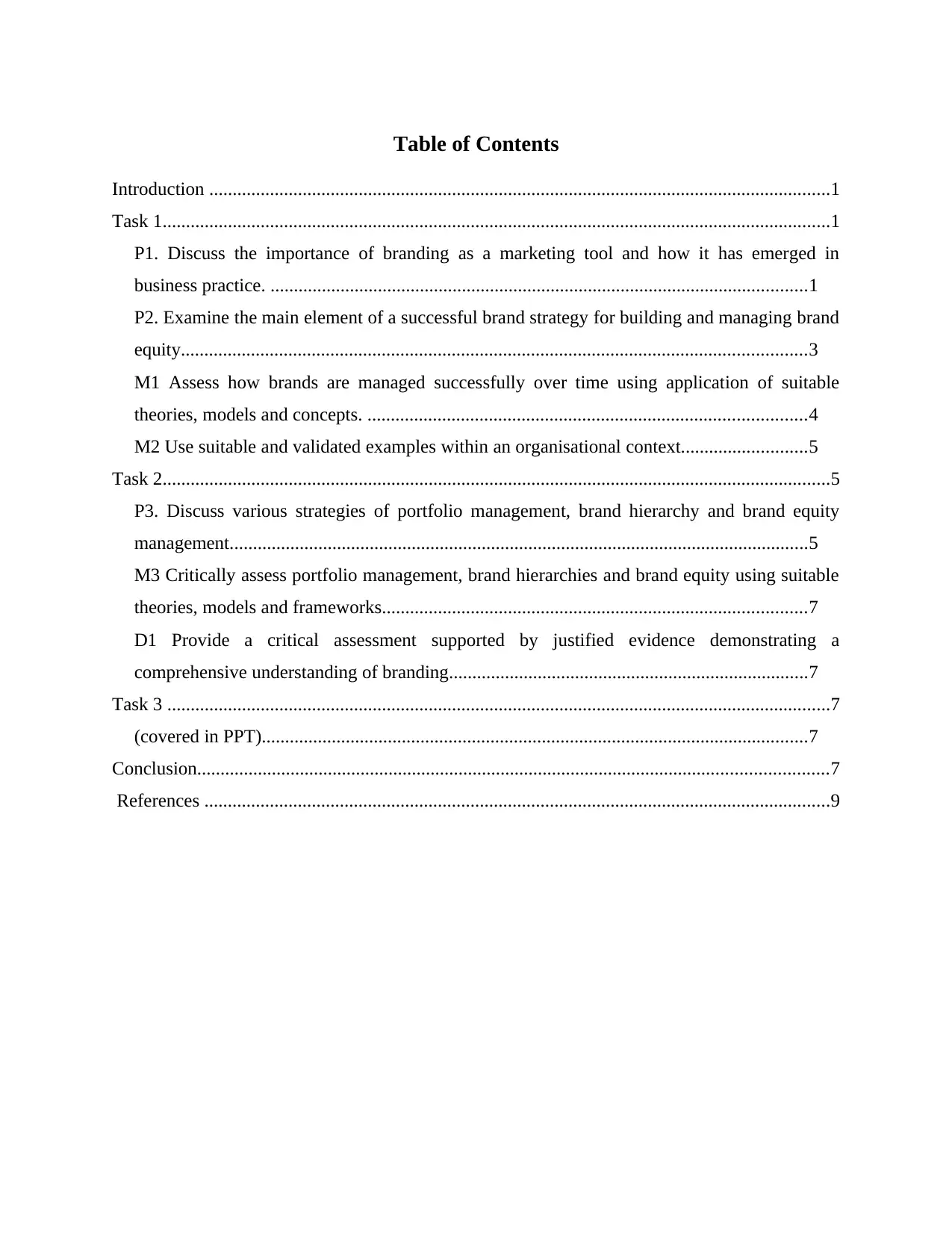
Table of Contents
Introduction .....................................................................................................................................1
Task 1...............................................................................................................................................1
P1. Discuss the importance of branding as a marketing tool and how it has emerged in
business practice. ...................................................................................................................1
P2. Examine the main element of a successful brand strategy for building and managing brand
equity......................................................................................................................................3
M1 Assess how brands are managed successfully over time using application of suitable
theories, models and concepts. ..............................................................................................4
M2 Use suitable and validated examples within an organisational context...........................5
Task 2...............................................................................................................................................5
P3. Discuss various strategies of portfolio management, brand hierarchy and brand equity
management............................................................................................................................5
M3 Critically assess portfolio management, brand hierarchies and brand equity using suitable
theories, models and frameworks...........................................................................................7
D1 Provide a critical assessment supported by justified evidence demonstrating a
comprehensive understanding of branding.............................................................................7
Task 3 ..............................................................................................................................................7
(covered in PPT).....................................................................................................................7
Conclusion.......................................................................................................................................7
References ......................................................................................................................................9
Introduction .....................................................................................................................................1
Task 1...............................................................................................................................................1
P1. Discuss the importance of branding as a marketing tool and how it has emerged in
business practice. ...................................................................................................................1
P2. Examine the main element of a successful brand strategy for building and managing brand
equity......................................................................................................................................3
M1 Assess how brands are managed successfully over time using application of suitable
theories, models and concepts. ..............................................................................................4
M2 Use suitable and validated examples within an organisational context...........................5
Task 2...............................................................................................................................................5
P3. Discuss various strategies of portfolio management, brand hierarchy and brand equity
management............................................................................................................................5
M3 Critically assess portfolio management, brand hierarchies and brand equity using suitable
theories, models and frameworks...........................................................................................7
D1 Provide a critical assessment supported by justified evidence demonstrating a
comprehensive understanding of branding.............................................................................7
Task 3 ..............................................................................................................................................7
(covered in PPT).....................................................................................................................7
Conclusion.......................................................................................................................................7
References ......................................................................................................................................9
Introduction
Brand management is defined as the process of analysing and determining the value of
specific brands as well as determining the essential value among the target customers. Effective
brand image allows the business organisation to gain competitive advantage in the marketplace
and attract large number of customers (Afifah, 2021). It is also refers to one of the essential
function used by the organisation to determine their marketing strategies to maintain, enhance
and create awareness regarding the brand. For this report Unilever is taken as the base company.
Unilever is one of the well established international consumer goods company offering wide
variety of products to their customers. The company was founded in 1929, having more than 400
brands around the globe. The company has strong brand image in the marketplace. This report
covers the benefits of branding as a marketing tools along with main components of a successful
brand strategy for managing brand equity is also highlighted in this report. In addition to this
various strategies of portfolio management, brand hierarchy and brand equity management is
also highlighted in this report.
Task 1
P1. Discuss the importance of branding as a marketing tool and how it has emerged in business
practice.
Brand is defined as an image or idea of a particular product and services among the
consumers which enables them to connect with the brand and enhance their performance in the
marketplace. It refers to something specific that consumers can connect with through able to
identify the logo, slogan, name or design owned by the company (Al-Dmourand et. al.,2021) . A
strong brand help in attracting large number of customers as well as allowing organisation to
gain competitive advantage in the marketplace. Brand plays an essential role in determining the
purpose of the organisation key objectives when developing a strategic marketing plan. It also
organisation to differentiate them from their competitors in the marketplace. In order to continue
to survive and gain competitive advantage it is essential for the organisation to build strong brand
in the market place. Branding refers to creating and implementing various feature and
characteristics to the business so as to attract large number of customers. It helps in enhancing
the recognisability of product and services among the target customers leading business to get
competitive edge in the marketplace. Branding plays an essential role in the marketing activity
1
Brand management is defined as the process of analysing and determining the value of
specific brands as well as determining the essential value among the target customers. Effective
brand image allows the business organisation to gain competitive advantage in the marketplace
and attract large number of customers (Afifah, 2021). It is also refers to one of the essential
function used by the organisation to determine their marketing strategies to maintain, enhance
and create awareness regarding the brand. For this report Unilever is taken as the base company.
Unilever is one of the well established international consumer goods company offering wide
variety of products to their customers. The company was founded in 1929, having more than 400
brands around the globe. The company has strong brand image in the marketplace. This report
covers the benefits of branding as a marketing tools along with main components of a successful
brand strategy for managing brand equity is also highlighted in this report. In addition to this
various strategies of portfolio management, brand hierarchy and brand equity management is
also highlighted in this report.
Task 1
P1. Discuss the importance of branding as a marketing tool and how it has emerged in business
practice.
Brand is defined as an image or idea of a particular product and services among the
consumers which enables them to connect with the brand and enhance their performance in the
marketplace. It refers to something specific that consumers can connect with through able to
identify the logo, slogan, name or design owned by the company (Al-Dmourand et. al.,2021) . A
strong brand help in attracting large number of customers as well as allowing organisation to
gain competitive advantage in the marketplace. Brand plays an essential role in determining the
purpose of the organisation key objectives when developing a strategic marketing plan. It also
organisation to differentiate them from their competitors in the marketplace. In order to continue
to survive and gain competitive advantage it is essential for the organisation to build strong brand
in the market place. Branding refers to creating and implementing various feature and
characteristics to the business so as to attract large number of customers. It helps in enhancing
the recognisability of product and services among the target customers leading business to get
competitive edge in the marketplace. Branding plays an essential role in the marketing activity
1
⊘ This is a preview!⊘
Do you want full access?
Subscribe today to unlock all pages.

Trusted by 1+ million students worldwide
through creating a bridge among the product and target customers and influencing customers to
take purchase decisions. It also helps in determining how organisation's target customers
perceive their brand. Marketing is the using various marketing tools and techniques in order to
communicate brand, product and services among the target customer. Marketing is considered to
be the tangible execution of the brand in order to build engagement and increase sale. Branding
is far more than just company's logo or slogan, the effective use of branding helps the
organisation in increasing its share of voice in the marketplace, also allows the organisation to
enhance their revenue (Freireand Gertner, 2021). In context to Unilever, the company has strong
brand image around the globe allowing them to continue to gain competitive advantage in the
marketplace. Company is considered to be leading producer of soap around the globe which
make them a well recognised brand. Unilever's brand helps them attract large number of
customers as well as retain them for long period of time. Branding plays an essential role as
marketing tools as mentioned below:
Increase revenues and market share: One of the essential feature of the branding is that
it helps the organisation to increase their overall revenue and market share. Effective branding
allows the organisation to attract large number of customers towards company's product and
services automatically leading to increase the profitability and productivity of the organisation.
Effective and strong branding allows helps the organisation to enter into new market share and
gain new and advance distribution strategy, enabling them to enhance their market share
effectively.
Enhance employees productivity: Effective and well known branding also helps the
organisation to enhance their employees productivity and continuously motivate them towards
achieving desired goals and objectives. When an organisation has well known brand in the
marketplace, people are willing to work for them, this helps organisation to attract talented and
skilled talent employees. Skilled and qualified employees lead to accomplishing desired goals of
the organisation and enhancing overall productivity of the business (Girniceanu and Mazilu,
2021) .
Customer loyalty and shared values: The branding helps the marketing team to attract
large number of customers and build customers loyalty. It is generally determined that the
customers are mainly attracted towards the brand which commonly share common values. It is
essential for the organisation to convey their values in order to build emotional connection with
2
take purchase decisions. It also helps in determining how organisation's target customers
perceive their brand. Marketing is the using various marketing tools and techniques in order to
communicate brand, product and services among the target customer. Marketing is considered to
be the tangible execution of the brand in order to build engagement and increase sale. Branding
is far more than just company's logo or slogan, the effective use of branding helps the
organisation in increasing its share of voice in the marketplace, also allows the organisation to
enhance their revenue (Freireand Gertner, 2021). In context to Unilever, the company has strong
brand image around the globe allowing them to continue to gain competitive advantage in the
marketplace. Company is considered to be leading producer of soap around the globe which
make them a well recognised brand. Unilever's brand helps them attract large number of
customers as well as retain them for long period of time. Branding plays an essential role as
marketing tools as mentioned below:
Increase revenues and market share: One of the essential feature of the branding is that
it helps the organisation to increase their overall revenue and market share. Effective branding
allows the organisation to attract large number of customers towards company's product and
services automatically leading to increase the profitability and productivity of the organisation.
Effective and strong branding allows helps the organisation to enter into new market share and
gain new and advance distribution strategy, enabling them to enhance their market share
effectively.
Enhance employees productivity: Effective and well known branding also helps the
organisation to enhance their employees productivity and continuously motivate them towards
achieving desired goals and objectives. When an organisation has well known brand in the
marketplace, people are willing to work for them, this helps organisation to attract talented and
skilled talent employees. Skilled and qualified employees lead to accomplishing desired goals of
the organisation and enhancing overall productivity of the business (Girniceanu and Mazilu,
2021) .
Customer loyalty and shared values: The branding helps the marketing team to attract
large number of customers and build customers loyalty. It is generally determined that the
customers are mainly attracted towards the brand which commonly share common values. It is
essential for the organisation to convey their values in order to build emotional connection with
2
Paraphrase This Document
Need a fresh take? Get an instant paraphrase of this document with our AI Paraphraser
their customers. Brand loyalty is often considered to be the major reason behind the growth and
success of the organisation.
Gain competitive advantage: The effective branding also helps the organisation to gain
competitive advantage in the marketplace and enhance their overall performance. Having strong
and recognised brand having consistent identity throughout the marketplace enables the
organisation to differentiate themselves from their competitors. Competitiveness helps the the
marketing department of the organisation to smoothly carry out their activity and attract large
number of customers (Hu, Yang and Zhang, 2021).
P2. Examine the main element of a successful brand strategy for building and managing brand
equity.
A brand strategy is defined as the long term plan taken into consideration by the business
organisation to accomplish various long term goals and objectives leading to the identification
and preference of brand through the target customers. It allows the organisation to implement
required rules and regulations on how, what, where and when the brand messages needed to be
communicated by the organisation to attract their target audience. Brand strategy plays an
essential role in effective building and managing the brand equity of the organisation leading to
enhance their overall performance. An effective branding strategy is an relationship developed
among its customers and organisation, it is how the organisation fulfils the changing needs and
wants of their target customers (Jawahar and Aslam, 2021). There are various essential
components of brand strategy which helps in building and managing brand equity are mentioned
below:
Purpose: One of the essential component of the brand strategy is purpose, before
developing the brand strategy it is essential for the organisation to determine or find the purpose
and cause behind what organisation do. Finding the brand purpose will helps in developing
effective brand strategy.
Vision: Another component is the vision, it is essential for the business organisation to
have proper vision basis of which the brand strategy can be formulated. Having proper and clear
vision will serve as the roadmap from where the branding will be carried out. It helps to analyse
the business goals for growth and development.
Values: It is also essential for the business organisation to develop or determine their
core values that will helps them to create a culture and required driving forces. Core values will
3
success of the organisation.
Gain competitive advantage: The effective branding also helps the organisation to gain
competitive advantage in the marketplace and enhance their overall performance. Having strong
and recognised brand having consistent identity throughout the marketplace enables the
organisation to differentiate themselves from their competitors. Competitiveness helps the the
marketing department of the organisation to smoothly carry out their activity and attract large
number of customers (Hu, Yang and Zhang, 2021).
P2. Examine the main element of a successful brand strategy for building and managing brand
equity.
A brand strategy is defined as the long term plan taken into consideration by the business
organisation to accomplish various long term goals and objectives leading to the identification
and preference of brand through the target customers. It allows the organisation to implement
required rules and regulations on how, what, where and when the brand messages needed to be
communicated by the organisation to attract their target audience. Brand strategy plays an
essential role in effective building and managing the brand equity of the organisation leading to
enhance their overall performance. An effective branding strategy is an relationship developed
among its customers and organisation, it is how the organisation fulfils the changing needs and
wants of their target customers (Jawahar and Aslam, 2021). There are various essential
components of brand strategy which helps in building and managing brand equity are mentioned
below:
Purpose: One of the essential component of the brand strategy is purpose, before
developing the brand strategy it is essential for the organisation to determine or find the purpose
and cause behind what organisation do. Finding the brand purpose will helps in developing
effective brand strategy.
Vision: Another component is the vision, it is essential for the business organisation to
have proper vision basis of which the brand strategy can be formulated. Having proper and clear
vision will serve as the roadmap from where the branding will be carried out. It helps to analyse
the business goals for growth and development.
Values: It is also essential for the business organisation to develop or determine their
core values that will helps them to create a culture and required driving forces. Core values will
3
helps business to directly connect with the target customers, enabling to guild the communication
and decision making and making customers realise what brand stand for (Rachnady,and Usman,
2021).
Target audience: Another component of brand strategy is target audience, having proper
knowledge and awareness regarding the target audience will helps in effectively positioning their
brand in the marketplace. When positioning the brand strategy in the marketplace, defining the
target customers will make it easier for the organisation to implement their brand strategy.
Market analysis: Another essential key component of market strategy is the market
analysis, determine the market and various elements available in the marketplace will helps the
organisation to effectively implement their strategy as well as differentiate their brand from
others. It will also help in determining the strength and weakness of the competitors and
implement the strategy accordingly.
Awareness goals: For an organisation effectively prioritizing awareness objectives and
initiatives will allow the organisation to market their brand and products more effectively. This
will also help in directly reaching to the target customers and make them aware of the brand
image. Proper brand awareness will help the organisation to gain competitive advantage in the
marketplace and enhance their overall performance. (Raposo and et.al., 2021)
M1 Assess how brands are managed successfully over time using application of suitable theories,
models and concepts.
Branding plays an essential role in enhancing the overall performance and profitability of
the organisation and attracting large number of customers. With the increasing competition, to
continue to succeed and gain competitive advantage in the marketplace the organisation has
effectively managed their brands effectively over time. The brand management has successful
strengthen their brand equity through using various marketing programmes and making
consumers aware of the brands and products, also expressing knowledge and information
regarding the brand among the consumers to not confuse them. Another strategy used by the
large number of organisation in successfully managing their brand is innovation, it is one of the
main essential key used in managing the brand and ensuring the effectiveness of the brand in the
market. It allows the brand to gain competitive advantage in the marketplace and enhance their
overall performance.
4
and decision making and making customers realise what brand stand for (Rachnady,and Usman,
2021).
Target audience: Another component of brand strategy is target audience, having proper
knowledge and awareness regarding the target audience will helps in effectively positioning their
brand in the marketplace. When positioning the brand strategy in the marketplace, defining the
target customers will make it easier for the organisation to implement their brand strategy.
Market analysis: Another essential key component of market strategy is the market
analysis, determine the market and various elements available in the marketplace will helps the
organisation to effectively implement their strategy as well as differentiate their brand from
others. It will also help in determining the strength and weakness of the competitors and
implement the strategy accordingly.
Awareness goals: For an organisation effectively prioritizing awareness objectives and
initiatives will allow the organisation to market their brand and products more effectively. This
will also help in directly reaching to the target customers and make them aware of the brand
image. Proper brand awareness will help the organisation to gain competitive advantage in the
marketplace and enhance their overall performance. (Raposo and et.al., 2021)
M1 Assess how brands are managed successfully over time using application of suitable theories,
models and concepts.
Branding plays an essential role in enhancing the overall performance and profitability of
the organisation and attracting large number of customers. With the increasing competition, to
continue to succeed and gain competitive advantage in the marketplace the organisation has
effectively managed their brands effectively over time. The brand management has successful
strengthen their brand equity through using various marketing programmes and making
consumers aware of the brands and products, also expressing knowledge and information
regarding the brand among the consumers to not confuse them. Another strategy used by the
large number of organisation in successfully managing their brand is innovation, it is one of the
main essential key used in managing the brand and ensuring the effectiveness of the brand in the
market. It allows the brand to gain competitive advantage in the marketplace and enhance their
overall performance.
4
⊘ This is a preview!⊘
Do you want full access?
Subscribe today to unlock all pages.
Trusted by 1+ million students worldwide
M2 Use suitable and validated examples within an organisational context.
Brand plays an essential role in the overall growth and development of the organisation
and enhancing their overall performance. For example Unilver is considered to be having one of
the strong brand image around the globe large base of loyal customers. Company's brand image
allows them to gain competitive advantage in the marketplace, also allowing them to easily
enhance their market share. Unilever's brand equity in the main reason behind their continuous
growth and success.
Task 2
P3. Discuss various strategies of portfolio management, brand hierarchy and brand equity
management.
Portfolio management is defined as the selection, determining and handling organisation's
programmes and projects, in aspects with its strategic goals and objectives. It is the process of
making decisions regarding matching investments to objectives, assets allocation. The main goal
of portfolio management is to effectively balance the implementation of change initiatives and
the maintenance of business, optimising return on investment. The portfolio management plays
an essential role in enhancing overall performance and profitability of the business as well as
leading business towards continuous growth and success. There are mainly two brand portfolio
strategies includes the design, deployment and management of multiple brands as a coordinated
portfolio of essentials assets of the organisation that leads to satisfying the needs and wants of
the customers in the marketplace (Rudzewicz and Strychalska-Rudzewicz, 2021). Proper design
helps in attracting large number of customers and enhance the overall performance of the
organisation. Proper portfolio of the brand also helps the organisation to effectively maintain
their market share with minimum overlap, analysing the role and scope of each and every brand,
create and design effective strategies, logical, and effective deployment that brings all the brands
together. It also allows the brand to grow and develop in the marketplace and enhance its overall
performance effectively.
Brand hierarchy is defined as a systematic branching structure of a brands elements for its
sub products and services. Initially when an well known organisation decides to diversify their
product and services with new products and various positioning schemes, it clearly leads to
creating hierarchy to easily identify and analyse the products and services. Proper brand
5
Brand plays an essential role in the overall growth and development of the organisation
and enhancing their overall performance. For example Unilver is considered to be having one of
the strong brand image around the globe large base of loyal customers. Company's brand image
allows them to gain competitive advantage in the marketplace, also allowing them to easily
enhance their market share. Unilever's brand equity in the main reason behind their continuous
growth and success.
Task 2
P3. Discuss various strategies of portfolio management, brand hierarchy and brand equity
management.
Portfolio management is defined as the selection, determining and handling organisation's
programmes and projects, in aspects with its strategic goals and objectives. It is the process of
making decisions regarding matching investments to objectives, assets allocation. The main goal
of portfolio management is to effectively balance the implementation of change initiatives and
the maintenance of business, optimising return on investment. The portfolio management plays
an essential role in enhancing overall performance and profitability of the business as well as
leading business towards continuous growth and success. There are mainly two brand portfolio
strategies includes the design, deployment and management of multiple brands as a coordinated
portfolio of essentials assets of the organisation that leads to satisfying the needs and wants of
the customers in the marketplace (Rudzewicz and Strychalska-Rudzewicz, 2021). Proper design
helps in attracting large number of customers and enhance the overall performance of the
organisation. Proper portfolio of the brand also helps the organisation to effectively maintain
their market share with minimum overlap, analysing the role and scope of each and every brand,
create and design effective strategies, logical, and effective deployment that brings all the brands
together. It also allows the brand to grow and develop in the marketplace and enhance its overall
performance effectively.
Brand hierarchy is defined as a systematic branching structure of a brands elements for its
sub products and services. Initially when an well known organisation decides to diversify their
product and services with new products and various positioning schemes, it clearly leads to
creating hierarchy to easily identify and analyse the products and services. Proper brand
5
Paraphrase This Document
Need a fresh take? Get an instant paraphrase of this document with our AI Paraphraser
hierarchy allows the organisation and its target customers to effectively communicate vital brand
elements and features. There are mainly three types of brand hierarchy as mentioned below:
Corporate, umbrella and family brands: The most highest level of hierarchy is
considered to be corporate, umbrella and family brands. It mainly includes continuous naming
and identity structures as well as ensuring that the individual product and services are
homogeneous in the range. It is mainly used by the large corporate organisation having various
divisions or subsidiaries.
Endorsed brands: This refers to those that have been endorsed through a parent brand
that can be either corporate, umbrella or family brand. The endorsement from the parent brand
leads to adding credibility to the endorsed brand effectively.
Individual: The another kind of hierarchy level is individual, the individual brand is
considered to be consumer facing brands under which no explicit link among the product and its
parent brand is promoted. It is also analysed that there is not particular link among the individual
brands themselves effectively.
Brand equity is refers to one of the essential marketing term used in order to determine
and analyse an organisation brand value. Mainly that value is being determined through
consumers perceptions regarding the brand. The brand equity mainly includes four dimensions
such as brand loyalty, brand awareness, brand association and perceived quality. Each offering
value to a firm in an effective and numerous ways. The brand loyalty refers to the brand offering
value to the the customers and connecting with them in honest ways leading to retain them for
long period of time. Another includes using various tools and techniques in order to make
consumers aware of the brand leading to create brand awareness among the target customers.
The third dimension of the brand equity is brand association, it includes including brand
association with the target customers in order to enhance overall performance of the
organisation. And the last is perceived quality through the brand leading to satisfy the needs and
wants of the target customers, retaining them for long period of time. The organisation establish
the brand equity through developing positive engagement with the target consumers in order to
retain them for long period of time and gain competitive advantage in the marketplace.
6
elements and features. There are mainly three types of brand hierarchy as mentioned below:
Corporate, umbrella and family brands: The most highest level of hierarchy is
considered to be corporate, umbrella and family brands. It mainly includes continuous naming
and identity structures as well as ensuring that the individual product and services are
homogeneous in the range. It is mainly used by the large corporate organisation having various
divisions or subsidiaries.
Endorsed brands: This refers to those that have been endorsed through a parent brand
that can be either corporate, umbrella or family brand. The endorsement from the parent brand
leads to adding credibility to the endorsed brand effectively.
Individual: The another kind of hierarchy level is individual, the individual brand is
considered to be consumer facing brands under which no explicit link among the product and its
parent brand is promoted. It is also analysed that there is not particular link among the individual
brands themselves effectively.
Brand equity is refers to one of the essential marketing term used in order to determine
and analyse an organisation brand value. Mainly that value is being determined through
consumers perceptions regarding the brand. The brand equity mainly includes four dimensions
such as brand loyalty, brand awareness, brand association and perceived quality. Each offering
value to a firm in an effective and numerous ways. The brand loyalty refers to the brand offering
value to the the customers and connecting with them in honest ways leading to retain them for
long period of time. Another includes using various tools and techniques in order to make
consumers aware of the brand leading to create brand awareness among the target customers.
The third dimension of the brand equity is brand association, it includes including brand
association with the target customers in order to enhance overall performance of the
organisation. And the last is perceived quality through the brand leading to satisfy the needs and
wants of the target customers, retaining them for long period of time. The organisation establish
the brand equity through developing positive engagement with the target consumers in order to
retain them for long period of time and gain competitive advantage in the marketplace.
6
M3 Critically assess portfolio management, brand hierarchies and brand equity using suitable
theories, models and frameworks
The brand portfolio management is one of the essentials frameworks that can be used by
the organisation to effectively manage their brand portfolio and implement required strategies.
Also the brand hierarchy will enable the organisation to divide the brand in different hierarchy
making it easy for the individual to understand and determine the brand. Brand equity plays an
essential role in enhancing overall performance and profitability of the organisation through
increasing awareness regarding the brand and attracting large number of customers effectively.
There are various models of brand equity that can be taken into consideration by the organisation
in order to enhance their brand equity such as brand loyalty, brand awareness or perceived
quality. These will helps in enhancing the brand equity of the organisation (Solihin, 2021).
D1 Provide a critical assessment supported by justified evidence demonstrating a comprehensive
understanding of branding
Branding is refers to the one of the essential process of creating strong and effective
perception of an organisation in the minds of target consumers leading to attract large number of
customers. Branding is beyond the process of creating awareness regarding the product and
services of the organisation. It is considered to be one of the essentials tool of marketing leading
to enhance overall performance of the organisation in the marketplace and attracting large
number of the customers. It allows the organisation to gain competition advantage in the
marketplace.
Task 3
(covered in PPT)
Conclusion
From the above report, it has been analysed that effective management of the brand helps
the organisation to continue to perform better and gain competitive advantage in the marketplace.
This report helps in analysing that branding plays an important role in effective marketing of the
organisation. Also main component of a successful brand strategy are also analysed in this
report along with the various strategies for portfolio management brand hierarchy and brand
equity management is also analysed.
7
theories, models and frameworks
The brand portfolio management is one of the essentials frameworks that can be used by
the organisation to effectively manage their brand portfolio and implement required strategies.
Also the brand hierarchy will enable the organisation to divide the brand in different hierarchy
making it easy for the individual to understand and determine the brand. Brand equity plays an
essential role in enhancing overall performance and profitability of the organisation through
increasing awareness regarding the brand and attracting large number of customers effectively.
There are various models of brand equity that can be taken into consideration by the organisation
in order to enhance their brand equity such as brand loyalty, brand awareness or perceived
quality. These will helps in enhancing the brand equity of the organisation (Solihin, 2021).
D1 Provide a critical assessment supported by justified evidence demonstrating a comprehensive
understanding of branding
Branding is refers to the one of the essential process of creating strong and effective
perception of an organisation in the minds of target consumers leading to attract large number of
customers. Branding is beyond the process of creating awareness regarding the product and
services of the organisation. It is considered to be one of the essentials tool of marketing leading
to enhance overall performance of the organisation in the marketplace and attracting large
number of the customers. It allows the organisation to gain competition advantage in the
marketplace.
Task 3
(covered in PPT)
Conclusion
From the above report, it has been analysed that effective management of the brand helps
the organisation to continue to perform better and gain competitive advantage in the marketplace.
This report helps in analysing that branding plays an important role in effective marketing of the
organisation. Also main component of a successful brand strategy are also analysed in this
report along with the various strategies for portfolio management brand hierarchy and brand
equity management is also analysed.
7
⊘ This is a preview!⊘
Do you want full access?
Subscribe today to unlock all pages.
Trusted by 1+ million students worldwide

8
Paraphrase This Document
Need a fresh take? Get an instant paraphrase of this document with our AI Paraphraser
References
Books and Journals
Afifah, N.F., 2021. Pengaruh Green Marketing, Consumer Knowledge, Brand Image, Quality
Product, dan Islamic Advertising Ethics Terhadap Keputusan Pembelian Produk
Izaura di Kabupaten Sragen.
Al-Dmour, H., and et. al.,2021. The effect of the electronic word of mouth on purchase intention
via the brand image as a mediating factor: an empirical study. International Journal of
Networking and Virtual Organisations, 24(2), pp.182-199.
Freire, J.R. and Gertner, R.K., 2021. The relevance of food for the development of a destination
brand. Place Branding and Public Diplomacy, 17(2), pp.193-204
Girniceanu, A. and Mazilu, M., 2021. The Identity/Image Of The Brancusi Brand. Annals-
Economy Series, 1, pp.218-228.
Han, L. and Han, L., Research on visual recognition intelligent system of city brand image based
on fuzzy theory and regional culture. Journal of Intelligent & Fuzzy Systems,
(Preprint), pp.1-9.
Hu, W., Yang, Z. and Zhang, Z., 2021, June. Research on the application of computer technology
in brand design under the new media era. In Proceedings of the 2021 International
Conference on Control and Intelligent Robotics (pp. 286-290).
Jawahar, D. and Aslam, M.M., 2021. Product-place image, destination loyalty and destination
brand equity: an empirical study of an Ayurvedic destination. International Journal of
Indian Culture and Business Management, 22(3), pp.401-416.
Rachnady, L. and Usman, O., 2021. The Influence of Brand Image, Features, and Price
Perception on Purchase Decision on OPPO Smartphone (Case Study at Faculty of
Economics Students of Jakarta State University 2018-2020). Features, and Price
Perception on Purchase Decision on OPPO Smartphone (Case Study at Faculty of
Economics Students of Jakarta State University 2018-2020)(January 18, 2021).
Raposo, D and et.al., 2021, July. Brand Marks Analysis. Criteria and Evaluation Components to
an Analysis Tool. In International Conference on Applied Human Factors and
Ergonomics (pp. 441-451). Springer, Cham.
Rudzewicz, A. and Strychalska-Rudzewicz, A., 2021. The Influence of Brand Trust on
Consumer Loyalty. European Research Studies, 24, pp.454-470.
9
Books and Journals
Afifah, N.F., 2021. Pengaruh Green Marketing, Consumer Knowledge, Brand Image, Quality
Product, dan Islamic Advertising Ethics Terhadap Keputusan Pembelian Produk
Izaura di Kabupaten Sragen.
Al-Dmour, H., and et. al.,2021. The effect of the electronic word of mouth on purchase intention
via the brand image as a mediating factor: an empirical study. International Journal of
Networking and Virtual Organisations, 24(2), pp.182-199.
Freire, J.R. and Gertner, R.K., 2021. The relevance of food for the development of a destination
brand. Place Branding and Public Diplomacy, 17(2), pp.193-204
Girniceanu, A. and Mazilu, M., 2021. The Identity/Image Of The Brancusi Brand. Annals-
Economy Series, 1, pp.218-228.
Han, L. and Han, L., Research on visual recognition intelligent system of city brand image based
on fuzzy theory and regional culture. Journal of Intelligent & Fuzzy Systems,
(Preprint), pp.1-9.
Hu, W., Yang, Z. and Zhang, Z., 2021, June. Research on the application of computer technology
in brand design under the new media era. In Proceedings of the 2021 International
Conference on Control and Intelligent Robotics (pp. 286-290).
Jawahar, D. and Aslam, M.M., 2021. Product-place image, destination loyalty and destination
brand equity: an empirical study of an Ayurvedic destination. International Journal of
Indian Culture and Business Management, 22(3), pp.401-416.
Rachnady, L. and Usman, O., 2021. The Influence of Brand Image, Features, and Price
Perception on Purchase Decision on OPPO Smartphone (Case Study at Faculty of
Economics Students of Jakarta State University 2018-2020). Features, and Price
Perception on Purchase Decision on OPPO Smartphone (Case Study at Faculty of
Economics Students of Jakarta State University 2018-2020)(January 18, 2021).
Raposo, D and et.al., 2021, July. Brand Marks Analysis. Criteria and Evaluation Components to
an Analysis Tool. In International Conference on Applied Human Factors and
Ergonomics (pp. 441-451). Springer, Cham.
Rudzewicz, A. and Strychalska-Rudzewicz, A., 2021. The Influence of Brand Trust on
Consumer Loyalty. European Research Studies, 24, pp.454-470.
9

Solihin, D., 2021. The Influence Of Brand Image And Atmosphere Store On Purchase Decision
For Samsung Brand Smartphone With Buying Intervention As Intervening Variables
(Study on Samsung Experience Store Karawaci Customers). International Journal of
Social Science and Business, 5(2).
10
For Samsung Brand Smartphone With Buying Intervention As Intervening Variables
(Study on Samsung Experience Store Karawaci Customers). International Journal of
Social Science and Business, 5(2).
10
⊘ This is a preview!⊘
Do you want full access?
Subscribe today to unlock all pages.
Trusted by 1+ million students worldwide

1 out of 14


Related Documents


Your All-in-One AI-Powered Toolkit for Academic Success.
+13062052269
info@desklib.com
Available 24*7 on WhatsApp / Email
![[object Object]](/_next/static/media/star-bottom.7253800d.svg)
Unlock your academic potential
Copyright © 2020–2026 A2Z Services. All Rights Reserved. Developed and managed by ZUCOL.