Market Research: Branding Impact on Consumer Behavior (Preet Agro)
VerifiedAdded on 2022/09/01
|28
|8046
|15
Report
AI Summary
This research report investigates the impact of branding strategies on consumer buying behavior, with a specific focus on the Preet Agro Group, a manufacturer of agricultural harvesters. The report begins with an introduction outlining the importance of branding in influencing consumer attitudes and purchasing decisions. It then establishes the research problem, aims, objectives, and research questions, including the impact of brand positioning and branding techniques on consumer behavior. A comprehensive literature review explores existing research on branding, social media marketing, crisis strategies, and brand extensions. The methodology section details the research philosophy, design, data collection methods, and ethical considerations. The discussion and analysis section examines the impact of branding strategies on consumer loyalty, purchase intentions, and aspirations, as well as the branding techniques employed by Preet Agro. Finally, the report concludes with recommendations for Preet Agro to enhance its branding strategies and positively impact its consumer base. The report is a part of a student's research project and is available on Desklib, a platform providing AI-based study tools.
Running head: MARKET RESEARCH REPORT FOR PREET AGRO
Market Research Report for Preet Agro
Name of the Student
Name of the University
Author Note
Market Research Report for Preet Agro
Name of the Student
Name of the University
Author Note

Paraphrase This Document
Need a fresh take? Get an instant paraphrase of this document with our AI Paraphraser
1MARKET RESEARCH REPORT FOR PREET AGRO
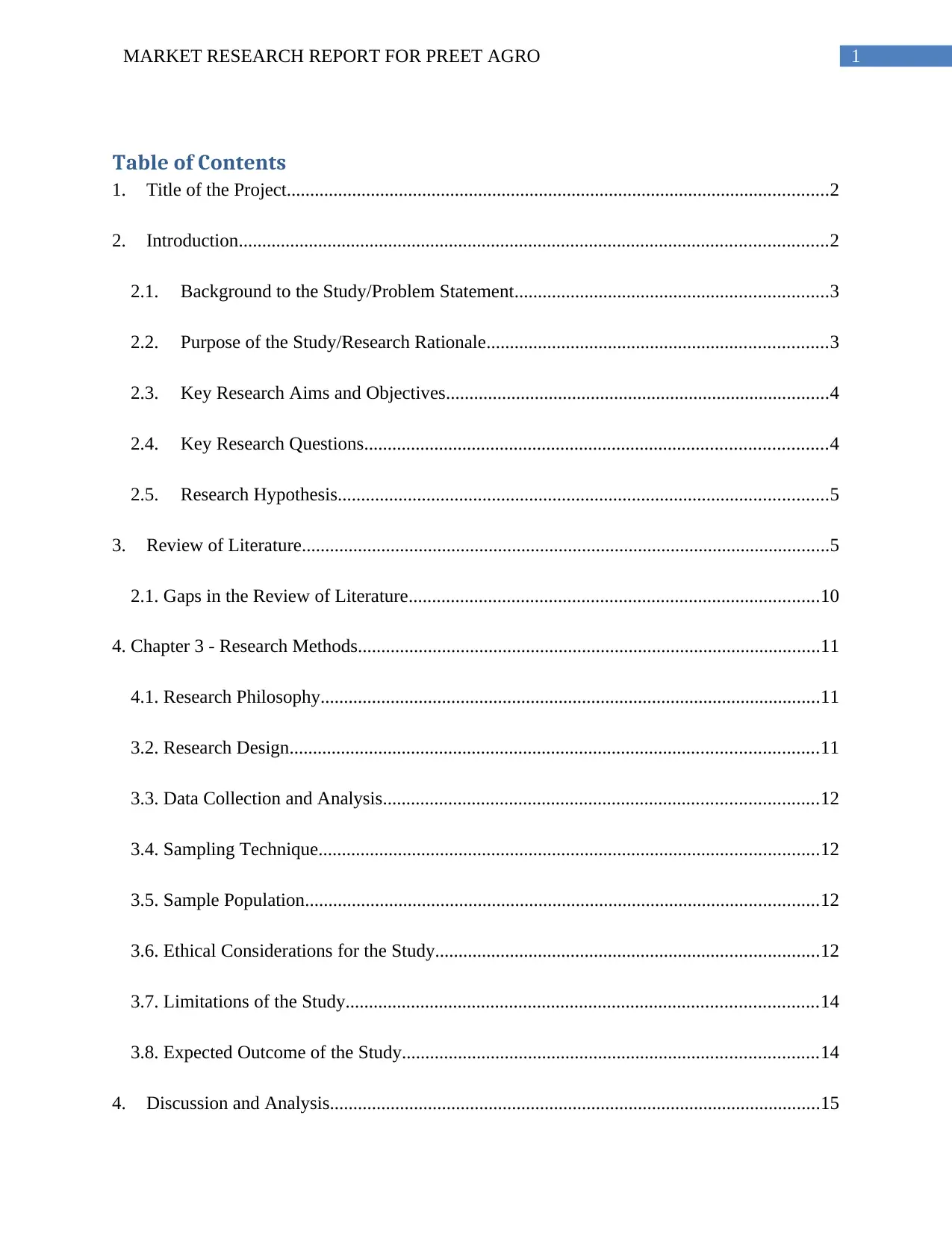
Table of Contents
1. Title of the Project....................................................................................................................2
2. Introduction..............................................................................................................................2
2.1. Background to the Study/Problem Statement...................................................................3
2.2. Purpose of the Study/Research Rationale.........................................................................3
2.3. Key Research Aims and Objectives..................................................................................4
2.4. Key Research Questions...................................................................................................4
2.5. Research Hypothesis.........................................................................................................5
3. Review of Literature.................................................................................................................5
2.1. Gaps in the Review of Literature........................................................................................10
4. Chapter 3 - Research Methods...................................................................................................11
4.1. Research Philosophy...........................................................................................................11
3.2. Research Design.................................................................................................................11
3.3. Data Collection and Analysis.............................................................................................12
3.4. Sampling Technique...........................................................................................................12
3.5. Sample Population..............................................................................................................12
3.6. Ethical Considerations for the Study..................................................................................12
3.7. Limitations of the Study.....................................................................................................14
3.8. Expected Outcome of the Study.........................................................................................14
4. Discussion and Analysis.........................................................................................................15
Table of Contents
1. Title of the Project....................................................................................................................2
2. Introduction..............................................................................................................................2
2.1. Background to the Study/Problem Statement...................................................................3
2.2. Purpose of the Study/Research Rationale.........................................................................3
2.3. Key Research Aims and Objectives..................................................................................4
2.4. Key Research Questions...................................................................................................4
2.5. Research Hypothesis.........................................................................................................5
3. Review of Literature.................................................................................................................5
2.1. Gaps in the Review of Literature........................................................................................10
4. Chapter 3 - Research Methods...................................................................................................11
4.1. Research Philosophy...........................................................................................................11
3.2. Research Design.................................................................................................................11
3.3. Data Collection and Analysis.............................................................................................12
3.4. Sampling Technique...........................................................................................................12
3.5. Sample Population..............................................................................................................12
3.6. Ethical Considerations for the Study..................................................................................12
3.7. Limitations of the Study.....................................................................................................14
3.8. Expected Outcome of the Study.........................................................................................14
4. Discussion and Analysis.........................................................................................................15
2MARKET RESEARCH REPORT FOR PREET AGRO
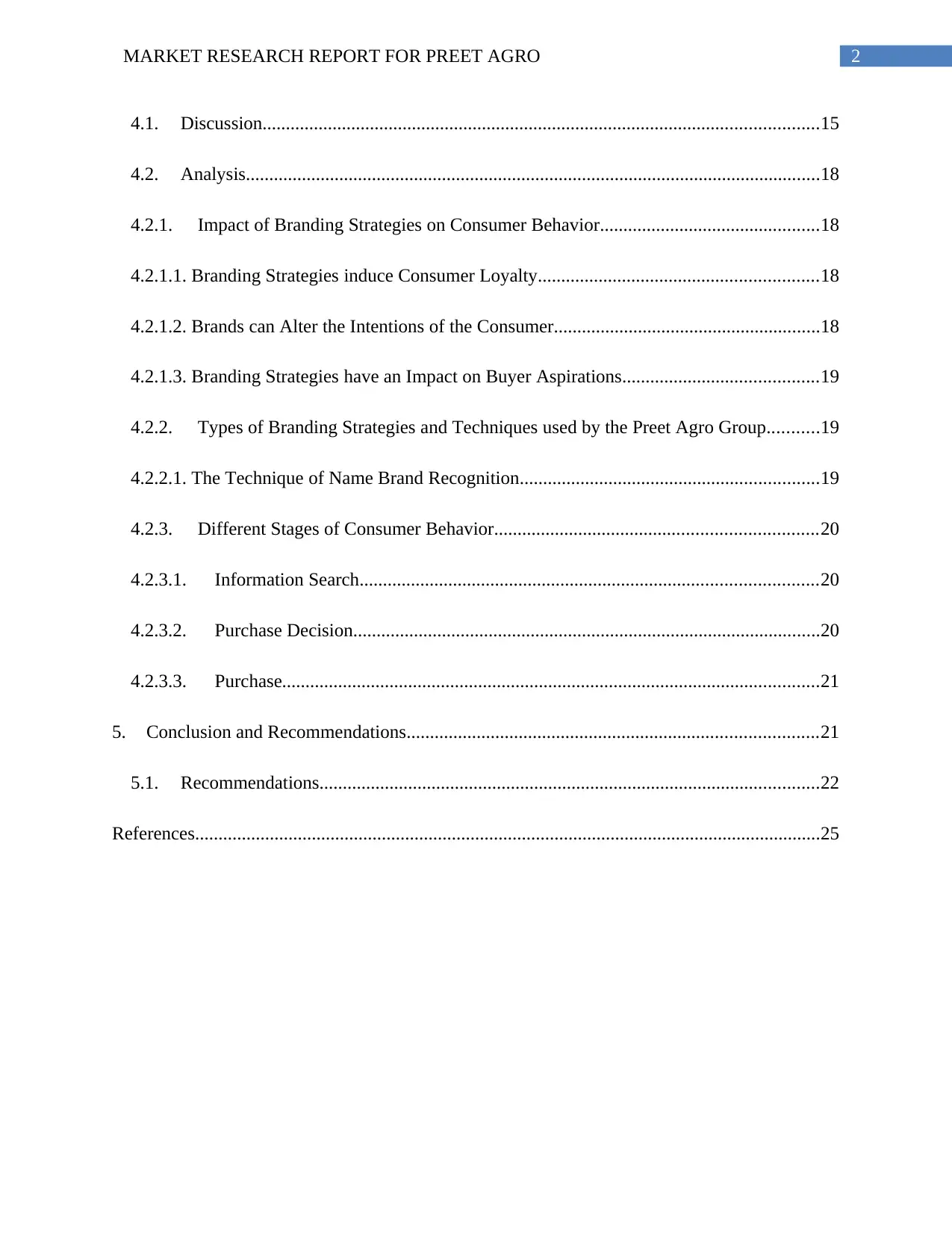
4.1. Discussion.......................................................................................................................15
4.2. Analysis...........................................................................................................................18
4.2.1. Impact of Branding Strategies on Consumer Behavior...............................................18
4.2.1.1. Branding Strategies induce Consumer Loyalty............................................................18
4.2.1.2. Brands can Alter the Intentions of the Consumer.........................................................18
4.2.1.3. Branding Strategies have an Impact on Buyer Aspirations..........................................19
4.2.2. Types of Branding Strategies and Techniques used by the Preet Agro Group...........19
4.2.2.1. The Technique of Name Brand Recognition................................................................19
4.2.3. Different Stages of Consumer Behavior.....................................................................20
4.2.3.1. Information Search..................................................................................................20
4.2.3.2. Purchase Decision....................................................................................................20
4.2.3.3. Purchase...................................................................................................................21
5. Conclusion and Recommendations........................................................................................21
5.1. Recommendations...........................................................................................................22
References......................................................................................................................................25
4.1. Discussion.......................................................................................................................15
4.2. Analysis...........................................................................................................................18
4.2.1. Impact of Branding Strategies on Consumer Behavior...............................................18
4.2.1.1. Branding Strategies induce Consumer Loyalty............................................................18
4.2.1.2. Brands can Alter the Intentions of the Consumer.........................................................18
4.2.1.3. Branding Strategies have an Impact on Buyer Aspirations..........................................19
4.2.2. Types of Branding Strategies and Techniques used by the Preet Agro Group...........19
4.2.2.1. The Technique of Name Brand Recognition................................................................19
4.2.3. Different Stages of Consumer Behavior.....................................................................20
4.2.3.1. Information Search..................................................................................................20
4.2.3.2. Purchase Decision....................................................................................................20
4.2.3.3. Purchase...................................................................................................................21
5. Conclusion and Recommendations........................................................................................21
5.1. Recommendations...........................................................................................................22
References......................................................................................................................................25
⊘ This is a preview!⊘
Do you want full access?
Subscribe today to unlock all pages.

Trusted by 1+ million students worldwide
3MARKET RESEARCH REPORT FOR PREET AGRO
1. Title of the Project
The impact of the branding strategies on consumer buying behavior: The Case of Preet Agro
Group
2. Introduction
Branding plays a crucial role in the marketing of a business or enterprise. Branding is
seen to have a significant impact on the attitudes, beliefs and images of consumers towards
products and services, and it has a large scale influence on their purchasing behavior (Matzler
2015). An important effect of branding on consumer behavior is the fact that it induces
customers to be loyal towards a particular product or service, in both the short and the long term.
A brand helps in conveying the views and ideas of entrepreneurs to the rest of the world, and it
also assists entrepreneurs to connect with prospective customers for their business. As a whole,
branding is seen to have quite a prominent impact on business affairs, especially so far as
consumer behavior is concerned (Li et al. 2017). The appeal or the attractive features of a
product are communicated to customers by the brand value of the product. Sometimes,
consumers are seen to buy products, regardless of their utility value, simply because the brand
value of the concerned product is high. Branding is an intricate process and is conducted by a
team of specialists who are hired by a firm or a business enterprise exclusively for this purpose.
Branding has a role to play in enhancing the business value of a commodity, above all else
(Godey et al. 2016). This assignment prepares a research report, that identifies the impact that
branding strategies have on consumer behavior, with special reference to the firm Preet-Agro.
For this purpose, the research problem, the key research aims, objectives and research questions
1. Title of the Project
The impact of the branding strategies on consumer buying behavior: The Case of Preet Agro
Group
2. Introduction
Branding plays a crucial role in the marketing of a business or enterprise. Branding is
seen to have a significant impact on the attitudes, beliefs and images of consumers towards
products and services, and it has a large scale influence on their purchasing behavior (Matzler
2015). An important effect of branding on consumer behavior is the fact that it induces
customers to be loyal towards a particular product or service, in both the short and the long term.
A brand helps in conveying the views and ideas of entrepreneurs to the rest of the world, and it
also assists entrepreneurs to connect with prospective customers for their business. As a whole,
branding is seen to have quite a prominent impact on business affairs, especially so far as
consumer behavior is concerned (Li et al. 2017). The appeal or the attractive features of a
product are communicated to customers by the brand value of the product. Sometimes,
consumers are seen to buy products, regardless of their utility value, simply because the brand
value of the concerned product is high. Branding is an intricate process and is conducted by a
team of specialists who are hired by a firm or a business enterprise exclusively for this purpose.
Branding has a role to play in enhancing the business value of a commodity, above all else
(Godey et al. 2016). This assignment prepares a research report, that identifies the impact that
branding strategies have on consumer behavior, with special reference to the firm Preet-Agro.
For this purpose, the research problem, the key research aims, objectives and research questions
Paraphrase This Document
Need a fresh take? Get an instant paraphrase of this document with our AI Paraphraser
4MARKET RESEARCH REPORT FOR PREET AGRO
are identified, an in-depth literature review on the subject of branding and consumer behavior is
undertaken, the methodology for the study is outlined, and the findings of the research are then
stated, discussed and analyzed thematically. The report concludes with a number of effective
recommendations that can be taken into consideration by Preet Agro, for improving its brand
strategies so as to have a more positive impact on its consumer base.
2.1. Background to the Study/Problem Statement
Preet Agro Group is a firm that concerns itself with the manufacture of harvesters that are
made use of in farming activities like paddy and wheat harvesting. The area over which planting
activities are undertaken covers as much as sixty five thousand square meters of land, with the
turnover over of the business being around 100 crores. The business is serviced by a substantive
employee base, with 500 workers and 325 staff members being employed under the payroll of
the company.
2.2. Purpose of the Study/Research Rationale
Preet Agro Group is situated in India, a country which is primarily agrarian and where
agriculture is the industry that employs fifty percent of the total workforce of the country.
Competition in the domain of agriculture is something that is seen to increase on a day to day
basis, and it is imperative for buying behavior to be understood and analyzed, so that companies
may be appropriately involved in the fruitful production of products and services. This research
is going to focus at an individual level as to how branding strategies have an impact on buying
behavior of consumers with special reference to the Preet Agro Group. Preet Agro has in the
recent past, emerged as a brand, and employs a considerable number of people in the region
where it operates, while acquiring a sizeable portion of returns from the market as well. It is
necessary to understand the ways and means by which the brand is being promoted among its
are identified, an in-depth literature review on the subject of branding and consumer behavior is
undertaken, the methodology for the study is outlined, and the findings of the research are then
stated, discussed and analyzed thematically. The report concludes with a number of effective
recommendations that can be taken into consideration by Preet Agro, for improving its brand
strategies so as to have a more positive impact on its consumer base.
2.1. Background to the Study/Problem Statement
Preet Agro Group is a firm that concerns itself with the manufacture of harvesters that are
made use of in farming activities like paddy and wheat harvesting. The area over which planting
activities are undertaken covers as much as sixty five thousand square meters of land, with the
turnover over of the business being around 100 crores. The business is serviced by a substantive
employee base, with 500 workers and 325 staff members being employed under the payroll of
the company.
2.2. Purpose of the Study/Research Rationale
Preet Agro Group is situated in India, a country which is primarily agrarian and where
agriculture is the industry that employs fifty percent of the total workforce of the country.
Competition in the domain of agriculture is something that is seen to increase on a day to day
basis, and it is imperative for buying behavior to be understood and analyzed, so that companies
may be appropriately involved in the fruitful production of products and services. This research
is going to focus at an individual level as to how branding strategies have an impact on buying
behavior of consumers with special reference to the Preet Agro Group. Preet Agro has in the
recent past, emerged as a brand, and employs a considerable number of people in the region
where it operates, while acquiring a sizeable portion of returns from the market as well. It is
necessary to understand the ways and means by which the brand is being promoted among its
5MARKET RESEARCH REPORT FOR PREET AGRO
consumers to assess the exact impact that branding has on consumer behavior. Consumer
behavior is seen to vary in nature and form from one industry to another, which is why there is
an overarching need for this behavior to be adequately understood in the context of agriculture.
Market research will therefore be conducted to review and assess the needs of customers, so that
their demands or expectations from a particular product or service can be met accordingly.
Preet Agro is a business that has the potential to expand and grow in the coming years. It
is operating in a profitable manner, and it is necessary for consumer behavior or buying behavior
of customers to be analyzed to understand how it is that consumers are going to react or behave,
if the business opts to expand in the near or distant future. Most importantly, the research will
provide an understanding of how Preet Agro as a business should position itself in the market, so
as to steer ahead of rivals and consumers while enjoying valuable and higher returns from
consumers at the same given time.
2.3. Key Research Aims and Objectives
The main aims and objectives of this research are as follows –
To determine the impact of brand strategies on consumer behavior
To determine the types of branding techniques and methods that are adopted by the Preet
Agro Group
2.4. Key Research Questions
The following are some of the key research questions that this assignment seeks to answer –
RQ 1 – What is the impact of brand positioning strategies on consumer behavior?
consumers to assess the exact impact that branding has on consumer behavior. Consumer
behavior is seen to vary in nature and form from one industry to another, which is why there is
an overarching need for this behavior to be adequately understood in the context of agriculture.
Market research will therefore be conducted to review and assess the needs of customers, so that
their demands or expectations from a particular product or service can be met accordingly.
Preet Agro is a business that has the potential to expand and grow in the coming years. It
is operating in a profitable manner, and it is necessary for consumer behavior or buying behavior
of customers to be analyzed to understand how it is that consumers are going to react or behave,
if the business opts to expand in the near or distant future. Most importantly, the research will
provide an understanding of how Preet Agro as a business should position itself in the market, so
as to steer ahead of rivals and consumers while enjoying valuable and higher returns from
consumers at the same given time.
2.3. Key Research Aims and Objectives
The main aims and objectives of this research are as follows –
To determine the impact of brand strategies on consumer behavior
To determine the types of branding techniques and methods that are adopted by the Preet
Agro Group
2.4. Key Research Questions
The following are some of the key research questions that this assignment seeks to answer –
RQ 1 – What is the impact of brand positioning strategies on consumer behavior?
⊘ This is a preview!⊘
Do you want full access?
Subscribe today to unlock all pages.
Trusted by 1+ million students worldwide
6MARKET RESEARCH REPORT FOR PREET AGRO
RQ 2 – What are the types of branding methods and techniques that are adopted by the Preet
Agro Group?
RQ 3 – What are the different stages of consumer buying behavior?
2.5. Research Hypothesis
This research seeks to validate the following hypothesis –
Hypothesis 1 – Branding strategies have a positive impact on consumer behavior
Hypothesis 2 – Branding strategies have a negative impact on consumer behavior
Hypothesis 3 – Branding strategies have no impact on consumer behavior
3. Review of Literature
Godey et al. (2016), have made an attempt to study the way by which social media
branding or marketing has an impact on the behavior of consumers. In the view of Godey et al.
(2016), the majority of people in today’s day and age are active users of social media and are
seen to long onto the social media platforms for at least two to three hours in a day. Godey et al.
(2016) argues that what makes the use of social media something that is so population is the easy
ways by which social media can be accessed and also the quick and easy dissemination of
knowledge that is facilitated through the use of social media. In the view of the researchers both
brand image as well as brand consciousness are significantly developed through the use of what
may be termed as social media marketing efforts. It is further argued by the researchers that a
direct relationship is seen to exist between social media marketing endeavors and various factors
of branding such as price premium, brand loyalty and brand preference among other things. It is
the conclusion of Godey et al. (2016) that social media marketing has a direct impact on
RQ 2 – What are the types of branding methods and techniques that are adopted by the Preet
Agro Group?
RQ 3 – What are the different stages of consumer buying behavior?
2.5. Research Hypothesis
This research seeks to validate the following hypothesis –
Hypothesis 1 – Branding strategies have a positive impact on consumer behavior
Hypothesis 2 – Branding strategies have a negative impact on consumer behavior
Hypothesis 3 – Branding strategies have no impact on consumer behavior
3. Review of Literature
Godey et al. (2016), have made an attempt to study the way by which social media
branding or marketing has an impact on the behavior of consumers. In the view of Godey et al.
(2016), the majority of people in today’s day and age are active users of social media and are
seen to long onto the social media platforms for at least two to three hours in a day. Godey et al.
(2016) argues that what makes the use of social media something that is so population is the easy
ways by which social media can be accessed and also the quick and easy dissemination of
knowledge that is facilitated through the use of social media. In the view of the researchers both
brand image as well as brand consciousness are significantly developed through the use of what
may be termed as social media marketing efforts. It is further argued by the researchers that a
direct relationship is seen to exist between social media marketing endeavors and various factors
of branding such as price premium, brand loyalty and brand preference among other things. It is
the conclusion of Godey et al. (2016) that social media marketing has a direct impact on
Paraphrase This Document
Need a fresh take? Get an instant paraphrase of this document with our AI Paraphraser
7MARKET RESEARCH REPORT FOR PREET AGRO
branding strategies adopted by businesses around the world to enhance the appeal or value of
their goods and services.
Singh et al. (2019) have tried to see how response and crisis strategies are seen to
have an impact on the manner by which consumers perceive or view corporate brand alliances.
Brand alliancing in the view of the researchers is quite a popular strategy and it is seen to hold
special value for allied brands. The results of the research reveal that preventable crisis is seen to
have quite a detrimental impact on the image that is associated with the culpable ally. Co-
branding in the view of the researchers is something that needs to be undertaken by companies
with a considerable degree of care, that crisis is something that needs to be planned for, and that
the viability of various types of response strategies must be judiciously considered. If this is not
done, in the view of the researchers, there is every possibility of the fact that the co-branding
strategies that are indeed adopted are those that work against the reputation or image of the
company instead of working in its favor.
The impact that various types of branding strategies are seen to have on
downward and horizontal line extensions is a subject that has been studied in a great amount of
detail by Boisvert and Ashill (2018). It is argued by the researchers that the sub-typing effects
which are created by sub branded downward line extensions are rated in a similar fashion to the
direct brand extensions that otherwise oppose the previous beliefs that have been put forward in
different types of non-luxury settings. The impact that gender is seen to have in this respect has
also been an area of investigation for the researchers. The research has been carried out in a cross
cultural context, and a number of managerial and theoretical insights have been provided on the
part of the researchers, with respect to the launching of new downward line extensions. These
downward line extensions entail proper use of different types of brand strategies and branding
branding strategies adopted by businesses around the world to enhance the appeal or value of
their goods and services.
Singh et al. (2019) have tried to see how response and crisis strategies are seen to
have an impact on the manner by which consumers perceive or view corporate brand alliances.
Brand alliancing in the view of the researchers is quite a popular strategy and it is seen to hold
special value for allied brands. The results of the research reveal that preventable crisis is seen to
have quite a detrimental impact on the image that is associated with the culpable ally. Co-
branding in the view of the researchers is something that needs to be undertaken by companies
with a considerable degree of care, that crisis is something that needs to be planned for, and that
the viability of various types of response strategies must be judiciously considered. If this is not
done, in the view of the researchers, there is every possibility of the fact that the co-branding
strategies that are indeed adopted are those that work against the reputation or image of the
company instead of working in its favor.
The impact that various types of branding strategies are seen to have on
downward and horizontal line extensions is a subject that has been studied in a great amount of
detail by Boisvert and Ashill (2018). It is argued by the researchers that the sub-typing effects
which are created by sub branded downward line extensions are rated in a similar fashion to the
direct brand extensions that otherwise oppose the previous beliefs that have been put forward in
different types of non-luxury settings. The impact that gender is seen to have in this respect has
also been an area of investigation for the researchers. The research has been carried out in a cross
cultural context, and a number of managerial and theoretical insights have been provided on the
part of the researchers, with respect to the launching of new downward line extensions. These
downward line extensions entail proper use of different types of brand strategies and branding
8MARKET RESEARCH REPORT FOR PREET AGRO
techniques that take cognizance of gender based issues and problems and which are seen to
target specific types of genders in particular, such as those who belong to the LGTBQ
community or who are seen to identify themselves as transvestite and transgender.
The co creation of brands with people who have acquired member of online brand
communities is a subject that has been studied and analyzed by Hajli (2016). In the view of the
researchers, the co-creation of value in the process of branding is something that is worthy of
further study and research. This study in particular has been carried out in the context of Iran. As
many as three online communities in the country of Iran were subjected to rigorous online
interviews, with the interviews and structured discussions that took place with the respondent
population being around 45 in number. Content analysis has been engaged in on the part of the
researcher and the results of the study reveal that the social interactions that are carried out by
people or customers in the online brand communities go a long way in enhancing the value or the
appeal of a particular brand. It is therefore concluded by the researchers, that firms ought to
create or develop branding strategies through the use of social media platforms. The procedure
by which they should do so is known as relationship marketing, with an online co-creation
strategy being utilized by the company owners, to this extent.
Turkei et al. (2015) have undertaken research on the impact that brand familiarity has on
the responses of consumers. The study has been carried out in the context of communications
pertaining to corporate social responsibility. An attempt has been made by the researchers to see
how brand familiarity can impact the type of communication that consumers are seen to engage
in, in the domain of corporate social responsibility. It is argued by the researchers that familiar
and unfamiliar brands are not seen to differ from each other in any given way, as far as consumer
attitudes are concerned, but generate responses which cannot be considered as similar to one
techniques that take cognizance of gender based issues and problems and which are seen to
target specific types of genders in particular, such as those who belong to the LGTBQ
community or who are seen to identify themselves as transvestite and transgender.
The co creation of brands with people who have acquired member of online brand
communities is a subject that has been studied and analyzed by Hajli (2016). In the view of the
researchers, the co-creation of value in the process of branding is something that is worthy of
further study and research. This study in particular has been carried out in the context of Iran. As
many as three online communities in the country of Iran were subjected to rigorous online
interviews, with the interviews and structured discussions that took place with the respondent
population being around 45 in number. Content analysis has been engaged in on the part of the
researcher and the results of the study reveal that the social interactions that are carried out by
people or customers in the online brand communities go a long way in enhancing the value or the
appeal of a particular brand. It is therefore concluded by the researchers, that firms ought to
create or develop branding strategies through the use of social media platforms. The procedure
by which they should do so is known as relationship marketing, with an online co-creation
strategy being utilized by the company owners, to this extent.
Turkei et al. (2015) have undertaken research on the impact that brand familiarity has on
the responses of consumers. The study has been carried out in the context of communications
pertaining to corporate social responsibility. An attempt has been made by the researchers to see
how brand familiarity can impact the type of communication that consumers are seen to engage
in, in the domain of corporate social responsibility. It is argued by the researchers that familiar
and unfamiliar brands are not seen to differ from each other in any given way, as far as consumer
attitudes are concerned, but generate responses which cannot be considered as similar to one
⊘ This is a preview!⊘
Do you want full access?
Subscribe today to unlock all pages.
Trusted by 1+ million students worldwide
9MARKET RESEARCH REPORT FOR PREET AGRO
another, with regards to their attitude towards purchase intentions and brands. The managerial
implications associated with the formulation as well as the dissemination of CSR communication
or CSR related messages have been well pointed out in the course of this study. In the view of
the authors, this formulation and dissemination of CSR communication is something that needs
to be engaged in on the part of managers, if stakeholders are to be kept happy and if they are to
be communicated with, in the desired manner or style.
Carlsson and Nilsson (2017), have studied the impact that country of origin cues are seen
to have on the investment behavior of consumers. The task of investing assets in the view of the
researchers, does not appear to be an easy one from the perspective of consumers. For instance, it
is argued by the researchers that investing in mutual funds can prove to be risky business for a
consumer. In this event, it is stated by Carlsson and Nilsson (2017) that country of origin cues
can prove to be helpful for consumers. By knowing more about the country and other local
information of the place from where the mutual fund originates, a decision can be taken by
consumers about whether or not to make an investment. A number of web based experiments
were carried out on the part of the researchers in order to test the research hypothesis. The
insights that have been gained from the study prove to be useful not only for consumers around
the world but also for individual service providers. The results of the research reveal with a great
degree of clarity that country of origin cues prove to be very useful in influencing investors to
make the right decision, especially when entering into a mutual fund investment.
Li et al. (2017) have proposed a new framework using which consumer behavior can be
better understood and this is known as the looseness and tightness framework. In the view of the
researchers, the cross cultural research that has previously taken place in the domain of consumer
behavior has tended to focus only on cultural values and nothing more. The tightness looseness
another, with regards to their attitude towards purchase intentions and brands. The managerial
implications associated with the formulation as well as the dissemination of CSR communication
or CSR related messages have been well pointed out in the course of this study. In the view of
the authors, this formulation and dissemination of CSR communication is something that needs
to be engaged in on the part of managers, if stakeholders are to be kept happy and if they are to
be communicated with, in the desired manner or style.
Carlsson and Nilsson (2017), have studied the impact that country of origin cues are seen
to have on the investment behavior of consumers. The task of investing assets in the view of the
researchers, does not appear to be an easy one from the perspective of consumers. For instance, it
is argued by the researchers that investing in mutual funds can prove to be risky business for a
consumer. In this event, it is stated by Carlsson and Nilsson (2017) that country of origin cues
can prove to be helpful for consumers. By knowing more about the country and other local
information of the place from where the mutual fund originates, a decision can be taken by
consumers about whether or not to make an investment. A number of web based experiments
were carried out on the part of the researchers in order to test the research hypothesis. The
insights that have been gained from the study prove to be useful not only for consumers around
the world but also for individual service providers. The results of the research reveal with a great
degree of clarity that country of origin cues prove to be very useful in influencing investors to
make the right decision, especially when entering into a mutual fund investment.
Li et al. (2017) have proposed a new framework using which consumer behavior can be
better understood and this is known as the looseness and tightness framework. In the view of the
researchers, the cross cultural research that has previously taken place in the domain of consumer
behavior has tended to focus only on cultural values and nothing more. The tightness looseness
Paraphrase This Document
Need a fresh take? Get an instant paraphrase of this document with our AI Paraphraser
10MARKET RESEARCH REPORT FOR PREET AGRO
framework has argued by the researchers is a new dimension using which consumer behavior can
be looked at and analyzed. As such the framework indicates the strength of various types of
social norms as well as the tolerance in society for deviant behavior. An attempt has been made
on the part of the researchers to assess the type of impact that the tightness looseness framework
is seen to have on persuasion in the area of advertising. Product diffusion and brand consumer
relationships have also been examined by a considerable degree in this piece of research. Finally,
the implications that the tightness looseness framework holds for the wellbeing of consumers is
also a subject that has been exposed to considerable scrutiny and examination in this piece of
work.
The relation between culture and brand personality has been studied to a great
extent by Matzler (2015). In the view of the researchers, brand personality is quite a useful
concept and it describes many different perceptions of countries as tourist destinations. It is
further argued by the researchers that the self-congruity of a consumer brand mediates the
relation that is seen to exist between visit intentions and perceived brand personality. Uncertainty
and individual avoidance have a role to play in moderating the relation between visit intentions
and brand self-congruity. It is further added on the part of the researchers that personality
characteristics constitute an effective segmentation approach with respect to the market. The use
or the implementation of brand personification strategies have also been recommended by the
researchers, arguing in the bargain that such strategies might appear to be effective depending on
of course, various types of cultural differences. In the view of Matzler (2015) tourist destinations
are seen to make particular use of brand personification strategies as these are strategies that are
seen to evoke consumer behavior that is positive and which is likely to work in favor of the
tourist destinations instead of going against the tourist destination.
framework has argued by the researchers is a new dimension using which consumer behavior can
be looked at and analyzed. As such the framework indicates the strength of various types of
social norms as well as the tolerance in society for deviant behavior. An attempt has been made
on the part of the researchers to assess the type of impact that the tightness looseness framework
is seen to have on persuasion in the area of advertising. Product diffusion and brand consumer
relationships have also been examined by a considerable degree in this piece of research. Finally,
the implications that the tightness looseness framework holds for the wellbeing of consumers is
also a subject that has been exposed to considerable scrutiny and examination in this piece of
work.
The relation between culture and brand personality has been studied to a great
extent by Matzler (2015). In the view of the researchers, brand personality is quite a useful
concept and it describes many different perceptions of countries as tourist destinations. It is
further argued by the researchers that the self-congruity of a consumer brand mediates the
relation that is seen to exist between visit intentions and perceived brand personality. Uncertainty
and individual avoidance have a role to play in moderating the relation between visit intentions
and brand self-congruity. It is further added on the part of the researchers that personality
characteristics constitute an effective segmentation approach with respect to the market. The use
or the implementation of brand personification strategies have also been recommended by the
researchers, arguing in the bargain that such strategies might appear to be effective depending on
of course, various types of cultural differences. In the view of Matzler (2015) tourist destinations
are seen to make particular use of brand personification strategies as these are strategies that are
seen to evoke consumer behavior that is positive and which is likely to work in favor of the
tourist destinations instead of going against the tourist destination.
11MARKET RESEARCH REPORT FOR PREET AGRO
The concept of the brand self and what may be termed as consumer brand identification
are concepts that have been studied by Dawetas and Diamantapoulos (2017). The role that
consumer brand identification has to play in influencing consumer responses towards the
purchase of regret is a subject that has been investigated by the researchers. Both consumer
brand relationship literature and regret theory have been drawn on, with extensive empirical
research being carried out on the part of the investigators to arrive at some definitive conclusions
on the subject matter. The results of the research happen to reveal that the process of consumer
brand identification is one that is seen to accentuate the negative impact of regret on brand
repurchase or recommendation and on satisfaction. A number of managerial insights have been
provided in the course of this research that contributes to an understanding of how effective
branding strategies can be conceived or developed especially in conditions where intensive
competitive pressure is seen to exist. It is only empirical research that has been undertaken for
the most part, with the scenario manipulation of the purchase of regret being carried out to
understand the protective role that is played by consumer brand identification.
2.1. Gaps in the Review of Literature
The literature that has been reviewed above, has pointed to the many ways by which
consumer behavior can be influenced, be it through the domain of social media marketing, or
various other types of factors or endeavors. The many dimensions and dynamics of consumer
behavior and the importance of product branding have also been touched upon in the review of
literature. What the literature review does not point out is how brand strategies impact consumer
behavior. This gap in the literature review will be studied in the context of Preet Agro Group for
this particular investigation.
The concept of the brand self and what may be termed as consumer brand identification
are concepts that have been studied by Dawetas and Diamantapoulos (2017). The role that
consumer brand identification has to play in influencing consumer responses towards the
purchase of regret is a subject that has been investigated by the researchers. Both consumer
brand relationship literature and regret theory have been drawn on, with extensive empirical
research being carried out on the part of the investigators to arrive at some definitive conclusions
on the subject matter. The results of the research happen to reveal that the process of consumer
brand identification is one that is seen to accentuate the negative impact of regret on brand
repurchase or recommendation and on satisfaction. A number of managerial insights have been
provided in the course of this research that contributes to an understanding of how effective
branding strategies can be conceived or developed especially in conditions where intensive
competitive pressure is seen to exist. It is only empirical research that has been undertaken for
the most part, with the scenario manipulation of the purchase of regret being carried out to
understand the protective role that is played by consumer brand identification.
2.1. Gaps in the Review of Literature
The literature that has been reviewed above, has pointed to the many ways by which
consumer behavior can be influenced, be it through the domain of social media marketing, or
various other types of factors or endeavors. The many dimensions and dynamics of consumer
behavior and the importance of product branding have also been touched upon in the review of
literature. What the literature review does not point out is how brand strategies impact consumer
behavior. This gap in the literature review will be studied in the context of Preet Agro Group for
this particular investigation.
⊘ This is a preview!⊘
Do you want full access?
Subscribe today to unlock all pages.
Trusted by 1+ million students worldwide

1 out of 28


Related Documents


Your All-in-One AI-Powered Toolkit for Academic Success.
+13062052269
info@desklib.com
Available 24*7 on WhatsApp / Email
![[object Object]](/_next/static/media/star-bottom.7253800d.svg)
Unlock your academic potential
Copyright © 2020–2026 A2Z Services. All Rights Reserved. Developed and managed by ZUCOL.