An Examination of Branding's Effectiveness on Consumer Choices: Lush
VerifiedAdded on 2023/01/05
|9
|2577
|95
Project
AI Summary
This project is a comprehensive case study that examines the effectiveness of branding on consumer choices, with Lush Cosmetics as the focal point. It begins by establishing the background of branding and its importance, as well as providing context on Lush as a company. The research explores the rationale behind the study, poses key research questions regarding branding's impact, and outlines the aim and objectives. The methodology section details the research approach, including the use of the research onion and deductive approach, survey strategy, and quantitative methods for data collection and analysis. The project also covers the timescale and resources needed for the research, including human, financial, technological, and physical resources. The study employs a sample size of 30 respondents, utilizing primary and secondary research methods, including questionnaires, articles, and journals. The project concludes with a list of references used for the research.
“An examination into the
effectiveness of branding
on consumer choices,
from a customer's
perspective”: A case study
on Lush
effectiveness of branding
on consumer choices,
from a customer's
perspective”: A case study
on Lush

Paraphrase This Document
Need a fresh take? Get an instant paraphrase of this document with our AI Paraphraser
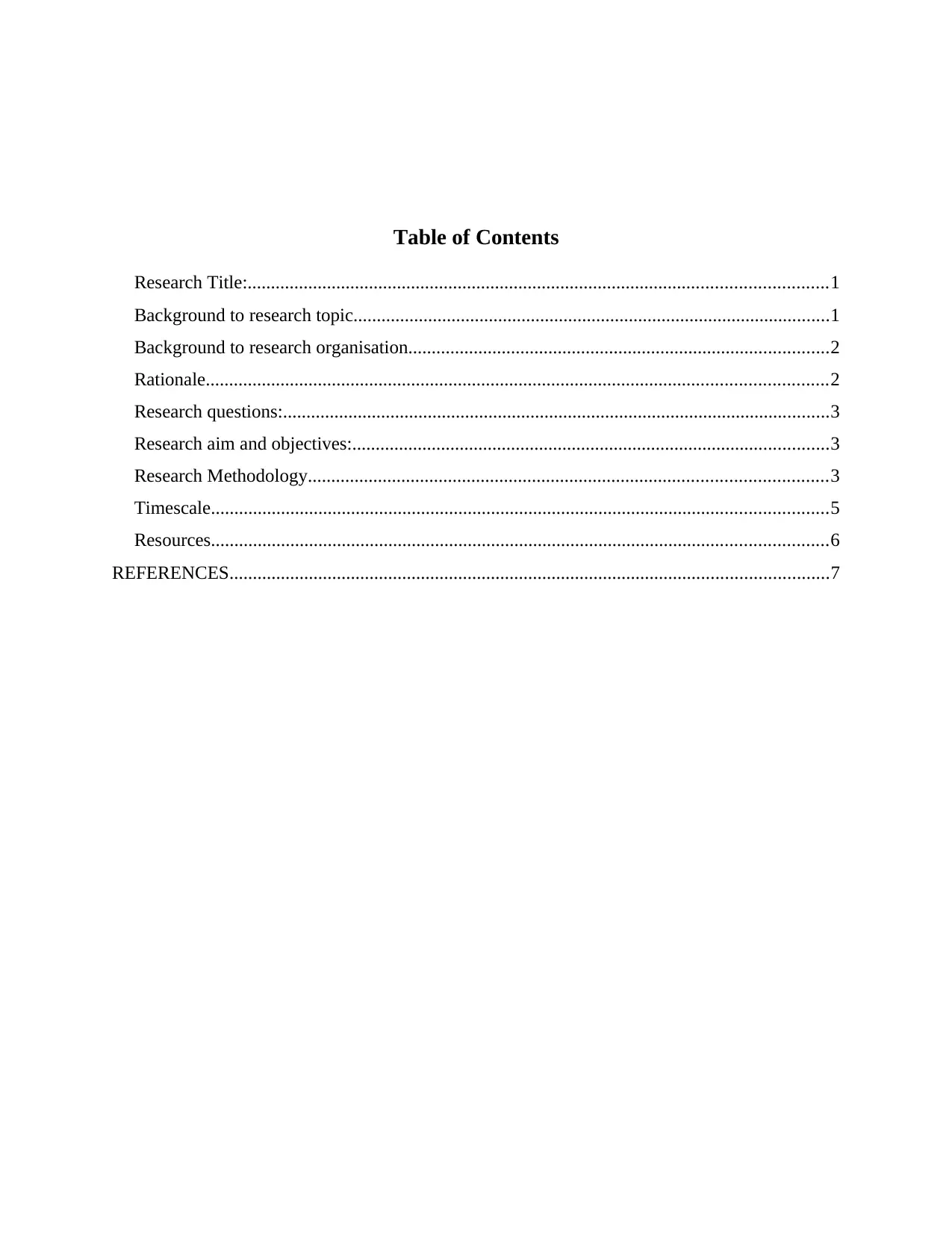
Table of Contents
Research Title:............................................................................................................................1
Background to research topic......................................................................................................1
Background to research organisation..........................................................................................2
Rationale.....................................................................................................................................2
Research questions:.....................................................................................................................3
Research aim and objectives:......................................................................................................3
Research Methodology...............................................................................................................3
Timescale....................................................................................................................................5
Resources....................................................................................................................................6
REFERENCES................................................................................................................................7
Research Title:............................................................................................................................1
Background to research topic......................................................................................................1
Background to research organisation..........................................................................................2
Rationale.....................................................................................................................................2
Research questions:.....................................................................................................................3
Research aim and objectives:......................................................................................................3
Research Methodology...............................................................................................................3
Timescale....................................................................................................................................5
Resources....................................................................................................................................6
REFERENCES................................................................................................................................7
Research Title:
“An examination into the effectiveness of branding on consumer choices, from a
customer's perspective”: A case study on Lush.
Background to research topic
Branding is usually nuanced as an art through which better and clear shaping of particular
brands and services is offered. It is also being used to create and develop certain strategy that
assists to establish self appearance so that strong connectivity is sparks as with marketplace and
targeted audience. It gives more values that ultimately used to enhance market reputation in
future period of time (Boisen and et. al., 2018). In support of branding business has uses strong
interconnectivity through which certain balance and consistency is developed that aid to attain
higher growth and development. It is an essential prospect for each company and as it assist to
make memorable impression within consumers. It also allows the client and customer's to
achieve better heights under which expectations of customer's and business both get achieved. In
this manner business easily differentiate its services from already present companies within
competitive marketplace. It processed sustain clarification through which offered services is
differed on the basis of selection of better choice. The vital purpose of branding is to ensure that
consistent identity is reflected in marketplace as by making clear prospect of sales, marketing,
support, product, corporate culture, operations, functions get expanded in compelled manner. It
is even more important for consumer prospective under which strong connection is processed by
business by which better relation in terms of emotional connection is developed. It is also used to
make and develop continuous loyalty, customer's retention, trust, faith, believe so that long term
effectiveness is processed in sustained mode.
There is different practices that is selected by business to develop effectiveness among
consumer choices in numerous manner. Branding has direct influence on the consumers choices
as in this customer get notice and related themselves in ordinate mode (Ebrahimi,
Hajmohammadi and Khajeheian, 2020). It also influence quicker response by which recognition
of products and services is progressed in systematic manner. In this the purchasing decision of
consumer is changes as per certain preference. It is processed by influencing purchasing and
customer decision making in relation to marketing, advertising. It helps to create strong
emotional connectivity by which long term sustainability is developed in effective mode. The
effectiveness of branding is more necessary aspect under which consumer has pay higher
1
“An examination into the effectiveness of branding on consumer choices, from a
customer's perspective”: A case study on Lush.
Background to research topic
Branding is usually nuanced as an art through which better and clear shaping of particular
brands and services is offered. It is also being used to create and develop certain strategy that
assists to establish self appearance so that strong connectivity is sparks as with marketplace and
targeted audience. It gives more values that ultimately used to enhance market reputation in
future period of time (Boisen and et. al., 2018). In support of branding business has uses strong
interconnectivity through which certain balance and consistency is developed that aid to attain
higher growth and development. It is an essential prospect for each company and as it assist to
make memorable impression within consumers. It also allows the client and customer's to
achieve better heights under which expectations of customer's and business both get achieved. In
this manner business easily differentiate its services from already present companies within
competitive marketplace. It processed sustain clarification through which offered services is
differed on the basis of selection of better choice. The vital purpose of branding is to ensure that
consistent identity is reflected in marketplace as by making clear prospect of sales, marketing,
support, product, corporate culture, operations, functions get expanded in compelled manner. It
is even more important for consumer prospective under which strong connection is processed by
business by which better relation in terms of emotional connection is developed. It is also used to
make and develop continuous loyalty, customer's retention, trust, faith, believe so that long term
effectiveness is processed in sustained mode.
There is different practices that is selected by business to develop effectiveness among
consumer choices in numerous manner. Branding has direct influence on the consumers choices
as in this customer get notice and related themselves in ordinate mode (Ebrahimi,
Hajmohammadi and Khajeheian, 2020). It also influence quicker response by which recognition
of products and services is progressed in systematic manner. In this the purchasing decision of
consumer is changes as per certain preference. It is processed by influencing purchasing and
customer decision making in relation to marketing, advertising. It helps to create strong
emotional connectivity by which long term sustainability is developed in effective mode. The
effectiveness of branding is more necessary aspect under which consumer has pay higher
1
⊘ This is a preview!⊘
Do you want full access?
Subscribe today to unlock all pages.

Trusted by 1+ million students worldwide
attention about offered product and service. The customer's generally purchase those products
that has better consistency in aggressive marketplace. In this customer's tries to maintain strong
connectivity that aid loyalty and trust in sufficient mode. The branding is basically a practice that
is selected by the business in order to create better values, name, design and symbol that is used
to identify stratified belongingness of a business. It is also be a procedure that is used by
business in order to communicate or proposed a unique selling through which different product
and its services are diverted in form of competition (Astrachan and et. al., 2018). In addition it
also involve creating of specific logo, name, attribute and image of business that is particularly
based on its offered products and services.
Background to research organisation
The company Lush is a cosmetic retailer and it was established in 1995 and founded by
Liz Weir and Mark Constantine along with having a headquartered in Poole, Dorset, UK. Lush is
retailing company of cosmetics and in addition to this business also produces sells creams,
shampoos, soaps, shower gel, moisturisers, lotions, masks, scrubs, shower gel and many other
cosmetic products and services as well (Flikkema and et. al., 2019). In addition company also
offer different product of cosmetic as for hair, face, body lotions that is developed under
vegetarian recipes in which 85% ingredients is about of vegan. Lust has operate its business in
49 other nations that is all around world and most of them is located in USA, UK, Germany,
Australia, Canada, Croatia etc. The company is originated in 1970 and traced by the co-founder
Mark Constantine and Liz Weir and set up the business as per cosmetics products. In the start of
business Constantine shows its interest towards theatrical make-up and take a training as
hairdresser. It is actually a privately owned business and its share is only on based on invitation.
The company also follow a scheme of “no advertising policy” and with this they didn't spend
much amount on TV campaigns either on celebrity endorsement rather than this they have relied
on user-generated content. Thus Lush has perform its advertising by engaging its staff as per
“random acts of kindness” under which product is offered to cheer up the customer's and it is
done to celebrate specific occasion. The company is not only worked for to target the audience as
per demographic but try to welcome more of customer's for continuous period of time.
Rationale
The reason behind the conduction of research is to know about the importance and impact
of branding through which working efficiency and effectiveness of business get varied in
2
that has better consistency in aggressive marketplace. In this customer's tries to maintain strong
connectivity that aid loyalty and trust in sufficient mode. The branding is basically a practice that
is selected by the business in order to create better values, name, design and symbol that is used
to identify stratified belongingness of a business. It is also be a procedure that is used by
business in order to communicate or proposed a unique selling through which different product
and its services are diverted in form of competition (Astrachan and et. al., 2018). In addition it
also involve creating of specific logo, name, attribute and image of business that is particularly
based on its offered products and services.
Background to research organisation
The company Lush is a cosmetic retailer and it was established in 1995 and founded by
Liz Weir and Mark Constantine along with having a headquartered in Poole, Dorset, UK. Lush is
retailing company of cosmetics and in addition to this business also produces sells creams,
shampoos, soaps, shower gel, moisturisers, lotions, masks, scrubs, shower gel and many other
cosmetic products and services as well (Flikkema and et. al., 2019). In addition company also
offer different product of cosmetic as for hair, face, body lotions that is developed under
vegetarian recipes in which 85% ingredients is about of vegan. Lust has operate its business in
49 other nations that is all around world and most of them is located in USA, UK, Germany,
Australia, Canada, Croatia etc. The company is originated in 1970 and traced by the co-founder
Mark Constantine and Liz Weir and set up the business as per cosmetics products. In the start of
business Constantine shows its interest towards theatrical make-up and take a training as
hairdresser. It is actually a privately owned business and its share is only on based on invitation.
The company also follow a scheme of “no advertising policy” and with this they didn't spend
much amount on TV campaigns either on celebrity endorsement rather than this they have relied
on user-generated content. Thus Lush has perform its advertising by engaging its staff as per
“random acts of kindness” under which product is offered to cheer up the customer's and it is
done to celebrate specific occasion. The company is not only worked for to target the audience as
per demographic but try to welcome more of customer's for continuous period of time.
Rationale
The reason behind the conduction of research is to know about the importance and impact
of branding through which working efficiency and effectiveness of business get varied in
2
Paraphrase This Document
Need a fresh take? Get an instant paraphrase of this document with our AI Paraphraser
sustained mode. For this business is able to make effectual modification through which it is easy
to intensify working practices as with this profitable ending is resulted as capabilities to attract
and retain attention of larger customer base is also get wider within stipulated period of instance
(Ben Youssef and et. al., 2018). It also help the business to design and develop various strategies
through which it is easy to make productive outcome within timely manner.
Research questions:
What is the importance of branding?
What are the different way through which branding impacts upon consumer choice?
What are the various strategies that is adopted by brand and affect consumer choices?
Research aim and objectives:
Aim: “An examination into the effectiveness of branding on consumer choices, from a
customer's perspective”: A case study on Lush.
Objectives:
To study the importance of branding.
To analyse the different ways through which branding impacts upon consumer choices.
To assess the different strategies adopted by a brand that can affect consumer choices.
Research Methodology
It is a procedure under which different techniques are implies in order to identify,
analyze, select and process its knowledge about certain topic (Garas, Mahran and Mohamed,
2018). It is processed with the usage of systematic structure so that better outcomes is developed
by maintaining clear impact over aim and objective of specified theme. The process is research
that is used by Lush is processed in parallel to research onion an it is described below as:
3
to intensify working practices as with this profitable ending is resulted as capabilities to attract
and retain attention of larger customer base is also get wider within stipulated period of instance
(Ben Youssef and et. al., 2018). It also help the business to design and develop various strategies
through which it is easy to make productive outcome within timely manner.
Research questions:
What is the importance of branding?
What are the different way through which branding impacts upon consumer choice?
What are the various strategies that is adopted by brand and affect consumer choices?
Research aim and objectives:
Aim: “An examination into the effectiveness of branding on consumer choices, from a
customer's perspective”: A case study on Lush.
Objectives:
To study the importance of branding.
To analyse the different ways through which branding impacts upon consumer choices.
To assess the different strategies adopted by a brand that can affect consumer choices.
Research Methodology
It is a procedure under which different techniques are implies in order to identify,
analyze, select and process its knowledge about certain topic (Garas, Mahran and Mohamed,
2018). It is processed with the usage of systematic structure so that better outcomes is developed
by maintaining clear impact over aim and objective of specified theme. The process is research
that is used by Lush is processed in parallel to research onion an it is described below as:
3
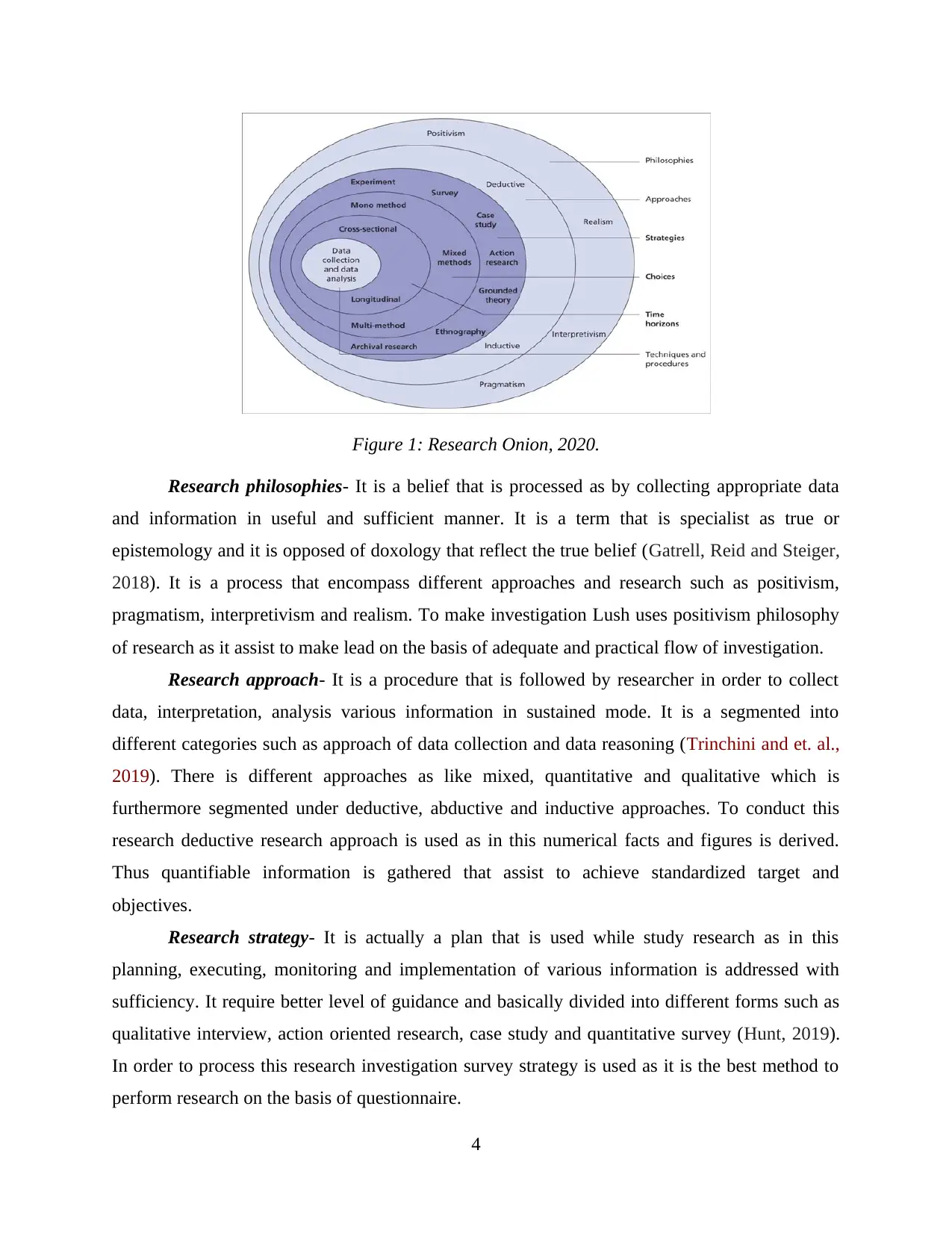
Figure 1: Research Onion, 2020.
Research philosophies- It is a belief that is processed as by collecting appropriate data
and information in useful and sufficient manner. It is a term that is specialist as true or
epistemology and it is opposed of doxology that reflect the true belief (Gatrell, Reid and Steiger,
2018). It is a process that encompass different approaches and research such as positivism,
pragmatism, interpretivism and realism. To make investigation Lush uses positivism philosophy
of research as it assist to make lead on the basis of adequate and practical flow of investigation.
Research approach- It is a procedure that is followed by researcher in order to collect
data, interpretation, analysis various information in sustained mode. It is a segmented into
different categories such as approach of data collection and data reasoning (Trinchini and et. al.,
2019). There is different approaches as like mixed, quantitative and qualitative which is
furthermore segmented under deductive, abductive and inductive approaches. To conduct this
research deductive research approach is used as in this numerical facts and figures is derived.
Thus quantifiable information is gathered that assist to achieve standardized target and
objectives.
Research strategy- It is actually a plan that is used while study research as in this
planning, executing, monitoring and implementation of various information is addressed with
sufficiency. It require better level of guidance and basically divided into different forms such as
qualitative interview, action oriented research, case study and quantitative survey (Hunt, 2019).
In order to process this research investigation survey strategy is used as it is the best method to
perform research on the basis of questionnaire.
4
Research philosophies- It is a belief that is processed as by collecting appropriate data
and information in useful and sufficient manner. It is a term that is specialist as true or
epistemology and it is opposed of doxology that reflect the true belief (Gatrell, Reid and Steiger,
2018). It is a process that encompass different approaches and research such as positivism,
pragmatism, interpretivism and realism. To make investigation Lush uses positivism philosophy
of research as it assist to make lead on the basis of adequate and practical flow of investigation.
Research approach- It is a procedure that is followed by researcher in order to collect
data, interpretation, analysis various information in sustained mode. It is a segmented into
different categories such as approach of data collection and data reasoning (Trinchini and et. al.,
2019). There is different approaches as like mixed, quantitative and qualitative which is
furthermore segmented under deductive, abductive and inductive approaches. To conduct this
research deductive research approach is used as in this numerical facts and figures is derived.
Thus quantifiable information is gathered that assist to achieve standardized target and
objectives.
Research strategy- It is actually a plan that is used while study research as in this
planning, executing, monitoring and implementation of various information is addressed with
sufficiency. It require better level of guidance and basically divided into different forms such as
qualitative interview, action oriented research, case study and quantitative survey (Hunt, 2019).
In order to process this research investigation survey strategy is used as it is the best method to
perform research on the basis of questionnaire.
4
⊘ This is a preview!⊘
Do you want full access?
Subscribe today to unlock all pages.
Trusted by 1+ million students worldwide
Choices of method- The choice of method is based on adoption of research and in this
quantitative method is used. As it assist to gather authentic outcome so that target and objective
of research is processed in flexible mode (Iyer, Davari and Paswan, 2018). In this researcher felt
easy to collect appropriate information that is suitable for collection of respective data through
which standardized objective is achieved in timely basis.
Data collection and analysis- It is a technique under which data is collected in form of
primary and secondary research. The questionnaire is conduced as a primary research and to
induce secondary research, articles and journals are used appropriately (Kamboj and et. al.,
2018). It helps the researcher to make productive outcome as with this productive outcome is
achieved within certain period of instance along with the support of both primary and secondary
research relative information is collected with adequateness.
Sample size- It is a size that is targeted by researcher while conducting research and for
this sample size of 30 respondent is selected as with random sampling method.
Analysis of data- The selected information is collected through literature review as it is
secondary type of research and for primary conduction pie chart and frequency table is used.
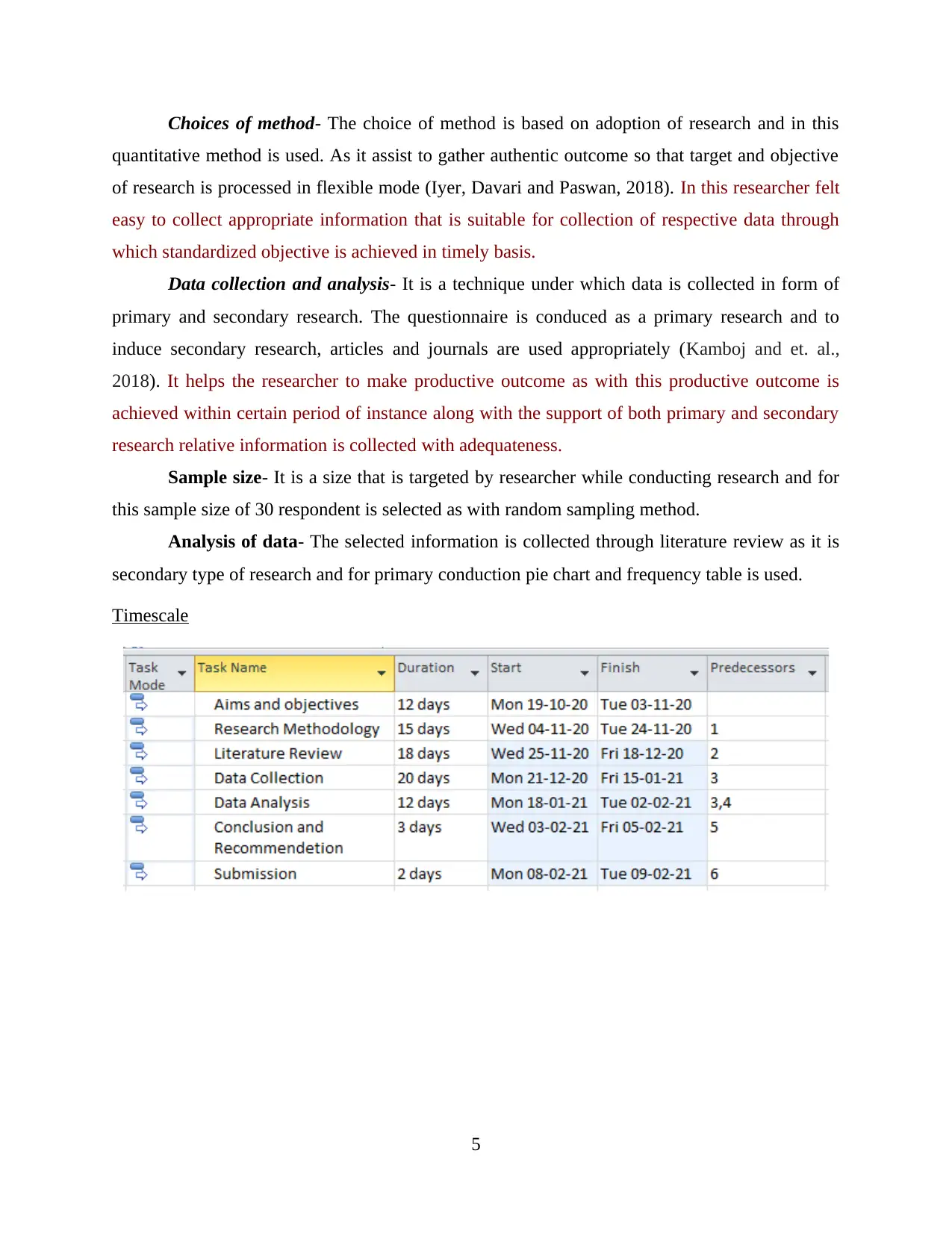
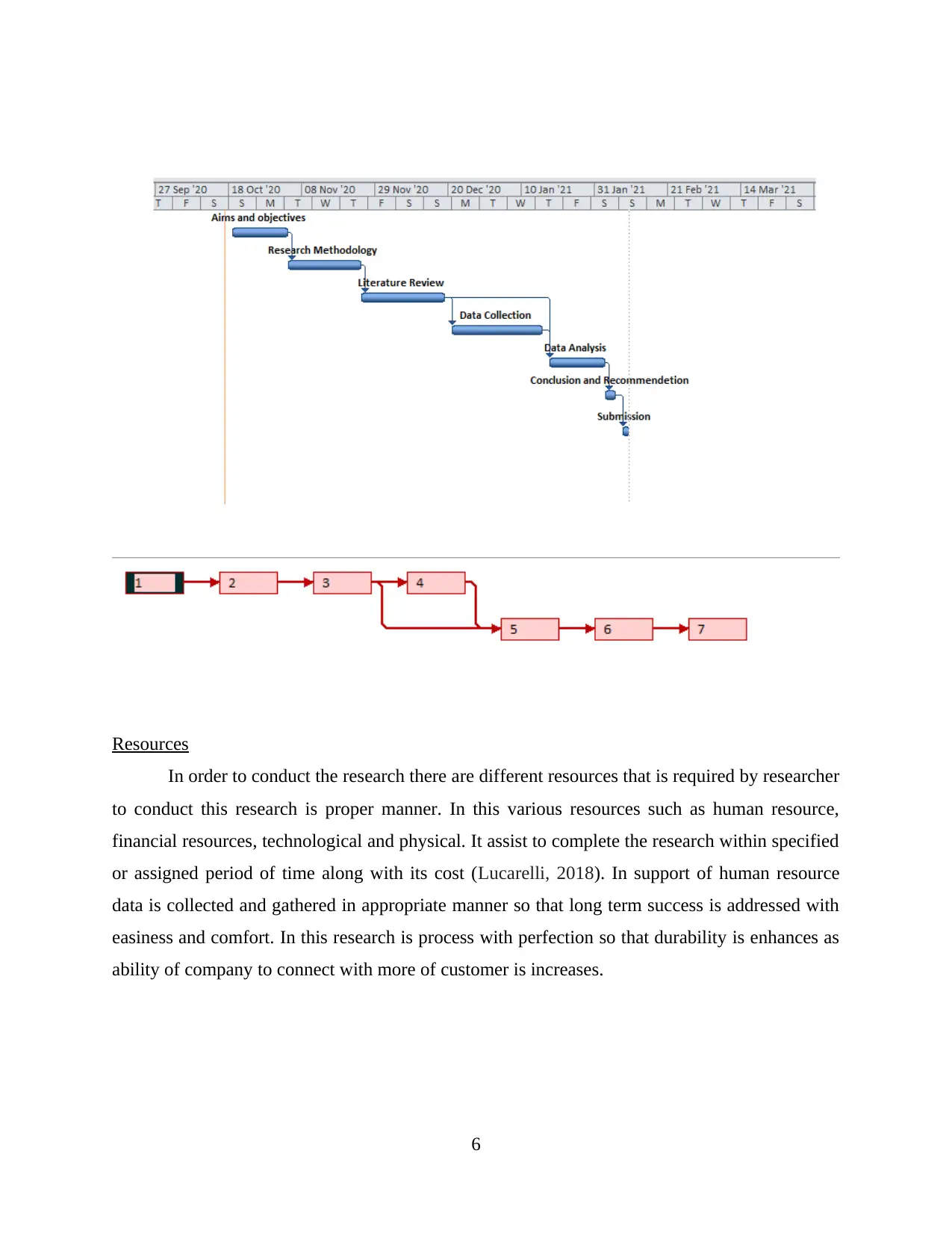
Timescale
5
quantitative method is used. As it assist to gather authentic outcome so that target and objective
of research is processed in flexible mode (Iyer, Davari and Paswan, 2018). In this researcher felt
easy to collect appropriate information that is suitable for collection of respective data through
which standardized objective is achieved in timely basis.
Data collection and analysis- It is a technique under which data is collected in form of
primary and secondary research. The questionnaire is conduced as a primary research and to
induce secondary research, articles and journals are used appropriately (Kamboj and et. al.,
2018). It helps the researcher to make productive outcome as with this productive outcome is
achieved within certain period of instance along with the support of both primary and secondary
research relative information is collected with adequateness.
Sample size- It is a size that is targeted by researcher while conducting research and for
this sample size of 30 respondent is selected as with random sampling method.
Analysis of data- The selected information is collected through literature review as it is
secondary type of research and for primary conduction pie chart and frequency table is used.
Timescale
5
Paraphrase This Document
Need a fresh take? Get an instant paraphrase of this document with our AI Paraphraser
Resources
In order to conduct the research there are different resources that is required by researcher
to conduct this research is proper manner. In this various resources such as human resource,
financial resources, technological and physical. It assist to complete the research within specified
or assigned period of time along with its cost (Lucarelli, 2018). In support of human resource
data is collected and gathered in appropriate manner so that long term success is addressed with
easiness and comfort. In this research is process with perfection so that durability is enhances as
ability of company to connect with more of customer is increases.
6
In order to conduct the research there are different resources that is required by researcher
to conduct this research is proper manner. In this various resources such as human resource,
financial resources, technological and physical. It assist to complete the research within specified
or assigned period of time along with its cost (Lucarelli, 2018). In support of human resource
data is collected and gathered in appropriate manner so that long term success is addressed with
easiness and comfort. In this research is process with perfection so that durability is enhances as
ability of company to connect with more of customer is increases.
6
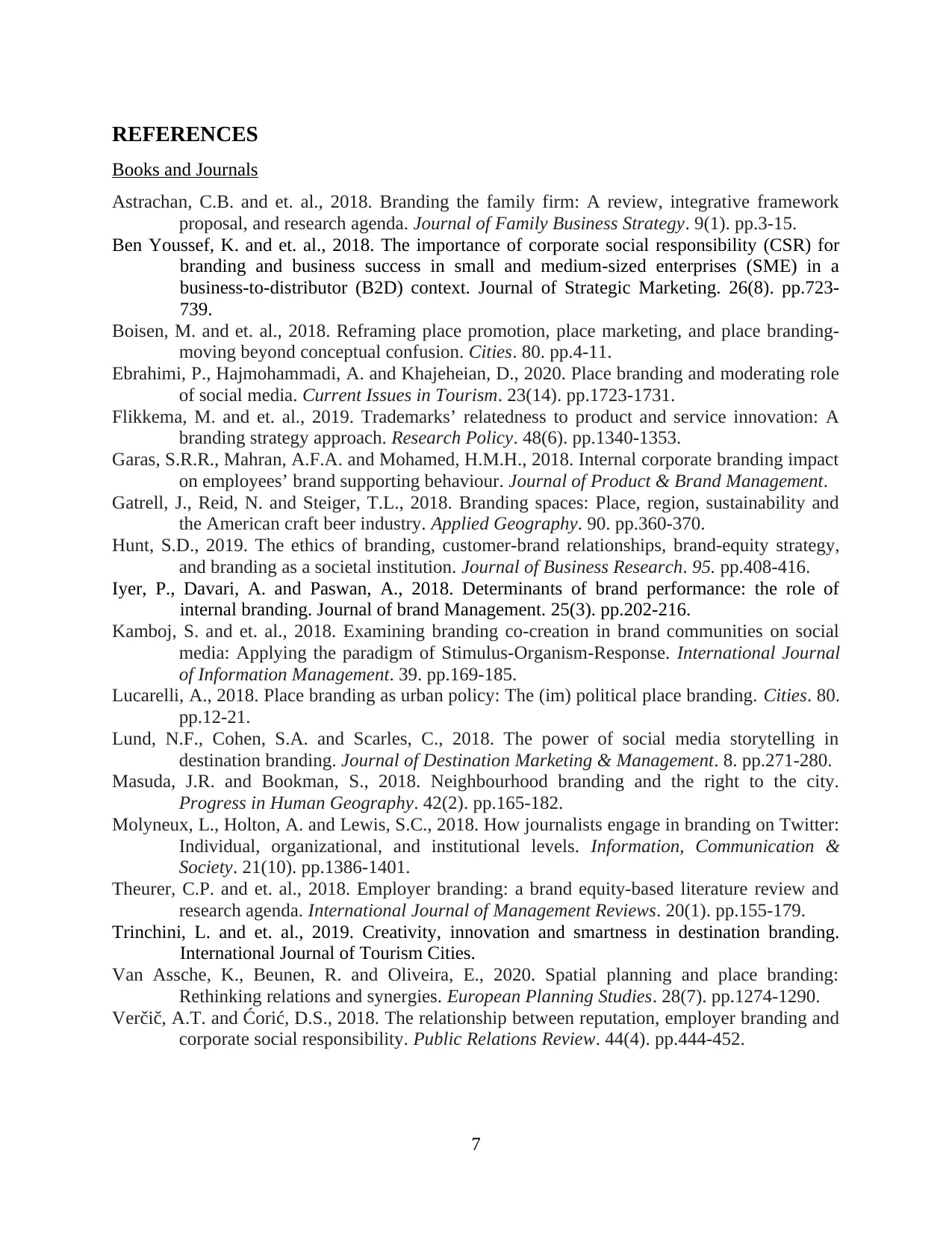
REFERENCES
Books and Journals
Astrachan, C.B. and et. al., 2018. Branding the family firm: A review, integrative framework
proposal, and research agenda. Journal of Family Business Strategy. 9(1). pp.3-15.
Ben Youssef, K. and et. al., 2018. The importance of corporate social responsibility (CSR) for
branding and business success in small and medium-sized enterprises (SME) in a
business-to-distributor (B2D) context. Journal of Strategic Marketing. 26(8). pp.723-
739.
Boisen, M. and et. al., 2018. Reframing place promotion, place marketing, and place branding-
moving beyond conceptual confusion. Cities. 80. pp.4-11.
Ebrahimi, P., Hajmohammadi, A. and Khajeheian, D., 2020. Place branding and moderating role
of social media. Current Issues in Tourism. 23(14). pp.1723-1731.
Flikkema, M. and et. al., 2019. Trademarks’ relatedness to product and service innovation: A
branding strategy approach. Research Policy. 48(6). pp.1340-1353.
Garas, S.R.R., Mahran, A.F.A. and Mohamed, H.M.H., 2018. Internal corporate branding impact
on employees’ brand supporting behaviour. Journal of Product & Brand Management.
Gatrell, J., Reid, N. and Steiger, T.L., 2018. Branding spaces: Place, region, sustainability and
the American craft beer industry. Applied Geography. 90. pp.360-370.
Hunt, S.D., 2019. The ethics of branding, customer-brand relationships, brand-equity strategy,
and branding as a societal institution. Journal of Business Research. 95. pp.408-416.
Iyer, P., Davari, A. and Paswan, A., 2018. Determinants of brand performance: the role of
internal branding. Journal of brand Management. 25(3). pp.202-216.
Kamboj, S. and et. al., 2018. Examining branding co-creation in brand communities on social
media: Applying the paradigm of Stimulus-Organism-Response. International Journal
of Information Management. 39. pp.169-185.
Lucarelli, A., 2018. Place branding as urban policy: The (im) political place branding. Cities. 80.
pp.12-21.
Lund, N.F., Cohen, S.A. and Scarles, C., 2018. The power of social media storytelling in
destination branding. Journal of Destination Marketing & Management. 8. pp.271-280.
Masuda, J.R. and Bookman, S., 2018. Neighbourhood branding and the right to the city.
Progress in Human Geography. 42(2). pp.165-182.
Molyneux, L., Holton, A. and Lewis, S.C., 2018. How journalists engage in branding on Twitter:
Individual, organizational, and institutional levels. Information, Communication &
Society. 21(10). pp.1386-1401.
Theurer, C.P. and et. al., 2018. Employer branding: a brand equity‐based literature review and
research agenda. International Journal of Management Reviews. 20(1). pp.155-179.
Trinchini, L. and et. al., 2019. Creativity, innovation and smartness in destination branding.
International Journal of Tourism Cities.
Van Assche, K., Beunen, R. and Oliveira, E., 2020. Spatial planning and place branding:
Rethinking relations and synergies. European Planning Studies. 28(7). pp.1274-1290.
Verčič, A.T. and Ćorić, D.S., 2018. The relationship between reputation, employer branding and
corporate social responsibility. Public Relations Review. 44(4). pp.444-452.
7
Books and Journals
Astrachan, C.B. and et. al., 2018. Branding the family firm: A review, integrative framework
proposal, and research agenda. Journal of Family Business Strategy. 9(1). pp.3-15.
Ben Youssef, K. and et. al., 2018. The importance of corporate social responsibility (CSR) for
branding and business success in small and medium-sized enterprises (SME) in a
business-to-distributor (B2D) context. Journal of Strategic Marketing. 26(8). pp.723-
739.
Boisen, M. and et. al., 2018. Reframing place promotion, place marketing, and place branding-
moving beyond conceptual confusion. Cities. 80. pp.4-11.
Ebrahimi, P., Hajmohammadi, A. and Khajeheian, D., 2020. Place branding and moderating role
of social media. Current Issues in Tourism. 23(14). pp.1723-1731.
Flikkema, M. and et. al., 2019. Trademarks’ relatedness to product and service innovation: A
branding strategy approach. Research Policy. 48(6). pp.1340-1353.
Garas, S.R.R., Mahran, A.F.A. and Mohamed, H.M.H., 2018. Internal corporate branding impact
on employees’ brand supporting behaviour. Journal of Product & Brand Management.
Gatrell, J., Reid, N. and Steiger, T.L., 2018. Branding spaces: Place, region, sustainability and
the American craft beer industry. Applied Geography. 90. pp.360-370.
Hunt, S.D., 2019. The ethics of branding, customer-brand relationships, brand-equity strategy,
and branding as a societal institution. Journal of Business Research. 95. pp.408-416.
Iyer, P., Davari, A. and Paswan, A., 2018. Determinants of brand performance: the role of
internal branding. Journal of brand Management. 25(3). pp.202-216.
Kamboj, S. and et. al., 2018. Examining branding co-creation in brand communities on social
media: Applying the paradigm of Stimulus-Organism-Response. International Journal
of Information Management. 39. pp.169-185.
Lucarelli, A., 2018. Place branding as urban policy: The (im) political place branding. Cities. 80.
pp.12-21.
Lund, N.F., Cohen, S.A. and Scarles, C., 2018. The power of social media storytelling in
destination branding. Journal of Destination Marketing & Management. 8. pp.271-280.
Masuda, J.R. and Bookman, S., 2018. Neighbourhood branding and the right to the city.
Progress in Human Geography. 42(2). pp.165-182.
Molyneux, L., Holton, A. and Lewis, S.C., 2018. How journalists engage in branding on Twitter:
Individual, organizational, and institutional levels. Information, Communication &
Society. 21(10). pp.1386-1401.
Theurer, C.P. and et. al., 2018. Employer branding: a brand equity‐based literature review and
research agenda. International Journal of Management Reviews. 20(1). pp.155-179.
Trinchini, L. and et. al., 2019. Creativity, innovation and smartness in destination branding.
International Journal of Tourism Cities.
Van Assche, K., Beunen, R. and Oliveira, E., 2020. Spatial planning and place branding:
Rethinking relations and synergies. European Planning Studies. 28(7). pp.1274-1290.
Verčič, A.T. and Ćorić, D.S., 2018. The relationship between reputation, employer branding and
corporate social responsibility. Public Relations Review. 44(4). pp.444-452.
7
⊘ This is a preview!⊘
Do you want full access?
Subscribe today to unlock all pages.
Trusted by 1+ million students worldwide

1 out of 9


Related Documents


Your All-in-One AI-Powered Toolkit for Academic Success.
+13062052269
info@desklib.com
Available 24*7 on WhatsApp / Email
![[object Object]](/_next/static/media/star-bottom.7253800d.svg)
Unlock your academic potential
Copyright © 2020–2026 A2Z Services. All Rights Reserved. Developed and managed by ZUCOL.