Professional Law: Case Analysis of Breach of Conduct and Negligence
VerifiedAdded on 2021/04/19
|8
|1805
|38
Report
AI Summary
This report analyzes a case involving Adrian, who sought legal advice from Sutton and Co regarding a medical condition sustained while working for Northern and Western Coal and Minerals Company. Sutton and Co initially advised Adrian to claim only general damages, but Adrian later discovered he had a stronger claim for special damages and that Sutton and Co had potential conflicts of interest. The report examines whether Sutton and Co breached professional conduct and was negligent. It references the SRA Code of Conduct 2011, including principles on integrity, independent decision-making, client best interests, and appropriate service standards. The report applies these principles and relevant case law, such as Solicitors Regulation Authority v Dennison, Alastair Brett v Solicitors Regulation Authority (SRA), and SRA v David Goldberg, White & Case LLP, to determine if Sutton and Co's actions constituted professional misconduct. The analysis highlights potential violations of the code, including a failure to maintain integrity, compromised independence, and a failure to act in Adrian's best interest, ultimately concluding that Adrian has grounds for a claim of professional misconduct against Sutton and Co. The report also references conflict of interest and duty of care owed by solicitors to clients.
Running head: PROFESSIONAL LAW
Professional Law
Name of the student
Name of the university
Author note
Professional Law
Name of the student
Name of the university
Author note
Paraphrase This Document
Need a fresh take? Get an instant paraphrase of this document with our AI Paraphraser

1
PROFESSIONAL LAW
Facts
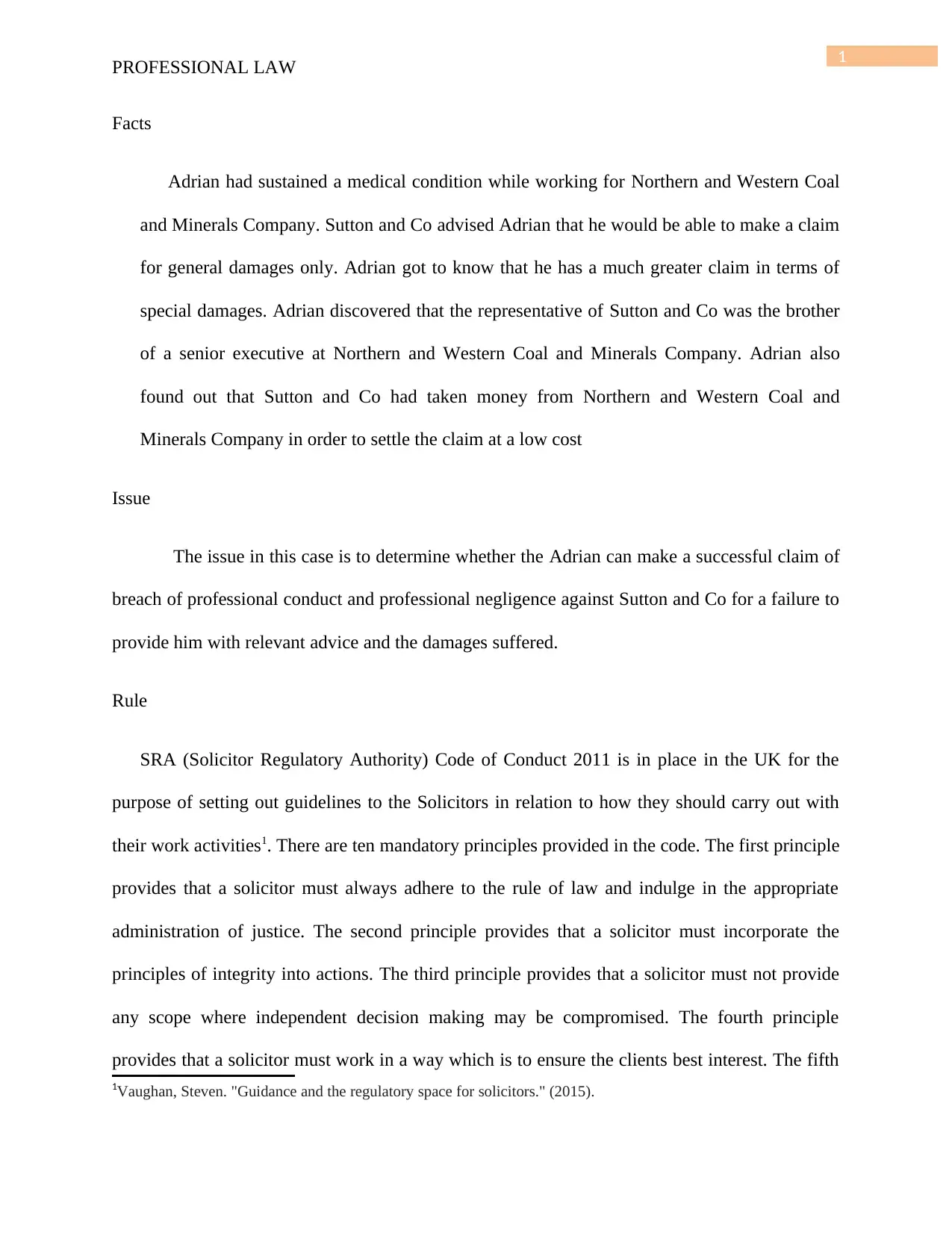
Adrian had sustained a medical condition while working for Northern and Western Coal
and Minerals Company. Sutton and Co advised Adrian that he would be able to make a claim
for general damages only. Adrian got to know that he has a much greater claim in terms of
special damages. Adrian discovered that the representative of Sutton and Co was the brother
of a senior executive at Northern and Western Coal and Minerals Company. Adrian also
found out that Sutton and Co had taken money from Northern and Western Coal and
Minerals Company in order to settle the claim at a low cost
Issue
The issue in this case is to determine whether the Adrian can make a successful claim of
breach of professional conduct and professional negligence against Sutton and Co for a failure to
provide him with relevant advice and the damages suffered.
Rule
SRA (Solicitor Regulatory Authority) Code of Conduct 2011 is in place in the UK for the
purpose of setting out guidelines to the Solicitors in relation to how they should carry out with
their work activities1. There are ten mandatory principles provided in the code. The first principle
provides that a solicitor must always adhere to the rule of law and indulge in the appropriate
administration of justice. The second principle provides that a solicitor must incorporate the
principles of integrity into actions. The third principle provides that a solicitor must not provide
any scope where independent decision making may be compromised. The fourth principle
provides that a solicitor must work in a way which is to ensure the clients best interest. The fifth
1Vaughan, Steven. "Guidance and the regulatory space for solicitors." (2015).
PROFESSIONAL LAW
Facts
Adrian had sustained a medical condition while working for Northern and Western Coal
and Minerals Company. Sutton and Co advised Adrian that he would be able to make a claim
for general damages only. Adrian got to know that he has a much greater claim in terms of
special damages. Adrian discovered that the representative of Sutton and Co was the brother
of a senior executive at Northern and Western Coal and Minerals Company. Adrian also
found out that Sutton and Co had taken money from Northern and Western Coal and
Minerals Company in order to settle the claim at a low cost
Issue
The issue in this case is to determine whether the Adrian can make a successful claim of
breach of professional conduct and professional negligence against Sutton and Co for a failure to
provide him with relevant advice and the damages suffered.
Rule
SRA (Solicitor Regulatory Authority) Code of Conduct 2011 is in place in the UK for the
purpose of setting out guidelines to the Solicitors in relation to how they should carry out with
their work activities1. There are ten mandatory principles provided in the code. The first principle
provides that a solicitor must always adhere to the rule of law and indulge in the appropriate
administration of justice. The second principle provides that a solicitor must incorporate the
principles of integrity into actions. The third principle provides that a solicitor must not provide
any scope where independent decision making may be compromised. The fourth principle
provides that a solicitor must work in a way which is to ensure the clients best interest. The fifth
1Vaughan, Steven. "Guidance and the regulatory space for solicitors." (2015).

2
PROFESSIONAL LAW
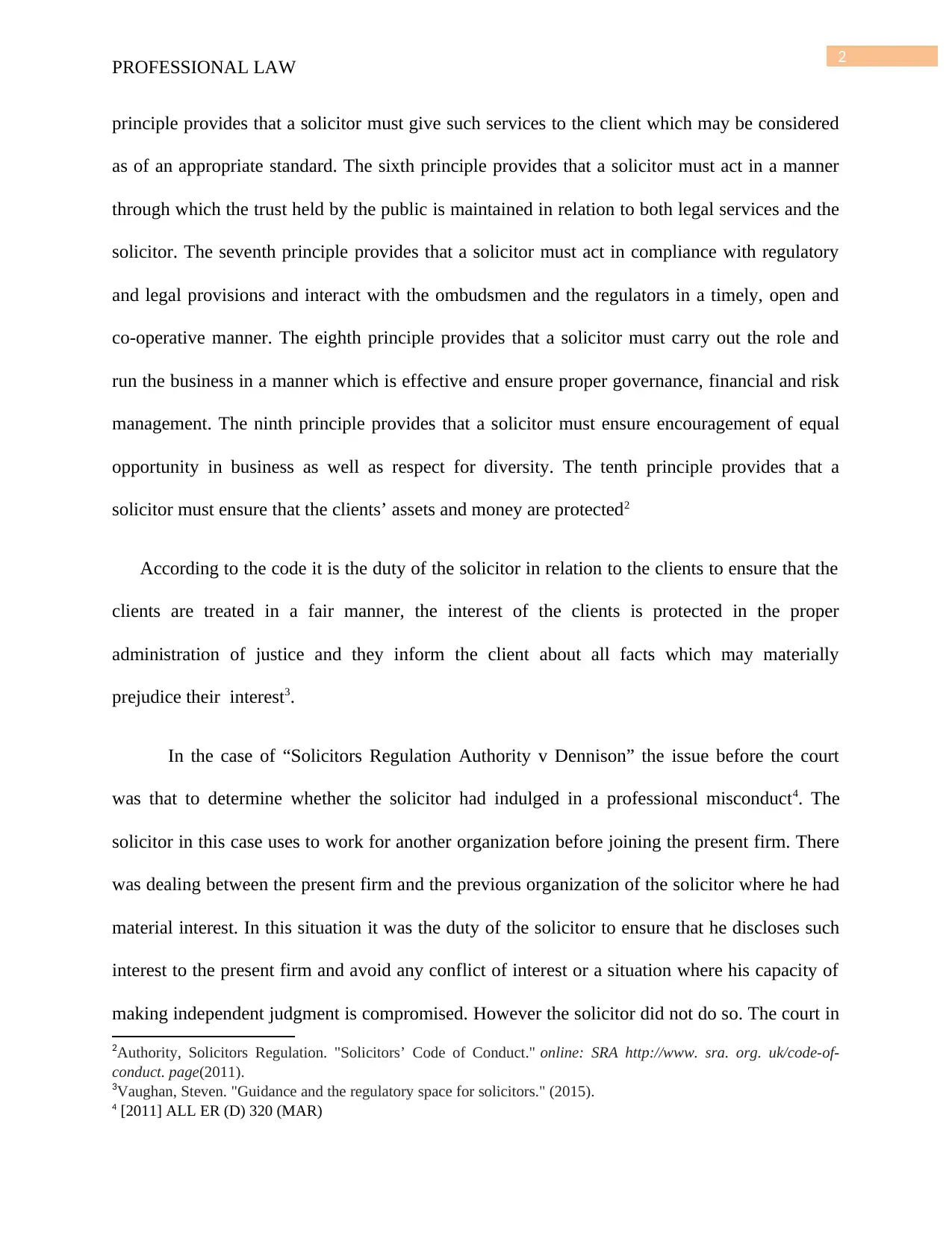
principle provides that a solicitor must give such services to the client which may be considered
as of an appropriate standard. The sixth principle provides that a solicitor must act in a manner
through which the trust held by the public is maintained in relation to both legal services and the
solicitor. The seventh principle provides that a solicitor must act in compliance with regulatory
and legal provisions and interact with the ombudsmen and the regulators in a timely, open and
co-operative manner. The eighth principle provides that a solicitor must carry out the role and
run the business in a manner which is effective and ensure proper governance, financial and risk
management. The ninth principle provides that a solicitor must ensure encouragement of equal
opportunity in business as well as respect for diversity. The tenth principle provides that a
solicitor must ensure that the clients’ assets and money are protected2
According to the code it is the duty of the solicitor in relation to the clients to ensure that the
clients are treated in a fair manner, the interest of the clients is protected in the proper
administration of justice and they inform the client about all facts which may materially
prejudice their interest3.
In the case of “Solicitors Regulation Authority v Dennison” the issue before the court
was that to determine whether the solicitor had indulged in a professional misconduct4. The
solicitor in this case uses to work for another organization before joining the present firm. There
was dealing between the present firm and the previous organization of the solicitor where he had
material interest. In this situation it was the duty of the solicitor to ensure that he discloses such
interest to the present firm and avoid any conflict of interest or a situation where his capacity of
making independent judgment is compromised. However the solicitor did not do so. The court in
2Authority, Solicitors Regulation. "Solicitors’ Code of Conduct." online: SRA http://www. sra. org. uk/code-of-
conduct. page(2011).
3Vaughan, Steven. "Guidance and the regulatory space for solicitors." (2015).
4 [2011] ALL ER (D) 320 (MAR)
PROFESSIONAL LAW
principle provides that a solicitor must give such services to the client which may be considered
as of an appropriate standard. The sixth principle provides that a solicitor must act in a manner
through which the trust held by the public is maintained in relation to both legal services and the
solicitor. The seventh principle provides that a solicitor must act in compliance with regulatory
and legal provisions and interact with the ombudsmen and the regulators in a timely, open and
co-operative manner. The eighth principle provides that a solicitor must carry out the role and
run the business in a manner which is effective and ensure proper governance, financial and risk
management. The ninth principle provides that a solicitor must ensure encouragement of equal
opportunity in business as well as respect for diversity. The tenth principle provides that a
solicitor must ensure that the clients’ assets and money are protected2
According to the code it is the duty of the solicitor in relation to the clients to ensure that the
clients are treated in a fair manner, the interest of the clients is protected in the proper
administration of justice and they inform the client about all facts which may materially
prejudice their interest3.
In the case of “Solicitors Regulation Authority v Dennison” the issue before the court
was that to determine whether the solicitor had indulged in a professional misconduct4. The
solicitor in this case uses to work for another organization before joining the present firm. There
was dealing between the present firm and the previous organization of the solicitor where he had
material interest. In this situation it was the duty of the solicitor to ensure that he discloses such
interest to the present firm and avoid any conflict of interest or a situation where his capacity of
making independent judgment is compromised. However the solicitor did not do so. The court in
2Authority, Solicitors Regulation. "Solicitors’ Code of Conduct." online: SRA http://www. sra. org. uk/code-of-
conduct. page(2011).
3Vaughan, Steven. "Guidance and the regulatory space for solicitors." (2015).
4 [2011] ALL ER (D) 320 (MAR)
⊘ This is a preview!⊘
Do you want full access?
Subscribe today to unlock all pages.

Trusted by 1+ million students worldwide

3
PROFESSIONAL LAW
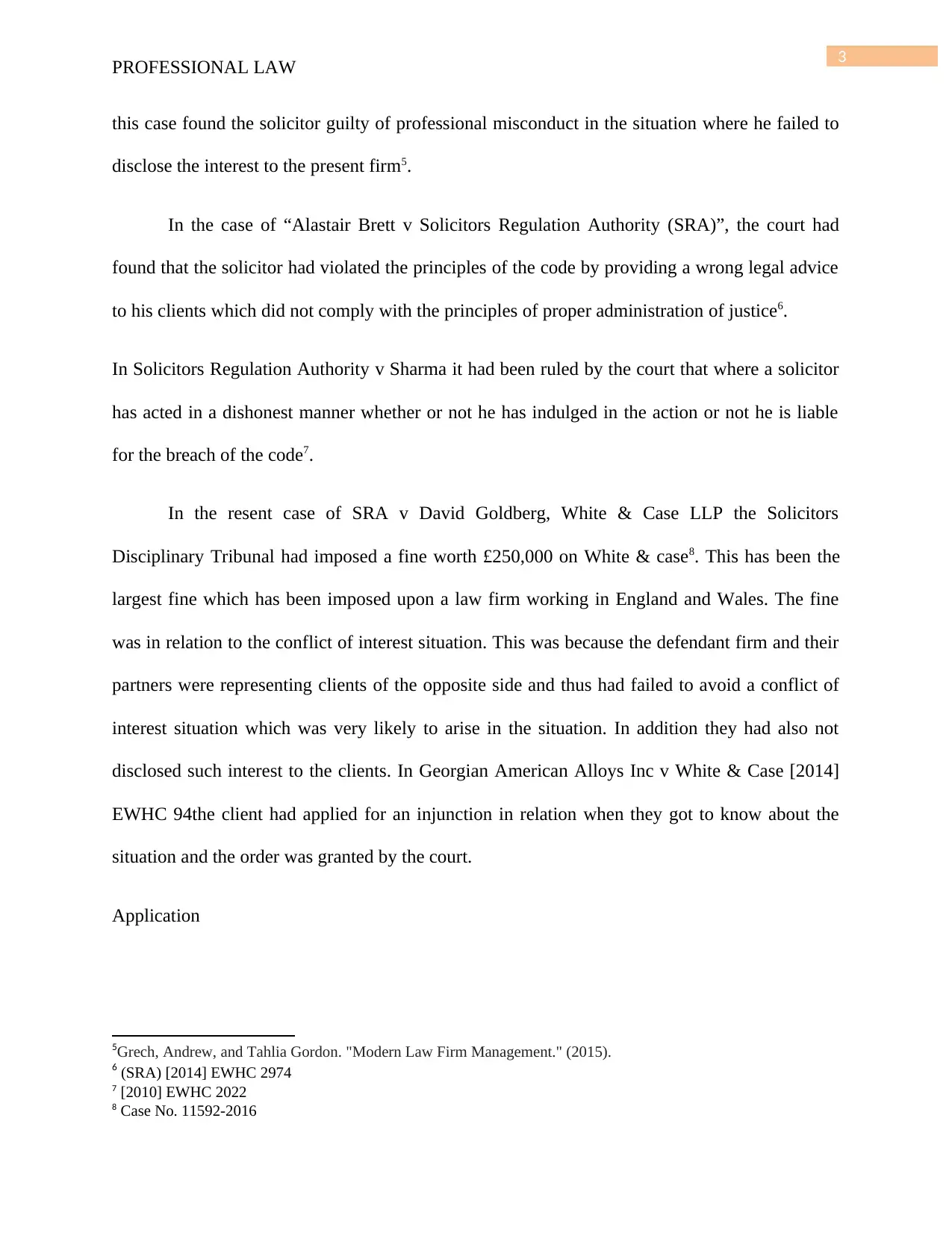
this case found the solicitor guilty of professional misconduct in the situation where he failed to
disclose the interest to the present firm5.
In the case of “Alastair Brett v Solicitors Regulation Authority (SRA)”, the court had
found that the solicitor had violated the principles of the code by providing a wrong legal advice
to his clients which did not comply with the principles of proper administration of justice6.
In Solicitors Regulation Authority v Sharma it had been ruled by the court that where a solicitor
has acted in a dishonest manner whether or not he has indulged in the action or not he is liable
for the breach of the code7.
In the resent case of SRA v David Goldberg, White & Case LLP the Solicitors
Disciplinary Tribunal had imposed a fine worth £250,000 on White & case8. This has been the
largest fine which has been imposed upon a law firm working in England and Wales. The fine
was in relation to the conflict of interest situation. This was because the defendant firm and their
partners were representing clients of the opposite side and thus had failed to avoid a conflict of
interest situation which was very likely to arise in the situation. In addition they had also not
disclosed such interest to the clients. In Georgian American Alloys Inc v White & Case [2014]
EWHC 94the client had applied for an injunction in relation when they got to know about the
situation and the order was granted by the court.
Application
5Grech, Andrew, and Tahlia Gordon. "Modern Law Firm Management." (2015).
6 (SRA) [2014] EWHC 2974
7 [2010] EWHC 2022
8 Case No. 11592-2016
PROFESSIONAL LAW
this case found the solicitor guilty of professional misconduct in the situation where he failed to
disclose the interest to the present firm5.
In the case of “Alastair Brett v Solicitors Regulation Authority (SRA)”, the court had
found that the solicitor had violated the principles of the code by providing a wrong legal advice
to his clients which did not comply with the principles of proper administration of justice6.
In Solicitors Regulation Authority v Sharma it had been ruled by the court that where a solicitor
has acted in a dishonest manner whether or not he has indulged in the action or not he is liable
for the breach of the code7.
In the resent case of SRA v David Goldberg, White & Case LLP the Solicitors
Disciplinary Tribunal had imposed a fine worth £250,000 on White & case8. This has been the
largest fine which has been imposed upon a law firm working in England and Wales. The fine
was in relation to the conflict of interest situation. This was because the defendant firm and their
partners were representing clients of the opposite side and thus had failed to avoid a conflict of
interest situation which was very likely to arise in the situation. In addition they had also not
disclosed such interest to the clients. In Georgian American Alloys Inc v White & Case [2014]
EWHC 94the client had applied for an injunction in relation when they got to know about the
situation and the order was granted by the court.
Application
5Grech, Andrew, and Tahlia Gordon. "Modern Law Firm Management." (2015).
6 (SRA) [2014] EWHC 2974
7 [2010] EWHC 2022
8 Case No. 11592-2016
Paraphrase This Document
Need a fresh take? Get an instant paraphrase of this document with our AI Paraphraser

4
PROFESSIONAL LAW
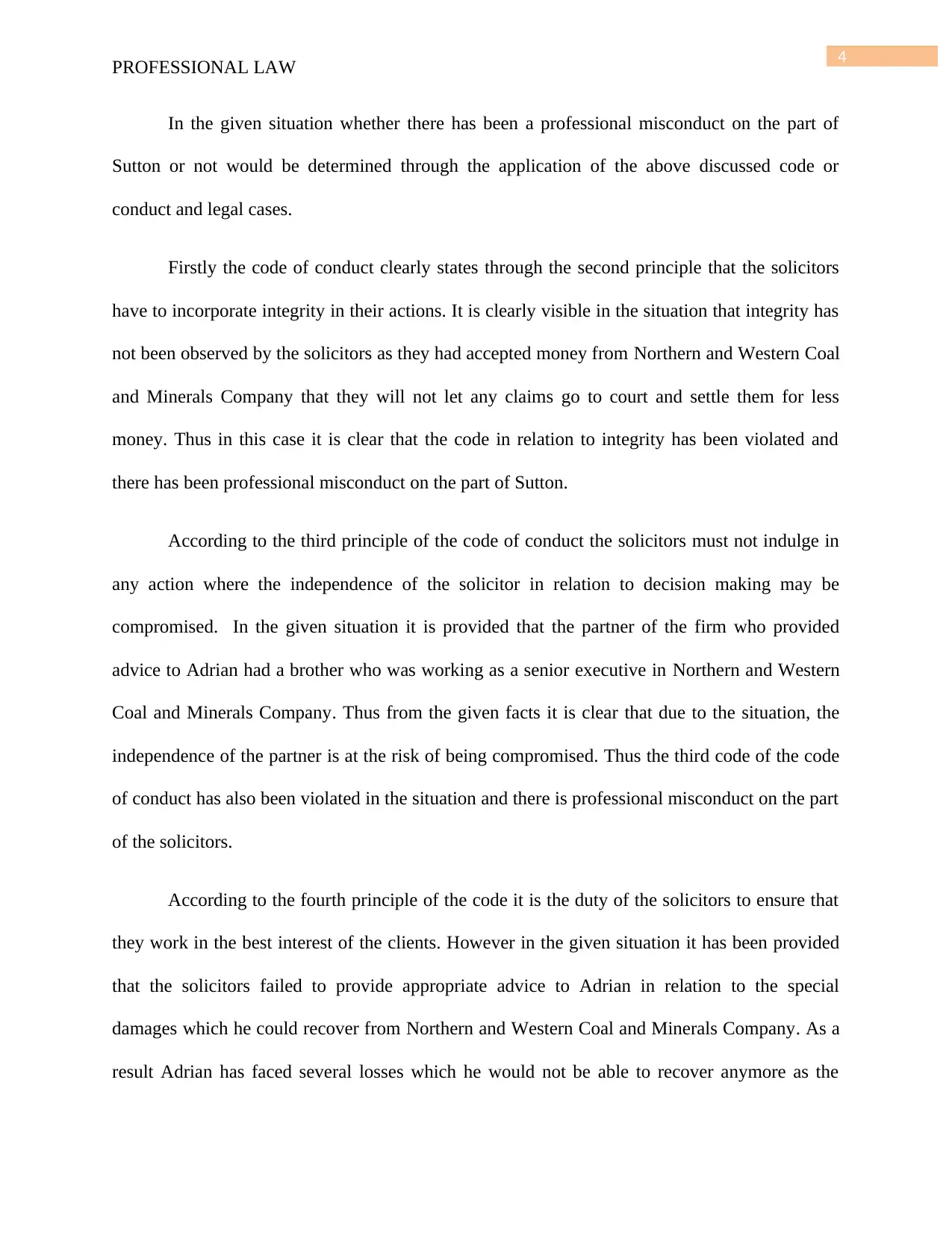
In the given situation whether there has been a professional misconduct on the part of
Sutton or not would be determined through the application of the above discussed code or
conduct and legal cases.
Firstly the code of conduct clearly states through the second principle that the solicitors
have to incorporate integrity in their actions. It is clearly visible in the situation that integrity has
not been observed by the solicitors as they had accepted money from Northern and Western Coal
and Minerals Company that they will not let any claims go to court and settle them for less
money. Thus in this case it is clear that the code in relation to integrity has been violated and
there has been professional misconduct on the part of Sutton.
According to the third principle of the code of conduct the solicitors must not indulge in
any action where the independence of the solicitor in relation to decision making may be
compromised. In the given situation it is provided that the partner of the firm who provided
advice to Adrian had a brother who was working as a senior executive in Northern and Western
Coal and Minerals Company. Thus from the given facts it is clear that due to the situation, the
independence of the partner is at the risk of being compromised. Thus the third code of the code
of conduct has also been violated in the situation and there is professional misconduct on the part
of the solicitors.
According to the fourth principle of the code it is the duty of the solicitors to ensure that
they work in the best interest of the clients. However in the given situation it has been provided
that the solicitors failed to provide appropriate advice to Adrian in relation to the special
damages which he could recover from Northern and Western Coal and Minerals Company. As a
result Adrian has faced several losses which he would not be able to recover anymore as the
PROFESSIONAL LAW
In the given situation whether there has been a professional misconduct on the part of
Sutton or not would be determined through the application of the above discussed code or
conduct and legal cases.
Firstly the code of conduct clearly states through the second principle that the solicitors
have to incorporate integrity in their actions. It is clearly visible in the situation that integrity has
not been observed by the solicitors as they had accepted money from Northern and Western Coal
and Minerals Company that they will not let any claims go to court and settle them for less
money. Thus in this case it is clear that the code in relation to integrity has been violated and
there has been professional misconduct on the part of Sutton.
According to the third principle of the code of conduct the solicitors must not indulge in
any action where the independence of the solicitor in relation to decision making may be
compromised. In the given situation it is provided that the partner of the firm who provided
advice to Adrian had a brother who was working as a senior executive in Northern and Western
Coal and Minerals Company. Thus from the given facts it is clear that due to the situation, the
independence of the partner is at the risk of being compromised. Thus the third code of the code
of conduct has also been violated in the situation and there is professional misconduct on the part
of the solicitors.
According to the fourth principle of the code it is the duty of the solicitors to ensure that
they work in the best interest of the clients. However in the given situation it has been provided
that the solicitors failed to provide appropriate advice to Adrian in relation to the special
damages which he could recover from Northern and Western Coal and Minerals Company. As a
result Adrian has faced several losses which he would not be able to recover anymore as the

5
PROFESSIONAL LAW
application time has expired. Thus it is clear that the actions of the solicitors had not been in the
best interest of Adrian and they had put their own interest before his interest and thus they have
indulged in professional misconduct.
As per the fifth principle of the code it was a duty of the solicitors to provide a service
which may be considered that of an appropriate standard. However in the given situation it is
clear that services which have been provided to Adrian has not been of an appropriate standard
as the solicitors missed out on computing the special damages which Adrian would have been
entitled to due to the injury caused to him and the losses incurred by him as a result of the injury.
As per the facts it is also evident that the solicitors had failed to act in a way where public
trust is upheld. This is because they have not acted in the best interest of the client in the pursuit
of personal interest. The public of notified about the situation would not have trust of solicitors
advice. Thus as a violation of the sixth principle the solicitors have indulged into professional
misconduct. In addition they have also violated the tenth principle which is in relation to the
protection of clients’ money and assents. They have not ensured that Adrian receives the total
amount of damages he was actually entitled to.
In addition through the application of the above discussed cases also it can be stated that
the solicitors had indulged in professional misconduct. Firstly as per the case of Solicitors
Regulation Authority v Dennison there was a failure on the part of the defendant to disclose the
personal interest he had in another company to the present firm. The same failure has also been
observed in the situation where the firm has not discussed the interest they had with Northern
and Western Coal and Minerals Company.
PROFESSIONAL LAW
application time has expired. Thus it is clear that the actions of the solicitors had not been in the
best interest of Adrian and they had put their own interest before his interest and thus they have
indulged in professional misconduct.
As per the fifth principle of the code it was a duty of the solicitors to provide a service
which may be considered that of an appropriate standard. However in the given situation it is
clear that services which have been provided to Adrian has not been of an appropriate standard
as the solicitors missed out on computing the special damages which Adrian would have been
entitled to due to the injury caused to him and the losses incurred by him as a result of the injury.
As per the facts it is also evident that the solicitors had failed to act in a way where public
trust is upheld. This is because they have not acted in the best interest of the client in the pursuit
of personal interest. The public of notified about the situation would not have trust of solicitors
advice. Thus as a violation of the sixth principle the solicitors have indulged into professional
misconduct. In addition they have also violated the tenth principle which is in relation to the
protection of clients’ money and assents. They have not ensured that Adrian receives the total
amount of damages he was actually entitled to.
In addition through the application of the above discussed cases also it can be stated that
the solicitors had indulged in professional misconduct. Firstly as per the case of Solicitors
Regulation Authority v Dennison there was a failure on the part of the defendant to disclose the
personal interest he had in another company to the present firm. The same failure has also been
observed in the situation where the firm has not discussed the interest they had with Northern
and Western Coal and Minerals Company.
⊘ This is a preview!⊘
Do you want full access?
Subscribe today to unlock all pages.

Trusted by 1+ million students worldwide

6
PROFESSIONAL LAW
Further through the application of SRA v David Goldberg, White & Case LLP case it is
also clear that a conflict of interest situation has to be avoided by the solicitors which was not
done in the present case. Thus they are liable for professional misconduct.
Conclusion
Adrian can make claim against Sutton for professional misconduct.
PROFESSIONAL LAW
Further through the application of SRA v David Goldberg, White & Case LLP case it is
also clear that a conflict of interest situation has to be avoided by the solicitors which was not
done in the present case. Thus they are liable for professional misconduct.
Conclusion
Adrian can make claim against Sutton for professional misconduct.
Paraphrase This Document
Need a fresh take? Get an instant paraphrase of this document with our AI Paraphraser

7
PROFESSIONAL LAW
Bibliography
Alastair Brett v Solicitors Regulation Authority (SRA) [2014] EWHC 2974
Authority, Solicitors Regulation. "Solicitors’ Code of Conduct." online: SRA http://www. sra.
org. uk/code-of-conduct. page(2011).
Boon, Andrew. "Understanding lawyer default in England and Wales: an analysis of insurance
and complaints data." International Journal of the Legal Profession 24.2 (2017): 91-108.
Grech, Andrew, and Tahlia Gordon. "Modern Law Firm Management." (2015).
Solicitors Regulation Authority v Dennison [2011] ALL ER (D) 320 (MAR)
Solicitors Regulation Authority v Sharma [2010] EWHC 2022
SRA v David Goldberg, White & Case LLP Case No. 11592-2016
Vaughan, Steven. "Guidance and the regulatory space for solicitors." (2015).
PROFESSIONAL LAW
Bibliography
Alastair Brett v Solicitors Regulation Authority (SRA) [2014] EWHC 2974
Authority, Solicitors Regulation. "Solicitors’ Code of Conduct." online: SRA http://www. sra.
org. uk/code-of-conduct. page(2011).
Boon, Andrew. "Understanding lawyer default in England and Wales: an analysis of insurance
and complaints data." International Journal of the Legal Profession 24.2 (2017): 91-108.
Grech, Andrew, and Tahlia Gordon. "Modern Law Firm Management." (2015).
Solicitors Regulation Authority v Dennison [2011] ALL ER (D) 320 (MAR)
Solicitors Regulation Authority v Sharma [2010] EWHC 2022
SRA v David Goldberg, White & Case LLP Case No. 11592-2016
Vaughan, Steven. "Guidance and the regulatory space for solicitors." (2015).
1 out of 8
Related Documents
Your All-in-One AI-Powered Toolkit for Academic Success.
+13062052269
info@desklib.com
Available 24*7 on WhatsApp / Email
Unlock your academic potential
Copyright © 2020–2026 A2Z Services. All Rights Reserved. Developed and managed by ZUCOL.