The Deeper Meaning of Bread: A Sociology Essay for HOSF 1281
VerifiedAdded on 2023/04/25
|6
|909
|417
Essay
AI Summary
This sociology essay delves into the rich history and cultural significance of bread, tracing its origins back to ancient times in Egypt. It explores interesting facts, such as bread's religious symbolism and traditional ceremonies. The essay examines the evolution of bread making, including the use of different types of flour like all-purpose, bread, whole wheat, and white whole wheat. It details the basic methods of bread preparation, from mixing ingredients to baking and cooling. The essay also highlights various bread recipes from around the world, including Australian Damper Bread, Focaccia, Pide, and Indian Flatbread, concluding with a note about the celebration of World Bread Day. References are provided to support the information presented.
Running head: SOCIOLOGY
SOCIOLOGY ASSIGNMENT
Name of the Student:
Name of the University:
Author Note:
SOCIOLOGY ASSIGNMENT
Name of the Student:
Name of the University:
Author Note:
Paraphrase This Document
Need a fresh take? Get an instant paraphrase of this document with our AI Paraphraser

1SOCIOLOGY
Introduction:
Background:
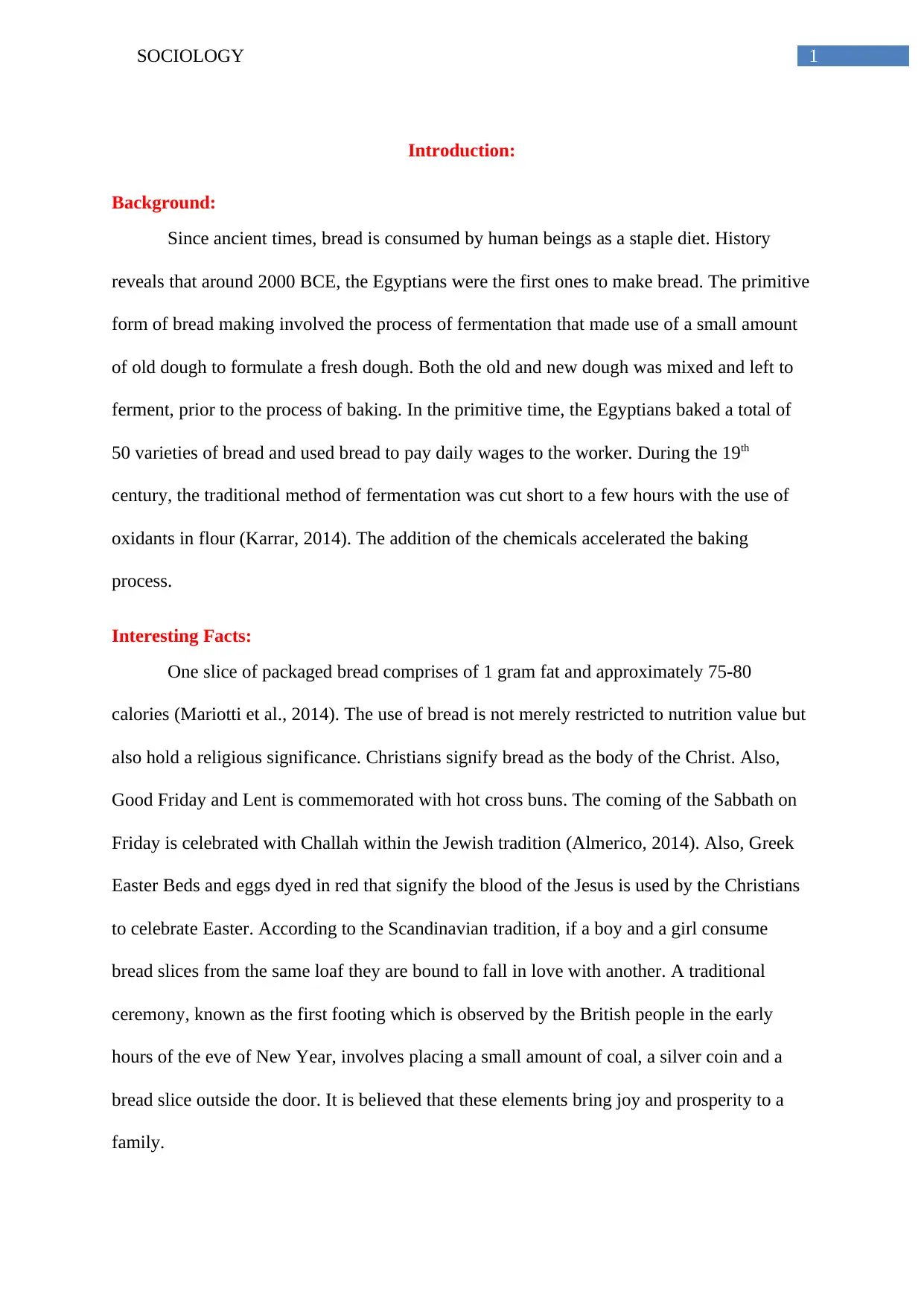
Since ancient times, bread is consumed by human beings as a staple diet. History
reveals that around 2000 BCE, the Egyptians were the first ones to make bread. The primitive
form of bread making involved the process of fermentation that made use of a small amount
of old dough to formulate a fresh dough. Both the old and new dough was mixed and left to
ferment, prior to the process of baking. In the primitive time, the Egyptians baked a total of
50 varieties of bread and used bread to pay daily wages to the worker. During the 19th
century, the traditional method of fermentation was cut short to a few hours with the use of
oxidants in flour (Karrar, 2014). The addition of the chemicals accelerated the baking
process.
Interesting Facts:
One slice of packaged bread comprises of 1 gram fat and approximately 75-80
calories (Mariotti et al., 2014). The use of bread is not merely restricted to nutrition value but
also hold a religious significance. Christians signify bread as the body of the Christ. Also,
Good Friday and Lent is commemorated with hot cross buns. The coming of the Sabbath on
Friday is celebrated with Challah within the Jewish tradition (Almerico, 2014). Also, Greek
Easter Beds and eggs dyed in red that signify the blood of the Jesus is used by the Christians
to celebrate Easter. According to the Scandinavian tradition, if a boy and a girl consume
bread slices from the same loaf they are bound to fall in love with another. A traditional
ceremony, known as the first footing which is observed by the British people in the early
hours of the eve of New Year, involves placing a small amount of coal, a silver coin and a
bread slice outside the door. It is believed that these elements bring joy and prosperity to a
family.
Introduction:
Background:
Since ancient times, bread is consumed by human beings as a staple diet. History
reveals that around 2000 BCE, the Egyptians were the first ones to make bread. The primitive
form of bread making involved the process of fermentation that made use of a small amount
of old dough to formulate a fresh dough. Both the old and new dough was mixed and left to
ferment, prior to the process of baking. In the primitive time, the Egyptians baked a total of
50 varieties of bread and used bread to pay daily wages to the worker. During the 19th
century, the traditional method of fermentation was cut short to a few hours with the use of
oxidants in flour (Karrar, 2014). The addition of the chemicals accelerated the baking
process.
Interesting Facts:
One slice of packaged bread comprises of 1 gram fat and approximately 75-80
calories (Mariotti et al., 2014). The use of bread is not merely restricted to nutrition value but
also hold a religious significance. Christians signify bread as the body of the Christ. Also,
Good Friday and Lent is commemorated with hot cross buns. The coming of the Sabbath on
Friday is celebrated with Challah within the Jewish tradition (Almerico, 2014). Also, Greek
Easter Beds and eggs dyed in red that signify the blood of the Jesus is used by the Christians
to celebrate Easter. According to the Scandinavian tradition, if a boy and a girl consume
bread slices from the same loaf they are bound to fall in love with another. A traditional
ceremony, known as the first footing which is observed by the British people in the early
hours of the eve of New Year, involves placing a small amount of coal, a silver coin and a
bread slice outside the door. It is believed that these elements bring joy and prosperity to a
family.

2SOCIOLOGY
⊘ This is a preview!⊘
Do you want full access?
Subscribe today to unlock all pages.

Trusted by 1+ million students worldwide

3SOCIOLOGY
Main Body:
Types of Flour:
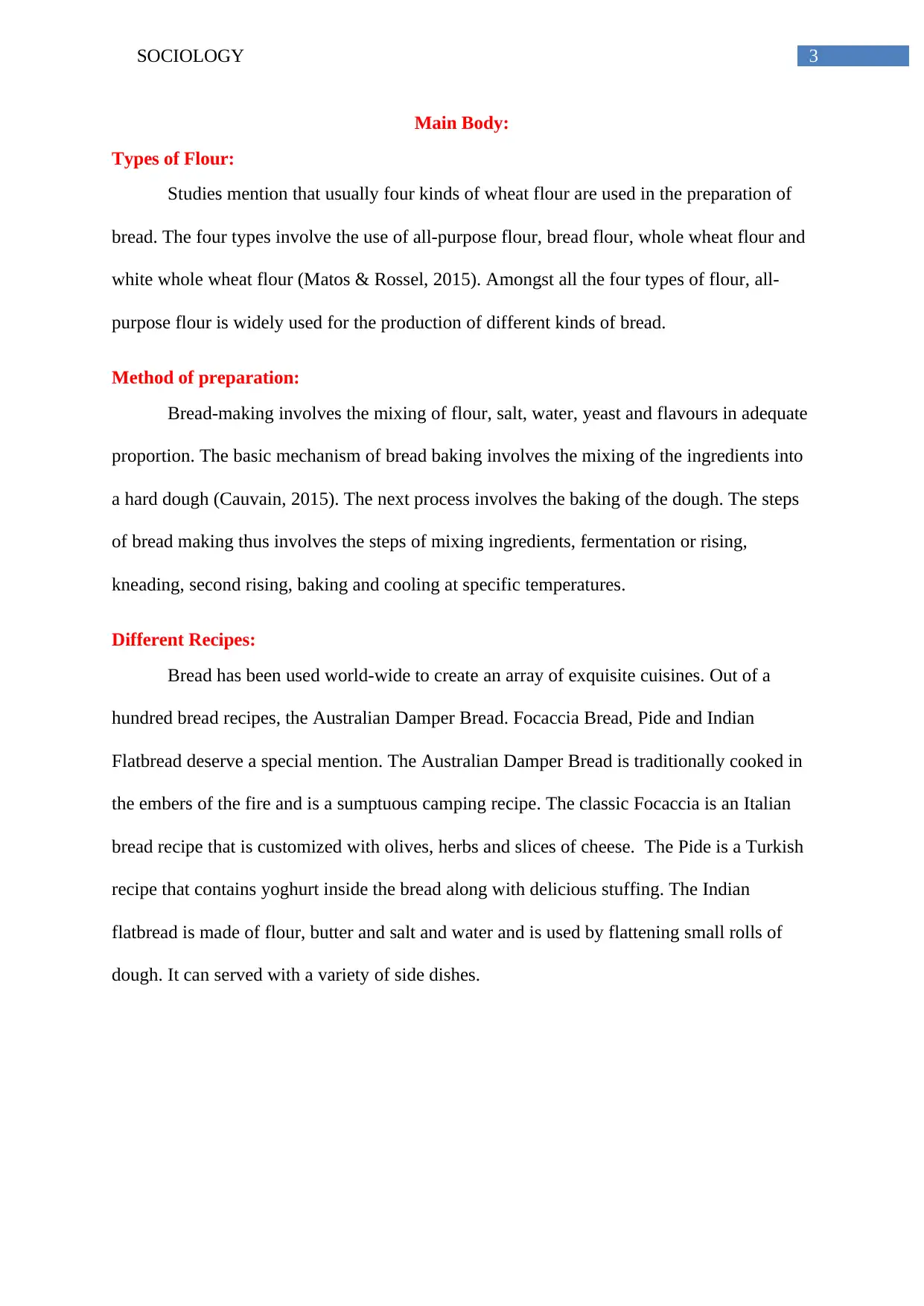
Studies mention that usually four kinds of wheat flour are used in the preparation of
bread. The four types involve the use of all-purpose flour, bread flour, whole wheat flour and
white whole wheat flour (Matos & Rossel, 2015). Amongst all the four types of flour, all-
purpose flour is widely used for the production of different kinds of bread.
Method of preparation:
Bread-making involves the mixing of flour, salt, water, yeast and flavours in adequate
proportion. The basic mechanism of bread baking involves the mixing of the ingredients into
a hard dough (Cauvain, 2015). The next process involves the baking of the dough. The steps
of bread making thus involves the steps of mixing ingredients, fermentation or rising,
kneading, second rising, baking and cooling at specific temperatures.
Different Recipes:
Bread has been used world-wide to create an array of exquisite cuisines. Out of a
hundred bread recipes, the Australian Damper Bread. Focaccia Bread, Pide and Indian
Flatbread deserve a special mention. The Australian Damper Bread is traditionally cooked in
the embers of the fire and is a sumptuous camping recipe. The classic Focaccia is an Italian
bread recipe that is customized with olives, herbs and slices of cheese. The Pide is a Turkish
recipe that contains yoghurt inside the bread along with delicious stuffing. The Indian
flatbread is made of flour, butter and salt and water and is used by flattening small rolls of
dough. It can served with a variety of side dishes.
Main Body:
Types of Flour:
Studies mention that usually four kinds of wheat flour are used in the preparation of
bread. The four types involve the use of all-purpose flour, bread flour, whole wheat flour and
white whole wheat flour (Matos & Rossel, 2015). Amongst all the four types of flour, all-
purpose flour is widely used for the production of different kinds of bread.
Method of preparation:
Bread-making involves the mixing of flour, salt, water, yeast and flavours in adequate
proportion. The basic mechanism of bread baking involves the mixing of the ingredients into
a hard dough (Cauvain, 2015). The next process involves the baking of the dough. The steps
of bread making thus involves the steps of mixing ingredients, fermentation or rising,
kneading, second rising, baking and cooling at specific temperatures.
Different Recipes:
Bread has been used world-wide to create an array of exquisite cuisines. Out of a
hundred bread recipes, the Australian Damper Bread. Focaccia Bread, Pide and Indian
Flatbread deserve a special mention. The Australian Damper Bread is traditionally cooked in
the embers of the fire and is a sumptuous camping recipe. The classic Focaccia is an Italian
bread recipe that is customized with olives, herbs and slices of cheese. The Pide is a Turkish
recipe that contains yoghurt inside the bread along with delicious stuffing. The Indian
flatbread is made of flour, butter and salt and water and is used by flattening small rolls of
dough. It can served with a variety of side dishes.
Paraphrase This Document
Need a fresh take? Get an instant paraphrase of this document with our AI Paraphraser

4SOCIOLOGY
Conclusion:
Therefore, bread making has evolved to a significant extent and each day marks the
discovery of another creative innovation in bread cuisine. Also, October 16th is celebrated as
the World’s Bread Day.
Conclusion:
Therefore, bread making has evolved to a significant extent and each day marks the
discovery of another creative innovation in bread cuisine. Also, October 16th is celebrated as
the World’s Bread Day.

5SOCIOLOGY
References:
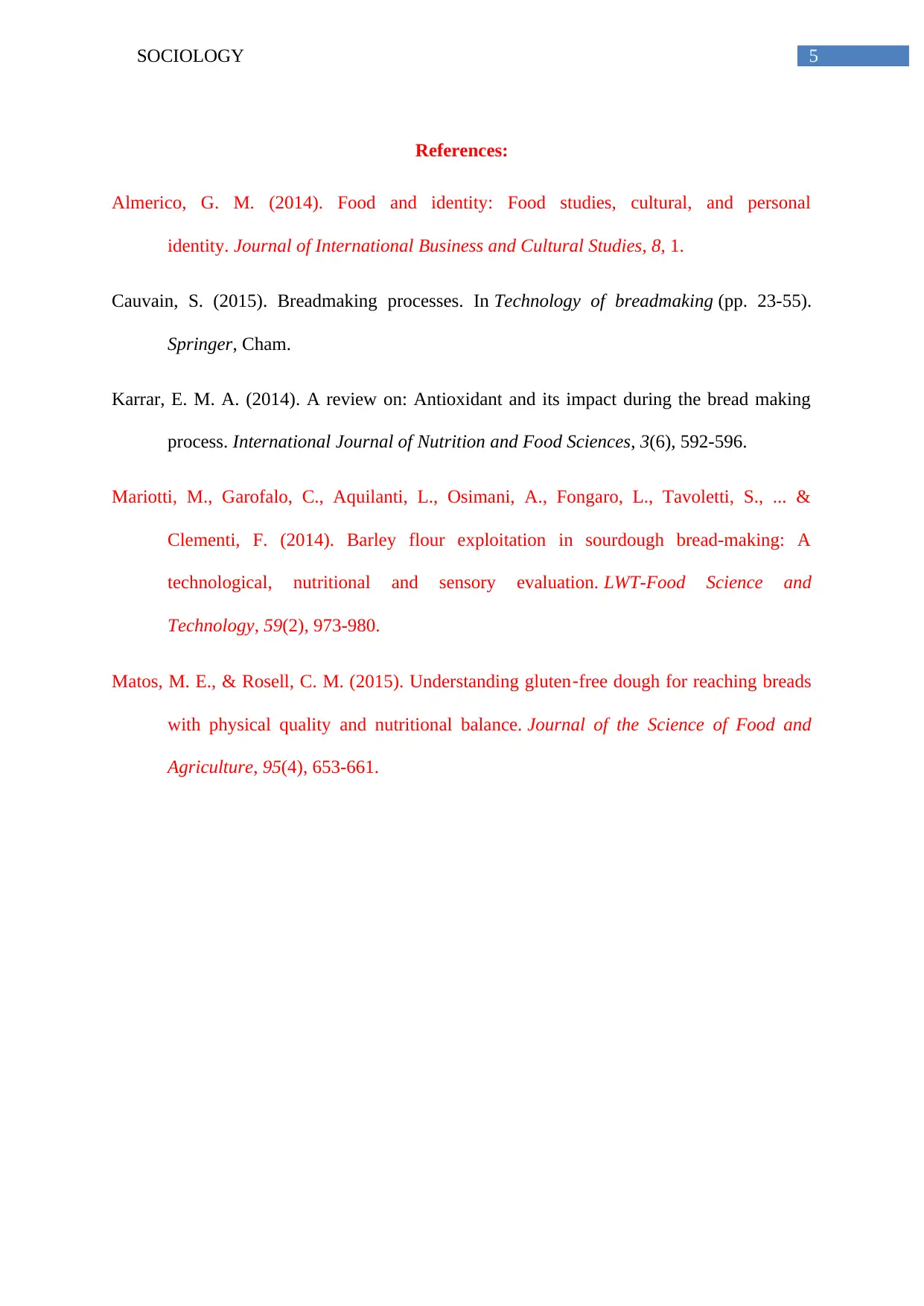
Almerico, G. M. (2014). Food and identity: Food studies, cultural, and personal
identity. Journal of International Business and Cultural Studies, 8, 1.
Cauvain, S. (2015). Breadmaking processes. In Technology of breadmaking (pp. 23-55).
Springer, Cham.
Karrar, E. M. A. (2014). A review on: Antioxidant and its impact during the bread making
process. International Journal of Nutrition and Food Sciences, 3(6), 592-596.
Mariotti, M., Garofalo, C., Aquilanti, L., Osimani, A., Fongaro, L., Tavoletti, S., ... &
Clementi, F. (2014). Barley flour exploitation in sourdough bread-making: A
technological, nutritional and sensory evaluation. LWT-Food Science and
Technology, 59(2), 973-980.
Matos, M. E., & Rosell, C. M. (2015). Understanding gluten‐free dough for reaching breads
with physical quality and nutritional balance. Journal of the Science of Food and
Agriculture, 95(4), 653-661.
References:
Almerico, G. M. (2014). Food and identity: Food studies, cultural, and personal
identity. Journal of International Business and Cultural Studies, 8, 1.
Cauvain, S. (2015). Breadmaking processes. In Technology of breadmaking (pp. 23-55).
Springer, Cham.
Karrar, E. M. A. (2014). A review on: Antioxidant and its impact during the bread making
process. International Journal of Nutrition and Food Sciences, 3(6), 592-596.
Mariotti, M., Garofalo, C., Aquilanti, L., Osimani, A., Fongaro, L., Tavoletti, S., ... &
Clementi, F. (2014). Barley flour exploitation in sourdough bread-making: A
technological, nutritional and sensory evaluation. LWT-Food Science and
Technology, 59(2), 973-980.
Matos, M. E., & Rosell, C. M. (2015). Understanding gluten‐free dough for reaching breads
with physical quality and nutritional balance. Journal of the Science of Food and
Agriculture, 95(4), 653-661.
⊘ This is a preview!⊘
Do you want full access?
Subscribe today to unlock all pages.

Trusted by 1+ million students worldwide
1 out of 6
Your All-in-One AI-Powered Toolkit for Academic Success.
+13062052269
info@desklib.com
Available 24*7 on WhatsApp / Email
Unlock your academic potential
Copyright © 2020–2025 A2Z Services. All Rights Reserved. Developed and managed by ZUCOL.