Analyzing Breakfast's Impact on Adolescent Girls' Health
VerifiedAdded on 2021/02/20
|11
|3073
|136
Report
AI Summary
This report investigates the effects of breakfast consumption and omission on the concentration of overweight and non-overweight adolescent girls. The study begins with an introduction to the importance of health and nutrition, particularly the role of breakfast as a key meal. The research aims to analyze the impact of breakfast habits on adolescent girls' concentration levels, considering weight. The literature review explores the benefits of breakfast consumption, such as improved cognitive function and metabolism, and the negative consequences of skipping breakfast, including potential health risks like obesity and heart disease. The methodology section outlines the qualitative research approach, inductive approach, and descriptive research design used, along with data collection methods, sampling techniques, and data analysis strategies. The report also includes a timeline for the research process. The conclusion summarizes the key findings and offers recommendations for maintaining healthy living standards, emphasizing the importance of nutrition, breakfast consumption, and physical activity for adolescent girls. The report aims to provide a comprehensive understanding of how breakfast habits influence the overall health and well-being of adolescent girls.
Health and nutrition
1
1

Paraphrase This Document
Need a fresh take? Get an instant paraphrase of this document with our AI Paraphraser

Table of Contents
INTRODUCTION.....................................................................................................................................3
Background of the study...................................................................................................................3
Aim and Objectives...........................................................................................................................3
LITERATURE REVIEW..............................................................................................................................4
RESEARCH METHODOLOGY...................................................................................................................6
TIMELINE...............................................................................................................................................8
CONCLUSION.........................................................................................................................................9
REFERENCES ........................................................................................................................................10
2
INTRODUCTION.....................................................................................................................................3
Background of the study...................................................................................................................3
Aim and Objectives...........................................................................................................................3
LITERATURE REVIEW..............................................................................................................................4
RESEARCH METHODOLOGY...................................................................................................................6
TIMELINE...............................................................................................................................................8
CONCLUSION.........................................................................................................................................9
REFERENCES ........................................................................................................................................10
2
Topic: “To analyse the effect of breakfast consumption vs breakfast omission on the
concentration of adolescent girls who are overweight and non-overweight.”
INTRODUCTION
Background of the study
Health and nutrition is one of the most important aspects which helps in healthy
standard of living. Nutrition is the important aspect which helps in proper nourishment to the
body (Ruhl and Everhart, 2015). Good nutrient food helps in effectively maintaining the
tissue growth which helps in improvising the heath of the individual. Breakfast is one of the
most important meal of the day. This study will highlight, the effect of breakfast consumption
vs breakfast omission on the concentration of adolescent girls who are overweight and non-
overweight.
Aim and Objectives
Aim
“To analyse the effect of breakfast consumption vs breakfast omission on the
concentration of adolescent girls who are overweight and non-overweight.”
Objectives
To evaluate the concept of health and nutrition.
To evaluate the influence of breakfast consumption on adolescent girls who are
overweight and non-overweight.
To assess the influence of breakfast omission on adolescent girls who are overweight
and non-overweight.
To recommend effective measures to maintain health living standards.
Research Questions
What is the concept of health and nutrition?
What is the influence of breakfast consumption on adolescent girls who are
overweight and non-overweight?
3
concentration of adolescent girls who are overweight and non-overweight.”
INTRODUCTION
Background of the study
Health and nutrition is one of the most important aspects which helps in healthy
standard of living. Nutrition is the important aspect which helps in proper nourishment to the
body (Ruhl and Everhart, 2015). Good nutrient food helps in effectively maintaining the
tissue growth which helps in improvising the heath of the individual. Breakfast is one of the
most important meal of the day. This study will highlight, the effect of breakfast consumption
vs breakfast omission on the concentration of adolescent girls who are overweight and non-
overweight.
Aim and Objectives
Aim
“To analyse the effect of breakfast consumption vs breakfast omission on the
concentration of adolescent girls who are overweight and non-overweight.”
Objectives
To evaluate the concept of health and nutrition.
To evaluate the influence of breakfast consumption on adolescent girls who are
overweight and non-overweight.
To assess the influence of breakfast omission on adolescent girls who are overweight
and non-overweight.
To recommend effective measures to maintain health living standards.
Research Questions
What is the concept of health and nutrition?
What is the influence of breakfast consumption on adolescent girls who are
overweight and non-overweight?
3
⊘ This is a preview!⊘
Do you want full access?
Subscribe today to unlock all pages.

Trusted by 1+ million students worldwide
What is the influence of breakfast omission on adolescent girls who are overweight
and non-overweight?
What effective measures are recommended to maintain health living standards?
Rationale
This research is beneficial for the researcher as it will help in getting in- depth
knowledge on the particular subject matter. The main reason for carrying out this research is
because it is the current issue which in turn helps in broadening the knowledge on the
particular subject matter. This research is beneficial for the scholar and is carried for the
academic interest.
Significance and scope of the study
The scope of this research is very wide as it helps in effectively analysing the effect of
breakfast consumption vs breakfast omission. It helps in critically examining the new
information which in turn results in gaining in- depth knowledge. This study helps in
understanding the concept of health and nutrition in order to maintain healthy standard of
living (Hearst and et.al., 2016).
LITERATURE REVIEW
(Velardo, 2015) sought to analyse the fact that, Nutrition is the important aspect
which helps in proper nourishment to the body. It helps in improvising the metabolism of the
individual which helps in maintaining health lifestyle by consuming nutrient and healthy
food. Health is referred to as a state of physical, social and emotional well being of the
individual. (de Ferranti and et.al., 2016) argued that, unhealthy food habit leads to increase
risk of chronic disease which in turn affects the health of the individual adversely. Proper
nutrition is important for the body in order to live happy and healthy life in the long run.
Along with physical exercise a healthy diet helps individual in maintaining an adequate
weight and also helps in reducing the risk of chronic disease which in turn affects the overall
health of the individual. It helps in boosting up the energy level and live healthy life. (Moore,
Chaudhary and Akinyemiju, 2017) sought to determine the fact that, Nutrition can be further
classified into nutrients, macro- nutrients and micro- nutrients. There are various types of
nutrients which a body needs which consists of fats, carbohydrates, minerals, proteins, dietary
fibre, water and vitamins. When nutrition is combined with physical health it leads to healthy
4
and non-overweight?
What effective measures are recommended to maintain health living standards?
Rationale
This research is beneficial for the researcher as it will help in getting in- depth
knowledge on the particular subject matter. The main reason for carrying out this research is
because it is the current issue which in turn helps in broadening the knowledge on the
particular subject matter. This research is beneficial for the scholar and is carried for the
academic interest.
Significance and scope of the study
The scope of this research is very wide as it helps in effectively analysing the effect of
breakfast consumption vs breakfast omission. It helps in critically examining the new
information which in turn results in gaining in- depth knowledge. This study helps in
understanding the concept of health and nutrition in order to maintain healthy standard of
living (Hearst and et.al., 2016).
LITERATURE REVIEW
(Velardo, 2015) sought to analyse the fact that, Nutrition is the important aspect
which helps in proper nourishment to the body. It helps in improvising the metabolism of the
individual which helps in maintaining health lifestyle by consuming nutrient and healthy
food. Health is referred to as a state of physical, social and emotional well being of the
individual. (de Ferranti and et.al., 2016) argued that, unhealthy food habit leads to increase
risk of chronic disease which in turn affects the health of the individual adversely. Proper
nutrition is important for the body in order to live happy and healthy life in the long run.
Along with physical exercise a healthy diet helps individual in maintaining an adequate
weight and also helps in reducing the risk of chronic disease which in turn affects the overall
health of the individual. It helps in boosting up the energy level and live healthy life. (Moore,
Chaudhary and Akinyemiju, 2017) sought to determine the fact that, Nutrition can be further
classified into nutrients, macro- nutrients and micro- nutrients. There are various types of
nutrients which a body needs which consists of fats, carbohydrates, minerals, proteins, dietary
fibre, water and vitamins. When nutrition is combined with physical health it leads to healthy
4
Paraphrase This Document
Need a fresh take? Get an instant paraphrase of this document with our AI Paraphraser
lifestyle. Unhealthy eating habit leads to obesity and have adverse impact on the health and
physical state of the individual. (Combs Jr and McClung, 2016) sought to analyse the fact
that, there are various risk factors which may lead to chronic, disease, type 2 diabetes,
hypertension, etc. a good nutrition and healthy lifestyle leads to overall improvement of the
health. Healthy breakfast helps in improving the cognitive function of the individual.
(Iovino and et.al., 2016) sought to analyse the fact that, breakfast is one of the most
important meal of the day which confers various health benefits and also leads to healthy
standard of living. Children and adolescent who consume breakfast regularly are more likely
have better combination of both micronutrient and micronutrient. They are less like to be
obese which in turn helps them in getting involved in various physical activity. It helps
adolescent girls to keep them physically as well as mentally fit. (Marlatt and et.al., 2016)
established that, Breakfast consumption helps in maintaining high metabolism rate which in
turn helps in boosting up the energy levels in the individual. Breakfast is considered to be the
first meal of the day and there are various negative impacts of skipping breakfast. It may lead
to increase risk of heart disease. It may also lead to gain of weight and mainly results in
obesity. Eating breakfast helps in increasing the energy level and metabolism of the
individual which in turn helps in getting involved in various physical activity. (Blondin and
et.al., 2016) said that, breakfast helps in providing all the basic nutrient right in the morning
to maintain the body mass index of adolescent girls. It is useful in maintaining healthy weight
which in turn leads to lower risk of health disease and obesity. It is also useful in maintaining
a better concentration level which in turn helps in revving up the brain power. Eating
breakfast helps in improving the mental health of the individual and helps in better physical
and mental activity.
(Dykstra and et.al., 2016) established that, Children and adolescent who tends to skip
breakfast leads to depletion in glycogen in the individual. Adolescent girls tend to skip
breakfast to control or reduce weight. Skipping breakfast leads to higher risk of obesity,
hypertension, obesity, asthma, sleeping disorder, overeating, heart disease, etc. skipping
breakfast is one of the most unhealthy practice among children and adolescents. Skipping the
first meal of the day leads to overeating in the subsequent meals. This in turn leads to
overweight because in turn affects the health of the individual. (Schlesinger, Ballon and
Neuenschwander, 2018) sought to determine the fact that, skipping breakfast can affect the
energy levels of the individuals and also impact the mood. It leads to high level of fatigue
5
physical state of the individual. (Combs Jr and McClung, 2016) sought to analyse the fact
that, there are various risk factors which may lead to chronic, disease, type 2 diabetes,
hypertension, etc. a good nutrition and healthy lifestyle leads to overall improvement of the
health. Healthy breakfast helps in improving the cognitive function of the individual.
(Iovino and et.al., 2016) sought to analyse the fact that, breakfast is one of the most
important meal of the day which confers various health benefits and also leads to healthy
standard of living. Children and adolescent who consume breakfast regularly are more likely
have better combination of both micronutrient and micronutrient. They are less like to be
obese which in turn helps them in getting involved in various physical activity. It helps
adolescent girls to keep them physically as well as mentally fit. (Marlatt and et.al., 2016)
established that, Breakfast consumption helps in maintaining high metabolism rate which in
turn helps in boosting up the energy levels in the individual. Breakfast is considered to be the
first meal of the day and there are various negative impacts of skipping breakfast. It may lead
to increase risk of heart disease. It may also lead to gain of weight and mainly results in
obesity. Eating breakfast helps in increasing the energy level and metabolism of the
individual which in turn helps in getting involved in various physical activity. (Blondin and
et.al., 2016) said that, breakfast helps in providing all the basic nutrient right in the morning
to maintain the body mass index of adolescent girls. It is useful in maintaining healthy weight
which in turn leads to lower risk of health disease and obesity. It is also useful in maintaining
a better concentration level which in turn helps in revving up the brain power. Eating
breakfast helps in improving the mental health of the individual and helps in better physical
and mental activity.
(Dykstra and et.al., 2016) established that, Children and adolescent who tends to skip
breakfast leads to depletion in glycogen in the individual. Adolescent girls tend to skip
breakfast to control or reduce weight. Skipping breakfast leads to higher risk of obesity,
hypertension, obesity, asthma, sleeping disorder, overeating, heart disease, etc. skipping
breakfast is one of the most unhealthy practice among children and adolescents. Skipping the
first meal of the day leads to overeating in the subsequent meals. This in turn leads to
overweight because in turn affects the health of the individual. (Schlesinger, Ballon and
Neuenschwander, 2018) sought to determine the fact that, skipping breakfast can affect the
energy levels of the individuals and also impact the mood. It leads to high level of fatigue
5
among the individuals and it also leads to poor memory skills among adolescent girls.
(Thomas and et.al., 2015) established that, skipping breakfast may also lead to menstrual
irregularities. It also increases the risk of high side effects to the health which in turn results
in weakness, headache, dizziness, rapid heart rate, tingling, etc. Skipping breakfast is largely
related with obesity.
(Ostachowska-Gasior and et.al., 2016) sought to analyse the fact that, to maintain
good health individuals need to take effective measure which in turn help in maintaining
higher standard of living. It helps in maintaining the mental health of the individual.
Adolescent girls must focus on eating nutritious food which in turn they should focus on
eating breakfast to boost up the metabolism of the individual. Adolescent girls must focus on
continuous exercise which in turn helps in maintaining weight and proper nutrients into the
body. (Mielgo-Ayuso and et.al., 2017) sought to determine the fact that, Adolescent girls
should focus on eating fruits and vegetables which helps them in boosting up the metabolism
and function actively to live a happy and healthy life. It also helps individual in distressing
which in turn helps adolescent girls in increasing the efficiency and mental health. They
should avoid eating junk foods which leads various health effects. Consumption of high
protein goods, rich in nutrients helps in maintaining a healthy lifestyle.
RESEARCH METHODOLOGY
Research methodology is an effective approach as it helps in solving the various
research problem of the particular area of study. It helps in broadening the current knowledge
on the particular subject matter.
Research methods: It is a strategic process which is very useful in uncovering new
information in order to have better understanding on the research topic. It can be
distinguished into qualitative and quantitative research methods. Qualitative method is based
on logical reasoning, behaviour and knowledge of the individual. It can be done through
grounded theory, case study, observation, experiments, etc. Quantitative method is based on
numerical and statistical investigation of the data. It can be done through polls,
questionnaire, survey, etc.
The researcher of this study will opt for qualitative method in order to analyse the
effect of breakfast consumption vs breakfast omission on the concentration of adolescent girls
who are overweight and non-overweight (Leidy and et.al., 2015).
6
(Thomas and et.al., 2015) established that, skipping breakfast may also lead to menstrual
irregularities. It also increases the risk of high side effects to the health which in turn results
in weakness, headache, dizziness, rapid heart rate, tingling, etc. Skipping breakfast is largely
related with obesity.
(Ostachowska-Gasior and et.al., 2016) sought to analyse the fact that, to maintain
good health individuals need to take effective measure which in turn help in maintaining
higher standard of living. It helps in maintaining the mental health of the individual.
Adolescent girls must focus on eating nutritious food which in turn they should focus on
eating breakfast to boost up the metabolism of the individual. Adolescent girls must focus on
continuous exercise which in turn helps in maintaining weight and proper nutrients into the
body. (Mielgo-Ayuso and et.al., 2017) sought to determine the fact that, Adolescent girls
should focus on eating fruits and vegetables which helps them in boosting up the metabolism
and function actively to live a happy and healthy life. It also helps individual in distressing
which in turn helps adolescent girls in increasing the efficiency and mental health. They
should avoid eating junk foods which leads various health effects. Consumption of high
protein goods, rich in nutrients helps in maintaining a healthy lifestyle.
RESEARCH METHODOLOGY
Research methodology is an effective approach as it helps in solving the various
research problem of the particular area of study. It helps in broadening the current knowledge
on the particular subject matter.
Research methods: It is a strategic process which is very useful in uncovering new
information in order to have better understanding on the research topic. It can be
distinguished into qualitative and quantitative research methods. Qualitative method is based
on logical reasoning, behaviour and knowledge of the individual. It can be done through
grounded theory, case study, observation, experiments, etc. Quantitative method is based on
numerical and statistical investigation of the data. It can be done through polls,
questionnaire, survey, etc.
The researcher of this study will opt for qualitative method in order to analyse the
effect of breakfast consumption vs breakfast omission on the concentration of adolescent girls
who are overweight and non-overweight (Leidy and et.al., 2015).
6
⊘ This is a preview!⊘
Do you want full access?
Subscribe today to unlock all pages.
Trusted by 1+ million students worldwide
Research approach: It helps in determining an effective plan and procedure which
helps in setting broad assumptions to carry out the study. It can be distinguished into
deductive and inductive approach (Quinlan and et.al., 2019). Deductive approach focuses on
developing a hypothesis and draw valid conclusion from the existing theory. Inductive
approach helps in specific evaluation of the objectives of the research study to wider the
current knowledge.
The researcher of this study will opt for inductive approach in order to evaluate the
concept of health and nutrition.
Research design: It is a technique which helps researcher in designing an effective
framework to attain desired aims and objectives on the particular area of study. It can be
distinguished into exploratory and descriptive research methods (Kumar, 2019). Descriptive
research design is based on in- depth study by critically investigating the subject matter by
asking questions like 'Why' 'when' 'whom', etc. Exploratory research design helps in
exploring the research study questions.
The researcher of this study will opt for descriptive research design in order to
evaluate the influence of breakfast consumption on adolescent girls who are overweight and
non-overweight.
Data collection:
Data collection helps in collecting, investigating, exploring, measuring and analysing
the subject matter. The data collected should be viable and reliable to gain new insights and
attain aim of the study. It can be distinguished into primary and secondary source. Primary
data is new information which has never been collected by someone else (Mackey and Gass,
2015). The various source includes observation, experiments, polls, survey, questionnaire,
investigation, case study, etc. the secondary data is already collected information and helps in
further carrying out and exploring the study. The various source includes books, journals,
articles, newspaper, census, manuals, reports, etc.
The researcher of this study will opt for primary as well as secondary source of data
collection to analyse the effect of breakfast consumption vs breakfast omission on the
concentration of adolescent girls who are overweight and non-overweight.
7
helps in setting broad assumptions to carry out the study. It can be distinguished into
deductive and inductive approach (Quinlan and et.al., 2019). Deductive approach focuses on
developing a hypothesis and draw valid conclusion from the existing theory. Inductive
approach helps in specific evaluation of the objectives of the research study to wider the
current knowledge.
The researcher of this study will opt for inductive approach in order to evaluate the
concept of health and nutrition.
Research design: It is a technique which helps researcher in designing an effective
framework to attain desired aims and objectives on the particular area of study. It can be
distinguished into exploratory and descriptive research methods (Kumar, 2019). Descriptive
research design is based on in- depth study by critically investigating the subject matter by
asking questions like 'Why' 'when' 'whom', etc. Exploratory research design helps in
exploring the research study questions.
The researcher of this study will opt for descriptive research design in order to
evaluate the influence of breakfast consumption on adolescent girls who are overweight and
non-overweight.
Data collection:
Data collection helps in collecting, investigating, exploring, measuring and analysing
the subject matter. The data collected should be viable and reliable to gain new insights and
attain aim of the study. It can be distinguished into primary and secondary source. Primary
data is new information which has never been collected by someone else (Mackey and Gass,
2015). The various source includes observation, experiments, polls, survey, questionnaire,
investigation, case study, etc. the secondary data is already collected information and helps in
further carrying out and exploring the study. The various source includes books, journals,
articles, newspaper, census, manuals, reports, etc.
The researcher of this study will opt for primary as well as secondary source of data
collection to analyse the effect of breakfast consumption vs breakfast omission on the
concentration of adolescent girls who are overweight and non-overweight.
7
Paraphrase This Document
Need a fresh take? Get an instant paraphrase of this document with our AI Paraphraser
Sampling: This is a statistical process as it helps in selecting the sample size from the
population in order to collect new information (Taylor, Bogdan and DeVault, 2015). It can be
distinguished into random, stratified, cluster, snowball, purposive, convenience sampling etc.
Random sampling is a technique where each individual from the population has equal
probability of getting selected in a sample size.
The researcher of this study will opt for random sampling method where 15
adolescent girls will be selected to further carry out and investigate the particular subject
matter.
Data analysis: This technique is useful in investigating, modifying, transforming and
cleansing the information in order to discover useful information and make interpretation
from the data collected (Taylor, Bogdan and DeVault, 2015).
The researcher of this study will opt for qualitative analysis where thematic analysis
will be used to evaluate the effect of breakfast consumption vs breakfast omission on
adolescent girls with effective recommendation.
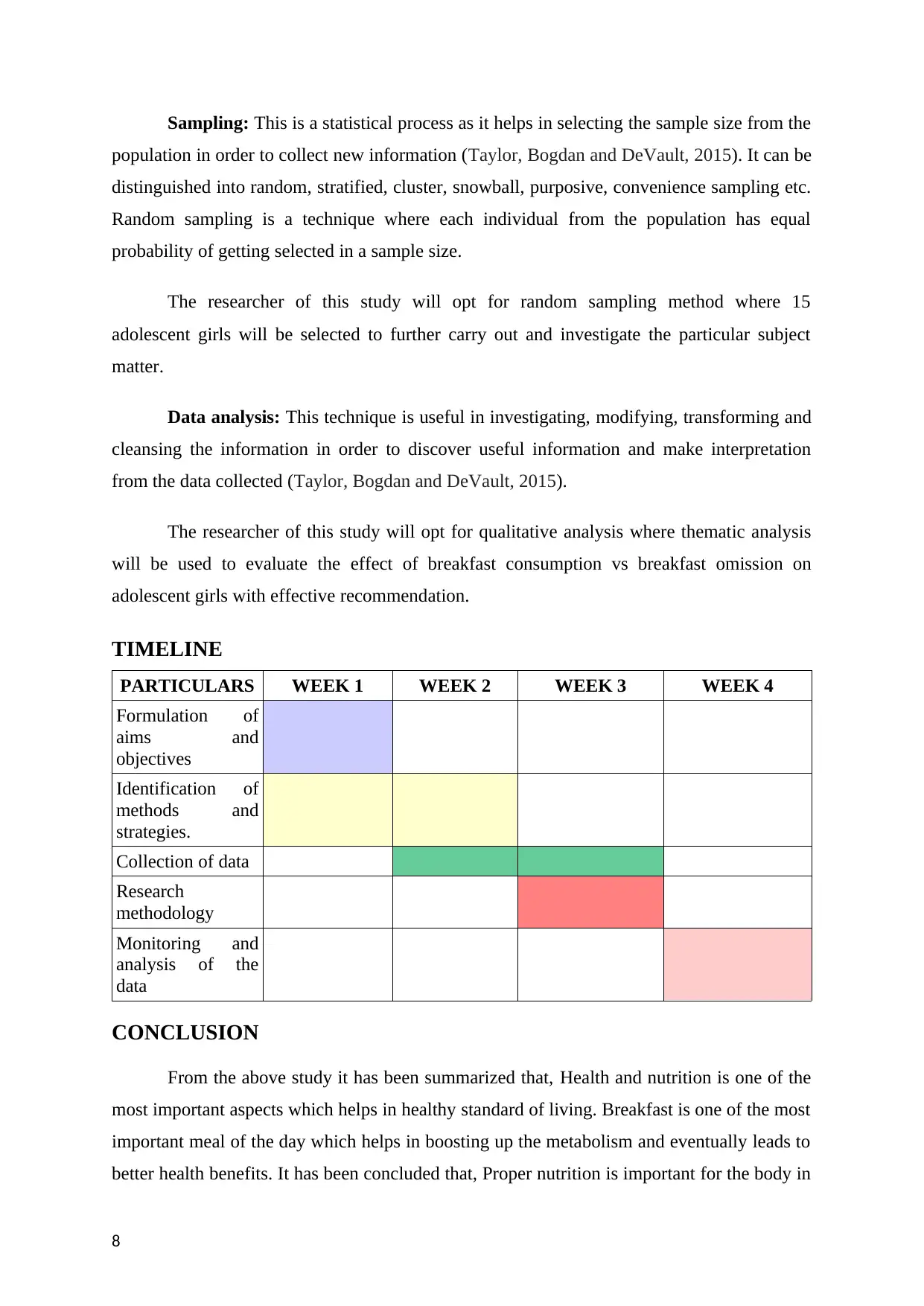
TIMELINE
PARTICULARS WEEK 1 WEEK 2 WEEK 3 WEEK 4
Formulation of
aims and
objectives
Identification of
methods and
strategies.
Collection of data
Research
methodology
Monitoring and
analysis of the
data
CONCLUSION
From the above study it has been summarized that, Health and nutrition is one of the
most important aspects which helps in healthy standard of living. Breakfast is one of the most
important meal of the day which helps in boosting up the metabolism and eventually leads to
better health benefits. It has been concluded that, Proper nutrition is important for the body in
8
population in order to collect new information (Taylor, Bogdan and DeVault, 2015). It can be
distinguished into random, stratified, cluster, snowball, purposive, convenience sampling etc.
Random sampling is a technique where each individual from the population has equal
probability of getting selected in a sample size.
The researcher of this study will opt for random sampling method where 15
adolescent girls will be selected to further carry out and investigate the particular subject
matter.
Data analysis: This technique is useful in investigating, modifying, transforming and
cleansing the information in order to discover useful information and make interpretation
from the data collected (Taylor, Bogdan and DeVault, 2015).
The researcher of this study will opt for qualitative analysis where thematic analysis
will be used to evaluate the effect of breakfast consumption vs breakfast omission on
adolescent girls with effective recommendation.
TIMELINE
PARTICULARS WEEK 1 WEEK 2 WEEK 3 WEEK 4
Formulation of
aims and
objectives
Identification of
methods and
strategies.
Collection of data
Research
methodology
Monitoring and
analysis of the
data
CONCLUSION
From the above study it has been summarized that, Health and nutrition is one of the
most important aspects which helps in healthy standard of living. Breakfast is one of the most
important meal of the day which helps in boosting up the metabolism and eventually leads to
better health benefits. It has been concluded that, Proper nutrition is important for the body in
8

order to live happy and healthy life in the long run. This study will also include research
methodology to evaluate the effect of breakfast consumption vs breakfast omission on
adolescent girls with effective recommendation.
9
methodology to evaluate the effect of breakfast consumption vs breakfast omission on
adolescent girls with effective recommendation.
9
⊘ This is a preview!⊘
Do you want full access?
Subscribe today to unlock all pages.
Trusted by 1+ million students worldwide
REFERENCES
Books and journals
Blondin, S.A and et.al., 2016. Breakfast consumption and adiposity among children and
adolescents: an updated review of the literature. Pediatric obesity, 11(5), pp.333-348.
Combs Jr, G.F. and McClung, J.P., 2016. The vitamins: fundamental aspects in nutrition and
health. Academic press.
de Ferranti, S.D and et.al., 2016. Prevalence of familial hypercholesterolemia in the 1999 to
2012 United States national health and nutrition examination surveys
(NHANES). Circulation, 133(11), pp.1067-1072.
Dykstra, H and et.al., 2016. Breakfast-skipping and selecting low-nutritional-quality foods
for breakfast are common among low-income urban children, regardless of food
security status. The Journal of nutrition, 146(3), pp.630-636.
Hearst, M.O and et.al., 2016. Barriers, benefits, and behaviors related to breakfast
consumption among rural adolescents. Journal of School Health, 86(3), pp.187-194.
Iovino, I and et.al., 2016. Breakfast consumption has no effect on neuropsychological
functioning in children: a repeated-measures clinical trial. The American journal of
clinical nutrition, 104(3), pp.715-721.
Kumar, R., 2019. Research methodology: A step-by-step guide for beginners. Sage
Publications Limited.
Leidy, H.J and et.al., 2015. A high‐protein breakfast prevents body fat gain, through
reductions in daily intake and hunger, in “breakfast skipping”
adolescents. Obesity, 23(9), pp.1761-1764.
Littlecott, H.J and et.al., 2016. Association between breakfast consumption and educational
outcomes in 9–11-year-old children. Public Health Nutrition, 19(9), pp.1575-1582.
Mackey, A. and Gass, S.M., 2015. Second language research: Methodology and design.
Routledge.
10
Books and journals
Blondin, S.A and et.al., 2016. Breakfast consumption and adiposity among children and
adolescents: an updated review of the literature. Pediatric obesity, 11(5), pp.333-348.
Combs Jr, G.F. and McClung, J.P., 2016. The vitamins: fundamental aspects in nutrition and
health. Academic press.
de Ferranti, S.D and et.al., 2016. Prevalence of familial hypercholesterolemia in the 1999 to
2012 United States national health and nutrition examination surveys
(NHANES). Circulation, 133(11), pp.1067-1072.
Dykstra, H and et.al., 2016. Breakfast-skipping and selecting low-nutritional-quality foods
for breakfast are common among low-income urban children, regardless of food
security status. The Journal of nutrition, 146(3), pp.630-636.
Hearst, M.O and et.al., 2016. Barriers, benefits, and behaviors related to breakfast
consumption among rural adolescents. Journal of School Health, 86(3), pp.187-194.
Iovino, I and et.al., 2016. Breakfast consumption has no effect on neuropsychological
functioning in children: a repeated-measures clinical trial. The American journal of
clinical nutrition, 104(3), pp.715-721.
Kumar, R., 2019. Research methodology: A step-by-step guide for beginners. Sage
Publications Limited.
Leidy, H.J and et.al., 2015. A high‐protein breakfast prevents body fat gain, through
reductions in daily intake and hunger, in “breakfast skipping”
adolescents. Obesity, 23(9), pp.1761-1764.
Littlecott, H.J and et.al., 2016. Association between breakfast consumption and educational
outcomes in 9–11-year-old children. Public Health Nutrition, 19(9), pp.1575-1582.
Mackey, A. and Gass, S.M., 2015. Second language research: Methodology and design.
Routledge.
10
Paraphrase This Document
Need a fresh take? Get an instant paraphrase of this document with our AI Paraphraser
Marlatt, K.L and et.al., 2016. Breakfast and fast food consumption are associated with
selected biomarkers in adolescents. Preventive medicine reports, 3, pp.49-52.
Mielgo-Ayuso, J and et.al., 2017. Regular breakfast consumption is associated with higher
blood vitamin status in adolescents: the HELENA (Healthy Lifestyle in Europe by
Nutrition in Adolescence) Study. Public health nutrition, 20(8), pp.1393-1404.
Moore, J.X., Chaudhary, N. and Akinyemiju, T., 2017. Peer reviewed: Metabolic syndrome
prevalence by race/ethnicity and sex in the United States, National Health and Nutrition
Examination Survey, 1988–2012. Preventing chronic disease, 14.
Ostachowska-Gasior, A and et.al., 2016. Breakfast and other meal consumption in
adolescents from southern Poland. International journal of environmental research and
public health, 13(5), p.453.
Quinlan, C and et.al., 2019. Business research methods. South Western Cengage.
Ruhl, C.E. and Everhart, J.E., 2015. Fatty liver indices in the multiethnic united states
national health and nutrition examination survey. Alimentary pharmacology &
therapeutics, 41(1), pp.65-76.
Scherbl, D. and et.al., 2017. Breakfast consumption induces retarded release of chlorogenic
acid metabolites in humans. European Food Research and Technology, 243(5), pp.791-
806.
Schlesinger, S., Ballon, A. and Neuenschwander, M., 2018. Skipping breakfast and risk of
type 2 diabetes: A systematic review and meta-analysis of prospective studies. Revue
d'Épidémiologie et de Santé Publique, 66, p.S352.
Taylor, S.J., Bogdan, R. and DeVault, M., 2015. Introduction to qualitative research
methods: A guidebook and resource. John Wiley & Sons.
Thomas, E.A and et.al., 2015. Usual breakfast eating habits affect response to breakfast
skipping in overweight women. Obesity, 23(4), pp.750-759.
Velardo, S., 2015. The nuances of health literacy, nutrition literacy, and food
literacy. Journal of nutrition education and behavior, 47(4), pp.385-389.
11
selected biomarkers in adolescents. Preventive medicine reports, 3, pp.49-52.
Mielgo-Ayuso, J and et.al., 2017. Regular breakfast consumption is associated with higher
blood vitamin status in adolescents: the HELENA (Healthy Lifestyle in Europe by
Nutrition in Adolescence) Study. Public health nutrition, 20(8), pp.1393-1404.
Moore, J.X., Chaudhary, N. and Akinyemiju, T., 2017. Peer reviewed: Metabolic syndrome
prevalence by race/ethnicity and sex in the United States, National Health and Nutrition
Examination Survey, 1988–2012. Preventing chronic disease, 14.
Ostachowska-Gasior, A and et.al., 2016. Breakfast and other meal consumption in
adolescents from southern Poland. International journal of environmental research and
public health, 13(5), p.453.
Quinlan, C and et.al., 2019. Business research methods. South Western Cengage.
Ruhl, C.E. and Everhart, J.E., 2015. Fatty liver indices in the multiethnic united states
national health and nutrition examination survey. Alimentary pharmacology &
therapeutics, 41(1), pp.65-76.
Scherbl, D. and et.al., 2017. Breakfast consumption induces retarded release of chlorogenic
acid metabolites in humans. European Food Research and Technology, 243(5), pp.791-
806.
Schlesinger, S., Ballon, A. and Neuenschwander, M., 2018. Skipping breakfast and risk of
type 2 diabetes: A systematic review and meta-analysis of prospective studies. Revue
d'Épidémiologie et de Santé Publique, 66, p.S352.
Taylor, S.J., Bogdan, R. and DeVault, M., 2015. Introduction to qualitative research
methods: A guidebook and resource. John Wiley & Sons.
Thomas, E.A and et.al., 2015. Usual breakfast eating habits affect response to breakfast
skipping in overweight women. Obesity, 23(4), pp.750-759.
Velardo, S., 2015. The nuances of health literacy, nutrition literacy, and food
literacy. Journal of nutrition education and behavior, 47(4), pp.385-389.
11

1 out of 11


Related Documents


Your All-in-One AI-Powered Toolkit for Academic Success.
+13062052269
info@desklib.com
Available 24*7 on WhatsApp / Email
![[object Object]](/_next/static/media/star-bottom.7253800d.svg)
Unlock your academic potential
Copyright © 2020–2026 A2Z Services. All Rights Reserved. Developed and managed by ZUCOL.