ACU ENGL202: Reflective Essays on Brecht's and Ionesco's Plays

Verified

Added on  2022/11/14

|3
|532
|76
Essay
AI Summary
This essay analyzes two plays, focusing on the innovative techniques employed by Bertolt Brecht in "Mother Courage and Her Children" and comparing them to Eugene Ionesco's "The Chairs." The student argues that Brecht's use of alienation, moral symbols, and audience engagement through songs and gestures successfully attracts the audience's intelligence and encourages critical reflection. In contrast, the essay critiques "The Chairs," asserting that it lacks the same level of innovation and fails to connect with contemporary audiences due to its self-conscious techniques and lack of engaging elements. The essay highlights how Brecht's play maintains relevance through its exploration of war and capitalism, while "The Chairs" struggles to resonate with the audience. The essay also references the use of MLA referencing style for the cited works.
Document Page
Surname 1
Name
Professor
Course
Date
Innovation
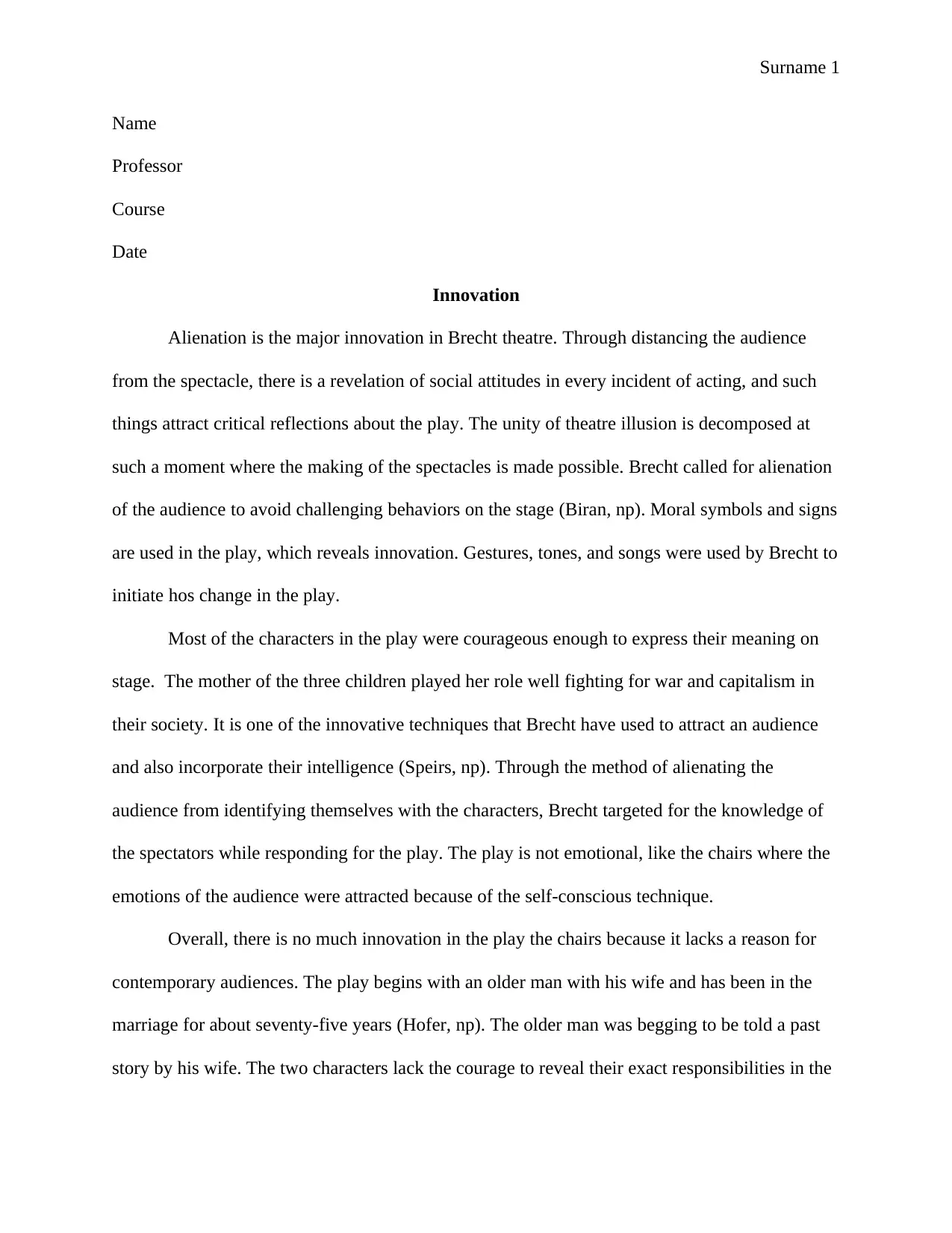
Alienation is the major innovation in Brecht theatre. Through distancing the audience
from the spectacle, there is a revelation of social attitudes in every incident of acting, and such
things attract critical reflections about the play. The unity of theatre illusion is decomposed at
such a moment where the making of the spectacles is made possible. Brecht called for alienation
of the audience to avoid challenging behaviors on the stage (Biran, np). Moral symbols and signs
are used in the play, which reveals innovation. Gestures, tones, and songs were used by Brecht to
initiate hos change in the play.
Most of the characters in the play were courageous enough to express their meaning on
stage. The mother of the three children played her role well fighting for war and capitalism in
their society. It is one of the innovative techniques that Brecht have used to attract an audience
and also incorporate their intelligence (Speirs, np). Through the method of alienating the
audience from identifying themselves with the characters, Brecht targeted for the knowledge of
the spectators while responding for the play. The play is not emotional, like the chairs where the
emotions of the audience were attracted because of the self-conscious technique.
Overall, there is no much innovation in the play the chairs because it lacks a reason for
contemporary audiences. The play begins with an older man with his wife and has been in the
marriage for about seventy-five years (Hofer, np). The older man was begging to be told a past
story by his wife. The two characters lack the courage to reveal their exact responsibilities in the
tabler-icon-diamond-filled.svg

Paraphrase This Document

Need a fresh take? Get an instant paraphrase of this document with our AI Paraphraser
Document Page
Surname 2
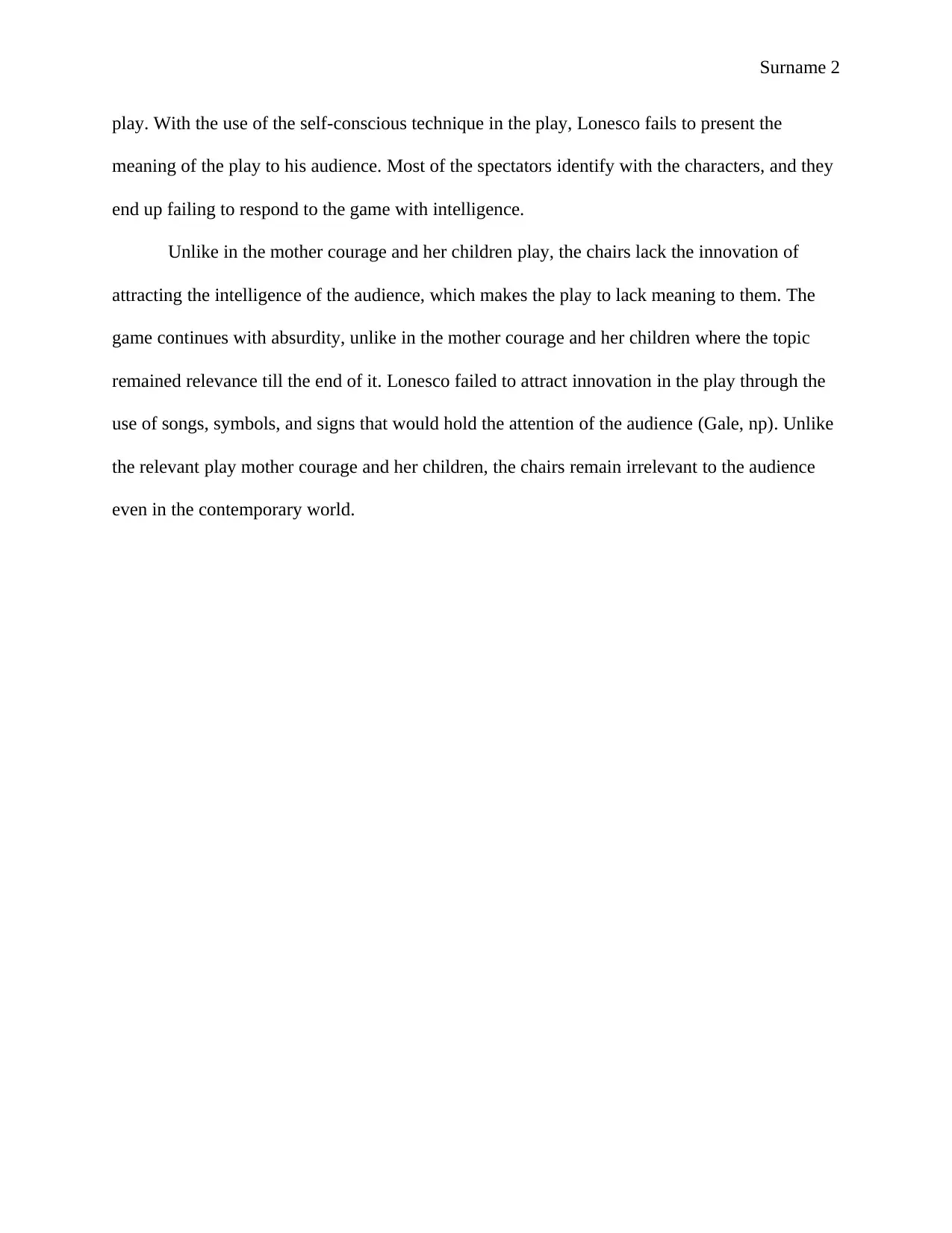
play. With the use of the self-conscious technique in the play, Lonesco fails to present the
meaning of the play to his audience. Most of the spectators identify with the characters, and they
end up failing to respond to the game with intelligence.
Unlike in the mother courage and her children play, the chairs lack the innovation of
attracting the intelligence of the audience, which makes the play to lack meaning to them. The
game continues with absurdity, unlike in the mother courage and her children where the topic
remained relevance till the end of it. Lonesco failed to attract innovation in the play through the
use of songs, symbols, and signs that would hold the attention of the audience (Gale, np). Unlike
the relevant play mother courage and her children, the chairs remain irrelevant to the audience
even in the contemporary world.
Document Page
Surname 3
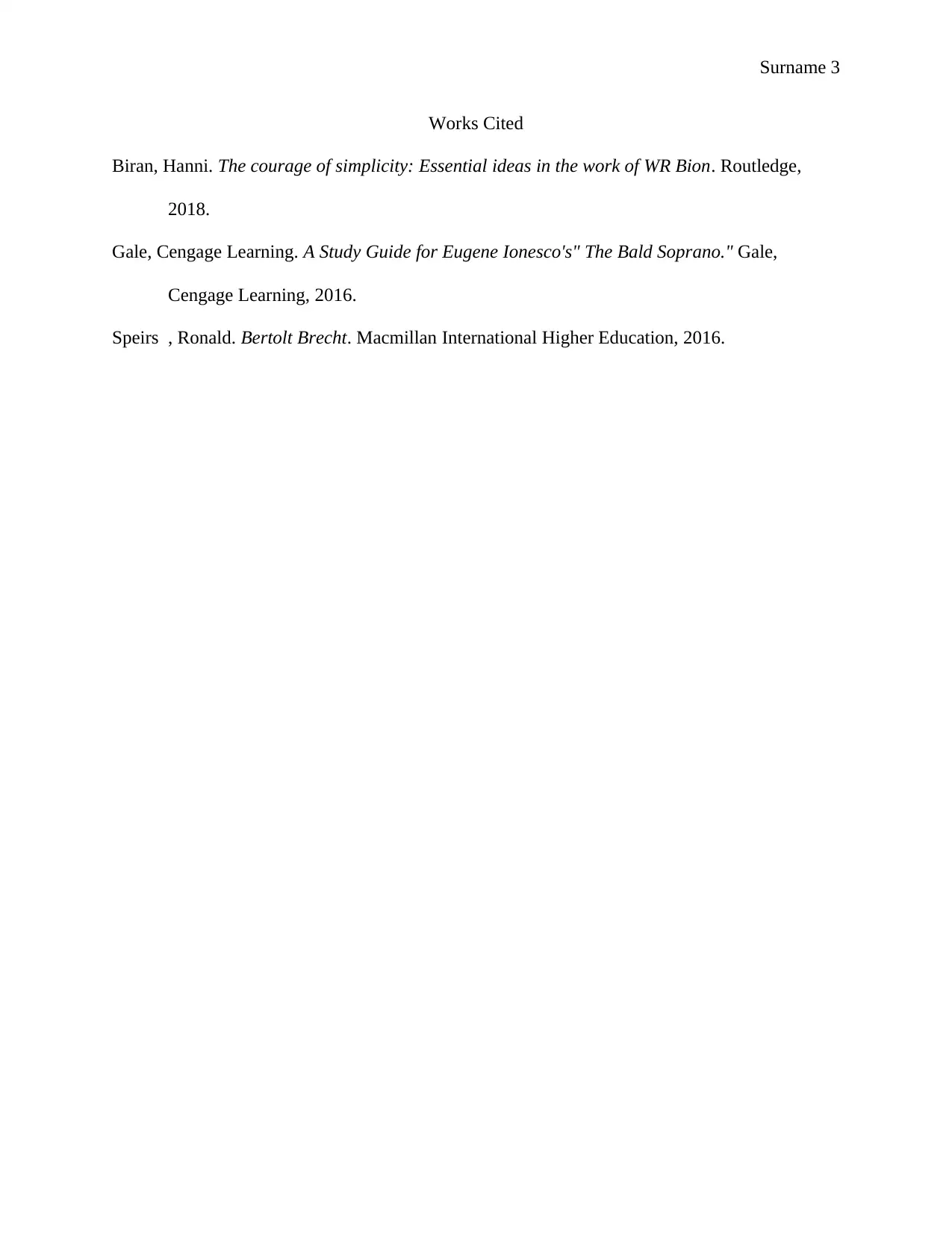
Works Cited
Biran, Hanni. The courage of simplicity: Essential ideas in the work of WR Bion. Routledge,
2018.
Gale, Cengage Learning. A Study Guide for Eugene Ionesco's" The Bald Soprano." Gale,
Cengage Learning, 2016.
Speirs , Ronald. Bertolt Brecht. Macmillan International Higher Education, 2016.
chevron_up_icon
1 out of 3
circle_padding
hide_on_mobile
zoom_out_icon
[object Object]