Breewer's Competitive Strategy: An Analysis of Advantages & Forces

Verified

Added on  2023/06/11

|8
|1516
|188
Report
AI Summary
This report provides a comprehensive analysis of Breewer's competitive strategy and strategic advantages in the craft beer industry. It identifies key elements of competitive advantage such as branding, product quality, distribution network, intellectual property, and customer service. The report also applies Porter's Five Forces model to assess the market attractiveness and profitability, considering competitive rivalry, bargaining power of suppliers and consumers, and the threat of substitute products and new entrants. Breewer's unique offering, leveraging machine learning and automation for high-quality craft beer fermentation, positions it favorably in the market. The analysis concludes that the industry is attractive and profitable, with potential for future growth due to increasing interest in home brewing.
Document Page
Running Head: Competitive Strategy
Breewer
Competitive Strategy
Strategic Advantages
tabler-icon-diamond-filled.svg

Paraphrase This Document

Need a fresh take? Get an instant paraphrase of this document with our AI Paraphraser
Document Page
Competitive Strategy P a g e | 1
Table of Content
Competitive Advantage................................................................................................................................................. 2
Branding......................................................................................................................................................................... 2
Quality of product offering...................................................................................................................................... 2
Distribution Network................................................................................................................................................ 2
Intellectual Property.................................................................................................................................................. 2
Customer Service........................................................................................................................................................ 3
Porter 5 Forces Model.................................................................................................................................................... 3
Competitive Rivalry................................................................................................................................................... 4
Bargaining Power of Suppliers.............................................................................................................................. 4
Bargaining power of Consumers.......................................................................................................................... 4
Threat of substitute product or services........................................................................................................... 4
Threat of New Entrant.............................................................................................................................................. 5
References.......................................................................................................................................................................... 6
Document Page
Competitive Strategy P a g e | 2
Competitive Advantage
Competitive advantage is the leverage the company has over its competitors, this is a set of
attributes which differentiates the company from its competitors and gives it an upper edge in
the highly competitive environment (Barney, 2014). The elements of competitive advantage for
Breewer are as follows:
Branding
Branding is the attribute which helps the company in creating a top of the mind recall for the
consumers. Breewer due to its unique offering and great utility holds much value for the craft
beer brewing. The branding elements of Breewer which makes its unique are its machine
learning algorithm, smart temperature control units, reduction in fermentation control time,
mailing of health reports, setting up of alerts and reminders makes it unique in the market. This
helps the company in creating a strong brand which is utilized in making quality craft beer (Xie,
Batra & Peng, 2015).
Quality of product offering
Breewer is used in the fermentation process while making beer; it is the longest process in
brewing which is responsible for adding the characteristics of flavour in the beer. A whole lot of
beer can be simply wasted due to incorrect temperature control, with brewer this complexity
vanishes. Breewer can be seen as the future of quality beer fermentation which is much ahead of
its times, easily programmable and creates a desired fermentation temperature profile which
increases its quality of product offering (Arnette & Brewer, 2017).
Distribution Network
Breewer is easily accessible via android and ios which makes it cover the entire ecosystem for
the Breewers. Further the target demographics make the product within the reach of its
consumers. The company is pushing the product as the smart, intelligent, machine learning
device which provides quality craft beer with all the factors of production in control.
Intellectual Property
Safeguarding the rights of IP becomes fairly important when the product is a big contributor
and a breakthrough product in making high quality craft beer. The final product gets into the
Document Page
Competitive Strategy P a g e | 3
hands of consumers after three stages of testing the product in controlled conditions; the final
results of Breewer are implemented into the programming. Registration of Patent, trademark
and safeguarding them from other competitors helps to keep its competitive edge over its
customers (Salelaw & Singh, 2015).
Customer Service
Customer service is a major attribute of determining the strength of any product and that of a
company. Breewer which is a high tech product with all its quality control features is at the
pinnacle of customer service. Not only the device automatically sends alerts, reminders and mail
to its consumers when the product is ready, daily reports, or alerts when something is wrong.
Besides this the company is active on social media and website, uses a customer feedback
process to identify and challenges the customer might be facing as a way to ensure a great
customer service experience for its customers(Friske & Zachary, 2017).
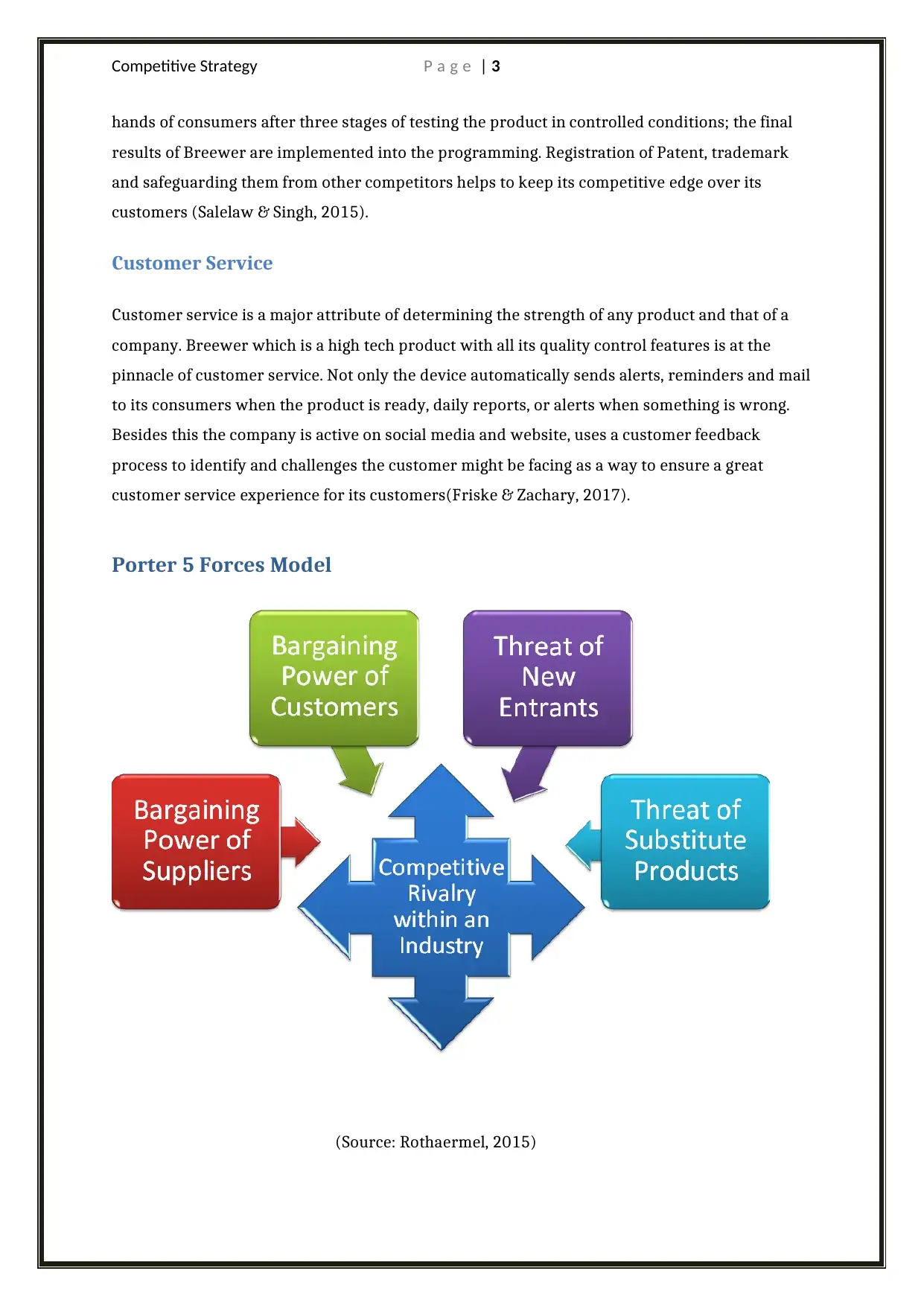
Porter 5 Forces Model
(Source: Rothaermel, 2015)
tabler-icon-diamond-filled.svg

Paraphrase This Document

Need a fresh take? Get an instant paraphrase of this document with our AI Paraphraser
Document Page
Competitive Strategy P a g e | 4
Porter 5 force model is an important framework which helps in determining the market
attractiveness and profitability of the industry in accordance with the 5 forces of Porter (Dobbs,
2014).
Competitive Rivalry
Competitive rivalry sets out the tone for the competition in the industry, thus is a very
important force for consideration .All the other products in the markets have less sophistication
and are not able to control the temperature variation in the beer manufacturing process.
Breewer is a unique offering in itself coupled up with machine learning and automation to
ensure high quality product for the home brewery. The competitive rivalry can be said as low
due to its unique offering and proposition. STC 100 is the most common unit used by Breewer
and is easily replaceable by Breewer.
Bargaining Power of Suppliers
The bargaining power of suppliers is low with Breewer as it’s a product which is designed and
created to work in the competitive times, and uses the modern day technology infrastructure to
support its functionalities. It is easily accessible via application on android and IOS, it has a very
limited control from the suppliers, because most of the components have large suppliers, thus
reducing the bargaining power of suppliers. Moreover, the unique product in the market has
larger domination over suppliers.
Bargaining power of Consumers
Breewer is a quality product made for home brewers; ICT 100 is the only other unit which is
available for the consumers. The limited functionality of ICT 100 makes it easily replaceable by
Breewer which gives plethora of functionality highly useful for the home brewers. The
demographic of the Home brewer is susceptible to online advertising thus making the Breewer
an easy product to buy for the consumers. The target demographics of Home brewer are 99%
males who want to control the beer fermentation process easily via app and able to make
quality craft beer. Due to inability to compete with a high end, technologically advanced and
easy to use product, bargaining power of consumers is high. This is also one of the reasons for a
moderately higher pricing of the product.
Document Page
Competitive Strategy P a g e | 5
Threat of substitute product or services
In the present day, Breewer does not have any threat from any of the existing product. Future
innovation can only keep the product to be the top pick for the home brewers. The substitute to
the product can be changes in the process of mashing and cooling before the process of
fermentation to lessen the utility of Breewer. As of now, the threat of substitute product or
services is extremely low.
Threat of New Entrant
The cost of creating the product is low; however it requires a sizable amount spent towards
Research and development and its marketing and promotions. Breewer has patented its product
and all other processes and trademarks are protected. This leaves very little scope for any
company to copy the mechanism and functioning of Breewer. However, a moderate investment
in creating the product makes the industry (moderate) susceptible for new entrant. The product
has to be out of the box thinking to replace high tech and consumer friendly Breewer out of the
competition.
There are over 1.1 million home brewers only in the USA and every year there is a 10% rise in
the existing number, this shows that the market is huge and highly attractive. The product is
priced at a higher price due to its unique market offering and position. All the factors mentioned
above reflect that the industry is highly attractive and profitable; it will see a surge in the
coming years as well.
Document Page
Competitive Strategy P a g e | 6
References
Arnette, A. and Brewer, B., 2017. The influence of strategy and concurrent engineering on design
for procurement. The International Journal of Logistics Management, 28(2), pp.531-554.
Barney, J.B., 2014. Gaining and sustaining competitive advantage. Pearson higher ed.
E. Dobbs, M., 2014. Guidelines for applying Porter's five forces framework: a set of industry
analysis templates. Competitiveness Review, 24(1), pp.32-45.
Friske, W. and Zachary, M.A., 2017. Regulation, competition, and economic growth: A resource-
advantage theory perspective. Journal of Research in Marketing and Entrepreneurship, 19(1),
pp.26-41.
Rothaermel, F.T., 2015. Strategic management. McGraw-Hill Education.
Salelaw, G. and Singh, A., 2015. Measuring consumer-based brand equity in the ethiopian
brewery industry. ZENITH International Journal of Multidisciplinary Research, 5(12), pp.74-98.
tabler-icon-diamond-filled.svg

Paraphrase This Document

Need a fresh take? Get an instant paraphrase of this document with our AI Paraphraser
Document Page
Competitive Strategy P a g e | 7
Xie, Y., Batra, R. and Peng, S., 2015. An extended model of preference formation between global
and local brands: The roles of identity expressiveness, trust, and affect. Journal of International
Marketing, 23(1), pp.50-71.
chevron_up_icon
1 out of 8
circle_padding
hide_on_mobile
zoom_out_icon
[object Object]