ACC2008 - Brexit's Impact on UK Financial Institutions and Markets
VerifiedAdded on 2023/06/12
|10
|2777
|451
Essay
AI Summary
This essay examines the potential short-term and long-term impacts of Brexit on UK financial institutions and financial markets, including investment banks, capital markets, insurance markets, and mortgage institutions. It discusses the roles of these institutions and relevant government policies, highlighting potential disruptions such as changes in banking regulations, insurance policy cancellations, and trade reporting requirements. The essay also provides recommendations for the Bank of England and the Financial Conduct Authority to prepare for Brexit, including balancing inflation, negotiating with EU financial regulators, and designing new rules to regulate the financial sector. The analysis emphasizes the need for proactive measures to minimize negative impacts and ensure the stability of financial markets.
FINANCIAL ENVIRONMENT 1
FINANCIAL ENVIRONMENT
Name of student:
Registration number:
Unit Title:
Unit Code:
Name of supervisor:
Date due:
FINANCIAL ENVIRONMENT
Name of student:
Registration number:
Unit Title:
Unit Code:
Name of supervisor:
Date due:

Paraphrase This Document
Need a fresh take? Get an instant paraphrase of this document with our AI Paraphraser
FINANCIAL ENVIRONMENT 2
Introduction
The decision by the United Kingdom to leave the European Union is expected to have
a very profound impact on the financial markets and economy of both the UK and the
rest of the EU members. ‘Brexit,’ as its commonly referred will disrupt the financial
markets both in the long term and the short term. The UK served the EU a notice of
withdrawal from the EU under Article 50 of the treaty on the European Union
(Leitner & Frauendorfer, 2017). This began a two year notice period, and this
triggered the introduction of the European Union withdrawal Bill to the House of
Commons on July 2017 (Whyman & Petrescu, 2017). The agreement in place is that
by December 2020, the UK should exit the single market and customs union. This
means that the UK goods and services will not be able to enjoy free access to the
European market. This change is expected to have a huge impact on the financial
markets in the region.
Disruption of financial markets in this region is likely to impact other economic
factors. It is therefore important that all crucial players in the financial sector in the
UK prepare adequately for Brexit. This will help this organization to minimize the
negative impact of Brexit and hence ensure the stability of the financial markets both
in the long term and in the short term. Financial institutions that are likely to be
affected by Brixit include Investment banks, capital markets, insurance market and
mortgage institutions (King, 2016). The paper discusses the function of the listed
financial institutions and discusses the government policies that govern the financial
markets and how they will be affected by this change. In addition to this, the paper
also identifies and discusses other contemporary issues arising in this industry. This
paper researches and analyzes the potential short term and long term impact of Brexit
Introduction
The decision by the United Kingdom to leave the European Union is expected to have
a very profound impact on the financial markets and economy of both the UK and the
rest of the EU members. ‘Brexit,’ as its commonly referred will disrupt the financial
markets both in the long term and the short term. The UK served the EU a notice of
withdrawal from the EU under Article 50 of the treaty on the European Union
(Leitner & Frauendorfer, 2017). This began a two year notice period, and this
triggered the introduction of the European Union withdrawal Bill to the House of
Commons on July 2017 (Whyman & Petrescu, 2017). The agreement in place is that
by December 2020, the UK should exit the single market and customs union. This
means that the UK goods and services will not be able to enjoy free access to the
European market. This change is expected to have a huge impact on the financial
markets in the region.
Disruption of financial markets in this region is likely to impact other economic
factors. It is therefore important that all crucial players in the financial sector in the
UK prepare adequately for Brexit. This will help this organization to minimize the
negative impact of Brexit and hence ensure the stability of the financial markets both
in the long term and in the short term. Financial institutions that are likely to be
affected by Brixit include Investment banks, capital markets, insurance market and
mortgage institutions (King, 2016). The paper discusses the function of the listed
financial institutions and discusses the government policies that govern the financial
markets and how they will be affected by this change. In addition to this, the paper
also identifies and discusses other contemporary issues arising in this industry. This
paper researches and analyzes the potential short term and long term impact of Brexit
FINANCIAL ENVIRONMENT 3
and provides a recommendation on how the Bank of England and the Financial
Conduct Authority should prepare for Brexit.
Financial institutions play a very huge in the financial markets and the economy of
any country. They make transactions easy and convenient, and others provide credit
and insurance services to the general population. Banks are one of the oldest and most
important financial institutions. Banks in the UK and the EU, in general, will be
affected by Brexit to a very great deal. Some of the roles that banks play include;
accepting deposits from clients, offering advances and other credit facilities, acting as
an intermediary when carrying out payments (Schoenmaker, Et Al. 2016). Investment
banks offer investment funds and financial advice to business institutions, and they
also offer property management services. Following the Brexit vote, the EU
commission issued a notice to the stakeholders in the financial sector outlining some
of the legal consequences of Brexit on banking and payment services. According to
the European Banking Authority, The minimum requirements for own funds and
eligible liabilities had to change. This means that authorization for banks in the UK
could become more difficult for banks from outside the UK. The banks that are
currently operating in the UK but are registered in other countries will find it difficult
to get authorization to operate within the UK. The UK is currently Europe`s major
international financial capital center and its the leader in cross-boarder lending.
Banks in the UK will, therefore, be affected by the new rules after Brexit. It will
become more difficult for the banks that are based in UK countries to lend to banks
located in other countries within the EU. This means that the banks are going to lose a
significant amount of revenue that they accrue from trading with other banks in the
region. The banks in the UK will also have to undertake a significant review of
operations and structure to adapt to the new rules and regulations as a result of Brexit.
and provides a recommendation on how the Bank of England and the Financial
Conduct Authority should prepare for Brexit.
Financial institutions play a very huge in the financial markets and the economy of
any country. They make transactions easy and convenient, and others provide credit
and insurance services to the general population. Banks are one of the oldest and most
important financial institutions. Banks in the UK and the EU, in general, will be
affected by Brexit to a very great deal. Some of the roles that banks play include;
accepting deposits from clients, offering advances and other credit facilities, acting as
an intermediary when carrying out payments (Schoenmaker, Et Al. 2016). Investment
banks offer investment funds and financial advice to business institutions, and they
also offer property management services. Following the Brexit vote, the EU
commission issued a notice to the stakeholders in the financial sector outlining some
of the legal consequences of Brexit on banking and payment services. According to
the European Banking Authority, The minimum requirements for own funds and
eligible liabilities had to change. This means that authorization for banks in the UK
could become more difficult for banks from outside the UK. The banks that are
currently operating in the UK but are registered in other countries will find it difficult
to get authorization to operate within the UK. The UK is currently Europe`s major
international financial capital center and its the leader in cross-boarder lending.
Banks in the UK will, therefore, be affected by the new rules after Brexit. It will
become more difficult for the banks that are based in UK countries to lend to banks
located in other countries within the EU. This means that the banks are going to lose a
significant amount of revenue that they accrue from trading with other banks in the
region. The banks in the UK will also have to undertake a significant review of
operations and structure to adapt to the new rules and regulations as a result of Brexit.
⊘ This is a preview!⊘
Do you want full access?
Subscribe today to unlock all pages.

Trusted by 1+ million students worldwide
FINANCIAL ENVIRONMENT 4
For example, the banks which are headquartered in the UK will need to evaluate
whether it's tenable for them to maintain the headquarters in the country or they
should shift to another country(Caporale, Gil-Alana and Trani, 2018). Some banks
with headquarters in London such as HSBC decided to retain the UK as its
headquarters. The banks will end up incurring huge costs which could lead to huge
losses for the banks. The banks that will remain in the UK will find it difficult to
access other word markets. This is because, presently UK banks access to world
markets through the Free Trade Agreement(FTA) made by the EU with other
countries (Verhofstadt, 2016). The exit of UK from the EU will, therefore, mean that
the UK will no longer be a signatory to the FTA”s on financial services.
Additionally, Brexit will affect trade reporting and clearing requirements. Under the
European Markets Infrastructure Regulation(EMIR), banks in member countries are
subjected to comprehensive rules concerning clearing, trade reporting, and mitigation
of risk. The exit of UK from the EU will, therefore, mean that banks that remain in the
UK will not be subject to this regulations.
UK banks that currently provide custody services to clients will be incapable of
providing these services once they leave the UK. The Alternative Investment Fund
Managers Directive(AIFMD) restricts the organizations that can act as a depository
for AIFs that are incorporated in the EU(Hellwig, 2017).
The Insurance Industry in the UK is huge, and London is a global hub for the
Insurance sector serving both local and international markets. Brexit is expected to
have a huge impact on this sector. This is because Brexit will mean the exit from
common financial services market of which Insurance is a major industry in this
market. One of the potential impacts on the Insurance industry is the cancellation of
For example, the banks which are headquartered in the UK will need to evaluate
whether it's tenable for them to maintain the headquarters in the country or they
should shift to another country(Caporale, Gil-Alana and Trani, 2018). Some banks
with headquarters in London such as HSBC decided to retain the UK as its
headquarters. The banks will end up incurring huge costs which could lead to huge
losses for the banks. The banks that will remain in the UK will find it difficult to
access other word markets. This is because, presently UK banks access to world
markets through the Free Trade Agreement(FTA) made by the EU with other
countries (Verhofstadt, 2016). The exit of UK from the EU will, therefore, mean that
the UK will no longer be a signatory to the FTA”s on financial services.
Additionally, Brexit will affect trade reporting and clearing requirements. Under the
European Markets Infrastructure Regulation(EMIR), banks in member countries are
subjected to comprehensive rules concerning clearing, trade reporting, and mitigation
of risk. The exit of UK from the EU will, therefore, mean that banks that remain in the
UK will not be subject to this regulations.
UK banks that currently provide custody services to clients will be incapable of
providing these services once they leave the UK. The Alternative Investment Fund
Managers Directive(AIFMD) restricts the organizations that can act as a depository
for AIFs that are incorporated in the EU(Hellwig, 2017).
The Insurance Industry in the UK is huge, and London is a global hub for the
Insurance sector serving both local and international markets. Brexit is expected to
have a huge impact on this sector. This is because Brexit will mean the exit from
common financial services market of which Insurance is a major industry in this
market. One of the potential impacts on the Insurance industry is the cancellation of
Paraphrase This Document
Need a fresh take? Get an instant paraphrase of this document with our AI Paraphraser
FINANCIAL ENVIRONMENT 5
the existing Insurance policy after the expiry of the transition period in March 2019.
There is a high likelihood that people in the UK who have insurance policies with
companies that are not incorporated in the UK will lose their insurance cover. This is
the same with the people in EU with insurance policies with companies incorporated
in the UK. This would, therefore, mean millions of individuals and businesses would,
therefore, lose their insurance cover.
Brexit is expected to lead to passport loss especially for non-EU firms seeking to
access the European Insurance market. If the EU withdraws a passport for UK
insurers, the companies will be forced to restructure their business. This will, for
example, mean incorporating another company in EU countries or entering into a
partnership to access this markets. This will cost the insurance company a lot of
money and hence affect their revenue flow.
Brexit is also expected to increase capital volatility since the insurance companies in
the UK will not be regulated by Solvency 2. New rules that will be set are expected
to cause market volatility due to uncertainty over the future. In addiction to this,
Brexit is expected to affect the taxation of insurance companies both in the UK and in
EU countries. Brexit will mean that UK incorporated insurance companies operating
in the EU will be subjected to high taxes since they will not get special treatment as
before(Hohlmeier and Fahrholz, 2018). Presently, taxation of companies across the
EU members is favorable due to the EU common market agreement. Brexit could also
bring about additional withholding tax on dividends and payments from operations in
other countries. Increase in tax will reduce profit margins for the companies.
the existing Insurance policy after the expiry of the transition period in March 2019.
There is a high likelihood that people in the UK who have insurance policies with
companies that are not incorporated in the UK will lose their insurance cover. This is
the same with the people in EU with insurance policies with companies incorporated
in the UK. This would, therefore, mean millions of individuals and businesses would,
therefore, lose their insurance cover.
Brexit is expected to lead to passport loss especially for non-EU firms seeking to
access the European Insurance market. If the EU withdraws a passport for UK
insurers, the companies will be forced to restructure their business. This will, for
example, mean incorporating another company in EU countries or entering into a
partnership to access this markets. This will cost the insurance company a lot of
money and hence affect their revenue flow.
Brexit is also expected to increase capital volatility since the insurance companies in
the UK will not be regulated by Solvency 2. New rules that will be set are expected
to cause market volatility due to uncertainty over the future. In addiction to this,
Brexit is expected to affect the taxation of insurance companies both in the UK and in
EU countries. Brexit will mean that UK incorporated insurance companies operating
in the EU will be subjected to high taxes since they will not get special treatment as
before(Hohlmeier and Fahrholz, 2018). Presently, taxation of companies across the
EU members is favorable due to the EU common market agreement. Brexit could also
bring about additional withholding tax on dividends and payments from operations in
other countries. Increase in tax will reduce profit margins for the companies.
FINANCIAL ENVIRONMENT 6
Human resource problem may also arise as a result of the change. Companies might
be forced to hire additional staff to support operations outside the UK. This situation
may also force the companies to transfer staff from the UK to streamline operations in
other locations. This may bring about some instability for the UK based insurance
firms.
The trading of shares will also be affected by the exit of UK from the EU. The
companies that are listed in the London stock exchange and are not incorporated in
the UK are expected to be affected the most. After Brexit, it will be difficult for
companies that are incorporated in EU to raise capital in the UK since the movement
of capital will be more restricted. In addiction to this, companies in the UK will have
different regulations and different regulatory bodies(Howarth and Quaglia, 2017). The
regulation under the Markets in Financial Instruments Regulations(MiFIR) will not
apply to UK companies. This will make it difficult for companies from the UK to
access capital from other countries outside the UK. Consequently, this will limit the
expansion and growth of different companies outside the country.
The Bank Of England(BOE) is the central bank of the UK and a model upon which
most central banks in the world are built. The primary function of BOE is to maintain
monetary stability and oversee monetary stability in the financial systems of the
United Kingdom. (Moloney, 2017) The Financial Conduct Authority(FCA) is a
government body that regulates the financial organizations providing services to
consumers in the UK. It also maintains the integrity of the financial market in the UK.
With Brexit now a reality and the impact that it is expected to have on the financial
market, it is important for both the BOE and the FCA to design policies and take
Human resource problem may also arise as a result of the change. Companies might
be forced to hire additional staff to support operations outside the UK. This situation
may also force the companies to transfer staff from the UK to streamline operations in
other locations. This may bring about some instability for the UK based insurance
firms.
The trading of shares will also be affected by the exit of UK from the EU. The
companies that are listed in the London stock exchange and are not incorporated in
the UK are expected to be affected the most. After Brexit, it will be difficult for
companies that are incorporated in EU to raise capital in the UK since the movement
of capital will be more restricted. In addiction to this, companies in the UK will have
different regulations and different regulatory bodies(Howarth and Quaglia, 2017). The
regulation under the Markets in Financial Instruments Regulations(MiFIR) will not
apply to UK companies. This will make it difficult for companies from the UK to
access capital from other countries outside the UK. Consequently, this will limit the
expansion and growth of different companies outside the country.
The Bank Of England(BOE) is the central bank of the UK and a model upon which
most central banks in the world are built. The primary function of BOE is to maintain
monetary stability and oversee monetary stability in the financial systems of the
United Kingdom. (Moloney, 2017) The Financial Conduct Authority(FCA) is a
government body that regulates the financial organizations providing services to
consumers in the UK. It also maintains the integrity of the financial market in the UK.
With Brexit now a reality and the impact that it is expected to have on the financial
market, it is important for both the BOE and the FCA to design policies and take
⊘ This is a preview!⊘
Do you want full access?
Subscribe today to unlock all pages.
Trusted by 1+ million students worldwide
FINANCIAL ENVIRONMENT 7
measures that will help to minimize the impact of the impending change. The
following are therefore the recommendations on actions that should be taken by the
BOE and the FCA to prepare for Brexit.
One of the recommendations for the BOE is trying to balance inflation, aggregate
output, and unemployment to maintain stability in the economy. This will be done by
closely regulating interest rates to ensure that they are not too high to bring in
inflation (Halligan & Lyons, 2017). Most investors are jittery on Brixit, and most
markets are performing poorly because of the uncertainty. Lowering the interest rates
slightly will encourage investors to borrow money, and hence the economic activities
are expected to increase and hence to minimize the impact of Brexit.
The BOE should ensure that there is enough money in circulation to avoid the
happenings of 2008 recession. One of the ways to do this is to reduce the amount of
money the central bank holds for commercial banks. The interest rates should also be
increased to ensure that there is enough money circulating in the economy.
The BOE and the FCA should also negotiate with European Union Financial
regulators such as the European Banking Authority(EBA) and The European
Securities and Markets Authority(ESMA) to ensure a smooth transition for players in
the financial services industry(Wymeersch, 2018). By carrying out these negotiations,
it will be possible for the BOE to sign agreements to enable the UK financial services
providers to access the EU market with relative ease.
The BOE and FCA should design new rules and regulations to regulate the financial
sector in the UK. This will help in filling the gaps in legislation left after the exit of
the European Union. The roles and responsibility that were being carried out by EU
organizations have to be transferred to new authorities in the UK. In addition to this,
measures that will help to minimize the impact of the impending change. The
following are therefore the recommendations on actions that should be taken by the
BOE and the FCA to prepare for Brexit.
One of the recommendations for the BOE is trying to balance inflation, aggregate
output, and unemployment to maintain stability in the economy. This will be done by
closely regulating interest rates to ensure that they are not too high to bring in
inflation (Halligan & Lyons, 2017). Most investors are jittery on Brixit, and most
markets are performing poorly because of the uncertainty. Lowering the interest rates
slightly will encourage investors to borrow money, and hence the economic activities
are expected to increase and hence to minimize the impact of Brexit.
The BOE should ensure that there is enough money in circulation to avoid the
happenings of 2008 recession. One of the ways to do this is to reduce the amount of
money the central bank holds for commercial banks. The interest rates should also be
increased to ensure that there is enough money circulating in the economy.
The BOE and the FCA should also negotiate with European Union Financial
regulators such as the European Banking Authority(EBA) and The European
Securities and Markets Authority(ESMA) to ensure a smooth transition for players in
the financial services industry(Wymeersch, 2018). By carrying out these negotiations,
it will be possible for the BOE to sign agreements to enable the UK financial services
providers to access the EU market with relative ease.
The BOE and FCA should design new rules and regulations to regulate the financial
sector in the UK. This will help in filling the gaps in legislation left after the exit of
the European Union. The roles and responsibility that were being carried out by EU
organizations have to be transferred to new authorities in the UK. In addition to this,
Paraphrase This Document
Need a fresh take? Get an instant paraphrase of this document with our AI Paraphraser
FINANCIAL ENVIRONMENT 8
the BOE and the FCA should negotiate a deal that will enable firms and FMIs to
continue treating UK firms preferentially under the Capital Requirements Regulations
regime (Alexander, 2018). This will ensure that there is no disruption in capital flow
within this region.
I would also recommend the amendment of Rule 2.1 of the Contractual Recognition
of Bail-In Part of the PRA Rulebook to ensure that the regulation does not apply in
respect to the EEA law governed liabilities created after the exit.
Conclusion
The exit of UK from the EU is expected to have a great impact on the financial
services industry in the UK. Some of the industry players that will be greatly
impacted by the Brexit include; banks, insurance companies, and the stock markets.
This report investigates the potential impact that Brexit will have on these institutions
as well as the market in general. The study is carried out using secondary data from
various sources such as journals, newspaper articles, government publications, and
internet sources. The paper also discusses the role of the BOE and the FCA and
proposes recommendations on how the impact of Brexit on the financial services
industry can be controlled. The BOE and FCA have to design new regulations to
govern financial services providers in the UK to cover the loopholes left about by the
separation from the EU. The BEO should enforce fiscal policies that will help to
prevent recession of inflation depending on the prevailing economic environment at
that particular time.
the BOE and the FCA should negotiate a deal that will enable firms and FMIs to
continue treating UK firms preferentially under the Capital Requirements Regulations
regime (Alexander, 2018). This will ensure that there is no disruption in capital flow
within this region.
I would also recommend the amendment of Rule 2.1 of the Contractual Recognition
of Bail-In Part of the PRA Rulebook to ensure that the regulation does not apply in
respect to the EEA law governed liabilities created after the exit.
Conclusion
The exit of UK from the EU is expected to have a great impact on the financial
services industry in the UK. Some of the industry players that will be greatly
impacted by the Brexit include; banks, insurance companies, and the stock markets.
This report investigates the potential impact that Brexit will have on these institutions
as well as the market in general. The study is carried out using secondary data from
various sources such as journals, newspaper articles, government publications, and
internet sources. The paper also discusses the role of the BOE and the FCA and
proposes recommendations on how the impact of Brexit on the financial services
industry can be controlled. The BOE and FCA have to design new regulations to
govern financial services providers in the UK to cover the loopholes left about by the
separation from the EU. The BEO should enforce fiscal policies that will help to
prevent recession of inflation depending on the prevailing economic environment at
that particular time.
FINANCIAL ENVIRONMENT 9
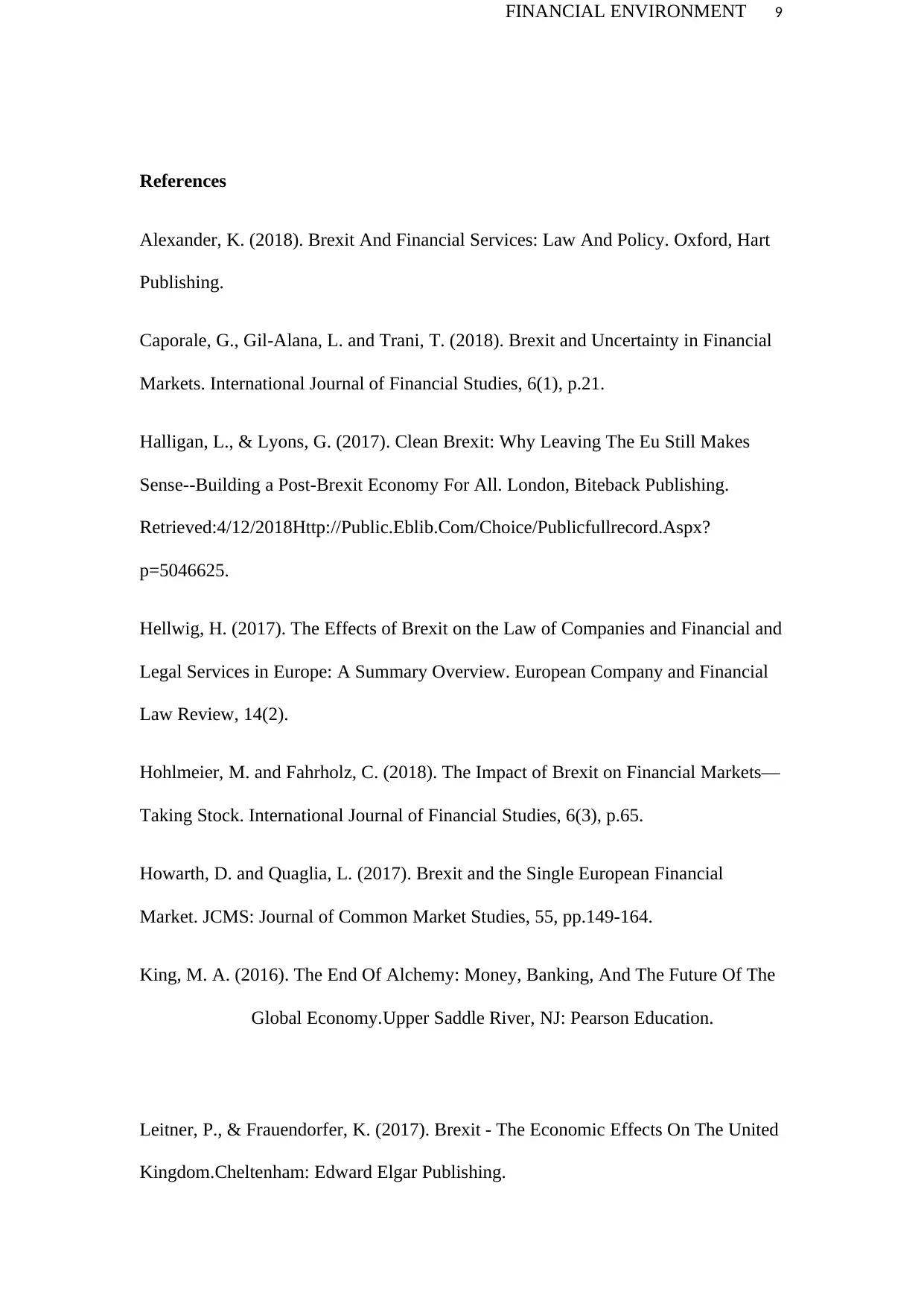
References
Alexander, K. (2018). Brexit And Financial Services: Law And Policy. Oxford, Hart
Publishing.
Caporale, G., Gil-Alana, L. and Trani, T. (2018). Brexit and Uncertainty in Financial
Markets. International Journal of Financial Studies, 6(1), p.21.
Halligan, L., & Lyons, G. (2017). Clean Brexit: Why Leaving The Eu Still Makes
Sense--Building a Post-Brexit Economy For All. London, Biteback Publishing.
Retrieved:4/12/2018Http://Public.Eblib.Com/Choice/Publicfullrecord.Aspx?
p=5046625.
Hellwig, H. (2017). The Effects of Brexit on the Law of Companies and Financial and
Legal Services in Europe: A Summary Overview. European Company and Financial
Law Review, 14(2).
Hohlmeier, M. and Fahrholz, C. (2018). The Impact of Brexit on Financial Markets—
Taking Stock. International Journal of Financial Studies, 6(3), p.65.
Howarth, D. and Quaglia, L. (2017). Brexit and the Single European Financial
Market. JCMS: Journal of Common Market Studies, 55, pp.149-164.
King, M. A. (2016). The End Of Alchemy: Money, Banking, And The Future Of The
Global Economy.Upper Saddle River, NJ: Pearson Education.
Leitner, P., & Frauendorfer, K. (2017). Brexit - The Economic Effects On The United
Kingdom.Cheltenham: Edward Elgar Publishing.
References
Alexander, K. (2018). Brexit And Financial Services: Law And Policy. Oxford, Hart
Publishing.
Caporale, G., Gil-Alana, L. and Trani, T. (2018). Brexit and Uncertainty in Financial
Markets. International Journal of Financial Studies, 6(1), p.21.
Halligan, L., & Lyons, G. (2017). Clean Brexit: Why Leaving The Eu Still Makes
Sense--Building a Post-Brexit Economy For All. London, Biteback Publishing.
Retrieved:4/12/2018Http://Public.Eblib.Com/Choice/Publicfullrecord.Aspx?
p=5046625.
Hellwig, H. (2017). The Effects of Brexit on the Law of Companies and Financial and
Legal Services in Europe: A Summary Overview. European Company and Financial
Law Review, 14(2).
Hohlmeier, M. and Fahrholz, C. (2018). The Impact of Brexit on Financial Markets—
Taking Stock. International Journal of Financial Studies, 6(3), p.65.
Howarth, D. and Quaglia, L. (2017). Brexit and the Single European Financial
Market. JCMS: Journal of Common Market Studies, 55, pp.149-164.
King, M. A. (2016). The End Of Alchemy: Money, Banking, And The Future Of The
Global Economy.Upper Saddle River, NJ: Pearson Education.
Leitner, P., & Frauendorfer, K. (2017). Brexit - The Economic Effects On The United
Kingdom.Cheltenham: Edward Elgar Publishing.
⊘ This is a preview!⊘
Do you want full access?
Subscribe today to unlock all pages.
Trusted by 1+ million students worldwide
FINANCIAL ENVIRONMENT
10
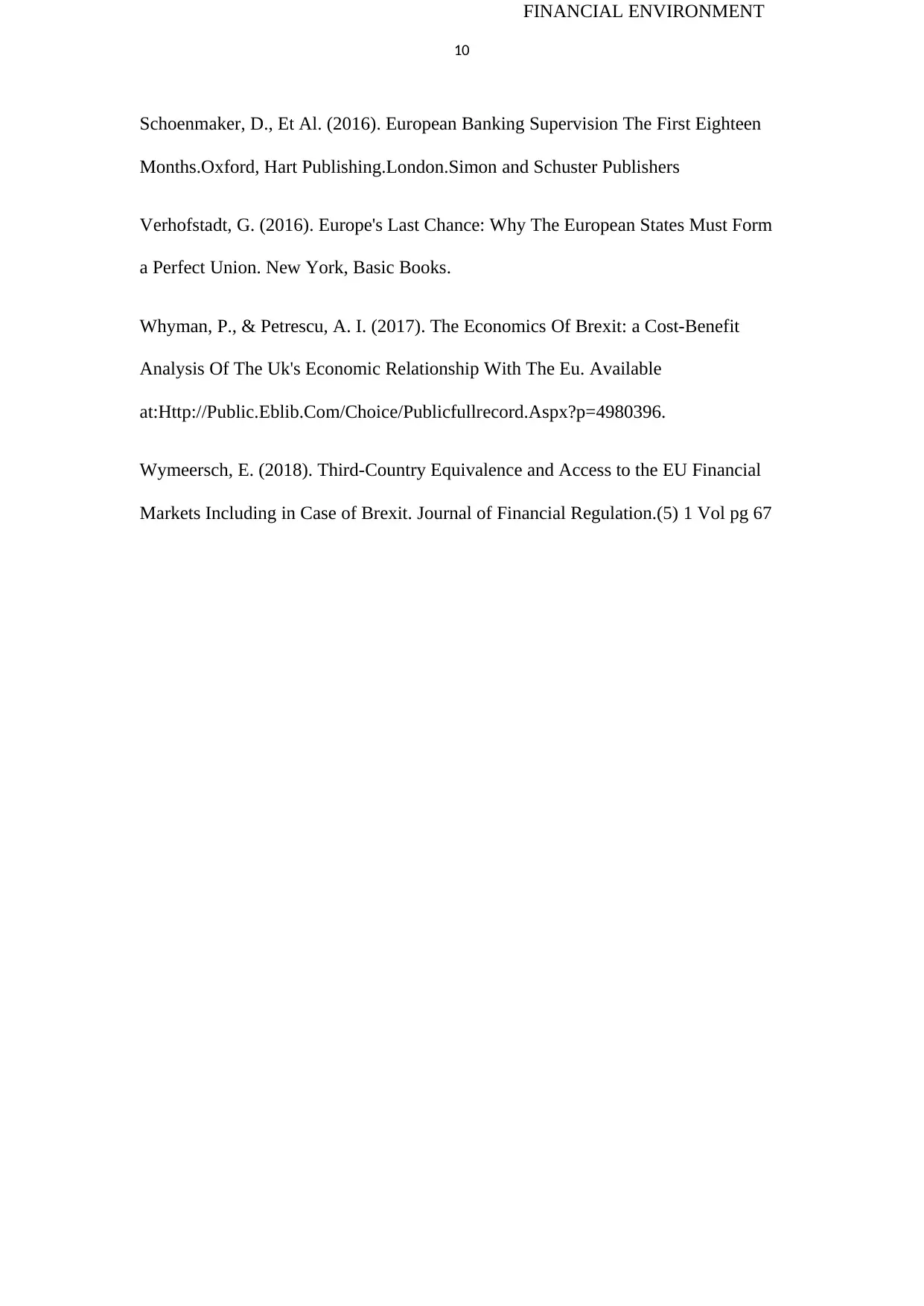
Schoenmaker, D., Et Al. (2016). European Banking Supervision The First Eighteen
Months.Oxford, Hart Publishing.London.Simon and Schuster Publishers
Verhofstadt, G. (2016). Europe's Last Chance: Why The European States Must Form
a Perfect Union. New York, Basic Books.
Whyman, P., & Petrescu, A. I. (2017). The Economics Of Brexit: a Cost-Benefit
Analysis Of The Uk's Economic Relationship With The Eu. Available
at:Http://Public.Eblib.Com/Choice/Publicfullrecord.Aspx?p=4980396.
Wymeersch, E. (2018). Third-Country Equivalence and Access to the EU Financial
Markets Including in Case of Brexit. Journal of Financial Regulation.(5) 1 Vol pg 67
10
Schoenmaker, D., Et Al. (2016). European Banking Supervision The First Eighteen
Months.Oxford, Hart Publishing.London.Simon and Schuster Publishers
Verhofstadt, G. (2016). Europe's Last Chance: Why The European States Must Form
a Perfect Union. New York, Basic Books.
Whyman, P., & Petrescu, A. I. (2017). The Economics Of Brexit: a Cost-Benefit
Analysis Of The Uk's Economic Relationship With The Eu. Available
at:Http://Public.Eblib.Com/Choice/Publicfullrecord.Aspx?p=4980396.
Wymeersch, E. (2018). Third-Country Equivalence and Access to the EU Financial
Markets Including in Case of Brexit. Journal of Financial Regulation.(5) 1 Vol pg 67

1 out of 10


Related Documents


Your All-in-One AI-Powered Toolkit for Academic Success.
+13062052269
info@desklib.com
Available 24*7 on WhatsApp / Email
![[object Object]](/_next/static/media/star-bottom.7253800d.svg)
Unlock your academic potential
Copyright © 2020–2026 A2Z Services. All Rights Reserved. Developed and managed by ZUCOL.