An Economic Analysis of the Impact of Brexit on the UK Economy
VerifiedAdded on 2021/01/02
|17
|3140
|280
Report
AI Summary
This report presents a qualitative analysis of the economic impact of Brexit on the United Kingdom. It begins with an abstract and introduction to the topic, defining Brexit and its implications. A literature review explores various perspectives on Brexit's effects, including its impact on immigration, trade, and monetary policies. The methodology section details the use of qualitative research and secondary data to assess the pre- and post-Brexit economic landscape, focusing on GDP, inflation, and employment. The discussion section examines the transition plan and potential effects on the free flow of people. The report then analyzes the impact on GDP, CPI inflation, effective exchange rates, wage growth, business investment, stock market performance, and employment. The conclusion summarizes the findings, highlighting the complex and multifaceted economic consequences of Brexit, supported by various graphs and data visualizations. The report uses secondary data sources like journals, articles, and websites to evaluate the economic effects of Brexit.

ACADEMIC ARTICLES

Paraphrase This Document
Need a fresh take? Get an instant paraphrase of this document with our AI Paraphraser
TABLE OF CONTENTS
ABSTRACT.....................................................................................................................................1
INTRODUCTION...........................................................................................................................1
Literature review.........................................................................................................................1
Research methodology................................................................................................................3
Discussion...................................................................................................................................3
Impact of Brexit on GDP............................................................................................................4
..........................................................................................................................................................4
Impact of Brexit on CPI inflation and effective exchange rate...................................................6
Wage growth ..............................................................................................................................8
Business Investment ...................................................................................................................9
Performance of UK stock since Brexit vote..............................................................................10
Strength of employment............................................................................................................11
CONCLUSION..............................................................................................................................11
REFERENCES..............................................................................................................................13
ABSTRACT.....................................................................................................................................1
INTRODUCTION...........................................................................................................................1
Literature review.........................................................................................................................1
Research methodology................................................................................................................3
Discussion...................................................................................................................................3
Impact of Brexit on GDP............................................................................................................4
..........................................................................................................................................................4
Impact of Brexit on CPI inflation and effective exchange rate...................................................6
Wage growth ..............................................................................................................................8
Business Investment ...................................................................................................................9
Performance of UK stock since Brexit vote..............................................................................10
Strength of employment............................................................................................................11
CONCLUSION..............................................................................................................................11
REFERENCES..............................................................................................................................13
ABSTRACT
In the present scenario, there are different analyses performed for quantifying economic
impact of Brexit on United Kingdom. The European Union is considered as largest trade partner
of UK as membership in EU had decreased trade cost among EU and UK as this creates services
and goods cheaper for consumers of UK and allows UK business for exporting more. Its
outcome are very confusing and ranging through different methods, different aspects along with
diverse assumptions are included. The risk related to Brexit are underestimated and economic
damage to UK is significantly more than mainstream. There is presence of thorough overview of
multiple advantages which is left and pointed out with relevance for growth and welfare. In the
current scenario, there is absence of universally accepted method of estimation with availability
of integrating all specific effect in comprehensive aspect.
INTRODUCTION
Brexit is abbreviation of British Exit and this word is used by people who discuss about
UK's decision for leaving EU. Brexit is judged for attaining success as it will be not depend on
some degree to economic affect. There is presence of different range of trade opportunities along
with arrangements with possibilities of UK and European Union along with other countries like
United States or post Brexit. The selected trade arrangement will be highly dependent on
negotiations of UK which will attempt to disentangle with its current ties with reference to
European Union and it also negotiates with arrangements for proper future of UK-EU trading
relationship. Both EU and UK has declared about specific intent with presence of positive
partnership but with discussion related to divorce arrangements and future accord which are
negotiated consecutively instead concurrently, this could directly lead to two parties with
absence of ability for reaching accommodations with mutually advantageous. It is likely to be
presented in numerous economic and political challenges for both aspect but especially in United
Kingdom. As per assessment of government with its economic impact of leaving European union
single market produced with estimated which is roughly in line with prior assessment. Its final
outcome will be presented on 29 March 2019.
Literature review
According to Bowler (2017), it had reduced overcrowding which has been complained
through UK as it is impacting UK on huge scale. The UK skilled workers are doing jobs in other
countries so BREXIT leads to bring its talent back to their home country. In this aspect
1
In the present scenario, there are different analyses performed for quantifying economic
impact of Brexit on United Kingdom. The European Union is considered as largest trade partner
of UK as membership in EU had decreased trade cost among EU and UK as this creates services
and goods cheaper for consumers of UK and allows UK business for exporting more. Its
outcome are very confusing and ranging through different methods, different aspects along with
diverse assumptions are included. The risk related to Brexit are underestimated and economic
damage to UK is significantly more than mainstream. There is presence of thorough overview of
multiple advantages which is left and pointed out with relevance for growth and welfare. In the
current scenario, there is absence of universally accepted method of estimation with availability
of integrating all specific effect in comprehensive aspect.
INTRODUCTION
Brexit is abbreviation of British Exit and this word is used by people who discuss about
UK's decision for leaving EU. Brexit is judged for attaining success as it will be not depend on
some degree to economic affect. There is presence of different range of trade opportunities along
with arrangements with possibilities of UK and European Union along with other countries like
United States or post Brexit. The selected trade arrangement will be highly dependent on
negotiations of UK which will attempt to disentangle with its current ties with reference to
European Union and it also negotiates with arrangements for proper future of UK-EU trading
relationship. Both EU and UK has declared about specific intent with presence of positive
partnership but with discussion related to divorce arrangements and future accord which are
negotiated consecutively instead concurrently, this could directly lead to two parties with
absence of ability for reaching accommodations with mutually advantageous. It is likely to be
presented in numerous economic and political challenges for both aspect but especially in United
Kingdom. As per assessment of government with its economic impact of leaving European union
single market produced with estimated which is roughly in line with prior assessment. Its final
outcome will be presented on 29 March 2019.
Literature review
According to Bowler (2017), it had reduced overcrowding which has been complained
through UK as it is impacting UK on huge scale. The UK skilled workers are doing jobs in other
countries so BREXIT leads to bring its talent back to their home country. In this aspect
1
⊘ This is a preview!⊘
Do you want full access?
Subscribe today to unlock all pages.

Trusted by 1+ million students worldwide
overcrowding has reduced and in this context HR could easily find suitable person for right job
and it helps for overcoming unemployment of people who belongs to UK. On the contrary
Goodwin and Heath (2016) has stated that all free entry for national of EU was banned as it
created increment in business cost. The people who were vendor and does trade of their products
through travelling from one country to country which were facing huge issues due to Brexit was
creating loss of revenues. While undertaking broad perspective, if organization is headquartered
in London and has offshore production units in Bulgaria or Romania then business entity could
not manage free entry as it is not possible for UK. In this aspect, headquarters could not move
because from years business values and relations has been created so in order for retaining goods
through members of EU then there is requirement of paying custom taxes.
As per views of Mason and Rawlinson (2017), this solves issues of multi currency as
transformation of Euros to pounds or pounds to Euros as individual currency with its availability.
It is leading to people out of confusion that either people must be hired with context of pounds or
Euros as it helps UK for enjoying independent monetary policies. However, Elgot and Mason
(2017) has stated that drop in immigration signifies various jobs for people who left, but labor
shortages could hold back to economy as it decreases potential for growth perspective. There is
absence of shortages in skills in workforce of UK as it had hurt some sectors. There is huge
proportion of nationalists of EU in restaurants and hotels, but in present scenario there is
requirement of visa for working. The Brexit signifies to kick nationals of UK and to recruit
people who belongs to UK. It is challenge to HR for recruiting white and blue collar jobs out of
nationals of British as well. In the previous aspect, there was presence of competition for UK
jobs as through 26 countries people tried for job. Henceforth, organization has the best employee
with perspective of business entity, acquires multi and mixed skills as now in blue collar jobs
through British is big deal as with appropriate suitability in highly not available.
According to O’Carroll (2017), this helps for free international trade as Britain has
capability for independent access for deal of international trade. This is creating opportunity for
negotiating it with innovative deals and chance for moving goods in free manner. However,
Britain is not undertaking part in the largest free trade negotiations of worlds among EU and US.
As per views of Brink (2016), there is not requirement of paying EU membership fees as it
hinders free movement of goods in international market. On the contrary, membership to EU
2
and it helps for overcoming unemployment of people who belongs to UK. On the contrary
Goodwin and Heath (2016) has stated that all free entry for national of EU was banned as it
created increment in business cost. The people who were vendor and does trade of their products
through travelling from one country to country which were facing huge issues due to Brexit was
creating loss of revenues. While undertaking broad perspective, if organization is headquartered
in London and has offshore production units in Bulgaria or Romania then business entity could
not manage free entry as it is not possible for UK. In this aspect, headquarters could not move
because from years business values and relations has been created so in order for retaining goods
through members of EU then there is requirement of paying custom taxes.
As per views of Mason and Rawlinson (2017), this solves issues of multi currency as
transformation of Euros to pounds or pounds to Euros as individual currency with its availability.
It is leading to people out of confusion that either people must be hired with context of pounds or
Euros as it helps UK for enjoying independent monetary policies. However, Elgot and Mason
(2017) has stated that drop in immigration signifies various jobs for people who left, but labor
shortages could hold back to economy as it decreases potential for growth perspective. There is
absence of shortages in skills in workforce of UK as it had hurt some sectors. There is huge
proportion of nationalists of EU in restaurants and hotels, but in present scenario there is
requirement of visa for working. The Brexit signifies to kick nationals of UK and to recruit
people who belongs to UK. It is challenge to HR for recruiting white and blue collar jobs out of
nationals of British as well. In the previous aspect, there was presence of competition for UK
jobs as through 26 countries people tried for job. Henceforth, organization has the best employee
with perspective of business entity, acquires multi and mixed skills as now in blue collar jobs
through British is big deal as with appropriate suitability in highly not available.
According to O’Carroll (2017), this helps for free international trade as Britain has
capability for independent access for deal of international trade. This is creating opportunity for
negotiating it with innovative deals and chance for moving goods in free manner. However,
Britain is not undertaking part in the largest free trade negotiations of worlds among EU and US.
As per views of Brink (2016), there is not requirement of paying EU membership fees as it
hinders free movement of goods in international market. On the contrary, membership to EU
2
Paraphrase This Document
Need a fresh take? Get an instant paraphrase of this document with our AI Paraphraser
creates Britain attractive for purpose of foreign investment and exit through EU as they are
losing 50% and 40% of import and export of UK respectively.
Canarella and Miller (2016) stated that, decreased policies had enabled firms for raising
productivity potential along with decreasing spend on adhering to major bureaucratic policies as
consumers are also benefited with this. However, Baldwin, (2016) said that leaving EU had
limited opportunity for taking part in decision of EU which concerns world affairs or for setting
European laws. In the similar aspect, British has responsibility for setting multiple policies and
for protecting consumption via law which banned harmful additives through food and maintains
a wide standard of animal welfare.
Research methodology
This research has been evaluated as qualitative research it is method of reasoning which
is inductive as in it premises are directly viewed with supply of evidence for fair aspect of
conclusion as this approach is highly concerned with generation of innovative theory with
emergence of new data. Further, with implication of interpretive philosophy, there is assumption
for accessing reality as it is via constructions of consciousness, language, instruments and shared
meanings. In the similar aspect, development on this philosophy is highly based on critique of
positivism, with context of social sciences as this study will be reflecting thematic analysis on
basis of GDP, employment level and many other with pre and post impact on economy.
Henceforth, the data for evaluation of pre and post impact has been gathered with application of
secondary data such as journals, scholarly articles, website, newspaper and it has been highly
ensured about authenticity and patented. This paper gives consideration about mediating
influence of global regulatory aspect in which both EU and UK are located regarding issue of
impact on UK economy with reference to Brexit. In this similar aspect, there is no evaluation of
primary data, because it is not possible for time being as its final outcome or voting is still left
which will held on 29 March 2019.
Discussion
It had been assessed that UK had retained whole access to capital as 3 million European
nationals who are living in UK could continue to work and live in country with absence of visas.
The UK citizens as 1.3 million could continue to do it similar in EU. In this context UK would
also directly abide through judgement of European court and laws of EU where UK could not
3
losing 50% and 40% of import and export of UK respectively.
Canarella and Miller (2016) stated that, decreased policies had enabled firms for raising
productivity potential along with decreasing spend on adhering to major bureaucratic policies as
consumers are also benefited with this. However, Baldwin, (2016) said that leaving EU had
limited opportunity for taking part in decision of EU which concerns world affairs or for setting
European laws. In the similar aspect, British has responsibility for setting multiple policies and
for protecting consumption via law which banned harmful additives through food and maintains
a wide standard of animal welfare.
Research methodology
This research has been evaluated as qualitative research it is method of reasoning which
is inductive as in it premises are directly viewed with supply of evidence for fair aspect of
conclusion as this approach is highly concerned with generation of innovative theory with
emergence of new data. Further, with implication of interpretive philosophy, there is assumption
for accessing reality as it is via constructions of consciousness, language, instruments and shared
meanings. In the similar aspect, development on this philosophy is highly based on critique of
positivism, with context of social sciences as this study will be reflecting thematic analysis on
basis of GDP, employment level and many other with pre and post impact on economy.
Henceforth, the data for evaluation of pre and post impact has been gathered with application of
secondary data such as journals, scholarly articles, website, newspaper and it has been highly
ensured about authenticity and patented. This paper gives consideration about mediating
influence of global regulatory aspect in which both EU and UK are located regarding issue of
impact on UK economy with reference to Brexit. In this similar aspect, there is no evaluation of
primary data, because it is not possible for time being as its final outcome or voting is still left
which will held on 29 March 2019.
Discussion
It had been assessed that UK had retained whole access to capital as 3 million European
nationals who are living in UK could continue to work and live in country with absence of visas.
The UK citizens as 1.3 million could continue to do it similar in EU. In this context UK would
also directly abide through judgement of European court and laws of EU where UK could not
3
vote with respect to laws. Now it is similar to relationship of Norway with EU as it critics for
opposing arrangement. Furthermore, the plan of transition does not allow UK for prohibiting free
flow of people through EU as it is primary reason which has been voted for Brexit. They were
highly concerned about increment in refugees through Africa and Middle east (Busch and
Matthes, 2016).
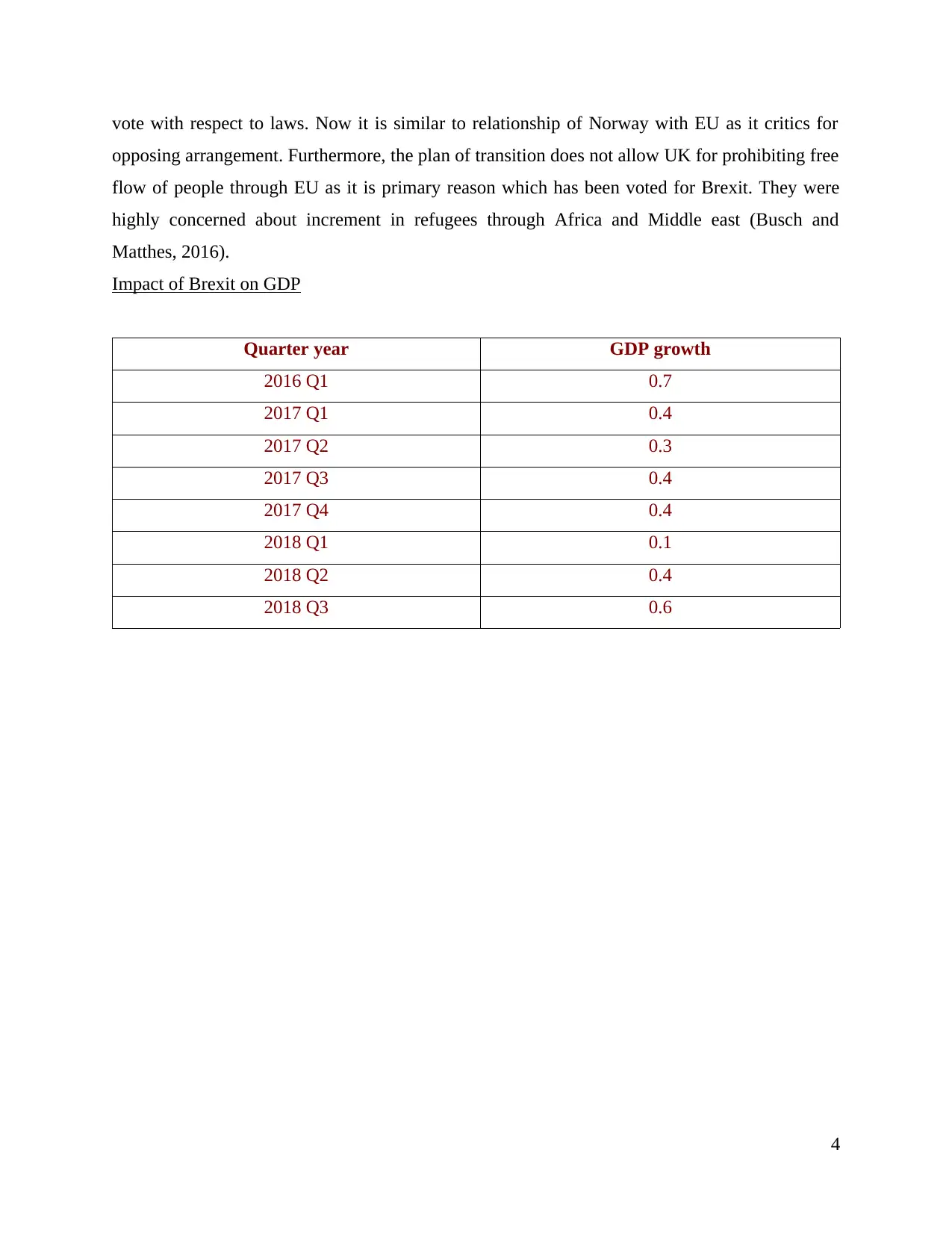
Impact of Brexit on GDP
Quarter year GDP growth
2016 Q1 0.7
2017 Q1 0.4
2017 Q2 0.3
2017 Q3 0.4
2017 Q4 0.4
2018 Q1 0.1
2018 Q2 0.4
2018 Q3 0.6
4
opposing arrangement. Furthermore, the plan of transition does not allow UK for prohibiting free
flow of people through EU as it is primary reason which has been voted for Brexit. They were
highly concerned about increment in refugees through Africa and Middle east (Busch and
Matthes, 2016).
Impact of Brexit on GDP
Quarter year GDP growth
2016 Q1 0.7
2017 Q1 0.4
2017 Q2 0.3
2017 Q3 0.4
2017 Q4 0.4
2018 Q1 0.1
2018 Q2 0.4
2018 Q3 0.6
4
⊘ This is a preview!⊘
Do you want full access?
Subscribe today to unlock all pages.
Trusted by 1+ million students worldwide
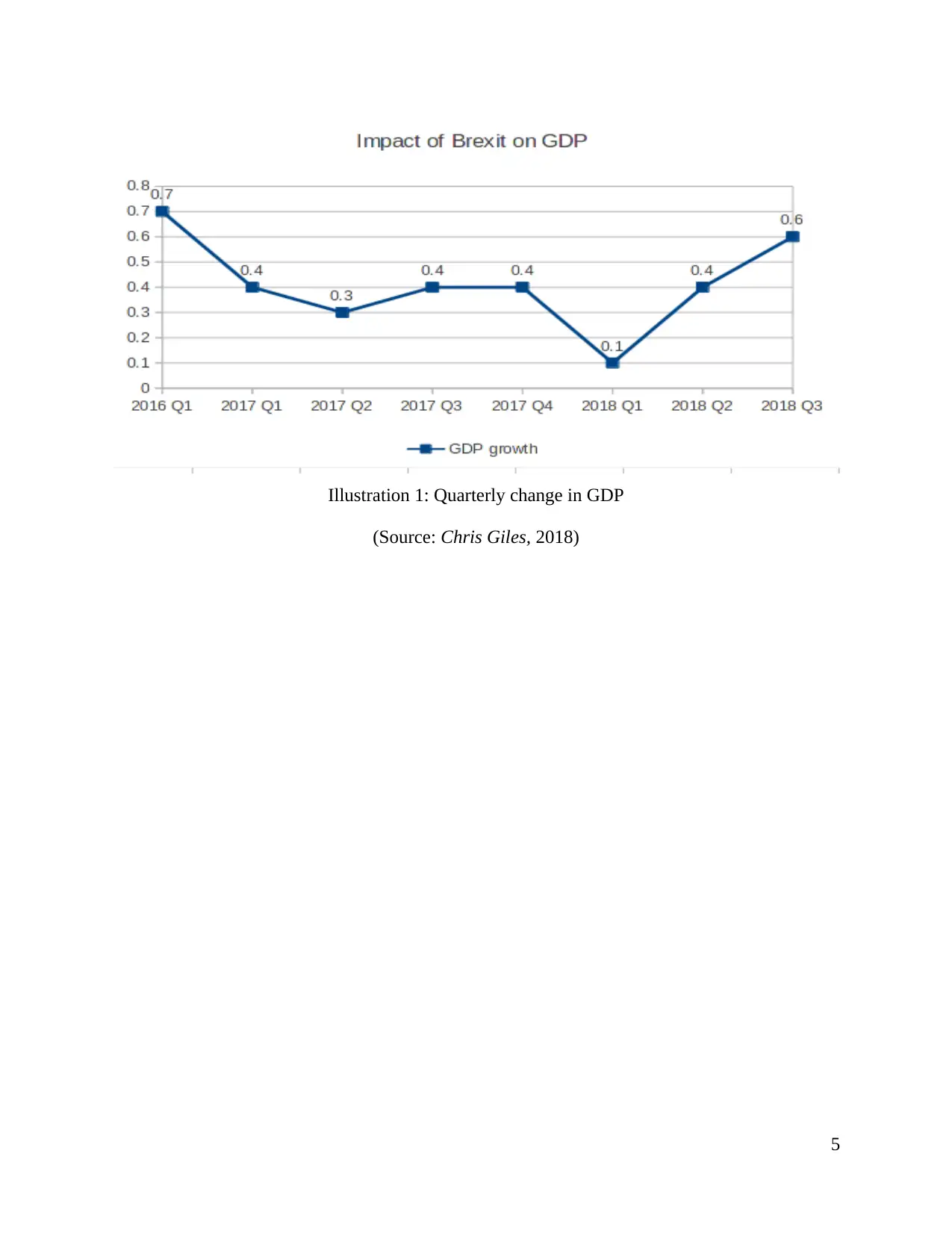
Illustration 1: Quarterly change in GDP
(Source: Chris Giles, 2018)
5
(Source: Chris Giles, 2018)
5
Paraphrase This Document
Need a fresh take? Get an instant paraphrase of this document with our AI Paraphraser
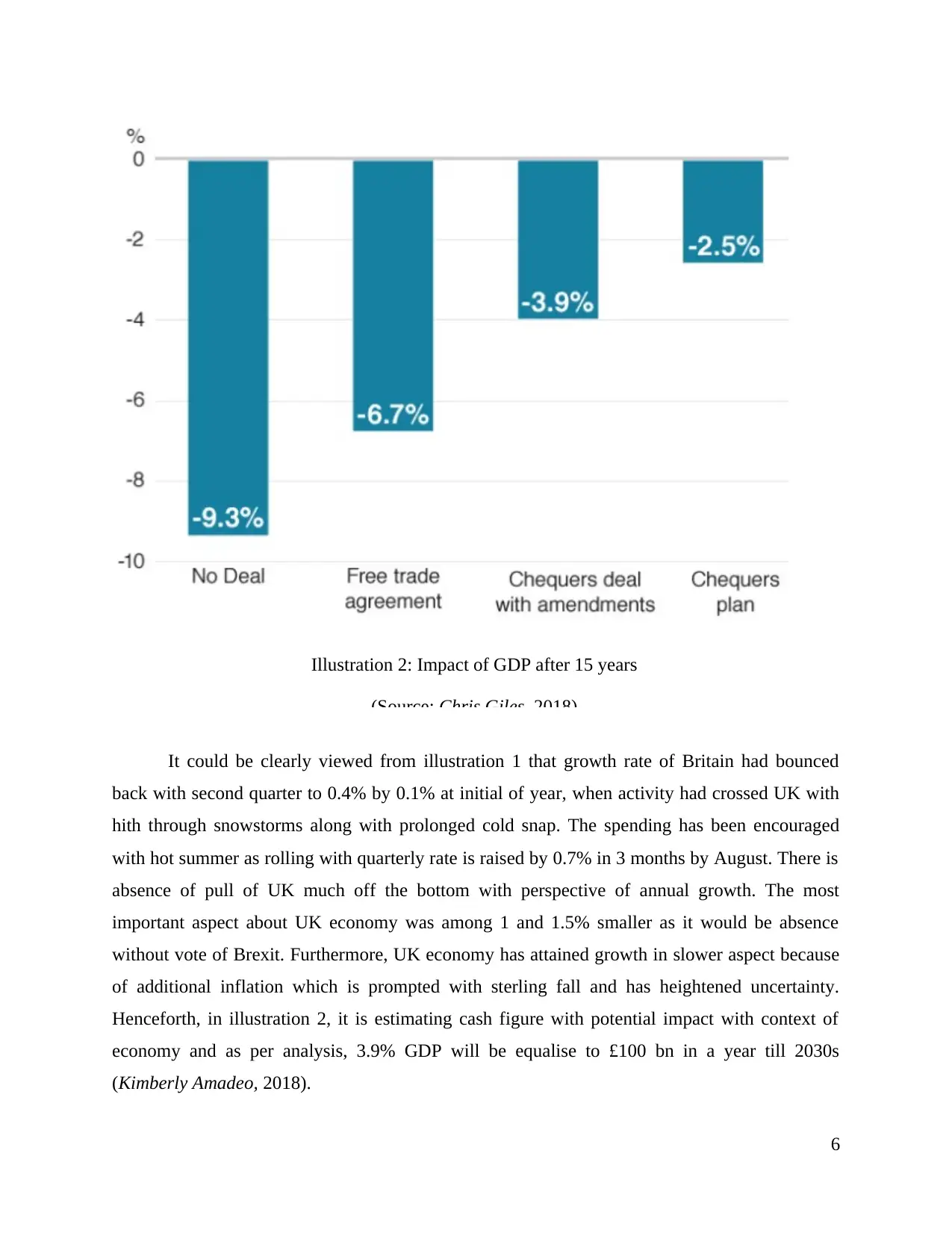
Illustration 2: Impact of GDP after 15 years
(Source: Chris Giles, 2018)
It could be clearly viewed from illustration 1 that growth rate of Britain had bounced
back with second quarter to 0.4% by 0.1% at initial of year, when activity had crossed UK with
hith through snowstorms along with prolonged cold snap. The spending has been encouraged
with hot summer as rolling with quarterly rate is raised by 0.7% in 3 months by August. There is
absence of pull of UK much off the bottom with perspective of annual growth. The most
important aspect about UK economy was among 1 and 1.5% smaller as it would be absence
without vote of Brexit. Furthermore, UK economy has attained growth in slower aspect because
of additional inflation which is prompted with sterling fall and has heightened uncertainty.
Henceforth, in illustration 2, it is estimating cash figure with potential impact with context of
economy and as per analysis, 3.9% GDP will be equalise to £100 bn in a year till 2030s
(Kimberly Amadeo, 2018).
6
(Source: Chris Giles, 2018)
It could be clearly viewed from illustration 1 that growth rate of Britain had bounced
back with second quarter to 0.4% by 0.1% at initial of year, when activity had crossed UK with
hith through snowstorms along with prolonged cold snap. The spending has been encouraged
with hot summer as rolling with quarterly rate is raised by 0.7% in 3 months by August. There is
absence of pull of UK much off the bottom with perspective of annual growth. The most
important aspect about UK economy was among 1 and 1.5% smaller as it would be absence
without vote of Brexit. Furthermore, UK economy has attained growth in slower aspect because
of additional inflation which is prompted with sterling fall and has heightened uncertainty.
Henceforth, in illustration 2, it is estimating cash figure with potential impact with context of
economy and as per analysis, 3.9% GDP will be equalise to £100 bn in a year till 2030s
(Kimberly Amadeo, 2018).
6
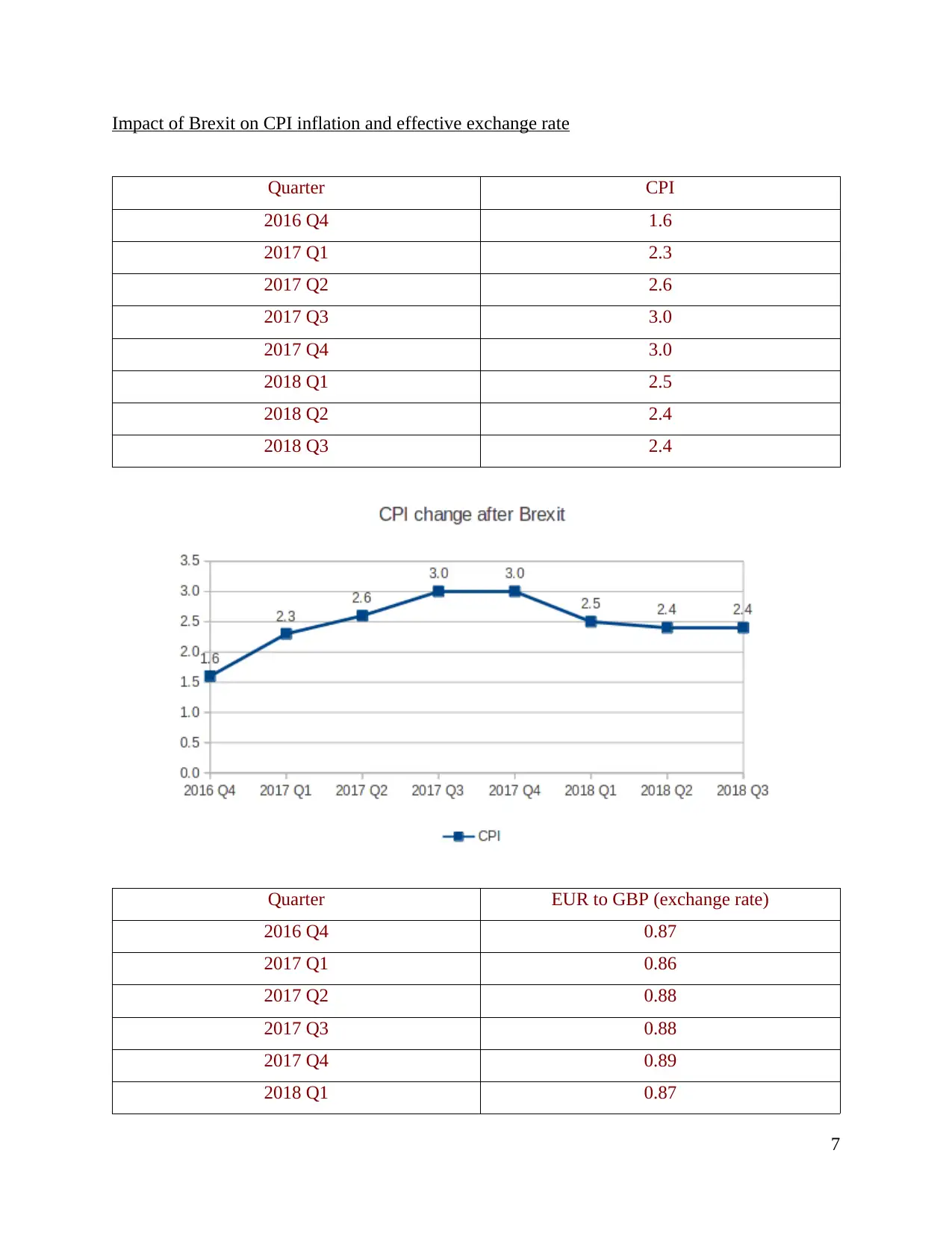
Impact of Brexit on CPI inflation and effective exchange rate
Quarter CPI
2016 Q4 1.6
2017 Q1 2.3
2017 Q2 2.6
2017 Q3 3.0
2017 Q4 3.0
2018 Q1 2.5
2018 Q2 2.4
2018 Q3 2.4
Quarter EUR to GBP (exchange rate)
2016 Q4 0.87
2017 Q1 0.86
2017 Q2 0.88
2017 Q3 0.88
2017 Q4 0.89
2018 Q1 0.87
7
Quarter CPI
2016 Q4 1.6
2017 Q1 2.3
2017 Q2 2.6
2017 Q3 3.0
2017 Q4 3.0
2018 Q1 2.5
2018 Q2 2.4
2018 Q3 2.4
Quarter EUR to GBP (exchange rate)
2016 Q4 0.87
2017 Q1 0.86
2017 Q2 0.88
2017 Q3 0.88
2017 Q4 0.89
2018 Q1 0.87
7
⊘ This is a preview!⊘
Do you want full access?
Subscribe today to unlock all pages.
Trusted by 1+ million students worldwide
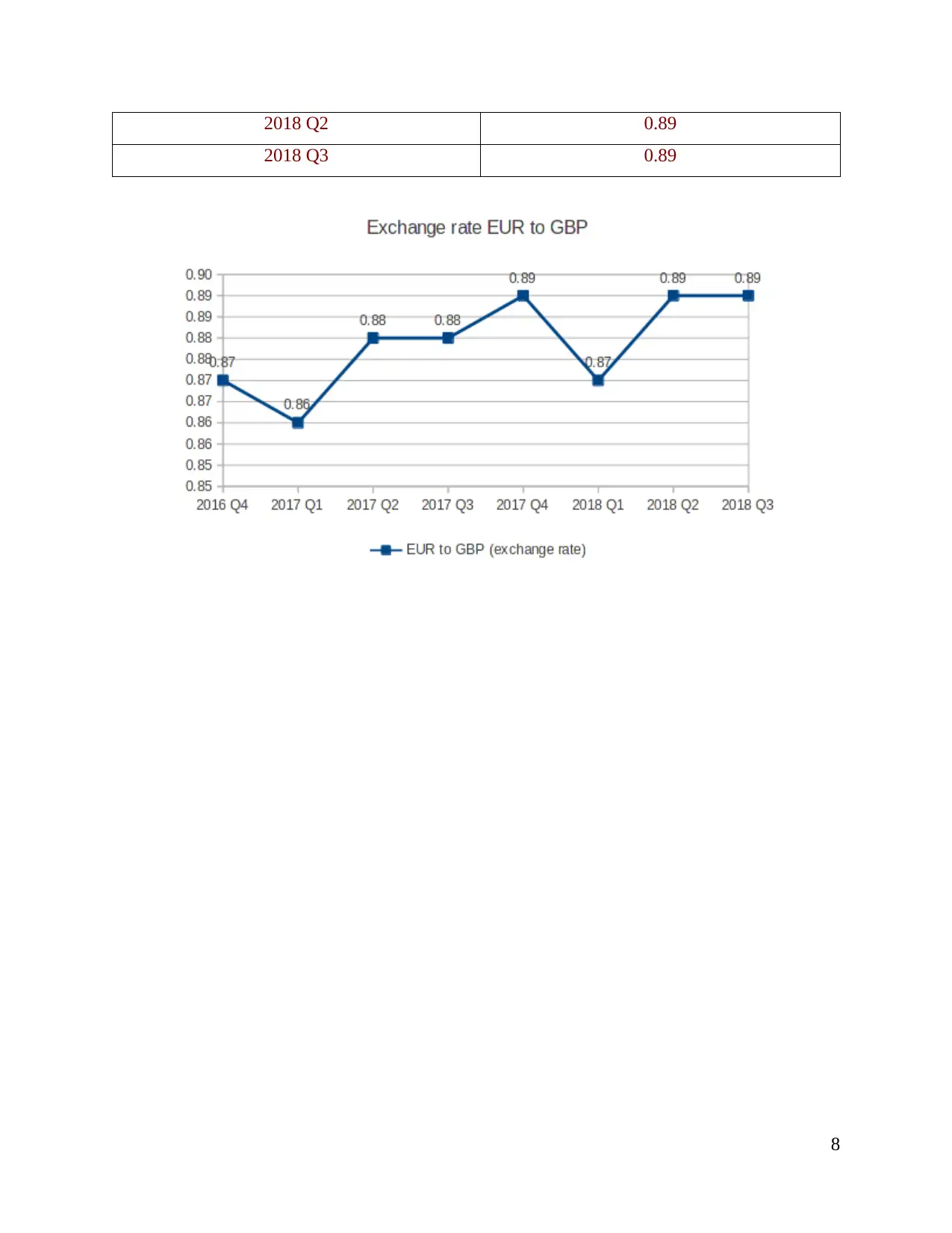
2018 Q2 0.89
2018 Q3 0.89
8
2018 Q3 0.89
8
Paraphrase This Document
Need a fresh take? Get an instant paraphrase of this document with our AI Paraphraser
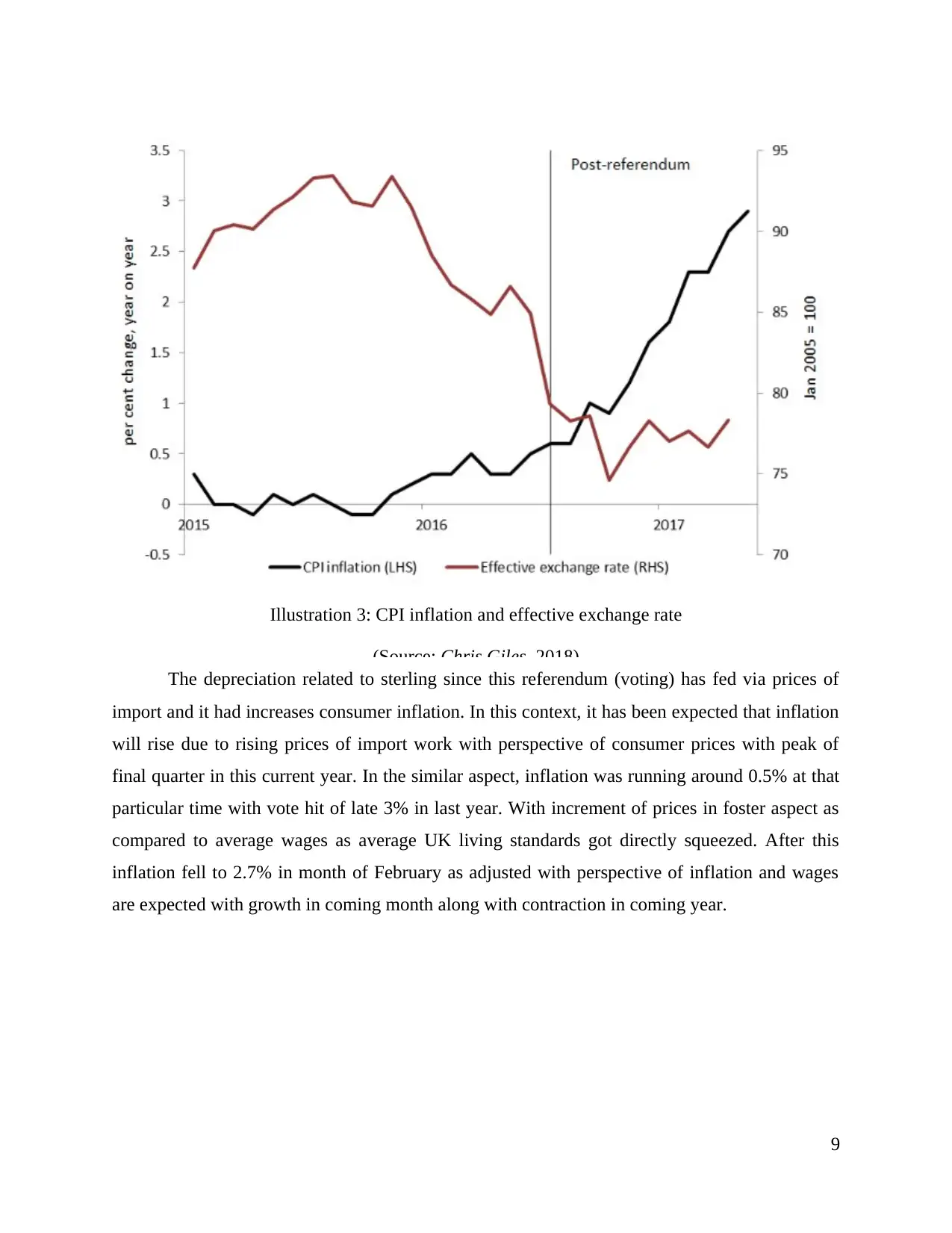
Illustration 3: CPI inflation and effective exchange rate
(Source: Chris Giles, 2018)
The depreciation related to sterling since this referendum (voting) has fed via prices of
import and it had increases consumer inflation. In this context, it has been expected that inflation
will rise due to rising prices of import work with perspective of consumer prices with peak of
final quarter in this current year. In the similar aspect, inflation was running around 0.5% at that
particular time with vote hit of late 3% in last year. With increment of prices in foster aspect as
compared to average wages as average UK living standards got directly squeezed. After this
inflation fell to 2.7% in month of February as adjusted with perspective of inflation and wages
are expected with growth in coming month along with contraction in coming year.
9
(Source: Chris Giles, 2018)
The depreciation related to sterling since this referendum (voting) has fed via prices of
import and it had increases consumer inflation. In this context, it has been expected that inflation
will rise due to rising prices of import work with perspective of consumer prices with peak of
final quarter in this current year. In the similar aspect, inflation was running around 0.5% at that
particular time with vote hit of late 3% in last year. With increment of prices in foster aspect as
compared to average wages as average UK living standards got directly squeezed. After this
inflation fell to 2.7% in month of February as adjusted with perspective of inflation and wages
are expected with growth in coming month along with contraction in coming year.
9
Wage growth
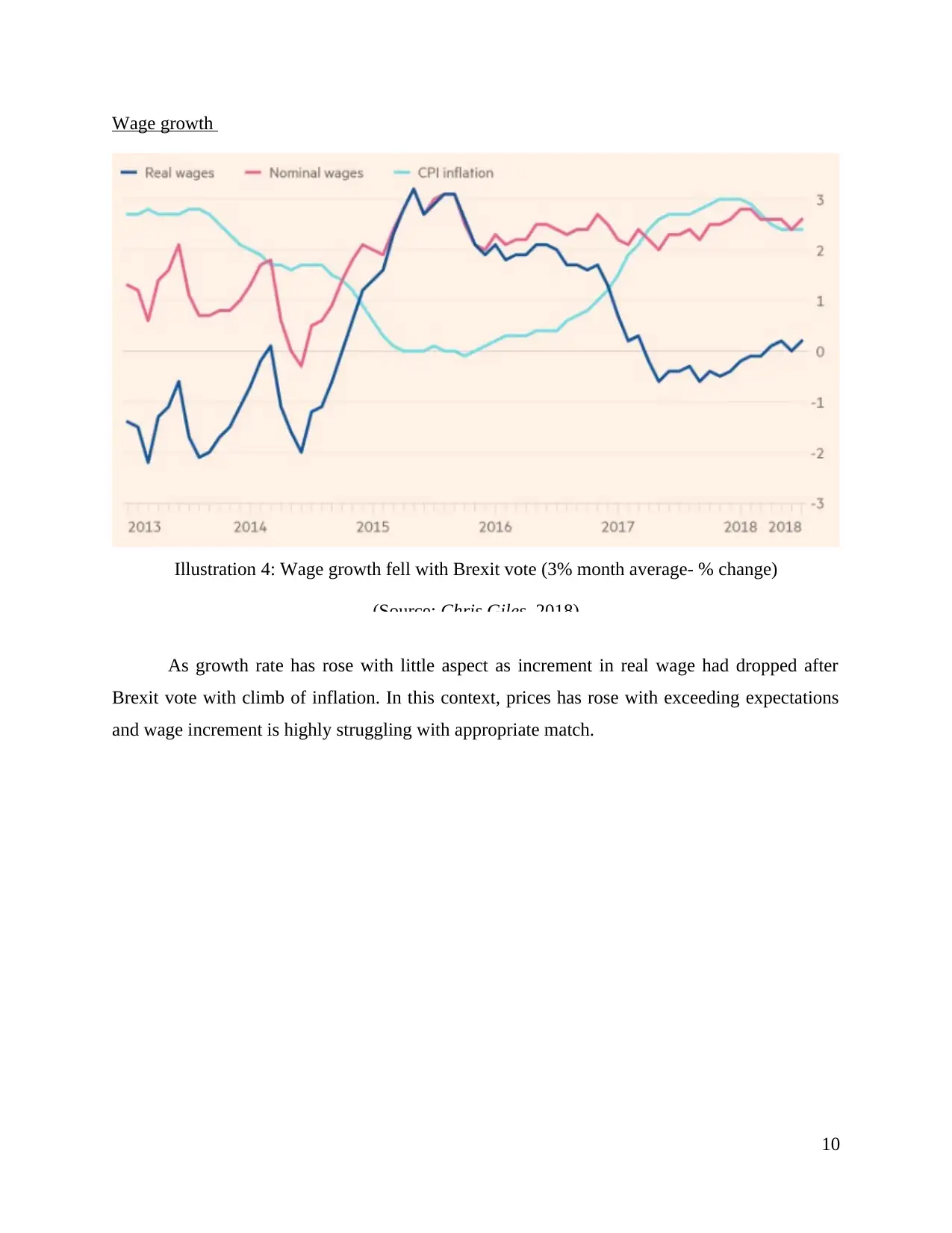
Illustration 4: Wage growth fell with Brexit vote (3% month average- % change)
(Source: Chris Giles, 2018)
As growth rate has rose with little aspect as increment in real wage had dropped after
Brexit vote with climb of inflation. In this context, prices has rose with exceeding expectations
and wage increment is highly struggling with appropriate match.
10
Illustration 4: Wage growth fell with Brexit vote (3% month average- % change)
(Source: Chris Giles, 2018)
As growth rate has rose with little aspect as increment in real wage had dropped after
Brexit vote with climb of inflation. In this context, prices has rose with exceeding expectations
and wage increment is highly struggling with appropriate match.
10
⊘ This is a preview!⊘
Do you want full access?
Subscribe today to unlock all pages.
Trusted by 1+ million students worldwide

1 out of 17


Related Documents


Your All-in-One AI-Powered Toolkit for Academic Success.
+13062052269
info@desklib.com
Available 24*7 on WhatsApp / Email
![[object Object]](/_next/static/media/star-bottom.7253800d.svg)
Unlock your academic potential
Copyright © 2020–2026 A2Z Services. All Rights Reserved. Developed and managed by ZUCOL.