University of Sunderland: Brexit's Effects on the NHS - SSC106

Verified

Added on  2022/11/18

|19
|1772
|237
Presentation
AI Summary
This presentation examines the multifaceted impact of Brexit on the UK's National Health Service (NHS). It begins with a concise introduction to Brexit and its implications, followed by an overview of the significant issues the NHS faces, including staffing shortages due to the loss of EU professionals, challenges in accessing treatments and medicines, and financial pressures resulting from reduced funding. The presentation delves into the reasons behind Brexit, focusing on sovereignty and immigration concerns, and analyzes the relevant political and social care policies. It also explores diverse societal views on Brexit's impact, particularly among youth and older demographics, along with the roles of key agencies like HPRA and the European Medicines Agency in addressing these challenges. The presentation concludes by summarizing the potential negative consequences of Brexit on the NHS and its impact on the youth and general people living in Britain, emphasizing the need for new policies and frameworks to mitigate these effects.

Document Page
How Will Brexit Affect
NHS?
Student Details
tabler-icon-diamond-filled.svg

Paraphrase This Document

Need a fresh take? Get an instant paraphrase of this document with our AI Paraphraser
Document Page
Introduction
Brexit is used to describe “British exit”.
It means the withdrawal of United Kingdom (UK) from the
European Union (EU).
This decision was made on 23rd June 2016, in a referendum, in
which 51.9 % voted to support the decision for leaving EU
(Triggle, 2018).
The Government implored Article 50 on EU treaty and started a
two year process to leave EU.
The due date to conclude this with UK’s exit was 29th March
2019, but now the deadline has been extended to 31st October
2019.
Document Page
Issues related to Brexit
The British exit, will cause a significant negative
impact to the UK National Health service (NHS).
It will have bad effects on the workforce of NHS,
its financing, vaccines, availability of medicines
and information sharing regarding the market
research (Martill & Staiger, 2018).
This negotiated agreement is initiated by the EU
and the UK Government, but is not accepted by
the Parliament.
It is considered that the impact of this agreement
will bring many adverse results.
Document Page
The issues that NHS will face due to Brexit are
explained in the following slides:
Staffing issues
The policies framed under EU allowed the free movement and recognition of
qualified professionals within the European Union.
After the Brexit movement the staffs from EU will not get such freedom and
recognition in UK.
The staffing process in NHS will be adversely affected as NHS staffs are mostly
recruited from the European countries (McKenna, 2016).
Presently, NHS is having trouble in recruiting and retaining permanent staffs.
There is a total shortfall of 5.9% between the number of post and the staffs
available for health care services in NHS.
tabler-icon-diamond-filled.svg

Paraphrase This Document

Need a fresh take? Get an instant paraphrase of this document with our AI Paraphraser
Document Page
Accessing treatment in UK and abroad
The European Union increased the number of immigrants living in
UK; more number of immigrants means more number of patients
needing NHS medical treatment.
The average use of services by the people of UK is lower than the
services used by immigrants.
The EU citizen holds EHIC (European Health Insurance Card), which
allows the temporary residents to access medical treatment during
their stay in any EEA country.
Document Page
Drugs and medical devices
Brexit will cause a problem related to marketing approvals and
regulatory arrangement, due to this UK will lose access to important
networks, databases and approvals for free flow of drugs and
medicines between EU member countries and UK (Ishtm, 2019).
There is a possibility that UK will be given a less priority for
producing new drugs, thus the patients will not get an advantage of
accessing certain drugs and medicines.
Document Page
Funding and finance
Before Brexit, raising finance was easy for NHS; it got its funding
from EU as UK was a part of the membership.
Since 2017, NHS leaders are facing problem in raising funds and has
a lot of financial pressure (Maddox, 2018).
The performance of NHS against the key targets is totally
deteriorating. On long term basis, the NHS funding will influence the
economy of UK.
HM treasury stated before the referendum, that the decision to leave
EU will leave an immediate and intense economic loss causing
uncertainty and instability that will make UK permanently poor
(HealthEuropa, 2018).
tabler-icon-diamond-filled.svg

Paraphrase This Document

Need a fresh take? Get an instant paraphrase of this document with our AI Paraphraser
Document Page
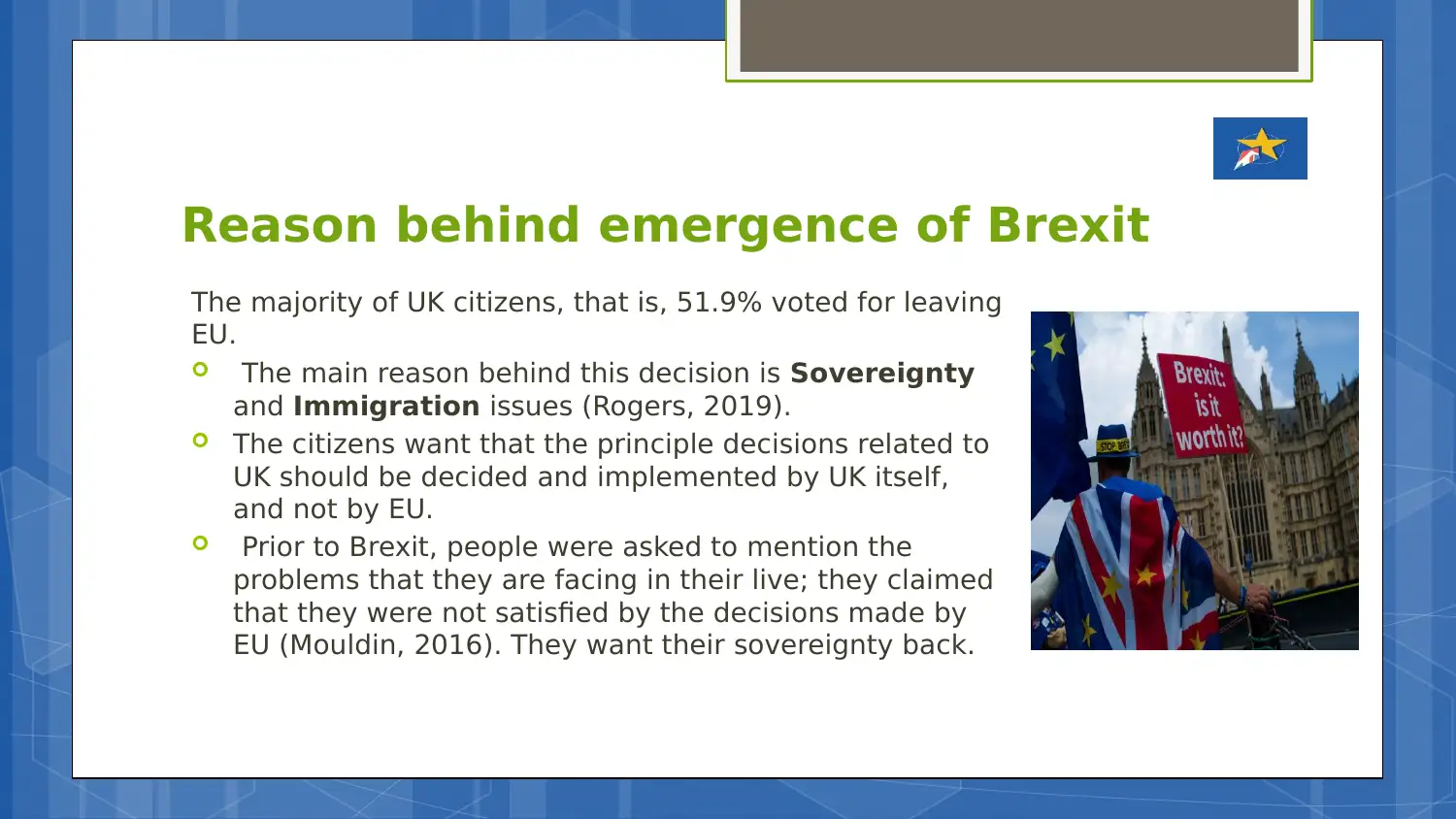
Reason behind emergence of Brexit
The majority of UK citizens, that is, 51.9% voted for leaving
EU.
The main reason behind this decision is Sovereignty
and Immigration issues (Rogers, 2019).
The citizens want that the principle decisions related to
UK should be decided and implemented by UK itself,
and not by EU.
Prior to Brexit, people were asked to mention the
problems that they are facing in their live; they claimed
that they were not satisfied by the decisions made by
EU (Mouldin, 2016). They want their sovereignty back.
Document Page
Politics and policies relevant
to social and health care
Since it is not sure that Brexit will be allowed or not, but this decision has
negatively affected the healthcare and social factors in the nation (Fahy,
2015).
The Government has to frame new policies regarding:
Work time directives
Procurement laws
Regulations of medical devices and medicines
Regulations to develop common professional standards between EEA
countries for medical education (McKenna, 2016)
Document Page
The view of the society towards
Brexit
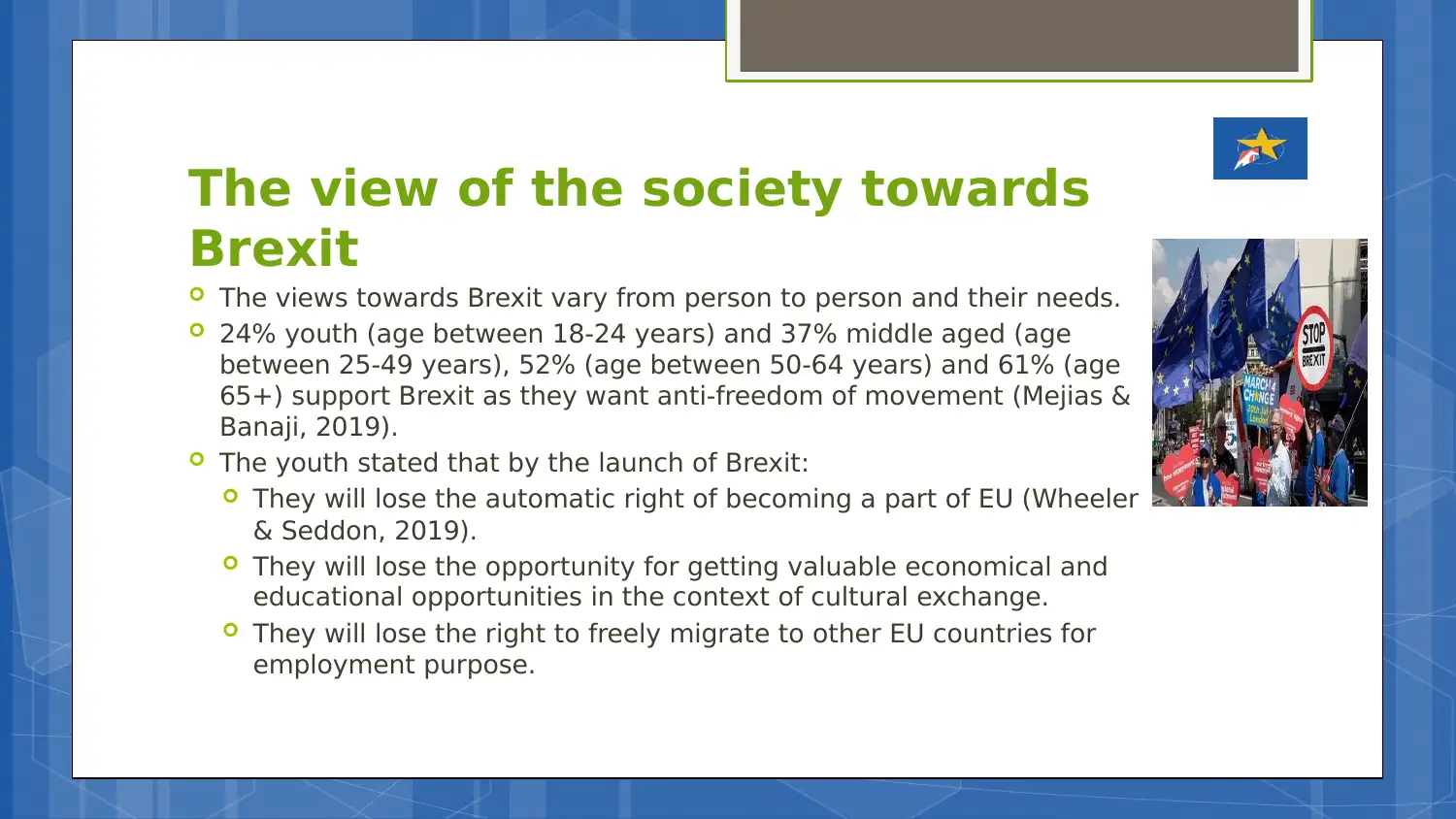
The views towards Brexit vary from person to person and their needs.
24% youth (age between 18-24 years) and 37% middle aged (age
between 25-49 years), 52% (age between 50-64 years) and 61% (age
65+) support Brexit as they want anti-freedom of movement (Mejias &
Banaji, 2019).
The youth stated that by the launch of Brexit:
They will lose the automatic right of becoming a part of EU (Wheeler
& Seddon, 2019).
They will lose the opportunity for getting valuable economical and
educational opportunities in the context of cultural exchange.
They will lose the right to freely migrate to other EU countries for
employment purpose.
tabler-icon-diamond-filled.svg

Paraphrase This Document

Need a fresh take? Get an instant paraphrase of this document with our AI Paraphraser
Document Page
The UK citizens have fear about getting permission for work visas to
other European Union nations (Hannan, 2016).
They claimed that this doubt can be clearly only after the
declaration of negotiation outcomes.
Other people discussed about the negative impact that will be
caused to loss of funds that EU provided, it will cause a variety of
social loss and damage in UK.
Another citizen showed his concern towards the art funding scheme
that was earlier funded by EU, could come to an end (Mejias &
Banaji, 2019).
Document Page
The role of agents and authority The citizens of Britain are concerned about how it will affect their
lives, business and facilities for health services.
There are few agencies that are helping the people to gain relevant
knowledge regarding developments in Brexit and health products.
The authorities that are helping in this concern are:
HPRA (Health Products Regulatory Authority)
Europeans Medicines Agency
chevron_up_icon
1 out of 19
circle_padding
hide_on_mobile
zoom_out_icon
[object Object]