Dissertation: Analyzing Brexit's Effect on UK-Nigeria Relations
VerifiedAdded on 2023/06/04
|25
|6807
|401
Thesis and Dissertation
AI Summary
This dissertation examines the impact of Brexit on the international relationship between the United Kingdom and Nigeria. It evaluates the different types of impacts on Nigeria resulting from Brexit, finding that foreign direct investment and oil prices have been significantly affected. The study employs secondary research, utilizing data from various journals and articles to support its analysis. Key areas explored include the economic impact of Brexit on the UK, principle issues for African nations, the role of the Commonwealth network, foreign direct investments, aid to Africa, and security considerations. The research concludes by providing relevant recommendations aimed at minimizing potential damage to Nigeria's economy, particularly focusing on mitigating the effects on foreign investment and trade relations. Desklib provides students access to this and many similar documents.
Running head: DISSERTATION
Dissertation
Name of the student
Name of the university
Author note
Dissertation
Name of the student
Name of the university
Author note

Paraphrase This Document
Need a fresh take? Get an instant paraphrase of this document with our AI Paraphraser
1DISSERTATION
Executive Summary
This study had evaluated the impact of Brexit on the international relationship between United
Kingdom and Nigeria. The different types of impacts on Nigeria due to Brexit has been
evaluated and the findings of the study shows that foreign direct and prices of oil has been
heavily affected by Brexit. The study has used secondary research to collect relevant data from
different journals and articles. The study has provided relevant conclusion and recommendation
based on the findings.
Executive Summary
This study had evaluated the impact of Brexit on the international relationship between United
Kingdom and Nigeria. The different types of impacts on Nigeria due to Brexit has been
evaluated and the findings of the study shows that foreign direct and prices of oil has been
heavily affected by Brexit. The study has used secondary research to collect relevant data from
different journals and articles. The study has provided relevant conclusion and recommendation
based on the findings.
2DISSERTATION
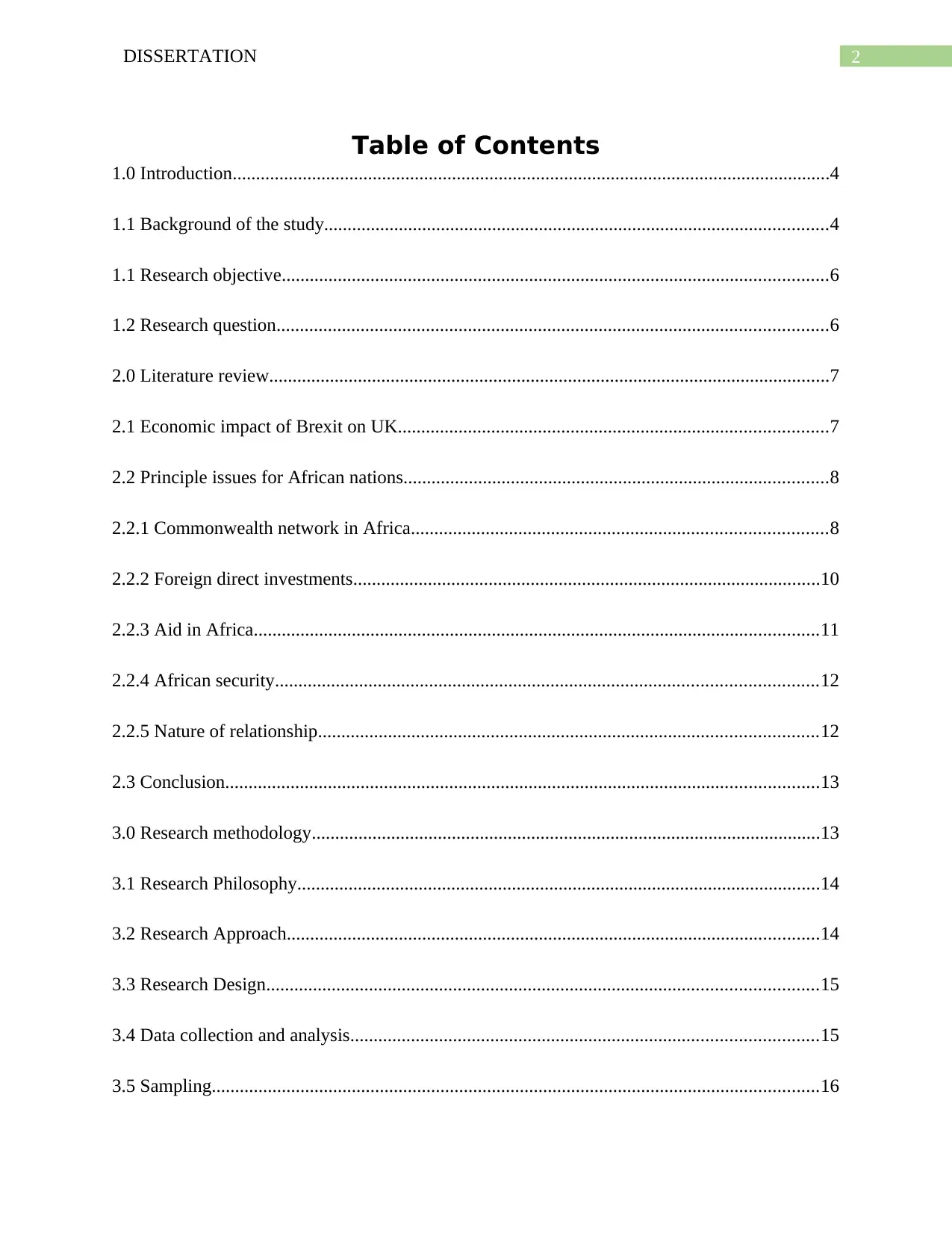
Table of Contents
1.0 Introduction................................................................................................................................4
1.1 Background of the study............................................................................................................4
1.1 Research objective.....................................................................................................................6
1.2 Research question......................................................................................................................6
2.0 Literature review........................................................................................................................7
2.1 Economic impact of Brexit on UK............................................................................................7
2.2 Principle issues for African nations...........................................................................................8
2.2.1 Commonwealth network in Africa.........................................................................................8
2.2.2 Foreign direct investments....................................................................................................10
2.2.3 Aid in Africa.........................................................................................................................11
2.2.4 African security....................................................................................................................12
2.2.5 Nature of relationship...........................................................................................................12
2.3 Conclusion...............................................................................................................................13
3.0 Research methodology.............................................................................................................13
3.1 Research Philosophy................................................................................................................14
3.2 Research Approach..................................................................................................................14
3.3 Research Design......................................................................................................................15
3.4 Data collection and analysis....................................................................................................15
3.5 Sampling..................................................................................................................................16
Table of Contents
1.0 Introduction................................................................................................................................4
1.1 Background of the study............................................................................................................4
1.1 Research objective.....................................................................................................................6
1.2 Research question......................................................................................................................6
2.0 Literature review........................................................................................................................7
2.1 Economic impact of Brexit on UK............................................................................................7
2.2 Principle issues for African nations...........................................................................................8
2.2.1 Commonwealth network in Africa.........................................................................................8
2.2.2 Foreign direct investments....................................................................................................10
2.2.3 Aid in Africa.........................................................................................................................11
2.2.4 African security....................................................................................................................12
2.2.5 Nature of relationship...........................................................................................................12
2.3 Conclusion...............................................................................................................................13
3.0 Research methodology.............................................................................................................13
3.1 Research Philosophy................................................................................................................14
3.2 Research Approach..................................................................................................................14
3.3 Research Design......................................................................................................................15
3.4 Data collection and analysis....................................................................................................15
3.5 Sampling..................................................................................................................................16
⊘ This is a preview!⊘
Do you want full access?
Subscribe today to unlock all pages.

Trusted by 1+ million students worldwide
3DISSERTATION
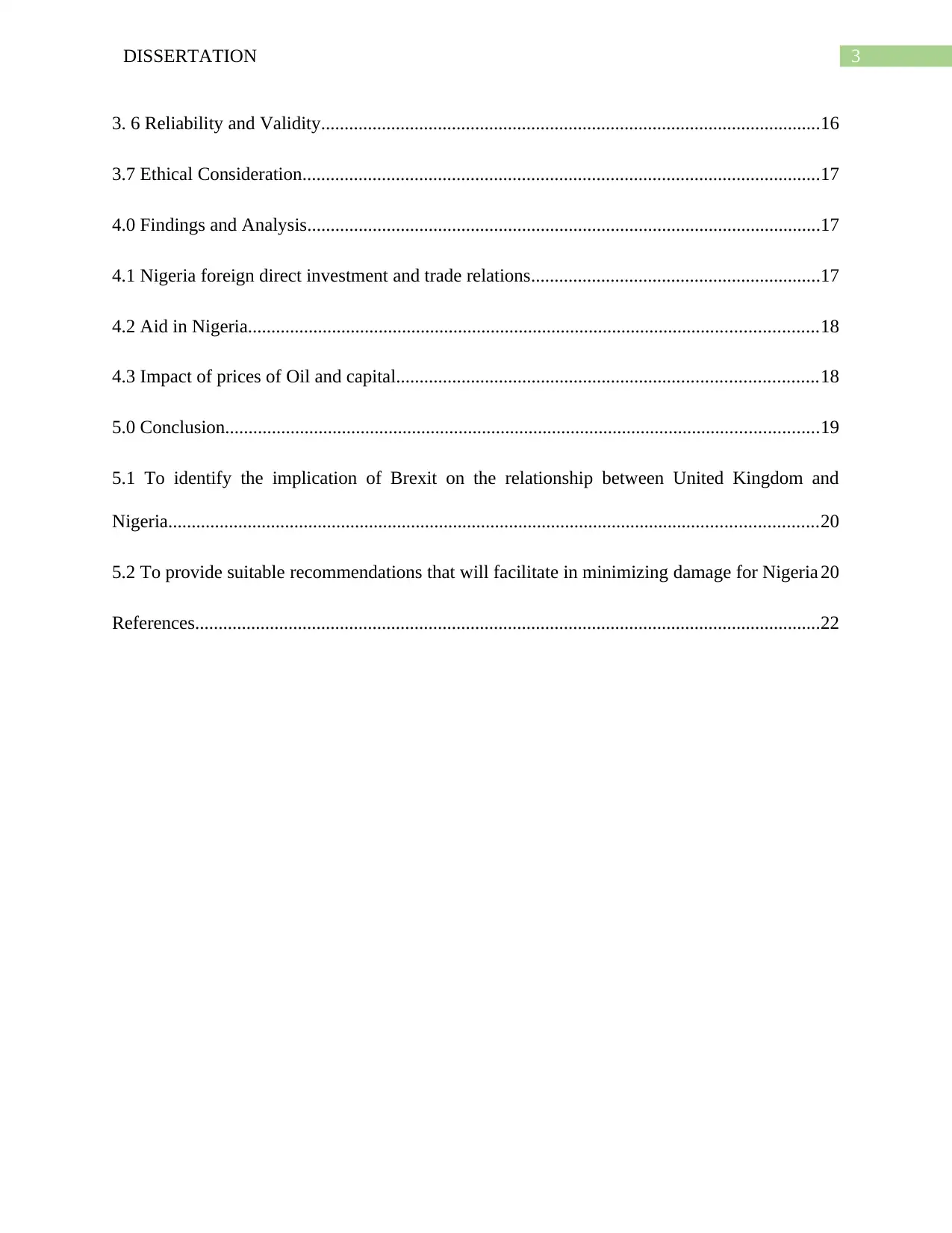
3. 6 Reliability and Validity...........................................................................................................16
3.7 Ethical Consideration...............................................................................................................17
4.0 Findings and Analysis..............................................................................................................17
4.1 Nigeria foreign direct investment and trade relations..............................................................17
4.2 Aid in Nigeria..........................................................................................................................18
4.3 Impact of prices of Oil and capital..........................................................................................18
5.0 Conclusion...............................................................................................................................19
5.1 To identify the implication of Brexit on the relationship between United Kingdom and
Nigeria...........................................................................................................................................20
5.2 To provide suitable recommendations that will facilitate in minimizing damage for Nigeria 20
References......................................................................................................................................22
3. 6 Reliability and Validity...........................................................................................................16
3.7 Ethical Consideration...............................................................................................................17
4.0 Findings and Analysis..............................................................................................................17
4.1 Nigeria foreign direct investment and trade relations..............................................................17
4.2 Aid in Nigeria..........................................................................................................................18
4.3 Impact of prices of Oil and capital..........................................................................................18
5.0 Conclusion...............................................................................................................................19
5.1 To identify the implication of Brexit on the relationship between United Kingdom and
Nigeria...........................................................................................................................................20
5.2 To provide suitable recommendations that will facilitate in minimizing damage for Nigeria 20
References......................................................................................................................................22
Paraphrase This Document
Need a fresh take? Get an instant paraphrase of this document with our AI Paraphraser
4DISSERTATION
Topic: The effect of Brexit on United Kingdom’s and African international relations: “A case
study of Nigeria”
1.0 INTRODUCTION
This research paper has aimed to examine the probable impact of Brexit on the African
union especially Nigeria. United Kingdom has been responsible for developing an effective trade
relationship with European Union which has been defined the Cotonou agreement. African
Nations like Nigeria are dependent on this trade relationship and there are certain consequences
that they will have to face due to Brexit. The controversial discussion of the impact of Brexit on
the African nations had led to the development of the grim predictions from the sceptics. As
stated by Kohnert (2018), the commonwealth states of Africa will face will face grave issues due
to Britain’s exit from the European Union. However, it will take time to fully understand the
impact of Brexit on the African nations and unless Britain makes their exit in March of 2019,
every theory and prediction is tentative in nature.
1.1 BACKGROUND OF THE STUDY
The African business community were aware of the fact that Brexit will have a deep
impact on the growth of the economy. United Kingdom has been instrumental in supporting
development and facilitate aid for all the African nations (Adler-Nissen, Galpin and Rosamond
2017). Moreover, when the United Kingdom had led the presidency of G8, many pro African
programs were implemented which could not have been possible if other nations were presiding
as they are more inward looking.
Brexit is a term defining the exit of Britain from the European Union. A referendum was
held where every citizen were allowed to participate where they could vote for or against the exit
Topic: The effect of Brexit on United Kingdom’s and African international relations: “A case
study of Nigeria”
1.0 INTRODUCTION
This research paper has aimed to examine the probable impact of Brexit on the African
union especially Nigeria. United Kingdom has been responsible for developing an effective trade
relationship with European Union which has been defined the Cotonou agreement. African
Nations like Nigeria are dependent on this trade relationship and there are certain consequences
that they will have to face due to Brexit. The controversial discussion of the impact of Brexit on
the African nations had led to the development of the grim predictions from the sceptics. As
stated by Kohnert (2018), the commonwealth states of Africa will face will face grave issues due
to Britain’s exit from the European Union. However, it will take time to fully understand the
impact of Brexit on the African nations and unless Britain makes their exit in March of 2019,
every theory and prediction is tentative in nature.
1.1 BACKGROUND OF THE STUDY
The African business community were aware of the fact that Brexit will have a deep
impact on the growth of the economy. United Kingdom has been instrumental in supporting
development and facilitate aid for all the African nations (Adler-Nissen, Galpin and Rosamond
2017). Moreover, when the United Kingdom had led the presidency of G8, many pro African
programs were implemented which could not have been possible if other nations were presiding
as they are more inward looking.
Brexit is a term defining the exit of Britain from the European Union. A referendum was
held where every citizen were allowed to participate where they could vote for or against the exit
5DISSERTATION
of Britain. The motion of leaving the European Union won by a vote of 51.9% out of the 71.8%
of the total population being the participants. In breaking down the result it was seen that
England and Wales voted for Brexit. On the contrary, Scotland and Northern Ireland voted
against Brexit and wanted to stay in the European Union. European Union is the partnership
formed between 28 countries in Europe based on political and economic relations (Farrell and
Newman 2017). The formation of the European Union facilitated in developing a single market
which allowed free trade and movement of people from one country to another country within
Europe. However, for a smooth transition, both the parties have proposed 21 months of time to
re-establish the new relationship.
Brexit has already affected the economy of the country. The corporate organizations
feared that Brexit would impact the trade relations between European Union and United
Kingdom. However, the Prime Minister had promised the business community that Brexit would
not affect the free trade between the countries but the negotiation has fallen short. This is a big
area of concern for the organizations in United Kingdom which will have a huge impact on the
business of the organizations (Sampson 2017). The business leaders have been calling for a
second vote which shows the grave impact Brexit will have on United Kingdom’s economy
which will in turn affect the economy of African Countries. Moreover, the most current likely
scenario is the fact that Britain may have to leave the European Union without any proper deals.
This means that free trade zone between United Kingdom and EU will be abolished, United
Kingdom being the link between the African commonwealth nations and European Union, the
trade relations are expected to more severe than expected.
United Kingdom has been one of the top importers of goods to Nigeria and companies
like Shell has invested a huge sum of capital and owns one third of the oil produced in Nigeria.
of Britain. The motion of leaving the European Union won by a vote of 51.9% out of the 71.8%
of the total population being the participants. In breaking down the result it was seen that
England and Wales voted for Brexit. On the contrary, Scotland and Northern Ireland voted
against Brexit and wanted to stay in the European Union. European Union is the partnership
formed between 28 countries in Europe based on political and economic relations (Farrell and
Newman 2017). The formation of the European Union facilitated in developing a single market
which allowed free trade and movement of people from one country to another country within
Europe. However, for a smooth transition, both the parties have proposed 21 months of time to
re-establish the new relationship.
Brexit has already affected the economy of the country. The corporate organizations
feared that Brexit would impact the trade relations between European Union and United
Kingdom. However, the Prime Minister had promised the business community that Brexit would
not affect the free trade between the countries but the negotiation has fallen short. This is a big
area of concern for the organizations in United Kingdom which will have a huge impact on the
business of the organizations (Sampson 2017). The business leaders have been calling for a
second vote which shows the grave impact Brexit will have on United Kingdom’s economy
which will in turn affect the economy of African Countries. Moreover, the most current likely
scenario is the fact that Britain may have to leave the European Union without any proper deals.
This means that free trade zone between United Kingdom and EU will be abolished, United
Kingdom being the link between the African commonwealth nations and European Union, the
trade relations are expected to more severe than expected.
United Kingdom has been one of the top importers of goods to Nigeria and companies
like Shell has invested a huge sum of capital and owns one third of the oil produced in Nigeria.
⊘ This is a preview!⊘
Do you want full access?
Subscribe today to unlock all pages.
Trusted by 1+ million students worldwide
6DISSERTATION
Nigeria is the largest producer of oil and natural gas in Africa but Brexit will led to the
development of new trade rules and regulation which will highly affect the struggling economy
of Nigeria. United Kingdom has used Nigeria as one of the most significant export markets in
Africa. Moreover, United Kingdom has provided aid to Nigeria, even though it is not dependent
on aid from foreign countries (Bradley and Helfer 2017). It is expected that will be shortfall in
investment from United Kingdom in Nigeria and the shortage of funds may not be covered by
the other countries in the European Union. United Kingdom has not only contributed to the
economy but manages security for Nigeria and helped them deal with extremist. Therefore, the
background of the study shows the significance of the relationship between United Kingdom and
Nigeria. The relationship is not based on trade but also other factors so overall development of
Nigeria will be hampered due to the abrupt change in the rules and regulations. Therefore, the
study will aim to predict the possible future impacts on the Nigerian Economy due to the exit of
Britain from the European. However, all the analysis will be tentative and may differ from the
actual impact.
1.1 RESEARCH OBJECTIVE
To identify the implication of Brexit on the relationship between United Kingdom and
Nigeria
To provide suitable recommendations that will facilitate in minimizing damage for
Nigeria
1.2 RESEARCH QUESTION
What is the implication of Brexit on the relationship between United Kingdom and
African Union?
Nigeria is the largest producer of oil and natural gas in Africa but Brexit will led to the
development of new trade rules and regulation which will highly affect the struggling economy
of Nigeria. United Kingdom has used Nigeria as one of the most significant export markets in
Africa. Moreover, United Kingdom has provided aid to Nigeria, even though it is not dependent
on aid from foreign countries (Bradley and Helfer 2017). It is expected that will be shortfall in
investment from United Kingdom in Nigeria and the shortage of funds may not be covered by
the other countries in the European Union. United Kingdom has not only contributed to the
economy but manages security for Nigeria and helped them deal with extremist. Therefore, the
background of the study shows the significance of the relationship between United Kingdom and
Nigeria. The relationship is not based on trade but also other factors so overall development of
Nigeria will be hampered due to the abrupt change in the rules and regulations. Therefore, the
study will aim to predict the possible future impacts on the Nigerian Economy due to the exit of
Britain from the European. However, all the analysis will be tentative and may differ from the
actual impact.
1.1 RESEARCH OBJECTIVE
To identify the implication of Brexit on the relationship between United Kingdom and
Nigeria
To provide suitable recommendations that will facilitate in minimizing damage for
Nigeria
1.2 RESEARCH QUESTION
What is the implication of Brexit on the relationship between United Kingdom and
African Union?
Paraphrase This Document
Need a fresh take? Get an instant paraphrase of this document with our AI Paraphraser
7DISSERTATION
2.0 LITERATURE REVIEW
Brexit is short for Britain’s Exit which is from the European Union. Brexit was the
initiation when the United Kingdom had a withdrawal from the European Union with a majority
of 52% votes who were in support of the exit. The Article of the Treaty of European Union has
been invoked by the government of United Kingdom on 29th March of 2017 (Hunt and Wheeler
2018).
2.1 ECONOMIC IMPACT OF BREXIT ON UK
There have various studies indicating the economic impact that Brexit has upon the
United Kingdoms. Booth et al. (2015) proposes a detailed study which is model-based to show
the impact that Brexit has on UK till the year 2030. The study states that from the time that UK
would leave the European Union till the year 2030, UK would get a huge amount of time to
change their own policies and arrangement regarding trade to forecast the effects that this
withdrawal would have on them. The study presents four scenarios that might occur based on
several variables. The first is the worst-case scenario which states that the UK does not take part
in any negotiation with the EI regarding a new trade agreement and the FTA with the third
countries would not change. This scenario will impact the GDP of the country which will suffer
a fall of 2.2 percent (Busch and Matthes 2016). The second scenario is the mid-range FTA 1
scenario where the United Kingdom indulges in a negotiation about a FTA which will result in
the loss of GDP of about 0.8 percent. The third scenario is the mid-range FTA 2 scenario which
states that along with the FTA 1 agreement, UK would also indulge in a free trade with the other
2.0 LITERATURE REVIEW
Brexit is short for Britain’s Exit which is from the European Union. Brexit was the
initiation when the United Kingdom had a withdrawal from the European Union with a majority
of 52% votes who were in support of the exit. The Article of the Treaty of European Union has
been invoked by the government of United Kingdom on 29th March of 2017 (Hunt and Wheeler
2018).
2.1 ECONOMIC IMPACT OF BREXIT ON UK
There have various studies indicating the economic impact that Brexit has upon the
United Kingdoms. Booth et al. (2015) proposes a detailed study which is model-based to show
the impact that Brexit has on UK till the year 2030. The study states that from the time that UK
would leave the European Union till the year 2030, UK would get a huge amount of time to
change their own policies and arrangement regarding trade to forecast the effects that this
withdrawal would have on them. The study presents four scenarios that might occur based on
several variables. The first is the worst-case scenario which states that the UK does not take part
in any negotiation with the EI regarding a new trade agreement and the FTA with the third
countries would not change. This scenario will impact the GDP of the country which will suffer
a fall of 2.2 percent (Busch and Matthes 2016). The second scenario is the mid-range FTA 1
scenario where the United Kingdom indulges in a negotiation about a FTA which will result in
the loss of GDP of about 0.8 percent. The third scenario is the mid-range FTA 2 scenario which
states that along with the FTA 1 agreement, UK would also indulge in a free trade with the other
8DISSERTATION
countries of the world. This scenario will contribute to a gain of GDP for the country of about
0.64 percent. The last scenario is the base case scenario which states that along with the FTA 2
scenario, UK will also introduce an approach of deregulation which will give an increase in the
GDP of about 1.55 percent (Hunt and Wheeler 2018).
Kierzenkowski et al. (2016) further implies that the level of uncertainty which surround
Brexit is the most important reason of the impact that is being caused on the economy of the
United Kingdom. The growth that could take place in the UK is being held back due to the
uncertainty that surrounds it and this has started to affect the trade relation with other countries
as well. The main trade partner for UK has always been the EU which would be affected gravely
once UK formally exists from the EU and this has been the topic of national unrest as this would
mean the loss of competitive advantage for the United Kingdom. It would be hard for UK to
negotiate a new agreement for trade with the European Union. Moreover, the existent trade
relations between the United Kingdom and the European Union will rise to be a costly affair due
to Brexit.
2.2 PRINCIPLE ISSUES FOR AFRICAN NATIONS
As stated by Adler-Nissen, Galpin and Rosamond (2017), Brexit will present both
opportunities threats for the African nations at large. Brexit has provided the African nations
with the opportunity of gaining more aid from Great Britain. On the contrary, Scott (2016) states
that Brexit will pose more challenges than opportunities for the commonwealth nations in the
country and it could increase resilience and ambiguity.
countries of the world. This scenario will contribute to a gain of GDP for the country of about
0.64 percent. The last scenario is the base case scenario which states that along with the FTA 2
scenario, UK will also introduce an approach of deregulation which will give an increase in the
GDP of about 1.55 percent (Hunt and Wheeler 2018).
Kierzenkowski et al. (2016) further implies that the level of uncertainty which surround
Brexit is the most important reason of the impact that is being caused on the economy of the
United Kingdom. The growth that could take place in the UK is being held back due to the
uncertainty that surrounds it and this has started to affect the trade relation with other countries
as well. The main trade partner for UK has always been the EU which would be affected gravely
once UK formally exists from the EU and this has been the topic of national unrest as this would
mean the loss of competitive advantage for the United Kingdom. It would be hard for UK to
negotiate a new agreement for trade with the European Union. Moreover, the existent trade
relations between the United Kingdom and the European Union will rise to be a costly affair due
to Brexit.
2.2 PRINCIPLE ISSUES FOR AFRICAN NATIONS
As stated by Adler-Nissen, Galpin and Rosamond (2017), Brexit will present both
opportunities threats for the African nations at large. Brexit has provided the African nations
with the opportunity of gaining more aid from Great Britain. On the contrary, Scott (2016) states
that Brexit will pose more challenges than opportunities for the commonwealth nations in the
country and it could increase resilience and ambiguity.
⊘ This is a preview!⊘
Do you want full access?
Subscribe today to unlock all pages.
Trusted by 1+ million students worldwide
9DISSERTATION
2.2.1 COMMONWEALTH NETWORK IN AFRICA
The commonwealth of nations consists of 19 of the 54 countries in Africa where South
Africa and Nigeria hold the majority of the importance. The commonwealth countries have their
say in the matter that would help grow their economy irrespective of their power and size on the
economy. The current trade relations between UK and Africa shows only 9% of the foreign trade
and UK is expected to improve the trade policies (Kohnert 2018). Liberalization and free trade
are expected which will facilitate in shaping the economies in Africa. Moreover, United
Kingdom has been the largest market for African exports and post Brexit liberal trade relations
will facilitate in improving the trade relations and improving the growth of the economy. The
trade relationship between Eu and African nations will continue even after the exit but the
Britain’s share will have to be omitted. Yueh (2017) states that trade relationship between EU
and African nations will expire in the year of 2020 and UK had a big role to play in establishing
this relationship but the future remains uncertain due to Britain’s exit and Cotonou agreement
will have to be renegotiated. As stated by Pareschi (2018), trade relations between EU and
Africa set in the Cotonou agreement consist of controversial regional Economic Partnership
Agreements which the different African nations will try to renegotiate. This may result in pulling
out of the trade agreement and various countries like Tanzania and Nigeria have not signed the
EPA agreements for protecting the domestic markets and nascent industries. Tanzania has not
signed the ECA-EPA agreement due to the prevailing circumstances in the EU.
This shows that only 12 African nations have signed the EPA and 12 have not. The hard
Brexit will result in African countries losing their access to the United Kingdom unless Bilateral
terms are negotiated with the African nations. Połońska-Kimunguyi and Kimunguyi (2017)
states that renegotiation between the African nations and UK will be a contentious undertaking
2.2.1 COMMONWEALTH NETWORK IN AFRICA
The commonwealth of nations consists of 19 of the 54 countries in Africa where South
Africa and Nigeria hold the majority of the importance. The commonwealth countries have their
say in the matter that would help grow their economy irrespective of their power and size on the
economy. The current trade relations between UK and Africa shows only 9% of the foreign trade
and UK is expected to improve the trade policies (Kohnert 2018). Liberalization and free trade
are expected which will facilitate in shaping the economies in Africa. Moreover, United
Kingdom has been the largest market for African exports and post Brexit liberal trade relations
will facilitate in improving the trade relations and improving the growth of the economy. The
trade relationship between Eu and African nations will continue even after the exit but the
Britain’s share will have to be omitted. Yueh (2017) states that trade relationship between EU
and African nations will expire in the year of 2020 and UK had a big role to play in establishing
this relationship but the future remains uncertain due to Britain’s exit and Cotonou agreement
will have to be renegotiated. As stated by Pareschi (2018), trade relations between EU and
Africa set in the Cotonou agreement consist of controversial regional Economic Partnership
Agreements which the different African nations will try to renegotiate. This may result in pulling
out of the trade agreement and various countries like Tanzania and Nigeria have not signed the
EPA agreements for protecting the domestic markets and nascent industries. Tanzania has not
signed the ECA-EPA agreement due to the prevailing circumstances in the EU.
This shows that only 12 African nations have signed the EPA and 12 have not. The hard
Brexit will result in African countries losing their access to the United Kingdom unless Bilateral
terms are negotiated with the African nations. Połońska-Kimunguyi and Kimunguyi (2017)
states that renegotiation between the African nations and UK will be a contentious undertaking
Paraphrase This Document
Need a fresh take? Get an instant paraphrase of this document with our AI Paraphraser
10DISSERTATION
as the African nations will try to leverage Brexit to their advantage. However, the African
nations are expected to affected highly due to the upcoming recession resulting from UK’s exit
from European Union. Moreover, immediately after the Brexit, UK will cease any form of
special trade relationship with African nations. UK will only aim to develop bilateral deals with
those economies in Africa that will have positive impact on the economy in UK.
2.2.2 FOREIGN DIRECT INVESTMENTS
Kohnert (2018) states that post Brexit, the prime minister of the country Teressa May
have announced that aid to the African nations will be reduced. However, the foreign direct
investment is expected to increase where South Africa will be among the largest recipients. This
means that the at the expense of the poor nations in Africa, UK will only invest in those
countries and sectors that will prove to be beneficial to them in long run. The increase in FDI is
due to the Compact with Africa initiative taken in G20 summit and many African nations have
joined the CwA initiative. On the contrary, Dhingra et al. (2016) criticized the CwA to be biased
and neglects the important issues for sustainable development in Africa. The first concern is the
fact that the initiative neglects investment in education which is one of the primary factors for
growth in any country. Secondly, it does not shed any light to G20 ‘s responsibility in generating
unfavourable trade and investment policies that harms the trade environment in Africa. Thirdly,
the environmental and social risks that are associated with the private investments are not
addressed. Fourthly, the comprehensive development agenda implied by the UN has been
disregarded in this agreement. This means that even though there will be increase in investment
and growth of the private sector, it will be at the cost of the taxpayers and detriment poverty even
more in those countries (Vines 2018). Finally, as UK companies own a large portion of natural
resources in different countries will aim to renegotiate terms with the African nations
as the African nations will try to leverage Brexit to their advantage. However, the African
nations are expected to affected highly due to the upcoming recession resulting from UK’s exit
from European Union. Moreover, immediately after the Brexit, UK will cease any form of
special trade relationship with African nations. UK will only aim to develop bilateral deals with
those economies in Africa that will have positive impact on the economy in UK.
2.2.2 FOREIGN DIRECT INVESTMENTS
Kohnert (2018) states that post Brexit, the prime minister of the country Teressa May
have announced that aid to the African nations will be reduced. However, the foreign direct
investment is expected to increase where South Africa will be among the largest recipients. This
means that the at the expense of the poor nations in Africa, UK will only invest in those
countries and sectors that will prove to be beneficial to them in long run. The increase in FDI is
due to the Compact with Africa initiative taken in G20 summit and many African nations have
joined the CwA initiative. On the contrary, Dhingra et al. (2016) criticized the CwA to be biased
and neglects the important issues for sustainable development in Africa. The first concern is the
fact that the initiative neglects investment in education which is one of the primary factors for
growth in any country. Secondly, it does not shed any light to G20 ‘s responsibility in generating
unfavourable trade and investment policies that harms the trade environment in Africa. Thirdly,
the environmental and social risks that are associated with the private investments are not
addressed. Fourthly, the comprehensive development agenda implied by the UN has been
disregarded in this agreement. This means that even though there will be increase in investment
and growth of the private sector, it will be at the cost of the taxpayers and detriment poverty even
more in those countries (Vines 2018). Finally, as UK companies own a large portion of natural
resources in different countries will aim to renegotiate terms with the African nations
11DISSERTATION
independently neglecting the EU ethical restrictions which will lead to further aggravation of
situation in the African nations.
This shows that the policies are aimed at improving the role of private financing in the
British economy. Even though London has proposed to be the hub for free trading between UK
and African nations, which is a method of channelling cash to former colonies in Africa.
Kohnert (2018) states the London free trade is nothing but subsidization of private investment in
Africa by the tax payers in Britain. This will result in aiding tax havens in the previous colonies
and Britain has been on the top of the list of contributing to tax havens where off shore wealth
concentration will have a lot of impact on United Kingdom. EU has blacklisted 17 havens which
is done for tax avoidance by most of the countries. Britain’s support to these illegal activities will
continue even after the Brexit which is expected to be reinforced.
2.2.3 AID IN AFRICA
The aid relationship between United Kingdom and Africa is dependent on the trade and
financial policy post Brexit. London’s policy shows that they will aid they trade agreements are
formed otherwise without trade agreements there will be no trade. Even though, it is essential for
UK to spend 0.7% of their GNI on Aid, Britain’s contribution to aid in Africa is expected to
decrease even further. There is ineffectiveness and mismanagement of aid which can be
reinforced by the scandals of Oxfam and UK exit from EU may have a multiplier effect on aid.
Hoekman et al. (2016) states that UK was able to maintain their prosperity, influence and
balance by working through EU even though power has shifted from UK and EU. The
depreciation of the pound Sterling is another major reason that there will be considerable amount
of decrease in Aid to the African nations. This is because of the fact that depreciation in the
currency will affect the GNI of the country due to the exit. Even though, London has made
independently neglecting the EU ethical restrictions which will lead to further aggravation of
situation in the African nations.
This shows that the policies are aimed at improving the role of private financing in the
British economy. Even though London has proposed to be the hub for free trading between UK
and African nations, which is a method of channelling cash to former colonies in Africa.
Kohnert (2018) states the London free trade is nothing but subsidization of private investment in
Africa by the tax payers in Britain. This will result in aiding tax havens in the previous colonies
and Britain has been on the top of the list of contributing to tax havens where off shore wealth
concentration will have a lot of impact on United Kingdom. EU has blacklisted 17 havens which
is done for tax avoidance by most of the countries. Britain’s support to these illegal activities will
continue even after the Brexit which is expected to be reinforced.
2.2.3 AID IN AFRICA
The aid relationship between United Kingdom and Africa is dependent on the trade and
financial policy post Brexit. London’s policy shows that they will aid they trade agreements are
formed otherwise without trade agreements there will be no trade. Even though, it is essential for
UK to spend 0.7% of their GNI on Aid, Britain’s contribution to aid in Africa is expected to
decrease even further. There is ineffectiveness and mismanagement of aid which can be
reinforced by the scandals of Oxfam and UK exit from EU may have a multiplier effect on aid.
Hoekman et al. (2016) states that UK was able to maintain their prosperity, influence and
balance by working through EU even though power has shifted from UK and EU. The
depreciation of the pound Sterling is another major reason that there will be considerable amount
of decrease in Aid to the African nations. This is because of the fact that depreciation in the
currency will affect the GNI of the country due to the exit. Even though, London has made
⊘ This is a preview!⊘
Do you want full access?
Subscribe today to unlock all pages.
Trusted by 1+ million students worldwide

1 out of 25


Related Documents


Your All-in-One AI-Powered Toolkit for Academic Success.
+13062052269
info@desklib.com
Available 24*7 on WhatsApp / Email
![[object Object]](/_next/static/media/star-bottom.7253800d.svg)
Unlock your academic potential
Copyright © 2020–2026 A2Z Services. All Rights Reserved. Developed and managed by ZUCOL.