HND Business Environment Analysis of British Airways Report
VerifiedAdded on 2020/07/22
|13
|3345
|51
Report
AI Summary
This report provides a comprehensive analysis of British Airways' business environment. It begins with an introduction to the concept of the business environment and its impact on organizational goals. The report then delves into the organizational structure of British Airways, illustrating the interrelationships between its functional departments and how they contribute to the company's objectives. A PESTLE analysis is conducted to highlight the positive and negative impacts of macro-environmental factors on the airline. Furthermore, the report examines British Airways' internal and external factors, identifying its strengths, weaknesses, opportunities, and threats. Finally, a TOWS analysis is applied to generate strategic recommendations, considering the interplay between internal and external factors to inform decision-making within the company.
Business Environment

Paraphrase This Document
Need a fresh take? Get an instant paraphrase of this document with our AI Paraphraser
TABLE OF CONTENTS
INTRODUCTION...........................................................................................................................1
TASK 1............................................................................................................................................1
TASK 2............................................................................................................................................1
P3 Explaining the functions of British Airways, how the functions are interrelated to each other
using organisational chart and how they link to organisational objectives.................................1
TASK 3............................................................................................................................................4
P4 Highlighting the positive and negative impact of macro environment using PESTLE analysis
of British Airways.......................................................................................................................4
TASK 4............................................................................................................................................5
P5 Conducting internal and external analysis for British Airways identifying the strengths and
weaknesses and how they influence decision making. ..............................................................5
P6 Applying TOWS analysis to British Airways in identifying strengths and weaknesses and the
interrelationship with external macro factors..............................................................................7
CONCLUSION ...............................................................................................................................9
REFERENCES..............................................................................................................................10
INTRODUCTION...........................................................................................................................1
TASK 1............................................................................................................................................1
TASK 2............................................................................................................................................1
P3 Explaining the functions of British Airways, how the functions are interrelated to each other
using organisational chart and how they link to organisational objectives.................................1
TASK 3............................................................................................................................................4
P4 Highlighting the positive and negative impact of macro environment using PESTLE analysis
of British Airways.......................................................................................................................4
TASK 4............................................................................................................................................5
P5 Conducting internal and external analysis for British Airways identifying the strengths and
weaknesses and how they influence decision making. ..............................................................5
P6 Applying TOWS analysis to British Airways in identifying strengths and weaknesses and the
interrelationship with external macro factors..............................................................................7
CONCLUSION ...............................................................................................................................9
REFERENCES..............................................................................................................................10
INTRODUCTION
Business environment means all the internal and external factors affecting the
business and help the business in achieving the goals and objective of the
organisation. The business environment include the factor like the customers, clients,
suppliers, competitions, owners, governments, market and society. The present report
is about the public, private and voluntary the size, range and scope of these
organisations. All the functional department of an organisation are interrelated with
each other as the all need to work together to achieve the organisational goals of the
business. In the report about British Airways and its organisational structures and how
all the functions at the airlines are interrelated to each other. British Airways is the
largest airline of UK in terms of size of fleet and UK's flag carrier and also one of the
top airlines of world. By using SWOT analysis the organisation can identify its
strengths, weaknesses, opportunity and threads of business and these also are
interrelated with the external macro factor.
TASK 1
P1 and P2 enclosed in PPT.
TASK 2
P3 Explaining the functions of British Airways, how the functions are interrelated to
each other using organisational chart and how they link to organisational
objectives.
Organisational structure or the organisational chart is a diagram which shows
the structure of a business organisation, the relationship of all the functional structures
and their link to organisational objectives (Prajogo, 2016.). Organisational structures
is the reflection of roles and tasks of employees, the scope of their contribution in
achievement of organisational objectives of profit maximization. British Airways is a
part of International Airlines Group (IAG) and along with British Airways also owns
Iberia, Vueling and Aer Lingus. British Airways structure was subjected to a certain
change in early 2015 by announcing that it would split its marketing team with part of
it joining commercial department and others forming a new customer experience team
focusing on travel experience. By this restructuring it was clear that British Airways is
1
Business environment means all the internal and external factors affecting the
business and help the business in achieving the goals and objective of the
organisation. The business environment include the factor like the customers, clients,
suppliers, competitions, owners, governments, market and society. The present report
is about the public, private and voluntary the size, range and scope of these
organisations. All the functional department of an organisation are interrelated with
each other as the all need to work together to achieve the organisational goals of the
business. In the report about British Airways and its organisational structures and how
all the functions at the airlines are interrelated to each other. British Airways is the
largest airline of UK in terms of size of fleet and UK's flag carrier and also one of the
top airlines of world. By using SWOT analysis the organisation can identify its
strengths, weaknesses, opportunity and threads of business and these also are
interrelated with the external macro factor.
TASK 1
P1 and P2 enclosed in PPT.
TASK 2
P3 Explaining the functions of British Airways, how the functions are interrelated to
each other using organisational chart and how they link to organisational
objectives.
Organisational structure or the organisational chart is a diagram which shows
the structure of a business organisation, the relationship of all the functional structures
and their link to organisational objectives (Prajogo, 2016.). Organisational structures
is the reflection of roles and tasks of employees, the scope of their contribution in
achievement of organisational objectives of profit maximization. British Airways is a
part of International Airlines Group (IAG) and along with British Airways also owns
Iberia, Vueling and Aer Lingus. British Airways structure was subjected to a certain
change in early 2015 by announcing that it would split its marketing team with part of
it joining commercial department and others forming a new customer experience team
focusing on travel experience. By this restructuring it was clear that British Airways is
1
⊘ This is a preview!⊘
Do you want full access?
Subscribe today to unlock all pages.

Trusted by 1+ million students worldwide
now attempting to place its marketing department at the forefront in airline's business
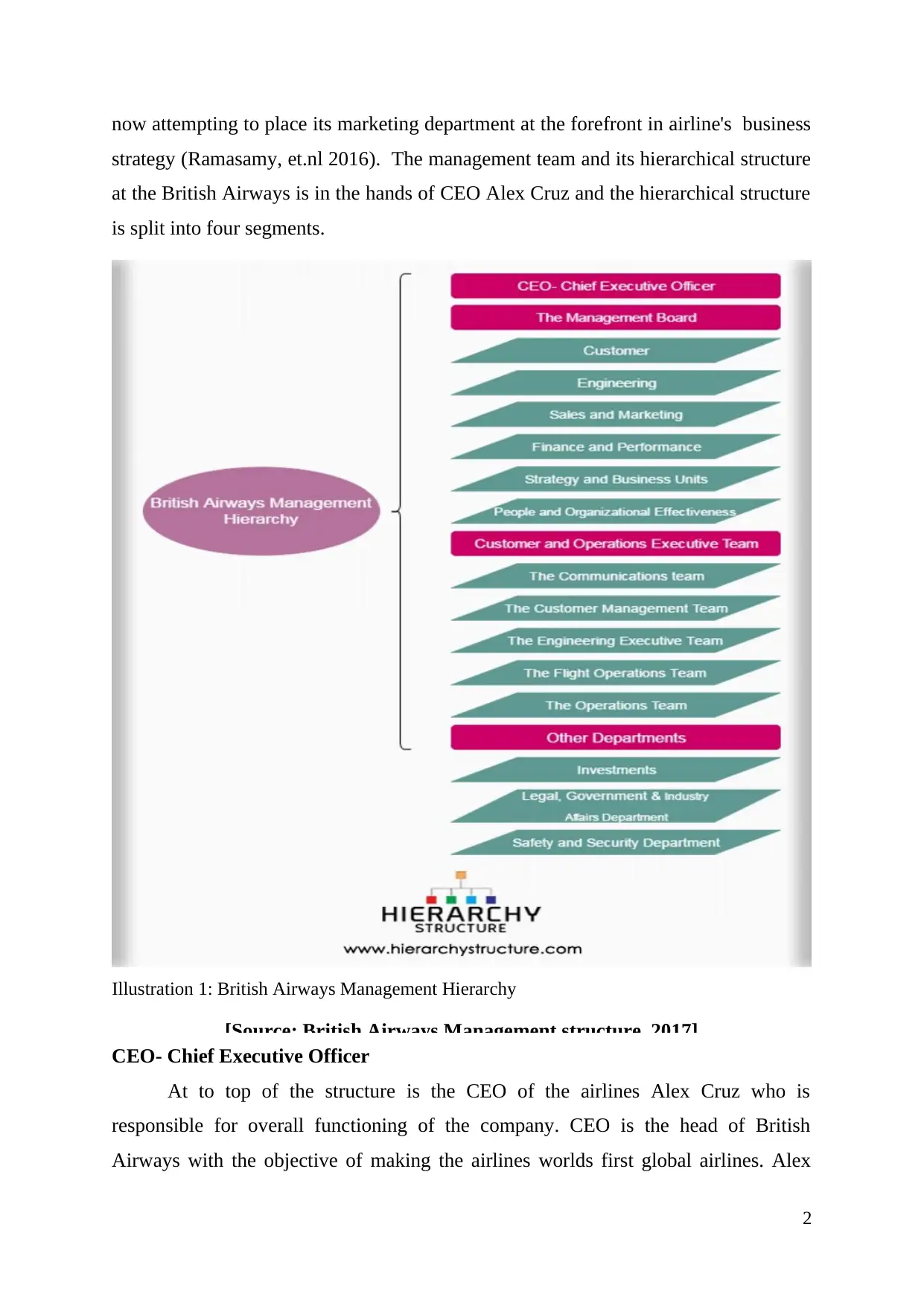
strategy (Ramasamy, et.nl 2016). The management team and its hierarchical structure
at the British Airways is in the hands of CEO Alex Cruz and the hierarchical structure
is split into four segments.
Illustration 1: British Airways Management Hierarchy
[Source: British Airways Management structure, 2017]
CEO- Chief Executive Officer
At to top of the structure is the CEO of the airlines Alex Cruz who is
responsible for overall functioning of the company. CEO is the head of British
Airways with the objective of making the airlines worlds first global airlines. Alex
2
strategy (Ramasamy, et.nl 2016). The management team and its hierarchical structure
at the British Airways is in the hands of CEO Alex Cruz and the hierarchical structure
is split into four segments.
Illustration 1: British Airways Management Hierarchy
[Source: British Airways Management structure, 2017]
CEO- Chief Executive Officer
At to top of the structure is the CEO of the airlines Alex Cruz who is
responsible for overall functioning of the company. CEO is the head of British
Airways with the objective of making the airlines worlds first global airlines. Alex
2
Paraphrase This Document
Need a fresh take? Get an instant paraphrase of this document with our AI Paraphraser
Cruz objective was to maximize the profits but as of now they have to change the aim
of having an increase in security as this was the main issue globally and need to keep
their customers safe after the terrorist activities (Huhtala, Vaniala and Tikkanen,
2016). The passengers were given advice to bring plastic bags instead of hand luggage
and regular anti terrorism drill was performed to deal with them. As CEO lead the
airlines so he is responsible for the security of the staff and passengers and to
maximize profits and handling all the functional areas.
The Management Board-
The management board are responsible for overall and day to day functioning
of the respective department and they are required to report CEO of the airlines. They
all are assisted by teams of their executives ensuring smooth functioning of whole
department and the airlines as well. The overall function of airlines are divided into
different departments like customer, engineering, sale & marketing, finance &
performance, strategy & business units and people & organisational effectiveness.
They all departments play a vital role in managing the airlines always and to achieving
the objective of the company.
Customer and Operations Executive Team-
This team at British Airways consist of different profile which monitor and
manage the main service area of the airlines i.e. the customer lobby and also look after
the flights and passengers of the airlines. The customer and operations executive team
consist of further sub divisions like the communication team, customer management
team, engineering executive team, flight operations team and the operations team
(Eling and Schaper, 2017). All these teams allow the day to day smooth functioning of
the airlines and solving the customer or passengers query at their end.
Other Departments-
There are other departments also who handle the left out functions of the
airlines they are assisted by a number of managers and senior managers depending
upon the operations involved. Other departments include the crucial departments like
the investments, legal, government & industry affairs department and last is the safety
& security department.
3
of having an increase in security as this was the main issue globally and need to keep
their customers safe after the terrorist activities (Huhtala, Vaniala and Tikkanen,
2016). The passengers were given advice to bring plastic bags instead of hand luggage
and regular anti terrorism drill was performed to deal with them. As CEO lead the
airlines so he is responsible for the security of the staff and passengers and to
maximize profits and handling all the functional areas.
The Management Board-
The management board are responsible for overall and day to day functioning
of the respective department and they are required to report CEO of the airlines. They
all are assisted by teams of their executives ensuring smooth functioning of whole
department and the airlines as well. The overall function of airlines are divided into
different departments like customer, engineering, sale & marketing, finance &
performance, strategy & business units and people & organisational effectiveness.
They all departments play a vital role in managing the airlines always and to achieving
the objective of the company.
Customer and Operations Executive Team-
This team at British Airways consist of different profile which monitor and
manage the main service area of the airlines i.e. the customer lobby and also look after
the flights and passengers of the airlines. The customer and operations executive team
consist of further sub divisions like the communication team, customer management
team, engineering executive team, flight operations team and the operations team
(Eling and Schaper, 2017). All these teams allow the day to day smooth functioning of
the airlines and solving the customer or passengers query at their end.
Other Departments-
There are other departments also who handle the left out functions of the
airlines they are assisted by a number of managers and senior managers depending
upon the operations involved. Other departments include the crucial departments like
the investments, legal, government & industry affairs department and last is the safety
& security department.
3
These all departments function together in achieving the goals and objective of
the airlines and all are having their own objectives also which the link up to the
organisational objectives.
TASK 3
P4 Highlighting the positive and negative impact of macro environment using
PESTLE analysis of British Airways.
The British Airways is the largest airlines of UK having the largest fleet size
and flies to 148 destinations worldwide this airline also runs a universal cargo
passengers service. The following PESTLE analysis of British Airways include the
study of all external factors on the airlines business which include political,
economical, social, technological, legal and the environmental factors.
Political factor- any business running need to be regulated by the government
of that country to secure the need of both external and internal factors affecting
the business. Similarly, British Airways is also subjected to high resolutions
and to guarantee security and safety of its passengers and staff (Jaakkola, et.nl
2016.). All the regulation lay down by governments of different country in
which airlines is serving, the airport slots used, the fare which it sets, business
partners that it works with and the infrastructure cost paid.
Economical factor- these factors are very commonly seen in any organisation
and also in airlines business any economic factor in the country will lead to
decline in the profits greatly. The great recession of 2007-08 affected British
airways like price of oil and service went up, financial crisis faced by UK and
the downfall of sterling in the global market. There are various others reason
leading to major drop down of airlines business and customers confidence like
uncertainty in capital markets, erosion of household budget rising in
unemployment and falling of house price.
Social factor- every passengers travelling by airlines whether the business
travellers or individual passengers they always look for a trusted airline.
Passengers always want that their trip must go smoothly giving them quality of
service and standards at less cost (Allsop, and Brennan, 2016). Like one
4
the airlines and all are having their own objectives also which the link up to the
organisational objectives.
TASK 3
P4 Highlighting the positive and negative impact of macro environment using
PESTLE analysis of British Airways.
The British Airways is the largest airlines of UK having the largest fleet size
and flies to 148 destinations worldwide this airline also runs a universal cargo
passengers service. The following PESTLE analysis of British Airways include the
study of all external factors on the airlines business which include political,
economical, social, technological, legal and the environmental factors.
Political factor- any business running need to be regulated by the government
of that country to secure the need of both external and internal factors affecting
the business. Similarly, British Airways is also subjected to high resolutions
and to guarantee security and safety of its passengers and staff (Jaakkola, et.nl
2016.). All the regulation lay down by governments of different country in
which airlines is serving, the airport slots used, the fare which it sets, business
partners that it works with and the infrastructure cost paid.
Economical factor- these factors are very commonly seen in any organisation
and also in airlines business any economic factor in the country will lead to
decline in the profits greatly. The great recession of 2007-08 affected British
airways like price of oil and service went up, financial crisis faced by UK and
the downfall of sterling in the global market. There are various others reason
leading to major drop down of airlines business and customers confidence like
uncertainty in capital markets, erosion of household budget rising in
unemployment and falling of house price.
Social factor- every passengers travelling by airlines whether the business
travellers or individual passengers they always look for a trusted airline.
Passengers always want that their trip must go smoothly giving them quality of
service and standards at less cost (Allsop, and Brennan, 2016). Like one
4
⊘ This is a preview!⊘
Do you want full access?
Subscribe today to unlock all pages.
Trusted by 1+ million students worldwide
passenger complaint over the bed bugs on the plane seat in the British Airways
while her flight from Vancouver to London.
Technological factors- a huge investment in the technological and warehouse
management system helps in improving customer experience and reduce cost.
And in this changing ear technology plays a vital role in the development of
company like now passengers at British Airways are using mobile phones and
internet for checking-in.
Legal factor- this include the issues related to infrastructure to route flights
and slot capacity keeping the security and environmental needs in mind. It also
needs to pay the settlement to employee regarding to lawsuits.
Environmental factor- there are many environmental factors faced by airline
industry like air, water and noise pollution, land care take and waste
management and it need to cope up with the climate change as well. The
British Airways now need to follow national, international and local
environmental regulations to limit the growth of emissions and radiations.
TASK 4
P5 Conducting internal and external analysis for British Airways identifying the
strengths and weaknesses and how they influence decision making.
The strengths and weaknesses of British Airways provide the internal and
external situations and the performance of the company and this influencing decision
making by the management team.
Strengths- British Airways is the largest aviation company of UK having a
long history of about 40 year old and still is enjoying a strong brand reputation
in the industry (Kumar and Pradhan, 2016.). The company is globally
recognised and trusted by passengers all over the world and it won the business
and consumer super brand award in UK in the year 2016 consecutively for 3
years. It is trusted and respected by clients and is having a good will of
consumers which any company need to survive and compete with the rivals.
For the year 2016-17 it was an operating profit of about £1,473 million with an
increase of 16.5% from the previous years. Therefore, company is able in
retention of its customer and ensured customer loyalty in this challenging
5
while her flight from Vancouver to London.
Technological factors- a huge investment in the technological and warehouse
management system helps in improving customer experience and reduce cost.
And in this changing ear technology plays a vital role in the development of
company like now passengers at British Airways are using mobile phones and
internet for checking-in.
Legal factor- this include the issues related to infrastructure to route flights
and slot capacity keeping the security and environmental needs in mind. It also
needs to pay the settlement to employee regarding to lawsuits.
Environmental factor- there are many environmental factors faced by airline
industry like air, water and noise pollution, land care take and waste
management and it need to cope up with the climate change as well. The
British Airways now need to follow national, international and local
environmental regulations to limit the growth of emissions and radiations.
TASK 4
P5 Conducting internal and external analysis for British Airways identifying the
strengths and weaknesses and how they influence decision making.
The strengths and weaknesses of British Airways provide the internal and
external situations and the performance of the company and this influencing decision
making by the management team.
Strengths- British Airways is the largest aviation company of UK having a
long history of about 40 year old and still is enjoying a strong brand reputation
in the industry (Kumar and Pradhan, 2016.). The company is globally
recognised and trusted by passengers all over the world and it won the business
and consumer super brand award in UK in the year 2016 consecutively for 3
years. It is trusted and respected by clients and is having a good will of
consumers which any company need to survive and compete with the rivals.
For the year 2016-17 it was an operating profit of about £1,473 million with an
increase of 16.5% from the previous years. Therefore, company is able in
retention of its customer and ensured customer loyalty in this challenging
5
Paraphrase This Document
Need a fresh take? Get an instant paraphrase of this document with our AI Paraphraser
competition. British airways is an offshoot of a large parent company IAG
which also owns and manages other airlines and the parent company is having
extensive network of operations both internationally and domestically. It is also
heading in the digitisation and technological innovation in the airline industry
(Ekinci, Calderon and Siala, 2016). British Airways has integrated information
technology and internet improving the efficiency of its services like the digital
boarding pass is used by 28000 people every day.
Weaknesses- uneven competition of company is been reflected in the revenue
ratios between both domestic and international operations. This is not good for
the company at the global level and for the near future. There are also several
complaints about the service disruptions due to employee and the infrastructure
system issues. As British Airways is having a strong worker's union which is
created for the interest of workers also including good working conditions,
remuneration and fair treatment of the worker by the company (Patra,
Mahapatra and Patnaik, 2016). There were several disruptions by the
employees to strikes over low pay and allowance and also the airlines have
resorted to job cuts. In the early 2017 about 2900 crew members went on the
strike over the poverty pay and this remains unsolved and about 1400 crews
again threatened to go on strike in July 2017. These kinds of strikes disrupts
airlines operations as the flights cancelled and the passengers were
compensated in many instances. There were also the technical faults in the
check-in systems at British Airways which caused the delay in many flights
worldwide in September 2016. In may 2017 there was IT failure due to power
surge and this affected its system globally more than 75000 passengers suffered
by this and had to pay about £100 million towards the compensation cost.
Incidents like these not only affected the company financially but also loss in
customer trust and brand image.
These all strengths and weaknesses of British Airways will always affect the level of
decision making in the company. With the strengths the company will come to know
what are the plus points of it and then help in the decision making process keeping
6
which also owns and manages other airlines and the parent company is having
extensive network of operations both internationally and domestically. It is also
heading in the digitisation and technological innovation in the airline industry
(Ekinci, Calderon and Siala, 2016). British Airways has integrated information
technology and internet improving the efficiency of its services like the digital
boarding pass is used by 28000 people every day.
Weaknesses- uneven competition of company is been reflected in the revenue
ratios between both domestic and international operations. This is not good for
the company at the global level and for the near future. There are also several
complaints about the service disruptions due to employee and the infrastructure
system issues. As British Airways is having a strong worker's union which is
created for the interest of workers also including good working conditions,
remuneration and fair treatment of the worker by the company (Patra,
Mahapatra and Patnaik, 2016). There were several disruptions by the
employees to strikes over low pay and allowance and also the airlines have
resorted to job cuts. In the early 2017 about 2900 crew members went on the
strike over the poverty pay and this remains unsolved and about 1400 crews
again threatened to go on strike in July 2017. These kinds of strikes disrupts
airlines operations as the flights cancelled and the passengers were
compensated in many instances. There were also the technical faults in the
check-in systems at British Airways which caused the delay in many flights
worldwide in September 2016. In may 2017 there was IT failure due to power
surge and this affected its system globally more than 75000 passengers suffered
by this and had to pay about £100 million towards the compensation cost.
Incidents like these not only affected the company financially but also loss in
customer trust and brand image.
These all strengths and weaknesses of British Airways will always affect the level of
decision making in the company. With the strengths the company will come to know
what are the plus points of it and then help in the decision making process keeping
6
these points in mind (Elias and Etim, 2017.). By keeping these strengths and
weaknesses while making the decision the company can over come the weaknesses
and increase its strengths in the industry.
P6 Applying TOWS analysis to British Airways in identifying strengths and
weaknesses and the interrelationship with external macro factors.
TOWS analysis is used to generate, compare and select strategies and is not
certainly same as the SWOT analysis. As TOWS is a tool of strategy generation and
SWOT analysis is a tool for audit analysis (Radwan, 2016.). The strengths and
weaknesses are the internal factor and the threats and opportunity are external factor
of the organisation.
Illustration 2: Illustration 2: TOWS analysis of British Airways
[Source:TOWS analysis of British Airways, 2017 ]
The four strategies of TOWS analysis are strengths or opportunity (SO),
weaknesses or opportunity (WO), strengths or threats (ST) and weaknesses or threats
7
weaknesses while making the decision the company can over come the weaknesses
and increase its strengths in the industry.
P6 Applying TOWS analysis to British Airways in identifying strengths and
weaknesses and the interrelationship with external macro factors.
TOWS analysis is used to generate, compare and select strategies and is not
certainly same as the SWOT analysis. As TOWS is a tool of strategy generation and
SWOT analysis is a tool for audit analysis (Radwan, 2016.). The strengths and
weaknesses are the internal factor and the threats and opportunity are external factor
of the organisation.
Illustration 2: Illustration 2: TOWS analysis of British Airways
[Source:TOWS analysis of British Airways, 2017 ]
The four strategies of TOWS analysis are strengths or opportunity (SO),
weaknesses or opportunity (WO), strengths or threats (ST) and weaknesses or threats
7
⊘ This is a preview!⊘
Do you want full access?
Subscribe today to unlock all pages.
Trusted by 1+ million students worldwide
(WT) all theses strategies help the British Airways in achieving the business objective
of the organisation.
Strengths Or Opportunity (SO)- in this the company use the strengths to
exploit the surrounding opportunity it can focus on the additional services
which it provides to the customers or the clients and can also use the Dublin
airport as a hub to attract more and more customer.
Weaknesses Or Opportunity (WO)- British Airways have many options to
overcome the weakness and then take advantage of the opportunities in this
they mitigate the weaknesses and exploit opportunities (Coelho, Lages and
Sousa, 2016.). British Airways can improve the human resource management
policy and the people process policy, can also improve IT or the infrastructural
policy and focus on that market from where the fleet is able to reach.
Strengths Or Threats (ST)- will exploit the strengths to over come any
potential weaknesses. British Airways can join the global alliance and use the
brand image it has to over come the possible threats.
Weaknesses Or Threats (WT)- with this strategy company is attempting to
minimise any weaknesses to avoid possible threats. British Airways can also
improve the environmental policies it has to avoid the future threats from
government of the other countries.
All these strengths, weaknesses, opportunities and threats have a relationship with the
external macro factors like the political, technological, economical, legal, social and
environmental factors of British Airways. The goal of British Airways is always to
present better quality service to its customers, stakeholder and employee as well. The
strengths of British Airways are its brand image, alliances, its size and stability and all
these affect the social and all other external factors. PESTLE analysis are the factors
which affect the business environment and SWOT analysis deals with the company's
inner working including its strengths and weaknesses (Yoon, 2016). Combining the
two analysis British Airways will get an overall picture of the threats the company
faces and how to deal with them and also to focus on the possible opportunities for
company so that British Airways can get the advantage of the two.
8
of the organisation.
Strengths Or Opportunity (SO)- in this the company use the strengths to
exploit the surrounding opportunity it can focus on the additional services
which it provides to the customers or the clients and can also use the Dublin
airport as a hub to attract more and more customer.
Weaknesses Or Opportunity (WO)- British Airways have many options to
overcome the weakness and then take advantage of the opportunities in this
they mitigate the weaknesses and exploit opportunities (Coelho, Lages and
Sousa, 2016.). British Airways can improve the human resource management
policy and the people process policy, can also improve IT or the infrastructural
policy and focus on that market from where the fleet is able to reach.
Strengths Or Threats (ST)- will exploit the strengths to over come any
potential weaknesses. British Airways can join the global alliance and use the
brand image it has to over come the possible threats.
Weaknesses Or Threats (WT)- with this strategy company is attempting to
minimise any weaknesses to avoid possible threats. British Airways can also
improve the environmental policies it has to avoid the future threats from
government of the other countries.
All these strengths, weaknesses, opportunities and threats have a relationship with the
external macro factors like the political, technological, economical, legal, social and
environmental factors of British Airways. The goal of British Airways is always to
present better quality service to its customers, stakeholder and employee as well. The
strengths of British Airways are its brand image, alliances, its size and stability and all
these affect the social and all other external factors. PESTLE analysis are the factors
which affect the business environment and SWOT analysis deals with the company's
inner working including its strengths and weaknesses (Yoon, 2016). Combining the
two analysis British Airways will get an overall picture of the threats the company
faces and how to deal with them and also to focus on the possible opportunities for
company so that British Airways can get the advantage of the two.
8
Paraphrase This Document
Need a fresh take? Get an instant paraphrase of this document with our AI Paraphraser
CONCLUSION
From the above report it has been concluded that the business environment
constitute of all the external and internal factors affecting the businesses as a whole.
SWOT and the PESTLE analysis of British Airways help the organisation in
identifying the strengths and the weaknesses and how it can grab the opportunities and
see the threats to ignore that. The political, economical, social, legal, technological
and the environmental factors play a vital role in the organisational decision making.
British Airways been the most successful airlines of UK and having many strengths
and weaknesses of it and it overcomes them all in achieving the organisational goal of
the company. The organisational function of British Airways is linked with each other
and all of them help in the decision making of the company.
9
From the above report it has been concluded that the business environment
constitute of all the external and internal factors affecting the businesses as a whole.
SWOT and the PESTLE analysis of British Airways help the organisation in
identifying the strengths and the weaknesses and how it can grab the opportunities and
see the threats to ignore that. The political, economical, social, legal, technological
and the environmental factors play a vital role in the organisational decision making.
British Airways been the most successful airlines of UK and having many strengths
and weaknesses of it and it overcomes them all in achieving the organisational goal of
the company. The organisational function of British Airways is linked with each other
and all of them help in the decision making of the company.
9
REFERENCES
Books and journals:
Allsop, M. and Brennan, M., 2016. Government agencies should be exemplars of
business behaviour. Small Enterprise Research. 23(3). pp.293-301.
Coelho, F., Lages, C. R. and Sousa, C. M., 2016. The Relationship Between
Personality and the Creativity of Frontline Employees: Evidence from
Services. In Marketing Challenges in a Turbulent Business Environment (pp.
589-590). Springer, Cham.
Ekinci, Y., Calderon, J. and Siala, H., 2016. Do personality traits
predict'complaining'consumers?. International Journal of Business
Environment. 8(1). pp.32-42.
Elias, I. and Etim, O., 2017. Traditional Budgeting in Today’ s Business
Environment. Journal of Applied Finance & Banking. 7(3). pp.1-7.
Eling, M. and Schaper, P., 2017. Under pressure: how the business environment
affects productivity and efficiency of European life insurance companies.
European Journal of Operational Research. 258(3). pp.1082-1094.
Huhtala, J. P., Vaniala, I. and Tikkanen, H., 2016. Market Orientation and
Innovation in Dynamic Competitive Markets. In Marketing Challenges in a
Turbulent Business Environment (pp. 73-73). Springer, Cham.
Jaakkola, et.nl 2016. Is more capability always beneficial for firm performance?
Market orientation, core business process capabilities and business
environment. Journal of Marketing Management. 32(13-14). pp.1359-1385.
Kumar, V. and Pradhan, P., 2016. Reputation Management Through Online
Feedbacks in e-Business Environment. International Journal of Enterprise
Information Systems (IJEIS). 12(1). pp.21-37.
Patra, S. K., Mahapatra, D. M. and Patnaik, R., 2016. Diffusion of Technological
Innovation in Business: A Study on New Generation Business in India in E-
Business Environment. Parikalpana: KIIT Journal of Management. 12(2).
10
Books and journals:
Allsop, M. and Brennan, M., 2016. Government agencies should be exemplars of
business behaviour. Small Enterprise Research. 23(3). pp.293-301.
Coelho, F., Lages, C. R. and Sousa, C. M., 2016. The Relationship Between
Personality and the Creativity of Frontline Employees: Evidence from
Services. In Marketing Challenges in a Turbulent Business Environment (pp.
589-590). Springer, Cham.
Ekinci, Y., Calderon, J. and Siala, H., 2016. Do personality traits
predict'complaining'consumers?. International Journal of Business
Environment. 8(1). pp.32-42.
Elias, I. and Etim, O., 2017. Traditional Budgeting in Today’ s Business
Environment. Journal of Applied Finance & Banking. 7(3). pp.1-7.
Eling, M. and Schaper, P., 2017. Under pressure: how the business environment
affects productivity and efficiency of European life insurance companies.
European Journal of Operational Research. 258(3). pp.1082-1094.
Huhtala, J. P., Vaniala, I. and Tikkanen, H., 2016. Market Orientation and
Innovation in Dynamic Competitive Markets. In Marketing Challenges in a
Turbulent Business Environment (pp. 73-73). Springer, Cham.
Jaakkola, et.nl 2016. Is more capability always beneficial for firm performance?
Market orientation, core business process capabilities and business
environment. Journal of Marketing Management. 32(13-14). pp.1359-1385.
Kumar, V. and Pradhan, P., 2016. Reputation Management Through Online
Feedbacks in e-Business Environment. International Journal of Enterprise
Information Systems (IJEIS). 12(1). pp.21-37.
Patra, S. K., Mahapatra, D. M. and Patnaik, R., 2016. Diffusion of Technological
Innovation in Business: A Study on New Generation Business in India in E-
Business Environment. Parikalpana: KIIT Journal of Management. 12(2).
10
⊘ This is a preview!⊘
Do you want full access?
Subscribe today to unlock all pages.
Trusted by 1+ million students worldwide

1 out of 13


Related Documents


Your All-in-One AI-Powered Toolkit for Academic Success.
+13062052269
info@desklib.com
Available 24*7 on WhatsApp / Email
![[object Object]](/_next/static/media/star-bottom.7253800d.svg)
Unlock your academic potential
Copyright © 2020–2026 A2Z Services. All Rights Reserved. Developed and managed by ZUCOL.