Comprehensive Marketing Analysis: British Airways Strategies Report
VerifiedAdded on 2022/09/12
|18
|4499
|22
Report
AI Summary
This report provides a comprehensive analysis of British Airways' marketing strategies and principles. It begins with an introduction to the airline industry and a brief history of British Airways, followed by a discussion of key marketing concepts such as product, production, selling, marketing, and societal market concepts, along with marketing mix, market segmentation, brand positioning, promotion strategies, and market entry strategies. The report then delves into how British Airways has applied these concepts to achieve its objectives, including market entry strategies, marketing research, product and production concepts, direct marketing, customer loyalty strategies, brand positioning, and societal market concepts. The 7Ps of marketing (product, place, price, promotion, people, process, and physical evidence) are examined in detail, followed by an overview of the company's STP (segmentation, targeting, and positioning) strategies and a conclusion summarizing the findings. The report concludes with a list of references.
Marketing Principles 1
Executive summary
The report begins with a brief introduction to the airline industry and the case study airline which
is British Airways. It gives a brief history of the company. Also, the introduction is how the
researcher will tackle the study. This is then followed by the main body which discusses the key
marketing concepts and terminologies likely to be encountered in the study. This is then
followed by the marketing concepts that have aided British Airways to accomplish their
objectives. After that are the 7ps and STP of the company which is discussed in detail. This is
then followed by a poster and explanation of how the marketing department works together and
after that is the conclusion. Finally is the list of references from where the information was
sourced.
Executive summary
The report begins with a brief introduction to the airline industry and the case study airline which
is British Airways. It gives a brief history of the company. Also, the introduction is how the
researcher will tackle the study. This is then followed by the main body which discusses the key
marketing concepts and terminologies likely to be encountered in the study. This is then
followed by the marketing concepts that have aided British Airways to accomplish their
objectives. After that are the 7ps and STP of the company which is discussed in detail. This is
then followed by a poster and explanation of how the marketing department works together and
after that is the conclusion. Finally is the list of references from where the information was
sourced.

Paraphrase This Document
Need a fresh take? Get an instant paraphrase of this document with our AI Paraphraser
Marketing Principles 2
Contents
Executive summary.........................................................................................................................1
Introduction......................................................................................................................................3
Literature review..............................................................................................................................3
Part one............................................................................................................................................3
Part 2................................................................................................................................................5
Part three..........................................................................................................................................8
Part 4..............................................................................................................................................12
Conclusion.....................................................................................................................................15
References......................................................................................................................................16
Contents
Executive summary.........................................................................................................................1
Introduction......................................................................................................................................3
Literature review..............................................................................................................................3
Part one............................................................................................................................................3
Part 2................................................................................................................................................5
Part three..........................................................................................................................................8
Part 4..............................................................................................................................................12
Conclusion.....................................................................................................................................15
References......................................................................................................................................16
Marketing Principles 3
Introduction
The airline industry is a business that involves the transportation of goods and people via air with
the use of vessels such as planes and helicopters. The first airplane was invented by the Wright
Brothers in 1903. (Hobbs, 2019). However, the first-ever commercial flight took off between St.
Petersburg and Tampa in 1914 in the United States. The industry can be subdivided into three,
namely; general, military and commercial. The commercial section includes international,
regional, national and cargo. In this report, the case study will be British Airlines (BA) in the
commercial sector. BA was founded on 31st March 1974. Its headquarters are in Waterside,
Harmondsworth. BA is the second-largest airline company in Britain in terms of passengers’
ferried and fleet size. In 2011, BA and Iberia merged to create the International Airline Group
(AIG) which is the second-largest airline in Europe and third in the world based on revenue. The
company became the first airline to accrue more than $1 billion in a year from a single air route,
(London Heathrow – New York JFK). (Airways, 2017). The report will look into the marketing
strategies and concepts the company has adopted to achieve its objectives. This will be
highlighted in details and also justification will be provided based on facts. It will also contain
how the marketing department works closely with other departments to achieve the company’s
objectives.
Literature review
Part one
For a company to be successful, it must have a well-planned marketing strategy. Marketing
concepts can be defined as the analysis undertaken by a firm on their customer needs and then
make decisions that satisfy them in a better way than its competitors. (Baker and Saren, 2016).
The key marketing concepts and terminologies that will be applicable for BA and will be
discussed in this report are as follows:
a) Product concept
Introduction
The airline industry is a business that involves the transportation of goods and people via air with
the use of vessels such as planes and helicopters. The first airplane was invented by the Wright
Brothers in 1903. (Hobbs, 2019). However, the first-ever commercial flight took off between St.
Petersburg and Tampa in 1914 in the United States. The industry can be subdivided into three,
namely; general, military and commercial. The commercial section includes international,
regional, national and cargo. In this report, the case study will be British Airlines (BA) in the
commercial sector. BA was founded on 31st March 1974. Its headquarters are in Waterside,
Harmondsworth. BA is the second-largest airline company in Britain in terms of passengers’
ferried and fleet size. In 2011, BA and Iberia merged to create the International Airline Group
(AIG) which is the second-largest airline in Europe and third in the world based on revenue. The
company became the first airline to accrue more than $1 billion in a year from a single air route,
(London Heathrow – New York JFK). (Airways, 2017). The report will look into the marketing
strategies and concepts the company has adopted to achieve its objectives. This will be
highlighted in details and also justification will be provided based on facts. It will also contain
how the marketing department works closely with other departments to achieve the company’s
objectives.
Literature review
Part one
For a company to be successful, it must have a well-planned marketing strategy. Marketing
concepts can be defined as the analysis undertaken by a firm on their customer needs and then
make decisions that satisfy them in a better way than its competitors. (Baker and Saren, 2016).
The key marketing concepts and terminologies that will be applicable for BA and will be
discussed in this report are as follows:
a) Product concept
⊘ This is a preview!⊘
Do you want full access?
Subscribe today to unlock all pages.

Trusted by 1+ million students worldwide
Marketing Principles 4
This concept implies that consumers are willing to spend on a product with regards to their
perceived quality, performance and features. Thus, products with high quality, performance and
features will sell more. (Cassia, et al, 2015)
b) Production concept
This means that consumers will prefer products that cheaper over expensive similar products.
The company thus prefers to sell more of the cheap products as they will sell more units at a
cheaper price thus making them more profitable.
c) Selling concept
This is where a company puts its efforts aggressively in making actual sales of their products
regards of their quality or customer needs. However, this concept does not incorporate customer
relation thus customer loyalty and repeat purchases are quite rare. (Zeithammer, 2015).
d) Marketing concept
Here, the company takes into account the consumer wants and needs and endeavors to meet them
for customer satisfaction. Since customers are satisfied, this leads to customer loyalty as it
emphasizes on the “pull strategy”. (Baker, 2014).
e) Societal market concept
This involves putting into consideration the well-being of society to build a company's name and
thus create consumer loyalty and also win new consumers. It involves compromising company
profits.
f) Marketing mix
This involves the combination of various tactics that firms adopt to promote their products to
consumers. The tool is commonly used is the 7ps of marketing, that is; price, place, product,
promotion, process and physical evidence. The 7p’s will be discussed later in detail in the report.
(Mohammad, 2015).
g) Market segmentation
This concept implies that consumers are willing to spend on a product with regards to their
perceived quality, performance and features. Thus, products with high quality, performance and
features will sell more. (Cassia, et al, 2015)
b) Production concept
This means that consumers will prefer products that cheaper over expensive similar products.
The company thus prefers to sell more of the cheap products as they will sell more units at a
cheaper price thus making them more profitable.
c) Selling concept
This is where a company puts its efforts aggressively in making actual sales of their products
regards of their quality or customer needs. However, this concept does not incorporate customer
relation thus customer loyalty and repeat purchases are quite rare. (Zeithammer, 2015).
d) Marketing concept
Here, the company takes into account the consumer wants and needs and endeavors to meet them
for customer satisfaction. Since customers are satisfied, this leads to customer loyalty as it
emphasizes on the “pull strategy”. (Baker, 2014).
e) Societal market concept
This involves putting into consideration the well-being of society to build a company's name and
thus create consumer loyalty and also win new consumers. It involves compromising company
profits.
f) Marketing mix
This involves the combination of various tactics that firms adopt to promote their products to
consumers. The tool is commonly used is the 7ps of marketing, that is; price, place, product,
promotion, process and physical evidence. The 7p’s will be discussed later in detail in the report.
(Mohammad, 2015).
g) Market segmentation
Paraphrase This Document
Need a fresh take? Get an instant paraphrase of this document with our AI Paraphraser
Marketing Principles 5
This involves subdividing the market into smaller groups based on various characteristics to
decide on the target market. Market segments are divided into demographic, psychographic,
behavioral, and geographic. (McDONALD, 2016).
h) Brand positioning
This is the brand image that the company wants to create in the mind of the consumer thus
increasing competitive distinctiveness. This is the perception the consumer has on a company’s
product. This is created through the use of the 4p’s, that is; price, place, product, and promotion.
(Singh, Kalafatis, and Ledden, 2014).
i) Promotion strategy
This is what a company does to persuade, inform, and influence an undecided consumer to
purchase their products. Promotions include discounts and advertising which help a company’s
product seem superior to other identical products via strategies such as product differentiation.
(Andrews and Shimp, 2017).
j) Market entry strategies
This is how a company enters a target market that is new or creates a stronghold into an existing
market. This could be through mergers, franchising, and amalgamations, among others.
(Deutschmann, 2014).
k) Direct marketing
This whereby a company sells its services and products directly to consumers without the
involvement of any middlemen such as retailers or agents. (Risselada, Verhoef, and Bijmolt,
2014).
l) Marketing research
This is the process collecting, analysis, and interpretation of data about a market needs
incorporating present, past, and future customers’ trends such as spending habits, location,
among others.
This involves subdividing the market into smaller groups based on various characteristics to
decide on the target market. Market segments are divided into demographic, psychographic,
behavioral, and geographic. (McDONALD, 2016).
h) Brand positioning
This is the brand image that the company wants to create in the mind of the consumer thus
increasing competitive distinctiveness. This is the perception the consumer has on a company’s
product. This is created through the use of the 4p’s, that is; price, place, product, and promotion.
(Singh, Kalafatis, and Ledden, 2014).
i) Promotion strategy
This is what a company does to persuade, inform, and influence an undecided consumer to
purchase their products. Promotions include discounts and advertising which help a company’s
product seem superior to other identical products via strategies such as product differentiation.
(Andrews and Shimp, 2017).
j) Market entry strategies
This is how a company enters a target market that is new or creates a stronghold into an existing
market. This could be through mergers, franchising, and amalgamations, among others.
(Deutschmann, 2014).
k) Direct marketing
This whereby a company sells its services and products directly to consumers without the
involvement of any middlemen such as retailers or agents. (Risselada, Verhoef, and Bijmolt,
2014).
l) Marketing research
This is the process collecting, analysis, and interpretation of data about a market needs
incorporating present, past, and future customers’ trends such as spending habits, location,
among others.
Marketing Principles 6
Part 2
Company objectives are the desired outcomes or goals that a company wishes to accomplish.
The objectives are closely related to the company mission and vision. BA vision is “to become
the world's most responsible airline and to be the world-leading global airline”. Their mission is,
“to provide good customer service and relations.” Their goals are:
i. By 2020, they should not send their waste to the UK landfill.
ii. By 2015, they should reduce the noise made by their aircraft by 15 percent.
iii. Making it simpler for their customers to carbon offset their journeys.
iv. To bring around conservation projects to the community and around the world.
v. Meet our customers' needs and improve margins through new revenue streams
vi. Grow business revenues and profits by an online retail website and in-flight sales.
From their goals, mission, and vision it is thus easy to deduce British Airline objectives. Thus,
the following are the marketing strategies and programs that have enabled BA to achieve their
objectives:
1. Market entry strategies
Via the strategy, the company was able to merge with Iberia to form the AIG Company that is
the third world leading Airways Company. This has enabled them to have a strong grip on the
global market in a bid to fulfill their objective of becoming their world-leading global airline.
After privatization in 1987, BA took over British Caledonian their most fierce domestic rivals
back then thus eliminating competition and increase sales and profitability eventually.
2. Marketing research
To wade off completion, create customer loyalty and acquire new customers, the company has
conducted numerous researches on customer needs and also on their rivals. Hill and Alexander,
2017). Through this research, the company has been able to make a name for itself thus making
it more profitable which is another of their objectives. This is highlighted in their product and
production concept strategies.
3. Product and production concept strategy
Part 2
Company objectives are the desired outcomes or goals that a company wishes to accomplish.
The objectives are closely related to the company mission and vision. BA vision is “to become
the world's most responsible airline and to be the world-leading global airline”. Their mission is,
“to provide good customer service and relations.” Their goals are:
i. By 2020, they should not send their waste to the UK landfill.
ii. By 2015, they should reduce the noise made by their aircraft by 15 percent.
iii. Making it simpler for their customers to carbon offset their journeys.
iv. To bring around conservation projects to the community and around the world.
v. Meet our customers' needs and improve margins through new revenue streams
vi. Grow business revenues and profits by an online retail website and in-flight sales.
From their goals, mission, and vision it is thus easy to deduce British Airline objectives. Thus,
the following are the marketing strategies and programs that have enabled BA to achieve their
objectives:
1. Market entry strategies
Via the strategy, the company was able to merge with Iberia to form the AIG Company that is
the third world leading Airways Company. This has enabled them to have a strong grip on the
global market in a bid to fulfill their objective of becoming their world-leading global airline.
After privatization in 1987, BA took over British Caledonian their most fierce domestic rivals
back then thus eliminating competition and increase sales and profitability eventually.
2. Marketing research
To wade off completion, create customer loyalty and acquire new customers, the company has
conducted numerous researches on customer needs and also on their rivals. Hill and Alexander,
2017). Through this research, the company has been able to make a name for itself thus making
it more profitable which is another of their objectives. This is highlighted in their product and
production concept strategies.
3. Product and production concept strategy
⊘ This is a preview!⊘
Do you want full access?
Subscribe today to unlock all pages.
Trusted by 1+ million students worldwide
Marketing Principles 7
One of the company’s objectives is to meet customer needs and at the same time maximizing
their profits by doing so. They have managed this by segmenting their target market into the
economy, premium economy, executive, and first-class. Their aircraft are divided these four
classes all of which have different services and prices to meet the customer needs, demands, and
expectations. They have also improved customer experience by the recent launch of terminal 5
thus creating punctuality.
4. Direct marketing strategies
BA has been able to eliminate middlemen in selling their products to consumers as they are in
direct contact with them. They have done this by launching their website, mobile apps and
recently a watch app that makes it easy and convenient for their customers to purchase their
products from anywhere. By eliminating middlemen, they bypass the cost associated with it thus
increasing their revenue and at the same time enhance customer experience due to convenience.
5. Customer loyalty strategy
British Airways has been able to create customer loyalty thus has repeated purchases and won
over new customers. Due to their experience, loyal customers can advertise by word of mouth to
their friends and peers. This also aids in reducing advertising costs which increases profits. They
are successful at this via the provision of services such as free WiFi, bonus flights to specific
destinations for club customers, free food and drinks among others.
6. Brand positioning strategy
Over the years, BA has undergone its share of downs and at even one time was a laughing stock
in the airline industry. However, they have managed to create a reputable image and gained their
customers back by enhancing their flight experience and are now labeled among the top airline
companies in the world thus increasing their sales and improving customer satisfaction.
7. Societal market concept strategy
The airline has been able to give back to the community and society at large by reducing its
carbon emission by over 60 tons since 1990. It has achieved this by improving its fuel efficiency
by 28%. This is evidence that they have achieved their objective of carbon offset.
One of the company’s objectives is to meet customer needs and at the same time maximizing
their profits by doing so. They have managed this by segmenting their target market into the
economy, premium economy, executive, and first-class. Their aircraft are divided these four
classes all of which have different services and prices to meet the customer needs, demands, and
expectations. They have also improved customer experience by the recent launch of terminal 5
thus creating punctuality.
4. Direct marketing strategies
BA has been able to eliminate middlemen in selling their products to consumers as they are in
direct contact with them. They have done this by launching their website, mobile apps and
recently a watch app that makes it easy and convenient for their customers to purchase their
products from anywhere. By eliminating middlemen, they bypass the cost associated with it thus
increasing their revenue and at the same time enhance customer experience due to convenience.
5. Customer loyalty strategy
British Airways has been able to create customer loyalty thus has repeated purchases and won
over new customers. Due to their experience, loyal customers can advertise by word of mouth to
their friends and peers. This also aids in reducing advertising costs which increases profits. They
are successful at this via the provision of services such as free WiFi, bonus flights to specific
destinations for club customers, free food and drinks among others.
6. Brand positioning strategy
Over the years, BA has undergone its share of downs and at even one time was a laughing stock
in the airline industry. However, they have managed to create a reputable image and gained their
customers back by enhancing their flight experience and are now labeled among the top airline
companies in the world thus increasing their sales and improving customer satisfaction.
7. Societal market concept strategy
The airline has been able to give back to the community and society at large by reducing its
carbon emission by over 60 tons since 1990. It has achieved this by improving its fuel efficiency
by 28%. This is evidence that they have achieved their objective of carbon offset.
Paraphrase This Document
Need a fresh take? Get an instant paraphrase of this document with our AI Paraphraser
Marketing Principles 8
According to the research conducted by the researcher, then it is viable to say the company has
ethically met its objectives. First off BA has met all legal obligations and is not embattled in
court with clients or other parties. Also, the airline has a code of ethics for its employees who
ensure their staffs are not ill-treated or their rights are infringed in any way. Due to this positive
motivation, employees can reciprocate the same to clients thus enhancing their experience.
(Chiew, and Braver, 2014). The company is also regarded as economical as it does not exploit
their customers and provides value for money. Finally, despite their large number of flights and
carbon emission caused by aircraft, the company has been ethical enough to reduce the same as
stated earlier and is also one of its objectives.
Part three
7ps of British Airways
7ps is a marketing strategy mix and it stands for the price, product, promotion, place, people,
process and physical evidence. The 7ps aids a firm in the definition and analysis of important
aspects that have an impact on the marketing of their services and products. The 7ps of BA are as
follows:
1. Product
These are the variety of physical or tangible items that a consumer can buy or sell from any
industry and should meet their expectations. (Loo and Leung, 2018). BA provides airline
services of a segment that is premium in nature. The airline has a wide range of competitive
advantages due to its customer customization emanating from their variety of choice which
makes it a major advantage. For example, in terms of teasing choices, the world traveler cabin
has an abundance of choice as they can choose from the healthy choice diet, taste of Britain,
vegetarian kitchen, Great British breakfast, and Gourmet Dining. In its service delivery, the
customers can choose while booking to either uses their website, mobile app, or apple watch app
all of which provide a summary of the customer's flight status, route, and departure time and
flight number.
2. Place
According to the research conducted by the researcher, then it is viable to say the company has
ethically met its objectives. First off BA has met all legal obligations and is not embattled in
court with clients or other parties. Also, the airline has a code of ethics for its employees who
ensure their staffs are not ill-treated or their rights are infringed in any way. Due to this positive
motivation, employees can reciprocate the same to clients thus enhancing their experience.
(Chiew, and Braver, 2014). The company is also regarded as economical as it does not exploit
their customers and provides value for money. Finally, despite their large number of flights and
carbon emission caused by aircraft, the company has been ethical enough to reduce the same as
stated earlier and is also one of its objectives.
Part three
7ps of British Airways
7ps is a marketing strategy mix and it stands for the price, product, promotion, place, people,
process and physical evidence. The 7ps aids a firm in the definition and analysis of important
aspects that have an impact on the marketing of their services and products. The 7ps of BA are as
follows:
1. Product
These are the variety of physical or tangible items that a consumer can buy or sell from any
industry and should meet their expectations. (Loo and Leung, 2018). BA provides airline
services of a segment that is premium in nature. The airline has a wide range of competitive
advantages due to its customer customization emanating from their variety of choice which
makes it a major advantage. For example, in terms of teasing choices, the world traveler cabin
has an abundance of choice as they can choose from the healthy choice diet, taste of Britain,
vegetarian kitchen, Great British breakfast, and Gourmet Dining. In its service delivery, the
customers can choose while booking to either uses their website, mobile app, or apple watch app
all of which provide a summary of the customer's flight status, route, and departure time and
flight number.
2. Place
Marketing Principles 9
This is where a company product can be accessed and where the services are offered. Luo,
Roach, and Jiratchot, 2015). The company has over 400 destinations globally with its largest
being London City, Gatwick, ad Heathrow airports. To access their product (air ticket), their
place of sale includes established online channels. Though they try to bypass it, their tickets can
also be bought offline via intermediaries such as sales agents.
3. Price
This is the monetary value attached to a company’s product. BA strategy of pricing can be
categorized as differentiation pricing. (Luo, Roach, and Jiratchot, 2015). This means that the
company charges higher prices for high-quality services while charging lower services for
budget airline services. Also, the company applies geographical and promotional strategies of
pricing occasionally. Finally, the company offers discount prices and offers for their executive
club members.
4. Promotion
This is how a company creates awareness and existence of their products or other changes such
as offers to their existing customers or potential and target customers. (Helm and Gritsch, 2014).
The company creates awareness of their products via line promotion or pipeline promotion. Line
promotion involves advertising via mainstream and social media such as Facebook, magazines or
television adverts. On the other hand, line promotion entails advertising via public relations like
in the case of this company, it does so via sponsorship, for example, large-scale rugby matches
or Olympics. Both strategies are quite crucial in expanding their customer base due to the large
audience involved.
5. Process
This is how the customer and service or product provider interact during the provision of such
products. However, services and products are different as the consumer receives ready-made
products. BA thus interacts with customers based on service provision for example air hostess
interaction while serving, quality of food served and all this has to be the same each time a
consumer chooses to fly with them.
6. Physical evidence
This is where a company product can be accessed and where the services are offered. Luo,
Roach, and Jiratchot, 2015). The company has over 400 destinations globally with its largest
being London City, Gatwick, ad Heathrow airports. To access their product (air ticket), their
place of sale includes established online channels. Though they try to bypass it, their tickets can
also be bought offline via intermediaries such as sales agents.
3. Price
This is the monetary value attached to a company’s product. BA strategy of pricing can be
categorized as differentiation pricing. (Luo, Roach, and Jiratchot, 2015). This means that the
company charges higher prices for high-quality services while charging lower services for
budget airline services. Also, the company applies geographical and promotional strategies of
pricing occasionally. Finally, the company offers discount prices and offers for their executive
club members.
4. Promotion
This is how a company creates awareness and existence of their products or other changes such
as offers to their existing customers or potential and target customers. (Helm and Gritsch, 2014).
The company creates awareness of their products via line promotion or pipeline promotion. Line
promotion involves advertising via mainstream and social media such as Facebook, magazines or
television adverts. On the other hand, line promotion entails advertising via public relations like
in the case of this company, it does so via sponsorship, for example, large-scale rugby matches
or Olympics. Both strategies are quite crucial in expanding their customer base due to the large
audience involved.
5. Process
This is how the customer and service or product provider interact during the provision of such
products. However, services and products are different as the consumer receives ready-made
products. BA thus interacts with customers based on service provision for example air hostess
interaction while serving, quality of food served and all this has to be the same each time a
consumer chooses to fly with them.
6. Physical evidence
⊘ This is a preview!⊘
Do you want full access?
Subscribe today to unlock all pages.
Trusted by 1+ million students worldwide
Marketing Principles 10
Although a company offers services, there should be a fixed element of physicality in the
provision of the service. For example, in a hotel, beds may be of quality but the surrounding
environment is quite different which opens room for competition. (Khan, 2014). BA practices
physical evidence by the provision of services such as WiFi, comfortable seats all in the name of
differentiating their product and making the customer experience more ideal thus becoming more
competitive.
7. People
People involve the staff or employees of a company who are in the frontline in running the
company and are the firsthand image of the company. BA ensures that they employ the best-
qualified employees and also provide training to ensure employees are the best place to deal with
customers thus building their company’s reputation consequently attracting more customers and
maintaining the existing. Also, their cabin is well trained to ensure maximum safety for their
passengers and investment in aircraft.
The STP of British Airline
STP simply stands for segmenting, targeting, and positioning. STP helps in the identification of
the right customer and the utilization of scarce marketing resources. (Wuryandani, Ismoyowati,
and Nugrahini, 2018). This process involves three steps as highlighted below:
1. Segmenting
This involves the identification of a group of similar consumers within a broad market and sub-
dividing them into smaller units according to their traits such as location, needs, age,
personalities, and interests. Segmentation is quite important as it helps the company identify the
specific need of consumers. BA has done this by identifying the four classes of consumers
explained earlier. (Cuadros and Domínguez, 2014).
2. Targeting
After segmentation, this is the next step that follows. The target involves matching the company
products and services with the wants and needs of the target consumers to what marketing
resources to use. BA having successfully identified the target market has established various
Although a company offers services, there should be a fixed element of physicality in the
provision of the service. For example, in a hotel, beds may be of quality but the surrounding
environment is quite different which opens room for competition. (Khan, 2014). BA practices
physical evidence by the provision of services such as WiFi, comfortable seats all in the name of
differentiating their product and making the customer experience more ideal thus becoming more
competitive.
7. People
People involve the staff or employees of a company who are in the frontline in running the
company and are the firsthand image of the company. BA ensures that they employ the best-
qualified employees and also provide training to ensure employees are the best place to deal with
customers thus building their company’s reputation consequently attracting more customers and
maintaining the existing. Also, their cabin is well trained to ensure maximum safety for their
passengers and investment in aircraft.
The STP of British Airline
STP simply stands for segmenting, targeting, and positioning. STP helps in the identification of
the right customer and the utilization of scarce marketing resources. (Wuryandani, Ismoyowati,
and Nugrahini, 2018). This process involves three steps as highlighted below:
1. Segmenting
This involves the identification of a group of similar consumers within a broad market and sub-
dividing them into smaller units according to their traits such as location, needs, age,
personalities, and interests. Segmentation is quite important as it helps the company identify the
specific need of consumers. BA has done this by identifying the four classes of consumers
explained earlier. (Cuadros and Domínguez, 2014).
2. Targeting
After segmentation, this is the next step that follows. The target involves matching the company
products and services with the wants and needs of the target consumers to what marketing
resources to use. BA having successfully identified the target market has established various
Paraphrase This Document
Need a fresh take? Get an instant paraphrase of this document with our AI Paraphraser
Marketing Principles 11
marketing modes and media that are best suited to reach the target consumer. For example, to
advertise to the first class the most appropriate means to use is via business journals while to
advertise to the economy class, the most appropriate means is via social media or television
adverts. (Haider, et al, 2019).
3. Positioning
This is the final stage of STP marketing. Positioning entails creating the intended image of a
product to the target audience. This is created via the use of the 4p’s of marketing. In this case
study, BA has created an image of value for money where you get what you pay for as per the
four travel cabins available in a bid to wade off competition from rivals. (Proctor, 2014).
marketing modes and media that are best suited to reach the target consumer. For example, to
advertise to the first class the most appropriate means to use is via business journals while to
advertise to the economy class, the most appropriate means is via social media or television
adverts. (Haider, et al, 2019).
3. Positioning
This is the final stage of STP marketing. Positioning entails creating the intended image of a
product to the target audience. This is created via the use of the 4p’s of marketing. In this case
study, BA has created an image of value for money where you get what you pay for as per the
four travel cabins available in a bid to wade off competition from rivals. (Proctor, 2014).
Marketing Principles 12
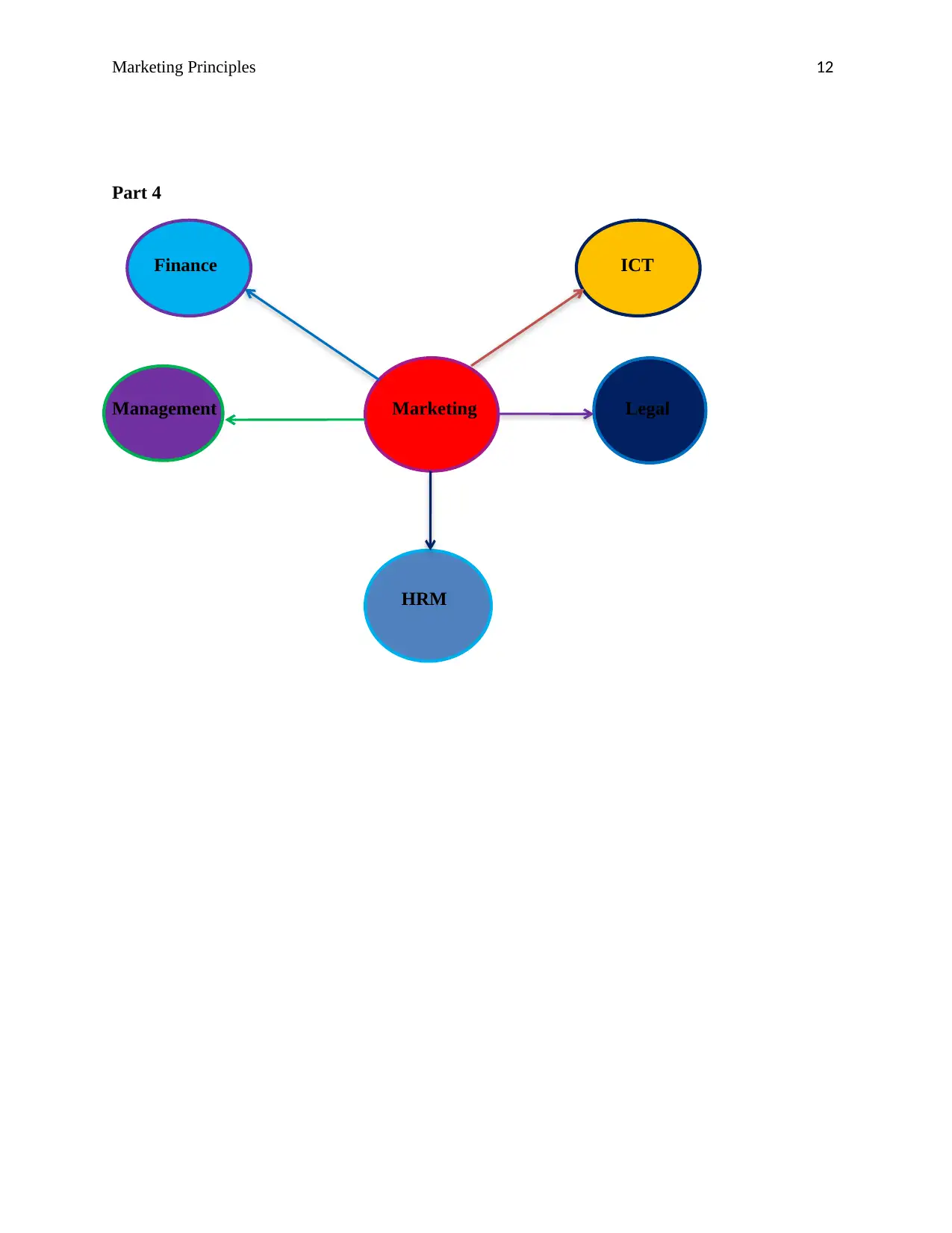
Part 4
Finance ICT
Management Marketing Legal
HRM
Part 4
Finance ICT
Management Marketing Legal
HRM
⊘ This is a preview!⊘
Do you want full access?
Subscribe today to unlock all pages.
Trusted by 1+ million students worldwide

1 out of 18


Related Documents


Your All-in-One AI-Powered Toolkit for Academic Success.
+13062052269
info@desklib.com
Available 24*7 on WhatsApp / Email
![[object Object]](/_next/static/media/star-bottom.7253800d.svg)
Unlock your academic potential
Copyright © 2020–2026 A2Z Services. All Rights Reserved. Developed and managed by ZUCOL.