Analysis of BP's Risk Management and Internal Control Processes
VerifiedAdded on 2022/12/26
|16
|4012
|37
Report
AI Summary
This report provides a comprehensive analysis of British Petroleum's (BP) organisational risk management and internal control processes. It examines BP's financial reporting, annual reports, and the application of internal controls, including the use of COBIT for IT governance. The report highlights the importance of internal controls in safeguarding assets, ensuring reliable financial data, and promoting operational efficiency. It analyzes BP's risk management process, including risk identification, assessment, and mitigation, and discusses the impact of the COVID-19 pandemic on the company's operations and internal controls. The report also includes a breakdown of BP's balance sheet and other financial data from its annual reports. The analysis covers the control environment, risk assessment, and information and communication systems within BP's internal control framework. The report emphasizes the importance of effective communication and the use of digital channels for sharing vital information and ensuring improved business performance. The report also presents diagrams of BP's internal control process and risk management process.
Organisational Risk
Management and
Internal Controls
Management and
Internal Controls

Paraphrase This Document
Need a fresh take? Get an instant paraphrase of this document with our AI Paraphraser
Table of Contents
INTRODUCTION...........................................................................................................................1
Main Body.......................................................................................................................................1
Analysis skills, contextualisation and critical analysis of current annual report of British
Petroleum Company plc:........................................................................................................1
Risk management and internal control processes...................................................................5
Evaluation of risk management theories and practice............................................................7
CONCLUSION................................................................................................................................9
REFERENCES..............................................................................................................................10
Appendix........................................................................................................................................11
1. The Internal Control Process diagram of British Petroleum company.............................11
2. Process of Risk Management diagram.............................................................................12
3. Mitigation of possible risk (Covid-19).............................................................................12
4. COBIT – (Control Objectives for Information and Related Technologies).....................12
INTRODUCTION...........................................................................................................................1
Main Body.......................................................................................................................................1
Analysis skills, contextualisation and critical analysis of current annual report of British
Petroleum Company plc:........................................................................................................1
Risk management and internal control processes...................................................................5
Evaluation of risk management theories and practice............................................................7
CONCLUSION................................................................................................................................9
REFERENCES..............................................................................................................................10
Appendix........................................................................................................................................11
1. The Internal Control Process diagram of British Petroleum company.............................11
2. Process of Risk Management diagram.............................................................................12
3. Mitigation of possible risk (Covid-19).............................................................................12
4. COBIT – (Control Objectives for Information and Related Technologies).....................12
INTRODUCTION
The organisational risk management and internal control is mainly associated with a set
of procedure which presents organisational structure and related activities to ensures adequate
business process and monitoring effective risk that needs to be managed for efficient operations
(Shah and Kant, 2021). Beside this, internal control and risk management also comprises of
application of effective managerial policies to reduce the risk which are affecting the global
business environment of a firm. The current report is based on 'The British Petroleum Company
plc’ which is a well-known British multinational oil and gas company having its headquarter in
London, England as is also among world’s supermajor seven oil company (Stepanyan, 2021).
The current report comprises of a discussion about current annual report of British Petroleum
Company presenting the information about its current commercial position and awareness.
Further, a Demonstration about the commercial awareness of risk management and internal
control processes is also made along with evaluation of effective risk management theories is
also made in current report.
Main Body
Internal controls can be analysed as a set of vital mechanism that are adopted within an
organisation to effectively coordinate adopted methods to ensure safeguard of its assets along
with checking accuracy and reliability of its accounting data in order to encourage operational
efficiency.
Analysis skills, contextualisation and critical analysis of current annual report of British
Petroleum Company plc:
The concept of organisational risk management can be defined as a discipline which is
employed by an organisation to effectively operate and mitigate risk at various level which
allows a company to enhance and maximize its value creation. This organisational risk
management is important and vital to analysis and identify the possible risk prevailing in current
business environment so that effective steps and strategies can be undertaken to mitigate that risk
in order to achieve set organisational gaol and maximization its value creation (Lu, Toms and
Wei, 2021).
Internal control- The internal control is mainly related with set accounting and auditing
measures which present an efficient process to safeguard the assets and resources of a firm
1
The organisational risk management and internal control is mainly associated with a set
of procedure which presents organisational structure and related activities to ensures adequate
business process and monitoring effective risk that needs to be managed for efficient operations
(Shah and Kant, 2021). Beside this, internal control and risk management also comprises of
application of effective managerial policies to reduce the risk which are affecting the global
business environment of a firm. The current report is based on 'The British Petroleum Company
plc’ which is a well-known British multinational oil and gas company having its headquarter in
London, England as is also among world’s supermajor seven oil company (Stepanyan, 2021).
The current report comprises of a discussion about current annual report of British Petroleum
Company presenting the information about its current commercial position and awareness.
Further, a Demonstration about the commercial awareness of risk management and internal
control processes is also made along with evaluation of effective risk management theories is
also made in current report.
Main Body
Internal controls can be analysed as a set of vital mechanism that are adopted within an
organisation to effectively coordinate adopted methods to ensure safeguard of its assets along
with checking accuracy and reliability of its accounting data in order to encourage operational
efficiency.
Analysis skills, contextualisation and critical analysis of current annual report of British
Petroleum Company plc:
The concept of organisational risk management can be defined as a discipline which is
employed by an organisation to effectively operate and mitigate risk at various level which
allows a company to enhance and maximize its value creation. This organisational risk
management is important and vital to analysis and identify the possible risk prevailing in current
business environment so that effective steps and strategies can be undertaken to mitigate that risk
in order to achieve set organisational gaol and maximization its value creation (Lu, Toms and
Wei, 2021).
Internal control- The internal control is mainly related with set accounting and auditing
measures which present an efficient process to safeguard the assets and resources of a firm
1
⊘ This is a preview!⊘
Do you want full access?
Subscribe today to unlock all pages.

Trusted by 1+ million students worldwide
through assuring operational effectiveness and efficiency. Further, internal control also
comprises of a process of encouraging meeting organisation objective through having a more
reliable and effective financial reporting which is an accordance with laws, regulations and
policies (Kovaitė and Stankevičienė, 2021). Thus, an analysis can be made out that internal
control is efficient and important for British Petroleum company as it helps and facilitates
reduction in the risk of asset loss along with ensuring a planned information which is complete
and accurate in form of reliable financial statement to a keep a check on financial business
position and performance.
Financial reporting- It refer and reflects to the standard practises of a firm associated with
giving the stakeholders the accurate depiction and actual position of finance of company which
includes its revenue, expenses along with presenting information about profit, capital and cash
flow of a company during one accounting year. Thus, financial reporting provides a deep insight
into the financial information of a company which aim at tracking, analysing and reporting the
actual business income and financial performance of a firm to ensure effective internal control
and mitigation of possible risk (Arinee, Idris and Rahim, 2021). Therefore, preparation of regular
financial reporting is important and vital for British petroleum company to ensure better check
and control offer efficiency of its business.
Annual reports- It basically presents the financial document of a company which is
published by most of the companies in order to summarise about transaction that take place
during an accounting year. The annual reports of a firm comprises of its balance sheet, income
statement along with the detailed cash flow statement which presents and discuss information
about company affairs along with notes to financial statements (Sadleir, 2021). Annual reports
are vital and important for British petroleum company as helps in achieving the desire level of
growth therefore clear presentation of business performance and possible risk so that precaution
measures and cations can be taken on time to mitigate and overcome that risk. Apart from this,
preparation of annual report also support more effective investment decisions based in analysis
of quantitative and qualitative information related with business performances thus, ensures and
lead out to more effective organisational magnet of risk and internal control for British petroleum
company. Following is the current annual report of British petroleum company presenting its
Balance sheet and all the required information about its assets and other resources (British
Petroleum company: Annual Report, (2021)).
2
comprises of a process of encouraging meeting organisation objective through having a more
reliable and effective financial reporting which is an accordance with laws, regulations and
policies (Kovaitė and Stankevičienė, 2021). Thus, an analysis can be made out that internal
control is efficient and important for British Petroleum company as it helps and facilitates
reduction in the risk of asset loss along with ensuring a planned information which is complete
and accurate in form of reliable financial statement to a keep a check on financial business
position and performance.
Financial reporting- It refer and reflects to the standard practises of a firm associated with
giving the stakeholders the accurate depiction and actual position of finance of company which
includes its revenue, expenses along with presenting information about profit, capital and cash
flow of a company during one accounting year. Thus, financial reporting provides a deep insight
into the financial information of a company which aim at tracking, analysing and reporting the
actual business income and financial performance of a firm to ensure effective internal control
and mitigation of possible risk (Arinee, Idris and Rahim, 2021). Therefore, preparation of regular
financial reporting is important and vital for British petroleum company to ensure better check
and control offer efficiency of its business.
Annual reports- It basically presents the financial document of a company which is
published by most of the companies in order to summarise about transaction that take place
during an accounting year. The annual reports of a firm comprises of its balance sheet, income
statement along with the detailed cash flow statement which presents and discuss information
about company affairs along with notes to financial statements (Sadleir, 2021). Annual reports
are vital and important for British petroleum company as helps in achieving the desire level of
growth therefore clear presentation of business performance and possible risk so that precaution
measures and cations can be taken on time to mitigate and overcome that risk. Apart from this,
preparation of annual report also support more effective investment decisions based in analysis
of quantitative and qualitative information related with business performances thus, ensures and
lead out to more effective organisational magnet of risk and internal control for British petroleum
company. Following is the current annual report of British petroleum company presenting its
Balance sheet and all the required information about its assets and other resources (British
Petroleum company: Annual Report, (2021)).
2
Paraphrase This Document
Need a fresh take? Get an instant paraphrase of this document with our AI Paraphraser
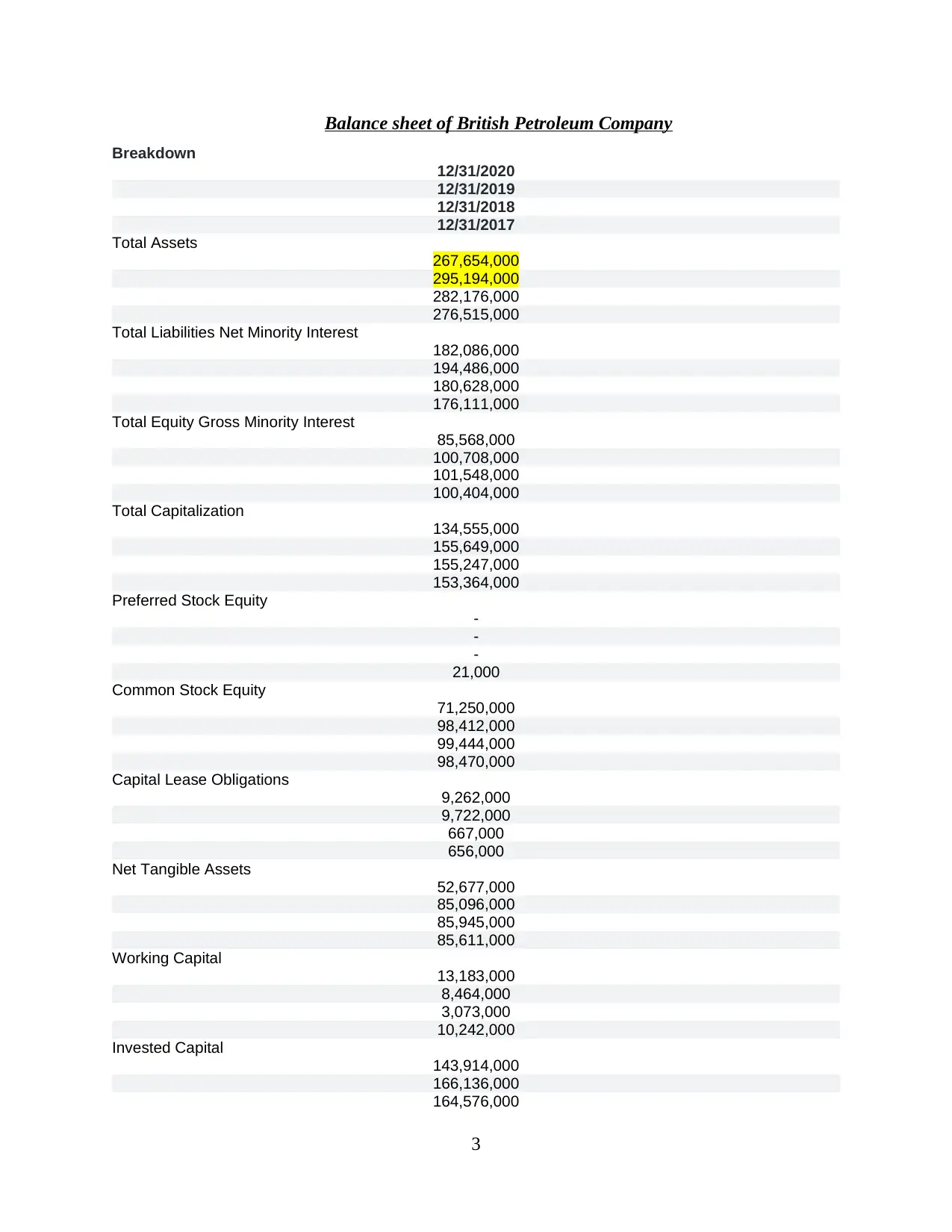
Balance sheet of British Petroleum Company
Breakdown
12/31/2020
12/31/2019
12/31/2018
12/31/2017
Total Assets
267,654,000
295,194,000
282,176,000
276,515,000
Total Liabilities Net Minority Interest
182,086,000
194,486,000
180,628,000
176,111,000
Total Equity Gross Minority Interest
85,568,000
100,708,000
101,548,000
100,404,000
Total Capitalization
134,555,000
155,649,000
155,247,000
153,364,000
Preferred Stock Equity
-
-
-
21,000
Common Stock Equity
71,250,000
98,412,000
99,444,000
98,470,000
Capital Lease Obligations
9,262,000
9,722,000
667,000
656,000
Net Tangible Assets
52,677,000
85,096,000
85,945,000
85,611,000
Working Capital
13,183,000
8,464,000
3,073,000
10,242,000
Invested Capital
143,914,000
166,136,000
164,576,000
3
Breakdown
12/31/2020
12/31/2019
12/31/2018
12/31/2017
Total Assets
267,654,000
295,194,000
282,176,000
276,515,000
Total Liabilities Net Minority Interest
182,086,000
194,486,000
180,628,000
176,111,000
Total Equity Gross Minority Interest
85,568,000
100,708,000
101,548,000
100,404,000
Total Capitalization
134,555,000
155,649,000
155,247,000
153,364,000
Preferred Stock Equity
-
-
-
21,000
Common Stock Equity
71,250,000
98,412,000
99,444,000
98,470,000
Capital Lease Obligations
9,262,000
9,722,000
667,000
656,000
Net Tangible Assets
52,677,000
85,096,000
85,945,000
85,611,000
Working Capital
13,183,000
8,464,000
3,073,000
10,242,000
Invested Capital
143,914,000
166,136,000
164,576,000
3
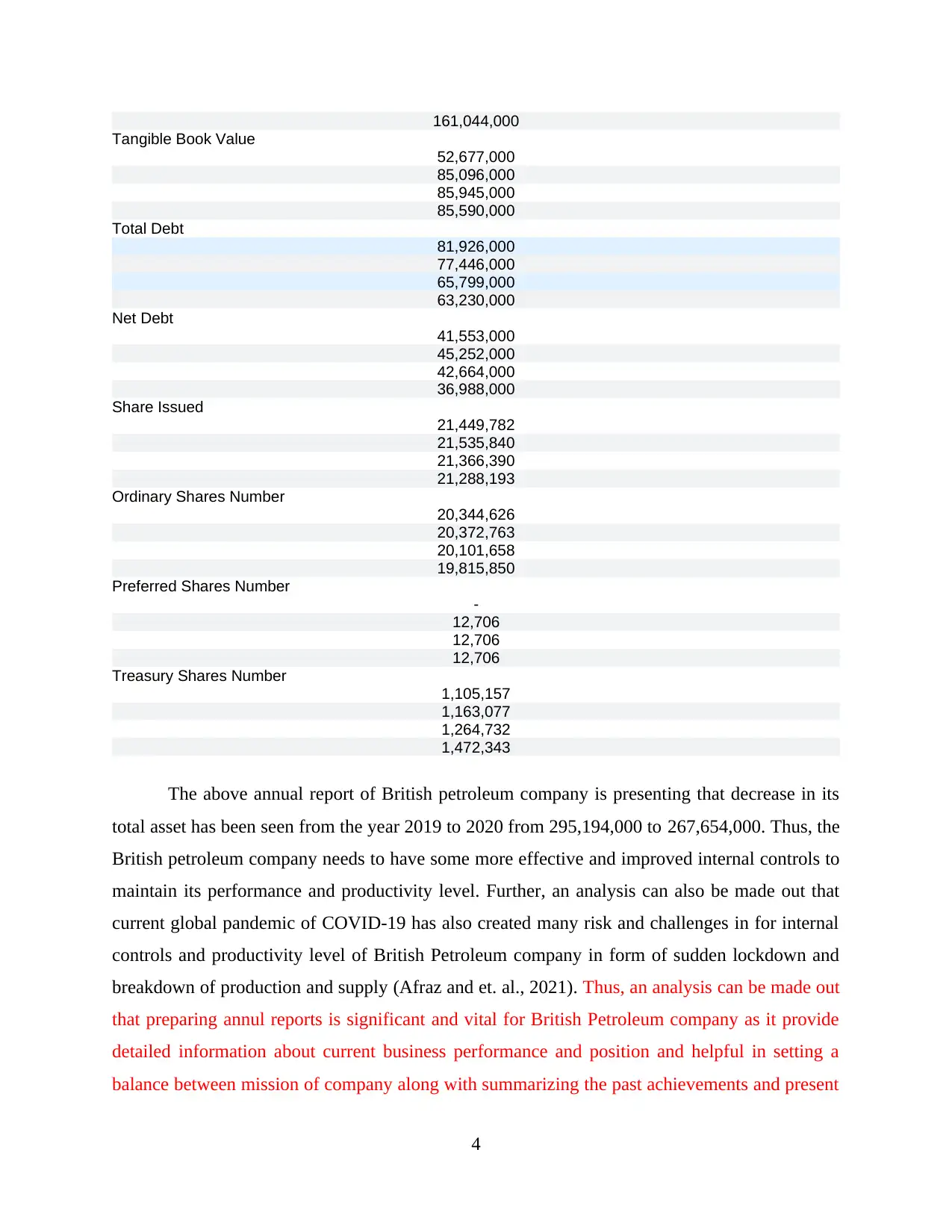
161,044,000
Tangible Book Value
52,677,000
85,096,000
85,945,000
85,590,000
Total Debt
81,926,000
77,446,000
65,799,000
63,230,000
Net Debt
41,553,000
45,252,000
42,664,000
36,988,000
Share Issued
21,449,782
21,535,840
21,366,390
21,288,193
Ordinary Shares Number
20,344,626
20,372,763
20,101,658
19,815,850
Preferred Shares Number
-
12,706
12,706
12,706
Treasury Shares Number
1,105,157
1,163,077
1,264,732
1,472,343
The above annual report of British petroleum company is presenting that decrease in its
total asset has been seen from the year 2019 to 2020 from 295,194,000 to 267,654,000. Thus, the
British petroleum company needs to have some more effective and improved internal controls to
maintain its performance and productivity level. Further, an analysis can also be made out that
current global pandemic of COVID-19 has also created many risk and challenges in for internal
controls and productivity level of British Petroleum company in form of sudden lockdown and
breakdown of production and supply (Afraz and et. al., 2021). Thus, an analysis can be made out
that preparing annul reports is significant and vital for British Petroleum company as it provide
detailed information about current business performance and position and helpful in setting a
balance between mission of company along with summarizing the past achievements and present
4
Tangible Book Value
52,677,000
85,096,000
85,945,000
85,590,000
Total Debt
81,926,000
77,446,000
65,799,000
63,230,000
Net Debt
41,553,000
45,252,000
42,664,000
36,988,000
Share Issued
21,449,782
21,535,840
21,366,390
21,288,193
Ordinary Shares Number
20,344,626
20,372,763
20,101,658
19,815,850
Preferred Shares Number
-
12,706
12,706
12,706
Treasury Shares Number
1,105,157
1,163,077
1,264,732
1,472,343
The above annual report of British petroleum company is presenting that decrease in its
total asset has been seen from the year 2019 to 2020 from 295,194,000 to 267,654,000. Thus, the
British petroleum company needs to have some more effective and improved internal controls to
maintain its performance and productivity level. Further, an analysis can also be made out that
current global pandemic of COVID-19 has also created many risk and challenges in for internal
controls and productivity level of British Petroleum company in form of sudden lockdown and
breakdown of production and supply (Afraz and et. al., 2021). Thus, an analysis can be made out
that preparing annul reports is significant and vital for British Petroleum company as it provide
detailed information about current business performance and position and helpful in setting a
balance between mission of company along with summarizing the past achievements and present
4
⊘ This is a preview!⊘
Do you want full access?
Subscribe today to unlock all pages.
Trusted by 1+ million students worldwide
position through effective comparisons. Beside this, annual reports are also vital to make
shareholders and stakeholders feel more safe and committed towards their investment and
participation in company.
It has been seen that British Petroleum company is making use of Control objectives for
information and related technologies (COBIT) to set and have effective IT business framework
which are designed specifically within this firm for IT management and governance. Thus, use of
COBIT is significant and important for British petroleum as it set out better control objectives
that helps its IT management along with ensuring improved governance professionals
management to have better IT operations. Beside this, COBIT also supports the best practices
and procedures that helps British Petroleum to achieve strategic objectives through an effective
use of available resources and minimization of the IT risks (please see appendix 4: COBIT).
Risk management and internal control processes
The risk management process of British petroleum company comprises of identifying,
assessing and controlling the all possible threats from creating adverse impact to organisational
capital and earnings. These risk which creates threats for British Petroleum company comprises
of financial uncertainty along with some legal liabilities and contingency. Apart from this,
strategic management errors and accidents along with global pandemic ad natural disasters also
create significant risk and threat form financial performance and business assets and resources of
British petroleum company. Implication of following internal control process is made British
petroleum company as risk management strategy to provide a structured and coherent approach
for identifying, assessing and effectively managing current business risk. The risk management
process that is being applied and used by British petroleum company to effectively analysis and
mitigate the identified risk are provided below in the appendix 2 as the Process of Risk
Management diagram of British Petroleum.
Internal control processes
Internal control process is a continuous and integrated process which is effective in
maintaining strategic internal control by the way of assuring operational efficiencies and
effectiveness through reliable financial reporting and compliance of legal laws (Li and et. al.,
2021). The implication of internal control process is made by British petroleum company for
effective working system which safeguard this company against risk of fraud and financial loss
through improving the overall financial reporting as well as leading improved monitoring of
5
shareholders and stakeholders feel more safe and committed towards their investment and
participation in company.
It has been seen that British Petroleum company is making use of Control objectives for
information and related technologies (COBIT) to set and have effective IT business framework
which are designed specifically within this firm for IT management and governance. Thus, use of
COBIT is significant and important for British petroleum as it set out better control objectives
that helps its IT management along with ensuring improved governance professionals
management to have better IT operations. Beside this, COBIT also supports the best practices
and procedures that helps British Petroleum to achieve strategic objectives through an effective
use of available resources and minimization of the IT risks (please see appendix 4: COBIT).
Risk management and internal control processes
The risk management process of British petroleum company comprises of identifying,
assessing and controlling the all possible threats from creating adverse impact to organisational
capital and earnings. These risk which creates threats for British Petroleum company comprises
of financial uncertainty along with some legal liabilities and contingency. Apart from this,
strategic management errors and accidents along with global pandemic ad natural disasters also
create significant risk and threat form financial performance and business assets and resources of
British petroleum company. Implication of following internal control process is made British
petroleum company as risk management strategy to provide a structured and coherent approach
for identifying, assessing and effectively managing current business risk. The risk management
process that is being applied and used by British petroleum company to effectively analysis and
mitigate the identified risk are provided below in the appendix 2 as the Process of Risk
Management diagram of British Petroleum.
Internal control processes
Internal control process is a continuous and integrated process which is effective in
maintaining strategic internal control by the way of assuring operational efficiencies and
effectiveness through reliable financial reporting and compliance of legal laws (Li and et. al.,
2021). The implication of internal control process is made by British petroleum company for
effective working system which safeguard this company against risk of fraud and financial loss
through improving the overall financial reporting as well as leading improved monitoring of
5
Paraphrase This Document
Need a fresh take? Get an instant paraphrase of this document with our AI Paraphraser
other business operations. The diagram which is reflecting about the internal control process of
the British Petroleum company is provided below under the appendix 1 as Internal Control
Process diagram of British Petroleum company. The main steps and stages of continuous
internal control process are discussed and analysed as below in context of British petroleum
company:
Control environment- It sets out the basis for British petroleum company for carrying out
an internal control across the whole organisation through set of standard process and structure.
Under this step the, board of directors and senior management of British petroleum company sets
to establish a tone and lead to communicate the importance of internal control through setting
standards of conduct on the basis of current conditions and situations prevailing in the business
environment. It has been analysed that during the times of Covid-19 certain important measures
are needed to be taken by British Petroleum company to mitigate the risk of coronavirus that are
provided and reflected below in the appendix 3 which would ensure a positive and safe working
environment for employees (Please see appendix 3). Thus, the tone and objective set out by
British Petroleum company is based on increasing its productivity and performance level through
enquiring more efficient accounting process and reliable financial performance to boost its
productivity and performance level which is setting a base for other components of internal
control (Jurevičienė, Skvarciany and Kravec, 2021).
Risk assessment- This stage of internal control process is related with identifying and
analysing the relevant risk that is currently prevailing in the business environment and creating
threats for achievement of set objectives. Thus, the stage of risk assessment comprises of
analysing about the current issues and threats which are prevailing in the business environment
that can lead barriers for efficient achievement and accomplishment of set objectives. It has been
analysed that the current global pandemic of COVID-19 is the biggest risk that is identified by
the managers of British petroleum company along with the risk of fraud and mismanaging of
accounting records (Kogg and Mont, 2012).
Information and communication system- This forms out to a be most vital part of
internal control process which is related with related with capturing and effectively exchanging
the information about the identified risk and steps that can be adopted to overcome and mitigate
that risk. Thus, information and communication forms out a vital part of internal control process
of British Petroleum company as it set out a process to identify, cater and share vital information
6
the British Petroleum company is provided below under the appendix 1 as Internal Control
Process diagram of British Petroleum company. The main steps and stages of continuous
internal control process are discussed and analysed as below in context of British petroleum
company:
Control environment- It sets out the basis for British petroleum company for carrying out
an internal control across the whole organisation through set of standard process and structure.
Under this step the, board of directors and senior management of British petroleum company sets
to establish a tone and lead to communicate the importance of internal control through setting
standards of conduct on the basis of current conditions and situations prevailing in the business
environment. It has been analysed that during the times of Covid-19 certain important measures
are needed to be taken by British Petroleum company to mitigate the risk of coronavirus that are
provided and reflected below in the appendix 3 which would ensure a positive and safe working
environment for employees (Please see appendix 3). Thus, the tone and objective set out by
British Petroleum company is based on increasing its productivity and performance level through
enquiring more efficient accounting process and reliable financial performance to boost its
productivity and performance level which is setting a base for other components of internal
control (Jurevičienė, Skvarciany and Kravec, 2021).
Risk assessment- This stage of internal control process is related with identifying and
analysing the relevant risk that is currently prevailing in the business environment and creating
threats for achievement of set objectives. Thus, the stage of risk assessment comprises of
analysing about the current issues and threats which are prevailing in the business environment
that can lead barriers for efficient achievement and accomplishment of set objectives. It has been
analysed that the current global pandemic of COVID-19 is the biggest risk that is identified by
the managers of British petroleum company along with the risk of fraud and mismanaging of
accounting records (Kogg and Mont, 2012).
Information and communication system- This forms out to a be most vital part of
internal control process which is related with related with capturing and effectively exchanging
the information about the identified risk and steps that can be adopted to overcome and mitigate
that risk. Thus, information and communication forms out a vital part of internal control process
of British Petroleum company as it set out a process to identify, cater and share vital information
6
in an effective form and prescribed time frame which enables its employees and people to
effectively understand and carry out their role and responsibility. Thus, it become vital and
important for the British petroleum company to have efficient communication channel which
should be comprises of use of online and digital channels like social media and official mail to
share the vital and all needed information about the making of reliable financial records to ensure
improved business performance (Heggen and Sridharan, 2021). Apart from this, efforts are also
made by managers of British petroleum company to make its employees aware about the
consequences and precaution related with risk of COVID-19 to ensure improved awareness in its
workforce to effectively mitigate and reduce the risk of spread of this virus.
Control activities- This stage of internal control process provides information about the
policies and procedure that could be adopted by a company to ensure better management of risk
along with having a directive control to overcome adverse situation in order to effectively set
objectives. In context of British Petroleum company having proper social distancing norms and
mitigating the set provisions like wearing a mask at workplace and implementing other
government rules is an effective control activity to mitigate and overcome the risk of COVID-19.
Further, providing regular accounting training and development session for reliable preparation
of financial reports is an effective action that can be taken by British Petroleum company to
overcome the that of mismanagement of accounting records and also reduce the chances of
accounting frauds (Proag, 2021).
Monitoring process- This section and step of internal control process mainly comprises of
assess and evaluation of quality of internal control performance of a company over a specific
period of time. Thus, monitoring step plays a crucial role in keeping a check on success of
control activities to ensure that they are effective in meeting the set objectives and reducing the
risk through there effective management (Shah and Kant, 2021). With respect to British
Petroleum company use of KPI (key performance indicator) is made to ensure effective control
and monitoring on set control policies and actions. Use of KPI provides an effective way to
compare the actual performance level with the budgeted or desired performance in order to have
better understanding about the lack in performance and present loopholes so that timely efforts
can be made out for their correction which ensures an improved financial performance and better
business position for British Petroleum company.
7
effectively understand and carry out their role and responsibility. Thus, it become vital and
important for the British petroleum company to have efficient communication channel which
should be comprises of use of online and digital channels like social media and official mail to
share the vital and all needed information about the making of reliable financial records to ensure
improved business performance (Heggen and Sridharan, 2021). Apart from this, efforts are also
made by managers of British petroleum company to make its employees aware about the
consequences and precaution related with risk of COVID-19 to ensure improved awareness in its
workforce to effectively mitigate and reduce the risk of spread of this virus.
Control activities- This stage of internal control process provides information about the
policies and procedure that could be adopted by a company to ensure better management of risk
along with having a directive control to overcome adverse situation in order to effectively set
objectives. In context of British Petroleum company having proper social distancing norms and
mitigating the set provisions like wearing a mask at workplace and implementing other
government rules is an effective control activity to mitigate and overcome the risk of COVID-19.
Further, providing regular accounting training and development session for reliable preparation
of financial reports is an effective action that can be taken by British Petroleum company to
overcome the that of mismanagement of accounting records and also reduce the chances of
accounting frauds (Proag, 2021).
Monitoring process- This section and step of internal control process mainly comprises of
assess and evaluation of quality of internal control performance of a company over a specific
period of time. Thus, monitoring step plays a crucial role in keeping a check on success of
control activities to ensure that they are effective in meeting the set objectives and reducing the
risk through there effective management (Shah and Kant, 2021). With respect to British
Petroleum company use of KPI (key performance indicator) is made to ensure effective control
and monitoring on set control policies and actions. Use of KPI provides an effective way to
compare the actual performance level with the budgeted or desired performance in order to have
better understanding about the lack in performance and present loopholes so that timely efforts
can be made out for their correction which ensures an improved financial performance and better
business position for British Petroleum company.
7
⊘ This is a preview!⊘
Do you want full access?
Subscribe today to unlock all pages.
Trusted by 1+ million students worldwide
Evaluation of risk management theories and practice
The main risk management theories which are applied and used by British petroleum
company for overcoming the risk of accounting mismanagement and COVID-19 are evaluated
and discussed as below:
Financial theory- The implication of financial theory is made by British petroleum
company to ensure proper value of its equity share that is basically determined by its
fundamental value and needs to be reflected as documented value to yield better future dividends
(Choosing project risk management techniques. A theoretical framework (2014)). Thus, this
finance theory is vital to ensure proper value of equity and dividend for shareholders to mitigate
the possible environmental risk at the time of adverse situation. Apart from this, the finance
theory is helpful for British petroleum company to lower volatility of cash flow and therefore
lower volatility of firm value (Stepanyan, 2021). Therefore, it seemed more rationale for British
petroleum company to mitigate and reduce corporate risk by maintaining higher debt capacity
during irrelevant conditions.
Agency theory- Utilisation of this risk management theory is made by British Petroleum
company to explain and effectively resolve the issues related with relationship among the
business principles and their agents which plays a crucial role in mitigating adverse situation.
Implication of agency theory is appropriate for British petroleum company to maintain positive
relationship with its agent and suppliers to ensure better and proper flow of its business
operations even during the time of this global pandemic of Coronavirus (Lu, Toms and Wei,
2021).
Stakeholders theory- It is also a vital risk management theory that leads emphasis of a
business towards it most important and crucial shareholders, customers, suppliers and other
associated parties. Thus, utilisation of stakeholder’s theory leads to better decision making and
strategy formulation by British Petroleum company which is beneficial and suitable for all its
stakeholders and also support better accomplishment of set organisational objectives. An analysis
can be made out that stakeholder’s theory is important for British Petroleum company as it helps
in keeping stakeholder’s happy even during the time of adverse situation and argues that
company is playing a very fabric and positive role to support the society which improves its
business performance through creating a positive image in target market (Kovaitė and
Stankevičienė, 2021).
8
The main risk management theories which are applied and used by British petroleum
company for overcoming the risk of accounting mismanagement and COVID-19 are evaluated
and discussed as below:
Financial theory- The implication of financial theory is made by British petroleum
company to ensure proper value of its equity share that is basically determined by its
fundamental value and needs to be reflected as documented value to yield better future dividends
(Choosing project risk management techniques. A theoretical framework (2014)). Thus, this
finance theory is vital to ensure proper value of equity and dividend for shareholders to mitigate
the possible environmental risk at the time of adverse situation. Apart from this, the finance
theory is helpful for British petroleum company to lower volatility of cash flow and therefore
lower volatility of firm value (Stepanyan, 2021). Therefore, it seemed more rationale for British
petroleum company to mitigate and reduce corporate risk by maintaining higher debt capacity
during irrelevant conditions.
Agency theory- Utilisation of this risk management theory is made by British Petroleum
company to explain and effectively resolve the issues related with relationship among the
business principles and their agents which plays a crucial role in mitigating adverse situation.
Implication of agency theory is appropriate for British petroleum company to maintain positive
relationship with its agent and suppliers to ensure better and proper flow of its business
operations even during the time of this global pandemic of Coronavirus (Lu, Toms and Wei,
2021).
Stakeholders theory- It is also a vital risk management theory that leads emphasis of a
business towards it most important and crucial shareholders, customers, suppliers and other
associated parties. Thus, utilisation of stakeholder’s theory leads to better decision making and
strategy formulation by British Petroleum company which is beneficial and suitable for all its
stakeholders and also support better accomplishment of set organisational objectives. An analysis
can be made out that stakeholder’s theory is important for British Petroleum company as it helps
in keeping stakeholder’s happy even during the time of adverse situation and argues that
company is playing a very fabric and positive role to support the society which improves its
business performance through creating a positive image in target market (Kovaitė and
Stankevičienė, 2021).
8
Paraphrase This Document
Need a fresh take? Get an instant paraphrase of this document with our AI Paraphraser
Thus, on the basis of above discussion about the various risk management theories that
having an effecting financial theory ensures higher equity even at the time of adverse situation to
mitigate financial risk. Further, agent theory and stakeholder’s theory plays a vital role in
creating positive business image and efficient relationship to ensures improved support from
stakeholders in order to overcome and mitigate the sudden risk and threats. Further, an analysis
can be made that involving stakeholders is a vital risk management practises that is adopted by
British Petroleum Company to ensures initial risk assessment and effective ways to mitigate that
(Arinee, Idris and Rahim, 2021). Further, leading out a clear and effective communication is also
a vital risk management strategy and practises that is applied by British Petroleum company to
mitigate possible threats by the way of effective sharing of knowledge and information along
with leading an improved collaboration and coordination at workplace to overcome a threat and
risk in more effective manner.
CONCLUSION
On the basis of above report, a conclusion can be made out that concept of risk management
is related with effectively operating and mitigating the risk at various level of business operation
through having an efficient internal control. Beside this, it has been also observed that internal
control provides an effective set of accounting practices to safeguard the assets and other vital
resources of a firm to maintain reliable financial position and business performance through
mitigating possible risk. Further, a conclusion can also be made that balance sheet, income
statement and profit loss statement forms out a vital part of annul report of a company. At last, a
summarisation can be made that internal control process and risk management theories like
finance theory, agent theory and stakeholders theory plays a vital role in mitigating
organisational risk.
9
having an effecting financial theory ensures higher equity even at the time of adverse situation to
mitigate financial risk. Further, agent theory and stakeholder’s theory plays a vital role in
creating positive business image and efficient relationship to ensures improved support from
stakeholders in order to overcome and mitigate the sudden risk and threats. Further, an analysis
can be made that involving stakeholders is a vital risk management practises that is adopted by
British Petroleum Company to ensures initial risk assessment and effective ways to mitigate that
(Arinee, Idris and Rahim, 2021). Further, leading out a clear and effective communication is also
a vital risk management strategy and practises that is applied by British Petroleum company to
mitigate possible threats by the way of effective sharing of knowledge and information along
with leading an improved collaboration and coordination at workplace to overcome a threat and
risk in more effective manner.
CONCLUSION
On the basis of above report, a conclusion can be made out that concept of risk management
is related with effectively operating and mitigating the risk at various level of business operation
through having an efficient internal control. Beside this, it has been also observed that internal
control provides an effective set of accounting practices to safeguard the assets and other vital
resources of a firm to maintain reliable financial position and business performance through
mitigating possible risk. Further, a conclusion can also be made that balance sheet, income
statement and profit loss statement forms out a vital part of annul report of a company. At last, a
summarisation can be made that internal control process and risk management theories like
finance theory, agent theory and stakeholders theory plays a vital role in mitigating
organisational risk.
9
REFERENCES
Books and journal
Afraz, M.F., Bhatti, S.H., Ferraris, A. and Couturier, J., 2021. The impact of supply chain
innovation on competitive advantage in the construction industry: Evidence from a
moderated multi-mediation model. Technological Forecasting and Social Change, 162,
p.120370.
Arinee, M.S.N., Idris, O. and Rahim, I.B.A., 2021. Human Factor Engineering in Oil and Gas
Construction Works–A Case Study to Mitigate Safety Risk. In Proceedings of the
International Conference on Civil, Offshore and Environmental Engineering (pp. 590-
601). Springer, Singapore.
Kogg, B. and Mont, O., 2012. Environmental and social responsibility in supply chains: The
practise of choice and inter-organisational management. Ecological Economics, 83,
pp.154-163.
Heggen, C. and Sridharan, V.G., 2021. The effects of an enabling approach to eco-control on
firms’ environmental performance: A research note. Management Accounting
Research, 50, p.100724.
Jurevičienė, D., Skvarciany, V. and Kravec, K., 2021. Assessment of reputational risk impact on
commercial banks financial performance. International Journal of Economics and
Business Research, 21(1), pp.62-86.
Kovaitė, K. and Stankevičienė, J., 2021. Risk assessment of business models driven by Industry
4.0. International Journal of Economics and Business Research, 21(1), pp.1-21.
Li, M., Yan, F., Niu, R. and Xiang, N., 2021. Identification of causal scenarios and application of
leading indicators in the interconnection mode of urban rail transit based on
STPA. Journal of Rail Transport Planning & Management, 17, p.100238.
Lu, Q., Toms, S. and Wei, Y., 2021. From light touch to top management control: HSBC’s
integration of its first two acquired subsidiaries 1960-1980. Business History, pp.1-23.
Proag, V., 2021. Human Resources Management for Infrastructure. In Infrastructure Planning
and Management: An Integrated Approach (pp. 563-593). Springer, Cham.
Sadleir, R., 2021. Designing a Human Rights Management Systems Standard: A Practical
Approach to Business Enterprise Human Rights in Asia. In Business and Human Rights
in Asia (pp. 239-256). Palgrave Macmillan, Singapore.
Shah, H.G. and Kant, R., 2021. Influence of knowledge management enablers in manufacturing
organisations: a multi-criteria decision making in Indian context. International Journal of
Business Information Systems, 36(1), pp.21-49.
Stepanyan, M., 2021. Common Security Culture: Myth or Reality? Security Co-creation from the
Risk Management Perspective: An Essay Based on Observation, Critical Thinking and a
Strong Belief in a Better Future. In International Security Management (pp. 123-136).
Springer, Cham.
Online:
British Petroleum company: Annual Report, (2021). [Online] Available Through:<
https://www.bp.com/content/dam/bp/business-sites/en/global/corporate/pdfs/investors/bp-
annual-report-and-form-20f-2019.pdf>.
10
Books and journal
Afraz, M.F., Bhatti, S.H., Ferraris, A. and Couturier, J., 2021. The impact of supply chain
innovation on competitive advantage in the construction industry: Evidence from a
moderated multi-mediation model. Technological Forecasting and Social Change, 162,
p.120370.
Arinee, M.S.N., Idris, O. and Rahim, I.B.A., 2021. Human Factor Engineering in Oil and Gas
Construction Works–A Case Study to Mitigate Safety Risk. In Proceedings of the
International Conference on Civil, Offshore and Environmental Engineering (pp. 590-
601). Springer, Singapore.
Kogg, B. and Mont, O., 2012. Environmental and social responsibility in supply chains: The
practise of choice and inter-organisational management. Ecological Economics, 83,
pp.154-163.
Heggen, C. and Sridharan, V.G., 2021. The effects of an enabling approach to eco-control on
firms’ environmental performance: A research note. Management Accounting
Research, 50, p.100724.
Jurevičienė, D., Skvarciany, V. and Kravec, K., 2021. Assessment of reputational risk impact on
commercial banks financial performance. International Journal of Economics and
Business Research, 21(1), pp.62-86.
Kovaitė, K. and Stankevičienė, J., 2021. Risk assessment of business models driven by Industry
4.0. International Journal of Economics and Business Research, 21(1), pp.1-21.
Li, M., Yan, F., Niu, R. and Xiang, N., 2021. Identification of causal scenarios and application of
leading indicators in the interconnection mode of urban rail transit based on
STPA. Journal of Rail Transport Planning & Management, 17, p.100238.
Lu, Q., Toms, S. and Wei, Y., 2021. From light touch to top management control: HSBC’s
integration of its first two acquired subsidiaries 1960-1980. Business History, pp.1-23.
Proag, V., 2021. Human Resources Management for Infrastructure. In Infrastructure Planning
and Management: An Integrated Approach (pp. 563-593). Springer, Cham.
Sadleir, R., 2021. Designing a Human Rights Management Systems Standard: A Practical
Approach to Business Enterprise Human Rights in Asia. In Business and Human Rights
in Asia (pp. 239-256). Palgrave Macmillan, Singapore.
Shah, H.G. and Kant, R., 2021. Influence of knowledge management enablers in manufacturing
organisations: a multi-criteria decision making in Indian context. International Journal of
Business Information Systems, 36(1), pp.21-49.
Stepanyan, M., 2021. Common Security Culture: Myth or Reality? Security Co-creation from the
Risk Management Perspective: An Essay Based on Observation, Critical Thinking and a
Strong Belief in a Better Future. In International Security Management (pp. 123-136).
Springer, Cham.
Online:
British Petroleum company: Annual Report, (2021). [Online] Available Through:<
https://www.bp.com/content/dam/bp/business-sites/en/global/corporate/pdfs/investors/bp-
annual-report-and-form-20f-2019.pdf>.
10
⊘ This is a preview!⊘
Do you want full access?
Subscribe today to unlock all pages.
Trusted by 1+ million students worldwide

1 out of 16


Related Documents


Your All-in-One AI-Powered Toolkit for Academic Success.
+13062052269
info@desklib.com
Available 24*7 on WhatsApp / Email
![[object Object]](/_next/static/media/star-bottom.7253800d.svg)
Unlock your academic potential
Copyright © 2020–2026 A2Z Services. All Rights Reserved. Developed and managed by ZUCOL.