Strategic Report: Analyzing Britoil's Decommissioning in the North Sea
VerifiedAdded on 2023/06/10
|11
|2248
|139
Report
AI Summary
This report critically evaluates the decommissioning opportunities in the North Sea for Britoil, a Scottish oil and gas company. It analyzes the potential of 20 billion barrels of oil reserves, considering the extraction timeline of over 20 years. The report employs PESTLE and Porter's Five Forces analyses to assess the political, economic, social, technological, environmental, and legal factors, along with competitive dynamics. A SWOT analysis identifies strengths like government support and strong infrastructure, weaknesses such as lack of planning, opportunities in standardized approaches, and threats from competition. The conclusion emphasizes the need for a systematic decommissioning plan to achieve a competitive advantage through innovative supply chain processes, despite market competition.
Running head: STRATEGIC DECISION MAKING
Strategic Decision Making
Name of the student
Name of the university
Author note
Strategic Decision Making
Name of the student
Name of the university
Author note

Paraphrase This Document
Need a fresh take? Get an instant paraphrase of this document with our AI Paraphraser
1STRATEGIC DECISION MAKING
Executive Summary
This report has been based on decommissioning opportunities in the North Sea for the
company named Britoil which has been one of oil and gas companies in Scotland, having
their headquarters in Glasgow. The report had performed a critical evaluation of the
decommissioning opportunities into the North Sea for Britoil. The North Sea consists of 20
billion barrels of oil reserves which are yet to be recovered and extraction of such oil and
natural gas will take more than 20 years. The findings of the report highlighted relevant facts
regarding the opportunities, threats, weaknesses and strengths. The conclusion that had been
drawn from the study is that Britoil would have to have more systematic and integrated in
planning the decommissioning process. Even though the organization would be facing
immense competition from the rival companies, Britoil could gain competitive advantage
through their innovative and superior supply chain processes.
Executive Summary
This report has been based on decommissioning opportunities in the North Sea for the
company named Britoil which has been one of oil and gas companies in Scotland, having
their headquarters in Glasgow. The report had performed a critical evaluation of the
decommissioning opportunities into the North Sea for Britoil. The North Sea consists of 20
billion barrels of oil reserves which are yet to be recovered and extraction of such oil and
natural gas will take more than 20 years. The findings of the report highlighted relevant facts
regarding the opportunities, threats, weaknesses and strengths. The conclusion that had been
drawn from the study is that Britoil would have to have more systematic and integrated in
planning the decommissioning process. Even though the organization would be facing
immense competition from the rival companies, Britoil could gain competitive advantage
through their innovative and superior supply chain processes.
2STRATEGIC DECISION MAKING
Table of Contents
Introduction................................................................................................................................3
PESTLE analysis........................................................................................................................3
Porter’s five forces.....................................................................................................................5
SWOT analysis...........................................................................................................................7
Conclusion..................................................................................................................................8
References..................................................................................................................................9
Table of Contents
Introduction................................................................................................................................3
PESTLE analysis........................................................................................................................3
Porter’s five forces.....................................................................................................................5
SWOT analysis...........................................................................................................................7
Conclusion..................................................................................................................................8
References..................................................................................................................................9
⊘ This is a preview!⊘
Do you want full access?
Subscribe today to unlock all pages.

Trusted by 1+ million students worldwide
3STRATEGIC DECISION MAKING
Introduction
This report is based on decommissioning opportunities in the North Sea for the
company named Britoil which is one of oil and gas companies in Scotland, having their
headquarters in Glasgow. The report will perform a critical evaluation of the
decommissioning opportunities into the North Sea for Britoil. The North Sea consists of 20
billion barrels of oil reserves which are yet to be recovered and extraction of such oil and
natural gas will take more than 20 years (Paul Wheelhouse 2018). Decommission is a major
opportunity for the companies in the energy industry where improvements in the supply chain
has to be made. There are various companies that are already capitalizing on the
decommissioning opportunities in the North Sea. The majority of the assets in the North Sea
has reached their field lives and decommissioning is highly required for tapping into the huge
reserves of oil still embedded into the North Sea.
PESTLE analysis
The PESTLE analysis is a macro environment analysis tool which will analyse the
political, economic, social, technological, environmental and legal environment.
Political
The Scottish government has been proactive is supporting the different organizations
in the oil and natural gas industry. They have been assisting in developing expertise and skills
which is the reason that they have acquired majority of the contracts for decommissioning
activities. The government has been also providing funds for new decommissioning activities
so that Scotland becomes the hub of decommissioning (Paul Wheelhouse 2018). The
decommissioning has attracted all the major companies to invest in decommissioning.
Politically the country is still stable but BREXIT may lead to instability. Therefore, Britoil
Introduction
This report is based on decommissioning opportunities in the North Sea for the
company named Britoil which is one of oil and gas companies in Scotland, having their
headquarters in Glasgow. The report will perform a critical evaluation of the
decommissioning opportunities into the North Sea for Britoil. The North Sea consists of 20
billion barrels of oil reserves which are yet to be recovered and extraction of such oil and
natural gas will take more than 20 years (Paul Wheelhouse 2018). Decommission is a major
opportunity for the companies in the energy industry where improvements in the supply chain
has to be made. There are various companies that are already capitalizing on the
decommissioning opportunities in the North Sea. The majority of the assets in the North Sea
has reached their field lives and decommissioning is highly required for tapping into the huge
reserves of oil still embedded into the North Sea.
PESTLE analysis
The PESTLE analysis is a macro environment analysis tool which will analyse the
political, economic, social, technological, environmental and legal environment.
Political
The Scottish government has been proactive is supporting the different organizations
in the oil and natural gas industry. They have been assisting in developing expertise and skills
which is the reason that they have acquired majority of the contracts for decommissioning
activities. The government has been also providing funds for new decommissioning activities
so that Scotland becomes the hub of decommissioning (Paul Wheelhouse 2018). The
decommissioning has attracted all the major companies to invest in decommissioning.
Politically the country is still stable but BREXIT may lead to instability. Therefore, Britoil
Paraphrase This Document
Need a fresh take? Get an instant paraphrase of this document with our AI Paraphraser
4STRATEGIC DECISION MAKING
has the opportunity of capitalizing on new opportunities in the market due to the
enhancement in support from the government.
Economic
The BREXIT vote has affected the economy as there has been depreciation of the
currency and inflationary pressure has increased significantly due to the increase in the cost
of raw materials, energy, transport and packaging. However, the government have been
proactive in taking measures to support the companies so that they can maintain their
sustainability in the market and boost the overall economy (Keating 2017). However,
currently the economy is stable till the BREXIT actually happens and the companies in the
oil and natural gas industry should focus on decommissioning opportunities provided by the
government in order to keep up with the rival companies in the market. The oil and natural
gas industry is one of the largest contributor to GDP and jobs to the population of which most
are well paid. This is an effective method of dealing with the impact of BREXIT.
Social
The majority of the population in the country age above the age group of 40 and after
the announcement of BREXIT the annual disposable income of the population have
decreased significantly (Walsh et al. 2017). However. A large portion of the population still
enjoy high disposable income and decommissioning of the infrastructure will result in the
catering to a huge market segment that require energy resources on a daily basis.
Technological
Scotland has already been technologically superior and the decommissioning projects
and opportunities have started new innovative and technologically advanced projects to
extract oil in the North Sea. The government has encouraged new innovative and feasible
projects so that the companies in the United Kingdom can compare with the global industry
has the opportunity of capitalizing on new opportunities in the market due to the
enhancement in support from the government.
Economic
The BREXIT vote has affected the economy as there has been depreciation of the
currency and inflationary pressure has increased significantly due to the increase in the cost
of raw materials, energy, transport and packaging. However, the government have been
proactive in taking measures to support the companies so that they can maintain their
sustainability in the market and boost the overall economy (Keating 2017). However,
currently the economy is stable till the BREXIT actually happens and the companies in the
oil and natural gas industry should focus on decommissioning opportunities provided by the
government in order to keep up with the rival companies in the market. The oil and natural
gas industry is one of the largest contributor to GDP and jobs to the population of which most
are well paid. This is an effective method of dealing with the impact of BREXIT.
Social
The majority of the population in the country age above the age group of 40 and after
the announcement of BREXIT the annual disposable income of the population have
decreased significantly (Walsh et al. 2017). However. A large portion of the population still
enjoy high disposable income and decommissioning of the infrastructure will result in the
catering to a huge market segment that require energy resources on a daily basis.
Technological
Scotland has already been technologically superior and the decommissioning projects
and opportunities have started new innovative and technologically advanced projects to
extract oil in the North Sea. The government has encouraged new innovative and feasible
projects so that the companies in the United Kingdom can compare with the global industry
5STRATEGIC DECISION MAKING
giants. This is the reason that they are funding and encouraging companies to set up
innovative projects such as the establishing a floating infrastructure made of dry rock solution
and developing a permanent crane at the quayside into the North Sea (Paul Wheelhouse
2018).
Legal
The man purpose of the government is enhancing the recovery of the resources in a
cost effective way. The government has updated the different regulations and licensing after
the year of 2014 which consist of regulations including processes such as licensing of oil and
gas, exploration of oil and gas, production of oil and gas and carbon storage licensing (Billing
et al. 2017). The government had developed regulations to facilitate the growth of the
industry after the fall in the prices of the oil and gas products. Moreover, as BREXIT will
result in increase in overall cost of production, export and import, the government has taken
precautionary measures.
Environmental
The government has been strict about the environmental laws in the country and
United Kingdom has additional laws in respect to carbon emission and industry benchmarks
for oil extraction and production (Cotton 2017). The effect of oil and natural gas extraction
has a major impact due to the high risk of accidents and hazardous events which may occur
due to negligence and lack of safety measures.
Porter’s five forces
Porter’s five forces is used to analyse the micro environment of any organization
which consists of factors such as bargaining power of the buyer, bargaining power of the
supplier, threat of substitution, competitive rivalry and threat of new entry.
giants. This is the reason that they are funding and encouraging companies to set up
innovative projects such as the establishing a floating infrastructure made of dry rock solution
and developing a permanent crane at the quayside into the North Sea (Paul Wheelhouse
2018).
Legal
The man purpose of the government is enhancing the recovery of the resources in a
cost effective way. The government has updated the different regulations and licensing after
the year of 2014 which consist of regulations including processes such as licensing of oil and
gas, exploration of oil and gas, production of oil and gas and carbon storage licensing (Billing
et al. 2017). The government had developed regulations to facilitate the growth of the
industry after the fall in the prices of the oil and gas products. Moreover, as BREXIT will
result in increase in overall cost of production, export and import, the government has taken
precautionary measures.
Environmental
The government has been strict about the environmental laws in the country and
United Kingdom has additional laws in respect to carbon emission and industry benchmarks
for oil extraction and production (Cotton 2017). The effect of oil and natural gas extraction
has a major impact due to the high risk of accidents and hazardous events which may occur
due to negligence and lack of safety measures.
Porter’s five forces
Porter’s five forces is used to analyse the micro environment of any organization
which consists of factors such as bargaining power of the buyer, bargaining power of the
supplier, threat of substitution, competitive rivalry and threat of new entry.
⊘ This is a preview!⊘
Do you want full access?
Subscribe today to unlock all pages.
Trusted by 1+ million students worldwide
6STRATEGIC DECISION MAKING
Competitive rivalry
The competitive rivalry in the industry is very intense especially in the upward stream
consisting of industry giants, private organizations and shale companies. Moreover, with the
vote of BREXIT the majority of the organization are facing challenges due to the increase in
cost and they are relatively unable to compete with the industry giants due to the increase in
the export and import costs (Dean 2018). Therefore, competitive rivalry is high in the
industry and Britoil can compete with their rivals by decommissioning strategy.
Threat of New entrant
The threat of new entrant in the market is low due to the huge investments that are
required in the industry. The national oil companies have the control over the majority of the
reserves and use of innovative research and development strategy has made it almost
impossible for the new entrants to survive in the market (Robinson and Morgan 2016).
Threat of Substitution
The threat of substitution in the industry is still low even though are large number of
substitutes available in the industry. The alternative sources to oil and gas are nuclear
energy, hydrogen, coal, biofuels and renewable sources of energy (Dean 2018). Even though
these sources of energy can replace a considerable amount of oil and natural gas products but
it requires considerable amount of research and development to produce energy in bulk to
meet the rising demand of energy sources.
Bargaining power of the buyers
The major buyers of natural gas and oil are distribution companies, international oil
and gas companies, traders, refineries, national oil companies and different countries. The
Competitive rivalry
The competitive rivalry in the industry is very intense especially in the upward stream
consisting of industry giants, private organizations and shale companies. Moreover, with the
vote of BREXIT the majority of the organization are facing challenges due to the increase in
cost and they are relatively unable to compete with the industry giants due to the increase in
the export and import costs (Dean 2018). Therefore, competitive rivalry is high in the
industry and Britoil can compete with their rivals by decommissioning strategy.
Threat of New entrant
The threat of new entrant in the market is low due to the huge investments that are
required in the industry. The national oil companies have the control over the majority of the
reserves and use of innovative research and development strategy has made it almost
impossible for the new entrants to survive in the market (Robinson and Morgan 2016).
Threat of Substitution
The threat of substitution in the industry is still low even though are large number of
substitutes available in the industry. The alternative sources to oil and gas are nuclear
energy, hydrogen, coal, biofuels and renewable sources of energy (Dean 2018). Even though
these sources of energy can replace a considerable amount of oil and natural gas products but
it requires considerable amount of research and development to produce energy in bulk to
meet the rising demand of energy sources.
Bargaining power of the buyers
The major buyers of natural gas and oil are distribution companies, international oil
and gas companies, traders, refineries, national oil companies and different countries. The
Paraphrase This Document
Need a fresh take? Get an instant paraphrase of this document with our AI Paraphraser
7STRATEGIC DECISION MAKING
nature of the industry has made the bargaining power of the buyers to be relatively small.
The oil and natural gas are categorized based on their prices and quality (Robinson and
Morgan 2016). The buyers are unable to affect the prices of oil as it is a necessity and they
will have to make a purchase even though there has been increase in price. The bargaining
power of the byers in the industry is low and they are highly dependent on the suppliers.
Bargaining power of the suppliers
The ability of the oil and natural gas suppliers to affect the prices are high due to their
high level of involvement in all the segments of oil and gas extraction and production.
Therefore, the big companies in the market experience a greater power in dictating prices in
the industry (Rouse et al. 2017). Britoil can become one of those dictators if they are able to
successfully decommission into the North Sea and extract the available resources.
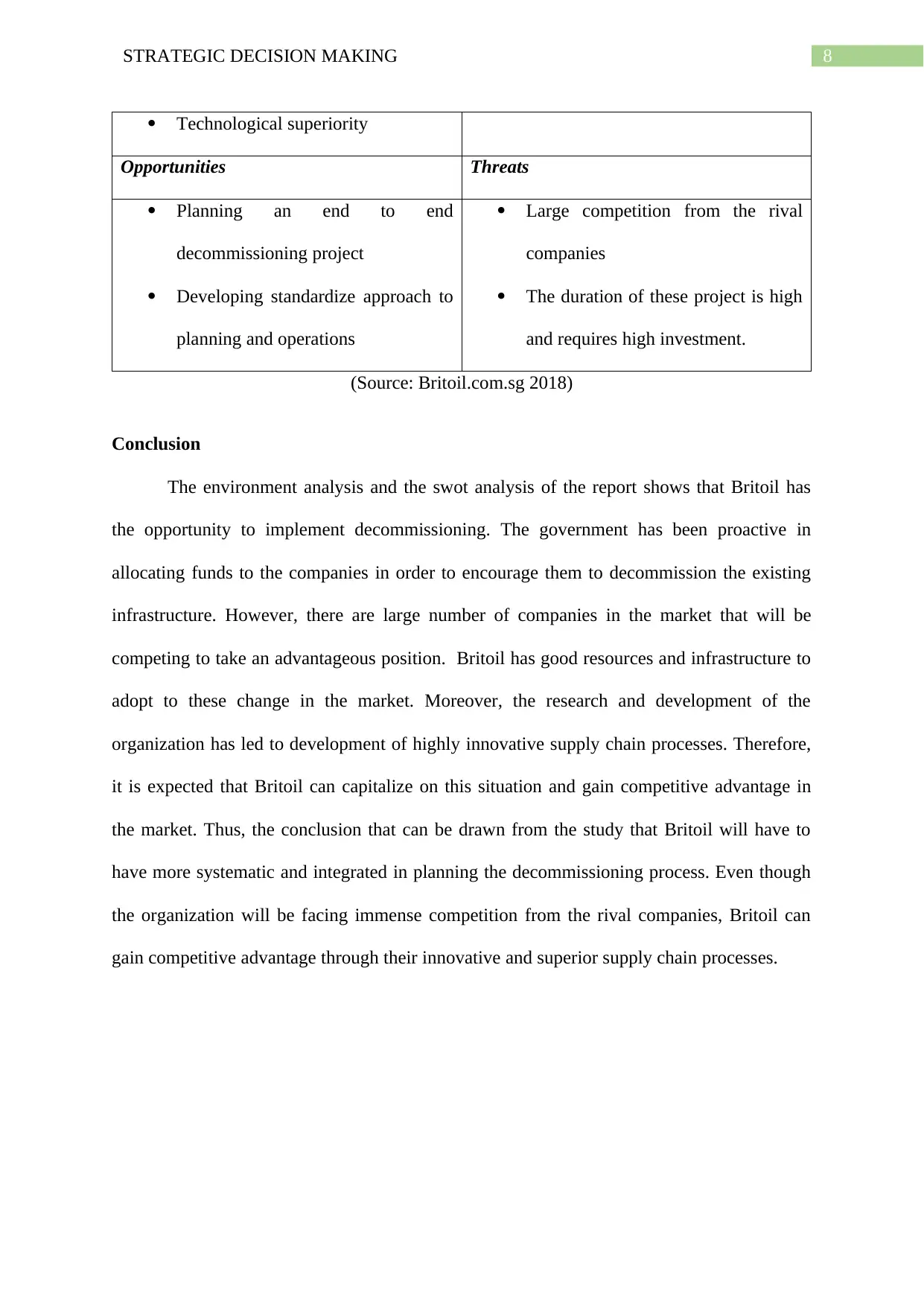
SWOT analysis
SWOT analysis is conducted to identify the internal strengths, weaknesses,
opportunities and threats of any organization. This are specific to each of the organization
and will vary depending upon their individual capabilities.
Strengths Weaknesses
Support from the government
Availability of funding
Strong infrastructure
Strong engineering knowledge and
supply capacity
Strong asset knowledge
High HSE standards and experience
Lack of continuity in work
The late life processes are unclear
Lack of planning in addressing the
decommissioning
Non-integrated approach
nature of the industry has made the bargaining power of the buyers to be relatively small.
The oil and natural gas are categorized based on their prices and quality (Robinson and
Morgan 2016). The buyers are unable to affect the prices of oil as it is a necessity and they
will have to make a purchase even though there has been increase in price. The bargaining
power of the byers in the industry is low and they are highly dependent on the suppliers.
Bargaining power of the suppliers
The ability of the oil and natural gas suppliers to affect the prices are high due to their
high level of involvement in all the segments of oil and gas extraction and production.
Therefore, the big companies in the market experience a greater power in dictating prices in
the industry (Rouse et al. 2017). Britoil can become one of those dictators if they are able to
successfully decommission into the North Sea and extract the available resources.
SWOT analysis
SWOT analysis is conducted to identify the internal strengths, weaknesses,
opportunities and threats of any organization. This are specific to each of the organization
and will vary depending upon their individual capabilities.
Strengths Weaknesses
Support from the government
Availability of funding
Strong infrastructure
Strong engineering knowledge and
supply capacity
Strong asset knowledge
High HSE standards and experience
Lack of continuity in work
The late life processes are unclear
Lack of planning in addressing the
decommissioning
Non-integrated approach
8STRATEGIC DECISION MAKING
Technological superiority
Opportunities Threats
Planning an end to end
decommissioning project
Developing standardize approach to
planning and operations
Large competition from the rival
companies
The duration of these project is high
and requires high investment.
(Source: Britoil.com.sg 2018)
Conclusion
The environment analysis and the swot analysis of the report shows that Britoil has
the opportunity to implement decommissioning. The government has been proactive in
allocating funds to the companies in order to encourage them to decommission the existing
infrastructure. However, there are large number of companies in the market that will be
competing to take an advantageous position. Britoil has good resources and infrastructure to
adopt to these change in the market. Moreover, the research and development of the
organization has led to development of highly innovative supply chain processes. Therefore,
it is expected that Britoil can capitalize on this situation and gain competitive advantage in
the market. Thus, the conclusion that can be drawn from the study that Britoil will have to
have more systematic and integrated in planning the decommissioning process. Even though
the organization will be facing immense competition from the rival companies, Britoil can
gain competitive advantage through their innovative and superior supply chain processes.
Technological superiority
Opportunities Threats
Planning an end to end
decommissioning project
Developing standardize approach to
planning and operations
Large competition from the rival
companies
The duration of these project is high
and requires high investment.
(Source: Britoil.com.sg 2018)
Conclusion
The environment analysis and the swot analysis of the report shows that Britoil has
the opportunity to implement decommissioning. The government has been proactive in
allocating funds to the companies in order to encourage them to decommission the existing
infrastructure. However, there are large number of companies in the market that will be
competing to take an advantageous position. Britoil has good resources and infrastructure to
adopt to these change in the market. Moreover, the research and development of the
organization has led to development of highly innovative supply chain processes. Therefore,
it is expected that Britoil can capitalize on this situation and gain competitive advantage in
the market. Thus, the conclusion that can be drawn from the study that Britoil will have to
have more systematic and integrated in planning the decommissioning process. Even though
the organization will be facing immense competition from the rival companies, Britoil can
gain competitive advantage through their innovative and superior supply chain processes.
⊘ This is a preview!⊘
Do you want full access?
Subscribe today to unlock all pages.
Trusted by 1+ million students worldwide
9STRATEGIC DECISION MAKING
References
Billing, S.L., Tett, P., Brennan, R. and Miller, R.G., 2017. Societal, Policy and Academic
‘Visions’ for the Future of the Marine Environment and Its Management, Exemplified in the
Western and Northern Isles of Scotland. Humanities, 6(4), p.81.
Britoil.com.sg 2018. Britoil Offshore Services Pte Ltd. [online] Britoil.com.sg. Available at:
https://britoil.com.sg/ [Accessed 2 Jul. 2018].
Cotton, M., 2017. Fair fracking? Ethics and environmental justice in United Kingdom shale
gas policy and planning. Local Environment, 22(2), pp.185-202.
Dean, G., 2018. The Scottish oil-shale industry from the viewpoint of the modern-day shale-
gas industry. Geological Society, London, Special Publications, 465, pp.SP465-13.
Keating, M. ed., 2017. Wealthier, Fairer Scotland: The Political Economy of Constitutional
Change. Edinburgh University Press.
Paul Wheelhouse, I. 2018. Opinion: Scotland must 'capitalise on decommissioning market' -
News for the Oil and Gas Sector. [online] Energy Voice. Available at:
https://www.energyvoice.com/opinion/157664/opinion-scotland-must-capitalise-
decommissioning-market/ [Accessed 2 Jul. 2018].
Robinson, C. and Morgan, J., 2016. North Sea Oil in the Future: economic analysis and
government policy. Springer.
Rouse, S., Kafas, A., Catarino, R., Peter, H. and Handling editor: Steven Degraer, 2017.
Commercial fisheries interactions with oil and gas pipelines in the North Sea: considerations
for decommissioning. ICES Journal of Marine Science, 75(1), pp.279-286.
References
Billing, S.L., Tett, P., Brennan, R. and Miller, R.G., 2017. Societal, Policy and Academic
‘Visions’ for the Future of the Marine Environment and Its Management, Exemplified in the
Western and Northern Isles of Scotland. Humanities, 6(4), p.81.
Britoil.com.sg 2018. Britoil Offshore Services Pte Ltd. [online] Britoil.com.sg. Available at:
https://britoil.com.sg/ [Accessed 2 Jul. 2018].
Cotton, M., 2017. Fair fracking? Ethics and environmental justice in United Kingdom shale
gas policy and planning. Local Environment, 22(2), pp.185-202.
Dean, G., 2018. The Scottish oil-shale industry from the viewpoint of the modern-day shale-
gas industry. Geological Society, London, Special Publications, 465, pp.SP465-13.
Keating, M. ed., 2017. Wealthier, Fairer Scotland: The Political Economy of Constitutional
Change. Edinburgh University Press.
Paul Wheelhouse, I. 2018. Opinion: Scotland must 'capitalise on decommissioning market' -
News for the Oil and Gas Sector. [online] Energy Voice. Available at:
https://www.energyvoice.com/opinion/157664/opinion-scotland-must-capitalise-
decommissioning-market/ [Accessed 2 Jul. 2018].
Robinson, C. and Morgan, J., 2016. North Sea Oil in the Future: economic analysis and
government policy. Springer.
Rouse, S., Kafas, A., Catarino, R., Peter, H. and Handling editor: Steven Degraer, 2017.
Commercial fisheries interactions with oil and gas pipelines in the North Sea: considerations
for decommissioning. ICES Journal of Marine Science, 75(1), pp.279-286.
Paraphrase This Document
Need a fresh take? Get an instant paraphrase of this document with our AI Paraphraser

10STRATEGIC DECISION MAKING
Walsh, D., McCartney, G., Collins, C., Taulbut, M. and Batty, G.D., 2017. History, politics
and vulnerability: explaining excess mortality in Scotland and Glasgow. Public health, 151,
pp.1-12.
Walsh, D., McCartney, G., Collins, C., Taulbut, M. and Batty, G.D., 2017. History, politics
and vulnerability: explaining excess mortality in Scotland and Glasgow. Public health, 151,
pp.1-12.

1 out of 11


Related Documents


Your All-in-One AI-Powered Toolkit for Academic Success.
+13062052269
info@desklib.com
Available 24*7 on WhatsApp / Email
![[object Object]](/_next/static/media/star-bottom.7253800d.svg)
Unlock your academic potential
Copyright © 2020–2026 A2Z Services. All Rights Reserved. Developed and managed by ZUCOL.