Journal Assessment 1: Broadband Adoption Factors in Australia

Verified

Added on  2022/08/24

|4
|882
|30
Journal and Reflective Writing
AI Summary
This journal assessment analyzes the factors influencing household adoption of high-speed broadband services in Australia, referencing the work of Adams, Farrell, Dalgarno, and Oczkowski (2017). The assessment examines the increasing need for high-speed internet due to digitization, globalization, and the rise of flexible working arrangements. It explores a model for predicting household behavioral intentions regarding broadband adoption and identifies key criteria impacting decisions, such as affordable pricing, easy installation, and lifestyle improvements. The assessment also highlights the potential economic benefits of broadband adoption, including improved productivity, educational opportunities, and support for self-employed individuals. It concludes by discussing methods for measuring the success of broadband integration and the challenges faced, primarily focusing on understanding the decision-making processes of households and the broader implications for Australia's economic standing. The author found the article easy to understand and gained insights into the factors influencing household decisions.
Document Page
Journal Assessment 1
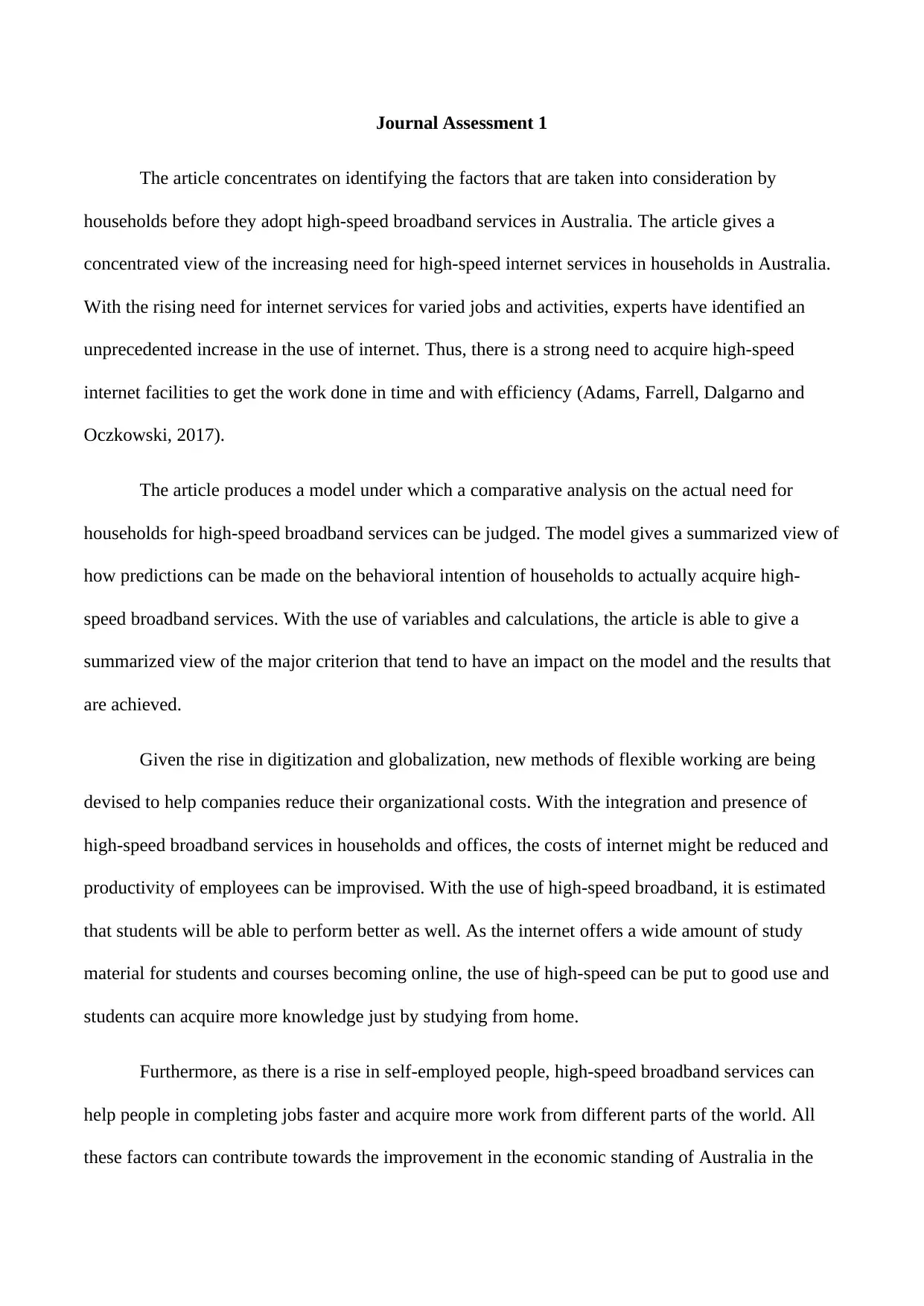
The article concentrates on identifying the factors that are taken into consideration by
households before they adopt high-speed broadband services in Australia. The article gives a
concentrated view of the increasing need for high-speed internet services in households in Australia.
With the rising need for internet services for varied jobs and activities, experts have identified an
unprecedented increase in the use of internet. Thus, there is a strong need to acquire high-speed
internet facilities to get the work done in time and with efficiency (Adams, Farrell, Dalgarno and
Oczkowski, 2017).
The article produces a model under which a comparative analysis on the actual need for
households for high-speed broadband services can be judged. The model gives a summarized view of
how predictions can be made on the behavioral intention of households to actually acquire high-
speed broadband services. With the use of variables and calculations, the article is able to give a
summarized view of the major criterion that tend to have an impact on the model and the results that
are achieved.
Given the rise in digitization and globalization, new methods of flexible working are being
devised to help companies reduce their organizational costs. With the integration and presence of
high-speed broadband services in households and offices, the costs of internet might be reduced and
productivity of employees can be improvised. With the use of high-speed broadband, it is estimated
that students will be able to perform better as well. As the internet offers a wide amount of study
material for students and courses becoming online, the use of high-speed can be put to good use and
students can acquire more knowledge just by studying from home.
Furthermore, as there is a rise in self-employed people, high-speed broadband services can
help people in completing jobs faster and acquire more work from different parts of the world. All
these factors can contribute towards the improvement in the economic standing of Australia in the
tabler-icon-diamond-filled.svg

Paraphrase This Document

Need a fresh take? Get an instant paraphrase of this document with our AI Paraphraser
Document Page
days to come. The best ways to reach the destination of integration of high-speed broadband services
in households in Australia is to firstly offer affordable pricing by companies. If such broadband
services are high on cost, it is estimated that majority of the residents would not prefer to subscribe
for it.
Apart from this, service providers must offer easy installation services and offer an
improvement in the lifestyle of the people with their services. The more people observe the need for
high-speed broadband services and recognize its importance in helping them build a better future, it
is speculated that more people would be ready to adopt its installation in their households.
Furthermore, with the use of high-speed broadband services, families can improve their social
influence and connect themselves with the world in a better manner. It is important for people to
recognize the different benefits of the services to be able to spend extra part of their income in its
adoption.
The best way to know that we have finished is by calculating the number of households that
have successfully integrated the high-speed broadband services and comparing it to the ideal number
of households that should have. It is also important to note the reasons that had an impact on this
decision of the households and estimate the reasons for the integration in the first place. It is
important to take into consideration the reasons why people can resign from the integration of high-
speed broadband services too, so that appropriate changes in strategic decision-making can be done
to ensure retention of household customers or subscribers. The more households adopt high-speed
broadband services for different reasons, the more we can say that the success was achieved. Overall,
the success surrounds the average compatibility with the lifestyle of the average household in
Australia and the actions that are taken to alter the existing plans to help more and more households
to sign up for the services at the end of the day.
Document Page
The challenges that I faced in undertaking this activity is to estimate the things that could go
wrong with high-speed broadband service integration in the households. Apart from that, I did not
face any dire challenges in either understanding the article or accounting the findings that were
achieved by the researchers. The article was easy to understand and it gave me an opportunity to
know more about the reasons and criteria that have an impact on the decision-making of households
today. The models developed by the researchers was also easy to comprehend as it takes into account
some of the basics that are required to know about the current condition of high-speed broadband
service adoption in Australia and the actions that are being taken by the government and service
providing companies as a whole.
Document Page
Reference
Adams, P., Farrell, M., Dalgarno, B. and Oczkowski, E. (2017). Household Adoption of Technology:
The Case of High-Speed Broadband Adoption in Australia. Science Direct and Elsevier. Vol
49.
chevron_up_icon
1 out of 4
circle_padding
hide_on_mobile
zoom_out_icon
[object Object]