Ecological Systems Theory: Analyzing Population Growth & Behavior

Verified

Added on  2023/06/04

|4
|638
|128
Report
AI Summary
This report provides a comprehensive analysis of Bronfenbrenner's Ecological Systems Theory, explaining how various environmental systems influence population growth and behavior. The report details the five ecological systems: the microsystem, which includes immediate environments like family and religious institutions; the mesosystem, which examines the interaction between different microsystems; the exosystem, involving external environments indirectly affecting the population such as social services and local politics; the chronosystem, which introduces the dimension of time and change; and the macrosystem, encompassing cultural values and economic systems. The report uses examples to illustrate how each system impacts population development, such as the influence of religious interactions on individual beliefs, the effect of community participation on youth development, and the impact of war on population growth. The analysis offers a detailed understanding of the complex interplay between a population and its environment, highlighting the importance of considering multiple environmental layers when studying human development.
Document Page
Poster description
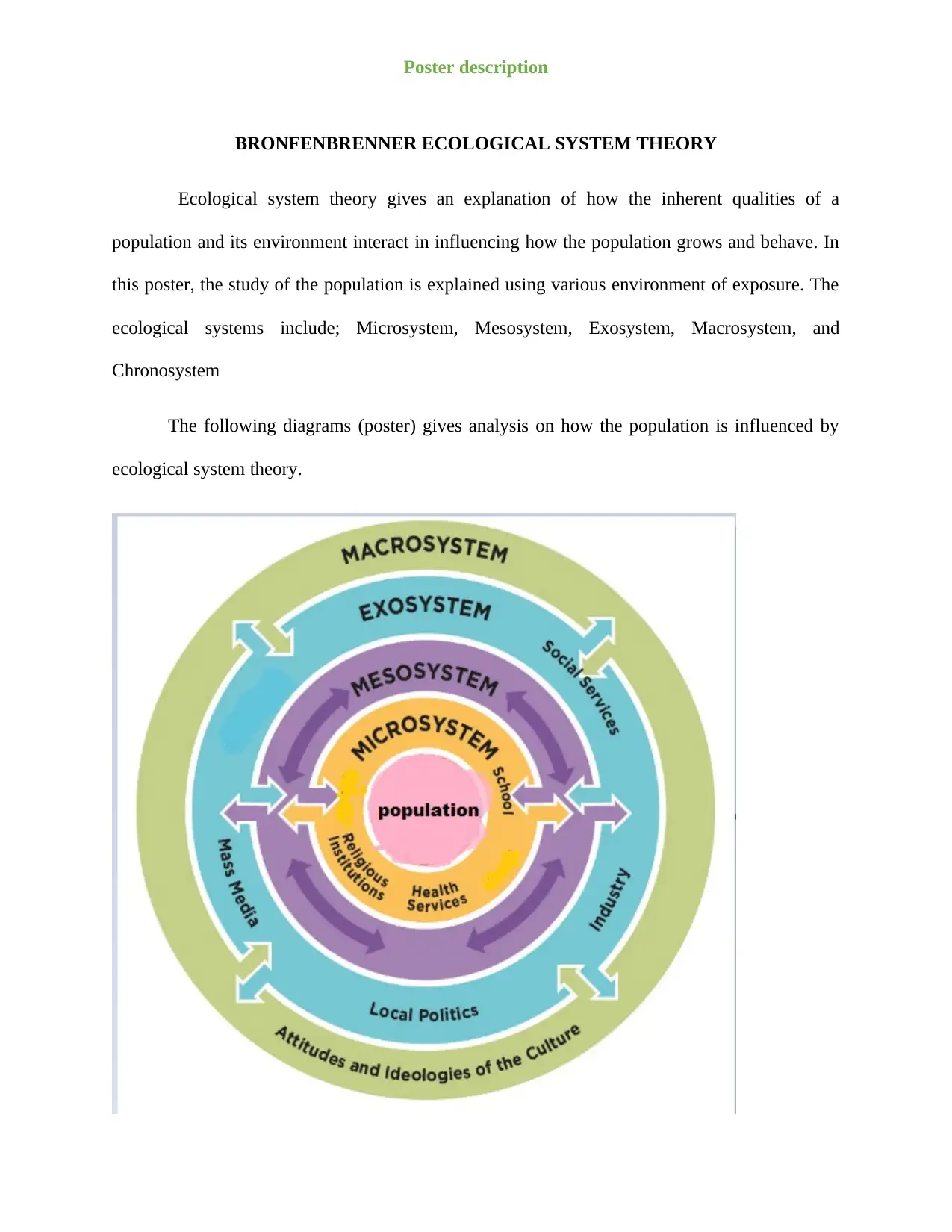
BRONFENBRENNER ECOLOGICAL SYSTEM THEORY
Ecological system theory gives an explanation of how the inherent qualities of a
population and its environment interact in influencing how the population grows and behave. In
this poster, the study of the population is explained using various environment of exposure. The
ecological systems include; Microsystem, Mesosystem, Exosystem, Macrosystem, and
Chronosystem
The following diagrams (poster) gives analysis on how the population is influenced by
ecological system theory.
tabler-icon-diamond-filled.svg

Paraphrase This Document

Need a fresh take? Get an instant paraphrase of this document with our AI Paraphraser
Document Page
Poster description
Microsystem
This the immediate environment that the population lives. The model gives the
compromise of the background of the population, health services, and community religious
institution environment. The interaction with these groups with the growing population
influences and determines how the population will grow. For example, the religious decision is
influenced by the kind of the population it will interact with. If the interaction is between
Christianity and Muslim population chances are high for anyone in the population to follow any
of the two religion.
The Mesosystem
This type of ecological system that defines the interaction of various microsystems the
growing population finds itself in. For example, population religious institution and population
health services are two different microsystems that a developing population finds itself in .If the
‘community at large' actively participate in the issues affecting the growing population (youth
population) and also appreciates the behavior of that population, then the development of the
growing population is affected positively. If the "community" dislikes the population conduct it
results in negative and conflicting emotions.
Exosystem
This is the environment in which a growing population is not directly involved but in a
way, it affects it anyway. Some of the exosystems that may affect the population are; social
services and local politics. For example, a community social services and local politics tend to
Document Page
Poster description
involve youths population mostly when a bad environment exists. Most of the action that effects
to that bad environment are performed by individuals but transmits the effects of the action to the
growing population (youth population for example). The growing population does not have a
direct connection with what happened in the community but in a way, it gets affected.
Chronosystem
The ecosystem introduces the useful dimension of time which offers a demonstration of
the influence of both change constancy in the population-environment. In simpler terms, the
ecological system tries to describe how different microsystem affects a population with a change
in the time factor. The chronosystem may include population structure change employment and
changes of immense society such as economic cycles and war.
For example, a population who bully other types of the population at school may display the role
of a terrified victim at community background.
The macro-system
This is the largest ecological system and it involves a large population and collection of
various places. It may comprise of different population cultural patterns and values, political and
systems of economic. For example, a population in war-torn regions experience unusual kind of
development that population in areas where peace reigns. At war region, the development is low
and sometimes negative while at peace region the development is abundant.
Document Page
Poster description
References
Rothery, M. (2001). Ecological systems theory. Theoretical perspectives for direct social work
practice: A generalist-eclectic approach, 65-82.
Wu, J., & David, J. L. (2002). A spatially explicit hierarchical approach to modeling complex
ecological systems: theory and applications. Ecological modelling, 153(1-2), 7-26.
chevron_up_icon
1 out of 4
circle_padding
hide_on_mobile
zoom_out_icon
[object Object]